Abdel Gadir Salim: The Life Story Behind Sudan's Traditional Star
In this post
- Sudan in 1946: A Childhood of Song
- Khartoum, the Oud, and the Traditional Sound
- Nujum Al-Lail and the World Hears Sudanese Song
- A Teacher, a Keeper, and the Later Years
- What Traditional Sudanese Music Means
- The Oud and the Sound of the Nile Valley
- The Songs That Keep a Culture Alive
- The Concerts That Taught the World
- A Life Spent in Service to Song
- My Take:
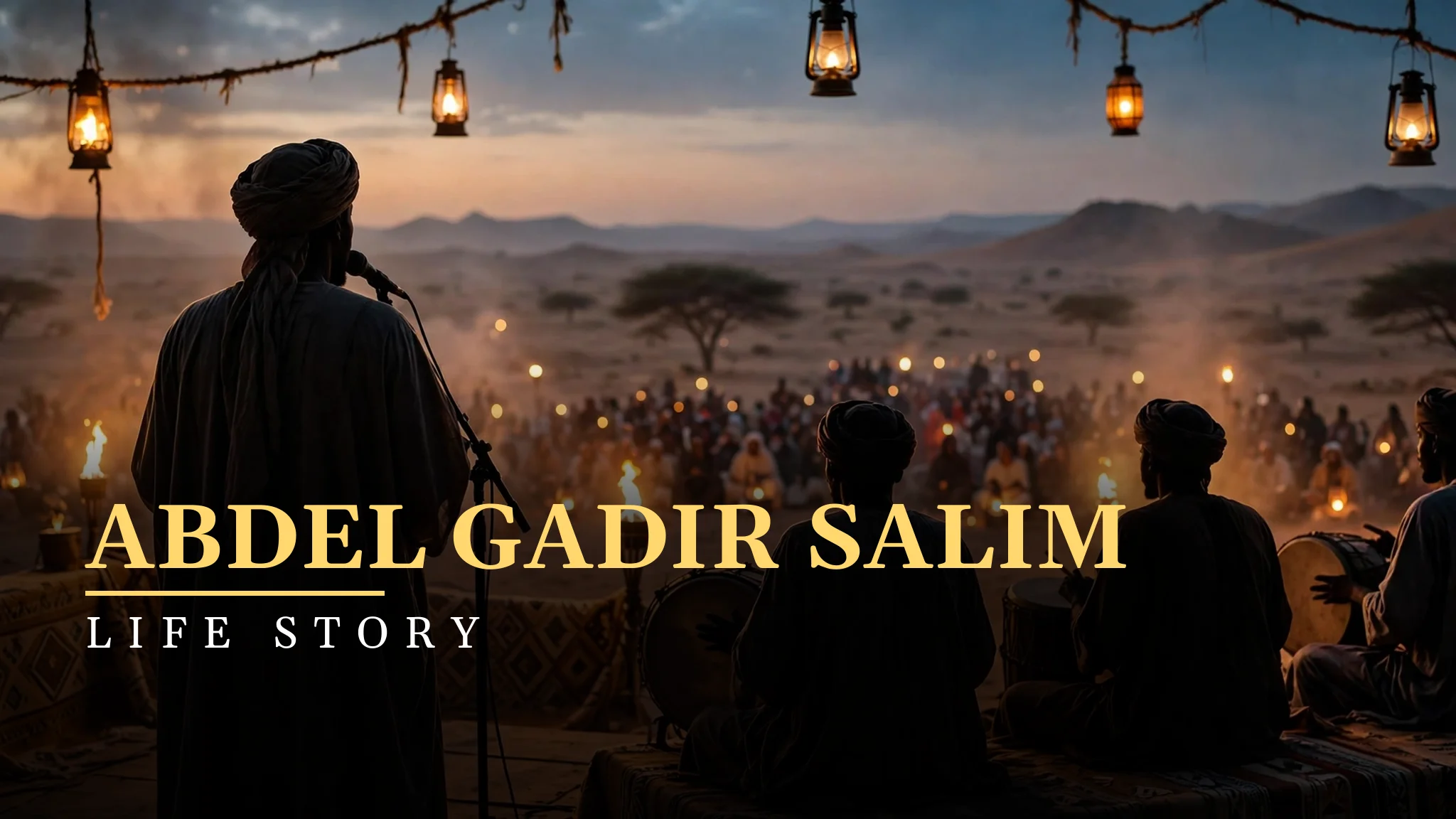
There are singers who chase the new sound, and there are singers who guard the old one. Abdel Gadir Salim is the second kind. He is a keeper of traditional Sudanese music, a singer and oud player whose work has carried the songs of Sudan, with their rhythms, their poetry, and their history, to audiences in Khartoum and around the world. He is not the loudest star in Sudanese music. He is one of the most respected, because he has spent his life making sure that the old songs are not forgotten.
He was born in Sudan in 1946, and he grew up in a country where music was a part of daily life, sung at weddings, at celebrations, and in the homes of ordinary people. He learned the oud, he learned the traditional songs, and he became a singer whose voice carried the sound of Sudan in its purest form. His career has taken him from the stages of Khartoum to concert halls in Europe and America, and his music has introduced listeners around the world to the richness of Sudanese song.
This is the story of that life: a traditional singer in a changing world, a man who chose to preserve rather than to chase, and whose songs are a bridge between the Sudan of the past and the Sudan of today.
Sudan in 1946: A Childhood of Song
Abdel Gadir Salim was born in Sudan in 1946, in a country that was still under Anglo-Egyptian rule and that would become independent ten years later, in 1956. He grew up in a Sudan that was changing fast, but where the old ways of life were still strong. Music was a part of that life, and it was heard everywhere: in the streets, in the markets, and in the homes where families gathered to sing. A child growing up in Sudan in the 1940s and 1950s learned the songs of his people before he learned anything else, and Abdel Gadir learned them well.
His family life was rooted in Sudanese culture, and he grew up hearing the music that had been sung in Sudan for generations. The songs were in Arabic, the language of Sudan, and they spoke about love, about the Nile, about the land, and about the lives of ordinary people. They were sung with the oud, with drums, and with voices that carried the feeling of the words. Abdel Gadir listened to those songs, and he began to sing them himself, first at home, and then in public. He was not a child star. He was a young man who loved the music of his country and who wanted to keep it alive.
As a boy, he was drawn to the oud, the pear-shaped lute that is the heart of Sudanese and Arab music. He learned to play it, and he became a skilled oud player, known for the warmth and the clarity of his playing. The oud is not an easy instrument to master. It requires patience, practice, and a deep feeling for music, and Abdel Gadir had all three. He practised, he listened, and he learned, and his playing became the foundation of his singing. A singer who plays the oud is a singer who understands his music from the inside, and Abdel Gadir understood it deeply.
He also learned the traditional rhythms of Sudan, which are different from the rhythms of other Arab countries. Sudanese music has its own beat, its own dance, and its own feeling, and it is rooted in the life of the Nile Valley and in the cultures of the country’s many peoples. Abdel Gadir learned those rhythms, and he made them the centre of his music. He did not try to copy Egyptian or Lebanese music. He played Sudanese music, and he played it with pride. That pride is part of his story, and it is one reason his work is so respected.
As a young man, he began to perform in Khartoum, the capital, and he entered the music scene there. Khartoum in the 1960s and 1970s was a city of music, with radio, with clubs, and with a lively audience for Sudanese song. Abdel Gadir arrived with his oud, his voice, and his knowledge of traditional music, and he set out to make a name for himself. He had a sound that was different from the pop singers of the time, because it was rooted in tradition, and that difference made him stand out. He was a traditional singer in a modern city, and his tradition was his strength.
Khartoum, the Oud, and the Traditional Sound
In Khartoum, Abdel Gadir Salim built his career as a singer and oud player, and his talent was recognised by audiences who loved traditional Sudanese music. He performed on Sudanese radio, which was the main way for a singer to reach a wide audience, and his voice was heard across the country. Radio in Sudan was a powerful medium, and a singer who was played on the radio became known to everyone, from the cities to the villages. Abdel Gadir’s voice, warm and clear, was perfect for radio, and his songs became favourites with listeners who loved the old sounds.
He also performed live, at concerts, at weddings, and at cultural events, and his live shows were known for their warmth and their authenticity. He did not perform with a big band or with elaborate staging. He performed with his oud, with drums, and with a small group of musicians, and the sound was intimate and direct. A listener at an Abdel Gadir concert did not hear a spectacle. The listener heard a singer, an oud, and a song, and that was enough. His performances were a reminder that great music does not need to be loud to be powerful. It needs only to be true.
His repertoire was built from the traditional songs of Sudan, and from new songs written in the traditional style. He sang about love, about the Nile, and about the life of his country, and his listeners recognised their own lives in his songs. He was not a singer who chased fashion. He was a singer who stayed with the music he loved, and who trusted that his audience would stay with him. That trust was rewarded, because his audience did stay, and his name became known as a guardian of Sudanese song.
He also worked as a teacher, sharing his knowledge of traditional music with younger musicians. That role as a teacher is an important part of his story. A traditional singer who does not teach will see his tradition die with him. A traditional singer who teaches will see it live on in his students. Abdel Gadir taught, and his students carried his knowledge forward. That is how a tradition survives, and it is one reason his work matters beyond his own performances.
By the 1970s and 1980s, he was a well-known figure in Sudanese music, and his name was respected by musicians and by audiences alike. He was not the most famous singer in Sudan — that title belonged to Mohammed Wardi — but he was one of the most respected, because his work was rooted in the deepest traditions of his country. He had become a keeper of the old songs, and his keeping of them was a service to Sudan.
Nujum Al-Lail and the World Hears Sudanese Song
In the late 1980s, Abdel Gadir Salim’s music reached a wider audience, when his album Nujum Al-Lail, which means Stars of the Night, was released and heard outside Sudan. The album, released in 1989, introduced his voice and his oud to listeners in Europe and America, and it was praised for its beauty and its authenticity. It was not a pop album. It was a record of traditional Sudanese music, played with care and with love, and its success showed that the world was ready to hear the old songs of Sudan.
The album’s songs were a mix of traditional pieces and new compositions in the traditional style, and they were recorded with a small group of musicians, with the oud at the centre. The sound was intimate, warm, and deeply Sudanese, and listeners who had never been to Sudan heard in it a music that was both new and ancient. Nujum Al-Lail became a landmark in the world music scene, and it made Abdel Gadir a name that was known to music lovers far beyond his own country.
The success of the album also brought him invitations to perform in Europe and America, and he toured with his band, playing at festivals and in concert halls. His concerts abroad were a revelation to audiences who had never heard Sudanese music. They heard the oud, they heard the rhythms, and they heard a voice that carried the feeling of the Nile Valley. They also saw a performer who was proud of his tradition and who shared it with generosity. A concert by Abdel Gadir Salim was not only a performance. It was a lesson in Sudanese culture, and his audiences left with a new understanding of a country they had known little about.
He also recorded more albums, and his work continued to be praised by critics and by other musicians. He was not a prolific recording artist in the way that some singers are, but each of his records was made with care, and each one added to his reputation as a master of traditional Sudanese music. His catalogue is not large, but it is deep, and it is a record of a life spent in service to a tradition.
The world music years also brought him recognition from cultural institutions, and his name became associated with the preservation of Sudanese song. He was not only a singer. He was a cultural ambassador, and his music was a form of diplomacy. A listener in Paris or in London who heard Abdel Gadir heard Sudan, and that hearing was a bridge between two worlds. That is a powerful thing for a traditional singer to achieve, and Abdel Gadir achieved it.
A Teacher, a Keeper, and the Later Years
In his later years, Abdel Gadir Salim continued to perform, to record, and to teach, and his role as a keeper of Sudanese music became even more important. Sudan went through difficult years, with conflict, with political change, and with the separation of South Sudan in 2011, and its culture was under pressure. In such times, a traditional singer who keeps the old songs alive is doing important work. Abdel Gadir did that work, and he did it with patience and with love. His songs were a reminder of what Sudan had been, and of what it could still be.
He continued to work with younger musicians, teaching them the oud, the rhythms, and the songs of Sudan. His students learned from him, and they carried his knowledge into their own work. That teaching is a part of his legacy that goes beyond his own recordings. A teacher’s work lives on in his students, and Abdel Gadir’s students are now playing the music he taught them, in Sudan and abroad. That is how a tradition survives, and it is a sign of the importance of his work.
He also remained a figure in Khartoum’s cultural life, performing at events, at festivals, and at gatherings that celebrated Sudanese music. His presence at such events was a sign of respect, and it showed that his work was valued by his country. He was not a star who had left Sudan behind. He was a musician who stayed, who worked, and who kept his tradition alive at home. That rootedness is part of his identity, and it is one reason his music has stayed honest.
His later career also brought him honours and recognition from the world music community, and his name is still mentioned whenever the history of Sudanese music is told. He is remembered as one of the great traditional singers of Sudan, alongside Mohammed Wardi and other masters, and his albums are still listened to by people who love the old sounds. He is a reminder that Sudanese music is not only about the big stars. It is also about the keepers, the teachers, and the singers who guard the tradition for the next generation.
Today, Abdel Gadir Salim remains active, and his music remains a part of life in Sudan and in the Sudanese diaspora. The boy who learned the oud in a Sudan that was still under colonial rule has become an old man who has seen his country change in many ways, and who has kept its songs alive through all of them. That is a life of extraordinary dedication, and it is one that Sudan will remember.
What Traditional Sudanese Music Means
Abdel Gadir Salim’s music is a window into traditional Sudanese song, and it is worth understanding what that tradition is. Sudanese music is a mix of Arab, African, and Nubian influences, and it has its own rhythms, its own instruments, and its own poetry. The oud is its central instrument, the drums give it its beat, and the voice carries its meaning. The songs are often long, with many verses, and they are sung in Arabic, with a diction that is clear and beautiful. A listener who hears Abdel Gadir hears all of that, in a form that is pure and unadorned.
His music also carries the history of Sudan. The songs he sings are not new. They have been sung for generations, and they carry the stories, the loves, and the sorrows of the Sudanese people. When Abdel Gadir sings them, he is not only performing. He is remembering, and he is asking his listeners to remember with him. That act of remembering is important, especially in a country that has known so much change and so much loss. A song can keep a memory alive when everything else has changed, and Abdel Gadir’s songs do that.
His work also shows the importance of the oud in Sudanese music. The oud is not only an instrument. It is a voice, and it speaks in a way that words cannot. Abdel Gadir’s oud playing is known for its warmth and its feeling, and it is the foundation of his singing. A listener who hears his oud hears the Nile, hears the desert, and hears the history of Sudan in a single instrument. That is the power of the oud, and Abdel Gadir is one of its great players.
His influence on younger musicians is also clear. Young Sudanese singers who want to learn traditional music look to him as an example, and they learn from his recordings, his performances, and his teaching. He showed them that traditional music is not old-fashioned. It is timeless, and it can be heard by audiences around the world. That lesson is one that will last as long as his music does, and it is part of his legacy.
The Oud and the Sound of the Nile Valley
Abdel Gadir Salim’s oud playing deserves its own place in his story, because the oud is the heart of his music and the instrument that carries its feeling. The oud is a pear-shaped lute, with a warm, deep sound, and it has been played in Sudan and across the Arab world for centuries. Abdel Gadir plays it with a touch that is gentle, precise, and full of feeling, and his playing gives his songs their depth. He does not play fast, and he does not show off. He plays slowly, carefully, and with a deep understanding of the music, letting each note ring out clearly. That restraint is the mark of a master, and it is one reason his music is so respected. A listener who hears his oud hears the Nile Valley in a single instrument: its history, its poetry, and its people. That is the power of the oud, and Abdel Gadir is one of its great players. He also teaches the oud to younger musicians, passing on a skill that cannot be learned from a book, but only from a teacher who has played for a lifetime.
The Songs That Keep a Culture Alive
Abdel Gadir Salim’s songs are not only performances. They are acts of preservation, and they keep Sudanese culture alive in a way that books and museums cannot. A song that is sung is a song that lives in the body, in the voice, and in the memory of the people who hear it. When Abdel Gadir sings a traditional song, he is not only performing it. He is passing it on, from one generation to the next, and he is making sure that it will not be forgotten. That passing is the most important work a traditional singer can do, and Abdel Gadir has done it for a lifetime. His songs are now part of the cultural memory of Sudan, and they will be sung long after he stops performing. That is a legacy that does not fade, and it is one that he earned with every song he sang.
The Concerts That Taught the World
Abdel Gadir Salim’s concerts abroad were more than performances. They were lessons in Sudanese culture, given by a singer who was proud of his tradition and who shared it with generosity. His audiences in Europe and America had never heard Sudanese music, and they left his concerts with a new understanding of a country they had known little about. He performed with a small group, with his oud at the centre, and the intimacy of those concerts was part of their power. A listener in a concert hall in Paris who heard Abdel Gadir did not hear a spectacle. The listener heard a singer, an oud, and a song, and that simplicity was a revelation. His concerts taught the world that Sudanese music is beautiful, that it is deep, and that it deserves to be heard. That teaching is a part of his legacy, and it is one that will last as long as his recordings do.
A Life Spent in Service to Song
Abdel Gadir Salim’s life can be summed up in a simple phrase: a life spent in service to song. He did not seek fame, he did not chase fashion, and he did not try to become a star in the usual sense. He served the songs of Sudan, he taught them to younger musicians, and he performed them with care and with love for a lifetime. That service is a form of greatness, and it is one that is often overlooked in a world that celebrates only the loudest voices. A singer who serves his tradition is a singer who understands that music is larger than any one person, and that it belongs to a people, not to a star. Abdel Gadir understood that, and he lived it. His life is a reminder that dedication, sustained over decades, is itself an achievement, and that a quiet life in service to art is a life well lived.
Khartoum itself deserves a final word in Abdel Gadir’s story, because it was the city where his music found its audience. It was a city of radio, of concerts, of weddings, and of cultural gatherings, and it gave a traditional singer a stage on which to be heard. A city that values its traditional music is a city that values its history, and Khartoum valued Abdel Gadir’s music because it recognised itself in it. He sang for Khartoum, and Khartoum listened, and that exchange, between a singer and his city, is the heart of his story. The traditional songs of Sudan found a home in Khartoum, and Abdel Gadir was their keeper there for a lifetime.
My Take:
I think Abdel Gadir Salim is one of the most quietly important singers I have ever written about, and I use the word quietly on purpose. He is not a loud star, he is not a singer who chases the charts, and he is not a performer who fills stadiums with spectacle. He is a keeper, a teacher, and a guardian of a tradition, and that work is quieter than the work of a pop star. But it is no less important. In fact, I think it is more important, because a tradition that is not kept will be lost, and a singer who keeps it is doing work that no one else can do. I admire him for that work more than I admire any single hit, because it shows a kind of dedication that is rare in music.
What moves me most about his story is the idea of keeping. He kept the old songs, he kept the oud, and he kept the rhythms of Sudan alive through decades of change. Sudan changed in many ways during his lifetime: independence, military rule, war, exile, and the separation of the south. Through all of that, Abdel Gadir kept singing the old songs, and his singing was a reminder that some things do not change, even when everything else does. That is a comforting thought, and it is one that I find deeply moving. A song can be an anchor, and Abdel Gadir’s songs were an anchor for Sudan.
Nujum Al-Lail is the album I return to most often, because it is a record that introduced Sudanese music to the world in its purest form. It is not a loud album. It is a quiet, beautiful record, with the oud at the centre and a voice that carries the feeling of the Nile. When I listen to it, I feel that I am hearing Sudan as it was, and as it still is in the hearts of its people. That is a powerful feeling, and it is one that few records give me. Abdel Gadir’s music gives it to me every time, and I am grateful for that.
I also admire his role as a teacher. A singer who teaches is a singer who understands that music is not only for himself. It is for the next generation, and it must be passed on. Abdel Gadir taught younger musicians, and his students now carry his knowledge forward. That is a generous act, and it is one that shows his character. He did not keep his knowledge for himself. He shared it, and sharing it made the tradition stronger. I think about the young oud players in Sudan today who learned from him, and about what it means to them to have a teacher like Abdel Gadir. It means that they are part of a chain, a chain that goes back generations, and that they have a responsibility to keep it going. That is a beautiful idea, and it is one that Abdel Gadir lived.
His oud playing is another thing I think about. The oud is a difficult instrument, and it requires a lifetime of practice to play well. Abdel Gadir played it for a lifetime, and his playing shows it. His notes are clear, his rhythms are steady, and his feeling is deep. I like that. A great oud player does not need to show off. He needs to serve the song, and Abdel Gadir served his songs beautifully. His oud was the foundation of his music, and his voice was the roof, and together they made a house that Sudanese listeners lived in for decades. That is a lovely image, and it is one that captures what his music meant to his country.
I will be honest about something: Abdel Gadir Salim’s music is not for everyone, and it is not music that you can dance to in the way you can dance to other African styles. It is slow, it is reflective, and it asks the listener to sit still and to listen. That is not a weakness. It is a strength, because it shows that music can do many things. It can make you dance, and it can make you think, and Abdel Gadir’s music makes you think. I hope young listeners give it a chance, because it will teach them something about patience, about tradition, and about the beauty of a single oud played well.
What I learn from his life is that keeping is as important as creating. Abdel Gadir did not invent a new style. He kept an old one alive, and that keeping was a creative act in itself. It takes skill to keep a tradition alive, and it takes dedication to do it for a lifetime. He did both, and his work is a reminder that not every artist needs to be an inventor. Some artists need to be guardians, and guardians are just as valuable. I think the music world needs more guardians, and Abdel Gadir is one of the best.
I also think about Sudan today, and about what his music means to Sudanese people who live far from home. A Sudanese person in London, in Cairo, or in America who hears Abdel Gadir hears home, and that hearing is a comfort. It tells them that their culture is still alive, that their songs are still sung, and that their home is still there, even if they are far away. That is a powerful gift for a singer to give, and Abdel Gadir gave it to thousands of people. I hope his music keeps being heard, because the Sudanese diaspora still needs it, and because Sudan still needs it.
In the end, I think Abdel Gadir Salim’s story is a story about a keeper. He kept the songs, he kept the oud, and he kept the tradition of Sudan alive through a lifetime of change. He did not do it loudly, and he did not do it for fame. He did it because he loved his music, and because he believed it was worth keeping. That is a simple reason, and it is a good one. I hope his students keep the tradition going, and I hope listeners around the world keep discovering his albums, because the world needs keepers, and Abdel Gadir Salim is one of the finest.
I also think about the Sudanese diaspora, and about what his music means to Sudanese people who live far from home. A Sudanese person in London, in Cairo, or in America who hears Abdel Gadir hears home, and that hearing is a comfort. It tells them that their culture is still alive, that their songs are still sung, and that their home is still there, even if they are far away. That is a powerful gift for a singer to give, and Abdel Gadir gave it to thousands of people. His concerts abroad were not only performances. They were homecomings, in a small way, for people who could not go home. I hope his music keeps being heard in the diaspora, because those listeners still need it, and because Sudan still needs it.
His oud playing is another thing I think about. The oud is a difficult instrument, and it requires a lifetime of practice to play well. Abdel Gadir played it for a lifetime, and his playing shows it. His notes are clear, his rhythms are steady, and his feeling is deep. I like that. A great oud player does not need to show off. He needs to serve the song, and Abdel Gadir served his songs beautifully. His oud was the foundation of his music, and his voice was the roof, and together they made a house that Sudanese listeners lived in for decades. That is a lovely image, and it is one that captures what his music meant to his country.
I think about the young oud players in Sudan today who learned from him, and about what it means to have a teacher like Abdel Gadir. It means that they are part of a chain, a chain that goes back generations, and that they have a responsibility to keep it going. That is a beautiful idea, and it is one that Abdel Gadir lived. He did not keep his knowledge for himself. He shared it, and sharing it made the tradition stronger. I hope his students keep the tradition going, and I hope they teach it to their own students, so that the chain never breaks. That is how a culture survives, and Abdel Gadir understood that better than most.
I will be honest about something: Abdel Gadir Salim’s music is not for everyone, and it is not music that you can dance to in the way you can dance to other African styles. It is slow, it is reflective, and it asks the listener to sit still and to listen. That is not a weakness. It is a strength, because it shows that music can do many things. It can make you dance, and it can make you think, and Abdel Gadir’s music makes you think. I hope young listeners give it a chance, because it will teach them something about patience, about tradition, and about the beauty of a single oud played well.
What I learn from his life is that keeping is as important as creating. Abdel Gadir did not invent a new style. He kept an old one alive, and that keeping was a creative act in itself. It takes skill to keep a tradition alive, and it takes dedication to do it for a lifetime. He did both, and his work is a reminder that not every artist needs to be an inventor. Some artists need to be guardians, and guardians are just as valuable. I think the music world needs more guardians, and Abdel Gadir is one of the best. His life shows that a quiet dedication, sustained over decades, can be as important as a loud breakthrough.
In the end, I keep coming back to the same thought: Abdel Gadir Salim’s story is about a keeper. He kept the songs, he kept the oud, and he kept the tradition of Sudan alive through a lifetime of change. He did not do it loudly, and he did not do it for fame. He did it because he loved his music, and because he believed it was worth keeping. That is a simple reason, and it is a good one. I hope his students keep the tradition going, and I hope listeners around the world keep discovering his albums, because the world needs keepers, and Abdel Gadir Salim is one of the finest.
I also think about the festivals and concert halls in Europe where Abdel Gadir performed, and about what those audiences learned from him. They learned that Sudanese music is not a single sound, but a rich tradition with its own rhythms, its own poetry, and its own history. They learned that the oud can speak in a way that words cannot, and that a traditional song can move a listener who has never been to Sudan. That learning is a form of cultural exchange, and it is one that Abdel Gadir facilitated with generosity. He did not perform for foreign audiences as if they were outsiders. He performed for them as if they were guests, and he welcomed them into his music. That generosity is part of his character, and it is one I admire.
There is one more thing I want to say about his quietness. In a world where so much music is loud, Abdel Gadir’s music is quiet, and its quietness is its strength. It asks the listener to slow down, to pay attention, and to hear the beauty of a single oud and a single voice. That is a rare quality, and it is one that the modern world needs more of. I hope his music keeps being heard, because it offers something that loud music cannot offer: a moment of stillness, a moment of reflection, and a moment of connection to a tradition that has lasted for generations. That is a gift, and Abdel Gadir gave it freely.
Frequently Asked Questions
When was Abdel Gadir Salim born?
Abdel Gadir Salim was born in Sudan in 1946. He grew up in a Sudan that was still under Anglo-Egyptian rule and that became independent in 1956.
What is Abdel Gadir Salim known for?
He is known as a keeper of traditional Sudanese music, a singer and oud player whose work has carried the old songs of Sudan to audiences in Khartoum and around the world.
What is Nujum Al-Lail?
Nujum Al-Lail, meaning Stars of the Night, is an album released in 1989 that introduced Abdel Gadir Salim’s music to listeners outside Sudan. It is regarded as a landmark of traditional Sudanese music.
What instrument does Abdel Gadir Salim play?
He plays the oud, the pear-shaped lute central to Arab and Sudanese music. His oud playing is known for its warmth, clarity, and feeling.
Did Abdel Gadir Salim perform outside Sudan?
Yes, he toured in Europe and America with his band, performing at festivals and concert halls and introducing audiences to traditional Sudanese song.
Is Abdel Gadir Salim a teacher as well as a singer?
Yes, he has taught younger musicians the oud, the rhythms, and the songs of Sudan, helping to keep the traditional music alive for the next generation.
Is Abdel Gadir Salim still active?
Yes, he remains active as a singer, oud player, and teacher, and his music remains a part of life in Sudan and in the Sudanese diaspora.


