Abu Bakr Salem: The Life Story Behind Yemen's Legendary Voice
In this post
- A Boy From Tarim in Hadhramaut
- Leaving Home, Aden, and the First Recordings
- The Voice That Became a Legend Across Arabia
- Songs of Love, Sea, and Home in Hadhramaut
- Life in Saudi Arabia and a Career That Spanned Decades
- Later Years, Illness, and a Death Mourned Across Arabia
- The Oud, the Poet, and the Craft of Hadhrami Song
- The Traveller’s Song and the Hadhrami Diaspora
- A Life in Music, From Tarim to Riyadh
- My Take:
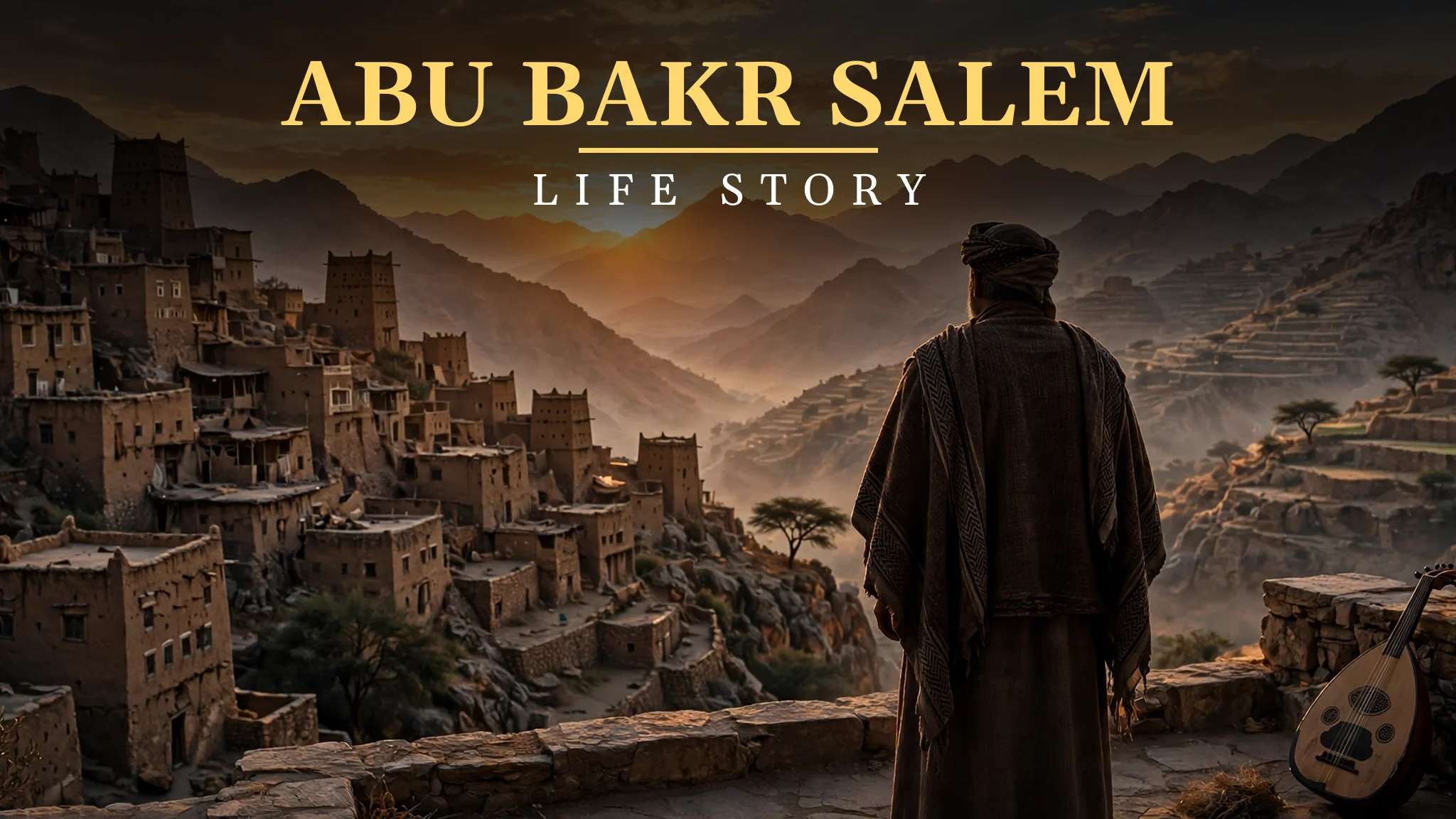
Abu Bakr Salem was a legend, and that word is used too often in music, but in his case it is true. He was one of the great voices of the Arab world, a singer from Hadhramaut in Yemen whose songs were loved from Aden to Riyadh to Cairo, and whose voice, deep, warm, and full of feeling, became a sound that defined a whole tradition of Arabic music. He sang for more than sixty years, and his songs are still played today, long after his death, because they are beautiful, because they are honest, and because they speak about love, about home, and about the sea, in a way that does not change with fashion.
He was born in Tarim, in Hadhramaut, in 1939, and he grew up in a world that was very different from the modern Arab world. Hadhramaut is a valley in eastern Yemen, with old towns, with mud-brick houses, and with a long history of poets, singers, and travellers. A child growing up there learns the old songs, the old poems, and the old stories, and Abu Bakr learned them well. He sang as a boy, and he learned the oud, and he began to write songs, and those songs would later travel far beyond his valley, to every corner of the Arab world.
His story is the story of a voice that came from a small place and reached the world, of a man who sang with dignity, who kept his traditions, and who became a legend not by chasing fame but by singing well, for a lifetime. He died in 2017, and his death was mourned across the Arab world, because his voice had been a part of people’s lives for so many years.
A Boy From Tarim in Hadhramaut
Abu Bakr Salem was born in Tarim, in the Hadhramaut valley of Yemen, on 17 March 1939, and his full name was Abu Bakr Salem Balfaqih. Tarim is an old town, known for its learning, its mosques, and its poets, and a child growing up there lives close to tradition, close to family, and close to the sounds of the valley. He grew up in a family that valued learning and music, and he learned the songs and poems of Hadhramaut from a young age, songs about love, about the sea, and about the land he loved.
He began singing as a boy, and he learned to play the oud, the pear-shaped instrument that is at the heart of Arabic music. The oud is not an easy instrument to learn, and it takes years of practice to play it well, but Abu Bakr learned it, and he used it to accompany his singing, to write new melodies, and to explore the music of his homeland. He sang at family gatherings, at weddings, and at community events, and the people who heard him said that his voice had a special depth, a warmth that suited the old songs of Hadhramaut.
As he grew older, he began to take music more seriously, and he studied the traditions of Hadhrami music, with its distinctive rhythms, its melodies, and its poetry. Hadhrami music is a rich tradition, with songs that speak about love, about travel, and about the sea, and Abu Bakr learned that tradition deeply. He practised in the way that young singers do, by singing again and again, until the voice feels like a part of the body, and until the songs feel like his own. That practice, done quietly and without an audience, was the foundation of his later career.
Hadhramaut also gave him a sense of place that would matter later. When he sang about love, about longing, and about home, he was singing about a valley he knew, with its towns, its people, and its long evenings. That sense of home is something that listeners can feel, even if they have never been to Yemen, because a song about missing home means more when the singer has a real home in mind, and Abu Bakr always has.
Leaving Home, Aden, and the First Recordings
As a young man, Abu Bakr Salem left Hadhramaut and moved to Aden, the great port city of southern Yemen, where music was a part of daily life. Aden was a busy, cosmopolitan city, with people from many countries, and with a lively musical scene, and it gave him a chance to perform in front of wider audiences, to work with other musicians, and to record his first songs. He sang in Aden, he played the oud, and he began to be known as a young singer with a beautiful voice and a deep knowledge of Hadhrami music.
He also moved to Saudi Arabia, where he lived for many years, and where his music reached a wider audience. In Saudi Arabia, he sang for large audiences, he recorded albums, and he became known as one of the great voices of the Gulf. His songs were played on the radio, his albums were sold in record shops, and his name became known in Riyadh, in Jeddah, and in many other cities. He had become, in a few short years, a regional star, and he had done it by staying close to the music of his homeland, while also reaching out to new listeners.
His first recordings were an important step, because they took his voice from the live world of weddings and gatherings to the recorded world of radio and albums, where a song can be heard again and again, by people who have never met the singer. A first recording is a test, and it asks a singer to choose songs, to work with producers, and to present himself to the world. Abu Bakr passed that test, and his voice began to be heard far beyond Hadhramaut.
He also learned the business of music, and he worked with composers, lyricists, and producers who understood his voice and his audience. He chose songs that suited him, he recorded them with care, and he released them at a steady pace, building a catalogue that grew year by year. That steady work is not glamorous, but it is what keeps a career alive after the first excitement fades, and Abu Bakr understood that from the start.
The Voice That Became a Legend Across Arabia
As his career grew, Abu Bakr Salem became known as one of the great voices of the Arab world, a singer whose name was mentioned alongside the greatest Arab singers of his time. His voice was deep, warm, and full of feeling, and it suited the romantic and poetic songs he loved. He sang about love, about the sea, about travel, and about home, and his songs were played at weddings, on the radio, and in homes across Yemen, Saudi Arabia, and the wider Arab world.
His sound was defined by his voice, by his oud, and by his choice of songs. He sang with control, with a clear diction that made every word easy to understand, and with a feeling that made every song feel personal. He did not shout, and he did not try to impress with tricks. He sang with a calm confidence, and he let the melody and the words do the work. That style suited the Hadhrami songs he loved, and it gave him a distinctive identity in a music world where many singers sound alike.
He also worked with some of the best composers and lyricists in the Arab world, and those collaborations helped his songs reach a wider audience. A good composer can write a melody that fits a singer’s voice perfectly, and a good lyricist can write words that speak to the heart, and Abu Bakr’s team understood his voice well. Together, they made songs that became classics, that were played for decades, and that were remembered long after they were released.
His albums, released over many years, form a body of work that is large and varied, and they show a singer who grew and changed while staying true to his roots. He sang songs about love, about home, about longing, and about the beauty of life, and he sang them with a voice that never lost its warmth. That consistency is a large part of why he is loved, because his audience knows what to expect from him, and they know that he will not disappoint them.
Songs of Love, Sea, and Home in Hadhramaut
Abu Bakr Salem’s songs are often about the sea, about travel, and about home, and those themes reflect the life of Hadhramaut, where many men travelled far from home to work, to trade, and to seek a better life. A song about a traveller, about a man who misses his home, and about a woman who waits for him, speaks to many people in Yemen and in the Gulf, because it is a story they know from their own lives. Abu Bakr sang those songs with a feeling that made listeners believe him, because he knew that life, and he had lived it himself.
His songs about love were also central to his work, and they were romantic, poetic, and full of feeling. He sang about love in a direct and honest way, and his audience loved him for that directness, because it made his songs feel like they were about their own lives. A love song is a simple thing, but it is also a hard thing to do well, because it must feel true, and Abu Bakr’s songs felt true to the people who heard them. His voice, deep and warm, gave those songs a beauty that made them stand out.
He also sang about Hadhramaut itself, about its valleys, its towns, and its people, and those songs became anthems for Hadhramis living far from home, in Saudi Arabia, in the Gulf, and in many other countries. For those listeners, his songs were a link to home, a reminder of the valley they loved, and a source of comfort in a foreign land. That is a special place for a song to hold, and Abu Bakr’s songs held it for many years.
His music was also a part of Yemeni cultural life, played at weddings, at family gatherings, and at national celebrations, where it became a part of people’s memories. A song by Abu Bakr can remind a Yemeni listener of a wedding, of a long drive, of an evening with family, and those memories give his music a meaning that goes beyond the charts. That is a legacy that few artists achieve, and it is one that Abu Bakr earned over many decades.
Life in Saudi Arabia and a Career That Spanned Decades
Abu Bakr Salem lived for many years in Saudi Arabia, and that country became a second home for him, a place where he performed, recorded, and built a large audience. He sang in Riyadh, in Jeddah, and in many other Saudi cities, and his concerts drew large crowds, including many Hadhramis and Yemenis living in Saudi Arabia, as well as Saudis who loved his music. He became a familiar voice in Saudi homes, and his songs were played on Saudi radio, at weddings, and at family gatherings, where they became a part of people’s lives.
He also worked with Saudi musicians, composers, and producers, and those collaborations helped his music grow. He sang songs in the Saudi style, as well as in the Hadhrami style, and he showed that he could move between traditions, from a slow, poetic song to a faster, more rhythmic track, without losing his identity. That flexibility helped his career grow, and it showed that his voice could carry many kinds of songs, from a classical Arabic song to a modern Gulf track.
His career spanned more than six decades, from the 1950s to the 2010s, and that length is rare for any singer. He began as a young man in Aden, and he was still singing, still recording, and still performing when he was in his seventies, and his voice, though it changed with age, never lost its warmth. He took care of it, he trained, and he performed with discipline, and that care is visible in the quality of his later work. In a music world that often rewards novelty over quality, he built his career on the opposite idea, that a good voice, a good song, and hard work will last longer than a fashion.
He also received honours and awards for his work, and he was recognised by his country and by the Arab world as one of its great singers. Those honours mattered, because they came from people who knew music, not only from fans, and they confirmed that his voice and his songs belonged in the history of Arabic music. He accepted those honours with humility, and he continued to sing, because singing was not only his career. It was his life.
Later Years, Illness, and a Death Mourned Across Arabia
In his later years, Abu Bakr Salem’s health declined, and he spent time in hospital, receiving treatment for illness. His fans followed news of his health with concern, and they sent messages of love and support, praying for his recovery. He was an old man by then, and he had lived a long life, and his audience knew that, but they still hoped that he would recover, because his voice had been a part of their lives for so many years, and they did not want to lose it.
He died in Riyadh on 10 December 2017, at the age of 78, and his death was mourned across the Arab world. People in Yemen, in Saudi Arabia, and in many other countries shared his songs online, played them on the radio, and remembered the moments in their lives when his voice had been with them. His funeral was attended by many people, and his death was reported widely, because he was not only a singer. He was a legend, a man whose voice had defined a tradition, and whose loss was felt by millions.
His death was a sad moment, but it was also a moment of remembrance, when people celebrated his life, his music, and his legacy. They played his songs, they told stories about him, and they shared their memories of his concerts, his albums, and his voice. That sharing is a large part of how a legend lives on, not in a single moment, but in the memories of the people who loved his work, and in the songs that continue to be played.
Today, his songs are still heard, still loved, and still shared, and his voice remains a familiar sound on Arab radio and online. He is no longer alive, but his music lives on, and it will live on for many years, because a good song, sung well, does not die with its singer. It lives in the hearts of its listeners, and Abu Bakr Salem’s songs live in many hearts.
The Oud, the Poet, and the Craft of Hadhrami Song
Abu Bakr Salem was not only a singer. He was also a player of the oud, and a writer of songs, and that double gift made him a complete musician. He played the oud with skill, and he used it to write melodies, to accompany his singing, and to explore the music of his homeland. The oud is a difficult instrument, and it takes years to master, but Abu Bakr mastered it, and his playing gave his songs a depth that few singers achieve.
He was also a poet, in the sense that he understood the words of his songs deeply, and he chose lyrics that were beautiful, poetic, and full of meaning. Hadhrami music is rich in poetry, with songs that speak about love, about travel, and about the sea, in words that are both simple and profound, and Abu Bakr understood that poetry, and he sang it with a feeling that made the words come alive. That understanding is a large part of why his songs are still loved, because they are not only melodies. They are poems, set to music, and sung with a voice that knew what they meant.
He worked with poets and lyricists, and he helped them shape their words into songs, and he worked with composers, and he helped them shape their melodies into recordings. That teamwork is a central part of music, and Abu Bakr was a good partner, a man who listened to others, and who let a song grow through collaboration. He was not a singer who stood alone. He was a musician who worked with others, and that generosity made his songs better.
In the end, his craft was the craft of Hadhrami song, a tradition that is old, rich, and beautiful, and he carried that tradition forward, from his valley to the world, and he gave it to new generations, who still sing his songs today. That is a legacy that few artists achieve, and it is one that Abu Bakr earned over a lifetime of work.
The Traveller’s Song and the Hadhrami Diaspora
Abu Bakr Salem’s songs were especially loved by Hadhramis living far from home, in Saudi Arabia, in the Gulf, in East Africa, and in many other countries, where they had travelled to work and to build a better life. For those listeners, his songs were a link to home, a reminder of the valley they loved, and a source of comfort in a foreign land. A song about a traveller, about a man who misses his home, speaks to that life, to the pain of separation, and to the hope of return, and Abu Bakr sang those songs with a feeling that made listeners believe him, because he knew that life, and he had lived it himself. His music became a bridge between Hadhramaut and the world, and it kept a community together, even when its people were scattered across many countries.
He also sang for Hadhramis at home, in Tarim, in Mukalla, and in many other towns in the valley, where his songs were played at weddings, at family gatherings, and at national celebrations. Those songs became a part of Hadhrami cultural life, and they are still played today, as a reminder of a great singer, and as a celebration of a tradition that is old, rich, and beautiful. That is a legacy that few artists achieve, and it is one that Abu Bakr earned over a lifetime of work, by singing with honesty, by playing with skill, and by staying true to his home.
A Life in Music, From Tarim to Riyadh
Abu Bakr Salem’s life in music took him from Tarim to Aden to Riyadh, and each move gave him new audiences, new collaborators, and new songs, while his roots in Hadhramaut stayed with him. He travelled, he performed, and he recorded, and he built a career that spanned more than six decades, from a young man singing in Aden to an old man whose voice was still loved in Riyadh. That journey is a large part of his story, because it shows that a singer can travel far from home without losing his home, and that a voice can carry a valley to the world, and keep it alive in the hearts of listeners who have never been there.
My Take:
When I think about Abu Bakr Salem, I first think about a legend, because that is the word that best describes him, and it is a word that is used too often, but in his case it is true. He sang for more than sixty years, and his voice became a sound that defined a whole tradition of Arabic music, a sound that people in Yemen, in Saudi Arabia, and across the Arab world grew up with, and loved, and remembered. I admire that length, because it is rare for any singer to last that long, and it is even rarer for a singer to last that long while staying true to his roots, and Abu Bakr did both, and that is a large achievement.
I admire his voice most of all, and I mean that in a simple way. His voice was deep, warm, and full of feeling, and it suited the romantic and poetic songs he loved. When he sang about love, about the sea, or about home, I believe him, not because I know his private life, but because the sound itself carries that feeling, a warmth that makes the listener feel that the song is about his own life. That is the test I use for any singer, and he passes it, again and again, in song after song. A voice can be trained, but that kind of honesty in the sound is a gift, and he used it with great care, never wasting it on a song that does not deserve it.
I also think about Hadhramaut, and what it means to come from a small valley and become a legend. He was a boy from Tarim, and he became a star in Aden, in Riyadh, and across the Arab world, but he did not forget where he came from, and he did not pretend to be from somewhere else. He sang as a Hadhrami, he played the oud, and he carried his homeland in his voice, and that honesty made his music travel further. I think that is a lesson for anyone who comes from a small place, that you do not have to hide your home to succeed. You can carry your home with you, and your home can make your work better, not weaker.
What I learn from him is the value of tradition, and of learning it deeply. He did not only sing modern songs. He learned the old songs, the old poems, and the old music of Hadhramaut, and he carried that tradition forward, to new audiences, in new places, and in new times. That is a generous act, because a tradition only lives if it is passed on, and Abu Bakr passed it on, by singing, by playing, and by writing, for more than sixty years. I think young musicians should learn from that, that a tradition is not a burden. It is a gift, and it can give a singer a voice that is both old and new, both rooted and free.
I think about his songs about the sea, and about travel, and what they mean to the people who listen to them. In Hadhramaut, many men travelled far from home to work, and their families waited for them, and a song about a traveller speaks to that life, to the pain of separation, and to the hope of return. Abu Bakr sang those songs with a feeling that made listeners believe him, because he knew that life, and he had lived it himself, and his audience heard that truth in his voice. That is a powerful thing, and it is one that few singers can do, because it requires not only a good voice but a life that has taught you what the words mean.
I also reflect on his death in 2017, and the mourning that followed it across the Arab world. When a legend dies, people do not only mourn a singer. They mourn a part of their own lives, a voice that was with them at weddings, at family gatherings, and in quiet moments alone, and that voice is now gone. I find that deeply moving, because it shows that a singer’s work is not only entertainment. It is a part of people’s memories, and when the singer dies, those memories become more precious, and they are shared with others, as a way of keeping the voice alive. Abu Bakr’s songs are still shared in that way, and they will be shared for many years.
If I am honest, I sometimes wish his music were better known outside the Arab world, because his voice deserves a wider audience. Many people outside the Arab world have never heard him, and that is a loss, not only for him but for them, because his voice is a beautiful example of Arabic music at its best, and his songs speak about love and home in a way that anyone can understand. I hope that streaming and online video will help his music reach new listeners, and that young people in other countries will discover his voice and love it as much as his Arab audience does.
I think about the young musicians in Yemen who listen to him today, and what his story tells them. It tells them that a boy from Tarim can become a legend, that a voice can travel across the Arab world, and that their own traditions matter. That is a hopeful message, and it matters more than any award, because it gives young people a path to follow, and it shows them that their own dreams are not foolish. Abu Bakr did not become a legend in a day, and he did not depend on luck. He practised, he played, he sang, and he kept going, for more than sixty years, and that slow path is the real path, and it is the one that lasts.
I also think about the oud, and how he played it, and what that means for a singer. A singer who plays an instrument understands music in a deeper way, because he knows how a melody is made, how a rhythm works, and how a song is built. Abu Bakr understood that, and his playing gave his songs a depth that few singers achieve. I admire that, because it shows that he was not only a voice. He was a musician, a complete artist, who understood his craft from the inside, and who used that understanding to make songs that were both beautiful and true.
When I compare him with other Arab singers, I see how rare his path is. Many singers have a few good years, and then they fade, because they depend on a single style, or a single hit, or a single moment of fame. Abu Bakr did not depend on one thing. He depended on his voice, on his oud, on his knowledge of tradition, and on his hard work, and those things lasted for more than sixty years. He is not only a singer of one decade. He is a singer of many decades, and his music has been a part of the lives of several generations, from parents to children to grandchildren, and that is a legacy that few artists achieve in any country.
I will remember Abu Bakr Salem as a legend who stayed true to his valley, to his voice, and to his audience, for more than sixty years. He sang with warmth, he played with skill, and he gave his people songs that they will remember for a lifetime, and that is a story worth telling in full. In a world where so many things change fast, a voice that stays is a gift, and Abu Bakr gave that gift to his people for a very long time. His songs still live, and they will live on, because a good song, sung well, does not die with its singer. It lives in the hearts of its listeners, and Abu Bakr’s songs live in many hearts, in Yemen, in Saudi Arabia, and across the Arab world.
I also think about the way his songs will be remembered, long after the charts have changed. A good song, sung well, can last for generations, and Abu Bakr’s songs have that quality, because they are beautiful, they are honest, and they speak about feelings that do not change. Long after new singers have come and gone, his songs will still be played at weddings, in homes, and on the radio, because they are a part of Yemeni life, and a part of people’s memories. That is a legacy that few artists achieve, and it is one that I hope his audience will keep alive, by sharing his songs with their children, and by remembering the voice that sang about love, about the sea, and about home, for a lifetime.
I hope, too, that his story helps other young singers understand that a long career is built on trust, on good songs, and on respect for the audience, and that those things matter more than a single hit. Abu Bakr built that trust over sixty years, and he kept it, and that is a large achievement, one that I think will be remembered long after the charts have changed, because trust, once earned, is not easily forgotten, and his audience trusts him still, even after his death.
I hope, too, that his story helps other young singers understand that a long career is built on trust, on good songs, and on respect for the audience, and that those things matter more than a single hit. Abu Bakr built that trust over sixty years, and he kept it, and that is a large achievement, one that I think will be remembered long after the charts have changed, because trust, once earned, is not easily forgotten, and his audience trusts him still, even after his death.
I also think about the oud in his hands, and what it meant to hear him play, because the oud is not only an instrument. It is a voice, a deep, warm voice that speaks without words, and when Abu Bakr played it, he was speaking in the language of Hadhramaut, a language of valleys, of sea, and of travel, that his listeners understood in their hearts, even if they had never been to his valley. That playing, combined with his singing, gave his music a depth that few singers achieve, because it was not only a voice. It was a whole tradition, played and sung by one man, and that is a rare and beautiful thing.
Another thought that stays with me is about the travellers who listened to him far from home, in Saudi Arabia, in the Gulf, and in many other countries, and what his songs meant to them in a foreign land. A traveller who hears a song from home can feel, for a few minutes, that he is back in his valley, with his family, and with the people he loves, and that feeling can give him strength to keep working, to keep going, and to hope for a return. Abu Bakr gave those travellers that feeling, again and again, for more than sixty years, and that is a generous gift, one that few artists can give, because it requires not only talent but a deep love of home, and Abu Bakr had that love, in every note he sang.
I think, too, about the poets whose words he sang, and how he honoured them by singing their poems with care, with feeling, and with a voice that knew what the words meant. Hadhrami poetry is rich, with words about love, about the sea, and about the pain of separation, and Abu Bakr understood that poetry, and he gave it a sound that made it live for new listeners, who might never have read the poems, but who heard them in his songs, and loved them. That is a service to a culture, and it is one that I respect deeply, because a singer who keeps poetry alive is keeping a whole tradition alive, and Abu Bakr did that, for a lifetime.
I also think about the way his oud sounded in a quiet room in Tarim, when he was a young man learning to play, and what that moment means for a musician, because a song begins not on a stage, but in a room, with an instrument, with a melody, and with a feeling that is hard to name, and Abu Bakr understood that, and he spent many hours in that room, trying new tunes, and listening to how they sounded, until the melody felt right, and that quiet work, done away from cameras, is the heart of music, and it is a work that deserves respect, because it is the work that makes a song last, long after the singer has gone.
Frequently Asked Questions
When was Abu Bakr Salem born and where did he grow up?
Abu Bakr Salem was born in Tarim, Hadhramaut, Yemen, on 17 March 1939, and he grew up in the Hadhramaut valley. He began singing as a boy, learned the oud, and learned the old songs and poems of his homeland.
What kind of songs did Abu Bakr Salem sing?
He sang romantic and poetic Arabic songs about love, the sea, travel, and home, in the Hadhrami tradition, with a deep, warm voice and the oud. His songs were played at weddings, on Arab radio, and in homes across Yemen and Saudi Arabia.
Why is Abu Bakr Salem called a legend?
He sang for more than sixty years, and his voice became a defining sound of Hadhrami and Arab music. His songs are still played today, and he is remembered as one of the great voices of the Arab world.
Where did Abu Bakr Salem live and work?
He left Hadhramaut as a young man, lived and performed in Aden, and then lived for many years in Saudi Arabia, where he recorded albums and performed for large audiences. His music reached listeners across the Arab world.
When did Abu Bakr Salem die?
He died in Riyadh on 10 December 2017, at the age of 78. His death was mourned across the Arab world, and his songs were shared widely as people remembered his life and his music.
What instrument did Abu Bakr Salem play?
He played the oud, the pear-shaped instrument at the heart of Arabic music, and he used it to write melodies, accompany his singing, and explore the music of Hadhramaut. His skill on the oud was a large part of his art.
What is Abu Bakr Salem’s legacy today?
His songs are still played, still loved, and still shared, and his voice remains a familiar sound in Arab music. He gave Hadhrami music a global audience, and his work continues to inspire young Yemeni and Arab singers.


