Adriano Celentano: The Life Story Behind Italy's Showman
In this post
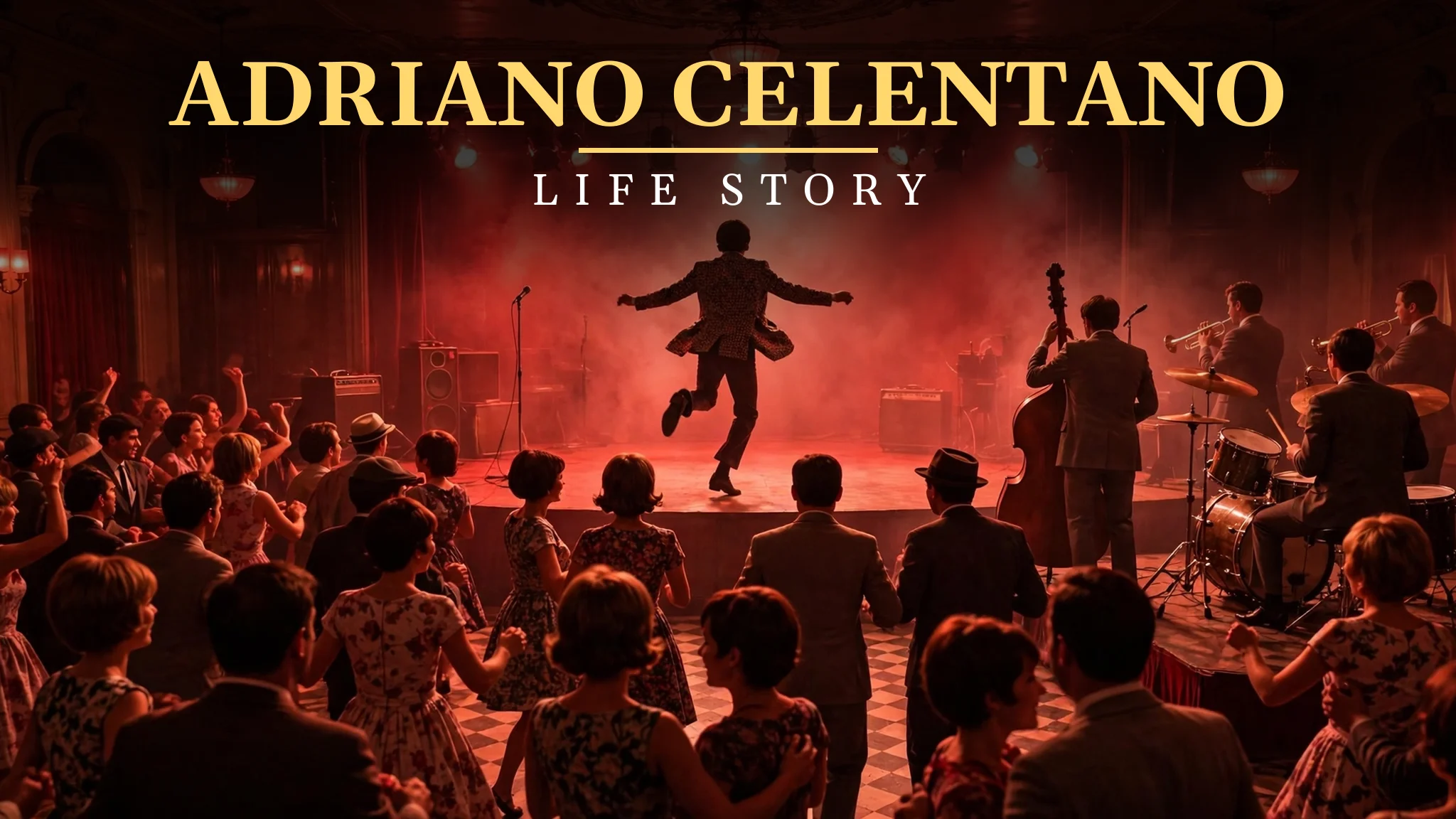
Adriano Celentano is one of the most unusual stars in the history of Italian entertainment. He is a singer, a dancer, an actor, a comedian, and a television presenter, and he has been famous for more than sixty years. He is known in Italy as Il Molleggiato, which means the springy one, because of the way he moves on stage, with a loose and bouncing step that looks as if his body is made of springs. That movement became his trademark, and it made him instantly recognisable. When he walks onto a stage, people smile before he has sung a single note.
He was born in Milan, in a working-class family, and he grew up in the streets of the city. He did not come from a musical family, and he did not study music in a formal way. He learned by listening to American rock and roll, by watching films, and by copying the singers he admired. He started as a rock and roll singer in the late 1950s, when that music was still new and shocking in Italy, and he became one of the first Italian singers to bring that energy to a wide audience. From there, he built a career that touched almost every part of Italian popular culture.
His story is about energy, humour, and a refusal to be put in a single box. He has sung some of the most famous Italian songs ever written, he has acted in more than forty films, he has hosted television shows that were watched by millions, and he has spoken about politics, religion, and the environment in a way that made people listen. He has also been a private man in many ways, living away from the centre of the entertainment world, and choosing his projects carefully. This is the story of how a boy from Milan became a legend.
A Boy From the Streets of Milan
Adriano Celentano was born on 6 January 1938 in Milan, into a family that had come from Puglia, in the south of Italy. His parents were working people, and the family lived in a modest home. Milan in the 1940s and 1950s was a city that was rebuilding after the war, and it was full of energy, noise, and change. Young Adriano grew up in that world, playing in the streets, listening to the music that came from the radio, and watching the films that arrived from America. He was not a quiet child. He was lively, funny, and full of movement, and he liked to make people laugh.
He worked as a watchmaker’s apprentice as a teenager, and he learned a trade that could have given him a steady life. But music was pulling him in a different direction. He listened to American rock and roll, to singers such as Elvis Presley and Jerry Lee Lewis, and he tried to copy their sound and their style. He sang in small clubs, he performed at local events, and he began to develop the springy dance step that would later make him famous. It was not a step he learned in a dance school. It was a natural movement, a way of letting the music move his body, and audiences loved it because it looked joyful and free.
His family did not always understand his dream, but they did not stop him. He was a young man with a strong will, and he knew what he wanted. He wanted to sing, to perform, and to make people happy. The streets of Milan had given him a sense of humour, a sense of rhythm, and a sense of how ordinary people lived. Those qualities stayed with him for his whole career, and they are the reason his songs and his films feel close to everyday life, even when they are performed on a big stage.
The Rock and Roll Years
Celentano’s professional career began in the late 1950s, when rock and roll was still a new and controversial music in Italy. Many older Italians thought it was noisy, vulgar, and foreign, and they did not want their children to listen to it. Young people thought it was exciting, modern, and free, and they wanted more of it. Celentano was one of the first Italian singers to bring that excitement to a wide audience, and he did it in his own way, singing in Italian and in a kind of broken English that made people laugh.
His early hits included Il tuo bacio è come un rock, released in 1959, which became a big success and showed that Italian audiences were ready for rock and roll. He performed on television, he toured, and he became a star. He also formed a group, I Ribelli, and he worked with other young musicians who shared his love of American music. The early years were full of energy, and they established him as a singer who was different from the polite pop stars of the time. He was loud, he was funny, and he moved like no one else on an Italian stage.
In those years he also began to act, and he discovered that he had a talent for comedy. His face, his voice, and his body all worked together to make people laugh, and directors began to offer him roles in films. He was not a trained actor, but he had a natural sense of timing, and he knew how to play a character who was funny without being stupid. That combination of singing and acting would become the centre of his career, and it would make him one of the most popular entertainers in Italy for decades.
Il Ragazzo della Via Gluck
In 1966, Celentano recorded Il ragazzo della via Gluck, a song about a boy who grows up in a street in Milan and watches the world around him change. The song was different from his early rock and roll hits. It was slower, more thoughtful, and more personal, and it spoke about the loss of a simple way of life as the city grew and changed. It became one of his most loved songs, and it is still played today whenever people talk about the great Italian songs of the 1960s. The street in the song, Via Gluck, was a real street in Milan, near the place where he grew up, and that made the song feel true.
The success of Il ragazzo della via Gluck showed that Celentano was not only a rock and roll singer. He could also sing a serious song about memory, about home, and about change, and he could do it with a tenderness that surprised people who only knew his loudest performances. The song also showed that he was thinking about the world around him, about the way cities change, and about the cost of progress. That concern for the world would become more important in his later work, when he began to speak about the environment and about the way Italy was changing.
The song has lasted because it is about something universal. Every person has a street, a neighbourhood, or a place from their childhood that has changed, and every person has felt the sadness of seeing that place disappear. Celentano sang about that feeling in simple words, and he sang it in a voice that sounded as if he had lived it. That is why the song is still loved, and why it is still one of the first songs people mention when they talk about him.
Azzurro and the Songs Everyone Knows
In 1968, Celentano recorded Azzurro, a song written by Paolo Conte, and it became one of the most famous Italian songs ever written. The song is about a man who is alone on a summer afternoon, who looks at the blue sky and thinks about a woman who is far away. It is a song about loneliness, about longing, and about the heat of an Italian summer, and it is sung with a lightness that makes the sadness feel bearable. Azzurro was a huge hit in Italy and abroad, and it has been covered by many other artists in many different languages.
The success of Azzurro confirmed Celentano as one of the great Italian singers, and it showed that he could take a song written by someone else and make it completely his own. He did not just sing the words. He lived them, and he gave them a feeling that was unmistakably his. The song is still played in Italy today, in bars, on the radio, and at parties, and it is one of the songs that people from other countries associate most strongly with Italy. When a foreign listener thinks of Italian music, Azzurro is often one of the first songs that comes to mind.
In the years that followed, he recorded many other successful songs, including Storia d’amore, Chi non lavora non fa l’amore, and Soli. He won the Sanremo Music Festival in 1970 with Chi non lavora non fa l’amore, singing as a duet with his wife Claudia Mori. That victory was important, because Sanremo was the most important music festival in Italy, and winning it confirmed his place at the centre of Italian popular music. He had come a long way from the streets of Milan, and he was now a national star.
Prisencolinensinainciusol and a Famous Joke
In 1972, Celentano recorded one of the strangest and most famous songs of his career, Prisencolinensinainciusol. The song is sung in a made-up language that sounds like English but means nothing at all. Celentano invented it as a joke, and as a comment on the way Italian listeners loved American songs even when they could not understand the words. The song was a huge hit in Italy, and it became a talking point around the world. People laughed at it, they danced to it, and they argued about what it meant.
The song is important because it shows Celentano’s sense of humour and his intelligence. He was not just a singer. He was a man who understood how popular music works, how people listen, and how a song can be both a joke and a serious comment at the same time. Prisencolinensinainciusol was a joke, but it was also a clever piece of social criticism, and it showed that Celentano was thinking about the music business in a deeper way than many of his contemporaries. The song is still played today, and it is still discussed by music writers who see it as a ahead-of-its-time experiment.
The success of the song also showed that Celentano could take a risk and make it work. A made-up language could have been a disaster, and many singers would not have dared to try it. He tried it, he committed to it, and he made it a hit. That willingness to take risks, to be funny, and to be different, is a thread that runs through his whole career. He has never been afraid to look silly, and he has never been afraid to try something new.
A Film Star and a Comedian
Celentano’s film career is almost as important as his music career. He acted in more than forty films, many of them comedies that were huge successes in Italy. Films such as Serafino, Yuppi du, Bluff, and Il bisbetico domato made him one of the most popular actors in Italian cinema. In Il bisbetico domato, released in 1980, he played a grumpy farmer who is softened by a woman, played by Ornella Muti, and the film became one of the biggest Italian box office hits of its time. His comic timing, his face, and his body language made him a natural film comedian.
He also directed films, including Yuppi du in 1975, which showed that he was interested in more than just acting. He wanted to tell stories, to shape a film, and to express his own ideas. His films were not always taken seriously by critics, but they were loved by audiences, and they made a lot of money. That success gave him the freedom to choose his projects, and to work on the films and songs that interested him, rather than the ones that were simply offered to him.
His work in film also brought him together with many of the great Italian actors and directors of his time. He worked with directors who understood comedy, and with actors who could match his energy. The films are still watched in Italy today, and they are still shown on television, where new generations discover his humour for the first time. For many Italians, Celentano is not only a singer. He is a film star, a comedian, and a part of their childhood memories.
Claudia Mori and a Long Marriage
Adriano Celentano married the singer and actress Claudia Mori in 1964, and their marriage has lasted for more than sixty years. Claudia Mori was a successful singer in her own right, and she became an important partner in his career, working with him on films, on television, and on his record company. Their marriage is one of the longest in Italian entertainment, and it has been a central part of his life. They have three children together, and they have lived for many years in a villa in Galbiate, in Lombardy, away from the centre of the entertainment world.
The marriage has not been without its difficulties, as all long marriages are, but the two of them have stayed together, and they have built a life that is grounded in family, work, and privacy. Celentano has spoken about his wife with respect and affection, and he has said that she is the most important person in his life. That loyalty is notable in a world where famous marriages often end quickly, and it tells us something about his character. He is a man who values stability, family, and a home, even while his public life has been loud and flamboyant.
Claudia Mori has also been a business partner, helping to run his record company and to manage his career. That partnership has given him the freedom to work on his own terms, to choose his projects, and to avoid the pressures of the music business. It is a partnership in the full sense of the word, and it is one of the reasons his career has lasted so long. He has not had to face the world alone. He has faced it with a partner who understands him, and who has stood beside him for more than sixty years.
Television, Opinions, and the Later Years
In the later years of his career, Celentano became a major figure on Italian television, hosting shows such as Fantastico and Rockpolitik, which were watched by millions of people. His television shows were not just entertainment. They were also a platform for his opinions about politics, religion, the environment, and the state of Italy. He spoke directly to the audience, in a slow and deliberate way, and he said things that other presenters would not say. Some people loved him for it, and some people criticised him, but everyone listened.
He has spoken about the environment for many years, long before it became a fashionable subject, and he has criticised the way Italian cities have grown, the way television works, and the way politics is conducted. His opinions are not always popular, and they are not always easy to understand, but they come from a genuine concern for the world around him. He is not a man who speaks to be liked. He speaks because he believes something, and he wants other people to think about it.
In recent years, he has worked less, and he has chosen his appearances carefully. He still records music, he still appears on television from time to time, and he still has a large and loyal audience. He lives a quieter life now, in his home in Lombardy, but his influence on Italian popular culture remains enormous. He is one of the few Italian entertainers who has been famous in every decade from the 1950s to the present day, and that longevity is a testament to his talent, his energy, and his ability to change with the times.
Why Celentano Still Matters
Today, Adriano Celentano is seen as a legend of Italian entertainment, and his songs are still played, his films are still watched, and his name is still known by every Italian. Azzurro, Il ragazzo della via Gluck, and Prisencolinensinainciusol are part of the Italian musical memory, and they are taught to young listeners as examples of great Italian songwriting. His films are still shown on television, and his television shows are still talked about. He has left a mark on Italian culture that few other entertainers have matched.
His legacy is not only in his songs and films. It is in the way he showed that an Italian entertainer could be many things at once, a singer, a dancer, an actor, a comedian, and a thinker, without being trapped by any single label. He showed that a working-class boy from Milan could become a national star, and that he could do it by being himself, by moving in his own way, and by singing in his own voice. That is a powerful example, and it is one that has inspired many younger Italian artists.
The story is not finished. Celentano is still alive, still working, and still speaking his mind, and his audience is still listening. The boy from the streets of Milan became a showman, a singer, and a legend, and he did it by never stopping, by never giving up, and by never pretending to be someone else. That is why his story still matters, and why it will still matter for many years to come.
Celentano also understood the power of a simple melody, and he knew that a song does not need to be complicated to be great. Azzurro is a simple song, with a simple story, and that simplicity is why it has lasted. People can sing it, they can remember it, and they can feel it, even if they do not know Italian. That is a rare gift, and it is one that many songwriters spend their whole lives trying to learn. He learned it early, and he used it again and again, in songs that are still played today.
His work as a television presenter also deserves more attention than it usually gets. Hosting a live show in front of millions of people is a difficult job, and doing it while also speaking about politics and the environment is even harder. He did it in his own slow and deliberate way, and he made people listen. Some people disagreed with him, but they still watched, because he was honest and because he was not afraid. That honesty is a part of his legacy, and it is one of the reasons he is still respected.
Finally, I think about the way he has lived his life away from the centre of fame, in a villa in Lombardy, with his wife and his family. That choice tells me that he knows what matters. Fame is exciting, but it is not a home. A home is a place where you can be yourself, where you can rest, and where you can think. He built that home, and he has kept it for decades, while still working and still speaking his mind. That balance is something I admire, and it is something I think many famous people never learn.
My Take:
When I think about Adriano Celentano, the first thing I think about is movement. He moves like no one else, with a loose and springy step that looks as if his body is dancing even when he is just walking. I love that, because it tells me that music is not just something he sings. It is something he feels in his whole body. Many singers stand still and sing beautifully, and that is fine. Celentano dances, he jumps, he bounces, and he makes the audience want to move too. That is a gift, and it is one of the reasons he has been loved for so long.
I admire the way he came from a working-class family in Milan and built a career that touched every part of Italian culture. He did not have a famous family, he did not have money, and he did not have a formal musical education. He had energy, humour, and a love of American rock and roll, and he turned those things into a career that has lasted for more than sixty years. That is an extraordinary achievement, and it tells me that talent is not only about training. It is also about energy, about a willingness to work, and about a refusal to give up when the road is hard.
I think about Il ragazzo della via Gluck, and about how that song shows a side of Celentano that people sometimes miss. It is a quiet song, a sad song, and a song about a place that has changed. It is not a loud rock and roll song, and it is not a joke. It is a song about memory, and it is sung with a tenderness that is surprising from a man who is famous for being funny and loud. I love that surprise, because it reminds me that a person can be many things at once. He can be funny and serious, loud and quiet, and he can sing about a street in Milan with the same honesty that he sings about love.
What I find most interesting in his story is Azzurro. It is a song that everyone knows, and it is a song that has been played so many times that it is easy to stop listening to it properly. But when I listen to it carefully, I hear a song about loneliness, about a man who is alone on a summer afternoon, and who is thinking about a woman who is far away. That is a sad story, but the song is light and joyful, and that contrast is what makes it great. Celentano understood that contrast, and he sang the song in a way that made the sadness feel bearable. That is a skill that few singers have.
I also think about Prisencolinensinainciusol, and about how brave it was to record a song in a made-up language. It could have been a disaster, and many singers would not have dared to try it. He tried it, and he made it a hit, and he made people laugh and think at the same time. I respect that, because it shows that he is not afraid to look silly, and he is not afraid to take a risk. In a music business that often rewards safe choices, he has always been willing to make an unsafe one, and that willingness has kept his work interesting for decades.
His film career is another part of his story that I admire. He was not a trained actor, but he became one of the most popular film comedians in Italy, and his films are still watched today. I think about Il bisbetico domato, and about how funny he is in that film, playing a grumpy farmer who does not want to be bothered by anyone. He plays the character with a warmth that makes the audience like him, even when he is being difficult. That is a hard thing to do, and it shows that his talent for comedy is real, not just a trick. He understands people, and he understands how to make them laugh without making them feel stupid.
I think about his marriage to Claudia Mori, too, and about how rare it is for a famous marriage to last for more than sixty years. In a world where famous couples often split up after a few years, they have stayed together, raised a family, and built a life. I do not think their marriage was perfect, because no marriage is perfect, but I do think it was real, and that it lasted because both of them worked at it. He has spoken about her with respect, and she has worked beside him for decades. That partnership is one of the most impressive parts of his story, and it tells me more about his character than any hit song ever could.
There is a part of his story that makes me think about television, and about the power of a presenter who speaks his mind. His television shows were watched by millions, and he used them to talk about politics, the environment, and the state of Italy. Some people loved him for it, and some people criticised him, but everyone listened. I admire that, because it takes courage to speak about difficult subjects on live television, in front of millions of people. He did not hide behind a script. He spoke directly, in his own words, and he said what he believed. That is a brave thing to do, and it is one of the reasons he is respected, even by people who disagree with him.
I also think about his concern for the environment, and about how early he started talking about it. Long before it became fashionable, he was speaking about the way Italian cities were growing, about the loss of green spaces, and about the need to protect the world. Some people laughed at him, and some people said he was not an expert. But he kept talking, and today many of the things he said have become common sense. I respect that, because it shows that he was thinking about the future, not just about his own career. He cared about the world his children would inherit, and he said so, even when it was unpopular.
When I compare him with other Italian singers of his generation, I think his greatest strength is his versatility. He can sing a rock song, a ballad, a funny song, and a serious song, and he can act in a comedy, direct a film, and host a television show. Most entertainers have one talent, and they use it for their whole career. Celentano has many talents, and he has used them all. That is rare, and it is one of the reasons his career has lasted so long. He has never been bored, and he has never bored his audience, because he has always been trying something new.
I think about the boy from Milan, working as a watchmaker’s apprentice, dreaming of rock and roll. He could have stayed in that trade, and he would have had a safe life. Instead, he followed the music, he learned to dance in his own way, and he became a legend. That choice, made by a teenager with no guarantee of success, is the heart of his story. It tells me that a safe life is not always the right life, and that sometimes the bravest thing you can do is to follow the sound you hear in your own head, even when no one else can hear it yet.
If I have a sadness in his story, it is the sadness that his later television appearances sometimes became controversial, and that some people remember the arguments more than the music. I wish people would remember the songs first, and the films second, and the arguments last. But I also understand that a man who speaks his mind will always make some people angry, and that is the price of honesty. He has paid that price, and he has kept speaking. I respect that, even when I do not agree with everything he says.
For a young reader, I think the lesson of Adriano Celentano is to be yourself, loudly and for a long time. He did not try to be a polite pop star. He was springy, funny, loud, and opinionated, and he stayed that way for sixty years. He sang the songs he wanted to sing, he made the films he wanted to make, and he said the things he wanted to say. That is a lesson for anyone who feels pressure to fit in. You do not have to fit in. You can be yourself, and if you work hard and you are honest, the world will make room for you, just as it made room for a boy from Milan who moved like a spring.
I keep returning to the image of him on a stage, bouncing, singing, and making people smile. That image is joyful, and it is the image I want to remember. He has given Italy sixty years of music, laughter, and thought, and he has done it in his own way. When I hear Azzurro now, I do not just hear a famous song. I hear a man who has lived a full and unusual life, and who has shared that life with his audience. That is why I admire him, and that is why I think his story will still matter when the controversies have faded and only the songs remain.
In the end, I think Adriano Celentano teaches us that an entertainer can be many things, and that the best entertainers are the ones who refuse to be put in a box. He was a singer, a dancer, an actor, a comedian, and a thinker, and he was all of those things at the same time. He did not choose one role. He chose them all, and he lived them all, loudly and for a long time. That is a full life, and it is a life worth learning from. I hope young artists hear his story and understand that they do not have to be one thing. They can be many things, and they can be themselves, just as he was.
I also think about the young people who discover Celentano today, through a film on television or a song on the radio, and who wonder who this funny and springy man is. I hope they go back and listen to his whole catalogue, because there is so much there to discover. They will find rock and roll, they will find ballads, they will find jokes, and they will find serious songs about the world. That variety is a gift, and it is a reminder that a great entertainer does not have to be one thing. He can be many things, and he can be himself in all of them.
Another thought that stays with me is about his voice, which is often overlooked because his dancing and his comedy are so famous. His voice is warm, it is distinctive, and it can be tender when a song needs tenderness. When he sings Il ragazzo della via Gluck, I hear a voice that is full of memory and feeling, and I understand why that song has lasted. It is not just the words. It is the voice, and the way he uses it to tell a story about a place that has changed.
I think about his sense of humour, too, and about how important humour is in a long career. Many singers take themselves very seriously, and they become boring because of it. Celentano has never taken himself too seriously. He has laughed at himself, he has made jokes about the music business, and he has been willing to look silly on stage. That humour has kept him young, and it has kept his audience laughing with him, not at him. It is a rare and valuable quality.
When I think about his films, I think about how they captured a particular Italy, a country that was changing fast in the 1970s and 1980s. His comedies were not just jokes. They were stories about ordinary people, about farmers, about workers, and about families, and they showed those people with warmth and respect. That is why the films are still watched. They are funny, but they are also true, and they tell us something about the Italy of that time.
Finally, I think about what his long marriage teaches us. In a world where fame often destroys relationships, he and Claudia Mori have stayed together for more than sixty years. That is not an accident. It is the result of work, of respect, and of a shared life. I admire that, because it shows that a famous life can also be a stable life, if the people in it choose to make it so. He chose family, he chose home, and he chose to keep going, and that is a lesson worth remembering.
Frequently Asked Questions
Where was Adriano Celentano born and what was his nickname?
Adriano Celentano was born on 6 January 1938 in Milan, and he is known as Il Molleggiato, meaning the springy one, because of his loose and bouncing dance step on stage.
What is Adriano Celentano’s most famous song?
Azzurro, recorded in 1968 and written by Paolo Conte, is his most famous song, and Il ragazzo della via Gluck from 1966 is another beloved classic. Prisencolinensinainciusol from 1972 is his most unusual and talked-about recording.
Did Adriano Celentano win the Sanremo Music Festival?
Yes, he won Sanremo in 1970 with Chi non lavora non fa l’amore, sung as a duet with his wife Claudia Mori. The festival is the most important music event in Italy, and the win confirmed his place at the centre of Italian pop.
What is Prisencolinensinainciusol about?
It is a song sung in a made-up language that sounds like English but means nothing, created by Celentano as a joke and as a comment on Italian listeners loving American songs they could not understand. It became a huge hit in Italy in 1972.
How many films has Adriano Celentano acted in?
He has acted in more than forty films, many of them comedies, including Serafino, Yuppi du, Bluff, and Il bisbetico domato from 1980, which became one of the biggest Italian box office hits of its time.
Who is Adriano Celentano married to?
He has been married to the singer and actress Claudia Mori since 1964, a marriage of more than sixty years. They have three children together and live in Lombardy, away from the centre of the entertainment world.


