Afgan: The Life Story Behind Indonesia's Smooth Voice
In this post
- A Teenager with a Smooth Voice
- Confession No. 1 and a First Album
- Sadis and the Song Everyone Knew
- Duets, Soundtracks and a Wider Stage
- A Voice That Did Not Chase Trends
- Still Singing in His Thirties
- What a Smooth Voice Can Teach
- The Concert Stage and Live Singing
- Songs for Films and Special Moments
- Songs That Became Part of Indonesian Life
- My Take:
Afgan is a singer whose voice does a simple thing very well: it makes a sad song feel gentle, and a love song feel honest. He does not shout, he does not show off, and he does not try to be louder than the song. He sings in a smooth, warm way that makes listeners feel as if he is singing directly to them, and that is why his songs have lasted for nearly twenty years in Indonesia. He is not a singer from one season. He is a singer from many seasons, and he is still singing.
His full name is Afgan Syahreza, and he was born on 27 May 1989 in Jakarta, Indonesia. Jakarta in the late 1980s was a city full of music, television, and new ideas, and a boy growing up there could hear many different songs at once. Afgan heard them, and he loved them. He was not born into a music family, but he had a clear, smooth voice, and he had a natural way of singing that made people notice him. As a teenager, he began to sing in public, and people who heard him remembered his voice.
What makes his story different from many pop singers is that he did not become famous by being loud or by chasing trends. He became famous by singing love songs well, in a style that was calm, romantic, and easy to listen to. That style is sometimes called pop, sometimes called R&B, and sometimes called simply Afgan, because his voice is so recognisable that it has become its own style. He has kept that style for nearly twenty years, while other singers have changed with every fashion, and that steadiness is part of why he has lasted.
A Teenager with a Smooth Voice
Afgan Syahreza grew up in Jakarta, in an ordinary family, going to school and spending time with friends. He was a quiet, thoughtful boy, with a love for music that showed early. He sang at home, he sang at school, and he sang whenever he had a chance, and people who heard him remembered his voice. It was smooth, warm, and clear, and it did not try to be louder than it needed to be. That smoothness became his signature, and it is why his songs still sound fresh today.
As a teenager, he was noticed for his singing, and he was given a chance to record. A young singer who is noticed early can easily be pushed too fast, into too many songs, too many shows, and too much fame, before he is ready. Afgan was not pushed too fast. He prepared, he practised, and he waited for the right moment to release his first album. That patience is one of the reasons his debut felt solid, rather than lucky, when it finally arrived.
His family supported him, but they also kept him in school, and they kept his life normal. He was not only a future singer. He was a student, and he took his studies seriously. Later, when he spoke in interviews, he often sounded thoughtful and well spoken, and that did not come from nowhere. It came from a childhood in which learning, music, and good manners were valued. Fame arrived later, but the habits of those early years stayed with him, and they helped him handle fame when it came.
Jakarta in the 2000s was a city of malls, television, and new music, and a teenager growing up there could see many different lives at once. Afgan saw them, and he also saw the world beyond Indonesia through music, through songs from other countries, and through the internet. That wider view is useful for a singer. A singer must understand feelings that are not only his own, and a person who has heard many kinds of music has a head start. Afgan did not have to imagine what a love song should feel like. He had heard many, and he could sing his own.
Confession No. 1 and a First Album
Afgan’s first album was Confession No. 1, released in 2008, when he was nineteen years old. The album included songs that became popular with young listeners, including “Terima Kasih Cinta”, which means Thank You, Love, a song about gratitude for love, and other songs about love, hope, and growing up. The album showed him as a pop singer with a smooth, romantic voice, and it introduced him to Indonesian audiences as a new star.
A debut album is a test, and the test is not only whether the audience likes you. It is whether you can sing well, whether your songs are honest, and whether you can perform them live, night after night. Afgan passed that test, and the album’s success showed it. Young Indonesians loved his songs, and they loved his voice, and he became a star. He was nineteen, he was handsome, and he was singing about love, and that combination is powerful.
The album also gave him a second career, as a live performer. He began to sing in concerts, in malls, on television, and in public life, and he learned how to hold a stage, how to talk to an audience, and how to sing the same song many times and still make it feel fresh. Those are not easy skills, but they are the skills that make a career last. A singer who only has a good recording will struggle when he must sing live. A singer who has learned to perform live will keep working, and Afgan was learning to perform live.
In the years after Confession No. 1, he released more music, and he built a reputation as a reliable, hardworking singer. He did not rush into a dozen albums at once. He took his time, he chose good songs, and he kept his voice strong. That patience is one of the reasons his career has lasted. A singer who releases too much too quickly can burn out. A singer who releases with care can last for decades, and Afgan has lasted.
Sadis and the Song Everyone Knew
In 2010, Afgan released a song that became one of the most famous of his career: “Sadis”, which means Cruel, a song about a love that hurts, about a person who is loved and left, and about the pain of that leaving. The song was a hit, and it was played on the radio, in cars, in malls, and at karaoke, across Indonesia. It showed a different side of Afgan: not only a gentle romantic, but a singer who could sing about pain, and make that pain feel real.
“Sadis” was important because it showed that Afgan could sing about more than happy love. He could sing about sad love, about a love that ends, and about the feelings that follow. That range is valuable for a singer, because audiences do not only feel happy. They also feel sad, and they want songs that understand their sadness. Afgan understood it, and he sang it with a smoothness that made the pain feel gentle, not harsh. That is a rare skill, and it is why “Sadis” is still remembered.
The song also gave him a new kind of fame. He was no longer only a young pop singer. He was a singer who could carry a sad song, and that gave him a standing in Indonesian music that went beyond popularity. He was now a voice that people turned to when they were sad, and that is a powerful place to be. A singer who is only for happy times will be forgotten in sad times. A singer who is for both happy and sad times will be remembered always, and Afgan became that singer.
In the years after “Sadis”, he released more songs, including “Panah Asmara”, which means Arrow of Love, and “Jodoh Pasti Bertemu”, which means Soulmates Will Surely Meet, and other songs that became popular with audiences. Each song added to his reputation as a romantic singer, and each song showed a different shade of love: happy, sad, hopeful, and patient. That variety is part of why his music has lasted. He did not sing the same song again and again. He sang many songs, about many kinds of love, and he sang them all well.
Duets, Soundtracks and a Wider Stage
Afgan’s career also grew through duets and soundtracks. He sang with other Indonesian singers, including Rossa, in songs that became popular, and he sang songs for films, which gave his voice a wider audience. A duet is a test for a singer, because you must blend your voice with another voice, without losing your own. Afgan blended well, and his duets showed that he could work with others, and that he was generous as a performer. He did not try to be the only voice in the song. He shared it, and that sharing made the song better.
He also sang for films, including songs that became linked with popular Indonesian movies. A film song is different from a pop song, because it must fit a story, a character, and a feeling, and it must be remembered long after the film ends. Afgan’s film songs were remembered, because they fitted the stories they were written for, and because his voice gave them a warmth that stayed with listeners. That is a skill that many pop singers do not have, and Afgan had it.
In the 2010s, he also performed in concerts, in Indonesia and abroad, including shows in Malaysia, Singapore, and other countries where Indonesian music is loved. Those concerts gave him a new kind of fame: international fame, where a viewer in another country could hear his voice without knowing anything about Indonesian pop. He handled that fame well, and he showed that his smooth, romantic style could travel, because love songs travel well, in any language, in any country.
His work in those years also included television, public appearances, and collaborations with other artists, and he kept his public image calm and professional. He did not chase scandal, and he did not try to be in the news every week. He worked, he sang, and he lived his life. That is a healthy way to handle fame, and it is one of the reasons he has lasted while other pop stars have faded.
A Voice That Did Not Chase Trends
One of the most interesting things about Afgan is what he did not do. He did not chase every new trend in music. He did not change his style every year to match the latest fashion. He kept his smooth, romantic voice, and he let the trends come and go around him. That steadiness is rare in pop music, where many singers change their sound so often that audiences forget who they are. Afgan did not forget who he was, and his audience did not forget him either.
His albums in the 2010s and 2020s, including Sides in 2016 and other releases, showed that steadiness. He sang love songs, he sang sad songs, and he sang songs about hope, in a style that was recognisably his. He worked with good songwriters, he chose good songs, and he sang them with care. That is a simple formula, but it is a hard one to follow for twenty years, because it asks for patience, for taste, and for a willingness to be yourself when the world tells you to be someone else. Afgan followed it, and it worked.
He also kept his voice healthy, which is a practical part of a singer’s life that many people forget. A singer must look after his voice, with rest, with practice, and with care, or the voice will fail. Afgan looked after his voice, and it has stayed smooth and strong for nearly twenty years. That is a sign of professionalism, and it is one of the reasons he can still perform live, still sing in concerts, and still record new songs, while other singers from his generation have stopped.
His steadiness also gave him a loyal audience. Fans who loved him in 2008 still love him in the 2020s, because he has not changed in a way that would make them feel left behind. He has grown, he has matured, but he has not become a different singer. He is still Afgan, with the same smooth voice, the same romantic feeling, and the same honesty. That loyalty is valuable, and it is one of the reasons his concerts still fill halls.
Still Singing in His Thirties
Today, Afgan is in his mid-thirties, with a career of nearly twenty years, and he is still singing, still performing, and still loved. He has released albums, he has sung duets, he has performed in concerts in Indonesia and abroad, and he remains one of the most recognised male pop singers in the country. His fans continue to ask about his next song, his next album, and his next concert, and those questions show how lasting his impact has been. A singer who is forgotten is not asked about. A singer who is remembered is asked about for years, and Afgan is remembered, for “Terima Kasih Cinta”, for “Sadis”, and for many other songs.
He has also become a figure that young Indonesian singers look to when they talk about a long career. His story shows that a career does not have to be built in one jump. It can be built song by song, album by album, concert by concert, over many years. Each song teaches you something, and each song makes the next one possible. Young singers who want everything at once should look at Afgan and see that songs work, one by one, over time.
His story is also a story about Jakarta, and about how a boy from the capital can become a voice for a whole country. He did not have to leave Indonesia to be famous. He sang in Indonesian, about Indonesian love, in an Indonesian style, and he became famous in Indonesia and beyond. That is a hopeful message for any young singer who thinks they must sing in English or move abroad to succeed. Afgan proves that singing well, in your own language, about your own feelings, can be enough, and can last for decades.
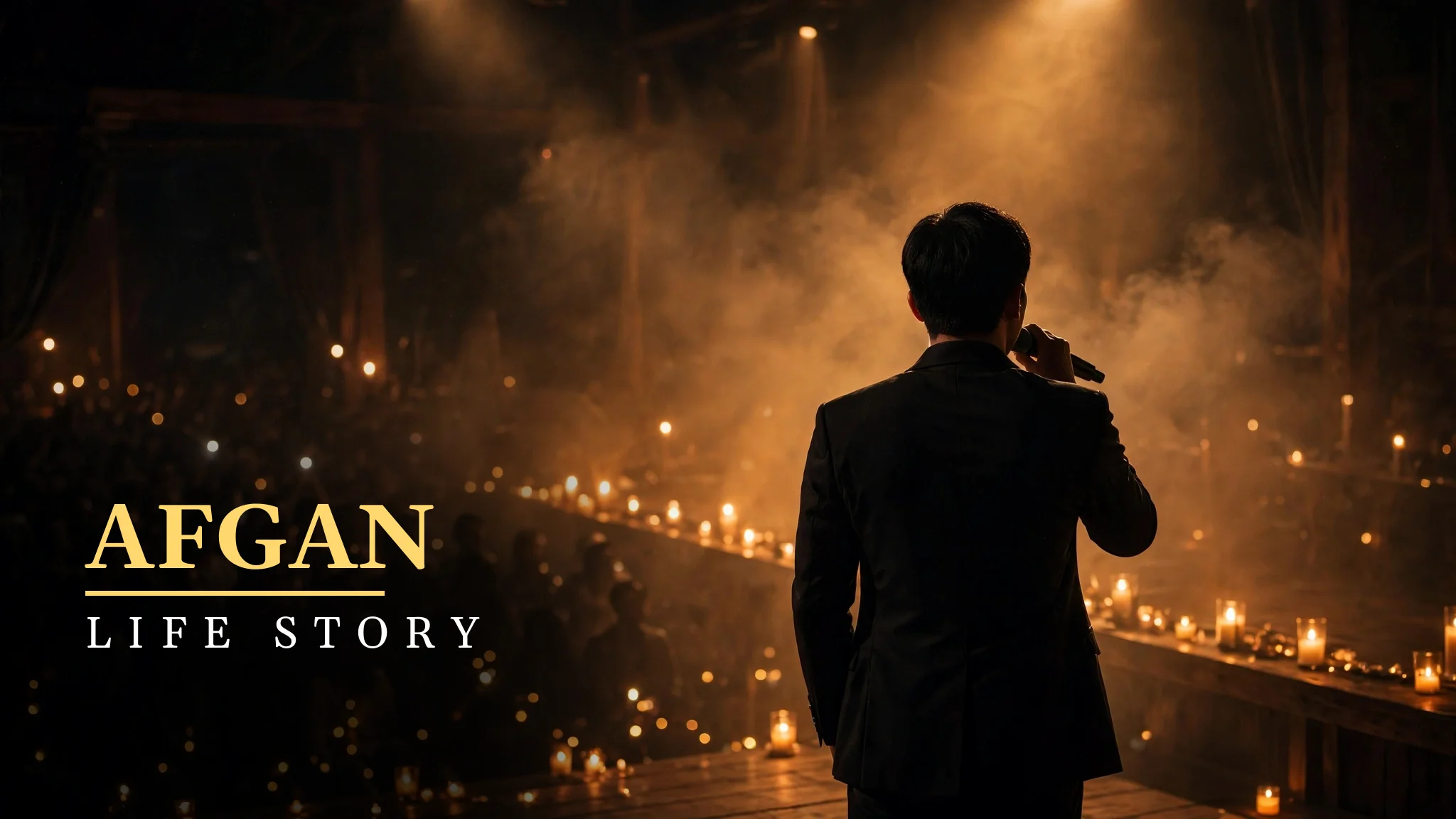
In the end, the image that stays is simple: a man in a black suit, holding a microphone, standing on a candle-lit stage, singing to a crowd of small lights. That is Afgan. He is a singer, he is a romantic, and he is a steady voice in a changing world, and he is still here, still singing, and still loved. That is a story worth telling, not only for what he has done, but for what he may do next.
What a Smooth Voice Can Teach
Afgan’s career teaches a simple lesson: you do not have to be loud to be heard. A smooth, gentle voice, sung with honesty, can be heard for twenty years, while a loud voice can be forgotten in a year. Afgan’s voice is smooth and gentle, and it has been heard for nearly twenty years, because it is honest. That is a lesson for any young singer, and for any young person in any job: be honest, be steady, and let your work speak, rather than shouting about it.
His career also teaches patience. He did not release a dozen albums at once. He released them one by one, with care, and he let each one find its audience. That patience is hard, because the world tells young stars to work all the time. Afgan worked, but he worked with care, and his music is stronger for it. A short list of good songs is better than a long list of forgotten ones, and his list is a good one.
The Concert Stage and Live Singing
Afgan is known for his live performances, and his concerts are a large part of his reputation. He does not perform with a huge, loud show. He performs with a smooth voice, a calm presence, and a feeling that he is singing directly to each person in the audience. Fans who go to his concerts often say they feel as if they are in a small room, even when they are in a large hall, because his voice makes a large place feel intimate. That feeling is hard to create, and it is one of the reasons his concerts are loved.
Live singing is a different skill from recording. On a recording, you can try again. On a stage, you have one chance, in front of thousands of people, and you must sing well, every time. Afgan has done that for nearly twenty years, and he has done it with a voice that is smooth, warm, and strong. That is a professional skill, and it is one that many singers do not have. He looks after his voice, he practises, and he treats a concert with respect, and that respect shows in his performances.
His concerts in Indonesia and abroad, including shows in Malaysia and Singapore, have shown that his romantic, smooth style can travel, because love songs travel well, in any language, in any country. A love song sung well does not need a translation. It needs only a voice that is honest, and Afgan’s voice is honest. Audiences in other countries have heard it, and they have responded to it, because they recognised the feeling, even if they did not know the words. That is a powerful thing for a song to do.
Concerts also gave him a way to connect with his fans over many years. A fan who saw him in 2008, as a teenager, can see him again in the 2020s, as a man in his thirties, and can feel that they have grown up together. That shared growth creates a bond that is hard to break, because the fan feels as if they have watched a life unfold, not only a career. Afgan understands that bond, and he respects it, by working hard, by singing well, and by not taking his fans for granted.
Songs for Films and Special Moments
Afgan has sung songs for films and for special moments in Indonesian life, and those songs have given his voice a wider audience than his albums alone could. A film song must fit a story, a character, and a feeling, and it must be remembered long after the film ends. Afgan’s film songs were remembered, because they fitted the stories they were written for, and because his smooth voice gave them a warmth that stayed with listeners. That is a skill that many pop singers do not have, and it is one that has kept his name alive, even in years when he did not release a new album.
He has also sung at weddings, at concerts, and at public events, where his romantic songs have become part of people’s happiest moments. A singer whose songs are played at a wedding is a singer whose music has entered people’s lives, not only their radios. Afgan’s songs have entered many lives that way, and that is a special kind of fame, a fame that is personal, not only public. He does not only sing for an audience. He sings for moments, and those moments last, in memory, long after the song ends.
Songs That Became Part of Indonesian Life
Some singers are known for one hit. Afgan is known for a whole shelf of songs that Indonesians have lived with for years. “Terima Kasih Cinta”, which means Thank You, Love, is a song of gratitude that became a favourite at weddings and anniversaries, because it says plainly what many people feel and cannot say well. “Sadis”, which means Cruel, is a song about a love that hurts, and it became one of the most played Indonesian ballads of its time, because its melody is gentle even when its words are sad. These are songs that people do not only hear. They keep them, they sing them, and they return to them in good times and hard times.
“Bawalah Cintaku”, which means Take My Love With You, is another song that stayed in the public memory. It is a soft, romantic ballad, the kind of song that plays on the radio late at night, and it showed Afgan’s gift for making a simple melody feel deep. “Jodoh Pasti Bertemu”, which means Soulmates Will Surely Meet, is a hopeful song about love arriving in its own time, and it became a favourite for couples who believed in that hope. “Panah Asmara”, which means Love’s Arrow, added a lighter, more playful side to his catalogue. Together these songs form a portrait of a singer who understands love in many forms: grateful, hurt, hopeful, and playful.
His duets added another colour to his work. “Kamu Yang Ku Tunggu”, which means You Are the One I Have Been Waiting For, sung with Rossa, brought two of Indonesia’s smoothest voices together, and the song became a favourite for its gentle harmony and its honest words about waiting for the right person. A duet asks two singers to listen to each other, to match each other, and to share the feeling rather than compete for it, and Afgan and Rossa did that well. The song is still played at weddings and on the radio, years after it was released, and it is a reminder that a good duet can last as long as a good solo song.
What is striking about these songs is how little they have aged. Pop music changes quickly, and many hits from 2008 or 2010 now sound old. Afgan’s ballads still sound fresh, because they were built on a good voice and a good melody, not on a fashion of the moment. A listener who hears “Terima Kasih Cinta” today hears the same warmth that listeners heard when it was new. That lasting quality is the mark of a singer who chose well, and it is one of the reasons Afgan is still asked to sing these songs, night after night, year after year.
My Take:
I like Afgan’s voice, and I will tell you why at the start: it is calm. In a world full of loud music, loud voices, and loud fame, a calm voice is a relief. Afgan sings in a smooth, warm way that makes a sad song feel gentle, and a love song feel honest, and I find that calming. I do not need a singer to shout to feel something. I need a singer to be honest, and Afgan is honest, and that is why I have listened to his songs for many years.
What strikes me first is “Terima Kasih Cinta”, because it is a song about gratitude, not only about love. Many love songs are about wanting someone, or losing someone, or missing someone. This song is about thanking someone for love, and that is a different feeling. It is a grateful feeling, and it is a kind feeling, and Afgan sings it with a warmth that makes the gratitude feel real. I think about that song often, because gratitude is a feeling we do not sing about enough, and Afgan sang about it well, at the start of his career, when he was only nineteen.
“Sadis” is the song I think about next, because it is about a love that hurts. It is a sad song, and it is a popular song, and that combination tells me something about audiences. People do not only want happy songs. They want songs that understand their sadness, and “Sadis” understands sadness. Afgan sings about a cruel love, about a person who is loved and left, and he sings it with a smoothness that makes the pain feel gentle, not harsh. That is a rare skill. A sad song that is sung harshly can make the listener feel worse. A sad song that is sung gently can make the listener feel understood, and Afgan makes the listener feel understood.
I also think about his steadiness, because it is easy to miss. He did not chase every trend. He did not change his style every year. He kept his smooth, romantic voice, and he let the trends come and go around him. That steadiness is rare in pop music, where many singers change their sound so often that audiences forget who they are. Afgan did not forget who he was, and his audience did not forget him either. I respect that steadiness, because it takes confidence to be yourself when the world tells you to be someone else. He was himself, and he stayed himself, for nearly twenty years.
His duets are another part of his story that I enjoy. Singing with another singer is a test, because you must blend your voice with theirs, without losing your own. Afgan blended well, especially in his duets with Rossa, and those songs became popular because they felt like a conversation between two people, not like a competition. He did not try to be the only voice in the song. He shared it, and that sharing made the song better. I wish more singers understood that sharing a song can make it stronger, not weaker.
I also think about his live performances, because a singer who only sounds good on a recording is not a complete singer. Afgan sounds good live, and he has performed in concerts for many years, in Indonesia and abroad. That takes a healthy voice, a lot of practice, and a willingness to work hard, night after night. He has done that work, and his voice has stayed smooth and strong. That is a sign of professionalism, and it is one of the reasons I respect him. He looks after his instrument, which is his voice, and he treats it with care.
If I am honest, I do not know Afgan as a person, and I should not pretend that I do. I do not know what he is like at home, or what he worries about, or what he hopes for. But I can see his public choices, and they show a pattern: he chooses good songs, he sings them with care, and he keeps his life calm and professional. That pattern is enough for me to respect him. I do not need gossip to respect a singer. I need only to listen to the songs, and the songs are there, in album after album, year after year.
One lesson I take from his story is about being calm. You do not have to be loud to be heard. A smooth, gentle voice, sung with honesty, can be heard for twenty years, while a loud voice can be forgotten in a year. That is a lesson for any young singer, and for any young person in any job: be honest, be steady, and let your work speak, rather than shouting about it. Afgan’s work speaks, and it has spoken for nearly twenty years, and it is still speaking.
Another lesson is about patience. He did not release a dozen albums at once. He released them one by one, with care, and he let each one find its audience. That patience is hard, because the world tells young stars to work all the time. Afgan worked, but he worked with care, and his music is stronger for it. A short list of good songs is better than a long list of forgotten ones, and his list is a good one. Young singers should learn from that, and young people in any job should learn from it too.
When I think about his future, I feel hopeful rather than worried. He is in his mid-thirties, he has a voice, he has experience, and he has a clear sense of who he is. He could sing more, he could write more, he could perform more, or he could do all three. Whatever he chooses, I think he will choose it well, because he has chosen well before. I hope he keeps choosing well, and I hope he keeps singing, because Indonesia needs smooth, honest voices like his, voices that make a sad song feel gentle, and a love song feel true.
In the end, my feeling about Afgan is warm and calm, like his voice. I started by hearing a smooth pop singer from a debut album, and I ended by hearing a steady, honest artist who has sung about love, loss, and gratitude for nearly twenty years, and who has done it with patience and care. That is a good story, and it is a story that is still being written. I look forward to its next song.
I also think about his concerts, because a concert is a different kind of performance from a recording. On a recording, you can try again. On a stage, you have one chance, in front of thousands of people, and you must sing well, every time. Afgan has done that for nearly twenty years, and he has done it with a voice that is smooth, warm, and strong. That is a professional skill, and it is one that many singers do not have. He looks after his voice, he practises, and he treats a concert with respect, and that respect shows in his performances, night after night.
There is a moment in a concert that I think about often: when a singer stands on a candle-lit stage, holding a microphone, and the crowd holds up small lights, and the whole room goes quiet, waiting for the next song. That moment is beautiful, and it is also fragile, because it depends on a voice, a song, and a crowd, all working together. Afgan has lived that moment many times, and he has made it look easy, but it is not easy. It takes years of work, and it takes a voice that has been looked after, and a heart that is willing to share. He has all of those things, and his concerts show them.
I also think about his fans, because they have grown up with him, from teenagers in 2008 to adults in the 2020s, and they have watched him grow from a young pop singer to a man in his thirties, with a voice that is still smooth and a career that is still going. That shared growth creates a bond that is hard to break, because the fans feel as if they have grown up together. Afgan understands that bond, and he respects it, by working hard, by singing well, and by not taking his fans for granted. That respect is a sign of maturity, and it is one of the reasons his fans have stayed loyal.
If I could give one piece of advice to a young singer who admires Afgan, it would be this: look after your voice, and be patient. A voice is an instrument, and it needs rest, practice, and care, or it will fail. A career is also an instrument, and it needs good songs, good choices, and time, or it will fail. Afgan looked after both, his voice and his career, and that is why he is still singing, still performing, and still loved, nearly twenty years after his debut. That is a good way to build a life, in music or in any job.
Finally, I want to say that I am grateful for Afgan’s calm voice, in a loud world. His songs make a sad feeling feel gentle, and a love song feel honest, and that is a gift. I hope he keeps singing, keeps performing, and keeps sharing that calm, because Indonesia needs smooth, honest voices like his, voices that do not shout, but that are heard, year after year, by people who need to hear them.
I also think about the way Afgan is seen by young singers, because his career is a kind of map for them. He started as a teenager with a smooth voice, he became a pop star, he sang love songs and sad songs, he performed in concerts in Indonesia and abroad, and he is still singing, in his mid-thirties, with a voice that is still smooth and a career that is still going. That map shows young singers that a career does not have to be built in one jump. It can be built song by song, album by album, concert by concert, over many years, with patience, with care, and with a willingness to be yourself, even when the world tells you to change. That is a useful map, and it is one that many young Indonesian singers are following, whether they know it or not.
There is another thought that stays with me about him: he is a singer who has never seemed desperate. In a world where many pop stars seem desperate to be watched, to be liked, to be talked about, Afgan has a calm that says he does not need your approval every day. He works, he sings, he goes home, and he lives his life, and that calm is attractive, because it shows confidence. A person who is confident does not need to shout. He can sing quietly, and people will still listen, because they know he has something worth hearing. That is a rare quality, and it is one of the reasons his fans have stayed loyal for nearly twenty years.
I also wonder about the songs he has not yet written, because I think his best work as a songwriter is still ahead of him. He has sung songs written by others, and he has sung them well, but he is now in his mid-thirties, with a life full of experience, and that experience could make his own songs deeper than they were in his twenties. A man who has lived, loved, and worked for nearly twenty years has more to say than a teenager, and I hope Afgan says it, in his own words, in his own voice, in a new album, with new songs that reflect the man he has become. I believe he will, because he has the talent, the experience, and the calm to do it well.
Finally, I want to say that Afgan’s story gives me hope for young people who want a career in music. He shows that you do not have to be loud to be heard, you do not have to change with every trend, and you do not have to be famous overnight. You can sing gently, you can be steady, and you can let your work speak, song by song, over many years, and it will be heard. That is a hopeful message, and it is one that many young singers need to hear, in a world that tells them to shout, to hurry, and to be seen. Afgan’s calm voice is a reminder that there is another way, a quieter way, and it works.
I also think about why a smooth voice stands out in a loud world, because it is not obvious. Pop music today is full of shouting, of big beats, of voices that try to be louder than the last one. Afgan sings the opposite way. He sings softly, clearly, and with control, and the listener has to lean in to hear him properly. That leaning in is a kind of respect: the singer trusts the listener to pay attention, and the listener trusts the singer to be worth the attention. I think that is why his songs last. A loud song is exciting for a week. A gentle song, sung well, can be loved for twenty years, because it does not tire the ear or the heart.
His audience beyond Indonesia is another part of his story that I admire. Afgan is loved in Malaysia and Singapore too, and he has performed there many times, singing in Indonesian to crowds who know every word. That is a remarkable thing, because it shows that a good song in Indonesian can travel, without translation, without changing its language, without pretending to be something else. Music crosses borders when it is honest, and Afgan’s music is honest. A singer who stays true to his own language and still finds listeners abroad has proved something important: you do not have to leave your culture behind to be heard by the world.
I also think about the songs he has written and chosen over the years, because a singer’s catalogue is a kind of diary. His early songs were about young love, about thanks, about hurt. His later work, in his thirties, carries more weight, more experience, more of a man who has lived, loved, and worked for a long time. That growth is visible in his voice too, which has grown warmer and deeper with the years. A voice is a living thing, and it changes as the person changes, and Afgan’s voice has changed well, like a good instrument that has been played carefully and often.
If a young singer asked me what to copy from Afgan, I would say this: look after your voice, and be patient with your own growth. A voice is an instrument, and it needs rest, practice, warm water, and care, or it will fail. A career is also an instrument, and it needs good songs, good choices, and time, or it will fail. Afgan looked after both, his voice and his career, and that is why he is still singing, still performing, and still loved, nearly twenty years after his debut. Do not chase every trend. Sing the song in front of you as well as you can, and let the years do the rest. That is a good way to build a life in music, and Afgan has built one that way.
One more thought stays with me, about the quiet power of a ballad at a wedding, or in a car late at night. Many of Afgan’s songs are played at moments that matter: a first dance, a long drive, a quiet evening after a hard day. A singer whose songs are chosen for those moments has become part of people’s lives, not only part of their playlists. That is a deeper kind of fame than a chart position, and it is a kinder kind too, because it is built on trust. People trust Afgan’s voice with their happiest and saddest moments, and he has earned that trust, song by song, year by year, without ever raising his voice.
Frequently Asked Questions
When was Afgan born?
Afgan Syahreza, known simply as Afgan, was born on 27 May 1989 in Jakarta, Indonesia. He became known as a pop singer as a teenager, with his first album released in 2008.
What was Afgan’s first album?
His first album was Confession No. 1, released in 2008, when he was nineteen years old. It included the popular song “Terima Kasih Cinta”, about gratitude for love, and introduced him as a smooth romantic singer.
What is Afgan’s most famous song?
Many people point to “Sadis”, released in 2010, a song about a cruel love that hurts, which became one of the most played Indonesian songs of its time. “Terima Kasih Cinta”, “Panah Asmara”, and “Jodoh Pasti Bertemu” are also among his best known songs.
Has Afgan sung duets with other singers?
Yes, he has sung duets with other Indonesian singers, including Rossa, and he has sung songs for films, which gave his voice a wider audience. His duets are known for the way his smooth voice blends with another singer’s voice.
Has Afgan performed outside Indonesia?
Yes, he has performed in concerts in Indonesia and abroad, including in Malaysia, Singapore, and other countries where Indonesian music is loved. His romantic, smooth style has travelled well beyond Indonesia.
What is Afgan doing now?
He is in his mid-thirties and remains an active singer in Indonesia, with albums, concerts, and new songs. His earlier hits are still widely played, and his fans continue to follow his next releases and performances.


