Alan Rickman: The Life Story Behind the Snape Star
In this post
- A Hammersmith Boy and the Loss of His Father
- RADA, the Stage, and a Late Start in Acting
- Die Hard and the Villain Who Stole the Film
- Robin Hood, Sense and Sensibility, and a Range of Roles
- Snape and the Harry Potter Years
- Directing, Later Work, and a Private Life
- Illness, Death, and a Lasting Legacy
- My Take:
Alan Rickman had one of the most recognisable voices in the world, a slow, deep, and careful voice that could make a simple sentence sound like a threat, a joke, or a confession. He was a tall man with a long face, a wry smile, and a way of pausing before he spoke that made audiences lean forward to listen. Millions of people know him as Severus Snape in the Harry Potter films, the cold and mysterious teacher who turns out to be one of the bravest characters in the story, and millions more know him as Hans Gruber in Die Hard, one of the greatest villains ever seen on screen. Behind those famous roles lies a long career in the theatre, where he learned his craft as a serious actor before Hollywood ever called his name.
He was born in Hammersmith, London, and he grew up in a working-class family where his father worked in a factory and his mother raised four children on her own after his father died young. He did not come from a theatre family, and he did not go to drama school as a young man. He trained first as a graphic designer, and he worked in that trade for several years before he decided, in his mid-twenties, to follow his love of acting. That late start gave him a maturity and a patience that many younger actors do not have, and it shaped the kind of performer he became.
What makes his story worth telling is the way he turned a late start into a great career, and the way he played villains with such depth that audiences could not hate them completely. He was not a man who chased fame, and he did not try to be a star in the loud sense. He chose good work, he played complex people, and he let his talent speak for itself. This is the story of how a boy from Hammersmith who lost his father young became one of the most loved actors in the world, and how he did it by working hard, by being patient, and by staying true to himself.
A Hammersmith Boy and the Loss of His Father
Alan Sidney Patrick Rickman was born on 21 February 1946 in Hammersmith, London, England. His father, Bernard, worked in a factory, and his mother, Margaret, was a housewife who looked after the family. Alan was the second of four children, and he grew up in a small home where money was tight but where there was love and a strong sense of family. He went to school in London, and he showed an early talent for art and for drawing, which would later lead him to a career in graphic design.
When Alan was only eight years old, his father died of lung cancer, and his mother was left to raise four children on her own. The loss changed the family for ever, and it gave Alan a sense of sadness and of responsibility that stayed with him for the rest of his life. He learned early that life can be unfair, and that people can be taken away too soon, and that understanding gave his later performances a depth that audiences could feel. He did not talk much about his father’s death in public, but those who knew him said it shaped the man he became.
At school he was a bright and quiet boy, and he won a scholarship to Latymer Upper School, a respected school in London. There he studied hard, he drew and painted, and he began to take part in school plays. He was not the loudest boy in the room, but he had a clear voice and a strong presence, and teachers noticed that he could hold an audience when he spoke. He left school with a love of art and a growing interest in the theatre, though he did not yet know that acting would become his life.
After school he went to Chelsea College of Art and Design, and then to the Royal College of Art, where he studied graphic design. He was good at it, and he worked as a designer for several years, but he felt that something was missing. He liked to draw, but he wanted to tell stories with his whole body and his voice, not just with a pen. That feeling grew stronger, and in his mid-twenties he decided to apply to drama school, a brave decision for a man who had already built a career in another field.
RADA, the Stage, and a Late Start in Acting
Rickman was accepted into the Royal Academy of Dramatic Art, RADA, one of the most respected drama schools in Britain, and he trained there from 1972 to 1974. He was older than most of his fellow students, and he brought a maturity and a focus that came from having worked in the real world. He learned voice, movement, and the study of plays, and he worked hard to make up for the years he had spent away from the stage. His teachers saw that he had a rare talent, and they gave him the chance to play leading roles in student productions.
After RADA he began his professional career on the stage, and he worked in repertory theatre and with the Royal Shakespeare Company. He played in plays by Shakespeare, by Chekhov, and by modern writers, and he became known for his clear voice, his intelligence, and his ability to show the inner life of a character. He was not a young star who was given leading roles at once. He worked his way up, playing many different parts, and learning his craft night after night.
One of his most important stage roles came in 1985, when he played the Vicomte de Valmont in Les Liaisons Dangereuses, a play about love, betrayal, and power in eighteenth-century France. His performance was praised as brilliant, and the play was a great success in London and later on Broadway in New York. He was nominated for a Tony Award, and the role made him known to theatre audiences on both sides of the Atlantic. It showed that he could play a villain with charm and intelligence, and that audiences would watch him even when his character did cruel things.
The stage years gave Rickman a strong base, and they taught him how to work with a company, how to listen to other actors, and how to make a play feel alive every night. He was a serious and dedicated actor, and he prepared carefully for every role. He did not seek attention for himself, and he did not try to be a celebrity. He simply did the work, and he did it well, and that is why directors kept asking him back.
He also worked at the Royal National Theatre and in the West End, and he became known as one of the finest stage actors of his generation. He played in plays by Harold Pinter, by Anton Chekhov, and by other great writers, and each time he brought a fresh and thoughtful reading to the part. By the time Hollywood called, he was already a respected actor in Britain, and he was ready for the next stage of his career.
Die Hard and the Villain Who Stole the Film
Rickman’s great breakthrough in film came in 1988, when he was cast as Hans Gruber in Die Hard, the action film starring Bruce Willis. Hans Gruber is a German terrorist who takes over a Los Angeles skyscraper on Christmas Eve, and Rickman played him with a cold intelligence, a sharp suit, and a voice that made every line sound dangerous. The film was a huge success, and Hans Gruber became one of the most famous villains in cinema history. Rickman was forty-two years old, and he had never made a film before, yet he stole the film from the hero.
He played Hans as a man who is clever, patient, and ruthless, but who also has a sense of humour and a love of fine things. He did not shout or wave a gun around. He spoke quietly, he planned carefully, and he made the audience believe that he could outsmart anyone. That quiet menace was far more frightening than a loud villain, and it showed the world what Rickman could do on screen. Critics praised his performance, and film directors began to see him as an actor who could play complex and dangerous men.
The success of Die Hard changed his life, because it made him known to audiences around the world. Suddenly, he was offered film roles in Hollywood and in Britain, and he was recognised as a star. He handled that fame with the same calm that he brought to his acting, and he did not let it change who he was. He kept working in the theatre, and he kept choosing parts that interested him, rather than simply taking the biggest pay cheque.
Die Hard remains one of the most loved action films ever made, and Rickman’s performance is a large part of why it has lasted. Every Christmas, people watch the film again, and they remember Hans Gruber, the man in the suit who falls from the tower at the end. It is a fitting tribute to an actor who could make a villain unforgettable, and who could do it in his very first film.
Robin Hood, Sense and Sensibility, and a Range of Roles
After Die Hard, Rickman took on a wide range of film roles, showing that he was far more than a villain. He played the Sheriff of Nottingham in Robin Hood: Prince of Thieves in 1991, a role that won him a BAFTA Award for Best Supporting Actor. He played the Sheriff as a funny and cruel man, with a wicked sense of humour that made audiences laugh even as they hated him. His performance was so strong that many people remember his Sheriff more than the hero of the film.
He also appeared in Truly, Madly, Deeply in 1990, a film about a woman who grieves for her dead husband, and who is visited by his ghost. Rickman played the ghost with warmth and tenderness, and the film showed a completely different side of his talent. He could be gentle, funny, and deeply sad, and he made the audience feel the pain of loss and the comfort of love at the same time. It is one of his most loved performances, and it showed that he was not only a villain.
In 1995 he played Colonel Brandon in Sense and Sensibility, the film directed by Ang Lee and written by Emma Thompson. Colonel Brandon is a quiet and honourable man who loves Marianne Dashwood, and Rickman played him with a deep and silent love that made the character unforgettable. He did not need many words to show how he felt. His face, his eyes, and his voice told the story, and audiences loved him for it. The film was a great success, and it brought him to a new audience who had never seen Die Hard.
He also appeared in films such as Galaxy Quest, in which he played a serious actor who is trapped in a science fiction adventure, and in Love Actually, in which he played Harry, a man whose marriage is tested by temptation. Each of these roles showed a different side of his talent, and each one was played with the same care and the same thoughtfulness. He could be a villain, a lover, a father, or a comic actor, and each time he made the character feel real.
Snape and the Harry Potter Years
Rickman’s most famous role came in 2001, when he was cast as Severus Snape in Harry Potter and the Philosopher’s Stone, the first film in the Harry Potter series. Snape is the Potions master at Hogwarts, a cold and mysterious teacher who seems to hate Harry, and Rickman played him with a slow and careful voice, a black cloak, and a face that gave nothing away. Children who watched the films were afraid of Snape, and they wondered why he was so cruel, yet Rickman made them curious about him too.
He played Snape in all eight Harry Potter films, from 2001 to 2011, and over those years the character grew and changed. Audiences learned that Snape had loved Harry’s mother, Lily, and that he had spent his life protecting Harry, even while pretending to hate him. Rickman knew the secret of Snape’s love from the start, because the author J. K. Rowling had told him, and he played the part with that knowledge in his eyes, even when the audience did not yet understand it. That hidden depth made his performance one of the greatest in the series.
The Harry Potter films were huge successes around the world, and they made Rickman known to a whole generation of children. He became the Snape that millions of readers pictured when they read the books, and his voice and his manner became part of the story itself. He handled that fame with humour and with grace, and he often joked about the role in interviews, saying that he was glad to be part of something that brought so much joy to children.
The Snape years were also a time of great happiness for Rickman, because he was working with a young cast who admired him, and with directors who respected his talent. He became a mentor to the young actors, and they looked up to him as a father figure on the set. His work in those films will be remembered for as long as children read Harry Potter, and it is a fitting crown to a long and great career.
Directing, Later Work, and a Private Life
Rickman was not only an actor. He also directed films, including The Winter Guest in 1997, a film about a mother and son in Scotland, and A Little Chaos in 2014, a film about a garden designer in the court of King Louis XIV. He directed with the same care and the same attention to detail that he brought to his acting, and his films were praised for their beauty and their quiet power. Directing gave him a new way to tell stories, and it showed that he was interested in more than his own performance.
He continued to act in films and on stage in his later years, appearing in films such as Alice in Wonderland, in which he voiced the Caterpillar, and in Eye in the Sky, in which he played a British general. He also returned to the stage, playing in plays that challenged him and that gave him a chance to work with actors he admired. He did not stop learning, and he did not stop taking on parts that asked something new of him.
His private life was kept largely out of the public eye, and he preferred to let his work speak for itself. He was in a long relationship with Rima Horton, a teacher and politician, whom he met when he was nineteen. They lived together for many years, and they married in 2012, after nearly fifty years together. He spoke rarely about his private life, but those who knew him said that Rima was the love of his life, and that their partnership gave him strength and happiness.
He was known for his kindness to young actors, for his generosity, and for his sense of humour, which was dry and sharp. He did not seek attention, he did not court the press, and he did not try to be a celebrity in the modern sense. He was an actor, and he let his work do the talking, and that is one of the reasons audiences trusted him and loved him.
Illness, Death, and a Lasting Legacy
In 2015, Rickman was diagnosed with pancreatic cancer, a serious illness that he kept private from all but his closest family and friends. He continued to work for as long as he could, and he did not speak publicly about his illness. He died on 14 January 2016, at the age of sixty-nine, and his death was mourned around the world. Tributes came from actors, directors, and from fans who had grown up watching him as Snape and as Hans Gruber.
The news of his death shocked many people, because he had kept his illness so private, and because he seemed to be a man who would go on working for many more years. Theatres in London dimmed their lights in his honour, and newspapers around the world wrote about his life and his work. The young cast of Harry Potter spoke about him with love, remembering him as a kind and funny man who had been a mentor to them.
His legacy is not measured in one famous film or one hit television show. It is measured in the many performances he gave, the many audiences he moved, and the many younger actors who learned from his example. He was a leading light of British theatre and film, and he helped to keep the tradition of careful, intelligent acting alive for new generations. His work as Snape, as Hans Gruber, and as Colonel Brandon will be watched and remembered for years to come.
Today Alan Rickman stands as one of the great actors of his time, a BAFTA winner, a stage star, and a performer whose work touched audiences in theatres, cinemas and living rooms around the world. His story is one of talent, patience and quiet power, and it shows that a long career built on real skill can be more lasting than a short burst of fame. He did the work, he did it well, and he kept doing it, and that is a legacy any actor would be proud to leave.
He is also remembered for his voice, for his kindness, and for his love of the theatre, and those memories will stay with the people who knew him and who saw him work. He was a tall man with a deep voice and a wry smile, and he gave that voice to characters who will live for a long time. That is a life well lived, and a legacy that will last.
My Take:
When I think about Alan Rickman, the first thing I feel is a sense of loss, because he died too young, and because I wish I could have seen more of his work. He was sixty-nine when he died, and he had so much more to give. I think about the films he might have made, the plays he might have acted in, and the characters he might have played, and I feel sad that we will never see them. Yet I also feel glad that he left so much work behind, and that his performances will be watched for years to come.
I think his voice is the heart of his story, and I feel that no other actor sounded like him. His voice was slow, deep, and careful, and it made every line he spoke feel important. When I hear him as Snape, I feel cold and curious at the same time. When I hear him as Hans Gruber, I feel afraid and fascinated at the same time. That is a rare gift, and it is one that made him unforgettable. I wish more actors would learn from him, and understand that how you speak can be as important as what you say.
I admire the way he played Snape, because it would have been easy to make Snape a simple villain. Rickman did not do that. He played him as a man who is cold on the outside and full of love on the inside, and he kept that secret in his eyes for ten years, until the audience finally understood it. I watched those films and I felt that Snape was a real person, not just a character in a book. That is what a great actor does. He takes a part that could be simple, and he makes it complex and human.
I also think about his late start in acting, and I admire his courage in changing careers at twenty-six. He had a good job as a graphic designer, and he could have stayed in that job for the rest of his life. He chose to go to drama school, to start again, and to learn a new craft from the beginning. I think that is a brave thing to do, and it is a lesson for anyone who feels stuck in a job they do not love. It is never too late to change, and it is never too late to follow a dream, if you are willing to work hard.
What moves me most in his story is his relationship with Rima Horton, his partner for nearly fifty years. They met when he was nineteen, and they stayed together for the rest of his life, marrying only in 2012. I think that is a beautiful story, because it shows that love does not need a big wedding or a public show. It needs patience, kindness, and a willingness to stay. Rickman stayed, and Rima stayed, and that is a kind of love that I admire deeply.
I also think about his father’s death when he was eight, and how that loss shaped him. He learned early that life can be unfair, and that people can be taken away too soon, and that understanding gave his performances a depth that audiences could feel. I do not think fame or awards can make that kind of pain smaller, but I think Rickman used it to make his work deeper, and that is a brave choice. He did not hide from his sadness. He let it make him a better actor.
I think his work in Truly, Madly, Deeply is one of the most moving things he ever did, because he plays a ghost who comes back to comfort the woman he loved. I have known loss in my own life, and I know how hard it is to let go of someone you love. Rickman played that ghost with warmth and tenderness, and he made the audience feel that love does not end when a person dies. It stays, and it can comfort us, even when we cannot see the person any more. That is a powerful message, and it is one that I carry with me.
I also admire his work as Colonel Brandon in Sense and Sensibility, because he plays a man who loves quietly and who waits patiently. He does not shout about his love, and he does not demand anything in return. He simply loves, and he waits, and in the end his love is returned. I think that is a good model for love in real life. We do not need to be loud about our feelings. We need to be honest, patient, and kind, and to trust that love will find its way.
I think about his role as Hans Gruber, and I find it fascinating that a man who was so kind in real life could play such a cold villain. Yet even in that role, you can see Rickman’s intelligence and his humour, and you can understand why Hans is so dangerous. He is not a monster. He is a clever man who has chosen to do bad things, and that makes him more frightening than a simple monster. I think that shows how well Rickman understood people, and how he could find the humanity in even the darkest characters.
I also think about his directing, and I admire that he wanted to tell stories from behind the camera as well as in front of it. He directed The Winter Guest and A Little Chaos with care and with beauty, and he showed that he was interested in more than his own performance. He wanted to shape a whole film, to work with actors in a different way, and to bring stories to the screen that mattered to him. That is a generous kind of artistry, and it is one that I respect.
I think his death from pancreatic cancer is a sad part of his story, and I feel that he kept his illness private because he did not want pity. He continued to work for as long as he could, and he did not make a show of his suffering. I respect that choice, because it shows a dignity that is rare in a world where so many people share everything. He faced his illness with the same quiet strength that he brought to his acting, and that is a lesson for all of us.
I also think about the young actors in Harry Potter, and how lucky they were to work with him. He was a mentor to them, and he taught them by example how to be a professional, how to be kind, and how to enjoy the work. I think that kind of teaching is more important than any award, because it passes the craft on to the next generation, and it keeps the theatre and the film world alive.
In the end, I think Alan Rickman’s story is about patience, talent, and quiet power. He did not chase fame, he did not chase money, and he did not chase the easy roles. He chased good work, and he found it, again and again, for more than forty years. He played villains and heroes, lovers and teachers, and he played them all with a depth and an honesty that made audiences love him. I admire him for that, and I think his life is a lesson for anyone who wants to do something well.
One more thought stays with me, and it is about the quiet power of his voice. I have heard many loud actors, and I have forgotten most of them. Rickman’s voice was slow and deep, and it stayed with you. It is the voice of a person who has read the words, understood them, and made them his own. I think that is the best kind of acting, and the best kind of life: not loud, not showy, but true.
I also think about how he made Snape feel like a real teacher to a whole generation of children. Many children who read Harry Potter will picture Rickman’s face when they think of Snape, and that is a wonderful thing. He gave them a teacher who was cold and strict, but who was also brave and loving, and he made Hogwarts feel like a real place. I think that is a gift that will last for a long time.
I also think about his love of the theatre, and how he kept returning to the stage even when film made him famous. He understood that the theatre is where an actor learns, and where an actor grows, and he never forgot that. I hope young actors look at his career and understand that the stage is not a stepping stone to film. It is a home, and it is a place where great work happens every night.
Finally, I think his story is a reminder that a long career built on real skill can be more lasting than a short burst of fame. He worked for more than forty years, he played hundreds of roles, and he left a legacy that will be remembered for a long time. I am glad that I have had the chance to learn from his life, and I hope that other people will learn from it too, because it shows what happens when talent meets hard work, and when patience meets courage.
I also think about the boy from Hammersmith who lost his father young, and how far he travelled from that small beginning. He became a BAFTA winner, he became Snape, and he became one of the most loved actors in the world, yet he never forgot where he came from. That is a good lesson for anyone who leaves home to follow a dream: you can go far, you can change, and you can still carry the best parts of home with you.
One last thought stays with me, and it is about the way he listened on stage. In every role I have read about, he listened to the other actors as if what they were saying truly mattered. That is a rare skill, and it is one that makes every scene better. I think we could all learn from it, in our own lives, to listen more and to speak less, and to give other people the same attention that Rickman gave to his fellow actors.
I also think about the many people who wrote tributes to him after his death, and how they all spoke of his kindness. He was not just a great actor. He was a great person, and the people who knew him will miss him for that as much as for his work. That is the best kind of legacy, and it is one that I hope to leave in my own life.
One more lesson I take from him is about not being afraid to change. He changed careers at twenty-six, he changed from designer to actor, and he changed from stage to film, and each time he did it with courage. I think we should all be willing to change when our hearts tell us to, even if it is scary, because change can lead to a better life.
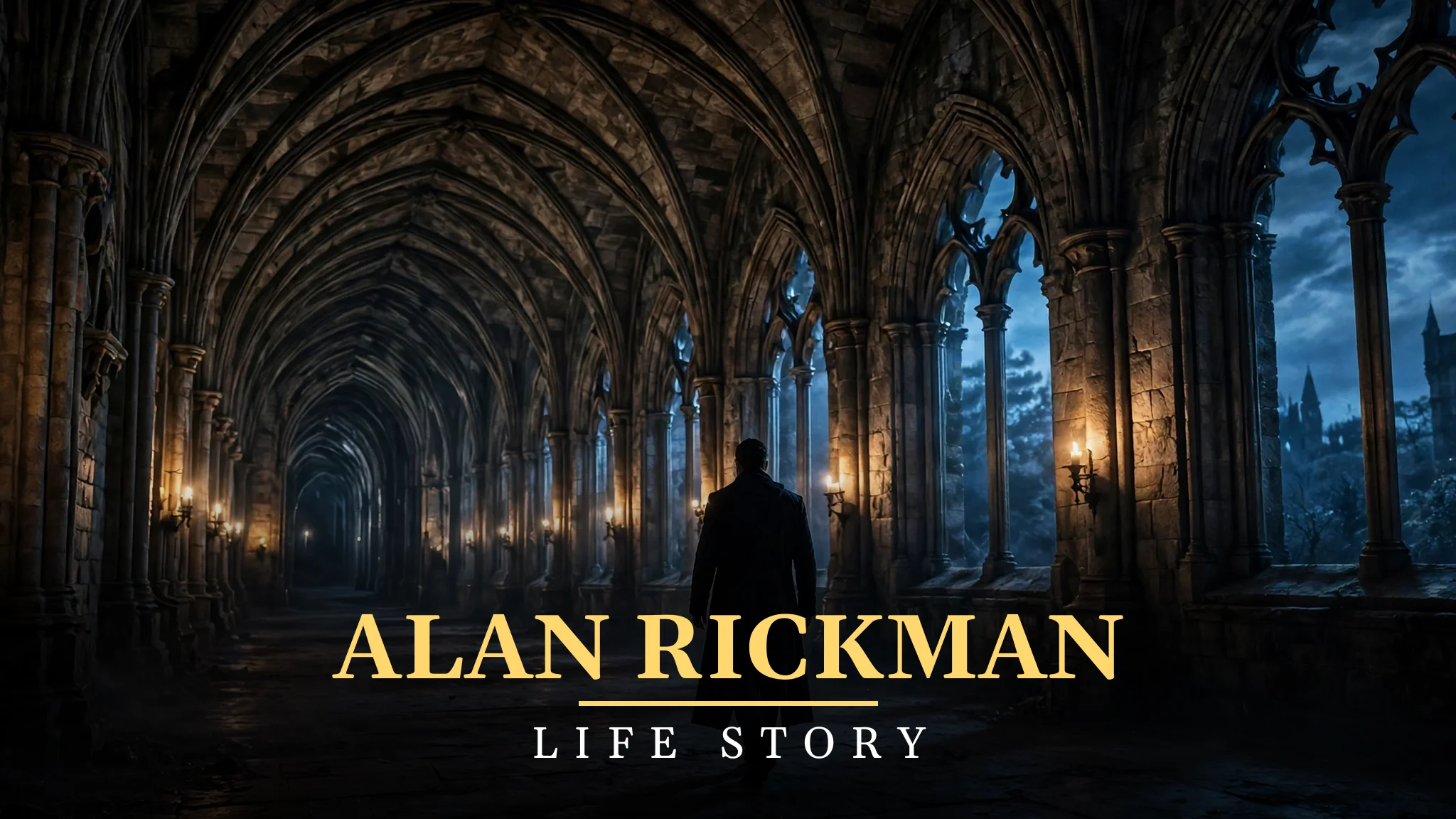
Finally, I think about the image of him walking through a dark cloister, in a long coat, with candles burning around him. It is a fitting image for a man who played Snape, and for a man who understood darkness and light. He knew that people are not simple, and that even the coldest person can have a warm heart. That is a truth worth remembering, and it is one that Rickman’s life and work teach us well.
I also think about how his voice will be heard by new audiences for many years, in films that children will watch with their parents. That is a wonderful kind of immortality, and it is one that few actors achieve. His voice will live on, and with it, the characters he loved and the stories he told.
Frequently Asked Questions
Why was Alan Rickman’s voice so famous?
His voice was slow, deep and careful, and it made every line he spoke feel important, whether he was playing Snape, Hans Gruber, or Colonel Brandon.
How did Alan Rickman become Snape in Harry Potter?
He was cast in 2001 for the first film, and he played Snape in all eight films, knowing from the start the secret of Snape’s love for Lily Potter.
What was Alan Rickman’s first film role?
His first film was Die Hard in 1988, when he was forty-two, playing Hans Gruber, one of the most famous villains in cinema history.
Did Alan Rickman train as an actor when he was young?
No, he first trained as a graphic designer and worked in that trade, then went to RADA in his mid-twenties to study acting.
What award did Alan Rickman win for Robin Hood: Prince of Thieves?
He won the BAFTA Award for Best Supporting Actor for playing the Sheriff of Nottingham in the 1991 film.
Who was Alan Rickman married to?
He was married to Rima Horton, his partner since he was nineteen, and they married in 2012 after nearly fifty years together.
When did Alan Rickman die?
He died on 14 January 2016 at the age of sixty-nine from pancreatic cancer, an illness he had kept private from the public.


