Alcione: The Life Story Behind Brazil's Samba Queen
In this post
- A Musical Family in São Luís
- Rio de Janeiro and the Long Wait
- Não Deixe o Samba Morrer and the Queen’s Crown
- A Loba, Meu Ébano, and a Voice That Never Ages
- The Hard Years and the Strength to Continue
- Fifty Years of Samba and the Legacy of Marrom
- The Voice and the Sound of Marrom
- Duets, Tributes, and the Respect of Other Artists
- The Queen’s Later Years and the Celebration of Fifty Years
- Alcione and the Culture of Maranhão
- The Romantic Singer and the Songs of Love
- Alcione and the Samba Schools of Rio
- My Take:
Alcione is called the Queen of Samba, and the title fits her. For fifty years she has been the voice that keeps samba alive in Brazil, singing with a deep, warm voice that sounds like it comes from the earth itself. Her nickname is Marrom, which means “brown”, a name given to her because of her skin and her warmth, and Brazilians use it with love. When Alcione sings, people do not just listen. They feel the history of samba, of the streets, of the festivals, and of the people who made this music.
She comes from São Luís, the capital of Maranhão, a state in the north-east of Brazil with a rich musical culture of its own. She grew up in a family of musicians, and she learned to sing before she learned to do almost anything else. Her journey took her from a small band in Maranhão to the biggest stages in Rio de Janeiro, and she has never stopped working since.
Her story is a story of work, of patience, and of a voice that refused to be forgotten. She has recorded dozens of albums, she has won a Latin Grammy, and she has become one of the most loved singers in Brazil. She is also a woman who has lived her life on her own terms, speaking her mind and singing what she believes. This is her story.
A Musical Family in São Luís
Alcione Dias Nazareth was born on 20 November 1947 in São Luís, the capital of Maranhão. Her family was musical: her father was a musician and the leader of a band, and her mother sang as well. Alcione grew up surrounded by instruments, rehearsals, and the sound of samba and the music of Maranhão. She began singing in her father’s band when she was only thirteen years old, playing at parties and local events. It was not a hobby. It was her life, and she learned her craft the hard way, by performing in front of real people night after night.
São Luís is a city with a strong Afro-Brazilian culture, and its music is rich and varied. Alcione absorbed all of it: samba, the rhythms of Maranhão, and the popular songs of the time. She also learned the discipline of a working musician. In a family band, there is no room for laziness. You rehearse, you play, you travel, and you do it again the next day. That discipline stayed with her for her whole career, and it is one of the reasons she has lasted so long.
As a young woman, she knew that São Luís was too small for her dreams. She wanted to sing for the whole of Brazil, and that meant going to Rio de Janeiro, the centre of the music business. It was a big step, and it meant leaving her family and her home. But she had the voice, she had the training, and she had the courage. In 1967, she moved to Rio, and her long journey to the top began.
Rio de Janeiro and the Long Wait
Moving to Rio was not easy. Alcione arrived in a city full of talented singers, and she had to find her place. She sang in bars, she worked as a backing singer, and she took whatever jobs she could find. She was a strong singer, but the music business is slow, and it took years before she got her chance. She did not give up. She kept singing, she kept improving, and she kept believing that her time would come.
Her first big break came in the early 1970s, when she began to record and to appear on television. People noticed her voice: deep, warm, and full of feeling. It was a voice made for samba, a voice that could carry both joy and sadness. In 1975, she released her first album, A Voz do Samba, which means “The Voice of Samba”. The title was a promise, and she spent the next fifty years keeping it. The album was well received, and it gave her a foothold in the world of Brazilian music.
The late 1970s were a time of growth. She recorded more albums, she toured, and she built a reputation as a singer who could be trusted to deliver a great performance every time. She was not an overnight star. She was a worker, and her career grew slowly and steadily, like a tree. That slow growth made her strong, because by the time she became famous, she knew exactly who she was and what she wanted to sing.
Não Deixe o Samba Morrer and the Queen’s Crown
In the late 1970s, Alcione recorded the song that would define her career: “Não Deixe o Samba Morrer”, which means “Do Not Let Samba Die”. The song, written by Edson Gomes and Aloísio Silva, became an anthem for samba itself. It said that samba is not just music, it is the soul of the Brazilian people, and it must be protected. Alcione sang it with such power and feeling that it became her signature song, and it is still the song most people think of when they hear her name.
The song’s message fitted Alcione perfectly. She was not just a singer of samba. She was a guardian of it. At a time when other styles of music were becoming popular, she kept singing samba, and she kept reminding people why it mattered. Her concerts became celebrations of samba, full of drums, dancing, and joy, and her audience loved her for it. She was crowned the Queen of Samba, not by a record company, but by the people who heard her sing.
Other hits followed. “Sufoco”, a song about the pain of love, became a favourite. “Você Me Vira a Cabeça”, “A Loba”, and “Meu Ébano” showed her range as a romantic singer, and “Gostoso Veneno” became another classic. Each song added to her reputation, and each album sold well. By the 1980s, Alcione was one of the biggest singers in Brazil, and her name was known in every corner of the country.
A Loba, Meu Ébano, and a Voice That Never Ages
Alcione’s voice has a quality that is hard to describe. It is deep, it is warm, and it is full of life. When she sings a romantic song like “A Loba”, which means “The She-Wolf”, she sounds strong and free, like a woman who knows what she wants. When she sings “Meu Ébano”, a tender song about a loved one, she sounds soft and gentle. That range is rare, and it is one of the reasons her fans stay loyal. She can sing about many kinds of love, and she makes each one feel real.
Her albums number more than forty, a remarkable achievement that shows how hard she has worked. She has recorded samba, romantic songs, and tributes to other great singers, and she has done it all with the same high standard. She has also performed with many of Brazil’s greatest artists, and she is respected by musicians across the country. Her work has been recognised with awards, including a Latin Grammy in 2003 for Best Samba/Pagode Album, an honour that confirmed what her fans already knew: she is one of the greats.
She has also been a strong and outspoken woman. Alcione has never been afraid to speak her mind, about music, about life, or about the treatment of Black artists in Brazil. She has spoken about racism and about the need for respect, and she has done it with the same directness she brings to her singing. That honesty has made her a role model for many people, especially for Black women in Brazil who see in her a woman who succeeded on her own terms.
The Hard Years and the Strength to Continue
A career of fifty years is never easy, and Alcione has faced her share of hard times. The music business changes, and singers who were once at the top can find themselves forgotten. Alcione never let that happen, because she never stopped working. She toured, she recorded, and she kept her connection with her audience. She understood that a singer’s career is like a garden: it must be tended every day, or it will fade.
She has also faced health problems and the natural challenges of age. Singing at her level takes great physical strength, and keeping a voice strong for fifty years is a remarkable achievement. She has taken care of herself, she has rested when she needed to, and she has kept performing with the same power. Her fans have watched her grow older with grace, and they have loved her more for it. She is not a singer who hides her age. She celebrates it, and she shows that a woman can be strong and beautiful at every stage of life.
There have also been moments of loss and sadness, as there are in any long life. Friends and fellow musicians have passed away, and the world of samba has changed. Alcione has mourned those losses, and she has honoured the people she lost by keeping their music alive. Her concerts are full of tributes to the great sambistas of the past, and she makes sure that young people hear their names and their songs. That work of memory is part of her gift to Brazil.
Fifty Years of Samba and the Legacy of Marrom
Today, Alcione is still performing, still recording, and still filling concert halls. She has celebrated fifty years of her career with special shows, and her fans have celebrated with her. She is a living legend, a singer who has become part of the history of Brazilian music. Her voice is still strong, her stage presence is still magnetic, and her love for samba is still clear in every note she sings.
Her legacy is large. She kept samba alive at a time when it could have faded, and she brought it to new generations. She showed that a woman from Maranhão could become the Queen of Samba, and she did it with hard work and a great voice. She also showed that a singer can be both a star and a guardian of tradition, both popular and serious, both joyful and deep. That balance is rare, and it is why she is loved.
For the people of São Luís and Maranhão, Alcione is a source of pride. She is their daughter, and she has carried their name to the whole world. For the people of Brazil, she is Marrom, the Queen, the voice that says: do not let samba die. As long as she sings, and as long as people sing her songs, samba will not die. That is her promise, and she has kept it for fifty years.
The Voice and the Sound of Marrom
Alcione’s voice is one of the most recognisable in Brazil. It is deep, warm, and full of life, with a richness that makes every song feel important. She sings with a power that comes from her chest, and her voice carries both joy and sadness at the same time. When she sings a romantic song, you believe her. When she sings a samba, you feel the rhythm in your body. That is a rare gift, and it is one that she has worked on for fifty years.
Her sound is also shaped by her home. São Luís has a musical culture that is different from Rio, with its own rhythms and its own way of singing. Alcione absorbed that culture as a girl, and she carries it in her voice. She also learned from the great sambistas of Rio, and she mixed those influences into a sound that is entirely her own. Her voice is a bridge between the north-east and the south, between Maranhão and Rio, and it is a bridge that millions of people have crossed.
She has also been a careful artist, choosing songs that fit her voice and her spirit. She does not record everything. She waits for the right song, and she sings it with care. That patience is part of her craft. A singer who records too much can lose the quality of her work. Alcione has kept her standards high, and her catalogue is full of songs that have lasted because they were chosen well and sung with love.
Duets, Tributes, and the Respect of Other Artists
Alcione has performed with many of Brazil’s greatest artists, and she is respected by musicians across the country. She has sung duets, she has recorded tributes to other singers, and she has been part of concerts that brought together the best voices in Brazilian music. Other artists seek her out, because they know that singing with Alcione is an honour, and because they know that her voice will make any song better.
She has also paid tribute to the great sambistas of the past, recording their songs and keeping their memory alive. That work of tribute is important, because samba is a tradition, and traditions live only if someone keeps singing them. Alcione has been one of the great keepers of samba, and her tributes have introduced young listeners to the masters who came before her. She is a bridge between generations, and that bridge is one of her greatest gifts.
Her work with other artists has also shown her generosity. She does not try to dominate a duet. She sings her part, she listens, and she lets the other singer shine. That generosity comes from confidence. A singer who is sure of her own voice does not need to overpower others. She can share the stage, and the music will be better for it. Alcione has shared the stage for fifty years, and her fans love her for it.
The Queen’s Later Years and the Celebration of Fifty Years
In recent years, Alcione has celebrated fifty years of her career with special concerts and recordings, and her fans have celebrated with her. She has performed across Brazil, singing the songs that made her famous and new songs that show her gift is still strong. Her voice remains powerful, her stage presence remains magnetic, and her love for samba remains clear in every note she sings.
She has also been honoured many times, and she is recognised as a living legend, a singer who has become part of the history of Brazilian music. Her fiftieth anniversary was a moment of national celebration, and it showed how much Brazil loves her. She is not only a singer. She is a national treasure, a woman whose voice has been part of the country’s life for half a century.
She continues to work, to record, and to perform, and she shows no sign of stopping. Her later years are a celebration of a life well lived, a career well built, and a voice well cared for. She is a model for young singers, showing that a career can last, that a voice can stay strong, and that samba can be sung with joy at every age.
Alcione and the Culture of Maranhão
Alcione’s music carries the culture of Maranhão, a state with a rich Afro-Brazilian heritage that is different from the samba of Rio. São Luís is known for its tambor de crioula, its bumba meu boi, and its own rhythms, and Alcione absorbed all of them as a girl. She grew up in a world where music was not only entertainment but a part of community life, of festivals, and of faith. That upbringing gave her a deep understanding of what music means to people, and it shaped her voice and her art.
She has spoken about Maranhão with pride throughout her career, and she has used her fame to bring attention to her home state. For many Brazilians, Alcione is the first person they think of when they hear the name Maranhão, and that is a great honour. She has carried her state’s culture to the whole country, and she has done it with the same warmth and strength that she brings to her singing. Her success is a source of pride for the people of São Luís, and it is a reminder that great art can come from anywhere.
The Romantic Singer and the Songs of Love
Alcione is known as the Queen of Samba, but she is also one of Brazil’s great romantic singers. Her songs about love are among the most loved in the country, and they show a different side of her art. “A Loba” is a song about a strong, free woman who knows what she wants, and it became an anthem for women who refuse to be small. “Meu Ébano” is a tender song about a loved one, sung with a softness that shows Alcione’s range. “Você Me Vira a Cabeça” is a song about the confusion of love, and it is sung with a warmth that makes listeners feel understood.
Those romantic songs are important because they show that Alcione is not only a singer of samba. She is a singer of life, of love, and of the many feelings that make us human. Her voice can carry both joy and sadness, both strength and tenderness, and that range is rare. It is one of the reasons her fans stay loyal: they know that whatever they are feeling, Alcione has a song for it, and she will sing it with honesty and with heart.
Alcione and the Samba Schools of Rio
Alcione has always been close to the samba schools of Rio de Janeiro, the great community institutions that keep samba alive. She has performed for the schools, she has sung their songs, and she has been a beloved figure in their world. The schools are not only about Carnival. They are places where people gather, learn, and celebrate their neighbourhoods, and Alcione’s voice has become part of that celebration. Her connection to the schools shows her respect for the tradition of samba, and her belief that the music belongs to the people who make it, not only to the stars who sing it.
Her work with the schools has also kept her close to the roots of samba. She sings the old songs, she honours the old masters, and she makes sure that young people hear them. That work of memory is important, because a tradition lives only if someone keeps singing it. Alcione has been one of the great keepers of samba, and her voice has carried the tradition from one generation to the next, with strength and with love, for fifty years.
My Take:
When I think about Alcione, I think about a voice that sounds like home. Her voice is deep and warm, and it feels like it comes from the ground, from the earth of Maranhão and the streets of Rio. It is not a light voice. It is a heavy, rich voice, and it carries feeling in every note. I think that is why people love her so much. When Alcione sings about love, you believe her. When she sings about samba, you feel it in your body. That is a rare gift, and it cannot be learned. It is something you are born with, and then you work on it for fifty years.
What I admire most is her patience. She moved to Rio in 1967, and her first album came in 1975. That is eight years of waiting, of singing in bars, of working as a backing singer, of being patient. Many people would have given up. Alcione did not. She kept going, and when her chance came, she was ready. That patience is a lesson for anyone who wants to build something real. Success does not always come fast, and the people who wait and work are often the ones who last the longest.
I also admire her loyalty to samba. At a time when other music was more fashionable, she kept singing samba. She sang “Não Deixe o Samba Morrer”, and she lived that message. She did not just sing the words. She made them true by her life. She kept samba alive, she taught young people about it, and she made sure it was not forgotten. That is not just a career. That is a mission, and I respect it very much.
There is something else I like about Alcione, and it is her strength as a woman. She has spoken openly about racism and about the need for respect, and she has done it without fear. In a world where Black women are often told to be quiet, Alcione has been loud, and she has been proud. She is a role model, not only for singers, but for anyone who has been told that they do not belong. She belongs, and she knows it, and she has made the whole country know it too.
I feel a little sadness when I think about the years she spent waiting in Rio, singing in bars while others became famous. Those years must have been hard, and they must have tested her belief in herself. But I also feel glad, because those years made her strong. A singer who has waited eight years for a chance does not waste it when it comes. Alcione did not waste hers. She took it and built a career that has lasted half a century.
For a reader, I think the lesson of Alcione is simple: know what you love, and do not let it go. She loved samba, and she held on to it through every change in fashion. Work hard, be patient, and trust that your time will come. Take care of your gift, because a voice, like any gift, needs care to last. And speak up for what you believe in, because a singer’s voice is not only for songs. It is also for truth.
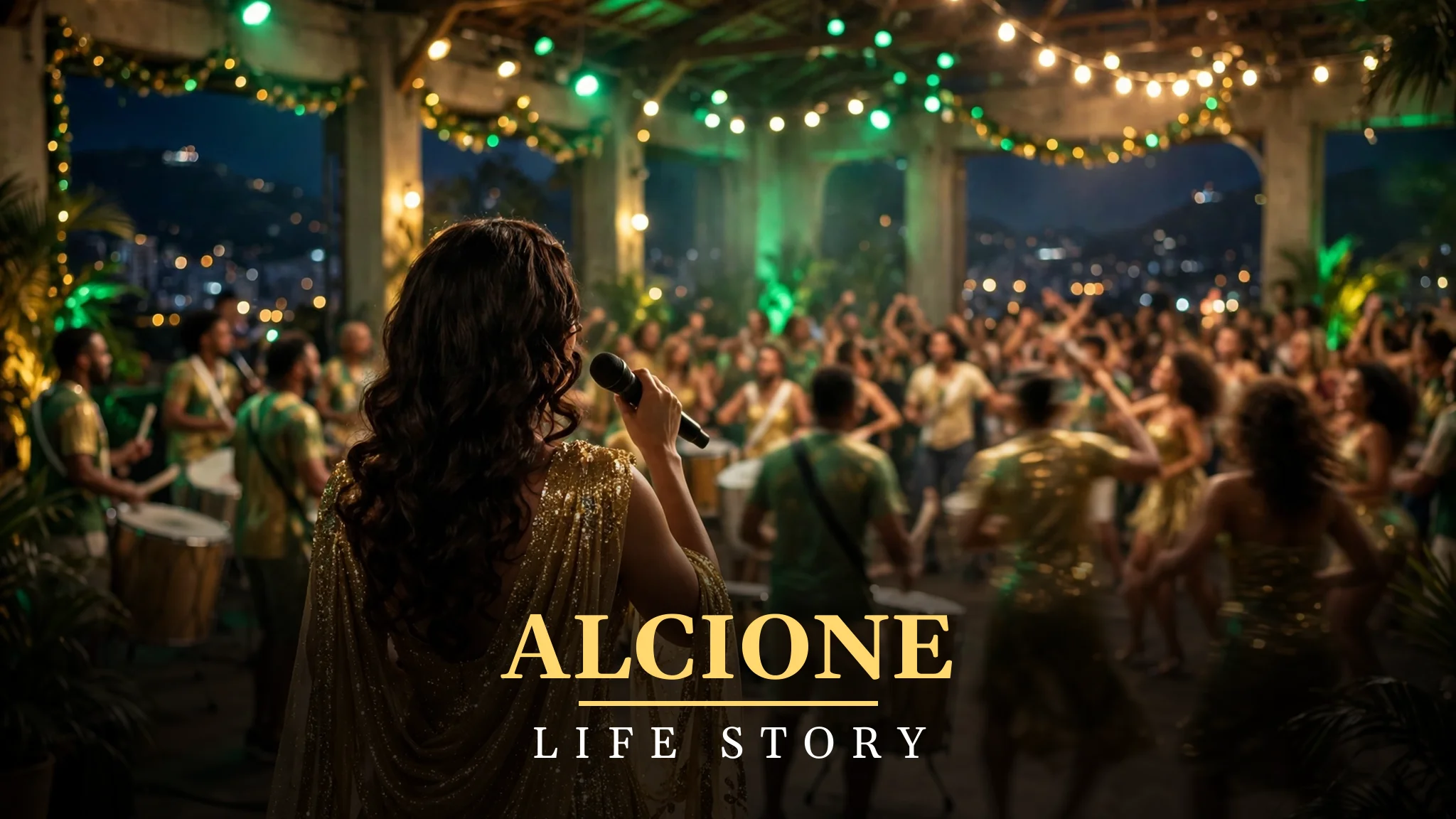
I will end with the image that stays with me: Alcione on stage, in a gold dress, singing “Não Deixe o Samba Morrer”, and the whole crowd singing with her. That is not just a concert. It is a promise, made by thousands of people at once, that samba will live. Alcione made that promise possible, and that is why she is the Queen.
I also think about her voice as a craft, and how much work it takes to keep a voice strong for fifty years. A voice is a living thing, and it needs care, rest, and respect. Alcione has given her voice that care, and it has repaid her with a career that has lasted half a century. That is a lesson for any singer: take care of your gift, because it is the foundation of everything you do.
I think about her work with other artists, and the generosity it shows. She has sung with the greatest voices in Brazil, and she has always shared the stage with grace. That generosity comes from confidence. A singer who is sure of her voice does not need to overpower others. She can listen, she can share, and the music will be better for it. Alcione has done that for fifty years, and her fans love her for it.
I also reflect on her role as a bridge between generations. She has kept the songs of the old sambistas alive, and she has introduced them to young listeners. That work matters, because traditions live only if someone keeps singing them. Alcione has been one of the great keepers of samba, and because of her, young people know the names and the songs of the masters who came before. That is a gift to Brazil, and it is a gift that will last.
There is a lesson here about patience and about the value of waiting. Alcione waited eight years in Rio before her first album, singing in bars and working as a backing singer. Many people would have given up. She did not. She kept going, and when her chance came, she was ready. That patience is a lesson for anyone who wants to build something real. Good work takes time, and the people who are willing to wait are often the ones who last the longest.
I feel sadness when I think about the years she spent waiting, singing in bars while others became famous. Those years must have been hard, and they must have tested her belief in herself. But I also feel glad, because those years made her strong. A singer who has waited eight years for a chance does not waste it when it comes. Alcione did not waste hers. She took it and built a career that has lasted half a century.
For a young singer reading this, I would say: learn from Alcione’s discipline and her loyalty. Take care of your voice, choose your songs well, and do not let go of the music you love. She loved samba, and she held on to it through every change in fashion. That loyalty is a form of courage, and it is one of the reasons her career has lasted so long. If your work is honest and beautiful, people will find it, and they will keep it.
I also think about her strength as a woman, and how she has spoken about racism and respect. In a world where Black women are often told to be quiet, Alcione has been loud, and she has been proud. She is a role model, not only for singers, but for anyone who has been told that they do not belong. She belongs, and she knows it, and she has made the whole country know it too. That is a powerful thing, and it is a lesson for all of us.
When I imagine her concerts, I see a woman in a gold dress, singing “Não Deixe o Samba Morrer”, and a whole crowd singing with her. That is not just a concert. It is a promise, made by thousands of people at once, that samba will live. Alcione made that promise possible, and that is why she is the Queen. Her voice is not only a sound. It is a vow, and it has been kept for fifty years.
I think about the fiftieth anniversary of her career, and what it means. Fifty years is a very long time to do one thing well, and very few artists manage it. Alcione has managed it by working hard, by taking care of her voice, and by never losing her love for samba. That is a model for any artist, and it is a reminder that a career is not built in a day. It is built in fifty years of days, one show at a time.
I also take a lesson about joy from her story. Her concerts are celebrations, full of drums, dancing, and happiness. That joy is not an accident. It is a choice, made every night, to bring happiness to people. In a world that is often sad, a singer who brings joy is a gift. Alcione has brought joy to Brazil for fifty years, and that is a legacy worth celebrating.
Finally, I want to say that Alcione reminds me why samba matters. Samba is not only music. It is history, it is community, and it is the soul of Brazil. Alcione has kept that soul alive, and she has done it with a voice that is deep, warm, and full of life. As long as she sings, and as long as people sing her songs, samba will not die. That is her promise, and she has kept it. That is why she is the Queen, and why her story will be told for a long time.
I will close with a simple feeling. When I hear Alcione sing, I hear a woman who has lived, loved, and worked for fifty years, and who still has more to give. That is a beautiful thing, and it is a reminder that a life well lived is a life of work, of love, and of song. Alcione has lived that life, and Brazil is richer for it.
I also think about Maranhão, and how much Alcione has done for it. She carries the culture of her home state to the whole country, and she does it with pride. For many Brazilians, she is the face of Maranhão, and that is a great honour. It shows that a singer can be an ambassador for her home, and that her success can bring attention to a place that is often ignored. That is a powerful thing, and it is a lesson for any artist who comes from a small place: your home is not a limitation. It is a gift.
I think about her romantic songs, and how they show a different side of her art. She is known as the Queen of Samba, but she is also a great singer of love, and her songs about love are among the most loved in Brazil. “A Loba” is a song about a strong woman, and it became an anthem for women who refuse to be small. That is a powerful message, and it is one that Alcione sings with a strength that inspires her listeners. A singer who can sing about both samba and love, with the same power, is a rare artist.
There is a lesson here about range. Many singers are good at one thing, and they stay with it. Alcione is good at many things: samba, romance, protest, and celebration. That range is the result of a long career, of listening, and of learning. It is a reminder that an artist should not be afraid to try new things, and that a voice that can carry many feelings is a voice that will last.
I also reflect on her patience, and how it shaped her career. She waited eight years in Rio before her first album, and she did not give up. Her patience holds a lesson for anyone hoping to build something that lasts. Good work takes time, and the people who are willing to wait are often the ones who last the longest. Alcione waited, and she built a career that has lasted half a century.
For a young singer from the north-east, I would say: learn from Alcione’s loyalty. She loved samba, she loved Maranhão, and she held on to both through every change in fashion. That loyalty is a form of courage, and it is one of the reasons her career has lasted so long. If your work is honest and beautiful, people will find it, and they will keep it.
Finally, I want to say that Alcione reminds me why a voice matters. Her voice is deep, warm, and full of life, and it carries the history of samba, the culture of Maranhão, and the feelings of millions of people. While her voice sounds and her songs are sung by others, samba will keep living. That is her promise, and she has kept it for fifty years. That is a legacy worth celebrating.
Frequently Asked Questions
Why is Alcione called the Queen of Samba?
Alcione is called the Queen of Samba because she has spent fifty years singing and protecting samba music in Brazil. Her powerful voice, her many albums, and her signature song “Não Deixe o Samba Morrer” made her the most loved female samba singer in the country.
Where was Alcione born?
Alcione was born on 20 November 1947 in São Luís, the capital of Maranhão in north-eastern Brazil. She grew up in a musical family, singing in her father’s band from the age of thirteen before moving to Rio de Janeiro in 1967.
What is Alcione’s most famous song?
“Não Deixe o Samba Morrer” is her most famous song, an anthem that asks Brazilians not to let samba die. Other beloved songs include “Sufoco”, “A Loba”, “Meu Ébano”, “Você Me Vira a Cabeça”, and “Gostoso Veneno”.
How many albums has Alcione recorded?
Alcione has recorded more than forty albums across a career of fifty years, covering samba, romantic songs, and tributes to other great singers. Her work earned her a Latin Grammy in 2003 for Best Samba/Pagode Album.
What does the nickname Marrom mean?
Marrom means “brown” in Portuguese, and it is Alcione’s affectionate nickname in Brazil. It refers to her warm brown skin and her warm personality, and Brazilians use it with great love and respect.
Is Alcione still singing today?
Yes, Alcione is still performing and recording, and she has celebrated fifty years of her career with special concerts. Her voice remains strong, and she continues to fill concert halls across Brazil.


