Alfonso Cuarón: The Life Story Behind the Oscar Director
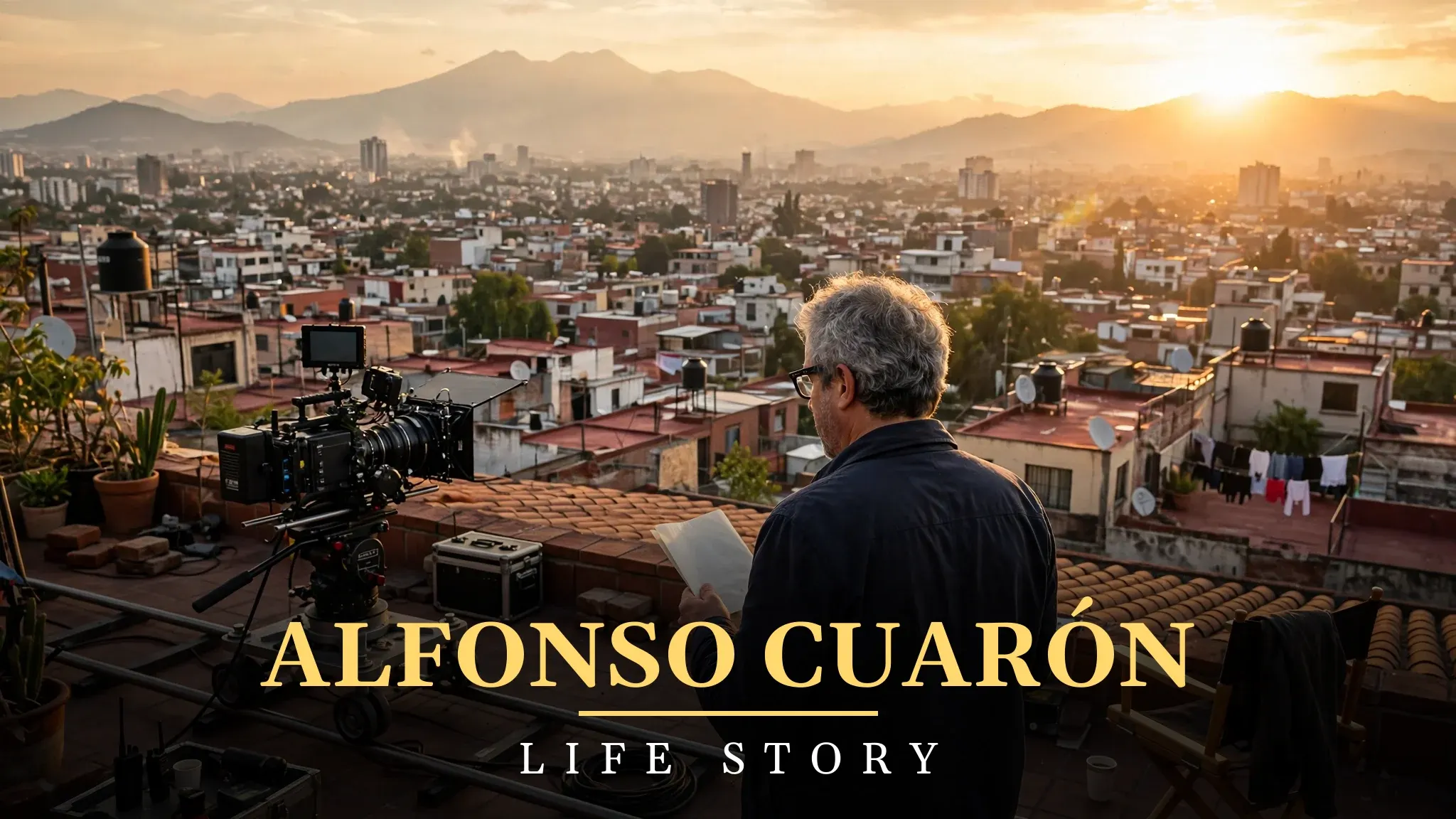
In this post
A Mexico City Boy Who Loved Cinema
Alfonso Cuarón was born in Mexico City on 28 November 1961, to Alfredo Cuarón, a doctor who worked for the United Nations, and Cristina Orozco, and he grew up in a household where education, culture and curiosity were valued, and where the cinema was not a distant dream but a part of everyday life, because Mexico City in the 1960s and 1970s was a city with a rich film culture, with cinemas, film clubs and a tradition of Mexican cinema that went back decades. Alfonso was drawn to film from a young age, not only as a viewer but as a maker, because he began experimenting with cameras as a teenager, filming his friends, his family and the streets of Mexico City, and learning, through trial and error, how a shot was composed, how a scene was cut and how a story was told in images. He studied philosophy at the National Autonomous University of Mexico, known as UNAM, because he was interested in ideas, in how people think and why they act as they do, and that philosophical training, which taught him to ask questions rather than to accept answers, stayed with him throughout his career as a filmmaker, because his films are not only stories but questions, about love, about loss, about power and about what it means to be human. He then studied film at the Centro Universitario de Estudios Cinematográficos, known as CUEC, the film school of UNAM, where he met other young filmmakers who would become his collaborators and friends, including Emmanuel Lubezki, who would become one of the greatest cinematographers in the world, and Carlos Cuarón, his younger brother, who would become a filmmaker in his own right. At CUEC, Alfonso learned the technical side of filmmaking, cinematography, editing, sound and direction, yet he also learned something more important, which is how to think about a film as a whole, as a work of art that must be both personal and universal, and that lesson, which he learned in Mexico City in the early 1980s, has shaped every film he has made since.
After film school, Alfonso began working in Mexican television, directing episodes of telenovelas and other programmes, which was a practical education, because Mexican television in the 1980s demanded speed, efficiency and professionalism, and a young director who could deliver a good episode on time and on budget was a director who would be hired again. He also worked as an assistant director on films, learning how a feature film set worked, how a director communicated with actors, with the crew and with the producers, and those early jobs, though they were not glamorous, taught him the discipline of filmmaking, which is the ability to make decisions quickly, to solve problems creatively and to keep a production moving, even when things go wrong, which they always do. His first feature film as a director was Sólo con tu pareja, released in 1991, a comedy about a man who believes he has AIDS and who must confront his promiscuous past, and the film was a critical success in Mexico, praised for its humour, its energy and its fresh approach to a serious subject, and it showed that Alfonso could direct a feature film, not only a television episode, and that his voice, which was witty, humane and visually inventive, was one that audiences and critics wanted to hear. Sólo con tu pareja was also a commercial success in Mexico, and it brought Alfonso to the attention of producers in the United States, who saw in him a director who could make a film that was both entertaining and intelligent, which is a rare combination, and who invited him to Hollywood, where the next chapter of his career would begin, in a very different kind of film, for a very different audience, yet with the same director at its centre.
The Hollywood chapter began with A Little Princess, released in 1995, a film adaptation of Frances Hodgson Burnett’s classic children’s novel, about a young girl, Sara Crewe, who is sent to a boarding school in New York and who must endure cruelty with imagination and kindness, and the film was a departure for Alfonso, because it was a children’s film, made for a family audience, in English, with a Hollywood studio behind it, yet he brought to it the same visual imagination, the same attention to detail and the same emotional honesty that had marked Sólo con tu pareja. A Little Princess was praised by critics for its beauty, its performances and its direction, and though it was not a commercial success, it showed that Alfonso could work in Hollywood, could direct in English, and could make a film that was both personal and universal, which is a test that many foreign directors fail, because they either lose their identity in Hollywood or refuse to adapt to it, while Alfonso did neither, keeping his voice while learning the language of American cinema. He followed A Little Princess with Great Expectations in 1998, a modern adaptation of Charles Dickens’s novel, starring Ethan Hawke, Gwyneth Paltrow and Robert De Niro, and the film, though it received mixed reviews, was a significant step, because it was a larger production, with bigger stars and a bigger budget, and it taught Alfonso how to work with movie stars, how to handle a studio, and how to make a film that was both a literary adaptation and a contemporary romance, which are skills that would serve him well in the films that followed, when he returned to Mexico to make the film that would define his early career.
Y Tu Mamá También and the Return to Mexico
In 2001 Alfonso returned to Mexico to make Y tu mamá también, a film that would become one of the most important Mexican films ever made, and one of the most influential road movies in world cinema. The film told the story of two teenage boys, Julio and Tenoch, played by Gael García Bernal and Diego Luna, who go on a road trip to a beach with an older woman, Luisa, played by Maribel Verdú, and the journey, which begins as a lark, becomes a story about friendship, about sex, about class, about Mexico itself, and about the end of youth, because the boys, who think they are going to the beach, are actually going to adulthood, and the film does not flinch from showing what that means. Y tu mamá también was shot with a handheld camera, with long takes, with natural light and with a voiceover that commented on the social and political realities of Mexico, from poverty to corruption to the lives of ordinary people, and the style, which was both intimate and expansive, was unlike anything in Mexican cinema at the time, because it mixed the personal and the political in a way that felt effortless, as if the camera were simply following life as it happened. The film was a critical and commercial success around the world, it was nominated for an Academy Award for Best Original Screenplay, and it made Gael García Bernal and Diego Luna into international stars, while it made Alfonso Cuarón into a director whose name was known to cinephiles everywhere, because the film proved that a Mexican film, in Spanish, about teenagers, could be a work of art that spoke to audiences in every country, which is a rare achievement, and one that Alfonso had achieved by returning home, to the streets, the beaches and the people he knew best.
After Y tu mamá también, Alfonso was invited to direct a film that seemed, on the surface, to be the opposite of a small Mexican road movie, yet that would become one of the most beloved films in a beloved franchise, Harry Potter and the Prisoner of Azkaban, released in 2004, the third film in the Harry Potter series, based on J.K. Rowling’s novels. The producers chose Alfonso because they wanted a director who could bring a darker, more mature tone to the series, as the young actors, Daniel Radcliffe, Rupert Grint and Emma Watson, were growing up, and the stories were becoming more serious, and Alfonso, who had shown in Y tu mamá también that he understood adolescence, was the right person to guide them through that transition. Prisoner of Azkaban is widely regarded as the best film in the Harry Potter series, praised for its visual inventiveness, its performances and its direction, and Alfonso’s contributions, including the use of long takes, the design of the Hogwarts sets, the introduction of the Dementors and the time-turner sequence, which showed the same events from two perspectives, are still discussed by fans and critics, because they showed a director who was not only adapting a book but making cinema, with a camera that moved, with images that told the story, and with a respect for the audience’s intelligence. The film was a huge commercial success, and it proved that Alfonso could direct a blockbuster, could work with a large cast, a large budget and a beloved franchise, and could do it without losing his identity, which is a test that many directors fail, because the franchise can swallow the director, while Alfonso swallowed the franchise, and made it his own, which is why Prisoner of Azkaban remains, more than twenty years later, the Harry Potter film that film lovers return to most often.
In 2006 Alfonso made Children of Men, a science fiction film based on P.D. James’s novel, set in a near-future London in which humanity has become infertile and society is collapsing, and the film told the story of Theo Faron, played by Clive Owen, a former activist who must protect Kee, played by Clare-Hope Ashitey, the first pregnant woman in eighteen years, and escort her to safety. Children of Men was a technical and artistic triumph, praised for its long takes, including a famous single shot that follows a car ambush and a battle scene, for its cinematography by Emmanuel Lubezki, and for its vision of a future that felt terrifyingly plausible, because the film’s London, with its refugees, its fences and its fear, looked like a world that could exist, and the audience recognised it, which is why the film has grown in reputation since its release, and is now regarded as one of the greatest science fiction films ever made. The film was nominated for three Academy Awards, including Best Adapted Screenplay, and though it was not a commercial success on its release, it has become a classic, studied in film schools, discussed by critics, and watched by audiences who discover it every year, because its themes, infertility, immigration, hope and despair, are more relevant now than they were in 2006, which is a sign of a film that was ahead of its time. Children of Men also showed Alfonso’s mastery of the long take, a technique in which the camera moves without cutting for several minutes, which requires extraordinary planning, rehearsal and coordination, and which Alfonso and Lubezki used to immerse the audience in the world of the film, making them feel as if they were there, in the car, in the battle, in the danger, which is a form of cinema that few directors can achieve, and that Alfonso has made his signature.
Gravity, Roma and the Academy Awards
In 2013 Alfonso made Gravity, a science fiction thriller starring Sandra Bullock as Dr. Ryan Stone, an astronaut who is stranded in space after her shuttle is destroyed, and George Clooney as Matt Kowalski, a veteran astronaut who helps her survive, and the film was a technical marvel, because it was shot largely with computer-generated imagery, with Bullock’s face often the only real element in a frame full of digital space, and the result was a film that made audiences feel as if they were in orbit, floating, spinning and gasping for air, which is an experience that no film had created before. Gravity was a huge commercial success, earning hundreds of millions of dollars around the world, and it won seven Academy Awards, including Best Director for Alfonso, Best Cinematography for Emmanuel Lubezki, and awards for visual effects, sound and editing, which is a remarkable achievement for a film with only two actors and a story that could be told in a sentence, because the film’s power came not from its plot but from its execution, from the way Alfonso and his team used technology to tell a human story about survival, grief and rebirth. Sandra Bullock’s performance, as a woman who has lost her daughter and who must find a reason to live, was praised as one of the best of her career, and Alfonso’s direction, which kept the camera close to her face, which used long takes to create tension, and which trusted the audience to follow a story with almost no dialogue, was praised as a masterclass in filmmaking. Gravity proved that Alfonso Cuarón was not only a director of small, personal films but a director who could make a blockbuster that was also a work of art, and the Academy Award for Best Director, his first, confirmed that the film industry recognised him as one of the greatest directors working in the world, which is a status that few directors achieve, and that Alfonso had earned through twenty years of work, from Sólo con tu pareja to Gravity, one film at a time.
In 2018 Alfonso made Roma, a film that was, in many ways, the opposite of Gravity, because it was black and white, in Spanish, set in Mexico City in the early 1970s, and based on Alfonso’s own childhood, yet it became, like Gravity, a global success, winning three Academy Awards, including Best Director for Alfonso, Best Cinematography for Alfonso himself, who served as his own cinematographer, and Best Foreign Language Film, and it was nominated for Best Picture, which is a rare honour for a foreign-language film. Roma told the story of Cleo, played by Yalitza Aparicio, a domestic worker in a middle-class family in the Roma neighbourhood of Mexico City, and the film followed her life, her work, her love affair, her pregnancy and her relationship with the family she served, with a patience, a detail and a love that made the audience feel as if they were living in that house, in that neighbourhood, in that time, which is a form of cinema that few directors can achieve, because it requires not only skill but memory, and Alfonso’s memory of his own childhood, of the woman who raised him, was the film’s foundation. Roma was released by Netflix, and it was watched by millions of people around the world, which is a significant fact, because a black-and-white, Spanish-language film about a domestic worker would once have been seen only by art house audiences, yet Netflix put it in front of a global audience, and the audience responded, because the film’s story, though it was specific to Mexico, was universal, about class, about family, about love and about the women who hold families together, which is a story that every culture understands. Yalitza Aparicio, who had never acted before, was nominated for an Academy Award for Best Actress for her performance as Cleo, which is a remarkable achievement, and a testament to Alfonso’s direction, because he chose a non-actor, trusted her, and guided her to a performance that moved the world.
Alfonso’s work as a producer has also been significant, because he has supported other filmmakers, including Guillermo del Toro, whose film Pan’s Labyrinth he helped to produce, and his son Jonás Cuarón, who directed the thriller Desierto in 2015, and his brother Carlos Cuarón, who directed Rudo y Cursi in 2008, and the Cuarón family, like the del Toro family, has become a dynasty in Mexican cinema, with multiple generations of filmmakers working together, supporting each other and telling Mexican stories for a global audience. He has also been a vocal advocate for Mexican cinema, for the need to support independent filmmakers, and for the importance of telling stories in Spanish, which is a cause he has championed throughout his career, because he believes that Mexican stories deserve to be told, and that the world wants to hear them, which Roma proved, and which Y tu mamá también proved before it. As of the 2020s, Alfonso Cuarón remains one of the most respected directors in the world, and his films, from Sólo con tu pareja to Roma, are studied in film schools, discussed by critics and watched by audiences who discover them every year, because they are films that ask questions, that show the world as it is, and that trust the audience to think, which is a rare quality in modern cinema, and one that Alfonso has never abandoned, from his first film in Mexico City to his latest, wherever it may take him.
What the Career Adds Up To
Looked at as a whole, Alfonso Cuarón’s career has a shape that is easy to miss if you only remember one film, because it is the shape of a person who began as a boy in Mexico City who loved cinema, studied philosophy and film, made a comedy in Mexico, a children’s film in Hollywood, a road movie that changed Mexican cinema, a Harry Potter film, a science fiction masterpiece, a space thriller that won seven Oscars, and a black-and-white film about his childhood that won three more, and who did it all with the same curiosity, the same visual imagination and the same respect for the audience, which is why he has lasted while other directors have faded. He has won two Academy Awards for Best Director, for Gravity and for Roma, which is an achievement that few directors reach, and he has done it with films that are very different from each other, which shows a range that is rare, because most directors find one kind of film and repeat it, while Alfonso has found many kinds and mastered each of them. The through-line is not fame but curiosity, because Alfonso Cuarón has always been curious, about people, about places, about how a camera can tell a story, and that curiosity has kept him learning, which is the only way a director survives for thirty years. His story also says something useful about where filmmakers come from, because he came not from Hollywood but from Mexico City, from a film school, and from a willingness to work, and that is a story that should encourage any young person from a small place who dreams of a bigger life, because the distance between Mexico City and the Academy Awards, which once seemed impossible to cross, turns out to have been crossable all along, by a boy who loved cinema.
The Long Take and the Human Story
There is one more part of Alfonso Cuarón’s story that deserves attention, and it is the way he uses the long take, a technique in which the camera moves without cutting for several minutes, which has become his signature, and which he has used in Children of Men, in Gravity and in Roma, to immerse the audience in the world of the film. The long take is a difficult technique, because it requires the actors, the camera, the lighting and the sound to be perfectly coordinated, and a single mistake means starting over, yet Alfonso uses it not as a trick but as a way of telling a story, because a long take, when it is done well, makes the audience feel as if they are present, as if they are in the car during an ambush, in space with an astronaut, or in a house in Mexico City with a family, and that presence is the goal of all cinema, to make the audience forget they are watching a film and feel as if they are living it. His collaboration with Emmanuel Lubezki, the cinematographer who shot Y tu mamá también, Children of Men, Gravity and many other films, is one of the great partnerships in modern cinema, because the two men, who met at film school in Mexico City, share a visual language, a love of natural light, of movement and of the long take, and their films together are among the most beautiful ever made. Alfonso’s story is a reminder that cinema is not only about stories but about images, and that a director who understands images can tell a story without words, which is exactly what Alfonso does, in the opening shot of Gravity, in the beach scene of Y tu mamá también, and in the quiet moments of Roma, where the camera simply watches a woman do her work, and the watching becomes the story.
A Director Who Asks Questions
Alfonso Cuarón’s films are not only stories but questions, about love, about loss, about power, about class and about what it means to be human, and that questioning quality, which comes from his study of philosophy, is what makes his films last, because a film that answers a question is forgotten when the answer is known, while a film that asks a question is remembered, because the audience keeps asking it long after the film has ended. Y tu mamá también asked what it means to grow up, Children of Men asked what it means to hope, Gravity asked what it means to survive, and Roma asked what it means to love someone who is not your family but who is part of it, and each of those questions is one that the audience carries with them, which is why the films stay with them. He has said that he makes films to understand the world, not to explain it, and that humility, that willingness to ask rather than to tell, is a rare quality in a director, because most directors want to give answers, while Alfonso wants to ask questions, and the audience respects him for it, because they feel trusted, not lectured. His career is, in the end, a story about a boy from Mexico City who asked questions, who learned to ask them with a camera, and who became one of the greatest directors in the world by never stopping asking, one film at a time, from Sólo con tu pareja to Roma, and counting.
My Take:
When I look at Alfonso Cuarón’s career, the first thing that strikes me is the range, because he has made a Mexican comedy, a children’s film, a road movie, a Harry Potter film, a science fiction masterpiece, a space thriller and a black-and-white film about his childhood, and each of them is different, yet each of them feels like a Cuarón film, because they share a visual imagination, a respect for the audience and a curiosity about people, which is a rare combination, because most directors find one kind of film and repeat it, while Alfonso has found many kinds and mastered each of them. I think his most important decision was the decision to return to Mexico to make Y tu mamá también, because he was in Hollywood, he had made A Little Princess and Great Expectations, and he could have stayed there, making studio films, yet he went home, to the streets, the beaches and the people he knew best, and the film he made there changed Mexican cinema, because it showed that a Mexican film, in Spanish, about teenagers, could be a work of art that spoke to audiences in every country. Y tu mamá también is a film about growing up, about friendship, about sex and about class, and its style, with a handheld camera, with long takes and with a voiceover that commented on Mexico itself, was unlike anything in Mexican cinema at the time, because it mixed the personal and the political in a way that felt effortless, and that mixture, which Alfonso would return to in Roma, is the signature of his work, the belief that a personal story is also a political story, and that the two cannot be separated.
The Gravity achievement deserves a closer look, because it is easy to praise the film’s technology and to forget its humanity, yet the technology was only a means to an end, and the end was a story about a woman who has lost her daughter and who must find a reason to live, which is a human story, not a technical one. I notice that the film’s power comes from its restraint, because there are only two actors, almost no dialogue, and a story that could be told in a sentence, yet the film lasts for ninety minutes and holds the audience’s attention throughout, because Alfonso trusted the audience to follow a story told in images, in long takes, in the face of Sandra Bullock, who carries the film with a performance that is both physical and emotional, and that trust, in the audience’s intelligence, is a generous kind of filmmaking. The seven Academy Awards, including Best Director, were a recognition of that achievement, and they confirmed that Alfonso was not only a director of small, personal films but a director who could make a blockbuster that was also a work of art, which is a rare combination, because blockbusters are usually made by directors who think about the audience as consumers, while Alfonso thinks about them as people, and that difference shows in the film. I also think his collaboration with Emmanuel Lubezki deserves credit, because the two men, who met at film school in Mexico City, share a visual language, and their films together, from Y tu mamá también to Gravity, are among the most beautiful ever made, because they use natural light, movement and the long take to immerse the audience in the world of the film.
What I admire most about Alfonso Cuarón is the curiosity, because he has always been curious, about people, about places, about how a camera can tell a story, and that curiosity has kept him learning, which is the only way a director survives for thirty years. His study of philosophy at UNAM gave him a way of thinking about film as a question, not as an answer, and his films, from Y tu mamá también to Roma, ask questions that the audience keeps asking long after the film has ended, which is why they last, because a film that answers a question is forgotten, while a film that asks one is remembered. Roma is the clearest example, because it is a film about Cleo, a domestic worker, and about the family she serves, and it asks what it means to love someone who is not your family but who is part of it, what it means to be a woman in a patriarchal society, and what it means to remember a childhood, and those questions have no single answer, which is why the film stays with the audience. I also think his decision to serve as his own cinematographer on Roma matters, because it showed a director who was willing to take on a new role, to learn a new skill, and to trust his own eye, which is a bravery that few directors possess, because they prefer to delegate, while Alfonso prefers to do it himself, when the film demands it. There are limits to what he has done, and I should name them, because he has made relatively few films, and the gaps between them, sometimes five years or more, mean that his output is smaller than that of other great directors, yet the quality of each film is so high that the quantity matters less, because a director who makes one great film every five years has done more than a director who makes five mediocre films every year.
For young filmmakers, especially those from Mexico and Latin America, Alfonso Cuarón’s career is a useful map, because it shows that the way to succeed is not to imitate Hollywood but to tell your own stories, in your own language, from your own place, and to trust that the world wants to hear them, because Roma proved that a black-and-white, Spanish-language film about a domestic worker could win three Academy Awards and be watched by millions, which is a proof that would have seemed impossible before it happened. His path, from Mexico City to film school to Hollywood to Y tu mamá también to Gravity to Roma, is a path that many filmmakers have taken, and the lesson of it is that the training matters, the return home matters, and the willingness to ask questions rather than to give answers matters, because each of those steps adds a skill and a connection that the next step depends on. My honest view is that Alfonso Cuarón is one of the greatest directors working in the world today, and that his career, taken as a whole, is stronger than any single film in it, because it is the story of a boy from Mexico City who loved cinema and became one of its masters, not by chasing fame but by asking questions, one film at a time, and that is a story worth remembering. The work continues, and the next film, whatever it is, will probably be as surprising as the last one, because Alfonso Cuarón has never done the expected thing twice.
One more thing about Alfonso Cuarón deserves to be said, and it is the way he has supported other filmmakers, because he has produced films for Guillermo del Toro, for his son Jonás, and for his brother Carlos, and that generosity, which is easy to miss, is a sign of a director who understands that cinema is not a competition but a community, and that the success of one Mexican filmmaker helps all of them. I think his advocacy for Mexican cinema matters too, because he has spoken about the need to support independent filmmakers, about the importance of telling stories in Spanish, and about the danger of an industry that only values English-language blockbusters, and his voice on those issues carries weight, because he has lived the life he is talking about, as a Mexican director who succeeded in Hollywood without ceasing to be Mexican. The story of Alfonso Cuarón is, in the end, a story about a boy who asked questions, who learned to ask them with a camera, and who became one of the greatest directors in the world by never stopping asking, and that is a story worth telling, because it shows that a director can be both an artist and a citizen, both a storyteller and a questioner, and that the best films are the ones that do both.
Finally, I want to say something about Children of Men, because it is the film that many critics consider his masterpiece, and it deserves to be remembered not only as a science fiction film but as a warning, because its vision of a future London, with refugees, fences and fear, felt plausible in 2006 and feels more plausible now, which is a sign of a film that was ahead of its time. The long takes in Children of Men, particularly the car ambush and the battle scene, are among the most impressive in cinema history, because they required extraordinary planning and coordination, yet they feel effortless, as if the camera were simply following life as it happened, which is the goal of all cinema, to make the audience forget they are watching a film. My honest view is that Children of Men will be watched for many years, because its themes, hope, despair, immigration and the future of humanity, are timeless, and Alfonso’s direction, which trusted the audience to understand a complex world without explaining it, is a masterclass in filmmaking. When the history of science fiction cinema is written, Children of Men will be in it, alongside Gravity and Roma, and that is a legacy worth having, because it is a legacy built on questions, on images and on the belief that the audience is intelligent, which is the highest compliment a director can pay.
I also want to reflect on Harry Potter and the Prisoner of Azkaban, because it is the film that introduced Alfonso to a mass audience, and it is widely regarded as the best film in the Harry Potter series, which is a remarkable achievement for a director who had never made a franchise film before. The film’s darkness, its visual inventiveness and its respect for the young actors’ growth showed that Alfonso understood adolescence, because he had explored it in Y tu mamá también, and that understanding, which the previous Harry Potter directors had not fully captured, made Prisoner of Azkaban feel like a film about growing up, not only about magic. I think the time-turner sequence, in which the same events are shown from two perspectives, is a perfect example of Alfonso’s filmmaking, because it uses cinema, not dialogue, to tell a story, and it trusts the audience to follow a complex idea, which is a generosity that many blockbuster directors lack. The film’s success proved that Alfonso could direct a blockbuster without losing his identity, which is a test that many directors fail, and that success opened the door to Gravity, to Roma and to everything that followed, which is why Prisoner of Azkaban, though it is a franchise film, is also a personal film, and a key chapter in Alfonso’s career.
One last thought on Alfonso Cuarón concerns his partnership with Emmanuel Lubezki, because the two men, who met at film school, have made some of the most beautiful films in modern cinema together, and their collaboration is a reminder that filmmaking is not a solitary art but a collaborative one, and that the best films are made by people who trust each other, who share a vision, and who are willing to take risks together. Lubezki’s cinematography, with its natural light, its movement and its long takes, is the visual signature of Alfonso’s films, and without it, the films would be different, which is why the partnership matters, and why it should be celebrated, not only as a collaboration but as a friendship, between two boys from Mexico City who dreamed of making films, and who did, together, for thirty years. I believe their films will be studied in film schools for many years, because they show what is possible when a director and a cinematographer share a vision, and when they are willing to push each other to be better, which is the highest form of collaboration, and one that Alfonso and Lubezki have achieved.
Finally, I think Alfonso Cuarón’s story offers a lesson about home, because he left Mexico for Hollywood, returned to Mexico for Y tu mamá también, left again for Harry Potter and Children of Men, and returned again for Roma, and that movement, between home and the world, is the pattern of his career, because home is where his stories come from, and the world is where they are told. The films he made at home, Y tu mamá también and Roma, are his most personal, and the films he made abroad, Gravity and Children of Men, are his most ambitious, and the balance between the two, between the personal and the ambitious, is what makes his career so strong, because it shows a director who is both rooted and restless, both Mexican and universal. My honest view is that his career is a triumph of that balance, of a man who never forgot where he came from, and who never stopped going where he had not been, one film at a time, from Mexico City to the Academy Awards and back again, and that is a story worth telling, because it shows that home is not a place you leave but a place you carry with you, wherever you go.
Frequently Asked Questions
Where was Alfonso Cuarón born?
Alfonso Cuarón was born in Mexico City on 28 November 1961. He studied philosophy at UNAM and film at the Centro Universitario de Estudios Cinematográficos (CUEC).
What was Alfonso Cuarón’s first feature film?
His first feature film was Sólo con tu pareja (1991), a comedy about a man who believes he has AIDS. It was a critical and commercial success in Mexico.
What is Y tu mamá también?
Y tu mamá también (2001) is a road movie about two teenage boys, played by Gael García Bernal and Diego Luna, who travel to a beach with an older woman, played by Maribel Verdú. It was nominated for an Academy Award for Best Original Screenplay.
Which Harry Potter film did Alfonso Cuarón direct?
He directed Harry Potter and the Prisoner of Azkaban (2004), the third film in the series, which is widely regarded as the best film in the franchise.
What is Children of Men?
Children of Men (2006) is a science fiction film set in a near-future London where humanity has become infertile, starring Clive Owen. It is famous for its long takes and is regarded as one of the greatest science fiction films ever made.
How many Academy Awards did Gravity win?
Gravity (2013), starring Sandra Bullock and George Clooney, won seven Academy Awards, including Best Director for Cuarón and Best Cinematography for Emmanuel Lubezki.
What is Roma?
Roma (2018) is a black-and-white film based on Cuarón’s childhood in Mexico City, telling the story of Cleo, a domestic worker played by Yalitza Aparicio. It won three Academy Awards, including Best Director, and was nominated for Best Picture.
Who is Emmanuel Lubezki?
Emmanuel Lubezki is a cinematographer who met Cuarón at film school in Mexico City and shot Y tu mamá también, Children of Men and Gravity, among other films. He is one of the most acclaimed cinematographers in the world.


