Alla Pugacheva: The Life Story Behind Russia's Pop Queen
In this post
- A Moscow Girl With a Big Voice
- Music School and Small Stages
- Harlequin and the First Triumph
- Million Roses and the Songs Everyone Knows
- Films, Television, and the Primadonna Years
- Family, Marriages, and a Daughter Who Sings
- Leaving Russia and the Later Years
- The Christmas Meetings and a Stage of Her Own
- Songs That Never Leave the Radio
- A Voice That Crossed Borders
- My Take:
Alla Pugacheva is the voice of Russia. For more than fifty years, her songs have played in Russian homes, in cars, at weddings, and on the radio, and almost every person in Russia knows her name. She is called the Primadonna, the first lady of Russian pop music, and the title fits her. She has a powerful voice, a dramatic style, and a presence on stage that fills the largest halls. When she sings, people listen, and when she stops, people remember.
She was born in Moscow in 1949, she studied music, she worked as a singer in small bands, and then, in 1975, she won a song contest with “Harlequin”, and her life changed. After that came “Million Roses”, “Harlequin”, “Primadonna”, and dozens of other songs that became part of Russian life. She sang on television, she toured the Soviet Union and the world, she acted in films, and she became the most famous singer in the country.
Her life has also been full of drama. She has been married several times, she has a daughter who is also a famous singer, she has twins with her husband Maxim Galkin, and in 2022 she left Russia with her family, a decision that made headlines around the world. This is the story of a woman who sang for a whole country, who became its Primadonna, and who has stayed in its heart, even from far away.
A Moscow Girl With a Big Voice
Alla Borisovna Pugacheva was born on 15 April 1949 in Moscow, then the capital of the Soviet Union. Her father was a worker, and her mother was a housewife, and the family lived an ordinary Soviet life. Alla grew up in Moscow, in a time when the country was rebuilding after the war, and when music was a central part of everyday life. She sang as a child, she loved songs, and she showed a strong voice early.
As a girl, she was lively, confident, and not afraid to be noticed. She sang at school, she took part in concerts, and she dreamed of a life on stage. Her voice was powerful, even when she was young, and people who heard her knew that she had something special. She studied music, she learned the piano, and she worked hard to develop her talent. She was not a child who was pushed onto the stage by her parents. She wanted to be there herself, and she fought for her place.
She studied at a music school in Moscow, and later at the Ippolitov-Ivanov Music College, where she learned to sing, to play, and to understand music. She also worked as a singer in small bands and as a backing singer, learning how the music world works from the inside. Those early years were not glamorous. She sang in small halls, she travelled, and she waited for her chance. But she learned her craft, and she learned how to perform for a live audience.
Moscow gave her a strong foundation. It is a city of music, of theatres, and of great singers, and Alla grew up in that world. She listened to Soviet songs, to foreign songs, and to the great voices of her time, and she learned from them all. Her own voice, powerful and dramatic, was ready, and it only needed a song that would let the whole country hear it.
Music School and Small Stages
After her studies, Alla Pugacheva worked as a singer in the Soviet music system, which was very different from the music business in the West. Singers worked for state concert organisations, they toured the country, and they sang songs that were approved by the authorities. Alla sang in bands, she sang on the radio, and she took part in concerts across the Soviet Union. She was a working singer, and she learned how to sing night after night, in different halls, for different audiences.
She also worked as a music teacher for a time, and she sang in the choir. These were not famous jobs, but they taught her discipline and they kept her close to music. She did not give up, even when success was slow to come. She believed in her voice, and she believed that her time would come. That belief kept her going through the hard years, when she was singing for small audiences and waiting for a break.
In the early nineteen seventies, she began to be noticed. She sang songs that were more modern, more emotional, and more personal than the usual Soviet pop songs, and audiences liked them. She had a style that was her own: dramatic, warm, and full of feeling. She did not sing like other Soviet singers. She sang like Alla Pugacheva, and people remembered her voice after hearing it once.
She also began to work with songwriters and composers who wrote songs for her, and she began to appear on television. Television was a powerful tool in the Soviet Union, and a singer who appeared on television could become famous overnight. Alla was ready for that moment, because she had spent years learning her craft on small stages. When her chance came, she took it, and she never looked back.
Harlequin and the First Triumph
In 1975, Alla Pugacheva won the Golden Orpheus song contest in Bulgaria with the song “Harlequin”, also known as “Arlekino”. The song is dramatic and theatrical, about a clown who laughs on stage and cries in private, and it suited Alla perfectly. She sang it with power and with feeling, and she won the contest. That win made her famous in the Soviet Union and in Eastern Europe, and it was the start of her career as a star.
“Harlequin” was a turning point. Before it, Alla was a working singer. After it, she was a star, and people wanted to hear her, to see her, and to buy her records. She began to tour, to appear on television, and to record songs that became hits. Her voice, her style, and her dramatic way of performing made her different from other Soviet singers, and audiences loved her for it.
In the years that followed, she released a series of hit songs, and she became the most popular singer in the Soviet Union. She sang about love, about loss, about happiness, and about sadness, and she sang them all with a power that made people feel the words. Her concerts filled large halls, and her records sold in huge numbers. She was no longer a singer waiting for a chance. She was the Primadonna, the first lady of Soviet pop music.
The success of “Harlequin” also gave her freedom. She could choose her songs, she could work with the best composers, and she could make her concerts her own. She used that freedom well, and she built a career that lasted for decades. The clown in “Harlequin” laughs on the outside and cries on the inside, and many people felt that the song was about Alla herself: a woman who performs with joy, but who feels deeply in private.
Million Roses and the Songs Everyone Knows
In 1982, Alla Pugacheva released one of her most famous songs, “Million Roses”, known in Russian as “Million alykh roz”. The song tells the story of a poor artist who sells everything he owns to buy a million roses for the actress he loves, and who is left with nothing but his love. It is a romantic and sad song, and Alla sang it with great feeling. The song became a huge hit, not only in the Soviet Union, but in many other countries, and it is still one of the most loved Russian songs of all time.
“Million Roses” is a perfect example of Alla’s art. It is a simple story, told in a simple way, but it is sung with such power that it becomes unforgettable. People in Russia know the song by heart, and they sing it at weddings, at parties, and at home. It has been covered by many other singers, but Alla’s version is the one that people remember. It is her song, and it will always be linked to her name.
She also sang many other famous songs in these years, including “Harlequin”, “Primadonna”, and songs from her films and concerts. Her albums sold in huge numbers, and her concerts were major events. She toured the Soviet Union, she toured Eastern Europe, and she performed in many countries around the world. She was the voice of Soviet pop music, and her name was known to everyone.
Her style also became famous. She wore dramatic clothes, she had a strong stage presence, and she performed with a confidence that filled the hall. She was not a shy singer. She was a queen on stage, and she acted like one. Audiences loved that confidence, because it made them feel that they were watching someone special, someone who belonged on the biggest stage.
Films, Television, and the Primadonna Years
Alla Pugacheva was not only a singer. She also acted in films, most famously in The Woman Who Sings in 1978, a film that was based on her own life and her rise to fame. The film was a great success in the Soviet Union, and it showed Alla as an actress as well as a singer. She played a singer who struggles to succeed, and the film’s songs became hits. It was a film that told her own story, and audiences loved it because it felt true.
She also became a major television star, appearing in New Year shows, in concerts, and in special programmes that were watched by millions of people in the Soviet Union. Her New Year performances were a tradition, and families gathered around the television to watch her sing. She was part of Russian life, not just a singer on a record, but a person who was in people’s homes, on their screens, year after year.
In 1991, she was named a People’s Artist of the USSR, one of the highest honours for an artist in the Soviet Union. It was a recognition of her place in Soviet culture, and it came just before the Soviet Union itself came to an end. After the fall of the Soviet Union, Alla continued to sing, to tour, and to make new songs, and she remained the most famous singer in Russia.
In 1997, she represented Russia at the Eurovision Song Contest with the song “Primadonna”, and she finished in fifteenth place. The song’s title was a joke about her own nickname, and it showed her humour and her confidence. She did not need to win Eurovision. She was already the Primadonna, and the contest was a chance to show her to a European audience. Her Eurovision appearance is still remembered, because it brought her dramatic style to a new stage.
Family, Marriages, and a Daughter Who Sings
Alla Pugacheva’s personal life has been as public as her career. She has been married several times, and her marriages have been followed closely by the Russian press and public. Her most famous marriage was to the singer and actor Philipp Kirkorov, a younger man, and their marriage was a major story in Russian show business. They later divorced, and Alla went on to marry the comedian and television presenter Maxim Galkin, with whom she has twins, a boy and a girl, born in 2013.
Her daughter, Kristina Orbakaite, born in 1971, is also a famous singer and actress in Russia. Kristina grew up in the world of her mother’s fame, and she built her own career, with her own songs and her own style. Alla has supported her daughter, and the two have performed together. The family is one of the most famous in Russian show business, and their lives have been followed by the public for decades.
Alla’s family life has not always been easy. Fame brings pressure, and her marriages and her relationships have been discussed in public in a way that would be hard for anyone to bear. But she has handled it with the same strength she shows on stage. She does not hide, and she does not apologise for her life. She lives it, and she sings about it, and her audience respects her for that honesty.
Her twins, born when she was in her sixties, were a joyful event, and she has spoken with love about her children and her family. She is a mother, a grandmother, and a wife, as well as a singer, and her family is central to her life. That family, with all its drama and its love, is part of why people feel close to her. She is not a distant star. She is a woman who has lived a full and complicated life, and who has shared it with her audience.
Leaving Russia and the Later Years
In 2022, after Russia’s full scale invasion of Ukraine, Alla Pugacheva left Russia with her husband Maxim Galkin and their children. They first went to Israel, and later lived in other countries. Her departure made headlines around the world, because she was not just any singer. She was the Primadonna, the voice of Russia, and her leaving was seen as a major moment. She later spoke out against the war, and she asked the Russian authorities to name her a foreign agent, in solidarity with her husband, who had been given that label.
Her decision to leave was controversial in Russia. Some people supported her, and some criticised her, and the argument about her departure continues today. But for Alla, it was a personal decision, made for her family and for her beliefs. She has continued to live abroad, and she has not returned to Russia to perform. Her songs, however, are still played in Russia, and her name is still known to everyone there. Leaving a country does not erase a lifetime of songs, and her music remains part of Russian life.
In her later years, Alla has sung less, and she has focused on her family. She gave farewell concerts in the past, and she has said that she has sung enough, that her voice has done its work. But her songs live on, in recordings, on the radio, and in the memories of millions of people. She is now in her seventies, and she is a legend, not just a singer, but a part of Russian history.
Her story is not over, and her place in Russian culture is secure. She sang for more than fifty years, she made songs that a whole country loves, and she became the Primadonna. Whatever happens next, that achievement cannot be taken away. She is Alla Pugacheva, and Russia will always remember her voice.
The Christmas Meetings and a Stage of Her Own
In the late nineteen eighties, Alla Pugacheva created a television project called Rozhdestvenskie vstrechi, which means Christmas Meetings, a festive show in which she invited young singers to perform with her. The show became a tradition in Russia, and it was a chance for new artists to be seen by millions of people. Alla used her fame to help young singers, and many of them remember that chance as the start of their careers. She was not only a star. She was a mentor, and she enjoyed sharing her stage with others.
She also created her own theatre and production work, and she built a team of musicians, dancers, and designers who worked with her for years. Her concerts were large and carefully planned, with beautiful costumes, with lights, and with a band that supported her voice. She was involved in every detail, from the choice of songs to the design of the stage, because she believed that a concert should be a complete show, not just a singer standing with a microphone.
Her voice, powerful and dramatic, was the centre of those shows, but her personality was also part of them. She talked to the audience, she joked, she told stories, and she made the hall feel like a party. People who saw her concerts remember them for years, because they were not just concerts. They were evenings with the Primadonna, and they felt special. That ability to make a large hall feel personal is a rare gift, and Alla has it in full.
Songs That Never Leave the Radio
Even today, Alla Pugacheva’s songs play on the radio in Russia, in homes, in cars, and at celebrations. “Million Roses” is sung at weddings, “Harlequin” is remembered by older listeners, and her ballads are still played on quiet evenings. Her music has become part of Russian life, not just a set of records, but a soundtrack that people carry with them. Young people who were not alive when she was at her peak still know her songs, because their parents and grandparents sang them.
Her albums have sold in huge numbers over the decades, and her name is still one of the most searched in Russian music. She has won many awards, she has been honoured by the state, and she has been called the Primadonna for so long that the title has become part of her name. That lasting fame is not an accident. It comes from songs that are well written, well sung, and full of feeling, and from a voice that people do not forget.
Her legacy is also in the singers she inspired. Many Russian pop singers, women and men, have said that they grew up listening to Alla, and that they wanted to sing like her. She showed them that a Russian singer could be a star, that a woman could lead the music world, and that a song in Russian could move millions of people. That example has lasted, and it will last, as long as her songs are sung.
A Voice That Crossed Borders
Alla Pugacheva’s fame was not limited to the Soviet Union and Russia. Her songs were known across Eastern Europe, in Bulgaria, in Poland, in Germany, and in many other countries where Soviet music was heard. She toured abroad, she performed in large halls in Europe, and she was invited to festivals where audiences who did not speak Russian still loved her voice. Music does not need translation when it is sung with feeling, and Alla’s voice carried its meaning across any language barrier, because the emotion in it was clear to everyone who heard it.
Her song “Million Roses” was translated into many languages, and it became a hit in countries far from Russia, including in Asia, where it is still loved today. The story of the poor artist who gives everything for love is a universal story, and Alla’s singing of it made it belong to the whole world, not only to Russia. That is a rare achievement for a singer who sings mainly in Russian, and it shows the power of a great voice and a great song to cross borders that politics cannot cross.
She also worked with composers and songwriters from different countries, and she was open to new sounds and new ideas. She did not stay in one style. She sang ballads, she sang pop songs, she sang dramatic songs, and she sang songs for films, and each one showed a different side of her voice. That variety kept her career fresh, and it kept her audiences interested, because they never knew what she would sing next, only that it would be sung with power and with feeling.
Her international fame also made her an ambassador for Russian culture, even though she never called herself one. When people in other countries heard her, they heard Russia: its language, its emotion, and its music. That is a responsibility, and Alla carried it with pride. She sang for her country, and she sang for the world, and both audiences loved her for it.
My Take:
When I think about Alla Pugacheva, I think about a voice that filled a whole country. Her voice is powerful, dramatic, and full of feeling, and when she sings, you cannot ignore her. She does not sing quietly. She sings with all her heart, and she makes you feel the song, whether it is about love, about loss, or about a clown who laughs on stage and cries at home. I admire that power, because it is rare. Many singers have a good voice, but few have a voice that can fill a stadium and still feel personal, as if she is singing to you alone. Alla has that voice, and she has used it for more than fifty years.
I admire “Million Roses” more than almost any other Russian song. It is a simple story, about an artist who gives everything for love, and it is sung with such feeling that it becomes unforgettable. When I hear it, I think about love that is generous and foolish at the same time, about giving everything and getting nothing back, and about the beauty of that sacrifice. Alla sings it as if she has lived it, and that is why people believe her. A song is only as good as the singer who sings it, and Alla makes “Million Roses” into something that lasts.
What I find most interesting in her story is the way she became the Primadonna. She was not born a queen. She was born in an ordinary family in Moscow, she studied music, she sang in small bands, and she worked for years before she became famous. She earned her title, song by song, concert by concert, and that is why it means something. The title Primadonna is not just a nickname. It is a recognition that she is the first, the best, and the most loved singer of her time. I respect that, because it was earned, not given.
I also think about her life in public, because it has not been easy. She has been married several times, her relationships have been discussed in newspapers and on television, and her family has been followed by the public for decades. That kind of attention would be hard for anyone, and I admire the way she has handled it. She has not hidden, and she has not apologised for her life. She has lived it openly, and she has sung about love and loss as she experienced them. That honesty is part of why her audience loves her. They feel that they know her, because she has shared her life with them, in her songs and in her choices.
If I have a sadness about her story, it is the sadness of her leaving Russia. She left in 2022, after the invasion of Ukraine, and she has not returned to perform. I understand why she left, and I respect her decision, because it was made for her family and for her beliefs. But I also feel sad that the voice of Russia is no longer singing in Russia, and that her concerts, which once filled halls in Moscow, are now memories. Her songs are still played there, and her name is still known, but the singer herself is far away, and that distance is painful for her fans, and perhaps for her too.
I think about her daughter Kristina, because it shows another side of Alla. Kristina is also a singer, and she grew up in her mother’s shadow, which must have been hard. Alla supported her, and Kristina built her own career, with her own songs. That is a loving thing for a mother to do, to let her daughter find her own voice, even when the mother’s voice is so big that it fills the whole room. I respect Alla for that, and I think it shows that she is not only a star. She is a mother who wants her daughter to succeed, in her own way.
Another thing I notice is her humour. She called her Eurovision song “Primadonna”, which is a joke about her own nickname, and she sang it with a smile. That humour is important, because it shows that she does not take herself too seriously, even though the whole country takes her seriously. A singer who can laugh at herself is a singer who is secure, and Alla is secure. She knows who she is, she knows what she has done, and she does not need to prove it to anyone.
I also think about her farewell concerts, and about the way she has sung less in recent years. It is hard for a great singer to stop singing, because singing is her life. But Alla has said that she has sung enough, and that her voice has done its work. I respect that decision, because it is honest. A voice changes with age, and a wise singer knows when to stop, rather than to keep singing past her best. Her recordings remain, and they are as powerful as ever, and that is enough. A great voice does not need to sing forever to be remembered.
In the end, what I take from Alla Pugacheva is a lesson about the power of a voice and the power of a life lived openly. She sang for more than fifty years, she made songs that a whole country loves, and she became the Primadonna by earning it, song by song. She lived her life in public, she loved, she married, she raised a daughter who also sings, and she left her country when she felt she had to. That is a full and dramatic life, and it is the life of a woman who has never been afraid to be herself. I will always remember her voice, and I will always remember “Million Roses”, and I believe Russia will remember her too, for as long as her songs are sung.
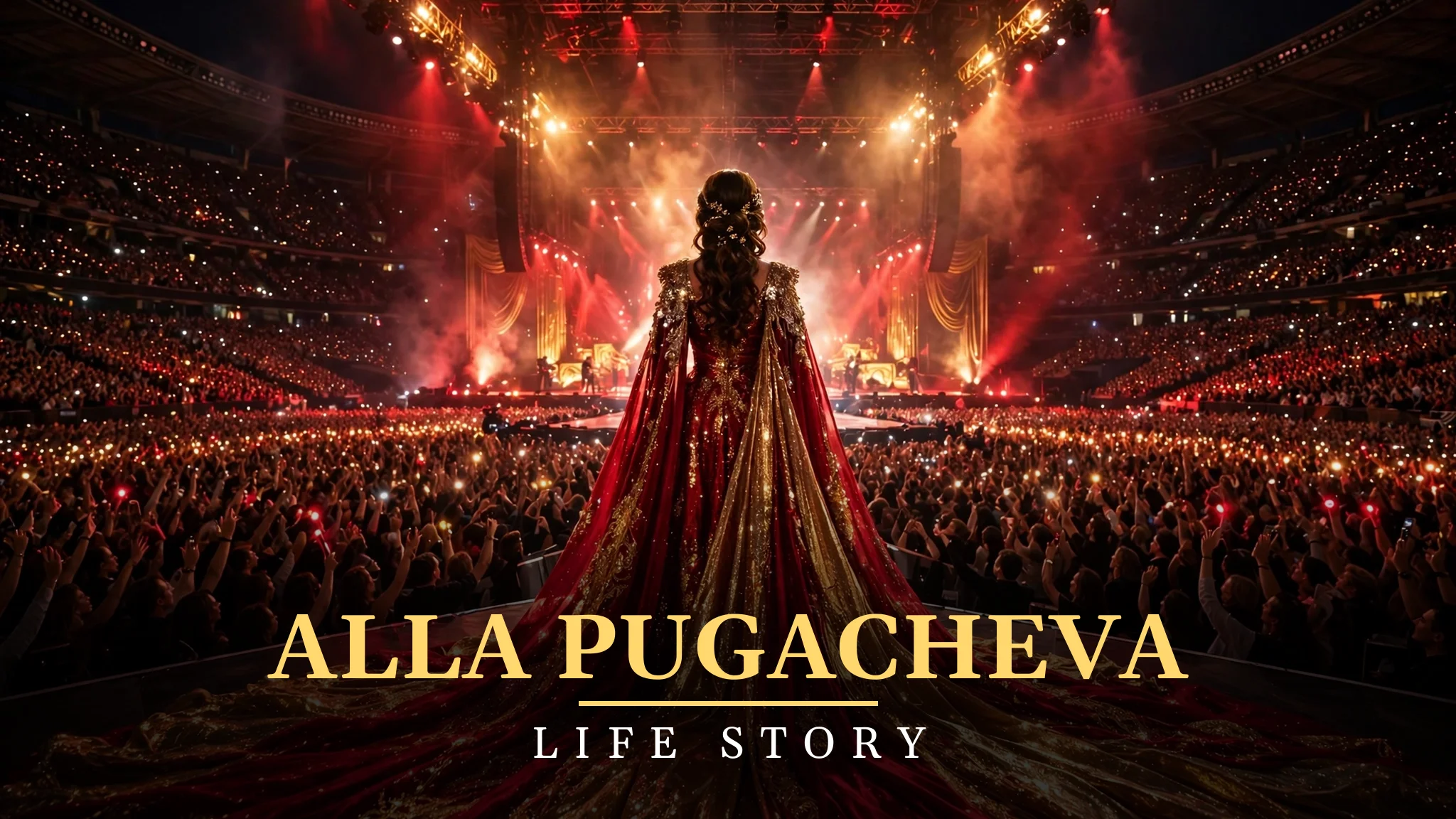
One more thought stays with me. When I picture Alla, I do not picture her in a quiet room. I picture her on a huge stage, in a long red and gold dress, facing a crowd of thousands, with lights shining and people singing along. That picture is grand, and it is right, because she is a grand singer. But I also picture her at home, with her children, singing a quiet song, and that picture is right too, because she is also a mother and a woman who loves her family. Both pictures are true, and both are part of her story. She is the Primadonna, and she is also a person, and that is why her story matters.
I also think about the way Alla sings about love, because it is so direct. She does not hide behind clever words. She sings about loving someone, about losing someone, and about wanting someone back, in words that anyone can understand. That directness is part of why her songs last. A song about love, sung simply and with feeling, can be understood by anyone, in any generation, and Alla’s love songs are like that. They are not fashionable, and they do not go out of fashion, because love does not go out of fashion.
Another thing I notice is her stage presence. When she walks onto a stage, the hall changes. People sit up, they watch, and they listen, because they know they are in the presence of someone special. That presence cannot be learned from a book. It comes from years of performing, from confidence, and from a belief in your own voice. Alla has that presence, and she has had it since she was young. It is one of the reasons she became the Primadonna, and it is one of the reasons she stayed the Primadonna for so long.
I think about the young singers she helped through her Christmas Meetings, because that generosity matters. A star who only thinks about herself will be forgotten when her fame fades. A star who helps young artists, who shares her stage, and who gives others a chance, will be remembered for that generosity as well as for her songs. Alla did that, and many young singers remember the chance she gave them. That is a kind of legacy that is just as important as a hit song.
There is something else I keep returning to, and it is the sadness of distance. Alla left Russia, and her songs are still played there, but she is far away. That distance is painful, for her and for her fans, and it is a reminder that a singer’s home is not just a place on a map. It is the audience, the hall, the people who sing along. When a singer leaves her audience, a part of her story is left behind, and that loss is real. I feel sad about it, and I hope that one day, the distance will close, and her songs will be sung where they were born.
In the end, I believe Alla Pugacheva will be remembered as the voice of a whole era. She sang for the Soviet Union, she sang for the new Russia, and she sang for millions of people who grew up with her songs. Her voice, powerful and dramatic, is part of Russian life, and it will stay part of it, as long as her songs are played. I am grateful to her for “Million Roses”, for “Harlequin”, and for the many evenings of music she gave to her country. She is the Primadonna, and that title, earned over fifty years, will always be hers.
I think about the generations who have grown up with Alla’s songs, from grandmothers who heard “Harlequin” in 1975 to young people who hear “Million Roses” today. A singer who can reach three generations is a rare thing, and Alla has done it, because her songs are about feelings that do not change: love, loss, hope, and the joy of singing. Those feelings belong to every generation, and Alla sings them in a way that each generation can understand.
I also think about her courage in leaving Russia, and about the price she paid for it. To leave your home, your audience, and your country, at seventy three years old, is a hard thing to do, and she did it for her family and for her beliefs. I respect that decision, even though it makes me sad, because it shows a woman who is willing to pay a price for what she believes. That courage is part of her story, and it will be remembered alongside her songs.
In the end, I will remember Alla Pugacheva as the Primadonna, the voice of Russia, and a woman who sang with all her heart for more than fifty years. Her songs will outlive the controversies, the arguments, and the distance, because a great song does not need a passport. It travels, it is sung, and it is loved, wherever people hear it. Alla’s songs will travel, and they will be loved, for as long as people sing.
I think about the Russian language in Alla’s songs, and about how it carries her voice to millions of people. She sings in Russian with power and with feeling, and her songs are part of the language itself, words that people know by heart and sing at weddings, at parties, and at home. A singer whose songs become part of a language has achieved something rare, and Alla has achieved it, because her voice and her words belong to Russia in a way that few singers ever do.
In the end, I will remember Alla Pugacheva as the Primadonna, the voice of Russia, and a woman who sang with all her heart for more than fifty years. Her songs will outlive the arguments and the distance, because a great song does not need a passport. It travels, it is sung, and it is loved, wherever people hear it.
I think about the word Primadonna, and about what it means to earn it. Alla earned it over fifty years, song by song, concert by concert, and that title will always be hers, because no one else has sung for Russia the way she has. Her voice, her songs, and her life are part of Russian culture, and they will stay part of it, as long as her songs are played and sung.
In the end, I will remember Alla Pugacheva as the voice of a whole era, a woman who sang with all her heart, and whose songs will outlive every argument and every distance. She is the Primadonna, and that is a title she earned, and one she will always keep.
Frequently Asked Questions
When was Alla Pugacheva born?
She was born on 15 April 1949 in Moscow, Russia. She studied music in Moscow and began her career singing in small bands before becoming famous.
What song made Alla Pugacheva famous?
She became famous by winning the Golden Orpheus contest in 1975 with “Harlequin”. Her song “Million Roses” from 1982 later became one of the most loved Russian songs of all time.
Why is Alla Pugacheva called the Primadonna?
She is called the Primadonna, meaning the first lady, because she has been the most famous and most loved female singer in Russian pop music for more than fifty years.
Did Alla Pugacheva take part in Eurovision?
Yes, she represented Russia at the Eurovision Song Contest in 1997 with the song “Primadonna”, finishing in fifteenth place. The song’s title was a joke about her own nickname.
Who is Alla Pugacheva’s daughter?
Her daughter is Kristina Orbakaite, born in 1971, who is also a famous singer and actress in Russia. Alla has also had twins with her husband Maxim Galkin, born in 2013.
Why did Alla Pugacheva leave Russia?
She left Russia in 2022 with her family after the full scale invasion of Ukraine, first going to Israel. She later spoke out against the war, and she has not returned to perform in Russia.


