Amália Rodrigues: The Life Story Behind the Queen of Fado
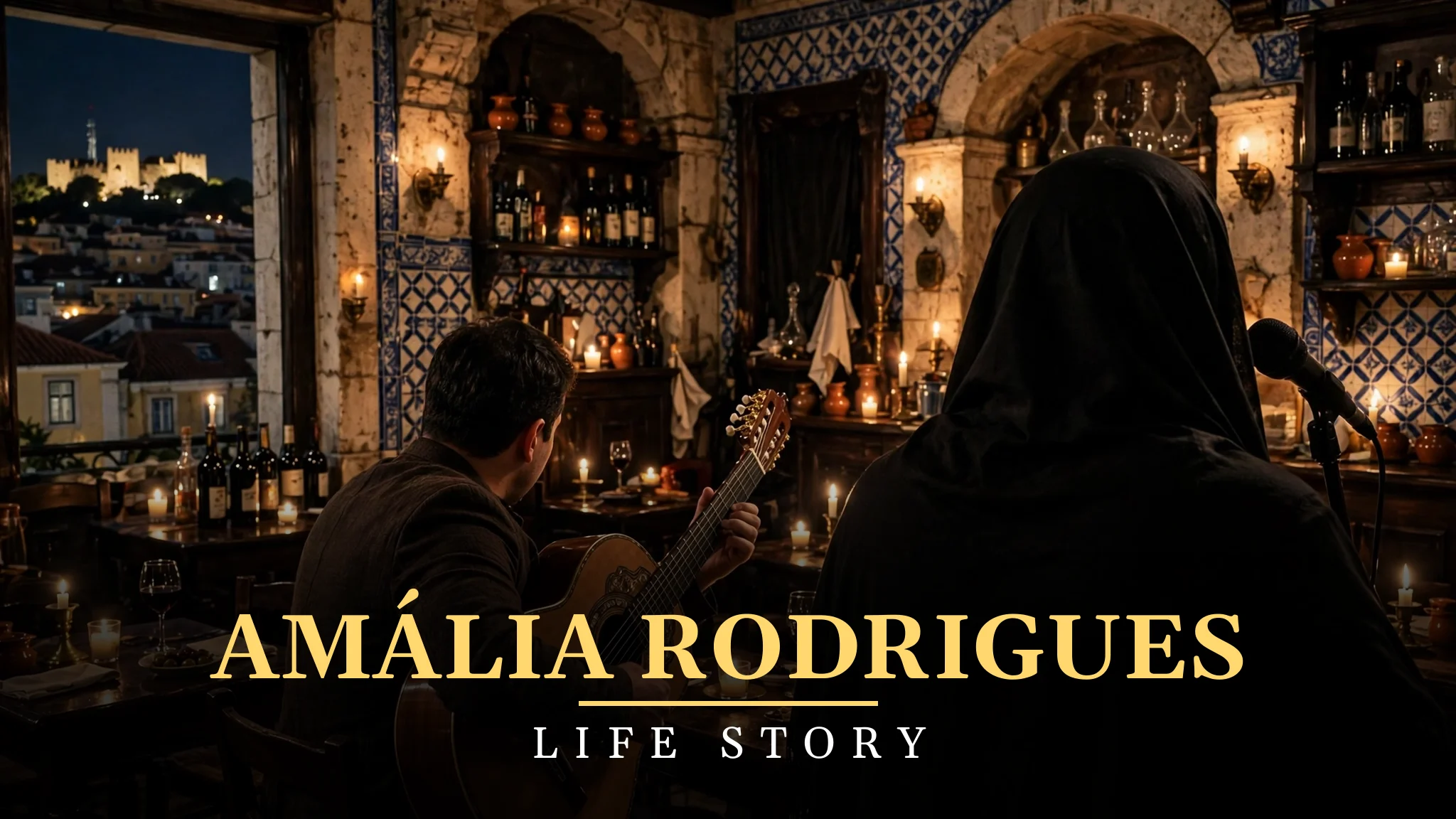
In this post
Amália Rodrigues is known in Portugal as the Queen of Fado, and the title is not an exaggeration. Fado is the traditional music of Portugal, a music of longing, of sadness, and of love, and Amália was its greatest voice. She sang fado for more than fifty years, she took it from the small taverns of Lisbon to the great concert halls of the world, and she made it known to audiences who had never heard Portuguese music before. Her voice was powerful, emotional, and unmistakable, and when she sang, people listened in silence.
She was born in Lisbon in 1920, into a poor family, and she grew up in the streets of the city, selling fruit and singing for her neighbours. She was discovered as a teenager, and within a few years she was one of the most famous singers in Portugal. She acted in films, she recorded hundreds of songs, and she became a national icon, a symbol of Portugal itself. She died in 1999, and her funeral was a national event, with thousands of people coming to say goodbye. She was later buried in the National Pantheon in Lisbon, an honour given to very few Portuguese figures.
Her story is about a voice, about a city, and about a music that is the soul of Portugal. It is also about a woman who rose from poverty to become a queen, not of a country, but of a song. This is the story of Amália Rodrigues, the Queen of Fado.
A Girl From Lisbon
Amália Rodrigues was born on 23 July 1920 in Lisbon, in the neighbourhood of Pena, into a poor family. Her parents were from the countryside, and they had come to Lisbon to find work. As a child, Amália lived in a small and crowded home, and she helped her family by selling fruit in the streets. She was a lively and musical child, and she sang as she worked, in the streets, in the markets, and at home. People who heard her noticed that her voice was unusual, strong, and full of feeling, even when she was still a girl.
Lisbon in the 1920s and 1930s was a city of fado, of small taverns, and of a music that was sung by ordinary people. Fado was not a music for the rich. It was a music for the poor, for sailors, for workers, and for people who had lost someone they loved. Amália grew up in that world, and she learned fado by listening to it, by singing it, and by feeling it. She did not study music in a formal way. She learned it from the streets, from the taverns, and from the people around her.
Her family was poor, but they supported her singing, and they recognised that she had a gift. She sang at local events, she sang for her neighbours, and she began to be known in her neighbourhood as a girl with a beautiful voice. That reputation spread, and it led to her first professional opportunities. The girl from the streets of Lisbon was about to become a star, and her life was about to change forever.
Discovery and the First Songs
Amália was discovered as a teenager, when she was heard singing in a local venue, and she was invited to perform in a fado house, a small tavern where fado was sung every night. Those fado houses were the heart of Lisbon’s musical life, and performing in one was a serious step for a young singer. She sang with a confidence that surprised older singers, and she quickly became a favourite. Her voice was powerful, her phrasing was natural, and her feeling for the music was deep. She was not just singing fado. She was living it.
In the late 1930s and early 1940s, she began to record her first songs, and she became known across Portugal. Songs such as Povo que lavas no rio and Ai, Mouraria became popular, and they showed her talent for singing about Lisbon, about its neighbourhoods, and about its people. She also began to act in films, and her first film roles made her face familiar to audiences who had not yet heard her sing. She was becoming a national figure, and she was still very young.
The early years were also years of hard work. She performed every night, she recorded in the studio, and she toured Portugal. She was a young woman in a male-dominated world, and she had to be strong to survive in it. She was strong, and she was determined, and she did not let anyone push her around. That strength would stay with her for her whole career, and it is one of the reasons she became a legend.
Uma Casa Portuguesa and National Fame
In the 1950s, Amália recorded Uma casa portuguesa, a song about a Portuguese house, about the simple life, and about the pride of being Portuguese. The song became one of her most famous works, and it is still sung today as an anthem of Portuguese identity. It is a simple song, with a melody that is easy to remember, and a lyric that speaks about home, about family, and about the values of a simple life. Amália sang it with a warmth that made it feel personal, and it became a part of the national memory.
During the 1950s and 1960s, she became the most famous singer in Portugal, and she was also becoming known abroad. She toured in Europe, in Brazil, and in other countries, and she performed in large concert halls. She sang fado for audiences who did not speak Portuguese, and they responded to the feeling in her voice, even if they did not understand the words. That is the power of fado, and the power of Amália. A song about longing does not need a translation to be felt.
She also recorded many other famous songs, including Gaivota, a song about a seagull, about freedom, and about the sea, and Estranha forma de vida, a song about a strange way of life, about love, and about the pain of living. Those songs are still played today, and they are still regarded as masterpieces of fado. Amália was not just a singer. She was a poet, a storyteller, and a voice for Portugal itself.
Gaivota and the Voice of Longing
Gaivota, recorded in the 1960s, is one of Amália’s most loved songs, and it is a perfect example of her art. The song is about a seagull, about the sea, and about the longing for freedom. Amália sings it with a voice that is both powerful and tender, and she makes the listener feel the wind, the sea, and the desire to fly away. The song is simple, but it is also deep, and it speaks to a feeling that everyone has, the feeling of wanting to be free, to escape, and to find a better life.
The song also shows her gift for phrasing, for the way she shapes a line, for the way she pauses, and for the way she lets a note hang in the air. That phrasing is the heart of fado, and Amália was a master of it. She did not just sing the words. She lived them, and she made the audience live them too. When she sang Gaivota, people in the audience felt as if they were the seagull, flying over the sea, looking for a home.
Gaivota became a signature song for Amália, and it is still associated with her today. It is played on the radio, it is sung by younger fado singers, and it is taught as an example of great fado singing. The song is a testament to her talent, and to the power of a voice that can make a simple story feel universal. It is one of the reasons she is still called the Queen of Fado, more than twenty years after her death.
Films, Tours, and a World Audience
Amália was not only a singer. She was also an actress, and she appeared in several Portuguese films in the 1940s and 1950s, including Capas Negras and Fado, História de uma Cantadeira. Her films made her face familiar to audiences across Portugal, and they helped to spread her fame. She was a beautiful woman, with a strong presence on screen, and her acting was natural and convincing. Her films are still watched today, as examples of Portuguese cinema from that period.
She also toured the world, performing in Paris, in London, in New York, and in many other cities. She sang in large concert halls, and she was praised by critics and by audiences who had never heard fado before. She was a cultural ambassador for Portugal, and she introduced fado to the world. In France, she was particularly loved, and she performed there many times. Her tours were a major part of her career, and they made her an international star.
The tours also brought her into contact with other musicians, with writers, and with artists from different countries. She was respected by her peers, and she was admired for her voice, her professionalism, and her dedication to her art. She was not a singer who rested on her fame. She worked hard, she toured, she recorded, and she kept her standards high. That work ethic is a part of her legacy, and it is one of the reasons she is still respected today.
A Private Life and a Public Icon
Amália’s private life was often in the public eye, and she was married twice, first to Francisco da Cruz and later to César Seabra. Her marriages were not always happy, and she spoke about her personal life with a frankness that was unusual for a public figure of her time. She was a strong and independent woman, and she did not let her marriages define her. She was defined by her music, by her voice, and by her work, and she kept those things at the centre of her life.
She lived in Lisbon for most of her life, in a house that became a museum after her death, and she was a central figure in the cultural life of the city. She was friends with writers, with poets, and with musicians, and she was a part of the intellectual life of Portugal. She was also a generous person, helping younger singers and supporting fado houses and musicians. That generosity is remembered by the people who knew her, and it is a part of her legacy.
She was also a woman who lived through a difficult period in Portuguese history, including the dictatorship of Salazar, and she had to navigate a world where artists were watched and controlled. She did so with dignity, and she kept singing, even when the political situation was difficult. Her music was a source of comfort for many Portuguese people, and her voice was a symbol of Portugal itself, even in dark times.
Death in 1999 and the National Pantheon
Amália Rodrigues died on 6 October 1999 in Lisbon, at the age of seventy-nine, after a long illness. Her death was a national event in Portugal, and it was mourned by the whole country. Her funeral was attended by thousands of people, including the President of Portugal, and her coffin was carried through the streets of Lisbon, with crowds singing her songs. It was a moment of national mourning, and it showed how much she meant to Portugal.
In 2001, her remains were transferred to the National Pantheon in Lisbon, an honour given to very few Portuguese figures, including writers, politicians, and other national heroes. She was the first woman to be buried there, and that honour is a testament to her importance in Portuguese culture. The Pantheon is a place where Portugal honours its greatest citizens, and Amália is there, among them, as the Queen of Fado.
Her house in Lisbon has become a museum, the Casa-Museu Amália Rodrigues, where visitors can see her personal belongings, her dresses, her records, and her awards. The museum is a place of pilgrimage for her fans, and it is a reminder of her life and her work. She is still loved in Portugal, and her songs are still played, still sung, and still taught to young fado singers.
Why Amália Still Matters
Today, Amália Rodrigues is seen as the greatest fado singer of all time, and her recordings are still the standard against which all other fado singers are measured. Her songs are played on the radio, they are sung in fado houses, they are covered by younger artists, and they are discovered by new listeners every year. She took fado from the small taverns of Lisbon to the world, and she made it a music that is known and loved around the globe.
Her legacy is also in the way she showed that a woman from a poor family could become a national icon, through talent, hard work, and determination. She rose from selling fruit in the streets to being buried in the National Pantheon, and that journey is a powerful story. It is a story about Portugal, about fado, and about the power of a voice to change a life and to touch a nation.
The story of Amália Rodrigues is the story of a queen, not of a country, but of a song. She was the Queen of Fado, and she will always be remembered as such. Her voice is still here, in her recordings, in the fado houses of Lisbon, and in the hearts of Portuguese people around the world.
Amália and the Soul of Portugal
Amália Rodrigues was more than a singer. She was a symbol of Portugal, a voice that represented the country to the world, and a figure who embodied the Portuguese soul. When people outside Portugal thought of Portuguese music, they thought of Amália. When people inside Portugal thought of their culture, they thought of her voice. That is a rare and powerful position, and it is one that she earned through decades of work, through hundreds of songs, and through a voice that was unmistakably Portuguese.
Her music was also a source of comfort during difficult times in Portuguese history. During the dictatorship, when many Portuguese people felt silenced, her songs gave them a voice, a way to express their longing, their sadness, and their hope. Fado is a music of saudade, of longing for something that is gone, and Amália sang that longing in a way that made people feel less alone. Her concerts were not just performances. They were gatherings, where people came to hear their own feelings sung back to them.
She also helped to preserve fado as a living tradition, by recording it, by performing it, and by inspiring younger singers to learn it. Without her, fado might have faded, or become a museum piece. With her, it became a living music, one that is still sung in Lisbon today, in fado houses, in concerts, and in homes. That preservation is a part of her legacy, and it is one that Portugal still honours.
Her tours abroad also deserve more attention, because they were not easy. She travelled to Paris, to London, to New York, and to many other cities, singing in Portuguese for audiences who did not understand the words. That takes courage, because a singer who sings in a foreign language has to trust that the feeling in her voice will be enough. Amália trusted it, and she was right. Audiences responded to her voice, to the emotion in it, and to the beauty of fado, even when they could not understand a single word. That is the power of music, and it is the power that Amália possessed.
She also worked with poets and writers, including the great Portuguese poet Ary dos Santos, who wrote lyrics for her, including Gaivota. That collaboration between a singer and a poet is a beautiful thing, and it shows that fado is not just a folk music. It is a literary music, a music of words, of images, and of ideas. Amália understood that, and she worked with the best writers in Portugal, to make songs that were both musical and literary. That is a part of why her songs are still studied today.
Amália also understood the importance of the Portuguese guitar, the small twelve-string guitar that is the heart of fado. She worked with great guitarists, she respected their art, and she gave them room to play. A fado performance is not just a singer. It is a singer and a guitarist, working together, listening to each other, and creating a sound that is intimate and powerful. Amália understood that partnership, and her recordings show it, with the guitar and the voice in perfect balance.
Her influence on Portuguese culture goes beyond music. She became a symbol of Lisbon, of Portugal, and of a way of life that is proud, sad, and beautiful at the same time. Her image is on stamps, on posters, and in books, and her name is known by every Portuguese person, young and old. That is a rare honour, and it is one that she earned through a lifetime of work, through a voice that was unique, and through a dedication to fado that never wavered.
One more part of her story deserves attention, and it is the way she was honoured after her death. To be buried in the National Pantheon, as the first woman, is an extraordinary honour, and it shows how Portugal sees her. She is not just a singer in the Pantheon. She is a national hero, alongside writers, politicians, and other great figures. That honour is a testament to her importance, and it is a reminder that a singer can be as important to a country as a writer or a leader. Amália was that singer, and Portugal knew it.
Her songs also continue to be used in films, in television, and in theatre, where they bring a sense of Portugal to audiences around the world. A film that uses a song by Amália is telling the audience something about longing, about love, and about the Portuguese soul. That use of her music, decades after her death, shows that her work is still alive, still relevant, and still powerful. She is not a singer from the past. She is a singer for the present, and for the future.
I also think about the young girl who sold fruit in the streets of Lisbon, and who sang as she worked, not knowing that her voice would one day be heard around the world. That girl had a gift, and she used it, day after day, in the streets, in the taverns, and on the great stages of the world. Her story is a reminder that a gift does not need a grand stage to begin. It can begin in a street, in a market, or in a small room, and it can grow, if the person who has it is willing to work, to sing, and to believe.
My Take:
When I think about Amália Rodrigues, the first thing I think about is her voice. It is powerful, emotional, and unmistakable, and it carries the feeling of fado in every note. Fado is a music of longing, of saudade, a Portuguese word that means a deep and sad longing for someone or something that is gone. Amália understood saudade, and she sang it in a way that made people feel it, even if they did not speak Portuguese. That is a rare gift, and it is one of the reasons she is still called the Queen of Fado.
I admire the way she rose from poverty to become a national icon. She was born into a poor family, she sold fruit in the streets, and she sang for her neighbours. She did not have money, she did not have connections, and she did not have a formal musical education. She had a voice, a determination, and a love of fado, and she turned those things into a career that lasted for more than fifty years. That is an extraordinary achievement, and it tells me that talent can come from anywhere, and that a voice can change a life.
I think about Gaivota, and about how that song captures the feeling of wanting to be free. A seagull flies over the sea, it is free, and it is alone, and Amália sings about it with a voice that is both powerful and tender. I love that, because it shows that a simple image, a bird over the sea, can carry a deep feeling. She did not need complicated words. She needed a seagull, a sea, and a voice, and that was enough to make a masterpiece.
What I find most moving in her story is her funeral, and the thousands of people who came to say goodbye. Her coffin was carried through the streets of Lisbon, and crowds sang her songs. That is a remarkable image, and it tells me how much she meant to Portugal. She was not just a singer. She was a symbol of the country, a voice for its people, and a part of its soul. When she died, Portugal lost a part of itself, and the whole country felt it.
I also think about her life in the fado houses of Lisbon, and about how she learned her art there. Fado houses are small, intimate places, where a singer stands close to the audience, and where the audience listens in silence. Amália learned to sing in those places, and she learned how to hold an audience with just her voice and a guitar. That training is visible in her later performances, in large concert halls, where she still sang as if she was in a small tavern, close to her listeners. That intimacy is a part of her art, and it is one of the reasons her recordings feel so personal.
There is a part of her story that makes me think about Portugal itself, and about how a small country can produce a great artist. Portugal is a small country, but it has a rich culture, a deep history, and a music that is unique in the world. Amália was a product of that culture, and she became its greatest ambassador. She took fado to the world, and she made the world listen to Portugal. That is a powerful achievement, and it is one that few artists from small countries have managed.
I think about her films, too, and about how she became a face as well as a voice. Her films made her known to audiences who had not heard her sing, and they showed that she was not only a singer. She was an actress, a performer, and a star. I admire that, because it shows that she was willing to try new things, to act, to tour, and to work hard in many different ways. She was not a singer who stayed in one place. She was an artist who explored, who travelled, and who grew.
When I compare her with other great singers, I think her greatest gift was her emotional honesty. She did not hide her feelings. She sang about longing, about love, about loss, and about the pain of living, and she sang about them with a directness that is rare. That honesty is what makes fado so powerful, and it is what makes Amália so loved. People do not just hear her songs. They feel them, and they recognise their own feelings in them.
I think about her private life, and about how strong she was as a woman in a male-dominated world. She was married twice, she lived through a dictatorship, and she had to navigate a world where women were often told to be quiet. She did not stay quiet. She sang, she spoke, and she lived her life on her own terms. That strength is a part of her legacy, and it is one that inspires younger women in Portugal today.
If I have a sadness in her story, it is the sadness that she lived through difficult times, including poverty in her childhood, and a dictatorship in her adult life, and that she had to fight for her place in a world that was not always kind to women. I wish her road had been easier, but I also know that the difficulties shaped her voice, and that her voice would not have been the same without them. Her sadness became her art, and her art became a comfort for millions of people.
For a young reader, I think the lesson of Amália Rodrigues is to trust your voice, even when you come from a poor place, and even when the world tells you that you do not belong. She trusted her voice, she sang in the streets, she sang in the taverns, and she became a queen. That is a lesson for anyone who has a talent and a dream. Your background does not define you. Your voice does, and if you use it with honesty and with courage, the world will listen.
I keep returning to the image of the girl from Lisbon, selling fruit in the streets, singing as she worked. She could not have known then that she would become the Queen of Fado, or that she would be buried in the National Pantheon. She just knew that she loved to sing, and that her voice was special. That love carried her through a long life, and it is the heart of her story.
In the end, I think Amália Rodrigues teaches us that a song can be a home, a country, and a soul. Fado is the soul of Portugal, and Amália was the voice of fado. When I hear her sing now, I do not just hear a famous singer. I hear a woman who rose from poverty, who sang for her country, and who gave the world a music that is still beautiful, still sad, and still true. That is why I admire her, and that is why her story will still matter for many years to come.
I also think about the word saudade, and about how Amália embodied it. Saudade is a Portuguese word that has no exact translation in English, but it means a deep longing, a sadness for something that is gone, and a hope that it might return. Amália sang saudade in every song, and she made it feel universal. I love that, because it shows that a feeling can be specific to a country, and also universal to all people. Everyone has felt saudade, even if they do not know the word for it.
Another thought that stays with me is about her house museum in Lisbon, and about the visitors who come there to remember her. They see her dresses, her records, and her personal belongings, and they feel close to her. That is a beautiful thing, because it shows that a singer can become a part of a city’s memory, a part of its streets, and a part of its life. Amália is still in Lisbon, in her house, in her songs, and in the hearts of the people who loved her.
I think about the younger fado singers who learned from her, and about how they carry her legacy forward. They sing her songs, they study her phrasing, and they try to capture the feeling in her voice. That is a wonderful thing, because it means that fado is not dead. It is alive, and it is being sung by a new generation, who learned it from the Queen. I hope those young singers keep singing, and I hope they keep the tradition alive for many more years.
Finally, I think about what I would say to someone who has never heard fado. I would tell them to listen to Amália, to close their eyes, and to hear the longing in her voice. I would tell them that fado is the soul of Portugal, and that Amália was its greatest voice. That is why I admire her, and that is why her story matters.
I also think about her work with poets, and about how it elevated fado from a folk music to a literary art. When a great poet writes a lyric, and a great singer sings it, the result is something that is both a song and a poem. Amália understood that, and she sought out the best writers in Portugal. I respect that, because it shows that she cared about words, about language, and about the quality of her songs. She did not just sing anything. She sang the best words she could find.
Another thought that stays with me is about her tours, and about the courage it took to sing in Portuguese for audiences who did not understand the language. That is a brave thing to do, and it shows her trust in music itself. She believed that a feeling does not need a translation, and she was right. Her audiences felt her songs, even when they did not understand them, and that is a testament to the power of her voice.
I think about her strength as a woman, too, and about how she lived through a dictatorship, through poverty, and through personal difficulties, and still kept singing. That strength is inspiring, and it is a part of her legacy. She was not just a voice. She was a person who endured, who worked, and who gave her music to the world, even when the world was difficult. That is a powerful example.
When I hear her sing now, I do not just hear a famous singer. I hear a woman who rose from the streets of Lisbon, who sang for her country, and who became a queen. I hear a voice that is full of longing, full of love, and full of the soul of Portugal. That is why I admire Amália Rodrigues, and that is why I think her story will still matter for many years to come.
Finally, I think about the fado houses of Lisbon, where her songs are still sung every night, by young singers who learned from her. Those houses are small, intimate, and full of feeling, just as they were when Amália first sang in them. Her voice is still there, in the walls, in the guitars, and in the hearts of the people who sing her songs. That is a beautiful legacy, and it is one that will last as long as fado is sung.
I also think about the Portuguese guitar, and about how Amália worked with her guitarists as partners, not as accompanists. A fado singer and a guitarist listen to each other, they breathe together, and they create a sound that is intimate and powerful. Amália understood that, and her recordings show a perfect balance between voice and guitar. I love that, because it shows that music is a conversation, not a solo performance, and that the best songs are made by people working together.
Finally, I think about Lisbon itself, and about the city that shaped her. Lisbon is a city of hills, of narrow streets, of the sea, and of fado, and Amália was a product of that city. She sang about its neighbourhoods, its people, and its soul, and she became a part of it. When I think of Lisbon, I think of her voice, and when I think of her voice, I think of Lisbon. That connection, between a singer and a city, is a beautiful thing, and it is one that will last as long as fado is sung in Lisbon.
Frequently Asked Questions
When and where was Amália Rodrigues born?
Amália Rodrigues was born on 23 July 1920 in Lisbon, Portugal, into a poor family, and she grew up selling fruit in the streets while singing. She was discovered as a teenager and became the most famous fado singer in Portugal.
What is Amália Rodrigues’s most famous song?
Uma casa portuguesa and Gaivota are among her most famous songs, along with Povo que lavas no rio and Estranha forma de vida. Each one shows a different side of fado, from a celebration of home to a song about longing and freedom.
What is fado?
Fado is the traditional music of Portugal, a music of longing, sadness, and love, known by the Portuguese word saudade. It is usually sung by a single singer with Portuguese guitar accompaniment, in small taverns and in large concert halls.
When did Amália Rodrigues die and where is she buried?
She died on 6 October 1999 in Lisbon at the age of seventy-nine, and in 2001 her remains were transferred to the National Pantheon in Lisbon. She was the first woman to be buried there, an honour given to very few Portuguese figures.
Did Amália Rodrigues act in films?
Yes, she appeared in several Portuguese films in the 1940s and 1950s, including Capas Negras and Fado, História de uma Cantadeira. Her films made her face familiar to audiences across Portugal and helped to spread her fame.
Is there a museum for Amália Rodrigues?
Yes, her house in Lisbon has become the Casa-Museu Amália Rodrigues, a museum where visitors can see her personal belongings, dresses, records, and awards. It is a place of pilgrimage for her fans.


