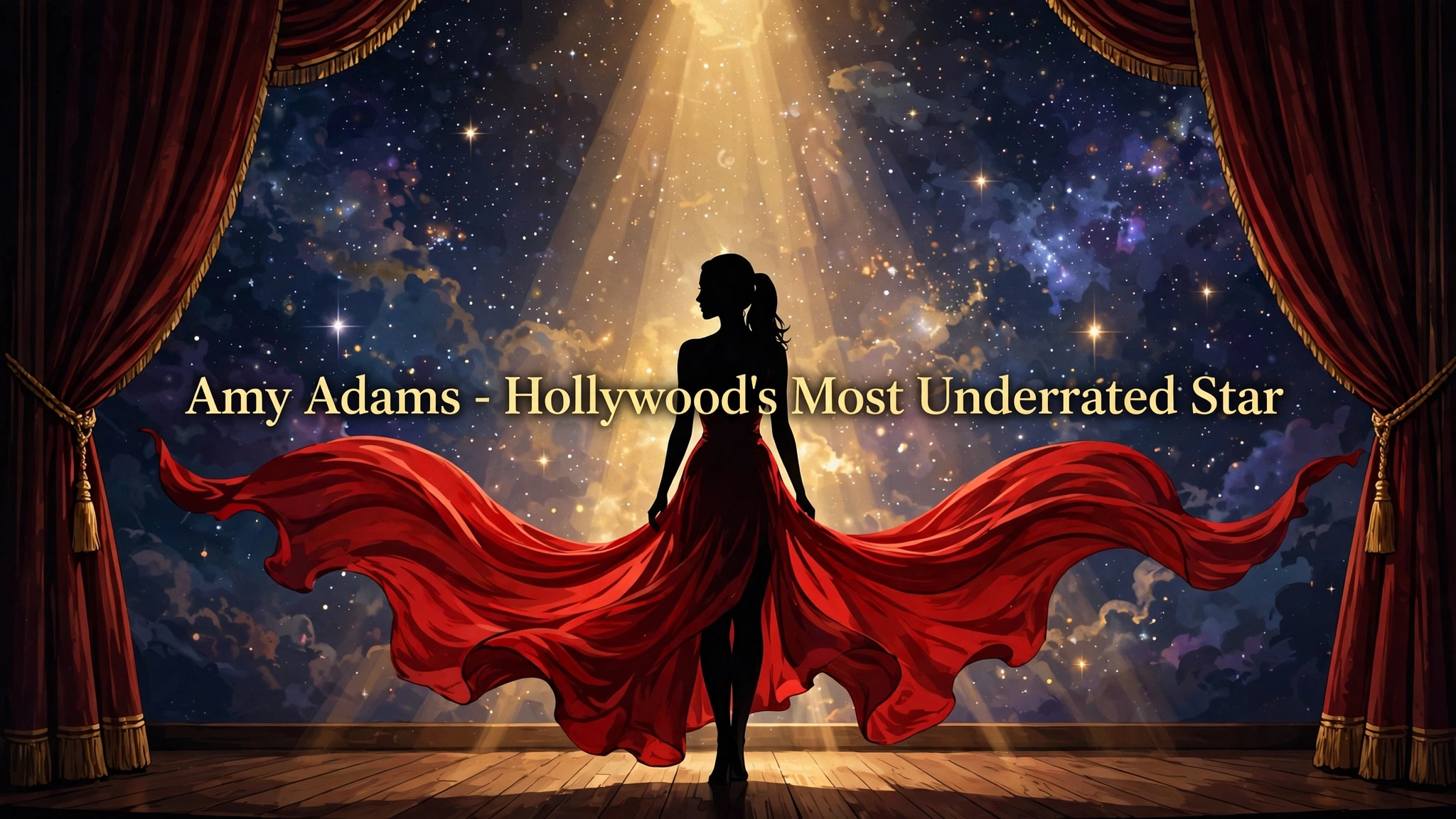
Amy Adams: The Life Story Behind Hollywood's Most Underrated Star
In this post
- Vicenza, Castle Rock, and a Mormon Childhood
- Dinner Theatre, Minnesota, and the Accidental Discovery
- Junebug and the Breakthrough
- Enchanted, Doubt, and the Rise to Stardom
- The Master, American Hustle, and the Leading Lady
- Arrival, Nocturnal Animals, and the Science-Fiction Turn
- Sharp Objects, Vice, and the Television Triumph
- Hillbilly Elegy, Disenchanted, and Nightbitch
- Family, Patience, and the Six Nominations
- The Approach: Listening, Preparation, and No Shortcuts
- My Take:
Amy Adams is one of the finest actresses of her generation, and she is also one of the most patient. She has been nominated for six Academy Awards and has never won one. She has played a pregnant innocent, a nun, a boxer’s girlfriend, a cult leader’s wife, a con artist, a linguist who talks to aliens, and a mother who thinks she is turning into a dog. She started as a waitress in a dinner theatre in Colorado, she was discovered by accident, and she spent years in small roles before anyone noticed her. Her career is a study in what happens when talent refuses to give up.
What follows is her story in full: the army childhood, the Colorado years, the dinner theatre, the long climb through Hollywood, the Oscar nominations, and the recent work that has made her one of the most respected actresses in the world.
Vicenza, Castle Rock, and a Mormon Childhood
Amy Lou Adams was born on 20 August 1974 in Vicenza, Italy, where her father, Richard Adams, was serving in the United States Army. She was the fourth of seven children, and her childhood was shaped by the military. The family moved frequently, as army families do, and Amy grew up in a household that was large, loud, and disciplined. Her mother, Kathryn, was a homemaker, and her father was a soldier who later became a singer in a restaurant.
When Amy was eight, the family settled in Castle Rock, Colorado, a small town south of Denver. She grew up there, attending Douglas County High School, where she was a cheerleader and a member of the choir. She was raised in the Church of Jesus Christ of Latter-day Saints, and her family was devout. She has spoken about her Mormon upbringing with affection, describing it as a childhood of community, of singing, and of strong values. She left the church as an adult, but she has said that the experience shaped her, giving her a sense of discipline and a love of performing.
She was not a child actor. She did not go to drama school. She sang in the school choir, she performed in school plays, and she dreamed of being a ballerina. She trained in dance, and she was good at it, but she was not good enough to make it a career. After high school, she worked at the Gap, folding clothes and selling jeans, and then, at eighteen, she got a job as a waitress at Hooters, the restaurant chain. She has spoken about that job with humour, saying that it taught her how to deal with people, how to work hard, and how to earn tips. It was not glamorous, but it paid the rent, and it gave her time to think about what she wanted to do.
What she wanted to do was perform. She auditioned for dinner theatre in Colorado, and she was hired by the Country Dinner Playhouse, a theatre in Colorado where actors performed while audiences ate. It was not Broadway, but it was a start. She performed in musicals, she sang, she danced, and she learned the discipline of live performance. She was twenty-one, she was working in a theatre that served dinner, and she had no idea that her life was about to change.
Dinner Theatre, Minnesota, and the Accidental Discovery
In 1998, Adams was performing at the Chanhassen Dinner Theatre in Minnesota, in a production of the musical Brigadoon, when she was spotted by a casting director who was in the audience. The casting director was working on a film called Drop Dead Gorgeous, a black comedy about a beauty pageant in Minnesota, and she thought Adams would be right for a small part. Adams auditioned, she got the role, and she made her film debut in 1999, playing Leslie Miller, a cheerleader. The film starred Kirsten Dunst, Denise Richards, and Ellen Barkin, and it was a modest success. Adams was twenty-four, and she had her first film credit.
She moved to Los Angeles, and she began the long, hard work of building a career. She appeared in small roles in films and television, including a part in the television series Buffy the Vampire Slayer in 2000, and in the film Psycho Beach Party in 2000. She was working, but she was not famous, and she was not making much money. She auditioned constantly, she was rejected constantly, and she kept going.
In 2002, she was cast in Catch Me If You Can, directed by Steven Spielberg, playing Brenda Strong, a nurse who falls in love with Frank Abagnale Jr., played by Leonardo DiCaprio. The role was small, but it was in a Spielberg film, and it put her on the radar. She has said that working with Spielberg was a revelation, that he treated her with respect, and that he gave her confidence. But the film did not make her a star. She went back to auditioning, back to small roles, and back to waiting.
She appeared in The Last Run in 2004, a small independent film, and she worked in television, including a recurring role in the series Dr. Vegas. She was in her late twenties, she had been in Hollywood for five years, and she was still waiting for a breakthrough. It was coming, and it was coming from the most unlikely place: a small independent film shot in North Carolina.
Junebug and the Breakthrough
In 2005, Adams starred in Junebug, directed by Phil Morrison, playing Ashley Johnsten, a pregnant young woman in North Carolina who is sweet, talkative, and endlessly optimistic. The film is a quiet, observational drama about a family, and Adams’s performance is a revelation. She plays Ashley as a woman who is naive but not stupid, who is kind but not weak, and who sees the best in people even when they do not deserve it. The performance earned her an Academy Award nomination for Best Supporting Actress, her first, and it changed her career.
Junebug was a small film, made for very little money, and it was not a box office hit. But it was a critical success, and Adams’s performance was widely praised. She was suddenly being talked about as one of the most talented young actresses in Hollywood. She was thirty-one, and she had been working for six years, and she had finally been noticed.
She followed Junebug with a series of roles that showed her range. In 2006, she appeared in Talladega Nights: The Ballad of Ricky Bobby, a comedy opposite Will Ferrell, playing Susan, a woman who helps a NASCAR driver. The film was a hit, and Adams’s performance was funny and charming. She also appeared in the television series The Office, playing Katy, a purse saleswoman who dates Jim Halpert, in three episodes. The role was small, but it introduced her to a television audience, and it showed that she could do comedy as well as drama.
Enchanted, Doubt, and the Rise to Stardom
In 2007, Adams starred in Enchanted, a Disney film directed by Kevin Lima, playing Giselle, a princess from an animated fairy tale who is transported to modern-day New York. The role required her to sing, to dance, and to be both innocent and funny, and she did it perfectly. The film was a massive hit, earning more than 340 million dollars worldwide, and Adams was nominated for a Golden Globe for her performance. She was suddenly a star, and she was being offered leading roles.
She followed Enchanted with a series of films that showed her dramatic range. In 2008, she starred in Doubt, directed by John Patrick Shanley, playing Sister James, a young nun who suspects that a priest, played by Philip Seymour Hoffman, is abusing a student. The film also starred Meryl Streep as Sister Aloysius, the principal, and Adams’s performance, as a nun torn between loyalty and conscience, earned her a second Academy Award nomination for Best Supporting Actress. She was acting opposite two of the greatest actors of her generation, and she held her own.
In 2009, she appeared in Julie & Julia, playing Julie Powell, a young woman who cooks her way through Julia Child’s cookbook, opposite Meryl Streep as Julia Child. The film was a hit, and Adams’s performance was warm and funny. She also appeared in Night at the Museum: Battle of the Smithsonian in 2009, playing Amelia Earhart, and in Sunshine Cleaning in 2008, a small independent film about two sisters who start a crime scene cleaning business. She was working constantly, in big films and small ones, in comedies and dramas, and she was building a reputation as one of the most versatile actresses in Hollywood.
In 2010, she starred in The Fighter, directed by David O. Russell, playing Charlene Fleming, the girlfriend of a boxer played by Mark Wahlberg. The film was based on a true story, and Adams’s performance, as a tough, smart woman who helps her boyfriend escape his family’s control, earned her a third Academy Award nomination for Best Supporting Actress. She had been nominated three times in five years, and she was becoming known as an actress who could do anything.
The Master, American Hustle, and the Leading Lady
In 2012, Adams starred in The Master, directed by Paul Thomas Anderson, playing Peggy Dodd, the wife of a cult leader played by Philip Seymour Hoffman. The film is a difficult, unsettling study of power and control, and Adams’s performance is chilling. She plays Peggy as a woman who is quietly, ruthlessly in control, and the performance earned her a fourth Academy Award nomination for Best Supporting Actress. She was acting opposite Hoffman again, and she was his equal.
In 2013, she starred in American Hustle, also directed by David O. Russell, playing Sydney Prosser, a con artist who becomes involved in a FBI sting operation. The film also starred Christian Bale, Bradley Cooper, and Jennifer Lawrence, and Adams’s performance, as a woman who is lying about who she is and falling in love at the same time, earned her a fifth Academy Award nomination, this time for Best Actress, and a Golden Globe Award for Best Actress. She was now a leading lady, and she was one of the most acclaimed actresses in Hollywood.
She followed American Hustle with a series of leading roles. In 2013, she appeared in Her, directed by Spike Jonze, playing Amy, the friend of a man who falls in love with an operating system. The film was a critical success, and Adams’s performance was warm and human. In 2014, she starred in Big Eyes, directed by Tim Burton, playing Margaret Keane, a painter whose husband took credit for her work. The performance earned her a second Golden Globe Award for Best Actress, and it was a reminder that she could carry a film on her own.
Arrival, Nocturnal Animals, and the Science-Fiction Turn
In 2016, Adams starred in Arrival, directed by Denis Villeneuve, playing Dr. Louise Banks, a linguist who is brought in to communicate with aliens who have landed on Earth. The film is a meditation on language, time, and loss, and Adams’s performance is extraordinary. She plays Louise as a woman who is grieving the death of her daughter, who is trying to understand an alien language, and who discovers that the language changes the way she experiences time. The performance was widely praised as one of the best of the year, and many critics said she deserved an Academy Award nomination. She did not receive one, and the omission was widely discussed as one of the biggest snubs of the year.
The same year, she appeared in Nocturnal Animals, directed by Tom Ford, playing Susan Morrow, an art gallery owner who reads a novel written by her ex-husband. The film is dark, stylish, and unsettling, and Adams’s performance, as a woman confronting her past, was praised. She was working with two of the most interesting directors in Hollywood, in the same year, and she was delivering two of the best performances of her career.
In 2017, she appeared in Justice League, playing Lois Lane, a role she had first played in Man of Steel in 2013. The superhero films were not her best work, but they paid well, and they introduced her to a new audience. She has spoken about the experience with humour, saying that she enjoyed playing Lois Lane, but that the films were not the reason she became an actress.
Sharp Objects, Vice, and the Television Triumph
In 2018, Adams starred in Sharp Objects, an HBO limited series based on Gillian Flynn’s novel, playing Camille Preaker, a journalist who returns to her hometown in Missouri to investigate the murder of two girls. Camille is an alcoholic, she self-harms, and she has a deeply troubled relationship with her mother, played by Patricia Clarkson. The series is dark, disturbing, and beautifully made, and Adams’s performance is one of the best in television history. She plays Camille as a woman who is broken, who is trying to heal, and who is haunted by her past, and the performance earned her a Golden Globe nomination and an Emmy nomination. It was a reminder that Adams could do television as well as film, and that she was willing to take on the hardest roles.
The same year, she appeared in Vice, directed by Adam McKay, playing Lynne Cheney, the wife of Dick Cheney, played by Christian Bale. The film is a satirical biography of Cheney, and Adams’s performance, as a woman who is as ambitious and as ruthless as her husband, earned her a sixth Academy Award nomination for Best Supporting Actress. She had now been nominated six times, and she had never won. The nominations themselves were a record, and they were a testament to her consistency. She was nominated in 2006, 2009, 2011, 2013, 2014, and 2019, a span of thirteen years, and each nomination was for a different kind of role.
Hillbilly Elegy, Disenchanted, and Nightbitch
In 2020, Adams starred in Hillbilly Elegy, directed by Ron Howard, playing Bev Vance, the mother of J.D. Vance, based on Vance’s memoir. The film was poorly received by critics, and Adams’s performance was criticised, but she defended the film, saying that she believed in the story. It was a rare misstep in a career that had been remarkably consistent.
In 2021, she appeared in Dear Evan Hansen, a musical film based on the Broadway show, playing Cynthia Murphy, the mother of a teenager who dies by suicide. The film was not a success, but Adams’s performance was praised. In 2022, she returned to the role of Giselle in Disenchanted, the sequel to Enchanted, and the film was a hit on Disney+. She also appeared in The Woman in the Window in 2021, a thriller in which she plays a woman who witnesses a crime.
In 2024, she starred in Nightbitch, directed by Marielle Heller, playing a mother who believes she is turning into a dog. The film is based on Rachel Yoder’s novel, and it is a surreal, darkly funny study of motherhood, identity, and rage. Adams’s performance was widely praised, and the film premiered at the Toronto International Film Festival. It was a return to the kind of risky, interesting work that had defined her career.
Family, Patience, and the Six Nominations
Adams married the actor and artist Darren Le Gallo in 2015, after they had been together for many years. They met in an acting class in 2001, and they have a daughter, Aviana, born in 2010. Adams has spoken about the importance of her family, and about the way motherhood changed her approach to acting. She takes fewer roles now, she chooses them carefully, and she spends time with her daughter. She lives in California, she keeps her private life private, and she rarely discusses it in public.
The six Oscar nominations are a defining part of her story, but they are not the whole story. She has been nominated for Junebug, Doubt, The Fighter, The Master, American Hustle, and Vice, and each nomination was deserved. She has won two Golden Globes, for American Hustle and Big Eyes, and she has been nominated for many other awards. The fact that she has never won an Oscar is often discussed, and it is often presented as a tragedy. Adams herself has said that she does not think about it, that she is grateful for the nominations, and that she is proud of the work. That attitude is part of what makes her admirable. She does not chase awards. She chases good roles, and the awards follow.
The story is not finished. Adams is in her early fifties, and she is still working, still choosing interesting roles, and still delivering performances that remind audiences why she is one of the best actresses of her generation. She was the girl from Castle Rock who worked at Hooters and sang in a dinner theatre, she became the woman in Junebug, she became Giselle, she became Louise Banks, and she became one of the most respected actresses in the world. The journey is not over, and the next chapter is likely to be as interesting as the ones that came before.
The Approach: Listening, Preparation, and No Shortcuts
There is a quality to Amy Adams’s acting that directors return to again and again, and it is her ability to listen. Watch her in Doubt, in the scenes with Meryl Streep, and notice how she reacts. She does not wait for her line. She listens, she processes, and she responds, and the response feels real because it is. Watch her in Arrival, in the scenes where she is trying to understand the alien language, and notice how she uses her face. She does not overact. She lets the confusion, the wonder, and the grief show in small ways, and the audience leans in to see it. That listening is a skill, and it is one that Adams has honed over twenty-five years. She has said that she prepares thoroughly, that she reads the script many times, that she thinks about the character’s history, and that she trusts the director. She does not improvise wildly. She does the work, and she trusts the work to carry her. It is a quiet, disciplined approach, and it is why she has been nominated for six Oscars.
My Take:
The first thing to say about Amy Adams is that she earned every single thing she has, and she earned it the hard way. She did not go to drama school. She did not have a famous family. She did not get discovered as a teenager. She worked at the Gap, she waited tables at Hooters, she sang in a dinner theatre in Colorado while audiences ate their food, and she was twenty-four before she appeared in her first film. She was thirty-one before anyone noticed her. That is a long time to wait, and most people would have given up. She did not, and that patience is the foundation of everything that followed.
Junebug is the performance I would show someone who had never seen her act. Ashley Johnsten is a pregnant young woman in North Carolina, and Adams plays her with a sweetness that could easily have become a caricature. She does not play Ashley as stupid. She plays her as kind, as open, as someone who sees the best in people, and the performance is heartbreaking because you know that the world is going to hurt her. The Oscar nomination she received for that film was not a surprise to anyone who saw it. It was a recognition of something that was already obvious: this was an actress of extraordinary talent, and she had been hiding in plain sight for years.
The six Oscar nominations are worth thinking about, not because she lost, but because of what they represent. She was nominated for Junebug, Doubt, The Fighter, The Master, American Hustle, and Vice. Those are six completely different roles. Ashley is innocent and pregnant. Sister James is a nun torn between loyalty and conscience. Charlene is a tough, smart woman from Massachusetts. Peggy Dodd is a cult leader’s wife who is quietly in control. Sydney Prosser is a con artist. Lynne Cheney is a political wife. No two of those characters are the same, and Adams plays each of them with total commitment. The nominations are not a consolation prize. They are a record of versatility, and they are a testament to the fact that the Academy, for all its flaws, recognised her talent again and again.
The fact that she has never won is often presented as a tragedy, and I think that is the wrong way to look at it. Winning an Oscar is partly a matter of timing, of competition, of campaigning, and of luck. Adams was nominated in years when the competition was fierce. She lost to Tilda Swinton for Junebug, to Penélope Cruz for Doubt, to Melissa Leo for The Fighter, to Anne Hathaway for The Master, to Cate Blanchett for American Hustle, and to Regina King for Vice. Those are all great performances, and losing to them is not a failure. It is a sign that she was in the best company. She has said herself that she does not think about the losses, that she is grateful for the nominations, and that she is proud of the work. That attitude is admirable, and it is also correct. The work is what lasts. The awards are a footnote.
Arrival is the performance that should have won her an Oscar, and the fact that she was not even nominated for it is one of the biggest oversights in recent Academy history. Dr. Louise Banks is a linguist who is brought in to communicate with aliens, and Adams plays her as a woman who is grieving the death of her daughter, who is trying to understand a language that changes the way she experiences time, and who discovers that the future is not what she thought it was. The performance is quiet, internal, and devastating. She does not shout. She does not cry on cue. She lets the grief show in her eyes, in her voice, and in the way she holds herself. It is one of the best performances of the decade, and the Academy’s failure to recognise it says more about the Academy than it does about Adams.
Her range is extraordinary, and it is worth listing what she has done, because the list itself is the argument. She has played a Disney princess in Enchanted, and she sang and danced in it. She has played a nun in Doubt. She has played a boxer’s girlfriend in The Fighter. She has played a cult leader’s wife in The Master. She has played a con artist in American Hustle. She has played a linguist in Arrival. She has played an art gallery owner in Nocturnal Animals. She has played a journalist in Sharp Objects. She has played Lynne Cheney in Vice. She has played Lois Lane in the superhero films. She has played a mother who thinks she is turning into a dog in Nightbitch. No other actress of her generation has played that many different kinds of characters, and no other actress has played them all so well.
Sharp Objects deserves a closer look, because it is the best television performance of her career, and one of the best television performances of the last decade. Camille Preaker is a journalist who returns to her hometown to investigate the murder of two girls, and she is an alcoholic, she self-harms, and she has a mother who is one of the most terrifying characters on television. Adams plays Camille as a woman who is broken, who is trying to heal, and who is haunted by her past. The performance is raw, and it is brave. She does not protect herself. She lets the audience see the scars, literal and figurative, and she trusts them to stay with her. The series was directed by Jean-Marc Vallée, and it is beautifully made, but it is Adams’s performance that carries it. She was nominated for a Golden Globe and an Emmy, and she deserved to win both.
Her work in Enchanted is also worth appreciating, because it is easy to dismiss a Disney film as light entertainment, and Enchanted is not light. Giselle is a character who has to be innocent without being stupid, funny without being silly, and romantic without being naive, and Adams plays her perfectly. She sings, she dances, and she makes the audience believe in a fairy tale. The film was a hit, and it made her a star, but it also showed that she could do musical comedy as well as drama. That versatility is rare, and it is part of why she has had such a long career.
There is a lesson in the way she has handled her career. She did not chase fame. She did not take every role that was offered. She chose carefully, she worked with great directors, and she built her reputation one film at a time. She worked with Paul Thomas Anderson, Denis Villeneuve, David O. Russell, Spike Jonze, Tom Ford, and Adam McKay, and each of those directors came back to her because she gave them something they could not get from anyone else. She is an actress who makes everyone around her better, and directors know it.
Her personal life is private, and it should stay that way. She married Darren Le Gallo in 2015, after they had been together for many years, and they have a daughter, Aviana, born in 2010. She has spoken about how motherhood changed her, about how she takes fewer roles now, and about how she chooses them carefully. That is a choice, and it is a choice that has made her work better, not worse. She is not trying to be in every film. She is trying to be in the right films, and she is succeeding.
So what is the lesson of Amy Adams’s career? It is that patience is not a weakness. It is a strength. She waited years to be noticed, she waited years to be nominated, and she is still waiting for an Oscar. But she has not let the waiting define her. She has let the work define her, and the work is extraordinary. She is one of the best actresses of her generation, and she will be remembered as one, whether or not she ever wins an Academy Award. The six nominations are not a record of failure. They are a record of excellence, sustained over thirteen years, across six completely different roles. That is a legacy, and it is one that Adams has earned, role by role, year by year, without ever making a fuss about it.
The final point is about the future. Adams is in her early fifties, and she is still working, still choosing interesting roles, and still delivering performances that remind audiences why she is one of the best. Nightbitch, in 2024, was a return to the kind of risky, strange work that defined her early career, and it showed that she is not done taking chances. She is not settling into safe roles. She is still growing, still learning, and still surprising people. That is the mark of a great actress, and it is why her story is not finished. The girl from Castle Rock who worked at Hooters and sang in a dinner theatre became one of the finest actresses in the world, and she did it by being patient, by being talented, and by refusing to give up. That is a story worth telling, and it is a story that is still being written.
One more dimension of her career deserves attention: her work as a singer. She has sung in Enchanted, in Dear Evan Hansen, and in other films, and her voice is warm, clear, and expressive. She trained as a dancer and a singer in her youth, and that training is visible in the way she performs musical numbers. She does not just sing the notes. She acts through the song, and the song becomes part of the character. In Enchanted, her songs are not just pretty. They are funny, they are romantic, and they tell the story. That ability to sing and act at the same time is rare, and it is part of why she was cast in Enchanted in the first place. Disney needed an actress who could do both, and Adams could.
There is also something to be said about the way she treats the people she works with. Actors and directors who have worked with Adams describe her as kind, prepared, and generous. She does not make demands. She does not create drama. She shows up, she does her work, and she supports the people around her. Meryl Streep, who has worked with her twice, has praised her publicly, and that praise means something coming from Streep. Directors return to her because she makes their films better, and actors enjoy working with her because she listens. That reputation is not an accident. It is the result of twenty-five years of showing up and doing the work, day after day, film after film.
Finally, consider what her career means for young actors who are starting out today, who are waiting tables, working in shops, and wondering if they will ever get a break. Adams is proof that the break can come late, and that it can come from the most unlikely place. She was thirty-one when Junebug was released. She had been working for six years. She had been rejected hundreds of times. And then, one small independent film changed everything. That is not a fairy tale. It is a reminder that talent, patience, and persistence matter more than timing, and that the work you do when nobody is watching is the work that prepares you for the moment when everybody is watching. Amy Adams did that work, and she is still doing it, and that is why her story matters.
And that is, in the end, the most important thing about Amy Adams. Not the nominations, not the awards she has won or lost, but the fact that she kept going when it would have been easier to stop, and that she kept getting better when it would have been easier to stay the same. She is a reminder that a career is not built in a day, and that the best work often comes after the longest wait.
Frequently Asked Questions
How did Amy Adams become famous?
She became known through Junebug in 2005, for which she was nominated for an Oscar, then became a star with Enchanted in 2007.
Has Amy Adams won an Oscar?
No. She has been nominated for six Academy Awards, but she has not won one yet, though she has won Golden Globes and BAFTAs.
What is Amy Adams’s best film?
Many critics point to Arrival from 2016 or American Hustle from 2013 as her best performances.
Is Amy Adams a singer?
Yes. She trained in musical theatre and sang in Enchanted and in her dinner theatre work in Colorado.
Is Amy Adams married?
Yes. She married actor and artist Darren Le Gallo in 2015, and they have a daughter together.
Is Amy Adams in Superman?
Yes. She played Lois Lane in the Superman films starting with Man of Steel in 2013.