Andreas Gabalier: The Life Story Behind the Austrian Folk Rock Star
In this post
- A Boy in the Mountains of Styria
- Learning the Guitar and Finding a Sound
- I Sing a Liad für di and the First Big Success
- Volks-Rock’n’Roller and Stadiums Full of Fans
- Amoi seg’ ma uns wieder and Songs of Home
- Family Loss and the Strength to Keep Singing
- Awards, Tours, and a Star Who Stays Home
- A Legacy in the Mountains and Beyond
- The Festival in the Valley and a Community That Sings
- My Take:
Andreas Gabalier is one of the most popular singers in Austria and Germany today, and he is a man who mixed folk music, rock music, and the traditions of the Austrian mountains into a new sound that he calls Volks-Rock’n’Roll. He was born in Friesach, in Styria, he grew up in the mountains, he learned the guitar, and he became a star with songs in the Styrian dialect, songs about home, about love, about mountains, and about the life of ordinary people. He wears leather trousers, he wears a hat, he plays the guitar, and he sings with a voice that is both strong and warm. His concerts are huge, his fans are loyal, and his songs are sung in beer tents, in stadiums, and in homes across Austria and Germany.
His story is a story about a young man from the mountains who became a star without leaving his roots behind. He did not move to a big city and forget where he came from. He took his home with him, he sang in his dialect, he sang about his mountains, and he made the world listen to Styria. He faced loss in his family, he faced criticism from people who did not understand his music, and he kept going, kept singing, and kept building a career that is now one of the biggest in Austrian music. He is a singer who is loved by many, debated by some, and respected by all for his hard work and his loyalty to his home.
This is the story of a boy from Friesach who became the Volks-Rock’n’Roller, who wrote I sing a Liad für di, Amoi seg’ ma uns wieder, and Sweet Little Sixteen, and who filled stadiums with fans who sing along to every word. It is a story about mountains, about music, about family, about loss, and about a man who never forgot where he came from, even when he became famous.
A Boy in the Mountains of Styria
Andreas Gabalier was born on 21 November 1984 in Friesach, a town in Styria, Austria, and he grew up in the mountains, in a family that loved music and the outdoors. His father was a mountaineer, his mother was a dancer, and the family lived a life that was close to nature, close to the mountains, and close to tradition. Andreas grew up hiking, skiing, and spending time in the mountains, and he learned to love the landscape of Styria, its valleys, its peaks, and its villages. He was a boy who was active, who was curious, and who liked music, and he soon found his way to the guitar.
As a child, he listened to music at home, he sang, and he began to play the guitar. He was not a child who was pushed into music by his parents. He found it himself, and he loved it. He listened to folk music, to rock music, and to the songs of his region, and he began to mix them in his own mind. He was a young man who liked Elvis Presley, who liked rock and roll, and who also liked the folk songs of Styria, and he began to think about how to bring those two worlds together. That idea would later become Volks-Rock’n’Roll, but at first it was just a boy in the mountains with a guitar and a dream.
He went to school in Styria, he studied, and he began to think about his future. He was a young man who loved the mountains, who loved to hike, and who loved to be outdoors, and he also loved to make music. He did not go to a big music school in Vienna. He learned by playing, by listening, and by performing for friends and family. He was a self-taught musician in many ways, a man who learned by doing, and that gave his music a natural and honest feel. He was not a polished pop star. He was a boy from the mountains who sang with his heart.
The most important thing about those early years is that Andreas never forgot his home. He grew up in Styria, he loved its mountains, its dialect, and its traditions, and he carried that love with him into his music. He did not try to hide where he came from. He celebrated it, he sang about it, and he made it the centre of his career. That loyalty to home is the heart of his story, and it is why his fans love him. He is a son of Styria, and he has never pretended to be anything else.
Learning the Guitar and Finding a Sound
As a teenager, Andreas Gabalier learned to play the guitar with care, and he began to write his own songs. He listened to rock and roll, to Elvis, to country music, and to the folk music of Austria, and he began to mix them. He liked the energy of rock, the honesty of folk, and the warmth of a good melody, and he wanted to create a sound that was both modern and traditional. He practised, he played for friends, and he performed at local events, and he slowly built a style that was his own. He was a young man with a guitar, a voice, and an idea, and he was ready to share it.
He studied law for a time at the University of Graz, but his heart was in music, and he soon left his studies to focus on singing. It was a brave choice, because law is a safe career, and music is not. But Andreas knew what he wanted, and he was willing to take a risk. He began to perform more, to write more songs, and to build an audience in Styria and in Austria. He played in small venues, in beer tents, and at festivals, and people began to notice him. He was a young man with a strong voice, a guitar, and a style that was different, and audiences liked it.
His early songs were in the Styrian dialect, a dialect that many people in Austria understand, but that is not the standard German of television. Singing in dialect was a bold choice, because it meant that his songs would be understood best in Austria and in southern Germany, but it also meant that his songs would feel real, honest, and close to home. Andreas did not want to sing in a language that felt distant. He wanted to sing in the language of his home, in the words that he grew up with, and that choice made his music special. It was music from Styria, for Styria, and for anyone who loved home.
During those years, he also learned how to perform, how to talk to an audience, how to make a concert feel like a party, and how to connect with fans. He was a natural performer, a man who liked to be on stage, who liked to joke, who liked to sing, and who liked to make people happy. He was not a shy singer. He was a showman, a man who could fill a tent with energy, and who could make a crowd sing along. That gift for performance, combined with his songs, would soon make him a star.
I Sing a Liad für di and the First Big Success
Andreas Gabalier’s breakthrough came with the song I sing a Liad für di, which means I sing a song for you in dialect. The song was a love song, a simple and tender song about singing for someone you love, and it became a huge hit in Austria. It was released in 2011, and it was the song that made him famous. People sang it at weddings, at parties, and at home, and it became one of the most loved songs in Austria. It was a song that showed his gift for melody, for words, and for emotion, and it was a song that felt personal, as if he was singing it just for you.
The album that went with the song, Da komm’ ich her, was also a success, and it showed that he was more than a one-song singer. He had other songs, other ideas, and a style that was growing. He followed it with the album Herzwerk in 2010 and with more music, and he began to tour, to perform in larger venues, and to build a fan base that was loyal and passionate. He was a star in Austria, and he was becoming a star in Germany as well. His concerts were growing, his fans were growing, and his name was becoming known far beyond Styria.
The success of I sing a Liad für di changed his life. He was no longer a local singer. He was a national star, and he had to learn how to live with fame, with travel, with interviews, and with the pressure to make another hit. He did it with the same honesty that had made him famous. He kept singing in dialect, he kept singing about home, and he kept being himself. He did not try to become a pop star in the usual sense. He stayed true to his sound, to his mountains, and to his fans, and that loyalty made him even more loved.
That song remains his most famous work, and it is still sung today. It is a song about love, about singing for someone, and about the power of a simple melody. It is a song that shows Andreas at his best: warm, honest, and full of heart. It was the song that made him a star, and it is the song that many people think of when they hear his name. It was the beginning of a career that would take him to stadiums, to awards, and to the top of Austrian music.
Volks-Rock’n’Roller and Stadiums Full of Fans
After his first success, Andreas Gabalier created a new name for his music: Volks-Rock’n’Roller, which means folk rock and roller. It was a name that summed up his style: folk music from the mountains, rock and roll energy, and a showman’s spirit. He wore leather trousers, he wore a hat, he played the guitar, and he performed with a band that mixed folk instruments with rock guitars and drums. His concerts became big events, with thousands of fans, with lights, with energy, and with everyone singing along. He was a folk singer who played like a rock star, and that combination made him unique.
He released albums such as Volks-Rock’n’Roller in 2011, Home Sweet Home in 2013, and Mountain Man in 2015, and each one was a success in Austria and Germany. He won awards, including the Amadeus Austrian Music Award, and he was honoured as one of the most popular singers in Austria. He performed in stadiums, in arenas, and at festivals, and his fans came from all ages, from young people to grandparents. He was a star who could fill a stadium, and who could also make a small tent feel like a family party. That range made him special.
His concerts are known for their energy, for their sing-alongs, and for their sense of community. Fans wear traditional clothes, they wave flags, they sing every word, and they feel like they are part of something. Andreas talks to the audience, he jokes, he tells stories about his home, and he makes each concert feel personal. He is not a distant star. He is a man from the mountains who is singing to his friends, and that feeling is why his fans are so loyal. They do not only love his songs. They love him, and they love what he stands for: home, tradition, and a love of life.
The Volks-Rock’n’Roller became a brand, a style, and a movement in Austrian music. He showed that folk music could be modern, that it could be rock, and that it could fill stadiums. He opened a door for other folk singers, and he proved that singing in dialect, singing about home, and singing with honesty could be a path to great success. He was a pioneer, and he remains the most famous Volks-Rock’n’Roller in Austria today.
Amoi seg’ ma uns wieder and Songs of Home
One of Andreas Gabalier’s most loved songs is Amoi seg’ ma uns wieder, which means We will see each other again sometime. The song is about saying goodbye, about hoping to meet again, and about the love that stays even when people are apart. It is a song that is played at farewells, at funerals, and at moments when people say goodbye, and it has become one of the most emotional songs in Austrian music. It shows a different side of Andreas, a side that is tender, sad, and thoughtful, and it shows that he can write about loss as well as about joy.
He also wrote Sweet Little Sixteen, a song about youth, about dancing, and about the joy of being young, and many other songs that are now part of Austrian culture. His songs are about home, about mountains, about love, about family, and about the simple things in life. He writes in dialect, he writes with honesty, and he writes songs that people can sing together. His music is not complicated. It is simple, it is warm, and it is true, and that is why it lasts. People do not only listen to his songs. They sing them, they live with them, and they pass them on to their children.
His albums have sold many copies, his concerts have been attended by hundreds of thousands of people, and he has won many awards. He has performed in Austria, Germany, Switzerland, and other countries, and he has become a star who is known far beyond Styria. But he has never forgotten his home. He still lives in Styria, he still sings about its mountains, and he still speaks in its dialect. He is a man who has become famous without leaving home, and that is a rare and beautiful thing. His songs of home are his true legacy, and they will be sung for many years.
During these years, he also faced criticism. Some people said his music was too simple, too traditional, or too focused on the past. Some people debated his views on politics and on culture, and his name was often in the news. Andreas did not hide from those debates. He spoke openly about what he believed, and he stood by his views, even when they were controversial. He was a man who was not afraid to say what he thought, and that made him both loved and debated. He was a star who was also a public figure, and he took that role seriously.
Family Loss and the Strength to Keep Singing
Andreas Gabalier’s life has also been marked by loss. His father died when Andreas was young, and his younger sister died by suicide in 2008, a loss that broke his heart. He has spoken openly about his sister’s death, about the pain it caused, and about how it changed his life. He was a young man who had lost his father and his sister, and he had to find a way to keep going, to keep singing, and to keep living. He has said that music helped him, that his family helped him, and that his faith helped him, and that he learned to live with grief while still finding joy in life.
The loss of his sister is a part of his story that he does not hide. He has spoken about it in interviews, he has written songs about loss and about hope, and he has tried to help other people who have faced similar pain. He is a man who has known deep sorrow, and who has turned that sorrow into music, into songs that help others. Amoi seg’ ma uns wieder, a song about meeting again, is often heard as a song about loss, about saying goodbye to someone you love, and about hoping to see them again. That song has helped many people who are grieving, and it shows that Andreas’s music is not only about joy. It is also about pain, about hope, and about healing.
His family remains important to him. He is close to his mother, to his family, and to his home in Styria. He has spoken about the importance of family, about the love of his parents, and about the support he has received. He is a man who values family, who values tradition, and who values the simple things in life. He has not married, and he has spoken about his life as a single man who is focused on music, on family, and on his fans. He is a private man in many ways, but he is open about his grief, and that openness has made him more loved, not less.
The strength to keep singing after loss is one of the most impressive parts of his story. Many people would give up after such pain, but Andreas kept going. He kept writing, kept performing, and kept building a career, even while carrying grief. That strength is a lesson for anyone who has faced loss: it is possible to keep going, to find joy again, and to turn pain into something that helps others. Andreas did that, and his music is proof of it.
Awards, Tours, and a Star Who Stays Home
Andreas Gabalier has won many awards, including the Amadeus Austrian Music Award, the Echo Award in Germany, and many other honours. He has sold millions of records, he has performed in stadiums, and he has become one of the most successful singers in Austrian history. He has toured in Austria, Germany, Switzerland, and other countries, and his concerts are known for their size, their energy, and their sense of community. He is a star who has achieved a great deal, and he has done it while staying true to his home, his dialect, and his style.
He has also worked on television, he has appeared in shows, and he has become a public figure in Austria and Germany. He is a man who is often in the news, who is interviewed, and who is asked about music, about culture, and about life. He speaks openly, he speaks with passion, and he is not afraid to say what he thinks. He is a star who is also a voice, and his voice is heard far beyond music. He is a man who has used his fame to speak about home, about tradition, and about the values he believes in, and that has made him both loved and debated.
Despite his fame, he still lives in Styria, he still hikes in the mountains, and he still sings about his home. He has not moved to a big city, he has not changed his style to please others, and he has not forgotten where he came from. He is a star who stays home, and that is a rare thing in the music world. Many stars move to London, to Berlin, or to Los Angeles, but Andreas stayed in Styria, and he brought the world to Styria instead. That loyalty is part of his appeal, and it is why his fans trust him. He is one of them, and he has never pretended to be anything else.
His tours continue, his albums continue, and his fans continue to grow. He is a singer who is still at the peak of his career, still performing, still writing, and still building. He is a man who has achieved a great deal, and who still has more to give. His story is still going on, and his music is still being written. He is a Volks-Rock’n’Roller, a son of Styria, and a star who has stayed true to himself.
A Legacy in the Mountains and Beyond
Andreas Gabalier’s legacy is a legacy of home, of dialect, and of a new sound that mixed folk and rock. He showed that a singer from the mountains could become a star, that singing in dialect could fill stadiums, and that folk music could be modern and exciting. He opened a door for other singers from Austria, and he proved that you do not need to leave home to be famous. You can take home with you, and you can make the world listen to it. That is a legacy that matters, and it will last.
His legacy is also in his songs, songs that are sung at weddings, at parties, at festivals, and at farewells. I sing a Liad für di, Amoi seg’ ma uns wieder, and his other songs are now part of Austrian culture, songs that are passed from one generation to the next. They are songs about love, about home, about loss, and about hope, and they are songs that will be sung for many years. He is a songwriter who has given Austria a new set of songs to sing together, and that is a gift that lasts longer than any award.
He is also remembered as a man who faced loss with courage, who spoke openly about grief, and who turned pain into music that helps others. That is a legacy of strength, of honesty, and of compassion. He is a star who is loved, a son of Styria who is proud of his home, and a singer who has stayed true to himself. His legacy is in the mountains, in the stadiums, and in the hearts of his fans, and it will continue to grow.
The Festival in the Valley and a Community That Sings
Andreas Gabalier’s concerts are not just concerts. They are festivals, gatherings where thousands of people come together in a valley, in a stadium, or in a beer tent, to sing, to dance, and to feel like they belong. His fans wear traditional clothes, they wave flags, they sing every word, and they feel like they are part of a family. That sense of community is a key part of his appeal, and it is something that many people are looking for today. In a world where many people feel alone, Andreas gives them a place to belong, a song to sing together, and a sense of home. His concerts are a reminder that music can bring people together, and that singing together can make strangers feel like friends.
His home in Styria is also a part of that community. He lives in the mountains, he hikes, he sings about his home, and he brings the world to Styria, rather than leaving Styria for the world. That loyalty is a beautiful thing, and it is why his fans trust him. He is one of them, a son of Styria, and he has never pretended to be anything else. He is a star who stays home, and that is a rare thing in the music world. Many stars move to big cities, but Andreas stayed, and he made Styria famous. That is a legacy that matters, and it is a legacy that will last in the mountains he loves.
His songs are also a part of that community. I sing a Liad für di is sung at weddings, Amoi seg’ ma uns wieder is sung at farewells, and his other songs are sung at parties and festivals. They are songs that people sing together, not just listen to alone, and that togetherness is their power. They are simple, they are warm, and they are true, and they have become part of Austrian culture. Andreas did not just write hits. He wrote songs that people sing together, and that is a gift that lasts longer than any chart position.
My Take:
When I think about Andreas Gabalier, I think about mountains, and I think about a man who took his home with him to the top. He was born in Friesach, in Styria, he grew up hiking and skiing, he learned the guitar, and he became a star by singing in his own dialect, about his own mountains, and about his own people. That is a brave thing to do, because the music world often tells you to sing in a standard language, to move to a big city, and to forget where you came from. Andreas did the opposite. He sang in dialect, he stayed in Styria, and he made the world come to him. I admire that loyalty, and I think it is the first thing I take from his story: home is not a weakness. Home is a strength, and if you are true to it, people will love you for it.
I think about I sing a Liad für di, and I feel the warmth of that song. It is a simple love song, a song about singing for someone you love, and it became a huge hit because it is honest. It does not try to be clever or fancy. It is a man with a guitar, singing a song for you, and that simplicity is beautiful. I think many songs today are too complicated, too loud, too full of tricks, and they forget that a good song is a simple song, sung with heart. Andreas remembered that, and his song touched millions of people. I respect him for that, and I think his song is a reminder that simple can be powerful, and that honesty can be a hit.
What moves me most is his loss, the death of his father when he was young, and the death of his sister in 2008. I cannot think about that without feeling a deep sadness. To lose a sister is a terrible thing, and to lose her by suicide is even harder, because it leaves questions that have no answers. Andreas has spoken openly about it, he has not hidden it, and he has tried to turn that pain into music that helps others. Amoi seg’ ma uns wieder, a song about meeting again, is a song that has helped many people who are grieving, and that shows that his music is not only about joy. It is also about pain, about hope, and about healing. I admire his courage in speaking about loss, and I feel only compassion for him. He kept singing after loss, and that is a brave thing to do.
I also think about his style, the leather trousers, the hat, the guitar, the Volks-Rock’n’Roller name, and I understand why some people love it and some people debate it. It is a style that is bold, that is traditional, and that is also modern, and it is a style that says something about who he is. He is a man from the mountains, a man who loves tradition, and a man who also loves rock and roll. That mix is his identity, and he wears it with pride. I think that is a good thing, because it shows that you can be many things at once: traditional and modern, folk and rock, local and famous. You do not have to choose one. You can be all of them, and Andreas is proof of that. I respect him for being himself, even when people debate him.
There is something else I keep thinking about, and it is the way his fans love him. His concerts are not just concerts. They are gatherings, they are parties, they are moments when thousands of people sing together, wear traditional clothes, and feel like they belong. That sense of belonging is powerful, and it is something that many people are looking for today. Andreas gives his fans a place to belong, a song to sing together, and a sense of home. That is more than music. It is community, and it is a gift. I think that is why his fans are so loyal, because he does not only sing to them. He sings with them, and he makes them feel like they are part of his family. That is a beautiful thing, and it is a lesson about what music can do.
I think about his decision to stay in Styria, to live in the mountains, and to not move to a big city, and I find it inspiring. Many stars move away, they forget their home, and they become distant. Andreas stayed, and he brought the world to Styria. He showed that you can be famous and still live at home, that you can be a star and still hike in the mountains, and that you can be successful without leaving your roots. That is a lesson for young people who come from small towns: you do not have to leave to succeed. You can succeed at home, you can take your home with you, and you can make your home famous. Andreas did that, and Styria is proud of him for it.
If I compare Andreas with other singers, I think what makes him special is his honesty. He sings in dialect, he sings about home, he speaks openly about loss, and he does not pretend to be something he is not. He is a man from the mountains, a man who loves his family, a man who loves music, and he shows all of that in his work. That honesty is rare, and it is why people trust him. In a world where many stars are polished and fake, Andreas is real, and real is refreshing. I think that is a lesson for all of us: be real, be honest, and people will love you for it, even if you are different.
For a young reader, I think the lesson is to be proud of where you come from. Andreas is proud of Styria, proud of its dialect, proud of its mountains, and proud of its traditions, and he made that pride into a career. He did not hide his dialect. He sang in it, and he made it famous. That tells me that your home, your language, and your story are not things to be ashamed of. They are things to be proud of, and they are what make you different. If you are proud of who you are, and you work hard, you can build a career that is true to you, and that will last. Andreas did, and his career is proof.
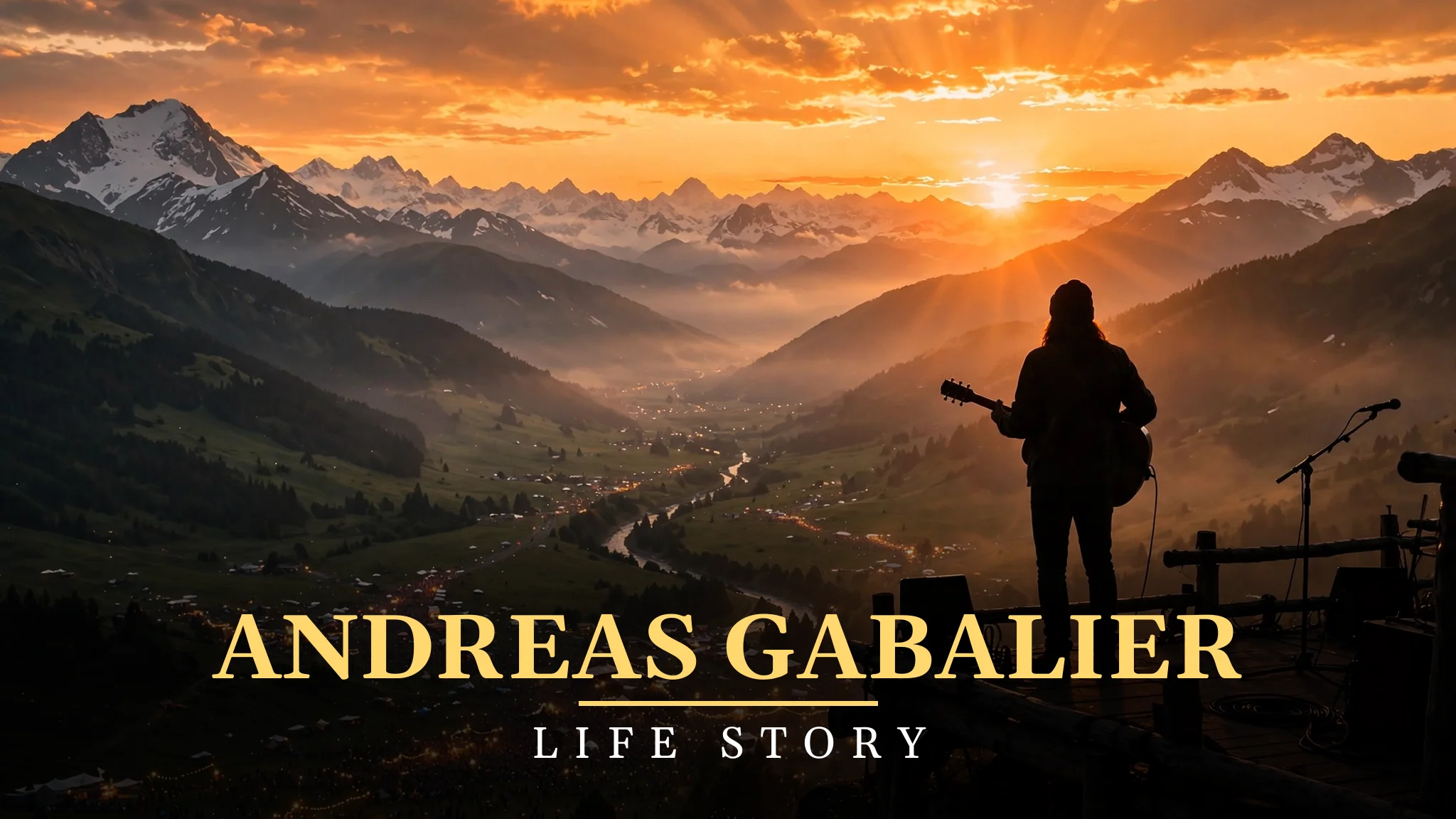
I keep thinking about the image of Andreas on a wooden stage in the mountains at sunset, looking over a valley full of lights, and I think it fits him perfectly. He is a man who stands on a mountain, who looks over his home, and who sings to the people below. He is a man who is both on stage and at home, both a star and a son of Styria, and that image captures his whole story. I wish him well, I wish him more music, and I wish him a life where he can continue to sing, to hike, and to be himself. He is a star who has stayed true, and he deserves to be celebrated for that.
In the end, I think Andreas Gabalier teaches us that home matters, that dialect matters, that family matters, and that a song sung with heart can fill a stadium. He was a boy from Friesach who became the Volks-Rock’n’Roller, who wrote songs that everyone sings, who faced loss with courage, and who stayed in the mountains he loves. He did not have a short or simple career. He had a career built on loyalty, on honesty, and on a love of home, and he is still living it. That is a legacy I respect, and a life I want to honour.
One more thought stays with me, and it is about Amoi seg’ ma uns wieder, about meeting again. I think about the people Andreas has lost, his father, his sister, and I think about the hope in that song, the hope that we will see each other again. That hope is a comfort for anyone who has lost someone, and it is a beautiful idea. Andreas gave that hope to many people through his song, and that is a gift that goes beyond music. It is a gift of comfort, of love, and of faith that love does not end with death. I am grateful for that song, and for the man who wrote it.
I think about Andreas’s fans, and I realise how much his concerts mean to them. They are not just shows. They are gatherings, festivals where thousands of people sing together, wear traditional clothes, and feel like they belong. In a world where many people feel alone, that sense of belonging is powerful, and Andreas gives it to his fans. He does not just sing to them. He sings with them, and he makes them feel like they are part of his family. That is a beautiful thing, and it is a lesson about what music can do: it can bring people together, it can make strangers feel like friends, and it can make a valley full of people feel like home.
I also think about his dialect, about singing in Styrian dialect, and about how brave that choice was. The music world often tells you to sing in a standard language, to be understood by everyone, and to forget your dialect. Andreas did the opposite. He sang in dialect, he celebrated it, and he made it famous. That tells me that your home, your language, and your story are not things to be ashamed of. They are things to be proud of, and they are what make you different. If you are proud of who you are, and you work hard, you can build a career that is true to you. Andreas did, and his career is proof.
There is a sadness in his story that I cannot ignore, the loss of his father and his sister, and the way he has spoken openly about grief. To lose a sister by suicide is a terrible thing, and to speak about it in public takes great courage. Andreas did, and he has helped other people who have faced similar pain. His song Amoi seg’ ma uns wieder, about meeting again, has helped many people who are grieving, and that shows that his music is not only about joy. His music also carries pain, hope, and the slow work of healing. I admire his courage, and I feel only compassion for him. He kept singing after loss, and that is a brave thing to do.
I think about his style, the leather trousers, the hat, the guitar, and I understand why some people love it and some debate it. It is a style that is bold, traditional, and modern at the same time, and it says something about who he is. He is a man from the mountains, a man who loves tradition, and a man who also loves rock and roll. That mix is his identity, and he wears it with pride. I think that is a good thing, because it shows that you can be many things at once: traditional and modern, folk and rock, local and famous. You do not have to choose one. You can be all of them, and Andreas is proof.
Another thought stays with me, and it is about his decision to stay in Styria. Many stars move away, they forget their home, and they become distant. Andreas stayed, and he brought the world to Styria. He showed that you can be famous and still live at home, that you can be a star and still hike in the mountains, and that you can be successful without leaving your roots. That is a lesson for young people who come from small towns: you do not have to leave to succeed. You can succeed at home, you can take your home with you, and you can make your home famous. Andreas did that, and Styria is proud of him.
I keep thinking about the image of Andreas on a wooden stage in the mountains at sunset, looking over a valley full of lights, and I think it fits him perfectly. He is a man who stands on a mountain, who looks over his home, and who sings to the people below. He is both on stage and at home, both a star and a son of Styria, and that image captures his whole story. I wish him well, and I hope he continues to sing, to hike, and to be himself for many more years.
Frequently Asked Questions
When was Andreas Gabalier born and where did he grow up?
Andreas Gabalier was born on 21 November 1984 in Friesach, Styria, Austria, and he grew up in the mountains of Styria, where he learned the guitar and began to write songs.
What does Volks-Rock’n’Roller mean?
Volks-Rock’n’Roller is the name Andreas gave to his style, which mixes folk music from the Austrian mountains with rock and roll energy. He wears leather trousers and a hat, plays guitar, and performs with a band that blends folk and rock.
What is Andreas Gabalier’s most famous song?
His most famous song is I sing a Liad für di, released in 2011, a love song in Styrian dialect that became a huge hit in Austria and is still sung at weddings and parties today.
What is Amoi seg’ ma uns wieder about?
Amoi seg’ ma uns wieder means We will see each other again sometime, and it is a song about saying goodbye, hoping to meet again, and the love that stays even when people are apart. It is often played at farewells.
Did Andreas Gabalier study law?
Yes, he studied law for a time at the University of Graz, but he left his studies to focus on music, a brave choice that led to his breakthrough as a singer.
What happened to Andreas Gabalier’s sister?
His younger sister died by suicide in 2008, a loss that broke his heart. He has spoken openly about it, and he has said that music, family, and faith helped him to keep going.
Is Andreas Gabalier still performing today?
Yes, he continues to tour, release albums, and perform in stadiums in Austria, Germany, and Switzerland, and he still lives in Styria, where he remains one of Austria’s most popular singers.


