Anita Mui: The Life Story Behind Hong Kong's Diva
In this post
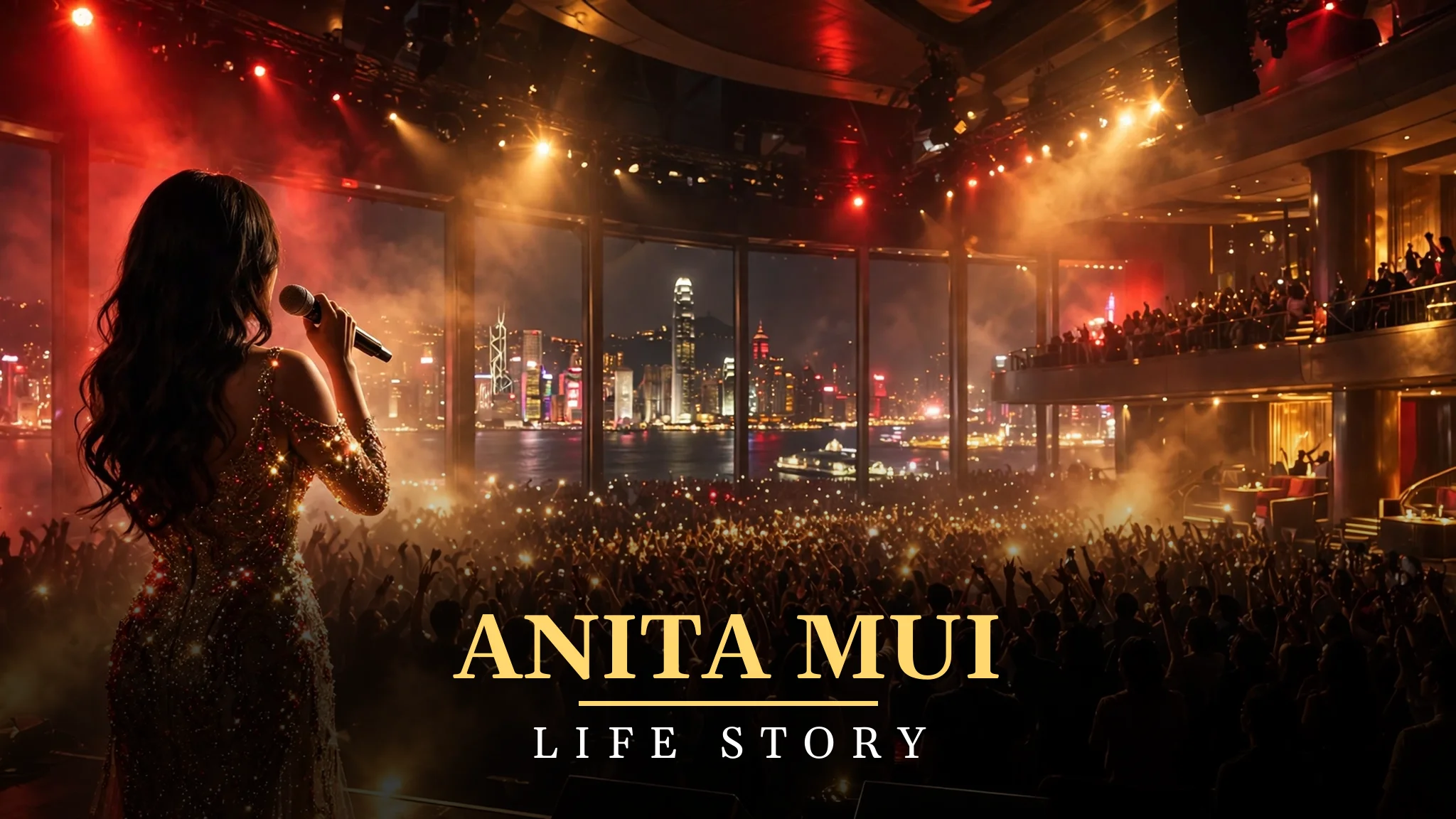
Anita Mui was the kind of star who could fill a stadium with her voice and then make a whole cinema fall silent with a single look. In Hong Kong she was known as the Madonna of Asia, not because she copied anyone, but because she had the same power to change her image, to lead fashion, and to hold a crowd in the palm of her hand. She sang, she acted, she danced, and she did it all with a boldness that few performers have ever matched. Her life was short, only forty years, but in that short life she became one of the most loved figures in the history of Hong Kong entertainment.
She was born on 10 October 1963 in Hong Kong, into a family that had very little money. Her father died when she was young, and her mother had to raise the children alone. To help the family survive, Anita began singing in nightclubs and on the streets when she was still a small child, standing beside her older sister Ann and singing for crowds of strangers. It was not a childhood of comfort. It was a childhood of work, of late nights, and of learning how to win over a room full of people who had not come to see a child. That hard start gave her a strength that never left her, and it also gave her a voice that sounded older and wiser than her years.
When she grew up, Anita Mui did not forget where she came from. She became famous, she became rich, and she became a symbol of Hong Kong itself, but she kept the toughness and the warmth of the little girl who had sung to keep her family fed. She won the top singing prize of her time, she made records that sold in huge numbers, and she starred in films that won her the highest acting awards. She also helped younger singers, she gave to charity, and she faced her final illness in public with a dignity that moved the whole city. This is the story of a girl who sang for survival and became a queen.
Singing for Survival as a Child
Anita Mui was born in Hong Kong in 1963, the youngest child in a family that struggled to make ends meet. Her father died while she was still very young, and the loss changed everything for the family. Her mother was left to bring up the children on her own, and money was always short. In a house where there was not enough to go around, the children had to grow up fast, and Anita grew up fastest of all. She learned early that life could be unfair, and she learned that the only way through was to work hard and to keep going.
When Anita was only a small girl, she began performing with her older sister Ann in nightclubs and in public places around Hong Kong. They sang popular songs for audiences who were eating, drinking, and talking, and they had to sing loudly and clearly to be heard at all. It was not glamorous work. The rooms were smoky, the hours were late, and a child singer had to be brave to stand up in front of adults and ask for their attention. Anita did it night after night, and the experience taught her things that no school could teach: how to read a crowd, how to hold a note when she was tired, and how to keep smiling when the room was not kind.
Her voice was remarkable even then. It was deep for a young girl, and it carried a feeling of sadness and strength that made people stop and listen. She sang songs that were meant for adults, and she sang them as if she understood every word, even though she was still a child. The people who heard her in those early years remembered the voice long after the night was over. She was not a child pretending to be a singer. She was a singer who happened to be a child, and the difference mattered.
School was difficult for Anita, because her work kept her out late and left little time for study. She left school early, and her education came from the stage instead. Some people might see that as a loss, but for Anita the stage was a real education. It taught her discipline, it taught her how to work with musicians, and it taught her how to survive in a hard business. By the time she was a teenager, she had already spent years in front of audiences, and she was ready for a bigger chance. That chance would come in 1982, and it would change her life in a single night.
The 1982 Contest That Changed Everything
In 1982, Anita Mui entered the first New Talent Singing Awards, a television contest in Hong Kong that was looking for new singers. She was eighteen years old, and she had already sung in more nightclubs than most adult singers ever would. She walked onto the stage with the confidence of someone who had nothing to lose, and she sang with a power that stunned the judges. She won the contest, and the win gave her a recording contract and a place in the professional music world. For a girl who had sung for survival, it was the first time that singing promised a real future.
The contest was a turning point not only for Anita but for Hong Kong music. The New Talent Singing Awards became one of the most important paths into Cantopop, and Anita’s win showed what the contest could do. She was not a polished product made by a company. She was a real singer with a real past, and the public loved her for it. Her first album came soon after, and it sold well. She had a voice that could handle fast dance songs and slow ballads, and she had a stage presence that made people watch her even when she was standing still.
In the years that followed, Anita released album after album, and each one seemed to push her further. Her 1985 album Bad Girl was a huge success, and it gave her a bold new image. The songs were daring, the clothes were daring, and the whole album felt like a statement: Anita Mui was not going to be a quiet, gentle singer. She was going to be strong, modern, and unafraid. The public loved it, and the album made her one of the biggest stars in Hong Kong. She was no longer the child singer from the nightclubs. She was a star in her own right.
By the middle of the 1980s, Anita was everywhere. She was on television, she was on the radio, she was in magazines, and her concerts drew large crowds. She became known for her changing looks, for her dramatic costumes, and for her ability to turn a concert into a piece of theatre. She was not just singing songs. She was creating a world on stage, and the audience was invited into it. That is why people began to call her the Madonna of Asia, and why the name stuck. Like the American star, she understood that a singer could be an artist, a fashion leader, and a performer all at once.
Bad Girl, Big Stages, and the Queen of Cantopop
The late 1980s were the peak years of Anita Mui’s music career, and they showed just how far she had come. She was now one of the leading singers of Cantopop, and her concerts at the Hong Kong Coliseum, the great indoor arena known as the Hung Hom, became legendary. She performed long runs of shows there, night after night, changing costumes, changing songs, and giving the audience a new experience each time. Her fans, who called themselves Mui fans with pride, filled the arena and sang along to every word. For many of them, an Anita Mui concert was the biggest night of the year.
Her music in this period was bold and varied. She sang dance songs that filled the dance floors, she sang ballads that made people cry, and she sang songs about love, about independence, and about being a woman in a fast-changing city. Her voice was deep and rich, and it carried emotion in a way that few voices could. She also worked with the best songwriters and producers in Hong Kong, and she took great care with each album. She did not release music carelessly. She chose songs that meant something to her, and she sang them as if they were her own story.
Anita was also known for her generosity to other singers. She was a mentor to many younger performers, and she used her fame to help them find their way. She was not a star who guarded her place jealously. She was a star who wanted the whole music world to grow, and she shared her stage, her advice, and her time with those who were starting out. That generosity became one of the things people loved most about her, and it is one of the reasons her name is still spoken with respect in Hong Kong music today.
By the end of the 1980s, Anita Mui had become more than a singer. She was a symbol of Hong Kong itself: tough, glamorous, hard-working, and full of heart. She had come from nothing, she had sung in nightclubs as a child, and she had become the queen of Cantopop. It was a story that Hong Kong understood deeply, because the city itself had come from nothing and built itself into a great place through hard work. Anita’s story was Hong Kong’s story, and the city loved her for it.
Rouge and a New Life in Film
While her music career was at its height, Anita Mui also became a serious film actress. She had appeared in films from the early 1980s, but her great film breakthrough came in 1987 with Rouge, directed by Stanley Kwan. In the film, she played Fleur, a courtesan from the 1930s who returns as a ghost to Hong Kong in the 1980s, searching for the lover who had promised to die with her. It was a beautiful and heartbreaking role, and Anita played it with a grace and a sadness that stunned audiences. She won the Hong Kong Film Award for Best Actress for the part, and the film became a classic of Hong Kong cinema.
Rouge showed that Anita was not just a singer who acted on the side. She was a real actress, with a gift for stillness, for longing, and for quiet pain. The film asked her to play a woman from another time, and she did it so fully that the audience forgot they were watching a pop star. Her performance in Rouge is still studied today as one of the finest in Hong Kong film, and it is the film that many people outside Hong Kong know her by. It proved that her talent went far beyond the concert stage.
She went on to make many more films, in many different styles. She starred in comedies, in action films, in dramas, and in musicals, and she brought the same energy to each one. She worked with the biggest directors and the biggest stars in Hong Kong, and she was never overshadowed. Her film career ran beside her music career, and the two fed each other. The stage taught her how to hold a crowd, and the film set taught her how to be still and let the camera find her. Together, they made her one of the most complete performers of her time.
One of her most famous film partnerships was with Leslie Cheung, her close friend and fellow star. They appeared together in Rouge, and their friendship became one of the most loved in Hong Kong entertainment. They were very different in some ways, but they understood each other, and they shared a deep respect for each other’s work. When Anita died, Leslie had already been gone for nine months, and the two losses together felt like the end of a golden age. Their friendship is still remembered as a symbol of the best of Hong Kong’s entertainment world.
She was also known for her work on television, where she appeared as a guest, as a judge, and as a performer, sharing her experience with the audience. Television in Hong Kong was a central part of daily life, and Anita’s appearances were events that families watched together. She sang, she talked, and she made people laugh, and she did it with a warmth that made viewers feel she was in their living room, not on a distant stage. That closeness to the public was one of her greatest gifts, and it is one of the reasons her fame was so deep. She was not a star who kept her distance. She was a star who came into people’s homes, and who stayed there, in their memories, long after the programme had ended.
The Final Concerts and a Brave Goodbye
In 2003, Anita Mui learned that she was seriously ill. She had cervical cancer, and the illness was advanced. She chose to face it in public, with the same honesty that had marked her whole life. She did not hide from her fans, and she did not pretend that everything was fine. Instead, she decided to give a final series of concerts in November 2003, at the Hong Kong Coliseum, the same arena where she had given so many great shows. She wanted to say goodbye to her fans in the way she knew best: on stage, singing.
Those final concerts were among the most moving events in the history of Hong Kong music. Anita was weak, and she was in pain, but she sang with all the strength she had left. She wore a white wedding dress for part of the show, a choice that moved the audience deeply, because she had never married and she said that the stage was her wedding. Fans wept, and the concerts became a farewell that no one who was there would ever forget. She gave eight concerts in all, and each one was a gift to the people who loved her.
After the concerts, Anita’s health declined quickly. She was admitted to hospital, and on 30 December 2003, she died at the age of forty. The news shocked Hong Kong, coming only nine months after the death of Leslie Cheung. The city had lost two of its greatest stars in a single year, and the grief was overwhelming. Fans gathered outside the hospital and outside the funeral hall, leaving flowers and letters, and the whole city seemed to stop. Her funeral was attended by many of the biggest names in Hong Kong entertainment, and thousands of ordinary fans lined the streets to say goodbye.
Anita’s final months showed a courage that matched her whole life. She did not spend her last days in hiding. She spent them singing, thanking her fans, and giving to charity. She set up a fund to help young people, and she spoke openly about her illness so that other women would take their health seriously. She faced death as she had faced life: with honesty, with grace, and with a deep love for the people who had supported her since she was a child singer in the nightclubs.
Helping Others and Giving Back
Anita Mui was famous, but she never forgot the little girl who had sung for money in the nightclubs, and that memory made her generous. She gave a great deal of her time and her money to charity, and she was known for helping people without making a show of it. She supported causes for children, for the elderly, and for people who were sick, and she often visited hospitals and homes for the aged to sing for people who could not come to her concerts. She did not do these things for publicity. She did them because she remembered what it was like to have nothing, and she wanted to help others who had nothing.
She was also a mentor to younger singers, and many of the stars who came after her have spoken about her kindness. She would invite young performers to her concerts, she would give them advice about singing and about life, and she would introduce them to the people who could help their careers. She was not afraid that a new singer would take her place. She believed that Hong Kong music was big enough for everyone, and that helping a young singer was part of being a star. That attitude is rare in a competitive business, and it is one of the reasons she is still loved by the people who worked with her.
Anita also used her fame to speak up for Hong Kong. She loved the city, and she was proud to be a Hong Kong singer. When the city faced difficult times, she was there, singing at charity concerts and raising money for people in need. She was a public figure who understood that fame brings a duty, and she took that duty seriously. Her charity work was not a side project. It was a central part of who she was, and it showed that her heart was as big as her voice.
In her final year, she gave even more. She set up the Anita Mui True Heart Fund to help young people, and she made sure that her final concerts raised money for good causes. She wanted her last gift to the city to be a practical one, not only a memory. That fund, and the many people she helped in her life, are part of her legacy, and they show that she was not only a great performer. She was a great neighbour, a great friend, and a great citizen of Hong Kong.
The Diva Hong Kong Still Misses
More than twenty years after her death, Anita Mui is still missed in Hong Kong, and her name is still spoken with love. Her songs are still played on the radio, her films are still shown, and young singers still study her performances to learn how a star should command a stage. In 2021, a film about her life, called Anita, was released, and it brought her story to a new generation of viewers who had never seen her live. The film was a reminder of how much she meant to the city, and how much the city still needs her example.
Her image is still everywhere in Hong Kong, in old photographs, in concert recordings, and in the memories of fans who saw her live. She is remembered as the Madonna of Asia, as the queen of Cantopop, and as the star of Rouge, but she is also remembered as a daughter of Hong Kong who never forgot her roots. She came from a poor family, she sang in nightclubs as a child, and she became a legend through talent and hard work. That journey is still an inspiration to young people in Hong Kong who come from difficult backgrounds and who dream of a better life.
The best way to meet Anita Mui today is through her work. Listen to her songs from the 1980s, especially the bold dance numbers and the deep ballads that showed her voice at its best. Watch Rouge, and see how a pop star became a great actress in a single film. Then watch the recordings of her final concerts, and see how a woman who was very ill still gave everything she had to her fans. Together, these pieces show a complete artist: a singer, an actress, a mentor, and a giver. Hong Kong has had many stars, but it has had only one Anita Mui, and the city knows it.
My Take:
When I think about Anita Mui, the first word that comes to my mind is not diva, even though that is the word the world used for her. The first word that comes to my mind is brave. She was brave as a child, standing up in a smoky nightclub and singing for strangers. She was brave as a young woman, walking onto a contest stage with nothing to lose. She was brave as a star, changing her image when others would have played it safe. And she was brave at the end, singing her final concerts while she was seriously ill. Bravery ran through her whole life like a thread, and I think that is the real story, more than the fame, more than the awards, more than the beautiful clothes.
I keep thinking about that little girl in the nightclubs, because it is easy to forget her when we see the glamorous photographs of the later Anita. She was a child, and she was working late at night in rooms full of adults. That is not a childhood any of us would choose for a child we love. Yet Anita did not grow up bitter about it. She grew up strong because of it, and she grew up generous because of it. She knew what it was like to sing for money, and so she knew what money meant to a family that had none. I think that is why she gave so much later. She was not giving from a distance. She was giving from memory. She remembered being poor, and she did not want others to feel alone in being poor. That is a lesson I carry with me: the hardest parts of our past can become the source of our kindness, if we let them.
Her win in the 1982 New Talent Singing Awards is one of my favourite parts of her story, because it shows what a single chance can do. She had sung for years in nightclubs, but no one had given her a real stage until that contest. One night, one song, one set of judges, and her life changed. I think about how many talented people never get that one chance, and I think about how ready Anita was when the chance came. She was ready because she had worked for years in the hardest school there is: the nightclub, where the audience does not care who you are and you must win them over every single night. That is a lesson for anyone who is waiting for a big break. The break matters, but the years before the break matter more, because they are the years that make you ready. Anita was ready, and when the door opened, she walked through it with her head high.
I admire her music, and I admire it for a reason that goes beyond the songs themselves. She was not afraid to be bold. Bad Girl was a bold album, and it could have failed. A woman singing daring songs in Hong Kong in 1985 was taking a risk, and Anita took it. She changed her image again and again, and she did it because she believed that an artist should grow. I think many performers are afraid to change, because they are afraid of losing the fans who loved the old image. Anita changed anyway, and her fans followed her, because they trusted her. That trust was built on talent and on honesty. She was honest with her audience, and they were loyal to her in return. I think that is a lesson for any artist, and for any person: if you are honest about who you are becoming, people will often come with you, even if the change surprises them.
Her acting in Rouge is the part of her work I find most moving. I have watched the story of Fleur many times in my mind since I first learned about it, and I keep coming back to the sadness of it. Fleur is a woman who loved so deeply that she could not let go, even after death, and Anita played her with a quiet grace that is hard to describe. She did not overact. She did not cry loudly or shout. She let the sadness sit in her eyes, in her voice, and in the way she moved. That is the hardest kind of acting, because it asks the audience to come to the character rather than the character coming to the audience. Anita did it, and she won the Best Actress award for it. I think that award meant a great deal to her, because it proved that she was not only a singer. She was an artist in the full sense of the word, and her art could live on a screen as well as on a stage.
I also think about her friendship with Leslie Cheung, because it tells us something about both of them. They were two of the biggest stars in Hong Kong, and they could have been rivals. Instead, they were close friends, and they supported each other. They worked together in Rouge, and they shared a deep respect for each other’s work. When Leslie died in April 2003, Anita lost a dear friend, and when Anita died nine months later, Hong Kong lost two of its brightest lights in a single year. I do not think it is a coincidence that they were friends. Great artists often recognise each other, and they often find comfort in each other, because only another great artist knows what the pressure feels like. Their friendship is a reminder that even the brightest stars need friends, and that rivalry is not the only way to live in a competitive world. Kindness between stars is possible, and it is beautiful when it happens.
Her final concerts are the part of her story that I find hardest to write about, because they are both inspiring and heartbreaking. She was seriously ill, she was in pain, and she still chose to sing. She wore a white wedding dress and told the audience that the stage was her wedding. That is a moment I will never forget, even though I was not there. It tells me that for Anita, the stage was not only a job. It was a home, a family, and a love. She wanted her last days to be spent with the people who loved her, doing the thing she loved most. I think that takes a kind of strength that is hard to understand unless you have faced something similar. She did not want pity. She wanted to sing, and she wanted to say thank you. That is dignity, and it is the highest kind of dignity, because it is dignity without complaint and without self-pity.
I also want to say something about her charity work, because it is easy to overlook it when we talk about stars. Anita gave to charity not as an afterthought, but as a central part of her life. She visited hospitals, she sang for old people, she helped young singers, and she set up a fund to help young people even as she was dying. That is not the behaviour of a person who only cares about fame. It is the behaviour of a person who remembers where she came from and who wants to leave the world a little better than she found it. I think we should judge stars not only by their work, but by their giving, and by that measure Anita Mui was one of the greatest. She gave her voice, she gave her time, and she gave her money, and she did it quietly, without asking for praise.
What I learn from Anita Mui, in the end, is that a hard start does not have to mean a hard heart. She had every reason to become bitter, to become selfish, to become closed. Instead, she became open, generous, and brave. She turned a childhood of work into a life of art, and she turned fame into a chance to help others. She also teaches me that we should take our health seriously, and that we should support the people we love when they are ill, because even the strongest stars need care. Her death from cervical cancer at forty is a reminder that life is short, and that we should not wait to do the things that matter. She did not wait. She sang, she acted, she gave, and she loved, all in forty short years, and she left a mark that is still visible today.
If I could speak to a young person who is just finding Anita Mui now, I would say this. Listen to her songs, and hear the strength in her voice. Watch Rouge, and see the grace in her acting. Learn about her childhood, and understand where that strength came from. Then think about your own life, and about the chances you have been given, and about the people you can help. Anita’s story is not only about a star. It is about a girl who worked hard, who stayed kind, and who never forgot her roots. That is a story worth remembering, and a life worth honouring.
I will remember Anita Mui as the queen of Cantopop, as the star of Rouge, and as the brave girl from the nightclubs who became the heart of Hong Kong. She sang for survival, she sang for joy, and she sang her goodbye with grace. Her voice is still with us, and her example is still with us, and that is why, more than twenty years after her death, Hong Kong still misses her and still loves her. I also think about her costumes, because Anita understood that a concert is not only about sound, but also about sight. She wore dresses that were bold, dramatic, and unforgettable, and she changed them again and again during a single show, so that the audience never knew what would come next. Her clothes were not vanity. They were part of the story she was telling, and each costume was a new character, a new mood, a new feeling. I think about the young designers in Hong Kong who still study her concert photographs, and I realise that she changed fashion in the city, not only on stage, but in the streets, where young women copied her style. She taught Hong Kong that a woman could dress boldly, could be strong and glamorous at the same time, and could use fashion as a way of saying who she was. That is a gift, and it is one that still lives in the city’s streets today.
Her work as a mentor is another part of her story that I admire deeply, because she did not keep her fame to herself. She invited young singers to her concerts, she gave them advice, and she introduced them to the people who could help their careers. She was not afraid that a new singer would take her place. She believed that Hong Kong music was big enough for everyone, and that helping a young singer was part of being a star. I think about the young performers who listened to her, and who went on to build their own careers, and I see that Anita’s influence goes far beyond her own songs. She helped to shape the next generation, and she did it with kindness, not with pride. That is a legacy that will outlast any single album, because it lives in other people’s lives, and in the music they make.
The white wedding dress she wore in her final concerts is an image I will never forget, even though I was not there. She had never married, and she told the audience that the stage was her wedding. That is a moment of extraordinary honesty, because it says that for Anita, the stage was not only a job. It was a love, a home, and a family. She wanted her last days to be spent with the people who loved her, doing the thing she loved most, and she wanted to say thank you in the most beautiful way she knew. I think about the fans who were in that arena, weeping as she sang in white, and I realise that a farewell can be a gift, if it is given with love. She did not want pity. She wanted to sing, and she wanted to be remembered singing, in a white dress, under the lights, with her voice still strong.
I also think about her charity fund, and about the practical good she wanted to leave behind. She set up the Anita Mui True Heart Fund to help young people, and she made sure that her final concerts raised money for good causes. She wanted her last gift to the city to be a practical one, not only a memory. That tells me who she was: a person who remembered being poor, who remembered singing for money as a child, and who wanted to help young people who had nothing. She was not giving from a distance. She was giving from memory, and that is the most honest kind of giving. I think about the young people who have been helped by her fund, and I see that her generosity is still working, even after her death, and that is a beautiful thing.
There is also something in her story about being a daughter of Hong Kong, and about what that means. She was born in the city, she grew up in its nightclubs, she became its queen, and she died in its hospital, and through it all she never left Hong Kong behind. She loved the city, and the city loved her, and that love was mutual, not one-sided. When the city faced difficult times, she was there, singing at charity concerts and raising money for people in need. She was a public figure who understood that fame brings a duty, and she took that duty seriously. I think about the stars who leave their city when they become famous, and I admire Anita for staying, for singing for Hong Kong, and for giving back to the place that made her. That loyalty is rare, and it is one of the reasons her name is still spoken with love in the city today.
Finally, I think about the film about her life that was released in 2021, and about the new generation of viewers who found her through it. They had never seen her live, they had never heard her sing in a concert hall, and yet they fell in love with her story, because it is a story that speaks to anyone who has come from nothing and who has worked hard. I think about a young person watching that film today, and feeling that Anita’s life is possible for them too, and I realise that her story is still doing work, still inspiring, still giving hope. That is what a legend truly is: not a person who was famous, but a person whose story keeps reaching new hearts, long after they are gone. Anita’s story does that, and it will keep doing it for many years to come.
Frequently Asked Questions
How did Anita Mui begin singing when she was still a child?
Anita Mui began singing as a small child with her older sister Ann in Hong Kong nightclubs, performing popular songs for adult audiences to help support her family after her father died when she was young.
What song made Anita Mui a star in the 1980s?
Anita Mui became a major star after winning the 1982 New Talent Singing Awards, and her 1985 album Bad Girl, with its bold songs and daring image, made her one of the leading singers of Cantopop.
Why did people call Anita Mui the Madonna of Asia?
People called Anita Mui the Madonna of Asia because, like the American star, she constantly changed her image and fashion, led trends, and turned her concerts into bold theatrical shows that went far beyond simple singing.
Which film won Anita Mui her Best Actress award?
Anita Mui won the Hong Kong Film Award for Best Actress for Rouge, a 1987 film directed by Stanley Kwan in which she played Fleur, a courtesan from the 1930s who returns as a ghost to search for her lost lover.
What were Anita Mui’s final concerts in 2003?
Anita Mui gave a final series of eight concerts at the Hong Kong Coliseum in November 2003 while seriously ill with cancer, wearing a white wedding dress for part of the show and saying the stage was her wedding.
How is Anita Mui remembered in Hong Kong today?
Anita Mui is remembered in Hong Kong through her songs and films, through a 2021 film about her life, and through her charity fund, and fans still honour her as the queen of Cantopop and one of the city’s greatest stars.


