Anthony Quinn: The Life Story Behind the Zorba Star
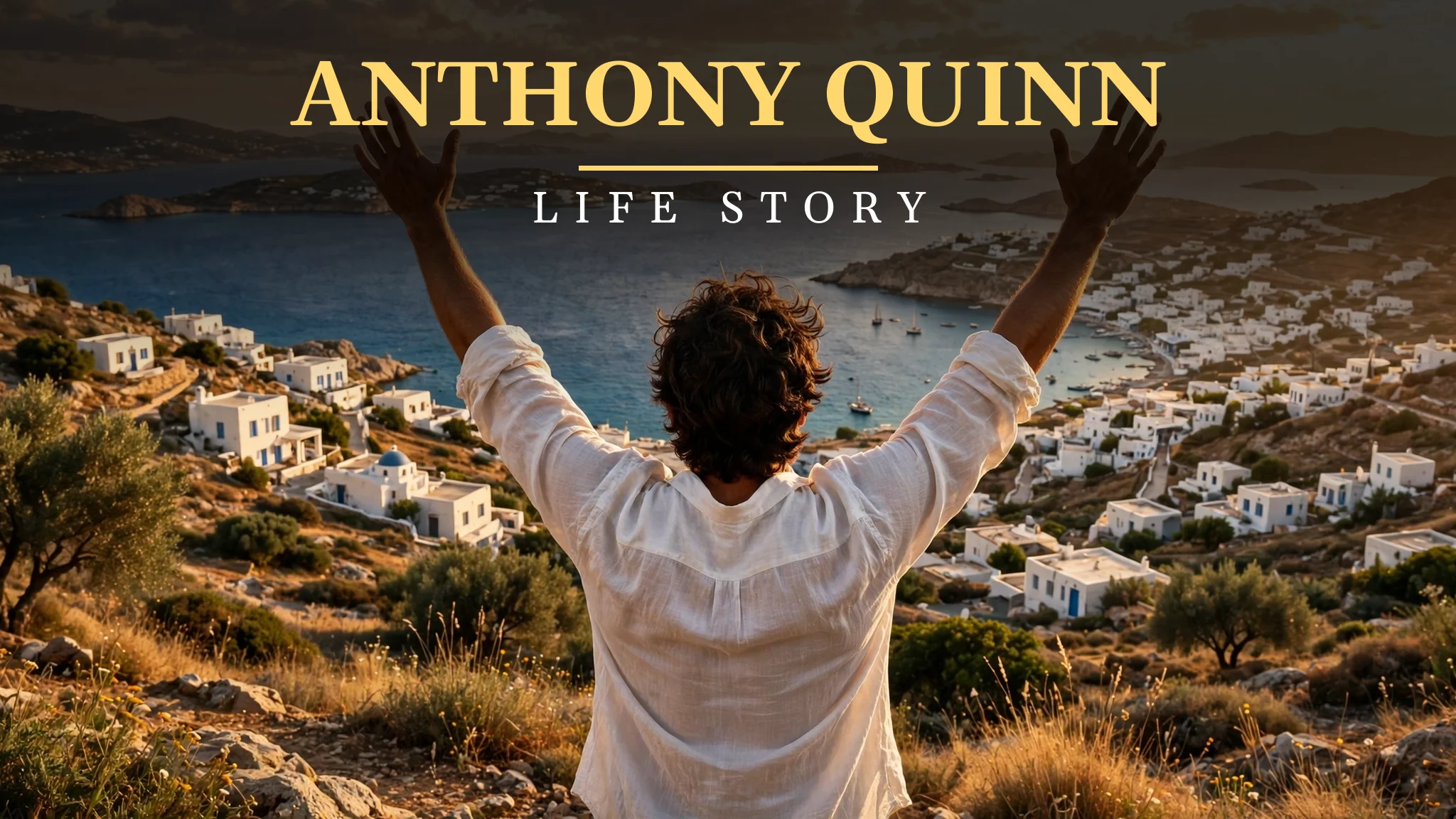
In this post
Anthony Quinn had a face that seemed to carry several countries at once, and a voice that could fill a room without ever rising to a shout. When people picture him now, they often picture the same scene: a broad, laughing man dancing on a Greek beach in Zorba the Greek, arms wide, feet stamping the sand, as if joy itself had taken human form. That picture is real, and it earned him a place in film history, but it is only one part of a life that stretched across Mexico, the United States, Italy, Greece and France, and across more than sixty years of acting, painting and sculpture.
He was not born into comfort, and he was not handed a career. He crossed borders as a child, worked with his hands, lost his father young, and came to acting late, after trying other ways to earn a living. He played Mexicans, Greeks, Italians, Arabs, Frenchmen and Russians, and he played them with a force that made audiences forget the question of where he was really from. Some of that casting would be judged very differently today, and it is worth saying so plainly, because Quinn himself talked about it. Yet the work lasted, and the two Academy Awards he won were for performances that few actors could have given.
What follows is the story of a man who refused to stay in one box. He was a son of the Mexican Revolution, a Hollywood character actor, a leading man in Europe, a painter who exhibited his work around the world, and a father of many children whose family life was as full and as complicated as his films. He kept working into his eighties, and he kept insisting that art was not a job for him but a way of living.
A Child of the Revolution in Chihuahua
Anthony Quinn was born on 21 April 1915 in Chihuahua, in northern Mexico, during the years of the Mexican Revolution. His father, Francisco Quinn, was of Irish and Mexican heritage, and his mother, Manuela Oaxaca, was Mexican. The family lived in a country that was changing fast, and in which ordinary people often had to move to survive. When Anthony was still small, the family crossed into the United States, settling first in Texas and then in California. The move shaped everything that came after, because Quinn grew up between two languages, two cultures and two ideas of home.
Life in California was not easy. The family was poor, and Anthony learned early that money had to be earned by hand. He worked at many small jobs as a boy, and he understood the value of hard work long before he understood the value of fame. His father died when Anthony was still young, and the loss left a mark on him. He later spoke of his father with warmth and with sadness, and the absence of that steady presence pushed him to grow up faster than many boys his age.
School was not the centre of his life. He was restless, physical and curious, and he liked to draw and to make things. He also liked to listen to stories, and he had a natural gift for imitating people, for changing his voice and his walk, for becoming someone else for a few minutes at a time. It was not yet acting. It was a child finding a way to be noticed in a crowded, hard world, and to make people laugh when there was not much to laugh about.
As a teenager in Los Angeles, Quinn tried his hand at several trades. He worked as a boxer for a time, and he learned what it felt like to be hit, to get up, and to keep going. He also studied architecture for a while, and the training stayed with him in an unexpected way. He learned to think about shape, space and structure, and years later, when he began to paint and sculpt seriously, that early interest in building things came back to him. Nothing in his early life pointed in a straight line towards Hollywood, and that may be why his acting never felt narrow or rehearsed.
What his childhood did give him was a deep sense of place. He knew what it was to be an outsider in America, to be judged by an accent or a surname, and to be told, in small and large ways, that he did not quite belong. He also knew what it was to belong to Mexico, to a family, to a language and a history that were older than any film studio. That double belonging became the engine of his career. He could play a man from almost anywhere because he had lived as a man from more than one place himself.
Los Angeles, Odd Jobs and a Chance at the Stage
Quinn came to acting through a side door. He was working in Los Angeles and taking classes when he began to be noticed for his size, his voice and his presence. He was a large man, strong and broad, and directors saw in him a kind of raw power that was hard to teach. His first film work came in the 1930s, in small parts that used him as a tough man, a sailor, a bandit or a foreigner. The parts were often short, and the characters were often thin, but Quinn treated each one as a chance to learn how a camera worked and how a scene was built.
He also found his way to the stage, and the stage taught him more than the early films did. On stage, there was no camera to cut away to, and no second take. An actor had to hold a room, remember lines, listen to other actors, and keep going when something went wrong. Quinn worked hard at that craft, and he began to be taken seriously by people who had first seen him only as a physical type. He married Katherine DeMille, the adopted daughter of the great director Cecil B. DeMille, in 1937, and the connection brought him closer to the centre of Hollywood, though it did not make his path easy. He still had to prove himself in every part.
The 1930s and early 1940s were years of learning. Quinn appeared in films such as The Plainsman and other studio pictures of the time, often in roles that asked him to be menacing or exotic rather than human. He did not like being limited in that way, but he understood that a working actor in that era had to take the work that was offered. He watched the leading actors of the day, studied how they moved and spoke, and began to build a method of his own, one that relied on instinct, on the body, and on a willingness to be large on screen without losing the small, true details.
There were also years when work was scarce, and when the roles dried up, Quinn turned to other things. He painted. He drew. He thought about the world beyond the studio gates. That habit of turning to art when acting was slow would stay with him for the rest of his life, and it kept him from becoming bitter about the parts he was not given. He was not only an actor waiting for a phone call. He was a man with a second life in a studio of his own, and that second life gave him a steadiness that many actors of his generation lacked.
By the end of the 1940s, he was ready for something bigger. He had the craft, the experience and the hunger, and he had a face that audiences remembered even when the part was small. What he needed was a role that would let him show the full range of what he could do, and that role was coming, though it would arrive in a form he had not expected.
Viva Zapata and the First Oscar
The turning point came with Viva Zapata! in 1952, a film about the Mexican revolutionary Emiliano Zapata, directed by Elia Kazan and starring Marlon Brando in the lead role. Quinn played Eufemio Zapata, the brother of the hero, a man who is brave and loyal but also rough, greedy and flawed. It was not a simple hero’s part, and that was exactly why it suited Quinn. He played Eufemio as a real man, not a symbol, a man who loved his brother, loved the land, and loved the rewards of power a little too much.
The performance won Quinn the Academy Award for Best Supporting Actor, his first Oscar. It was a remarkable moment, because he was playing a Mexican character in a film about Mexico, and he brought to it a knowledge that came from his own family history. He knew the sound of the language, the feel of the land, and the weight of a revolution that had shaped his parents’ lives. Audiences and critics could feel that knowledge, even if they could not name it, and the award confirmed what many in Hollywood had begun to suspect: Quinn was not a supporting player by nature. He was a leading actor waiting for the right part.
The Oscar changed the way studios saw him, but it did not change him overnight. He continued to take a wide range of roles, in American films and in European films, and he continued to be cast as men from many different countries. He played in La Strada in 1954, the Italian film directed by Federico Fellini, in which he was Zampano, a brutal strongman who travels with a young woman played by Giulietta Masina. The film was a great success, and it showed a different side of Quinn, a side that was quieter, crueller and more tragic than the warm, laughing man audiences would later love in Zorba.
In 1956, he won his second Academy Award for Best Supporting Actor, for Lust for Life, in which he played the painter Paul Gauguin opposite Kirk Douglas as Vincent van Gogh. The part was short, but Quinn made it unforgettable, playing Gauguin as a man of great confidence and great selfishness, a man who could inspire and wound in the same breath. Two Oscars in five years was a rare achievement, and it placed Quinn among the most respected actors of his time. Yet he was still not a conventional leading man in Hollywood, and the biggest roles often went to others.
He did not complain in public about that, at least not in a way that stopped him working. He went where the good parts were, and in the 1950s and early 1960s, many of the good parts were in Europe. He worked in Italy, in France and in Greece, and he learned to work in different languages and different film cultures. That willingness to travel, to learn and to adapt became one of the defining features of his career, and it prepared him for the role that would make him famous around the world.
The Big Epics and the Road to Greece
In the early 1960s, Quinn appeared in some of the largest films of the era. He was in The Guns of Navarone in 1961, a war adventure about a team of Allied soldiers sent to destroy a German gun position on a Greek island, and he was in Lawrence of Arabia in 1962, David Lean’s great desert epic, in which he played Auda abu Tayi, a Bedouin leader. Both films were huge in scale, shot in real landscapes, with large casts and long schedules, and Quinn thrived in that world. He liked the physical work, the heat, the dust, the long days on location, and the sense that a film could be as large as the landscape it was shot in.
Lawrence of Arabia in particular showed how far he had come. He was acting alongside Peter O’Toole, Omar Sharif and Alec Guinness, in a film that would be remembered as one of the greatest ever made, and he held his own. His Auda was proud, shrewd and dangerous, a man who could change sides when it suited him and who understood power in a way the British officers did not. It was not a soft performance, and it was not meant to be. Quinn understood that some men in history were not heroes in the simple sense, and he was willing to play them as they were.
These epic films also brought him to Greece, to the islands and the sea, to a culture that felt, in some ways, close to his own. He liked the food, the music, the warmth of the people, and the way life was lived outdoors, in the open air. He liked the idea that a man could be judged by his actions and his generosity rather than by his paperwork. It was in that world, a few years later, that he would find the part that would define him for the rest of his life.
Before that part arrived, Quinn continued to work steadily, in films that ranged from westerns to dramas to adventures. He was a working actor in the truest sense, and he did not wait for perfect scripts. He believed that a good actor could find something true even in an ordinary part, and that a bad film could still teach you something about your craft. That attitude kept him employed, kept him learning, and kept him ready when the right director and the right story came along.
He was also, by now, a family man with a large and growing family, and the demands of that life pushed him to keep working. He had children from his marriage to Katherine DeMille, and later from other relationships, and he took his responsibilities seriously, even when his personal life was complicated. He was not a man who lived only for himself, and the weight of providing for a large family was part of what drove him to take on so much work, in so many places, for so many years.
Zorba the Greek and a Dance That Never Stopped
In 1964, Quinn played Alexis Zorba in Zorba the Greek, directed by Michael Cacoyannis and based on the novel by Nikos Kazantzakis. The story is simple on the surface: a young English writer, played by Alan Bates, comes to Crete to work in a mine, and he meets Zorba, an older man who lives by his senses, by music, by dance, by food and by love, and who teaches the younger man to live more fully. Quinn played Zorba as a force of nature, a man who could laugh, cry, dance and mourn in the same afternoon, and who refused to let fear or sadness have the last word.
The film was a great success, and Quinn was nominated for the Academy Award for Best Actor, though he did not win. It did not matter. The performance became his signature, and the dance at the end of the film, the sirtaki on the beach, became one of the most famous scenes in cinema. People who had never seen the film knew the music, knew the dance, and knew the name Zorba. Quinn had become, in the eyes of the world, the embodiment of a certain kind of joy, a joy that was not naive but hard-won, a joy that came from a man who had known loss and had chosen to dance anyway.
The success of Zorba changed his life in a practical way as well. He was now a star in the full sense, a man whose name could sell a film, and he used that freedom to choose parts that interested him. He continued to work in Europe and in America, and he continued to play men of many nations, from a pope to a Bedouin chief to a Mexican general. Some of those films were good, and some were not, but Quinn brought the same energy to each one, and audiences could always tell when he was on screen.
He also became, in Greece, a beloved figure. The Greek people took Zorba to heart, and Quinn took Greece to heart in return. He spent time there, he learned the language in his own way, and he became a part of the country’s cultural life. It was a rare thing for an actor to be adopted by a country that was not his own, and it said something about the honesty of his performance. He had not played a Greek man as a costume. He had played a human being who happened to be Greek, and the Greek audience recognised the truth in it.
In the years after Zorba, Quinn’s career continued at a fast pace. He made films in the late 1960s and through the 1970s, often playing strong, older men, men who had seen the world and who had opinions about it. He was not afraid to be unlikable on screen, and he was not afraid to be funny. That range, from comedy to tragedy, from warmth to menace, was what kept him working when many actors of his generation had retired or been forgotten.
Painting, Sculpture and a Second Career
What many people did not know about Quinn, even at the height of his fame, was that he was also a serious artist. He had drawn since childhood, and he had studied architecture, and in his adult life he painted and sculpted with the same energy he brought to acting. His paintings were often bold and colourful, full of strong shapes and strong feelings, and his sculptures were large and physical, made to be touched and walked around. He exhibited his work in galleries in the United States, in Europe and in Mexico, and he was taken seriously as an artist, not only as an actor who painted as a hobby.
Art gave him a freedom that acting did not always give him. In a film, an actor is part of a large team, and the final result belongs to many people. In a studio, Quinn was alone with his materials, and the work was his own from start to finish. He liked that solitude, and he liked the physical work of shaping clay and stone, of mixing paint and seeing a picture grow. It was a different kind of performance, quieter and slower, but it came from the same place: a need to make something real with his hands.
He also wrote, and in his later years he published books about his life, in which he spoke openly about his family, his marriages, his children, and his mistakes. He did not present himself as a perfect man, and he did not hide the difficult parts of his story. He wrote about love and loss, about work and art, about being a father and about being a son, and readers found in those books a man who was thoughtful, funny and honest about his own failings. The books added a new layer to his public image, and they showed that Quinn was not only a performer but a thinker, a man who had spent a lifetime trying to understand his own life.
His family life was large and complex. He had many children, and he was proud of them, though his relationships with them, like his marriages, were not always simple. He married Katherine DeMille in 1937, and they had children together before the marriage ended. He later had children with other partners, and in his later years he married Kathy Benvin, with whom he had two children. He spoke of his children with love, and he tried, in his own way, to be present for them, even when work took him far from home. The size of his family, and the love he felt for it, was a central part of who he was.
By the 1980s, Quinn was in his late sixties and early seventies, but he was still working, still painting, and still travelling. He appeared in films and on television, he took on stage roles, and he continued to exhibit his art. He did not slow down in the way many people expected him to, and he did not talk about retirement as if it were a goal. Work was, for him, a way of staying alive, of staying in touch with the world, and of staying true to himself.
The Last Years and a Life That Kept Growing
In his final decades, Quinn returned to some of the places and stories that had shaped him. He played older men, men with authority and with regrets, men who had lived long enough to know what mattered and what did not. He appeared in films such as A Walk in the Clouds in 1995, in which he played a vineyard owner, a part that suited his age and his warmth, and he continued to take on television work that brought him to new audiences. He was, by now, a living link to the golden age of Hollywood, a man who had worked with directors and actors from a world that had largely passed away.
He also continued to paint and sculpt, and his art became more personal in his later years. He painted portraits of his family, landscapes from his travels, and images that reflected his Mexican heritage. He was proud of his roots, and he never forgot where he had come from, even when he was living in Rome or in Los Angeles or in New York. He spoke Spanish, he loved Mexican food and music, and he kept in touch with the country of his birth throughout his life.
His health began to fail in his eighties, but he kept working as long as he could. He died on 3 June 2001 in Boston, at the age of 86. The news was reported around the world, and the tributes that followed spoke of Zorba, of the Oscars, of the great films, and of the man behind them: a man who had crossed borders, who had worked hard, who had loved widely, and who had never stopped making art. He was buried, in the end, as he had lived, as a man of many places, and as a man whose life could not be reduced to a single country or a single role.
His legacy is not only in the films. It is in the example he set for actors who came from outside the usual Hollywood mould, for Mexican-American actors, for actors who spoke with an accent, for actors who were told they were too big, too foreign, too rough, or too old. Quinn proved that a man could be all of those things and still be a star, still win Oscars, still be loved by audiences in many countries, and still be remembered for joy as much as for skill. The dance on the beach in Zorba the Greek continues, in a way, every time someone watches that film and feels a little braver about living fully.
My Take:
I have to be honest when I say that Anthony Quinn is one of those actors I admired long before I understood why. When I first saw Zorba the Greek, I thought the joy in it was simple, the kind of joy that comes easily to a man who has never been hurt. I was wrong about that, and the more I learned about Quinn’s life, the more I saw that the joy in Zorba was not simple at all. It was the joy of a man who had known poverty, who had lost his father, who had worked with his hands, who had been told he did not belong, and who had decided to live fully anyway. That is a different kind of joy, and it is much harder to fake.
What I admire most about Quinn is that he did not let Hollywood decide who he was. Hollywood in his time had very narrow ideas about what a Mexican actor could be, and Quinn was offered, again and again, the same small, hard, foreign parts. He took them, because he needed the work, but he did not accept them as his limit. He learned his craft, he went to the stage, he went to Europe, he worked with Fellini and Kazan and Lean, and he built a career that was bigger than any one studio’s idea of him. That takes a stubborn kind of courage, the kind that does not shout but keeps going, year after year, until the world has to see you differently.
I also think about his two Oscars, and about how strange it is that both were for supporting roles. He won for Viva Zapata! and for Lust for Life, and both performances were short, sharp and unforgettable. I think that says something important about Quinn. He did not need to be the centre of every scene to be the most memorable person in it. He could enter a film, change its temperature, and leave, and audiences would remember him long after the leading man had faded. That is a gift, but it is also a choice. He chose to serve the story, not his own ego, and that choice made his work last.
There is a part of his story that makes me uncomfortable, and I want to name it plainly, because pretending it is not there would be dishonest. Quinn played men from many countries, and in his time that was normal in Hollywood. Today, we would ask harder questions about who should play whom, and we would be right to ask them. I do not think Quinn was trying to take work from others. I think he was a man from two cultures trying to find a place in a business that did not know what to do with him. But I also think it is fair to say that some of his casting would not happen now, and that the change is a good one. Admiring his talent does not mean defending every choice the studios made around him.
What moves me most is his second life as a painter and sculptor. I love the idea that a man who was famous for being loud on screen could go into a quiet studio and make something with his hands, something that belonged only to him. It tells me that Quinn did not see himself as only an actor. He saw himself as an artist, in the broadest sense, and he needed more than one way to say what he felt. I think many people live like that, with a public job and a private art, and they are often told that the private art does not count. Quinn proved that it does count, and that it can be serious, and that it can be shown in galleries and taken seriously by strangers.
I think about his childhood a lot, because it explains so much. A boy who crosses a border, who loses his father, who works as a boxer and studies architecture, who draws in notebooks and listens to stories, is a boy who is learning to survive by paying attention. Quinn paid attention for his whole life. He paid attention to the way people walked, to the way they spoke, to the way they held a glass or a tool, and he put all of that into his acting. That is why his performances feel real even when the films around them are not. He was not inventing a character from nothing. He was remembering people he had known, and letting them live again on screen.
His family life is the part of his story I find hardest to judge, and I do not want to judge it simply. He had many children, and he loved them, and his marriages and relationships were complicated, as human lives often are. I think it is easy, from a distance, to say that a man who travelled so much and worked so much must have been absent, and there may be truth in that. But I also think it is easy to forget how hard it is to provide for a large family in a business as uncertain as film, and how much Quinn worked to do exactly that. I do not want to excuse him, and I do not want to condemn him. I want to say that he was a man, not a saint, and that his love for his family and his failures as a father can both be true at the same time.
The dance in Zorba stays with me because it is not a dance of triumph. It happens after loss, after a mine has failed, after a woman has died, after hope has been tested. Zorba dances anyway, and he invites the younger man to dance with him, not because the world is good, but because dancing is a way of saying that you are still alive. I think that is the heart of Quinn’s message, if he had one. Life will hurt you. Work will disappoint you. People will leave you. Dance anyway. Paint anyway. Work anyway. Love anyway. That is not a cheerful slogan. It is a hard, practical kind of hope, and I find it more useful than most of the easy advice I hear.
I also admire the way he aged. He did not try to stay young on screen, and he did not pretend that his best years were behind him. He played older men with dignity, he took on parts that suited his age, and he kept painting and writing into his eighties. There is a lesson in that for anyone who is afraid of getting older. Quinn did not fight age. He used it. He let his face carry the years, and he let his work carry the weight of a long life. I think that is a braver choice than trying to look thirty forever, and it is a choice that more actors should make.
If I could ask him one question, I would ask him what he felt when he first heard the music of Zorba, when he first understood that a film about a Greek man and an English writer would become a part of the world’s imagination. I wonder if he knew, in that moment, that he would be remembered for that dance for the rest of his life, and I wonder if he minded. I suspect he did not mind, because he knew that Zorba was not a mask. Zorba was a part of him, the part that loved food and music and the sea, the part that had survived and still wanted to celebrate. To be remembered for your joy is not a small thing. It is a rare and generous legacy.
I think his story matters for people who come from two places, who speak two languages, who are told they are too much of one thing and not enough of another. Quinn lived that life openly, and he turned it into art. He did not choose one side and abandon the other. He kept both, and he let both show in his work. That is a lesson I would pass on to any young person who feels caught between worlds. You do not have to choose. You can carry both worlds with you, and you can make something new from the space between them.
In the end, I do not think of Anthony Quinn as only Zorba, though Zorba is the image that will last. I think of him as a worker, a man who used his hands, his voice, his body and his brush to make a life out of very little. He started with almost nothing, in a country at war, and he ended with Oscars, with paintings in galleries, with children and grandchildren, and with a dance that people still copy on beaches and at weddings. That is not a perfect life, and it was not an easy life, but it was a full life, and it was lived on his own terms. I admire that, and I think it is worth remembering, not only for the films, but for the man who made them.
I also think about Quinn as a painter, and I want to spend more time on that, because it is easy to treat his painting as a hobby, and it was not a hobby. He exhibited, he sold, he was taken seriously, and he worked at it with the same discipline he brought to a film set. His paintings were bold, his sculptures were large, and they came from a man who had studied architecture, who understood shape, and who needed to make things with his hands. I think that need, to make something physical, is something many actors share, and few talk about. Acting is fleeting, a performance happens and then it is gone, but a painting stays, a sculpture stays, and Quinn, who had spent his life in a business where a film could be cut, a part could be lost, a career could fade, wanted something that would stay. His art stayed, and it is still, today, in galleries and in private collections, a quieter legacy than Zorba, but a real one.
There is another part of his story I keep returning to, and that is his language. He spoke Spanish and English, he moved between Mexico and the United States, and he understood, in a way that few Hollywood stars did, what it is to live in two languages, to dream in one and work in another, to be, in one country, a foreigner, and in another, a son. That double life gave his acting a depth that a monolingual actor could not easily copy, because he knew, from his own body, what it felt like to translate yourself, to change your voice, to change your manners, to fit in, and to decide, in the end, not to fit in completely, but to keep both languages, both cultures, both homes. I think that is a lesson for anyone who lives between worlds, and there are many of us now, in a world of migration, of mixed families, of two passports and two homes.
I also want to say something about his age, about working into his eighties, because it is easy to admire a young star and hard to admire an old one, and Quinn was, in his eighties, still working, still painting, still travelling, still learning. He did not retire to a quiet life, he did not stop, and I think that is because work, for him, was not a job but a habit, a way of being alive, a way of staying in the world. Many people, when they get old, are told to slow down, to rest, to enjoy retirement, and Quinn, in his own way, said no to that, not by shouting, but by continuing to show up, to paint, to act, to live. I find that inspiring, not because everyone should work until they die, but because everyone should be allowed to choose, to keep doing what they love, for as long as they love it, without being told that they are too old.
Finally, I think about the dance, and I will end where I began, with Zorba on the beach, because that dance is, for me, the image that sums up Quinn’s life. It is not a dance of a young man, it is a dance of an older man, a man who has lost, who has failed, who has been hurt, and who dances anyway, who invites a younger man to dance with him, who says, in movement, what words cannot say: that life is hard, that loss is real, and that joy, even after loss, is possible, and is worth choosing. I have watched that scene many times, and every time, I feel a little braver, a little more willing to dance, in my own life, in my own way, even when the mine has failed, even when the woman has died, even when hope seems thin. That is Quinn’s gift, and it is a gift I carry with me, long after the film ends.
Frequently Asked Questions
Where was Anthony Quinn born and when did he move to the United States?
Anthony Quinn was born on 21 April 1915 in Chihuahua, Mexico, during the Mexican Revolution. His family moved to the United States when he was still a small child, first to Texas and then to California, where he grew up between Mexican and American cultures.
For which films did Anthony Quinn win his two Academy Awards?
He won Best Supporting Actor for Viva Zapata! in 1952, playing Eufemio Zapata, and again for Lust for Life in 1956, playing the painter Paul Gauguin. He was later nominated for Best Actor for Zorba the Greek, but he did not win that award.
What made his performance in Zorba the Greek so famous?
He played Alexis Zorba as a joyful, earthy man who teaches a young English writer to live fully, and the final dance on the beach, set to music that became world-famous, turned the film into a lasting image of freedom and celebration.
Did Anthony Quinn really paint and sculpt as well as act?
Yes, he painted and sculpted seriously throughout his adult life, and he exhibited his work in galleries in the United States, Europe and Mexico. He had studied architecture as a young man, and art gave him a private creative life away from film sets.
Which other major films did Anthony Quinn appear in?
His best-known films include La Strada, The Guns of Navarone, Lawrence of Arabia, in which he played Auda abu Tayi, and A Walk in the Clouds in his later years, alongside many westerns, dramas and European films.
When did Anthony Quinn die and how old was he?
He died on 3 June 2001 in Boston, at the age of 86, after a long career in film, on stage, and as a painter and sculptor that had lasted for more than sixty years.


