Apocalyptica: The Life Story Behind Finland's Cello Metal Band
In this post
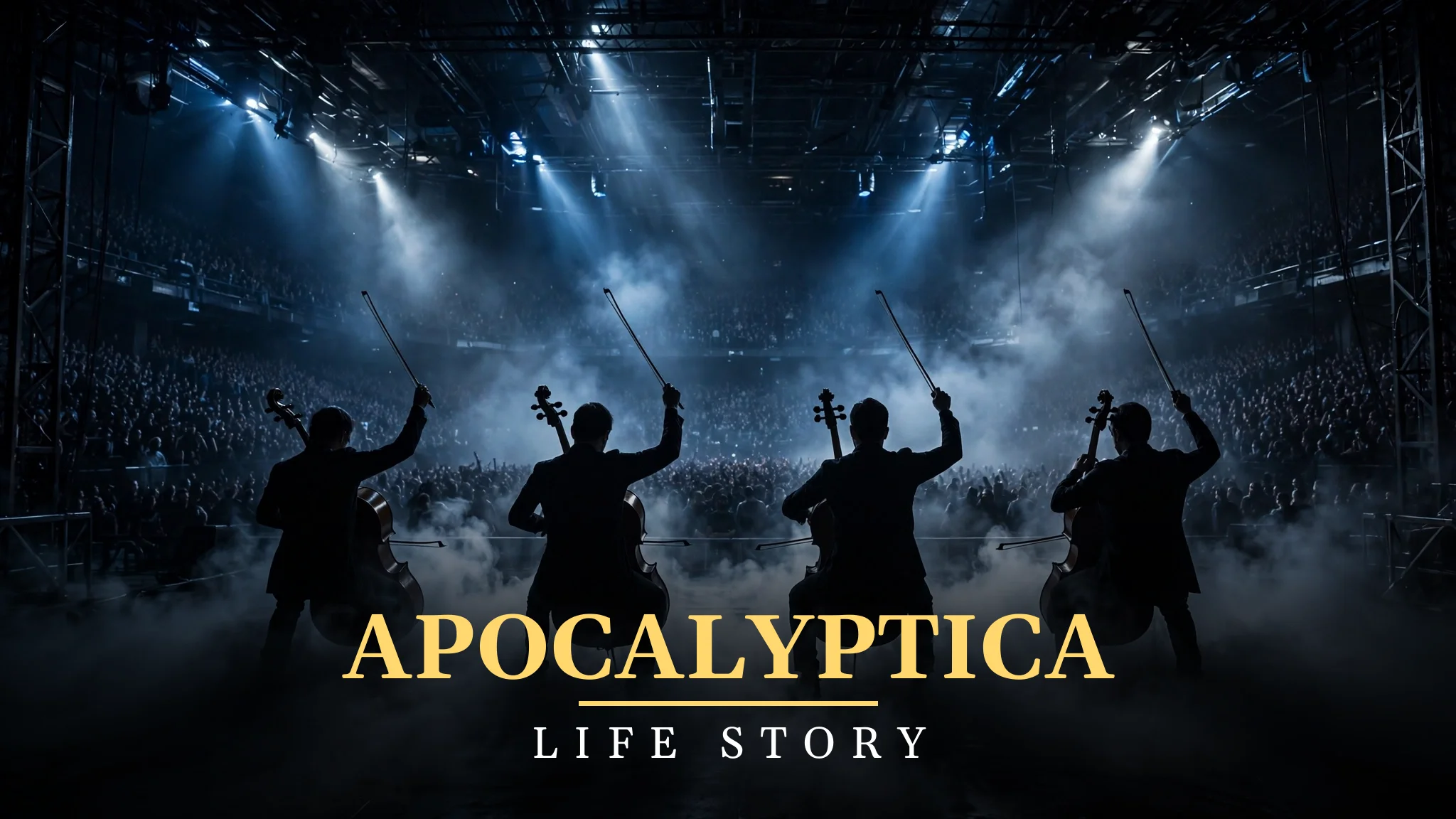
A cello is an instrument most people connect with quiet concert halls, with classical music, and with soft and serious sounds. Apocalyptica took that instrument and played heavy metal on it. Four young cello students from Helsinki stood on a stage and played the songs of Metallica, one of the loudest metal bands in the world, on wooden instruments that were built for a very different kind of music. The sound was deep, rich, and powerful, and the people who heard it could not believe what a cello could do.
The band did not start as a joke or as a trick. The four players were serious students at the Sibelius Academy in Helsinki, and they loved both classical music and metal. They found that the cello could carry the heavy riffs of a metal song in a way that no other instrument could, because the cello can be both low and loud, and it can also sing like a human voice. What began as a fun idea between friends became a real band, and that band is still playing more than thirty years later.
This is the story of Apocalyptica, a band that changed what people thought a cello could do. It is a story about students who loved two kinds of music, about a first album that surprised everyone, about learning to write their own songs, and about touring the world with nothing but four cellos and a drum kit. It is also a story about staying together, about changing members without losing the sound, and about a band that never stopped believing in a strange and beautiful idea.
There is something hopeful in the story of Apocalyptica, because it shows that a good idea does not need to fit into a neat box. The music world likes to put bands into groups, and a cello band that plays metal did not fit into any group at all. But the band did not change to fit a group. They kept playing, they kept recording, and slowly the world came to them. Today, their name is known in many countries, and young cello players all over the world have picked up the instrument because they heard Apocalyptica first.
Four Students at the Sibelius Academy
Apocalyptica began in 1993 in Helsinki, when four cello students at the Sibelius Academy, Eicca Toppinen, Paavo Lötjönen, Max Lilja, and Antero Manninen, started playing metal songs on their cellos. The Sibelius Academy was one of the best music schools in Finland, and the four young men were serious classical players who spent their days practising scales, studying scores, and playing in orchestras. In their free time, they listened to heavy metal, and they began to wonder what a Metallica song would sound like on a cello.
The idea was simple, but it needed real skill to make it work. A metal song is built on fast guitar riffs and loud drums, and a cello is played with a bow, not a pick. The four players had to find a way to make the cello sound heavy, and they did it by playing hard, by using the low strings, and by treating the cello as if it were a guitar. They practised together, they tried different songs, and they found that the music of Metallica worked well on the cello, because those songs have strong melodies that can be heard clearly even on a different instrument.
At first, they played only for friends and for fun. They performed at small events and student parties, and people were surprised by what they heard. The sound was new, and it was exciting, because it mixed two worlds that seemed far apart. A person who loved classical music could enjoy the skill of the playing, and a person who loved metal could enjoy the power of the songs. The four students did not plan to become famous. They were simply doing something they loved, and the joy of it showed in the way they played.
The name Apocalyptica was a play on words, joining apocalypse with Metallica, and it fit the band well. It sounded dark and dramatic, and it told listeners that the band was about the end of old rules. The name also showed the band’s sense of humour, because four polite classical students calling themselves Apocalyptica was funny in a gentle way. But behind the joke there was a serious idea. The band believed that music should not be divided into boxes, and their name said that clearly.
Playing Metallica and the First Album
The band’s big break came when they decided to record an album of Metallica songs played on cellos. The album, called Plays Metallica by Four Cellos, was released in 1996, and it surprised everyone. Metallica fans bought it because they loved the songs, and classical music lovers bought it because they were curious. The album sold well, not only in Finland but in many other countries, and suddenly four cello students from Helsinki were known around the world.
The album worked because the playing was so good. The four cellists did not play the songs in a soft or simple way. They played them with the same power that Metallica brought to the stage, and they showed that a cello could be as loud and as heavy as an electric guitar. Songs that fans knew well sounded fresh and new, because the cello gave them a different colour. A listener could hear the melody more clearly, and the low notes of the cello gave the music a deep and warm sound that a guitar could not give.
Metallica themselves heard about the band, and they were supportive. That support mattered, because it told the world that the band was not making fun of the music. They were honouring it. The band began to tour, and they played in clubs and at festivals where metal fans gathered. At first, some people in the crowd did not know what to expect, but by the end of the show, the crowd was cheering. The band had won them over with skill and with heart.
The band also learned something important on those early tours. A crowd that comes to hear metal does not want a quiet and polite show. They want power, they want energy, and they want to feel the music in their bodies. Apocalyptica learned to give them that feeling, not by shouting or by jumping around, but by playing with all their strength and by letting the deep sound of the cellos fill the room. The crowd could feel the low notes in their chests, and that physical feeling made the shows unforgettable.
The success of the first album gave the band a choice. They could keep playing covers of other people’s songs, or they could try to write their own music. Covers had made them famous, but the band wanted to grow. They wanted to show that the cello could do more than play songs written for the guitar. That choice would shape the next part of their story, and it would test whether the band was more than a clever idea.
Learning to Write Their Own Music
The band’s second album, Inquisition Symphony, came out in 1998, and it mixed covers of bands like Sepultura, Pantera, and Faith No More with the band’s own first original songs. The album showed that Apocalyptica was not only good at playing other people’s music. They could also write music of their own, and their own songs had the same power as the covers. The band was growing up, and they were finding their own voice.
Their next album, Cult, was released in 2000, and it was mostly made of original music. This was a brave step, because the band’s fans had come to them for Metallica songs, and now the band was asking them to listen to something new. The fans stayed, because the new songs were strong. The band had learned how to write for the cello in a way that used the instrument’s full range, from the deepest notes to the highest, and the music sounded like no one else. The album also showed that the band could be quiet and gentle as well as loud and heavy.
During these years, the band began to work with singers. Until then, their music had been instrumental, with no words at all. Working with a singer changed the sound, because a voice added a human feeling that the cello could not give on its own. The band worked with singers from other rock bands, and the songs with voices reached new listeners who liked to sing along. The band was careful about this change. They did not want the voice to take over. They wanted it to join the cellos as one more instrument in the group.
The band also began to tour more widely, playing in Europe, in America, and in many other places. Touring with four cellos was not easy, because the instruments are large and delicate, and they need care. But the band loved playing live, because a live show was the best way to show people what the cello could do. On stage, the four players moved with the music, and the audience could see the power of the playing up close. A recording is one thing, but a live show is another, and Apocalyptica became known as a great live band.
New Members and a Bigger Sound
In the early 2000s, the band went through changes in its members. Max Lilja left the group, and Perttu Kivilaakso joined as the new cellist. Changes like this can break a band, because the sound depends on the people who play it, and a new player brings a new way of playing. But Apocalyptica handled the change well. Perttu was a strong player, and he fitted into the band’s sound, and the band kept going without losing what made them special.
The band also added a drummer, Mikko Sirén, who became a full member of the group. A drummer gave the music more power, because the drums could drive the songs forward in the way that a metal band needs. With drums and four cellos, the band sounded bigger and louder than ever before, and their live shows became even more exciting. The band was no longer a small group of students. They were a full rock band, and they played like one.
The album Reflections, released in 2003, was a turning point, because it was fully instrumental and fully original. The band had come a long way from playing Metallica covers in a practice room. They were now writing complex and beautiful music of their own, and the album showed how far they had grown. The songs were longer, the ideas were deeper, and the playing was more confident. The band had found their own language, and they were speaking it fluently.
In 2005, the band released an album simply called Apocalyptica, and it included songs with guest singers, including Ville Valo of HIM and Lauri Ylönen of The Rasmus. The song Bittersweet, with both singers, became well known, and it showed how the band could work with other artists without losing their own sound. The album was a success, and it brought the band to a wider audience. People who had never heard of a cello band were now listening to them on the radio.
Worlds Collide and the Big Stages
The album Worlds Collide, released in 2007, was one of the band’s biggest successes. It included the song I’m Not Jesus, with Corey Taylor of Slipknot singing, and the song reached many new listeners. The album also included a cover of Heroes by David Bowie, with the singer Till Lindemann of Rammstein, and that song showed the band’s range. They could play a quiet and sad song, and they could also play a loud and angry one, and both sounded true.
During these years, the band toured with some of the biggest names in rock music. They played with Metallica, with Rammstein, and with many other bands, and they learned from every tour. Playing with a big band is a test, because the crowd has come to see the main act, and the opening band has to win them over. Apocalyptica did that again and again, because their sound was so different that people stopped to listen. A crowd that had never heard a cello band before would stand and watch, and by the end of the show, they were fans.
The band also played at large festivals, where thousands of people gathered to hear rock music. At a festival, a band has only a short time to make an impression, and Apocalyptica made the most of it. They played with energy, they moved on the stage, and they showed the crowd that classical instruments could be as exciting as electric guitars. The band’s live shows became famous, and people who saw them once wanted to see them again.
The album 7th Symphony, released in 2010, continued the band’s success, and it included songs with singers like Gavin Rossdale and Lacey Sturm. The band was now working with singers from many different kinds of rock music, and each song sounded different. That variety kept the band fresh, and it showed that the cello could work with almost any voice. The band was not stuck in one style. They were open to new ideas, and that openness kept them growing.
Those big tours also taught the band how to look after themselves on the road. Life on a tour bus is hard, with little sleep, long drives, and the same songs every night, and a band that tours for months at a time has to learn how to stay healthy and how to stay friends. Apocalyptica learned to give each other space, to rest when they could, and to remember that the show belonged to the audience, not to their own tiredness. That discipline is one reason they are still playing today.
Later Albums and a Return to the Cello
In 2015, the band released Shadowmaker, an album with the singer Franky Perez as a full member of the group. This was a new step, because the band had never had a permanent singer before. Franky brought a strong and soulful voice to the band, and the songs on the album were written with his voice in mind. The album showed a band that was still willing to try new things after more than twenty years together, and the fans responded well to it.
After Shadowmaker, the band decided to go back to their roots. Their next album, Cell-0, released in 2020, had no singers at all. It was fully instrumental, and it was the band’s most serious and complex work. The album was about the cello itself, and about what the instrument could do when it was left alone to speak. The band wanted to show that after all the years of working with singers, they could still make powerful music with only their cellos and drums. The album was praised by fans and by critics, and it proved that the band had not lost their first love.
In 2024, the band released Plays Metallica Vol. 2, a return to the idea that had started everything. The album included Metallica songs played on cellos, and it also included guest appearances by Metallica’s own members. The circle was complete. The band that had started by playing Metallica songs in a practice room was now recording with Metallica themselves, and the music world could see how far they had come. The album was a celebration, and it showed that the band’s first idea was still strong.
Today, Apocalyptica is still touring and still recording, more than thirty years after four students picked up their cellos and played a metal song. The band has changed members, they have changed their sound, and they have worked with many singers, but the heart of the band has stayed the same. Four cellos, played with power and with feeling, can make music that touches people all over the world, and that is a simple and beautiful truth.
What Apocalyptica Changed for Music
Apocalyptica changed the way people think about the cello. Before the band, most people thought of the cello as an instrument for quiet and serious music, played by people in formal clothes in a concert hall. After the band, people knew that the cello could be loud, wild, and exciting, and that it could stand on a rock stage next to electric guitars and drums. That change opened doors for many other musicians who wanted to mix classical instruments with rock music.
The band also changed the way people think about cover songs. A cover is often seen as a lesser thing, a copy of someone else’s work. Apocalyptica showed that a cover can be an act of love and a work of art in its own right. Their versions of Metallica songs were not copies. They were new pieces of music that used the original songs as a starting point and built something different on top of them. That lesson has stayed with the band, and it has stayed with their fans.
For Finland, the band was another example of how a small country could produce music that reached the world. Finland has a strong tradition of classical music, and it also has a strong tradition of metal, and Apocalyptica joined those two traditions into one. They showed that a musician does not have to choose between the music they studied and the music they loved. They can bring both together, and the result can be something new and wonderful.
The band also gave hope to young musicians who felt caught between two worlds. Many young players love classical music and rock music at the same time, and they are often told to choose one and to leave the other behind. Apocalyptica showed them that they did not have to choose. They could keep both loves, and they could build a career on both. That message has reached music schools in many countries, and it has changed the way some young players think about their future, because it tells them that their two loves are not a problem to solve, but a gift to use.
The band’s long career also shows the value of friendship and patience. The core members have played together for decades, and they have worked through changes, through hard tours, and through the ups and downs of the music world. They did not give up when the first excitement faded, and they did not change their sound to chase a fashion. They kept playing, they kept learning, and they kept trusting each other. That is a lesson for any group of people who want to build something that lasts.
My Take:
When I think about Apocalyptica, the first thing that comes to my mind is the surprise of it. A cello is not supposed to play metal, and four polite students are not supposed to become rock stars, and yet that is exactly what happened. I love that surprise, because it tells me that the rules about music are not as fixed as people think. A person who loves two kinds of music does not have to choose one and throw the other away. They can put them together, and if they do it with skill and with heart, the result can be beautiful. That is a lesson that goes far beyond music.
I admire the skill of the players, because playing a cello well is hard enough on its own, and playing it like a guitar is harder still. The four members had to learn a new way to hold the bow, a new way to move their hands, and a new way to think about rhythm. They did not do this in a week. They practised for years, first as students and then as a band, and the practice shows in every note they play. When I listen to their music, I hear the years of work behind it, and I respect that work deeply. Talent is a gift, but the kind of playing Apocalyptica does is built on patience and on daily effort.
What I find most moving about the band is that they started with joy. They were not trying to make money or to become famous. They were students who loved metal and who wanted to hear what it would sound like on their instruments. That joy is still in their music, even after thirty years. You can hear it in the way they play, in the energy of a live show, and in the way they keep trying new things. A band that starts with joy and keeps that joy is a rare thing, and I think it is one of the reasons their fans have stayed loyal for so long.
I also think about the courage it took to record an album of Metallica covers. It would have been easy for people to laugh at the idea, and some people surely did. A cello band playing metal could have been a joke that lasted for one show and then ended. But the band did not let the laughter stop them. They recorded the album, they played the songs with full seriousness, and they let the music speak for itself. That takes a quiet kind of courage, the kind that does not shout but simply keeps working. I admire that courage, because many good ideas die when people are afraid of being laughed at.
When I listen to their version of a Metallica song, I hear something that the original does not have. The cello gives the melody a warmth that an electric guitar cannot give, and it makes the song feel closer, as if it is being played in the same room as the listener. I do not think their versions are better than the originals, and I do not think they are worse. They are different, and that difference is valuable. It shows that a good song can live in more than one form, and that a song does not belong to only one instrument. That is a generous idea, and I like it.
I think about the singers the band has worked with, and I am glad they did not let the singers take over. A band with a strong sound can be tempted to add a singer and become a normal rock band, and then the thing that made them special disappears. Apocalyptica kept the cello at the centre, and the voice joined the cello as a partner, not as a boss. That balance is hard to keep, and the band kept it for many years. It shows that they knew what they were, and they did not lose themselves when success came.
There is also something I respect about the way the band handled change. When Max Lilja left, they did not fall apart. When they added a drummer, they did not lose their sound. When they worked with a permanent singer, they did not forget how to play on their own. Change is hard for any group, and many bands break when a member leaves. Apocalyptica treated change as a part of life, and they kept going. That steadiness is a sign of a group that trusts each other and that cares more about the music than about any one person.
I feel a little sad when I think about how hard it must be to tour with cellos. A guitar can be thrown in a case and carried on a plane, but a cello is large and delicate, and it needs care at every step. The band has spent years carrying their instruments through airports, through rain, and through long nights on the road, and they have done it because they love the music. That kind of hard work is invisible to most fans, who see only the show, but it is a real part of the story, and I want to honour it here.
The album Cell-0 matters to me, because it shows a band that was willing to go back to the beginning after many years of success. It would have been easy to keep making albums with singers and to keep chasing the radio, but the band chose to make a quiet and serious album with only their instruments. That choice tells me that they still love the cello itself, not only the fame that the cello brought them. A band that can go back to its first love after thirty years is a band that has kept its soul, and I think that is a rare and beautiful thing.
I also think about the young cello players who have picked up the instrument because of this band. A child who hears Apocalyptica and then asks for cello lessons is a child who might never have touched a classical instrument otherwise. The band has brought new players into classical music, and they have done it without making classical music seem boring or old. That is a gift to music itself, and it is a gift that will last long after the band stops touring. Every young player who starts because of them is a part of their legacy.
For a reader who has never heard the band, I would say this. Do not think about the cello as a quiet instrument. Listen to one song, and listen to the way the low notes shake the air, and listen to the way the melody sings above them. Then imagine four people standing on a stage, playing with all their strength, and a crowd of metal fans cheering for a cello. That picture is the heart of Apocalyptica, and it is a picture that makes me smile. It is proof that music can surprise us, and that the best surprises come from people who love what they do.
In the end, I think Apocalyptica teaches us that a strange idea is not a bad idea. It is only an idea that has not been tried yet, and it needs someone brave enough to try it. Four students in Helsinki tried it, and they changed the way the world hears the cello. They did not do it in one day, and they did not do it alone. They did it together, over many years, with practice, with patience, and with joy. That is a story I will remember, and it is a story that makes me want to try my own strange ideas instead of waiting for permission.
One more thought stays with me, and it is about the friendship at the centre of the band. Eicca Toppinen and Paavo Lötjönen have played together since they were students, and that is a very long friendship. Friends who can work together for thirty years, who can argue about music and still stand on a stage together, have something rare. I think the music sounds so warm because the friendship is warm, and the audience can feel it even if they do not know the story. A band is not only a group of players. It is a group of friends, and when the friendship is real, the music is real too.
I also want to say that I respect the band for never pretending to be something they were not. They were classical students who loved metal, and they never hid either part of themselves. They did not dress up as wild rock stars, and they did not pretend to be serious classical musicians who looked down on metal. They were both things at once, and they were honest about it. That honesty is the reason their music feels true, and it is the reason I trust them as artists. In a world where many bands wear a mask, Apocalyptica showed their real faces, and the world loved them for it.
I think about the first time a metal fan hears a cello play a song they know, and I imagine the look on their face. It must be a mix of surprise and delight, because the song is familiar and yet it sounds completely new. That moment of surprise is a gift, and the band has given it to millions of people. I think we need more moments like that in life, moments when something we thought we knew turns out to have a whole new side. Apocalyptica gives people that moment, and they do it with four wooden instruments and a lot of hard work.
There is a quiet lesson here about practice, and I want to name it clearly. The band did not become great by wishing for it. They became great by playing every day, by studying at a serious music school, and by working on their sound for years before anyone knew their name. That kind of daily work is not glamorous, and no one writes songs about it, but it is the foundation of everything they built. If a young person reads this story and takes one thing from it, I hope it is this: the hours no one sees are the hours that matter most.
I also feel grateful that the band kept going when the world changed around them. Music has changed a great deal since 1993, and many bands from that time have disappeared. Apocalyptica is still here, still touring, still recording, and still playing with the same joy they had as students. That staying power is not an accident. It comes from a love of the music itself, and from a friendship that has lasted for decades. I think that is the most beautiful part of their story, and it is the part I will remember longest.
When I finish thinking about this band, I feel hopeful. The world often tells us to pick one thing and to stay in one box, but Apocalyptica shows that we can carry two loves at once, and that the place where they meet can be the most interesting place of all. A cello and a metal song should not work together, and yet they do, and the proof is in every show this band has played. That proof gives me courage, and I hope it gives courage to anyone who reads this story and has a strange idea of their own.
I will end with a simple image that stays in my mind. Four young men in a practice room in Helsinki, holding cellos, playing a song that was written for electric guitars, and smiling because it works. That image is the whole story in one small scene. It is the moment when a strange idea becomes a real thing, and it is the moment that made everything else possible. Every big stage, every album, and every crowd came from that small room, and that is why I love this band.
Frequently Asked Questions
When did Apocalyptica form and who started the band?
Apocalyptica formed in Helsinki in 1993, when four cello students at the Sibelius Academy, Eicca Toppinen, Paavo Lötjönen, Max Lilja, and Antero Manninen, began playing metal songs on their cellos. They started by playing the music of Metallica, and their first album was a collection of Metallica songs played on four cellos.
What is Apocalyptica’s first album called?
Their first album is called Plays Metallica by Four Cellos, and it was released in 1996. The album took well known Metallica songs and played them on cellos, and it sold well in Finland and in many other countries, making the band famous around the world.
Does Apocalyptica play only Metallica songs?
No, the band soon began to write their own music, and most of their later albums are made of original songs. They still play Metallica songs at times, and they released Plays Metallica Vol. 2 in 2024, but their own music, on albums like Cult, Reflections, and Cell-0, is the larger part of their work.
Who sings with Apocalyptica?
The band is mostly instrumental, but they have worked with many guest singers over the years, including Ville Valo, Lauri Ylönen, Corey Taylor, and Till Lindemann. For a time, Franky Perez was a full member of the band as singer on the album Shadowmaker, released in 2015.
What is the band’s most famous song?
Many fans would name Bittersweet, from the 2005 album Apocalyptica, or I’m Not Jesus, from Worlds Collide in 2007, as their most famous songs with singers. Among their instrumental works, their cello versions of Metallica songs remain the best known, and they are still played at their shows.
Is Apocalyptica still playing today?
Yes, the band is still active, touring and recording more than thirty years after they formed. They released Plays Metallica Vol. 2 in 2024, and they continue to play live shows in many countries, with Eicca Toppinen and Paavo Lötjönen still at the centre of the group.


