Arvo Pärt: The Life Story Behind Estonia's Sacred Composer
In this post
- A Boy in Paide
- The Young Composer in Soviet Estonia
- Silence, Faith, and the Search for a New Sound
- Für Alina, Spiegel im Spiegel, and Tintinnabuli
- Exile in Berlin and a World Audience
- Return to Estonia and a Lasting Legacy
- Fratres, Te Deum, and Music for Many Voices
- The Arvo Pärt Centre and a Home by the Sea
- My Take:
Arvo Pärt is a composer who writes music that sounds like silence. His pieces are slow, simple, and full of space, and they make the listener stop and listen. In a world full of noise, his music is quiet, and that quiet has made him one of the most loved living composers. His works, such as Spiegel im Spiegel and Für Alina, are played in concert halls, in films, and in churches around the world, and they touch people who have never heard of classical music before.
He was born in Estonia, a small country on the Baltic Sea, and his life has been shaped by the history of that country. He grew up under Soviet rule, he faced bans on his music, and he had to leave his home and live in exile. He found a new way to compose, a style he called tintinnabuli, and that style changed his life. It was a music of bells, of simple notes, and of deep calm, and it came from his faith and from his search for truth.
What makes his story worth telling is the journey from noise to silence. He began as a young composer who wrote bold and modern music, and he became a composer who wrote music of great stillness. He lost his way, he searched for a new path, and he found it in the old music of the church and in the simple sound of a bell. This is the story of a boy from Paide who became one of the great composers of our time, and how he learned that less can be more.
A Boy in Paide
Arvo Pärt was born on 11 September 1935 in Paide, a small town in Estonia. Estonia was then an independent country, but the years that followed brought war and occupation. When Arvo was a small child, the Second World War began, and Estonia was taken over first by the Soviet Union, then by Nazi Germany, and then by the Soviet Union again. He grew up in a country that was not free, and that experience shaped his view of life and of music.
His family moved to Rakvere, another town in Estonia, and he grew up there. He was a quiet child, and he loved music from a young age. He listened to the radio, he played the piano, and he began to compose small pieces. He was not a child who sought attention. He was a child who listened, who watched, and who thought deeply about the world around him. Music was a way for him to express what he felt, and it became the centre of his life.
He went to music school in Tallinn, the capital of Estonia, and he studied composition. Tallinn was a city with a strong musical tradition, and it had a conservatory where young musicians could learn. Arvo was a talented student, and his teachers saw that he had a gift. He learned about classical music, about modern music, and about the craft of writing for instruments and for voices. He was a serious student, and he worked hard to learn his art.
In those early years, he was interested in the new music of the time. He listened to composers from the West, he studied serial music, and he wrote pieces that were bold and modern. He was a young composer who wanted to be part of the new world of music, and he was not afraid to try new ideas. That boldness would later lead him into trouble with the Soviet authorities, but it was also the start of his journey as a composer.
The Young Composer in Soviet Estonia
After his studies, Arvo Pärt began to work as a composer in Soviet Estonia. He wrote music for films, for the radio, and for the concert hall, and he became known as a talented young composer. His early works were modern and experimental, and they showed a composer who was looking for new sounds. He wrote a piece called Nekrolog in 1960, and it was one of the first serial works to be performed in the Soviet Union. It was a bold step, and it made people notice him.
He also worked as a sound engineer for Estonian Radio, and that job gave him a chance to hear many kinds of music. He listened to old church music, to folk music, and to the music of other countries, and he stored those sounds in his mind. He was a composer who listened widely, and that listening would later help him to find his own style. He was not only interested in modern music. He was interested in all music, from the oldest to the newest.
But life in Soviet Estonia was not free. The state controlled art, and composers were expected to write music that fit the ideas of the party. Music that was too modern, too religious, or too Western was not liked. Arvo’s music was often too bold for the authorities, and he faced criticism. His work Credo, written in 1968, used words from the Bible and from the Sermon on the Mount, and it was banned after its first performance. The ban was a shock, and it made him think hard about his music and his life.
The years that followed were difficult. He felt lost as a composer, and he did not know what to write next. He stopped composing for a while, and he searched for a new way. He studied old church music, he read about faith, and he thought about the meaning of music. He was a man in a crisis, and that crisis would lead him to a new and simpler style. It was a hard time, but it was also the most important time in his life.
Silence, Faith, and the Search for a New Sound
In the early 1970s, Arvo Pärt entered a period of silence. He wrote very little, and he spent his time studying the music of the medieval church. He listened to Gregorian chant, he studied the works of old composers, and he thought about the power of simple notes. He was searching for a music that was true, that was honest, and that did not need to be loud or complex to be beautiful. He wanted a music that spoke to the soul, not only to the mind.
He also turned to his faith. He joined the Russian Orthodox Church, and his faith became a central part of his life. He believed that music could be a form of prayer, and that a simple note, played with care, could be more powerful than a hundred notes played in haste. He studied the Bible, he prayed, and he thought about the relationship between music and silence. He came to believe that silence is not empty. It is full of meaning, and music grows out of silence.
During this time, he lived a quiet life with his wife, Nora, and their family. He worked, he studied, and he waited. He did not rush to compose. He let the new style grow slowly, like a plant that needs time to grow. He was a patient man, and he trusted that the music would come when it was ready. That patience is rare in the modern world, where artists are expected to produce new work every year. Arvo waited, and the waiting was part of his art.
The result of that waiting was a new style, which he called tintinnabuli. The name comes from the Latin word for little bells, and it describes a music based on simple triads, on the sound of bells, and on the relationship between two voices. One voice moves step by step, and the other voice rings like a bell. The music is simple, slow, and full of calm, and it sounds like nothing else in modern music. It was a breakthrough, and it changed his life.
Für Alina, Spiegel im Spiegel, and Tintinnabuli
The first piece in the new style was Für Alina, written in 1976 for solo piano. It was a short and simple piece, dedicated to a young girl, and it showed the tintinnabuli style in its purest form. The music is slow, the notes are few, and the silence between the notes is as important as the notes themselves. Für Alina is now one of the most played piano pieces in the world, and it is loved by pianists and by listeners who have never heard of Arvo Pärt before.
In 1977, he wrote Tabula Rasa, a work for two violins, strings, and prepared piano. The piece was a major success, and it brought his new style to a wider audience. It was recorded and played in many countries, and it showed that tintinnabuli could work for a large ensemble as well as for a solo piano. The music was calm, it was beautiful, and it was very different from the loud and complex music of the time. People who heard it felt that they had heard something new and true.
In 1978, he wrote Spiegel im Spiegel, which means Mirror in the Mirror in German. The piece is for violin and piano, and it is one of the most famous works of modern classical music. It is slow, it is simple, and it is deeply moving. The violin plays a long and gentle melody, and the piano plays simple chords underneath. The music feels like a meditation, like a prayer, and it has been used in many films, in dance, and in concerts around the world. It is a piece that many people know, even if they do not know the composer’s name.
He also wrote Cantus in Memoriam Benjamin Britten in 1977, a piece for strings and a bell, written in memory of the English composer Benjamin Britten. The piece is slow and sad, and it builds to a powerful climax before fading into silence. It is one of his most loved works, and it shows the depth of his tintinnabuli style. These early tintinnabuli works made Arvo Pärt famous, and they are still played today, more than forty years later.
Exile in Berlin and a World Audience
In 1980, Arvo Pärt and his family left the Soviet Union and moved to the West. They first lived in Vienna, and then in Berlin, in Germany. The move was a big change, and it was not easy. He had to leave his home, his friends, and his country, and he had to start again in a new place. But the move also gave him freedom. He could compose without the fear of bans, and he could work with musicians from around the world. Berlin became his home for many years, and it was there that his music reached a world audience.
In Berlin, he continued to write in the tintinnabuli style, and he wrote many new works. He wrote Fratres, a piece that has been arranged for many different instruments, and he wrote Te Deum, a large work for choir and orchestra. He wrote music for films, for dance, and for the church, and his music was recorded by major labels. He became known as one of the most important living composers, and his works were played in concert halls around the world.
His music also became popular in films. Directors used his pieces in their films because the music was calm, it was emotional, and it made the images on the screen feel deeper. Spiegel im Spiegel, Für Alina, and other works were used in many films, and that brought his music to people who had never been to a classical concert. He was a composer whose music crossed the line between classical and popular, and that was a rare achievement.
During his years in Berlin, he also received many honours. He was given awards, he was invited to festivals, and he was respected by other composers. He did not seek fame, but fame came to him because his music was so beautiful and so different. He remained a quiet and humble man, and he continued to live a simple life with his family. He was a composer who let his music speak for him, and his music spoke very well.
Return to Estonia and a Lasting Legacy
In 2010, Arvo Pärt and his wife returned to live in Estonia. The country was now free and independent, and he could live there without fear. He settled in Laulasmaa, a quiet place by the sea, not far from Tallinn. There, a centre was built in his name, the Arvo Pärt Centre, which holds his archive, his manuscripts, and his library. The centre is a place for research, for concerts, and for people who want to learn about his music. It is a fitting home for a composer who has given so much to Estonia.
He continues to compose, and his later works include Adam’s Lament, written in 2010, and other pieces for choir and orchestra. His music is still slow, still simple, and still full of calm, and it is still loved by listeners around the world. He is now in his nineties, and he is regarded as one of the great composers of the twentieth and twenty-first centuries. His works are played every day, in many countries, and they continue to touch new listeners.
His legacy is not only his music. It is also his example. He showed that a composer can be true to his faith, true to his art, and true to himself, even when the world around him is difficult. He showed that silence can be powerful, that less can be more, and that a simple note, played with love, can be enough. That is a lesson that goes beyond music, and it is a lesson for anyone who wants to live a meaningful life.
Today, Arvo Pärt is celebrated in Estonia and around the world. His music is played in churches, in concert halls, and in films, and it brings peace to people who hear it. He is a quiet man who has made a loud impact on the world, not by shouting, but by whispering. His story is a story of patience, of faith, and of the power of simple beauty, and it will be remembered for a long time.
Fratres, Te Deum, and Music for Many Voices
Arvo Pärt’s tintinnabuli style was not only for piano and violin. He used it for many different instruments and voices, and one of his most loved works is Fratres, written in 1977. Fratres means brothers in Latin, and the piece has been arranged for many different groups, from a single violin to a full orchestra. Each version sounds different, but each one has the same calm and the same beauty. Fratres shows how flexible tintinnabuli can be, and how a simple idea can grow into many forms. It is a piece that musicians love to play, because it is both simple and deep.
He also wrote Te Deum, a large work for choir and orchestra, which was first performed in 1985. Te Deum is a hymn of praise, and Arvo’s version is slow, solemn, and full of light. The choir sings in a simple way, and the orchestra supports them with gentle sounds. The piece feels like a prayer, and it has been performed in churches and in concert halls around the world. It shows that tintinnabuli can work for a large group as well as for a solo instrument, and that it can express both joy and reverence.
These works, and others like them, made Arvo Pärt known as a composer who could write for any group, and who could make any group sound beautiful. He wrote for strings, for voices, for piano, and for orchestra, and each piece had the same quality: it was simple, it was calm, and it was true. He did not write music to show off. He wrote music to serve the listener, and to give them a moment of peace. That service is at the heart of his work, and it is why his music is so loved.
In his later years, he continued to write in this style, and he wrote Adam’s Lament in 2010, a work for choir and orchestra based on the story of Adam. The piece is about loss, about sorrow, and about hope, and it is one of his most moving works. It shows that even in his seventies, he was still growing as a composer, and still finding new ways to express old truths. His music did not stop, and it did not become stale. It kept growing, like a tree that keeps putting out new leaves.
The Arvo Pärt Centre and a Home by the Sea
In 2010, when Arvo Pärt returned to Estonia, a centre was built in his name in Laulasmaa, a quiet place by the sea, not far from Tallinn. The Arvo Pärt Centre holds his archive, his manuscripts, his books, and his recordings, and it is a place for research, for concerts, and for learning. The building is simple and beautiful, with wood and glass, and it fits the landscape around it. It is a place where people can come to learn about his music, to listen, and to think in peace. It is a fitting home for a composer who loves silence and simplicity.
The centre is not only a museum. It is a living place, where musicians come to study, where students come to learn, and where concerts are held. It has a library, a concert hall, and a chapel, and it is open to anyone who wants to learn about Arvo Pärt. The centre shows how much Estonia loves him, and how proud the country is of its great composer. It is a tribute, but it is also a gift to future generations, who can learn from his work and from his example.
Arvo and his wife, Nora, live near the centre, in a quiet house by the sea. They live a simple life, and they are close to nature. He walks by the sea, he thinks, and he composes when he feels ready. He is not a man who rushes. He is a man who waits, who listens, and who lets the music come when it is ready. That patience is a part of his art, and it is a part of his life. He has found a home that suits him, a place of calm and beauty, and he is happy there.
The centre also helps to keep his music alive for the future. Young composers come there to study his manuscripts, to learn how he worked, and to be inspired by his example. They see that a composer can be humble, can be patient, and can be true to his faith, and still make music that the whole world loves. That is a powerful lesson, and it is one that the centre helps to share. Arvo Pärt’s legacy is not only his music. It is also the place where his music is kept, studied, and loved.
My Take:
I think Arvo Pärt is a composer who teaches us how to listen. When I hear his music, I do not hear a rush of notes. I hear a few notes, played slowly, with silence between them, and that silence makes me pay attention. In a world that is always loud, his music is a gift. It gives us a chance to stop, to breathe, and to think. I admire him for making that choice, because it is a brave choice. Most composers try to impress with speed and complexity. Arvo tries to move us with simplicity, and that is much harder.
I think his story teaches us that a crisis can be a beginning. He was a successful young composer, and then he was banned, and then he felt lost. Many people would have given up at that point. They would have stopped composing, or they would have written safe music to please the authorities. Arvo did not do that. He stopped, he studied, he prayed, and he waited. He let the crisis teach him, and he found a new way to compose. I think that is a lesson for anyone who feels lost. Sometimes you have to stop and listen, and the new path will appear.
What I admire most is his patience. He waited for years before he found tintinnabuli, and he did not rush the process. In our world, we are told to be fast, to produce more, to be busy all the time. Arvo was patient, and his patience gave him a style that has lasted for more than forty years. I think that is a beautiful thing. It shows that good work takes time, and that waiting is not wasted time. It is a part of the work itself.
I also think about his faith, and how it shaped his music. He joined the Orthodox Church, and he believed that music could be a form of prayer. That belief is at the heart of his work. His music sounds like a prayer because it is a prayer, written in notes. I do not share his faith in the same way, but I can feel the sincerity in his music. It is honest, it is humble, and it is full of love. That honesty is what makes it powerful, even for people who do not believe as he does.
I find Für Alina very moving. It is a short piece for piano, and it is so simple that a child could play it, but it is also so deep that a great pianist can spend a lifetime with it. That is a rare thing in music. Most pieces are either simple or deep, but Für Alina is both. It shows that simplicity is not the same as emptiness. A simple piece can be full of meaning, if it is written with care. I think that is a lesson for all artists, not only for composers.
I think Spiegel im Spiegel is a perfect example of his style. The violin plays a long melody, the piano plays simple chords, and the music feels like a mirror reflecting a mirror. It is calm, it is beautiful, and it makes me feel peaceful. I have heard it in films, in concerts, and on the radio, and each time it feels new. That is a sign of great music. It does not wear out. It grows with you, and it means something different each time you hear it.
There is something I find sad in his story, and it is the years he spent in exile. He had to leave Estonia, his home, because the Soviet Union did not allow him to be free. He lived in Berlin for many years, and he made a good life there, but he was far from home. I think that must have been hard, even when his music was successful. Home is not only a place. It is a language, a landscape, and a people, and to be away from it for so long is a real loss. I am glad he was able to return to Estonia in 2010, and to live there in peace.
I think about what young composers can learn from Arvo. The first lesson is to listen. Listen to old music, listen to silence, and listen to your own heart. The second lesson is to be patient. Do not rush to write a hundred pieces. Write one good piece, and let it be true. The third lesson is to be honest. Write the music you believe in, even if it is not popular, even if it is not loud, even if it is different. Arvo wrote quiet music in a loud world, and the world came to him. That is a hopeful lesson for any artist who feels different.
I also admire the way he has lived his life. He is a quiet man, he does not seek fame, and he does not make a show of himself. He lives simply, he works with care, and he lets his music speak. In a world where many artists chase attention, he has stayed humble. I think that humility is part of his art. It is the same humility that is in his music, a music that does not shout, but whispers, and that whisper is heard around the world.
When I think about his return to Estonia, I feel happy. He came home, and his country welcomed him. The Arvo Pärt Centre in Laulasmaa is a beautiful place, and it shows how much Estonia loves him. It is a centre for his music, for his archive, and for people who want to learn. I think that is a fitting tribute to a man who gave so much to his country, even when his country was not free. He never forgot Estonia, and Estonia has not forgotten him.
I think about the power of his music in films, and how it has touched people who have never been to a concert. A director uses Spiegel im Spiegel in a film, and suddenly millions of people hear Arvo Pärt, and they feel something deep. That is a wonderful thing. It shows that classical music is not only for a small group of people. It is for everyone, if it is honest and beautiful. Arvo’s music is for everyone, and that is why it is so loved.
If I have a criticism, it is not about Arvo. It is about the world that banned his music. The Soviet authorities banned Credo, they made his life hard, and they forced him into exile. That was a loss for Estonia, and a loss for music. But Arvo turned that loss into something beautiful. He found a new style, he made great music, and he came home in the end. I think that is a victory, not only for him, but for all artists who are silenced by power. Art can be banned, but it cannot be killed.
In the end, I think Arvo Pärt teaches us that less can be more. A few notes, played with love, can be more powerful than a thousand notes played in haste. Silence can be full of meaning. Patience can be a form of courage. And a quiet man from a small town in Estonia can change the music of the world, not by shouting, but by whispering. That is a beautiful lesson, and it is one I will remember.
I also think about his work as a sound engineer for Estonian Radio, and how that job shaped him. He listened to many kinds of music, from old church music to folk songs, and he stored those sounds in his mind. That listening was a form of learning, and it helped him to find tintinnabuli later. I think that is a lesson for any artist. Listen widely, even to music that is not your own, and you will learn things that will help you later. Arvo listened, and his listening made him a better composer.
I think about the beauty of Fratres, and how one piece can be played in so many ways. A violin can play it, an orchestra can play it, and each version is beautiful in its own way. That is a sign of great music. It is not tied to one instrument. It is an idea, and that idea can live in many forms. I think that is a wonderful thing. It shows that a simple idea, well made, can grow and change, and still be true. Arvo’s ideas are like that, and that is why his music lasts.
I also think about his wife Nora, and how important she has been to his life and his work. She has been with him through the hard years, through the silence, through exile, and through the return home. A composer’s life is not easy, and to have a partner who understands and supports you is a great gift. I do not know their private life, and I do not want to guess, but I can see in his work a man who is loved and supported. That support is part of why he could wait, could search, and could find his true style.
When I think about the Arvo Pärt Centre, I feel happy that Estonia has honoured him in this way. A centre that holds his archive, that hosts concerts, and that teaches young composers is a beautiful tribute. It is not a statue that only looks back. It is a living place that looks forward, and that helps new artists to learn. I think that is the best kind of honour a country can give to an artist. It says that your work matters, and that it will be kept alive for the future.
I think about what it means to be a composer in a small country like Estonia, and how Arvo has put Estonia on the map for classical music. Many people who had never heard of Estonia now know it because of Arvo Pärt. That is a great achievement, and it shows that a small country can make a big contribution to the world. I think that is a hopeful message for artists in small places everywhere. Your home may be small, but your art can be large, and it can travel far.
Another thing I notice is how his music is used in films, and how it makes the images on screen feel deeper. A director uses Spiegel im Spiegel in a film, and suddenly a simple scene feels profound. That is the power of his music. It does not compete with the images. It supports them, and it gives them a depth they would not have alone. I think that is a sign of great film music. It serves the story, and it makes the audience feel more. Arvo’s music does that, again and again.
I also think about the idea of silence in his music, and how important it is. In our world, we are afraid of silence. We fill every moment with noise, with music, with talking. Arvo’s music teaches us that silence is not empty. It is full, and it is a part of music. When he leaves space between notes, he is inviting us to listen to that space, and to find meaning in it. I think that is a lesson for life, not only for music. We need silence, we need space, and we need time to think. Arvo gives us that, and I am grateful for it.
Finally, I think about his age, and how he is still composing in his nineties. That is a remarkable thing. Many artists stop, or they repeat themselves, but Arvo keeps writing, keeps thinking, and keeps growing. I hope he keeps going for many more years, because the world needs his quiet music. In a loud world, his whisper is a gift, and it is a gift that I want to keep receiving. His story is a story of patience, of faith, and of beauty, and it will stay with me for a long time.
I also think about the way his music is played in churches, and how it fits that space. A church is a place of silence, of prayer, and of reflection, and Arvo’s music belongs there. It is not loud, it is not showy, and it does not demand attention. It invites prayer, and it gives people a chance to be still. I think that is a beautiful thing. In a world that is always busy, a church with Arvo’s music playing is a place where a person can rest, can think, and can feel close to something larger than themselves. That is a gift, and it is one that his music gives freely.
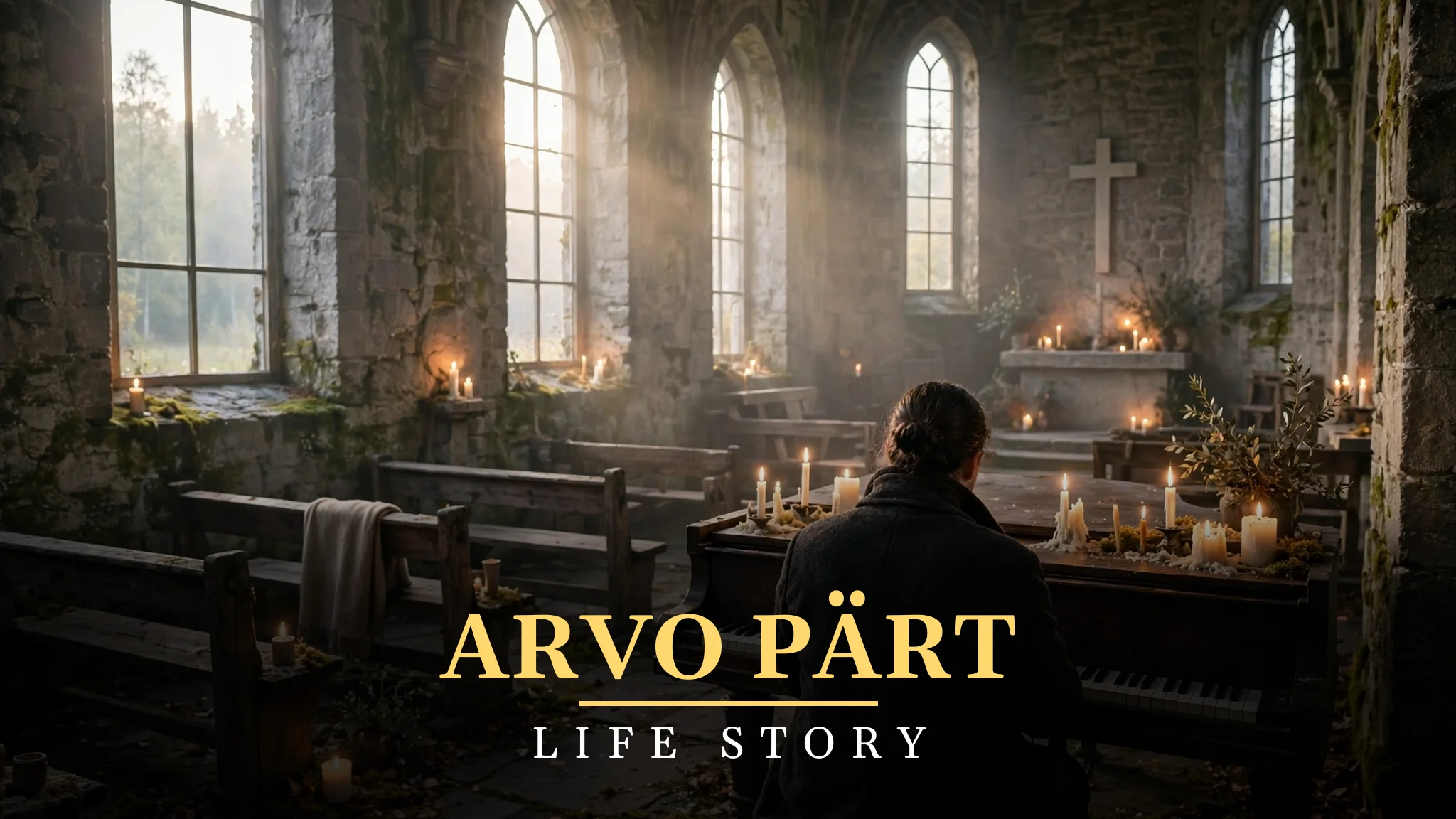
Finally, I think about the simple image of a man at a piano in an old stone church, playing a few notes and listening to the silence between them. That image stays with me, because it captures who Arvo Pärt is. He is a quiet man, a patient man, and a man who believes that less can be more. He did not need a large orchestra to make great music. He needed a piano, a few notes, and the courage to let silence speak. That is a lesson I will remember, not only for music, but for life: sometimes the most powerful thing you can do is to be quiet, to listen, and to let the silence do its work.
Frequently Asked Questions
Where was Arvo Pärt born?
Arvo Pärt was born on 11 September 1935 in Paide, Estonia. He grew up in Rakvere and studied music in Tallinn, the capital of Estonia.
What is tintinnabuli?
Tintinnabuli is the style Arvo Pärt created in the 1970s, named from the Latin word for little bells. It uses simple triads and two voices, one moving step by step and one ringing like a bell, to make slow and calm music.
What is Arvo Pärt’s most famous work?
His most famous works include Spiegel im Spiegel from 1978, Für Alina from 1976, and Cantus in Memoriam Benjamin Britten from 1977. Spiegel im Spiegel is one of the most played pieces of modern classical music.
Why was Arvo Pärt’s music banned in the Soviet Union?
His work Credo, written in 1968, used words from the Bible and was banned after its first performance. The Soviet authorities did not like music that was religious or too modern, and his work faced criticism.
Did Arvo Pärt live in exile?
Yes, in 1980 he and his family left the Soviet Union and moved to Vienna and then to Berlin, where he lived for many years. He returned to live in Estonia in 2010, after the country became free and independent.
Where is the Arvo Pärt Centre?
The Arvo Pärt Centre is in Laulasmaa, near Tallinn in Estonia. It holds his archive and library, and it is a place for research, concerts, and learning about his music and life.


