Atahualpa Yupanqui: The Life Story Behind Argentina's Folk Poet
In this post
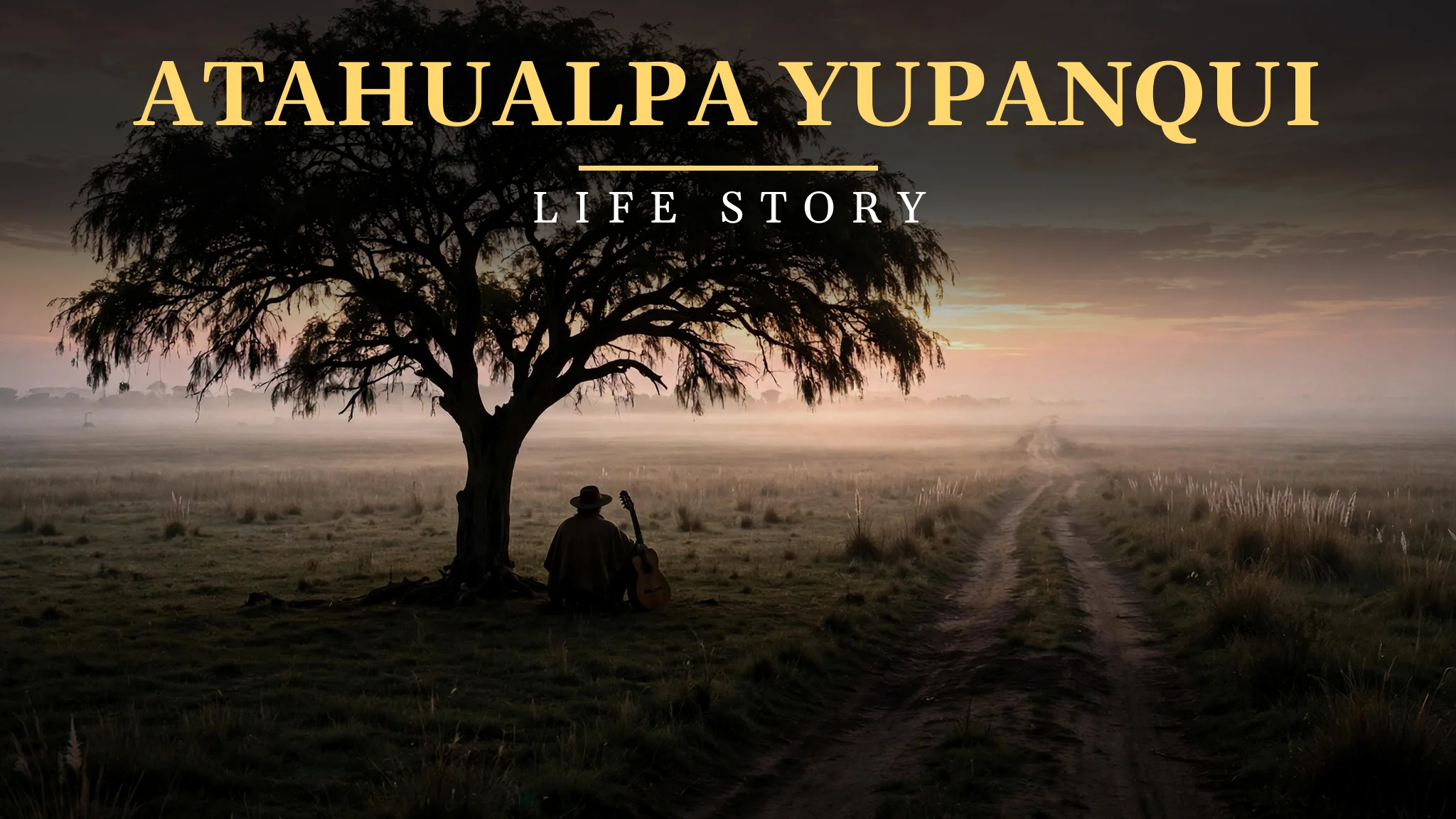
Atahualpa Yupanqui was a poet with a guitar, a man who spent his life listening to the Argentine countryside and turning what he heard into songs. He was not a pop star, and he did not chase fame in the usual way. He travelled on horseback through the pampas, he worked with rural labourers, he slept under the stars, and he wrote songs about the land, about the poor, and about the dignity of people who live close to the earth. His voice was quiet and deep, and his guitar playing was simple and honest, and together they created a kind of music that feels as old as the land itself.
His life was long and full of trouble. He was persecuted for his political beliefs, he was imprisoned, and he was forced to live far from Argentina for many years. He lived in Paris, he toured Europe, and he was welcomed by audiences who loved his songs even though they knew little about the Argentine countryside. Then he came home, and he settled in a small house in the hills of Córdoba, and he kept writing and singing until the end of his life. He died in France in 1992, at the age of eighty-four, and he left behind a body of songs and poems that are now part of the soul of Argentina.
His most famous songs, Los ejes de mi carreta and Luna tucumana, are still sung today, and his name is spoken with respect by folk singers across Latin America. He was not only a musician. He was a writer, a thinker, and a witness to a way of life that was changing fast. This is the story of how a boy from a small town became the folk poet of Argentina, and why his songs still speak to people who have never seen the pampas.
A Boy of the Pampas
Atahualpa Yupanqui was born Héctor Roberto Chavero on 31 January 1908 in Pergamino, a town in the province of Buenos Aires. He grew up in the town of Junín, and his childhood was spent close to the life of the Argentine countryside. His father worked on the railway, and the family lived a modest life. The young Héctor learned to ride a horse, to work with his hands, and to listen to the songs of the rural workers around him. The pampas, the great flat grasslands of Argentina, were his first school, and he never forgot what they taught him.
As a young man he took the name Atahualpa Yupanqui, a name drawn from the Quechua language of the Indigenous peoples of the Andes. Atahualpa was the name of the last Inca emperor, and Yupanqui is a word that speaks of memory and of being remembered. The name was a choice, and it said something about who he wanted to be: a singer who carried the memory of the Indigenous peoples and the rural workers of his country, and who would not let their stories be forgotten. He was not born with that name. He chose it, and he lived up to it for the rest of his life.
He learned to play the guitar, and he began to write songs and poems about the life he saw around him. He was not trained in a conservatory, and he did not learn music from books. He learned it from the people of the countryside, from the workers and the gauchos, and from the long silences of the pampas. His songs were simple, but they carried a deep feeling for the land and for the people who worked it.
The Road and the Guitar
In his twenties, Yupanqui began to travel across Argentina, often on horseback, and he lived the life of the people he sang about. He worked in the fields, he shared meals with rural labourers, and he slept in small houses and under the open sky. He was not a tourist in the countryside. He lived there, and he learned its hardships and its beauty from the inside. His songs grew out of that life, and they spoke about it with a truth that no one who had only visited the countryside could have matched.
He wrote songs that became classics of Argentine folk music. Los ejes de mi carreta is a song about a cart and its creaking wheels, and about the slow, hard life of a rural worker. Luna tucumana is a song about the moon over the province of Tucumán, and about the beauty of a night in the countryside. El arriero is a song about a mule driver, and about the loneliness of the road. These songs are not grand or showy. They are quiet, honest, and full of feeling, and they have been sung by folk singers in Argentina for generations.
He also began to write prose, and his books, including Piedra sola, showed that he was not only a songwriter but a thinker and a writer. He wrote about the land, about the people, and about the changes that were coming to the countryside. He saw that the old way of life was under threat, and he wanted to record it before it disappeared. His work was a kind of memory, a way of keeping the past alive for the future.
Politics, Prison, and Exile
Yupanqui joined the Communist Party in his youth, and his political beliefs brought him into conflict with the governments of his time. He believed that the poor should have land, work, and dignity, and he sang about those beliefs in his songs. The authorities did not like his music or his ideas, and he was persecuted for them. He was arrested and imprisoned, and his songs were banned from the radio. He was a poet who had become a political prisoner, and his life was changed by that experience.
In 1949, he was invited to Paris by the great French singer Edith Piaf, who had heard his music and admired it. He went to France, and he stayed there for years, living in exile from his own country. In Paris he performed for audiences who loved his songs, and he recorded albums that carried his music to Europe. He was far from the pampas, but his songs carried the pampas with him, and his guitar became a link to the home he had left behind.
The years in Paris were hard, but they were also fruitful. He met his wife, Pauline Pepin, who was known as Nenette, and she became his companion and his support for the rest of his life. She was a French writer and a pianist, and she understood his work and his beliefs. Together they built a life in France, but they never forgot Argentina, and they always dreamed of returning. Yupanqui’s exile taught him that a singer can carry his country with him, even when he is far from it, and that a song can be a home.
The Return to Argentina
Yupanqui returned to Argentina in the early 1950s, and he settled in Cerro Colorado, a small place in the hills of the province of Córdoba. He built a house there, and he lived a quiet life, writing, composing, and receiving visitors who came to hear him play. Cerro Colorado became a place of pilgrimage for folk musicians and writers, and Yupanqui welcomed them with the same warmth that he had shown to the rural workers of his youth. He was not a star who lived behind walls. He was a man who lived close to the land, and who shared his life with others.
In the years that followed, his fame grew, and he was recognised as one of the great figures of Argentine folk music. He toured Argentina and other countries, and he recorded albums that brought his songs to new audiences. He was honoured by the government and by cultural organisations, and his work was studied in schools. He had been persecuted and exiled, but he had outlived his persecutors, and his songs had survived.
He continued to write and to sing, and his later work showed the same honesty and the same love for the countryside that had marked his early songs. He did not change his style to suit the fashions of the time. He stayed true to the music he had learned on the pampas, and that faithfulness became part of his greatness. He was a man who knew who he was, and who did not need to pretend to be anyone else.
The Last Years
In his later years, Yupanqui lived between Argentina and France, and he continued to write and to perform when his health allowed. He was an old man by then, but his voice was still strong, and his guitar was still a part of him. He wrote books and poems, and he gave interviews in which he spoke about the land, about music, and about the need for justice. He was respected as a wise man, a kind of elder of Argentine culture, and young musicians came to him for advice and for inspiration.
He died on 23 May 1992 in Nîmes, in the south of France, at the age of eighty-four. His death was mourned in Argentina and in France, and his body was brought back to Argentina to be buried in Cerro Colorado, the place he had loved. His grave is in the hills he had chosen as his home, and it is visited by people who love his songs and who want to pay their respects to a man who gave his life to the music of his country.
His wife Nenette survived him, and she worked to keep his memory alive. His books and his songs were reissued, and his house in Cerro Colorado became a museum and a place of memory. His life had been long, and it had been full of trouble, but it had also been full of music, and the music remained.
A Poet of the Land
Today, Atahualpa Yupanqui is remembered as one of the greatest folk poets of Argentina, and his songs are part of the national heritage. Los ejes de mi carreta and Luna tucumana are taught to young folk singers, and his poems are read in schools. His name is spoken with respect by musicians across Latin America, and his influence can be heard in the work of many artists who came after him, including Mercedes Sosa, who sang his songs with great love.
His legacy is not only musical. He showed that a singer could be a poet, a thinker, and a witness to the life of a people, and that a song could carry the memory of a whole way of life. He took the name of an Inca emperor, and he lived up to it, because he made sure that the memory of the Indigenous peoples and the rural workers of Argentina would not be forgotten. His guitar was quiet, but his voice was strong, and it still speaks today to anyone who listens with an open heart.
The Writer and His Books
Atahualpa Yupanqui was not only a songwriter. He was a writer of prose and of poetry, and his books are an important part of his legacy. His best-known book, Piedra sola, published in 1941, is a work of short stories and reflections about the life of the Argentine countryside, and it shows a writer who could capture a landscape, a character, and a feeling in a few pages. He also wrote El canto del viento, a book of poems and thoughts, and other works that showed his gift for words. His writing was simple, direct, and full of feeling, and it carried the same honesty as his songs.
His books were not written for scholars. They were written for ordinary people, and they spoke about the things those people knew: the land, the work, the animals, and the sky. He wrote about the gauchos, about the rural workers, and about the changes that were coming to the countryside, and he did it with a love that was clear on every page. His prose was like his guitar playing, quiet, honest, and full of feeling, and it showed that he was a poet in every sense of the word.
He also wrote about his own life, about his travels, and about the people he had met, and his books are a record of a life spent close to the land. They are not grand histories. They are small, true stories, and they are valuable because they record a way of life that was changing fast. He saw that the old countryside was disappearing, and he wanted to write it down before it was gone. His books are a kind of memory, and they are as important as his songs.
His writing was recognised by other writers, and he was respected as a literary figure as well as a musician. He was a man of letters, a thinker, and his books are still read in Argentina today. They show a mind that was deep, curious, and full of love for his country, and they are a reminder that Yupanqui was more than a singer. He was a writer who used both the pen and the guitar to tell the truth about his land.
Today, his books are reissued, and they are studied in schools, and they are loved by readers who want to understand the Argentine countryside. They are a part of his legacy, and they show that his gift was not only musical. It was literary, and it was human, and it was rooted in a deep love for the land and for the people who lived on it.
Yupanqui’s Guitar and His Sound
The guitar was the centre of Yupanqui’s music, and his way of playing it was unlike anyone else’s. He played with a simple, direct style, using his fingers rather than a pick, and he made the guitar sound like the land itself, quiet, patient, and full of feeling. His playing was not showy, and it was not fast. It was slow, thoughtful, and deeply felt, and it gave his songs a sense of space and of silence that made them powerful. He understood that a guitar does not need to be loud to be heard.
His sound was influenced by the folk music of Argentina, by the zamba, the chacarera, and the milonga, and he played those rhythms with a respect that came from living them. He had heard them in the countryside, he had danced to them, and he had played them with rural musicians, and his guitar carried that lived experience. His playing was not learned from books. It was learned from life, and it showed.
He also used his guitar to accompany his voice in a way that was intimate and direct. He did not need a big band or a loud arrangement. He needed only his guitar and his voice, and together they were enough. His concerts were often just him, alone on a stage with his guitar, and the audience listened in silence, because the music was so quiet and so true. That is a rare kind of performance, and it takes a great deal of confidence to do it.
His guitar playing has influenced many folk musicians in Argentina, and his style is still studied by young guitarists who want to learn how to play with honesty. He showed that a guitar could be a voice, and that a simple melody, played with feeling, could be more powerful than a complex piece played without it. His sound was the sound of the pampas, and it is still heard today.
He also wrote songs that were built around the guitar, with melodies that fit the instrument perfectly, and his songs are still played by guitarists in many countries. His guitar was not only an instrument. It was a companion, a friend, and a voice, and it carried his songs across the world. When he died, his guitar fell silent, but his recordings remain, and they still carry the sound of the Argentine countryside.
Yupanqui and the Indigenous Peoples
Atahualpa Yupanqui’s choice of name was a promise, and it was a promise he kept for his whole life. By calling himself Atahualpa, after the last Inca emperor, and Yupanqui, a Quechua word that speaks of memory, he was saying that he would carry the memory of the Indigenous peoples of the Andes, and that he would not let their stories be forgotten. That was a brave choice in a country where Indigenous history was often ignored, and it was a choice that shaped everything he wrote and sang.
He learned about Indigenous life not from books alone, but from travelling, from listening, and from living close to the land. He met Indigenous workers, he heard their songs, and he learned their stories, and he carried those stories into his own songs. His music was not an imitation of Indigenous music. It was a respectful meeting, a singer from the pampas listening to the peoples of the mountains, and finding a common feeling in their love of the land and their dignity in hard work.
His songs speak about the land in a way that honours Indigenous understanding, as a living thing, not only as property. He wrote about the earth, about the sky, and about the animals, and he did it with a reverence that came from listening to people who had lived on the land for centuries. His work is a reminder that Argentina is not only a country of European immigrants. It is also a country of Indigenous peoples, and their memory is a part of its soul.
He also spoke about the injustices suffered by Indigenous peoples, about the loss of their land, and about the need for respect. He did not shout about it. He sang about it quietly, in songs that carried the pain and the dignity of a people who had been pushed aside. His gentleness was his strength, and it made his message more powerful, because it came from love rather than from anger.
His name is now a symbol in Argentina, and it is spoken with respect by Indigenous organisations and by folk musicians alike. He is remembered as a singer who chose to stand with the Indigenous peoples, and who used his fame to make their memory visible. That is a great legacy, and it is one that goes beyond music. It is a legacy of conscience, and of respect for the first peoples of the land.
Today, young Indigenous musicians in Argentina speak of Yupanqui as an inspiration, and they sing his songs alongside their own. His work has become a bridge between the folk music of the pampas and the music of the Andes, and that bridge is still being crossed. He kept his promise, and the memory he carried is still alive, in his songs and in the voices of those who sing them.
His choice of name was also a lesson for other artists, that a name can be a duty, and that an artist can choose who he wants to be. Yupanqui chose to be a keeper of memory, and he lived up to that choice for eighty-four years. That is a rare and beautiful thing, and it is the reason his name is still spoken with such respect today.
My Take:
I think Atahualpa Yupanqui is a different kind of great artist from the ones who fill stadiums, and I think we need his kind of greatness more than we realise. He did not chase fame, he did not sing loud songs to make people dance, and he did not try to be modern or fashionable. He travelled on horseback, he lived with rural workers, he slept under the stars, and he wrote songs about the slow, hard life of the countryside. That is a quiet kind of greatness, and it is easy to overlook, but I think it is one of the most honest kinds there is.
What I admire most is that he chose his name, and he lived up to it. He was born Héctor Roberto Chavero, and he chose to call himself Atahualpa Yupanqui, a name from the Quechua language that speaks of memory. That choice tells me everything about who he was. He wanted to be a keeper of memory, a man who would not let the stories of the Indigenous peoples and the rural workers be forgotten. He did not choose a name that would make him sound grand. He chose a name that gave him a duty, and he spent the rest of his life doing that duty. I find that deeply moving, because it says that identity is not only something you are born with. It is something you choose, and something you must live up to.
I also think about the way he lived. He did not write about the countryside from a comfortable house in the city. He lived in the countryside, he worked in the fields, and he shared the life of the people he sang about. That is why his songs feel true. When he sings about a cart and its creaking wheels, you can hear the cart. When he sings about the moon over Tucumán, you can feel the night. He did not invent those images from his imagination. He lived them, and he turned them into songs. I think that is a lesson for anyone who wants to write or sing about a place: go there, live there, and learn it from the inside, because no amount of imagination can replace real life.
His political life makes me think about courage in a different way. He joined the Communist Party because he believed the poor should have land and dignity, and he paid for that belief with prison and exile. He could have kept quiet, he could have sung safe songs, and he could have protected himself. He did not. He sang what he believed, and he accepted the cost. I think that is a hard choice, and I do not pretend it is easy. But I admire him for making it, because his songs would not have been the same if he had been afraid to say what he thought. His honesty was part of his art, and his art was part of his honesty.
The years in Paris move me, because he was so far from home, and yet his songs carried his home with him. He was invited by Edith Piaf, one of the great singers of France, and he performed for audiences who knew nothing about the pampas, and yet they loved his music. I think that says something important about folk music. It is rooted in one place, but it speaks to something universal in all of us: the love of the land, the pain of hard work, the beauty of a night sky, the longing for home. Yupanqui’s songs were Argentine, but they were also human, and that is why they travelled so well.
I also think about his wife Nenette, and about the life they built together in France and in Argentina. She was a French writer who understood his work, and she stood by him through exile and through the hard years. I think great artists often have a partner who believes in them when the world does not, and Nenette was that person for Yupanqui. Their life together reminds me that a creative life is not only about talent. It is also about love, about support, and about having someone who understands what you are trying to do and who helps you keep going.
His return to Cerro Colorado is one of my favourite parts of his story. He built a house in the hills of Córdoba, and he lived there quietly, writing and receiving visitors, and he became a kind of elder of Argentine culture. I like the image of young musicians travelling to his house to hear him play, and of an old man with a guitar sharing his songs with a new generation. It is a beautiful picture of how culture is passed on: not through books alone, but through a person, sitting with a guitar, telling stories and singing songs to people who have come to listen.
I feel sad when I think about the way of life he sang about, because much of it has changed. The pampas are not what they were, the rural workers live different lives, and the old songs are not sung as often as they once were. But I also feel hopeful, because Yupanqui’s songs are still here, and they still carry the memory of that life. He did what he set out to do. He made sure that the memory would not be lost, and his songs are the proof. That is a great achievement, and it is one that will last as long as people keep singing.
If I had to take one lesson from his life, it would be this: pay attention to the quiet things, and do not be afraid to live the life you sing about. Yupanqui paid attention to a cart, to a moon, to a mule driver on a lonely road, and he turned those small things into songs that have lasted for generations. He did not need grand subjects. He needed honest eyes and an honest heart, and he had both. I think we can all learn from that. Look closely at the life around you, live it honestly, and turn what you see into something true. That is what Atahualpa Yupanqui did, and that is why his songs still speak to us today.
I also think about his books, and about how they show a different side of him. He was not only a singer. He was a writer, and his book Piedra sola is a work of short stories about the countryside that is as honest as his songs. I think that is a beautiful thing, that a man can be a poet with a pen and a poet with a guitar, and that both kinds of poetry can come from the same heart. His books are a record of a way of life that was changing, and they are valuable because they were written by someone who lived that life, not by someone who only visited it.
I think about his guitar, and about the way he played it. He did not play fast, and he did not play loud. He played slowly, with his fingers, and he let the notes breathe, and he made the guitar sound like the land itself. I think that is a lesson about how to play any instrument, and about how to do any kind of work. You do not need to be loud to be heard. You need to be honest, and you need to be patient, and the honesty will carry your work further than any show of skill ever could.
I also think about the name he chose, and about how it has stayed with me. Atahualpa Yupanqui, a name from the Quechua language, a name that speaks of memory. I think about how many people choose a stage name to sound grand, and how he chose a name to give himself a duty. That is a rare and beautiful choice, and it says everything about who he was. He wanted to be remembered, not for himself, but for the people whose memory he carried, and he spent his life doing that work.
I think about his travels on horseback, and about how different that is from the life of a modern musician. He did not travel in a tour bus, with a team of managers and a schedule. He travelled on a horse, he slept under the stars, and he shared meals with rural workers, and he learned their songs from the inside. I think that is a lesson about how to learn anything. Go there, live there, and learn it from the people who live it every day. No book can teach you what a life like that can teach you.
I also feel sad when I think about the way of life he sang about, and about how much of it has changed. The pampas are not what they were, the rural workers live different lives, and the old songs are not sung as often. But I also feel hopeful, because his songs are still here, and they still carry the memory. He did what he set out to do. He made sure that the memory would not be lost, and his songs are the proof. That is a great achievement, and it is one that will last.
I think about his wife Nenette, and about the life they built together, in France and in Argentina. She was a French writer who understood his work, and she stood by him through exile and through the hard years. I think that is a beautiful part of his story, because it shows that a creative life is not only about talent. It is also about love, about support, and about having someone who believes in you when the world does not. Their life together was a partnership, and it was a strong one.
I also think about Edith Piaf, and about the invitation that took him to Paris. She heard his music, she admired it, and she invited him to France, and that invitation changed his life. I think about how a single act of kindness, a single invitation, can change a person’s fate, and I feel grateful to her for it. She was a great singer herself, and she recognised greatness in another, and she acted on it. That is a generous thing to do, and it is a reminder that artists should help each other, not only compete with each other.
I think about his house in Cerro Colorado, and about the young musicians who travelled there to hear him play. I imagine an old man with a guitar, sitting with young people, telling stories and singing songs, and I feel happy just thinking about it. That is how culture is passed on, not through books alone, but through a person, sitting with a guitar, sharing what he knows. Yupanqui did that, and his house became a school, and his songs became lessons.
I also think about the political side of his life, and about the price he paid for his beliefs. He was imprisoned, he was exiled, and his songs were banned, and yet he kept singing. I think that is a hard choice, and I do not pretend it is easy. But I admire him for making it, because his songs would not have been the same if he had been afraid to say what he thought. His honesty was part of his art, and his art was part of his honesty, and together they made him who he was.
I think about the moon over Tucumán, and about the song Luna tucumana, and about how a simple image can become a great song. He looked at the moon, he felt its beauty, and he turned it into a song that people still sing today. I think that is a lesson for anyone who wants to write. Look closely at the world around you, find the beauty in it, and turn it into something true. Yupanqui did that, and his songs are proof that small, honest images can last for generations.
I finish by thinking about the quietness of his music, and about how it speaks in a loud world. His guitar was quiet, his voice was quiet, and his songs were quiet, and yet they have lasted for almost a century. That tells me that loudness is not strength, and that quietness is not weakness. A quiet song, sung with honesty, can be stronger than a loud one, and it can last longer. Yupanqui proved that, and his songs are still here to prove it today.
I also think about his name, and about the promise it carried. He chose to call himself Atahualpa Yupanqui, and that choice gave him a duty: to carry the memory of the Indigenous peoples, and to make sure their stories were not forgotten. I think that is a rare and beautiful thing, that a person can choose a name and then live up to it for a whole lifetime. Most of us are given our names, but Yupanqui chose his, and he chose it with purpose, and that purpose guided his whole life.
I think about the Indigenous peoples of Argentina, and about how often their history is ignored. Yupanqui did not ignore it. He listened, he learned, and he sang about it, quietly and with respect, and his songs made their memory visible. I think that is a model for any artist. Listen to the people whose stories are not being told, and tell them with love, and your work will matter in a way that goes beyond entertainment.
I also think about the land, and about the way Yupanqui wrote about it as a living thing. He did not write about the land as property, to be bought and sold. He wrote about it as a home, as a mother, and as a part of who we are, and that understanding came from listening to Indigenous wisdom. I think we need that understanding now more than ever, when the land is under threat, and Yupanqui’s songs remind us to treat it with respect.
I finish by thinking about the promise in his name, and about how he kept it. He lived for eighty-four years, and he spent them carrying a memory, and that memory is still alive in his songs. That is a great achievement, and it is one that I admire more than I can say. A name can be a duty, and a song can be a memory, and Yupanqui proved both, and his voice is still keeping that promise today.
Frequently Asked Questions
Who was Atahualpa Yupanqui?
Atahualpa Yupanqui was an Argentine folk singer, guitarist, and poet, born Héctor Roberto Chavero in 1908. He is famous for songs like Los ejes de mi carreta and Luna tucumana, and he is remembered as one of the great voices of Argentine folk music.
Why did Atahualpa Yupanqui change his name?
He chose the name Atahualpa Yupanqui from the Quechua language, taking the name of the last Inca emperor. The name spoke of memory, and it showed his wish to carry the memory of the Indigenous peoples and rural workers of Argentina in his songs.
What are Atahualpa Yupanqui’s most famous songs?
His most famous songs include Los ejes de mi carreta, Luna tucumana, and El arriero. These are quiet folk songs about rural life, the land, and the people who work it, and they are still sung today.
Why was Atahualpa Yupanqui exiled?
Yupanqui was persecuted for his political beliefs as a member of the Communist Party, and his songs were banned. He was imprisoned and later lived in Paris for many years, where he was invited by the singer Edith Piaf.
Where did Atahualpa Yupanqui live in Argentina?
After his return, he lived in Cerro Colorado, in the hills of the province of Córdoba. His house there became a meeting place for folk musicians, and he is buried there.
How did Atahualpa Yupanqui die?
He died on 23 May 1992 in Nîmes, France, at the age of eighty-four. His body was brought back to Argentina and buried in Cerro Colorado.


