Banda MS: The Life Story Behind Mexico's Banda Stars
In this post
- Mazatlan, Sinaloa, and the Sound of Home
- The First Records and the Search for a Voice
- El Mecho and the Big Breakthrough
- Love Songs, Stadiums, and El Color de Tus Ojos
- Hard Times, Changes, and Keeping the Band Together
- The Band Today and Its Place in Banda Music
- The Sound That Carried a Whole Region
- My Take:
There is a sound that belongs to the streets and parties of Sinaloa, and it is loud, bright, and impossible to ignore. It is the sound of trumpets, trombones, clarinets, and a deep tuba carrying the beat, and when Banda MS plays, people do not just listen. They dance, they sing, and they feel proud of where they come from. Banda MS became the most famous banda group of its time, not by changing that sound, but by playing it with care, with strong singers, and with songs that spoke about love, loss, and everyday life in simple words that millions of people understood.
The group began in Mazatlan, a port city on the Pacific coast of Mexico, in 2003. Its full name is Banda Sinaloense MS de Sergio Lizarraga, and the letters MS stand for Mazatlan, Sinaloa. Sergio Lizarraga, the man who put the group together, believed that banda music deserved to be heard far beyond the towns where it was born. He wanted a band that was big, disciplined, and professional, and he wanted songs that could fill a stadium as well as a small family party. That dream grew slowly at first, but it never stopped growing.
What makes the story of Banda MS worth telling is how steady it has been. Many music groups rise fast and fall fast. Banda MS rose step by step, album by album, and tour by tour, until its songs were known across Mexico, the United States, and much of Latin America. Its singers, Alan Ramirez and Oswaldo Silvas, became voices that fans could recognise in the first few seconds of a song. Its hits, from “El Mecho” to “El Color de Tus Ojos”, became part of the soundtrack of weddings, birthdays, and long nights with friends. This is the story of how a new banda from Mazatlan became a name that stands for the music of Sinaloa itself.
Mazatlan, Sinaloa, and the Sound of Home
Mazatlan sits on the coast of Sinaloa, a state in northwestern Mexico where banda music has deep roots. Banda is played by a large group of musicians, with brass, woodwinds, and percussion, and it grew out of the brass bands that once played in town squares and at local celebrations. In Sinaloa, banda is not background music. It is the music of parties, of funerals, of saints days, and of long evenings when neighbours gather and the whole town seems to sing together. A child growing up in Mazatlan hears that sound early, and it stays in the ear for life.
Sergio Lizarraga grew up in that world, and he understood it well. He was not a man who wanted to copy what already existed. He wanted to build a band that respected the old sound but sounded fresh and clean, with every instrument in its place. In 2003 he brought together a group of young musicians, many of them from Sinaloa, and gave them a clear goal: play banda at the highest level, rehearse hard, and treat every show, big or small, as if it mattered. The early years were not easy, because Mexico already had many famous banda groups, and a new band had to earn its place.
The name itself told the story. MS stood for Mazatlan, Sinaloa, and that was a promise. The band would carry the name of its home wherever it went. In those first years, the group played wherever it could find an audience, and it began to record. The musicians learned to play together as one body, with the tuba holding the low notes, the trumpets carrying the melody, and the clarinets adding colour. A banda with more than a dozen players can easily sound messy, but Banda MS learned to sound tight and full, and that discipline became one of its marks.
There was also a practical side to the beginning. A large band costs money to keep on the road, and it needs strong organisation. Lizarraga took on that work, and he built the group like a serious business as well as a musical family. The singers were chosen for voices that could rise above the brass without shouting. The songs were chosen for words that ordinary people could feel. The band did not rush. It built its name in Sinaloa first, then in the rest of Mexico, and then beyond the border. That slow, careful start is one of the reasons the group lasted. In Mazatlan, a band earns respect one show at a time, and Banda MS learned that a crowd remembers how a band treats it. If the band played with energy at a small party, the people at that party would ask for it again at a wedding. If it played well at a wedding, the guests would ask for it at a festival. Word of mouth moved slowly, but it moved surely, and it built a base that no advertisement could buy. The musicians also learned to listen to the crowd, to notice which songs made people dance and which songs made people quiet, and to shape their sets around what they saw in front of them.
The First Records and the Search for a Voice
Every new band needs songs that people remember, and Banda MS spent its early years searching for that sound. The first albums introduced the group to radio listeners, but they did not yet make it famous across the country. The band kept recording, kept touring, and kept learning what its audience wanted. It learned that a banda song works best when the words are direct, when the melody is easy to sing, and when the brass gives the song a lift that makes people want to move.
The singers mattered a great deal in that search. A banda has many players, but the voice is what the listener holds on to. Alan Ramirez and Oswaldo Silvas became the two lead voices of the group, and their styles worked well together. One voice could carry the soft, sad songs about a love that had ended, and the other could lift the joyful songs about celebration and pride. Fans began to know them by name, and their voices became part of the band’s identity. When people heard a new Banda MS song on the radio, they often knew it was Banda MS before the announcer said so.
In those years the group also learned how to work with songwriters. Banda MS did not only sing its own songs. It took songs from writers across Mexico, and it chose the ones that fitted its sound and its singers. That choice was important, because a good song in the wrong hands can fall flat, while the right song in the right hands can change a career. The band looked for songs about love, about longing, about family, and about the life of ordinary people, and it sang them without pretence.
The breakthrough was still to come, but the groundwork was laid in those early records. The band had a full, clean sound. It had two strong singers. It had a leader who understood both music and business. And it had a home base in Mazatlan that gave it a clear identity. Many bands fail because they have only one of those things. Banda MS had all of them, and it was only a matter of time before the right song met the right moment.
El Mecho and the Big Breakthrough
The song that changed everything for Banda MS was “El Mecho”, released in the early 2010s. It was a lively, catchy song, and it spread quickly through radio, parties, and the internet. People danced to it, they shared it, and they asked for it again and again. For a band that had worked for years in the shadow of older groups, “El Mecho” was the moment when the whole country seemed to notice at once. It was not a complicated song, and that was its strength. It was fun, it was direct, and it sounded like a party.
After “El Mecho”, the band’s life changed. The shows got bigger, the crowds got louder, and the invitations came from further away. But the group did not treat the hit as an accident to be repeated once. It treated it as a door that had opened, and it walked through it with more good songs. “Mi Razon de Ser” followed, a romantic song that showed a softer side of the band. It became one of its most loved songs, played at weddings and sung by couples, and it proved that Banda MS could do tenderness as well as celebration.
Then came “Hermosa Experiencia”, another song that found a wide audience. Each hit added a new layer to the band’s name. It was no longer just a promising banda from Mazatlan. It was a group that could deliver a hit in different moods, and that made radio stations, promoters, and fans trust it. The band began to play in large venues in Mexico and the United States, where many Mexican families living far from home came to hear the music of their homeland.
The breakthrough years also brought a lesson. A hit can make a band famous, but only good work after the hit can keep it famous. Banda MS kept recording, kept touring, and kept its sound steady. It did not chase every new fashion in music. It stayed close to banda, and it let the songs do the work. That choice, made again and again, is why the breakthrough of “El Mecho” became a career rather than a single bright moment. It also taught the band something about its audience: people did not want a new Banda MS every year. They wanted the same band, growing a little each time, with new songs that still sounded like the band they loved.
Love Songs, Stadiums, and El Color de Tus Ojos
As the 2010s went on, Banda MS became one of the biggest names in regional Mexican music. Its albums sold well, its videos were watched by millions, and its concerts filled arenas and stadiums. The band’s romantic songs became its trademark. “Hablame de Ti” and “Tu Postura” were songs about love and about the small details of a relationship, and fans sang them word for word. The band had learned that a love song, sung with honesty over a full brass sound, can move a crowd as much as any fast dance song.
One of the group’s most loved songs of this period was “El Color de Tus Ojos”. It was a gentle, romantic song, and it became a favourite at weddings and anniversaries. The song showed how far the band had come. It was no longer only the loud party band of “El Mecho”. It was a band that could sing about the colour of a person’s eyes and make a whole stadium feel quiet and close. That range, from loud celebration to soft romance, is rare, and it is one of the reasons the band’s audience grew so wide.
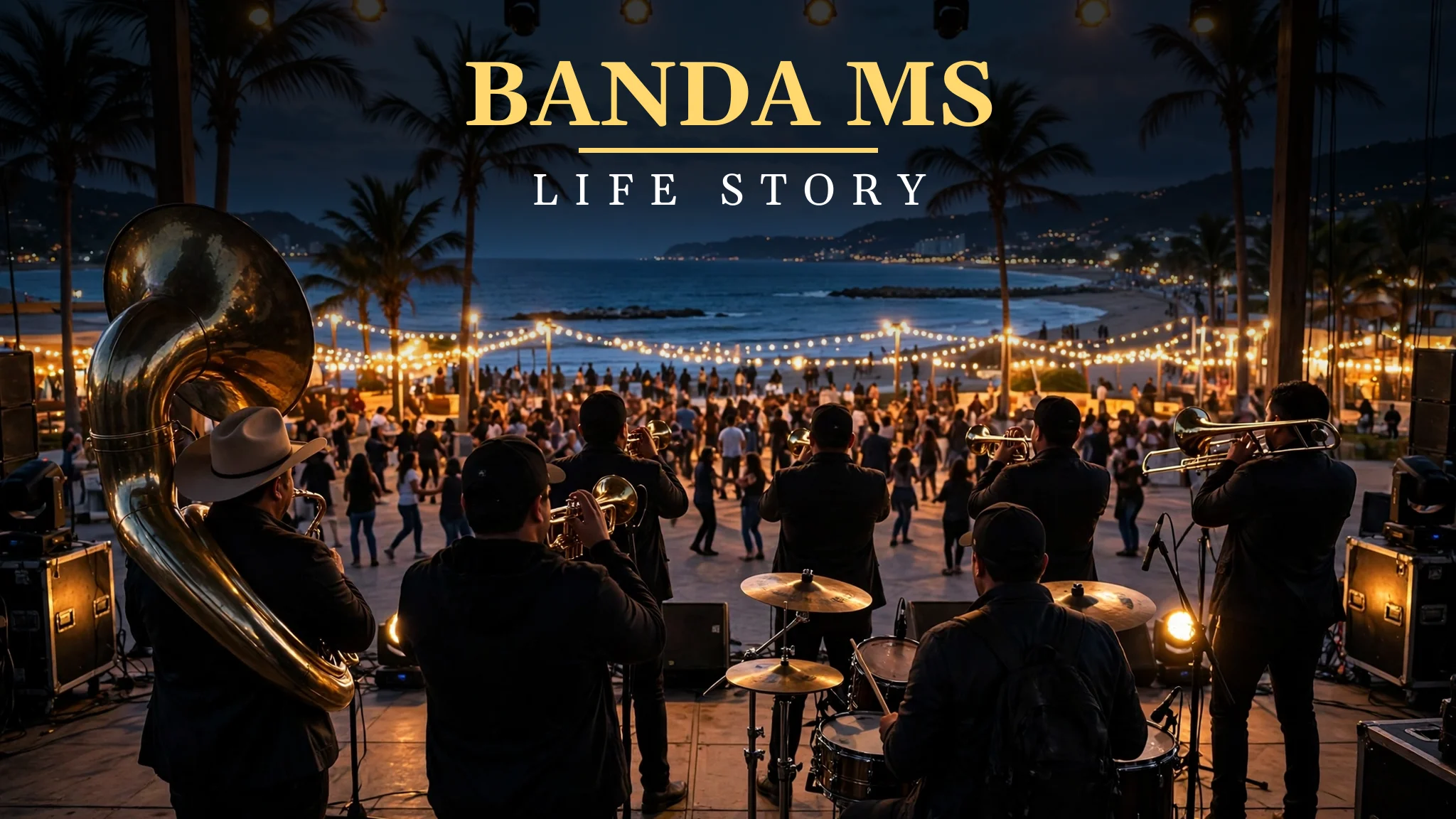
The live shows became a large part of the story. A Banda MS concert is a big event, with more than a dozen musicians on stage, bright lights, and a crowd that knows the words. The band plays for hours, and the audience sings along, dances, and waves. For many fans in the United States, a Banda MS concert is a link to home, a night when the music of Sinaloa fills a hall in Los Angeles or Houston or Chicago. The band understood that feeling, and it played for those fans with the same energy it gave at home.
Awards and nominations followed. Banda MS was nominated for Latin Grammy Awards and won honours at the Billboard Latin Music Awards and other ceremonies. But the real measure of its success was not a trophy. It was the sight of a full arena singing its songs, and the sound of its music in cars, kitchens, and workplaces across two countries. By the end of the decade, the band was not just a group. It was an institution in banda music.
Hard Times, Changes, and Keeping the Band Together
Success does not remove problems, and Banda MS faced its share of them. Keeping a large band together is hard work. Musicians leave, singers change, and the business of touring can wear people down. The group had to manage all of that while staying on stage night after night. There were times when the line-up changed, and fans watched closely to see if the sound would change too. The band worked to keep its identity steady, so that a new face did not mean a new sound.
The music world also changed around it. Streaming took over from CDs, and songs spread through phones and social media as much as through radio. Banda MS had to learn to reach fans in new ways, with videos, with online releases, and with a presence that younger listeners could find. The band adapted without losing its core. It still recorded full albums, it still toured, and it still played the brass-heavy banda that had made its name.
There were also hard years for live music as a whole, when tours were cancelled and halls stood empty. Like every touring band, Banda MS had to wait, and it had to find ways to stay close to its fans without a stage. Those years tested the group’s patience, but they did not break it. When live music returned, the band returned with it, and the crowds came back too. That return said something important about the bond between the band and its audience. It was not built on one song or one tour. It was built over many years.
Through all of this, the leadership of Sergio Lizarraga stayed central. He kept the band organised, he kept the standards high, and he kept the focus on the music. A band of this size can fall apart without strong leadership, and Banda MS did not. Its story in the hard years is not a story of drama. It is a story of steady work, of patience, and of a group that refused to let trouble turn into an ending.
The Band Today and Its Place in Banda Music
Today Banda MS stands as one of the leading banda groups in the world. It still records, it still tours, and its songs still reach the top of the regional Mexican charts. Its catalogue is now large, with many albums and many hits, and new listeners can spend hours discovering songs they have never heard. The band’s name is known even to people who do not follow banda closely, because its music has travelled so far.
The group’s influence goes beyond its own records. It showed younger banda groups that a band from Sinaloa could become a major act without leaving its roots behind. It showed that a large brass band could fill a stadium, that a romantic song could be as powerful as a party song, and that a group could stay together for more than twenty years if it worked with discipline. Many younger musicians look to Banda MS as an example of what is possible.
The band also carries the name of Mazatlan and Sinaloa wherever it goes. When it plays in the United States, it plays for families who left Mexico years ago and who hear in its music the sound of home. When it plays in Mexico, it plays for fans who grew up with banda as part of daily life. That double role, as a band for home and for those far from home, is part of its meaning. It is not just entertainment. It is a link between people and the place they come from.
Banda MS is still writing its story. New songs, new tours, and new audiences keep coming, and the band keeps doing what it has always done: playing banda with full brass, strong voices, and honest songs. It began as a new group in Mazatlan in 2003, and it became a name that stands for a whole sound. That journey, from a local band to a leading name in Latin music, is the heart of its life story. And it is a journey that is still going, because the band has never treated success as a finish line. Each new year brings new listeners, and each new listener finds a catalogue of songs waiting, ready to be played at the next party, the next wedding, and the next long drive home.
The Sound That Carried a Whole Region
There is one more thing that matters about Banda MS, and it is the sound itself. Banda music is often described as loud, but that word misses the point. The brass can be loud, but it can also be soft, and the tuba can carry a melody as gently as any singer. Banda MS learned to use the full range of its instruments, so that a song could rise and fall, could whisper and then shout. That skill is what makes its records worth listening to again and again.
The band’s songs also matter because of their words. They are written in simple Spanish, about love, about missing someone, about pride, and about the small moments of life. They do not try to be clever or distant. They speak directly, and that directness is why so many people feel that the songs are about them. A listener in Sinaloa, in Los Angeles, or in a small town far from both can hear a Banda MS song and find a line that fits his own life.
That is the legacy the band is building. It is not only a list of hits or a list of awards. It is a body of music that people use in their own lives, at weddings, at parties, at moments of joy and at moments of sadness. A band that can be part of so many lives has done something rare. Banda MS did it by staying true to its home, by working hard, and by never forgetting that the music belongs to the people who listen to it. It also did it by respecting the older banda groups that came before it, learning from their sound, and then adding its own voice. That respect for the past, joined to a clear hope for the future, is what keeps the music alive.
My Take:
When I think about Banda MS, I think first about the sound. I have heard many kinds of music, but there is something special about a full banda playing together, with the trumpets bright on top and the tuba deep underneath, holding everything together. It is a sound that feels like a community, because it takes many people to make it, and no single player can carry it alone. I admire Banda MS because it understood that from the start. It did not try to make banda smaller or quieter to fit a fashion. It made it bigger, cleaner, and prouder, and it let the sound speak for itself.
I admire the patience in this story more than anything else. Banda MS did not become famous in a year. It worked for years in Mazatlan and across Mexico, recording, touring, and learning, before “El Mecho” made the whole country notice. That kind of patience is hard, because it means working without the reward, and believing that the work will matter one day. I think many young musicians today want fame at once, and they give up when it does not come. Banda MS shows a different path. It shows that slow, steady work, done well, can build something that lasts longer than a quick hit.
I also think about Sergio Lizarraga, the man who built the group. He is not the singer, and he is not the face on the poster, but without him there would be no Banda MS. He had a clear idea, he chose good musicians, he kept the band organised, and he kept the standards high for more than twenty years. I respect that kind of leadership, because it is quiet and it is not about applause. It is about making sure that every show is good, that every record is worth hearing, and that the band survives the hard years as well as the good ones. A band this large needs a steady hand, and Lizarraga gave it one.
The singers matter to me too, because a banda without a good voice is only half a band. Alan Ramirez and Oswaldo Silvas gave Banda MS voices that people could love, and they sang love songs with a warmth that made the brass sound softer. I think about “Mi Razon de Ser” and “El Color de Tus Ojos”, and I hear songs that are simple in their words but deep in their feeling. They are not trying to impress anyone with clever lines. They are saying, in plain words, that love matters, that a person matters, and that a small detail like the colour of someone’s eyes can stay in the memory for years. That simplicity is a gift, and it is harder to write than it looks.
What moves me most is what Banda MS means to people far from home. I think of a Mexican family living in the United States, working hard, raising children in a new country, and going to a Banda MS concert on a Saturday night. For a few hours, the music brings Mazatlan into a hall in Los Angeles or Houston. The children hear the sound their parents grew up with, and the parents feel close to the place they left. That is not just entertainment. That is a link between generations, and between a home left behind and a life built somewhere new. I think music that can do that has a real purpose.
I also respect the way the band handled change. The music business changed a great deal since 2003. CDs faded, streaming took over, and live music stopped for a time. Many bands could not adapt, and they faded away. Banda MS adapted, but it did not change its soul. It still plays banda, it still uses a large brass section, and it still sings in the same direct way. I think that balance is the hardest thing in music: to change enough to survive, but not so much that you lose yourself. Banda MS found that balance, and that is why it is still here.
There is a sadness in this story too, though it is a quiet one. A band that tours for twenty years spends a great deal of time away from home. The musicians miss birthdays, they miss ordinary days with their families, and they live much of their lives on buses and in hotels. The fans see the bright lights and the loud music, but they do not see the tired mornings and the long journeys. I think about that when I listen to the songs, and I feel grateful for the work that goes into making something sound easy. Nothing about keeping a band of this size together for this long is easy.
I have a criticism as well, and it is an honest one. Banda MS is so good at its own sound that it rarely steps far outside it. I would like to hear the band take more risks, to try a song that surprises people, or to work with artists from a very different world. It has done some collaborations, but its heart is always in the same place. That is also its strength, so I do not ask it to change. I only wonder what else it could do, because a band with this much skill could do many things. Still, I understand the choice. When you have built something that millions of people love, you do not throw it away to chase a surprise.
What I learn from Banda MS is simple, and I think it is worth remembering. Do the work well, do it for a long time, and do it for real people rather than for fashion. Stay close to where you come from, and let that place be part of your name. Choose good people, trust them, and keep the standard high even when no one is watching. That is how a band from Mazatlan became a name across a continent. It did not happen by luck. It happened by playing, night after night, year after year, until the whole world could hear the sound of Sinaloa.
I think the band’s legacy will be the songs people keep singing. Long after the tours end, a song like “El Color de Tus Ojos” will still be played at a wedding, and a song like “El Mecho” will still make a room full of people stand up and dance. That is the test of music. It is not the chart position in one week. It is whether people still want to hear it years later, and whether it still means something to them. Banda MS passes that test, and I believe it will keep passing it for a long time. That is why I admire this band, and why I think its story matters.
I also think about the musicians who are not singers, the men on trumpet, trombone, clarinet, and tuba who stand on stage night after night. In a band this large, each player must trust the others, and each must play his part exactly. If one trumpet is late, the whole sound suffers. If the tuba player loses the beat, the dancers lose their step. I admire that discipline, because it is a kind of teamwork that most people never see. The audience hears one sound, but that sound is made by many hands working together, and it only works when every hand does its job.
Another thing I notice is how the band treats its home. Many successful groups leave their hometown behind and pretend they came from somewhere bigger. Banda MS put Mazatlan and Sinaloa into its very name, and it has carried those names onto the biggest stages in Latin music. I think that takes pride, and it takes courage, because it means the band is judged as a representative of its place. When it plays well, Sinaloa looks good. When it fails, Sinaloa is the name on the poster. The band accepted that responsibility, and it has honoured it for more than twenty years.
I wonder sometimes what a young musician in Mazatlan feels when he hears Banda MS on the radio. He hears a sound from his own streets, played by people from his own state, filling a stadium in another country. That must give him hope. It must tell him that he does not have to leave his music behind to succeed, and that the sound he grew up with is enough. I think that is one of the best things a successful band can do: it can open a door for the next generation, simply by showing that the door exists.
I also reflect on the love songs, because they are the heart of the band’s catalogue. A love song can be cheap and forgettable, or it can be honest and lasting, and the difference is in the words and in the voice. Banda MS chose songs that speak plainly about love, and it sang them without showing off. I think that honesty is why couples choose these songs for their weddings, and why people play them when they miss someone. The songs do not promise a perfect love. They speak about a real one, with its joy and its pain, and that is why they last.
There is a lesson here for anyone who wants to build something that lasts. Banda MS did not build its name on a single trick. It built it on a sound, on good songs, on strong singers, on a steady leader, and on years of touring. Each part matters, and if one part had been missing, the story might have been different. I think that is a useful way to look at any long career. Success is rarely one big moment. It is many small choices, made well, over a long time, until one day people look back and see a career that looks inevitable, even though it was built one show at a time.
Finally, I think about what I would say to someone who has never heard Banda MS. I would tell them to listen to the brass first, to hear how the trumpets and the tuba work together, and then to listen to the words. I would tell them that this is music made for people, not for critics, and that its power is in its directness. It does not ask you to understand a complicated idea. It asks you to dance, to sing, and to feel. That is enough, and it is more than enough. It is the reason a band from a port city in Sinaloa can fill a hall thousands of miles away, and why its songs will be sung long after the lights go down.
I will end with a simple thought that stays with me after reading this story. Banda MS did not become great by being the loudest band in Mexico, even though its brass can be very loud. It became great by being the most steady, the most honest, and the most faithful to its home. In a world where music changes every year, that steadiness is a rare thing, and it deserves respect. When I hear a Banda MS song now, I do not just hear a hit. I hear twenty years of work, a city on the Pacific coast, and a group of musicians who decided, long ago, that their sound was worth playing well. That is a story I am glad to have learned, and it is one I will remember. I will also remember the faces in the crowd at a Banda MS concert, singing every word, because a band is only as strong as the people who sing along. Banda MS gave those people songs worth singing, and they gave the band a reason to keep playing. That exchange, between a band and its listeners, is the real heart of this story, and it is why the music still matters today. When a crowd sings a chorus together, strangers become neighbours for a few minutes, and a song becomes a shared memory. Banda MS has created thousands of those moments, in halls and stadiums across two countries, and each one adds to a legacy that no single award can measure.
Frequently Asked Questions
When was Banda MS formed and where did it begin?
Banda MS was formed in 2003 in Mazatlan, Sinaloa, Mexico, by Sergio Lizarraga, and its full name is Banda Sinaloense MS de Sergio Lizarraga, with MS standing for Mazatlan, Sinaloa.
Who are the lead singers of Banda MS?
The best-known lead singers of Banda MS are Alan Ramirez and Oswaldo Silvas, whose voices became a central part of the band’s sound on its romantic songs and its big hits.
What is Banda MS best known for?
Banda MS is best known for its large brass banda sound and for hit songs such as “El Mecho”, “Mi Razon de Ser”, “Hermosa Experiencia”, “Hablame de Ti”, and “El Color de Tus Ojos”.
What does MS mean in the name Banda MS?
MS stands for Mazatlan, Sinaloa, the city and state in Mexico where the band was formed, and the name is a promise that the band carries its home with it wherever it plays.
Has Banda MS won major music awards?
Banda MS has been nominated for Latin Grammy Awards and has received honours at the Billboard Latin Music Awards and other Latin music ceremonies, though its widest success is measured by its sold-out concerts and chart hits.
Where can fans hear Banda MS live today?
Banda MS tours widely in Mexico and the United States, playing large venues and festivals, and its concert dates are announced through its official pages and through concert listing sites.


