Béla Tarr: The Life Story Behind Hungary's Slow Cinema Master
In this post
Béla Tarr is a Hungarian film director who makes films unlike almost anyone else in the world. His films are long, slow, black and white, and full of rain, wind, mud and silence, and they are loved by film lovers who believe that cinema can be an art, not only entertainment. He is famous for Sátántangó, a film that lasts more than seven hours, and for Werckmeister Harmonies and The Turin Horse, films that are slow, beautiful and deeply sad.
He was born in 1955 in Pécs, Hungary, and he started making films when he was still a teenager, with a small camera and a desire to show real life as it was. He did not go to film school at first. He learned by doing, by watching people, and by filming the world around him. His early films were about working-class life in Hungary, and his later films became more poetic, more philosophical, and more focused on time, on waiting, and on the end of the world.
This is the story of a director who refused to make fast, easy films, who chose slowness, silence and black and white, and who became one of the most respected directors in world cinema. It is a story about patience, about art, and about a man who believes that a film should take its time, just as life takes its time.
A Teenager with a Camera in Pécs
Béla Tarr was born on 21 July 1955 in Pécs, a city in southern Hungary, and he grew up in a Hungary that was under communist rule. He was interested in film from a young age, and he began making amateur films when he was still a teenager, using a small camera and filming the people and places around him. He did not have a big budget or a film school. He had curiosity, patience, and a desire to show life as it really was.
His early amateur work was noticed by people in the Hungarian film world, and he was invited to work at a film studio, where he learned the craft of directing. He did not study in the usual way. He learned by watching, by trying, and by making mistakes, and that hands-on learning gave his films a raw, direct feeling that film school might have taken away. He was a self-taught director, and he was proud of that.
Pécs and the Hungarian countryside shaped his eye. He loved the flat plains, the rain, the mud, the wind, and the long, empty roads, and those images would return in his films again and again. He did not film beautiful tourist places. He filmed the places where ordinary people lived, worked and waited, and he found beauty in those places, even when they were bleak and hard.
His youth in communist Hungary also shaped his view of the world. He saw how power worked, how people lived under a strict system, and how hope could fade slowly, not in a single moment, but over years. That slow fading, that feeling of waiting for something that never comes, is at the heart of his later films, and it comes from his own experience of life in Hungary.
Early Films: Real Life, Real People
Tarr’s first feature film, Family Nest, was released in 1979, when he was only twenty-four years old. The film tells the story of a young couple living in a crowded flat with their parents, trying to find space, privacy and a life of their own. It was shot in a raw, documentary style, with long takes and natural acting, and it felt like real life, not like a polished Hollywood film. Audiences in Hungary recognised the life on screen, because it was their life too.
He followed it with The Prefab People in 1982 and Almanac of Fall in 1984, films that continued his focus on working-class life, on cramped flats, on unhappy marriages, and on the small struggles of everyday existence. These early films were not easy to watch. They were slow, they were sad, and they did not offer easy answers, but they were honest, and they showed a director who was not afraid to look at life as it was, without making it prettier than it was.
In these early years, Tarr was part of a new generation of Hungarian filmmakers who wanted to show the truth about life under communism, about housing, about work, about family, and about the gap between what the state promised and what people actually lived. His films were not political speeches. They were stories about people, and the politics were in the background, in the flats, in the jobs, in the waiting, and that made them more powerful, not less.
His early style was already slow and patient. He liked long takes, where the camera stays on a scene for a long time, without cutting, and he liked to let the audience watch people eat, walk, talk and wait. That style would become his trademark, and it would later make him famous around the world, but in the early years, it was simply his way of telling the truth, slowly and carefully.
Damnation and the Turn to Poetry
In 1988, Tarr made Damnation, a film that marked a big change in his work. The film is in black and white, it is slow, it is full of rain and mud, and it tells the story of a man in a bleak town who is in love with a married woman and who dreams of escaping. The film is not a simple love story. It is a poem about despair, about waiting, and about a world that seems to be falling apart, and it showed that Tarr was moving from realism to a more poetic, more philosophical kind of cinema.
Damnation was the first film in which Tarr worked closely with the writer László Krasznahorkai, who would become his most important collaborator. Krasznahorkai wrote novels and scripts that were long, slow and full of beautiful, dark language, and Tarr filmed them in a way that matched that language. Together, they created a world that was both Hungarian and universal, a world of rain, of bars, of empty streets, and of people waiting for something that never comes.
The film also introduced Tarr’s mature visual style: black-and-white photography, very long takes, a camera that moves slowly through a scene, and a focus on faces, on hands, on rain on a window, on a dog in the street. These images are beautiful, even when the story is sad, and they make the audience feel time passing, slowly, in real time. That feeling of time is central to Tarr’s work, and it is what makes his films different from almost all other films.
Damnation was not a commercial success, but it was loved by critics and by film lovers, and it showed that Tarr was a director with a unique vision. He was no longer only a filmmaker about Hungarian working-class life. He was a poet of cinema, a director who used images, sound and time to say things that words alone could not say.
Sátántangó: Seven Hours of Cinema
Tarr’s most famous film is Sátántangó, released in 1994, based on a novel by László Krasznahorkai. The film lasts more than seven hours, and it tells the story of a group of people in a dying collective farm in Hungary, who are waiting for a man named Irimiás, who they believe will save them, or who will trick them, or who will lead them somewhere new. The film is shown in twelve parts, and it moves forward and backward in time, showing the same events from different points of view.
Sátántangó is famous for its length, but its length is not a trick. The film needs its seven hours, because it is about waiting, about time, about the slow decay of a community, and about the way hope can be both real and false. The long takes, the rain, the mud, the wind, the faces of the characters, all of it adds up to a feeling that the audience lives inside the film, not just watches it. It is a demanding film, but for those who watch it all the way through, it is also a deeply moving experience.
The film was shot in black and white, with a camera that moves very slowly, and with very little music. The sound of rain, of wind, of footsteps in mud, becomes the music of the film. The actors, many of whom were not professional stars, perform with a natural, tired, human quality that makes the characters feel real, even when the story is strange and dreamlike. Sátántangó is not a film for everyone, and Tarr knew that, but for film lovers, it is a masterpiece.
Today, Sátántangó is shown at festivals and in cinemas around the world, often with breaks, and it is still talked about as one of the greatest films ever made. It is a film that proves that cinema can be long, slow and difficult, and still be great, if it is made with honesty and with art. Tarr’s seven hours are not a waste of time. They are a way of showing how time itself feels when a community is dying and when people are waiting for a saviour who may never come.
Werckmeister Harmonies and The Turin Horse
After Sátántangó, Tarr made Werckmeister Harmonies in 2000, based on another novel by Krasznahorkai. The film tells the story of a small Hungarian town where a travelling circus arrives with a whale and a mysterious figure called the Prince, and the town slowly falls into chaos and violence. The film is beautiful, strange and sad, and it is full of long, slow shots of the town, of the whale, of people walking in the rain, and of a young man named János who tries to understand what is happening.
Werckmeister Harmonies is often called Tarr’s most accessible film, because it is shorter than Sátántangó, it has a clearer story, and it is full of images that are easy to remember, such as the whale in the square and the crowd moving through the town at night. The film is about how a society can fall apart, how fear can spread, and how a single event can change everything. It is also about music, about harmony, and about the idea that the world is out of tune, and that no one knows how to fix it.
In 2011, Tarr made The Turin Horse, which he said would be his last film. The film is based on a story about the philosopher Friedrich Nietzsche, who, in Turin in 1889, saw a horse being beaten, ran to it, and then fell into madness. Tarr imagines the life of the horse’s owner, a farmer, and his daughter, in the days after that event, as their world slowly ends. The film is in black and white, it is very slow, and it shows the same daily routine, again and again, as the wind blows, the food runs out, and the light fades.
The Turin Horse is a film about the end of the world, not in a loud, explosive way, but in a quiet, slow way, where a well runs dry, a horse stops eating, and a lamp goes out. It is a sad, beautiful film, and it is a fitting end to Tarr’s career, because it brings together all of his themes: time, waiting, decay, and the dignity of ordinary people in the face of a world that is ending. After the film, Tarr said he would not make another feature film, and he has kept that promise.
A Teacher, a School, and a Life After Film
After The Turin Horse, Tarr did not disappear. He became a teacher and a mentor to young filmmakers, and he founded a film school in Sarajevo, in Bosnia and Herzegovina, where he taught students from around the world. The school was called the film.factory, and it was based on Tarr’s belief that film should be taught by doing, by watching, by making, and by thinking about time, about images, and about truth, not only by learning technical skills.
His teaching was as slow and patient as his films. He told students to watch the world, to listen, to wait, and to find their own voice, not to copy him or anyone else. He believed that a young director should make films about their own life, their own place, and their own people, and that they should not be afraid to be slow, to be difficult, or to be different. Many of his students have gone on to make films of their own, and they carry his influence with them.
Tarr also continued to be a presence at film festivals, where his films are shown, discussed and celebrated. He is a respected figure in world cinema, and he is often asked about his work, about his style, and about why he stopped making films. He has said that he said what he wanted to say, and that he does not want to repeat himself. That honesty is part of his character, and it is why his decision to stop is respected, even by fans who wish he would make one more film.
He lives in Hungary, and he remains a quiet, thoughtful man, who does not seek fame or attention. He is not a celebrity in the usual sense. He is an artist, a teacher, and a thinker, and his life after film is as calm and as serious as his films themselves. He has given cinema some of its most beautiful and most challenging works, and he has given young filmmakers a teacher who believes in them.
Legacy: The Master of Slow Cinema
Béla Tarr’s legacy is the legacy of slow cinema, a kind of film that takes its time, that trusts the audience, and that believes that an image can say more than a hundred words. His films are not for everyone, and he never tried to make them for everyone, but for those who love them, they are among the greatest films ever made. Sátántangó, Werckmeister Harmonies and The Turin Horse are still shown, still discussed, and still loved by film lovers around the world.
His influence on other directors is large. Many young filmmakers have learned from his long takes, his black-and-white images, his use of sound, and his patience with time. They have learned that a film does not need to be fast to be exciting, and that slowness can be a form of excitement, if it is done with care and with art. Tarr showed that cinema can be a meditation, a poem, and a way of thinking about life and death.
His partnership with László Krasznahorkai is also a major part of his legacy. Together, they created a world that is both Hungarian and universal, a world of rain, mud, wind and waiting, and that world has become a part of world cinema. Their films are studied in film schools, and they are still a source of inspiration for writers and directors who want to tell stories about the end of a world, about hope, and about despair.
In the end, Béla Tarr will be remembered as a director who refused to compromise, who made films his own way, and who trusted that there would be an audience for slow, beautiful, difficult cinema. He was right, and his films will keep finding new audiences, new students, and new lovers, for as long as people care about cinema as an art.
Rain, Wind, and the Hungarian Plain
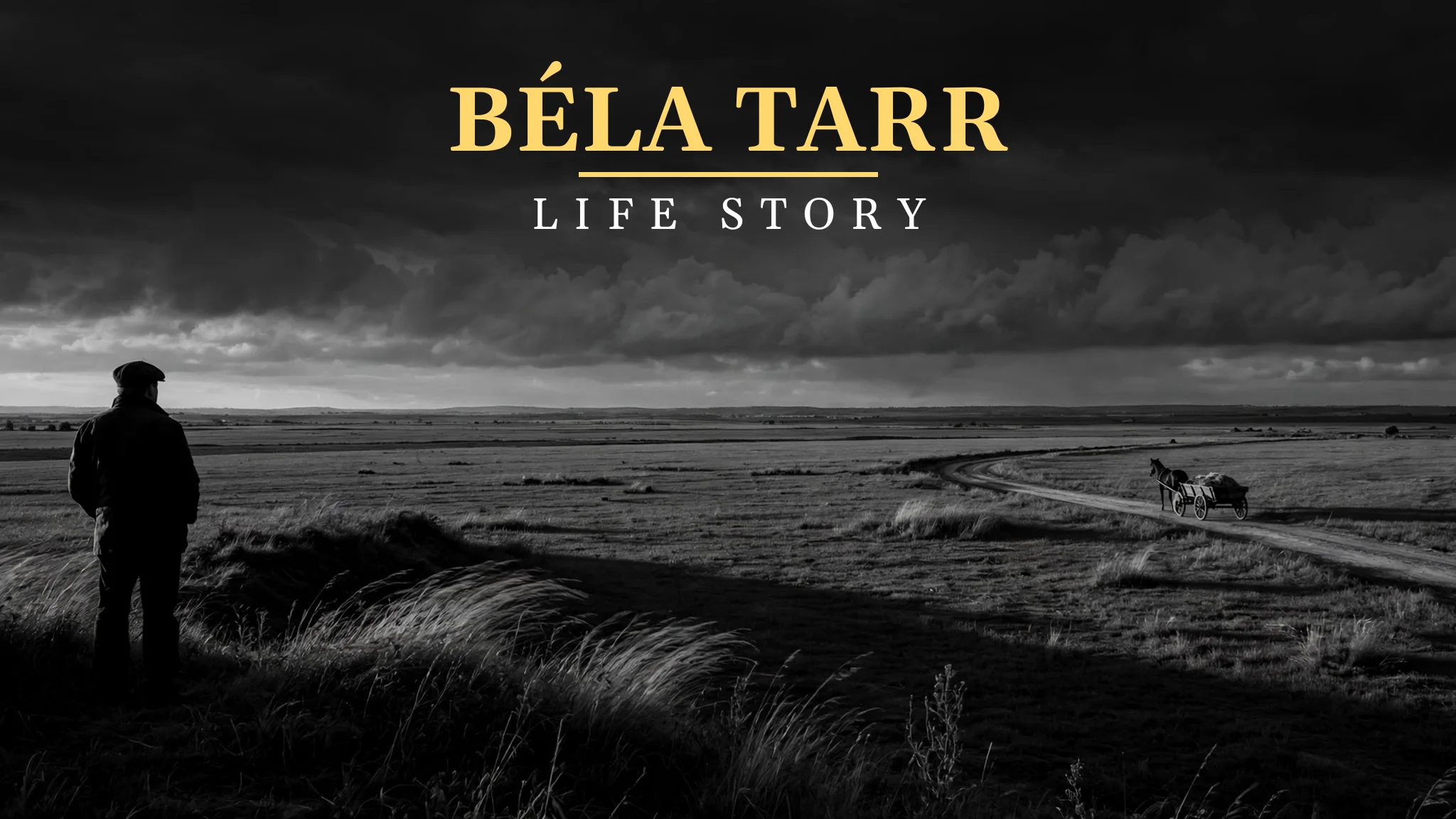
Béla Tarr’s films are full of rain, wind, mud, and the flat Hungarian plain, and those images are not only background. They are characters in his films, forces that shape the lives of the people who live in them, and that show how small a human being is in a large, indifferent world. The plain in Hungary is vast, flat, and empty, with a horizon that seems to go on for ever, and Tarr films it with a slow, patient camera, letting the audience feel the wind, hear the rain, and see the mud on a man’s boots, as if they were standing on that plain themselves. That feeling of place is central to his work, and it is why his films feel so real, even when their stories are strange and dreamlike, because the place is real, and the people in it are real, even if their hopes are not.
Rain is especially important in Tarr’s films. It rains in Damnation, it rains in Sátántangó, it rains in Werckmeister Harmonies, and the rain is not a romantic, beautiful rain. It is a cold, grey, persistent rain, that soaks clothes, that turns roads to mud, that makes people hurry, and that makes the world feel bleak and hard. Tarr films rain with a love for its sound, its look, and its feeling, and he lets the audience hear it, see it, and feel it, for a long time, without cutting away. That patience with rain is a form of respect for nature, and for the audience, because it says, this is how the world really is, in Hungary, in winter, in a small town, and you should sit with it, feel it, and understand it, rather than rushing past it to the next scene.
Wind is also a character in his films, especially in The Turin Horse, where the wind blows constantly, through the farm, through the house, through the lives of the farmer and his daughter, and it never stops, even when the world is ending. The wind in Tarr’s films is not a gentle breeze. It is a strong, cold, relentless wind, that makes doors bang, that makes trees bend, and that makes people tired. Tarr films the wind by filming its effects, on clothes, on hair, on a cart, on a horse, and the audience feels the wind, even though they cannot touch it, because they can see what it does to the world. That is a clever, cinematic way to film something invisible, and it shows Tarr’s gift as a visual poet.
The Hungarian plain, the rain, and the wind together create a world that is both beautiful and bleak, a world that is hard to live in, but that is also full of a strange, quiet beauty, in the light, in the clouds, in the long horizon, and in the faces of the people who live there. Tarr does not film that world to make it look pretty. He films it to make it look true, and that truth includes both beauty and bleakness, both light and darkness, both hope and despair. That is why his films are so powerful, because they do not choose one side. They show both, slowly, patiently, and with a deep respect for the place and for the people who call it home.
In his teaching, Tarr often told his students to look at the world, to watch the rain, to listen to the wind, and to find their own plain, their own place, and to film it with honesty. He believed that every filmmaker has a place, a home, a landscape that shaped them, and that they should film that place, not copy someone else’s place, because only then will their films feel true. That lesson is at the heart of his work, and it is why his films, even though they are about Hungary, feel universal, because every person has a plain, a rain, and a wind of their own, a place where they grew up, and a weather that shaped them, and Tarr shows us how to film that place with love and with truth.
My Take:
When I think about Béla Tarr, I think first about time, because his films are about time more than they are about plot. He makes me wait, he makes me watch rain fall, he makes me watch a man walk across a muddy field, and at first, that waiting feels hard. Then, slowly, I begin to understand what he is doing. He is teaching me to pay attention, to look at the world as it really is, and to feel time passing, not as a rush, but as a slow, real thing. I admire that, because in a world where everything is fast, Tarr dares to be slow, and his slowness is a form of respect for the audience and for life itself.
What I love most about Sátántangó is not its length, although its length is famous, but its feeling of living inside a dying world. The film shows a collective farm in Hungary, with people waiting for a saviour, and it shows their hope, their fear, and their disappointment, in a way that feels true, even if I have never lived on a farm in Hungary. I see in those people a universal feeling, the feeling of waiting for something to change, of hoping that a new leader, a new idea, or a new day will save us, and of learning, slowly, that salvation may not come. That is a sad lesson, but it is also an honest one, and I respect Tarr for telling it without softening it.
I also think about his collaboration with László Krasznahorkai, because it shows what can happen when a director and a writer truly share a vision. Krasznahorkai writes long, dark, beautiful sentences, and Tarr films long, dark, beautiful images, and together they create a world that feels complete. I think about my own work, and I think about how important it is to find a partner who understands what you are trying to do, and to trust that partner. Tarr and Krasznahorkai trusted each other, and the result was films that neither could have made alone. That trust is a lesson for any artist.
The Turin Horse moves me in a different way, because it is about the end of the world, not with explosions, but with a well running dry, a horse refusing to eat, and a lamp going out. That is a very quiet apocalypse, and it feels more real to me than a loud one, because the world often ends slowly, in small ways, not in a single moment. I think about the farmer and his daughter, doing the same routine every day, eating the same food, going to the same well, and I feel both sadness and respect for them. They do not give up. They keep going, even when the light is fading, and that dignity is what makes the film beautiful.
I feel sad when I think about how few people watch Tarr’s films, because they are demanding, and many viewers do not have the patience for a seven-hour film, or for a film with very little dialogue and very long takes. I understand that, because I also find his films hard, and I also have to make an effort to watch them. But I also feel that the effort is worth it, because his films give me something that fast films do not give me: a feeling of time, of place, and of being alive in a real world. I wish more people would try, even if they only watch Werckmeister Harmonies, which is shorter and easier, because they might discover a new way of seeing cinema.
Another thing I admire is his decision to stop making films after The Turin Horse. It would have been easy to keep making films, to keep chasing festivals and prizes, but Tarr said he had said what he wanted to say, and he stopped. That takes honesty, and it takes courage, because it means letting go of fame and of the identity of being a director. He did not stop working. He became a teacher, and he gave his knowledge to young filmmakers, and that is a generous way to end a career. I learn from that. Knowing when to stop is as important as knowing when to start, and a good ending can be as beautiful as a good beginning.
I also think about his early films, Family Nest and The Prefab People, because they show a different Tarr, a young director filming real life in crowded flats, with natural acting and a documentary eye. Those films are not as famous as his later work, but they are important, because they show where he came from, and they show that his later poetry grew out of realism. He did not start as a poet. He started as a witness, watching people live, and then he slowly became a poet, using images to say what words could not say. That journey, from realism to poetry, is a lesson for any artist who wants to grow.
If I have a criticism, it is only that Tarr’s films can feel cold, and that some viewers may feel that he does not love his characters enough. His people are often sad, tired, and hopeless, and the world around them is often bleak, with rain and mud and wind. I understand that criticism, and I sometimes feel it myself, when I watch his films and wish for a little more warmth, a little more hope. But I also think that Tarr’s coldness is honest, because the world he films is cold, and to pretend otherwise would be false. His films are not warm, but they are true, and that truth has its own kind of beauty.
For a young reader who wants to make films, I would say this. Learn from Tarr, but do not copy him. Learn to watch, to wait, to pay attention to rain, to wind, to a face, to a hand, and to trust that an image can carry meaning. Do not rush to cut, to explain, to add music, or to make everything fast. Let your film breathe, let your audience think, and let time do its work. Tarr teaches us that slowness is not a weakness. It is a strength, if it is used with care and with purpose.
In the end, I think Béla Tarr teaches us that cinema can be an art, not only entertainment, and that art can be slow, difficult and beautiful at the same time. His films are not easy, but they are rewarding, and they stay with me long after I have watched them. I think about the rain in Sátántangó, the whale in Werckmeister Harmonies, and the lamp going out in The Turin Horse, and I feel that I have seen something true about life, about waiting, and about the end of things. That is a gift, and I am grateful for it, even if it is a sad gift.
I also want to say something about his teaching, because it stays with me. He founded a school in Sarajevo, a city that had itself lived through war and destruction, and he taught young filmmakers there to make films about their own lives, their own places, and their own truths. That is a generous act, and it shows that Tarr believes in the future of cinema, even if he has stopped making films himself. He is passing his knowledge on, and that is the best way to keep an art alive. I hope his students carry his patience, his eye, and his honesty into their own films.
Finally, I think about the plain in his films, the flat Hungarian plain, with wind blowing across it, and a man walking alone. That image is simple, and it is also profound, because it shows a human being, small, in a large world, trying to keep going. That is all of us, in the end, small people in a large world, walking, waiting, and hoping. Tarr shows us that walk, slowly, and he makes us feel its weight. I will remember that walk, and I will remember his films, as a reminder to slow down, to look, and to feel time passing, before it is gone.
I think about Tarr’s rain, and I feel cold, because his rain is not a movie rain, with a few drops and a romantic light. It is a real rain, cold, grey, and persistent, that soaks a man’s coat, that turns a road to mud, and that makes life hard. I admire Tarr for filming that rain, for not making it pretty, for letting the audience feel it, and for trusting that the audience will stay, even when the rain is uncomfortable. That trust is a form of respect, and it is a lesson for any artist: do not make the world prettier than it is, to please people. Show it as it is, with rain, with mud, with wind, and people will respect you for your honesty, even if they are cold.
Another thought that stays with me is about the Hungarian plain, and how vast, flat, and empty it is, and how small a person looks on it. Tarr films a man walking across that plain, and the man is tiny, the sky is huge, and the wind is strong, and that image tells me something about life, about how small we are, about how large the world is, and about how we keep walking, even when the world is large and we are small. I think about my own life, and about the times when I have felt small, and Tarr’s image gives me comfort, because it shows that being small is not a weakness. It is a truth, and a small person walking, with dignity, across a large plain, is a beautiful, brave image, and it is one I will keep.
I also think about his teaching, and his advice to students to find their own plain, their own place, and to film it honestly. That advice is simple, but it is profound, because it tells a young filmmaker not to copy Hollywood, not to copy Tarr, but to look at their own home, their own street, their own rain, and to film it with love. I learn from that. In my own work, I should look at my own place, my own life, and my own people, and tell their story, rather than copying someone else’s story, because my place is enough, if I look at it with care. That is a lesson that Tarr teaches, not only in his films, but in his teaching, and it is a lesson that will help young filmmakers for a long time.
There is also a sadness in thinking about Tarr’s world, because it is a world that is ending, a world of collective farms, of small towns, of people waiting for a saviour who never comes, and that ending is slow, painful, and real. I feel sad for those people, for their hopes, for their disappointments, and for the rain that keeps falling on them, even as their world fades. But I also feel grateful that Tarr filmed them, that he gave them dignity, that he showed their faces, their walks, their waits, and that he did not forget them. That remembering is a form of love, and it is why his films matter, even when they are sad, because they remember people who might otherwise be forgotten.
Finally, I think about the wind in The Turin Horse, and how it never stops, even when the world is ending, and how the farmer and his daughter keep going, even when the wind is strong, the food is gone, and the light is fading. That image stays with me, because it shows dignity in the face of the end, a quiet, stubborn dignity that does not shout, but that keeps walking, keeps eating, keeps living, even when living is hard. I hope I can have a little of that dignity in my own life, to keep going, even when the wind is strong, and to do it with patience, with honesty, and with a respect for the place where I live. That is a lesson Tarr teaches, with rain, with wind, and with a plain, and it is a lesson I will keep for a long time.
Frequently Asked Questions
When was Béla Tarr born and where is he from?
Béla Tarr was born on 21 July 1955 in Pécs, Hungary. He began making amateur films as a teenager, and he learned filmmaking by doing, rather than by going to film school at first, before working at a Hungarian film studio.
What is Béla Tarr’s most famous film?
His most famous film is Sátántangó, released in 1994 and based on a novel by László Krasznahorkai. The film lasts more than seven hours and tells the story of people on a dying collective farm in Hungary who are waiting for a man named Irimiás.
What are Werckmeister Harmonies and The Turin Horse about?
Werckmeister Harmonies, from 2000, is about a small Hungarian town thrown into chaos when a travelling circus arrives with a whale. The Turin Horse, from 2011, imagines the life of a farmer and his daughter after the philosopher Nietzsche saw a horse being beaten in Turin.
Why are Béla Tarr’s films so slow?
Tarr uses very long takes, black-and-white photography and little dialogue to make the audience feel time passing in real life. His slowness is a deliberate choice, meant to show waiting, decay and the dignity of ordinary people, rather than to rush through a plot.
Did Béla Tarr stop making films?
Yes, Tarr said that The Turin Horse, released in 2011, would be his last feature film, and he has kept that promise. After that, he became a teacher and founded a film school in Sarajevo, where he mentored young filmmakers from around the world.
Who is László Krasznahorkai?
László Krasznahorkai is a Hungarian writer who worked closely with Tarr on Damnation, Sátántangó, Werckmeister Harmonies and The Turin Horse. His long, dark and poetic novels provided the stories and the mood for Tarr’s most famous films.


