Benicio del Toro: The Life Story Behind Puerto Rico's Oscar-Winning Actor
In this post
Benicio del Toro is one of the most respected actors in the world, a man known for his quiet intensity, his deep voice, and his ability to disappear into a character. He won an Academy Award for his role in Traffic, he played Che Guevara in Che, he was a mysterious figure in The Usual Suspects, and he has played killers, cops, lawyers, and outlaws with the same truth and the same care. He is not a loud star. He is a thoughtful actor, a man who chooses his roles carefully, and who gives each one his full attention.
He was born in San Germán, Puerto Rico, in 1967, and he moved to the United States when he was a teenager. He studied acting, he worked in small roles, and he built his career slowly, one film at a time. He did not become famous in one night. He worked, he learned, and he grew, and when his big chance came, he was ready. His performance in The Usual Suspects made people notice him, and his performance in Traffic made him an Oscar winner. Since then, he has been one of the most sought-after actors in Hollywood, and one of the most respected.
What makes his story special is the way he has stayed true to himself in a world that often asks actors to be loud, to be famous, and to be everywhere. Benicio is quiet, he is private, and he is careful about the roles he takes. He chooses films that matter to him, he works with directors he respects, and he gives each character a life that feels real. He is a Puerto Rican actor who has become a world star, without losing his roots, his calm, or his love of acting. This is the story of how a boy from San Germán became an Oscar-winning actor, and why his work still matters today.
A Boy From San Germán
Benicio Monserrate Rafael del Toro Sánchez was born on 19 February 1967 in San Germán, Puerto Rico, a historic town in the west of the island. His family was a professional family, and his father was a lawyer, his mother was also a lawyer, and his brother was a doctor. He grew up in a home where education mattered, where books were read, and where hard work was valued. He was a quiet boy, and he showed an early interest in art, in drawing, and in the world around him. He was not a child who dreamed of Hollywood. He was a child who watched, who listened, and who thought.
San Germán is one of the oldest towns in Puerto Rico, with a rich history, and Benicio grew up in that history. He learned about his island, its culture, and its people, and he carried those lessons with him. He was a Puerto Rican boy, and he was proud of it, even when he later moved to the United States. His home gave him roots, and those roots have stayed with him through his whole career. He speaks Spanish, he loves Puerto Rico, and he returns to his island with pride. His early years in San Germán shaped the man he would become, a thoughtful, quiet, and observant person.
When he was a child, his mother died, and that loss shaped his life deeply. He was young, and the loss was hard, and it taught him about sadness, about family, and about the fragility of life. He does not speak about it often, because he is a private man, but it is a part of his story, and it is a part of the depth that he brings to his acting. An actor who has known loss can play loss with truth, and Benicio has done that many times. His early loss gave him a seriousness, a depth, and a quiet strength that audiences can feel in his performances.
His family moved to the United States when he was a teenager, and the move changed his life. He left Puerto Rico, his home, and he went to a new country, with a new language, and a new way of life. It was hard, but he was brave, and he learned quickly. He went to school in Pennsylvania, he learned English, and he began to think about what he wanted to do with his life. He first studied business, but his heart was in art, in acting, and in storytelling. The boy from San Germán was on his way to becoming an actor, and his journey had only just begun.
Moving to America and Finding Acting
When Benicio was twelve years old, his family moved to Mercersburg, Pennsylvania, in the United States, after the death of his mother. It was a big change, from a warm, Spanish-speaking island to a small, English-speaking town in America. He had to learn a new language, make new friends, and find his place in a new world. It was not easy, but he was observant, and he watched people, he listened to them, and he learned. That habit of watching would later make him a great actor, because an actor must watch people closely to play them truthfully.
He went to school in Pennsylvania, and he first studied business at the University of California, San Diego, because his family wanted him to have a practical career. But his heart was not in business. He loved acting, he loved film, and he wanted to try it. He took acting classes, he performed in student plays, and he discovered that acting was what he wanted to do. It was a brave decision to leave business and to follow art, but he made it, because he knew that he would not be happy doing anything else. He moved to New York to study acting, and he began his journey as an actor.
In New York, he studied at the Circle in the Square Theatre School, and he also studied with the famous acting teacher Stella Adler, who taught many great actors. He learned the craft of acting, how to use his voice, how to move, how to listen, and how to become a character. He was a serious student, and he worked hard, because he knew that acting is not only talent. It is also work, discipline, and practice. He took small roles, he worked in theatre, and he built his skills, one role at a time. He was not in a hurry. He knew that a great actor takes time to grow.
He also moved to Los Angeles, the centre of film in America, and he began to work in television and in small film roles. He was a young actor, with a distinctive look, a deep voice, and a quiet intensity, and casting directors noticed him. He played small parts, he learned from each one, and he built a reputation as a reliable, talented actor. He was not yet a star, but he was on his way. The boy from San Germán had become a student of acting, and his education was preparing him for the roles that would make him famous.
Small Roles and The Usual Suspects
In the late 1980s and early 1990s, Benicio del Toro took small roles in films and television, and he learned his craft in each one. He appeared in television shows, in small films, and in supporting roles, and he gave each one his full attention. He was not a star yet, but he was a working actor, and he was learning how film works, how a set works, and how to work with directors and other actors. Those small roles were his school, and he was a good student. He watched, he listened, and he grew.
His breakthrough came in 1995 with the film The Usual Suspects, a crime film that became a classic. Benicio played Fred Fenster, a small-time criminal with a strange, mumbling way of speaking, and his performance was unforgettable. He was not the lead actor, but he stole every scene he was in, with his humour, his mystery, and his unique voice. Audiences remembered him, critics praised him, and directors took notice. The Usual Suspects made him a name in Hollywood, and it showed that he could take a small role and make it into something special. It was a turning point, and it changed his career.
The film also taught him about the power of a character actor. A character actor is not always the hero. He is the person who makes the film real, who gives it colour, and who makes the audience believe in the world of the story. Benicio is a great character actor, and The Usual Suspects proved it. He did not need to be the star to be memorable. He needed to be truthful, and he was. His performance in that film is still talked about today, and it is a proof of his talent. It was the role that opened doors, and he walked through them with care.
After The Usual Suspects, Benicio was offered more roles, and he chose them carefully. He did not take every role that was offered. He chose films that mattered to him, films with good directors, good scripts, and characters that interested him. He played in Fear and Loathing in Las Vegas, in The Way of the Gun, and in other films, and each role showed a different side of his talent. He was becoming known as an actor who could play many kinds of characters, from funny to dark, from quiet to violent, and who could do it all with truth. His career was growing, and his best work was still ahead of him.
Traffic and the Academy Award
In 2000, Benicio del Toro starred in the film Traffic, directed by Steven Soderbergh, and his performance won him the Academy Award for Best Supporting Actor. He played Javier Rodríguez, a Mexican police officer caught in the drug war, a man who is honest in a corrupt world, and who tries to do the right thing. It was a powerful performance, quiet, intense, and full of feeling, and it moved audiences and critics. He spoke mostly in Spanish in the film, and his Spanish was natural, warm, and true. It was a role that showed his depth, his talent, and his ability to carry a serious film.
Traffic was a film about the drug trade, about its effects on many lives, and Benicio’s character was at its heart. He played a man who sees the corruption, who faces danger, and who keeps his integrity, even when it costs him. It was a difficult role, and it required great skill, because the character is quiet, and his feelings are shown in small ways, in a look, in a pause, in a silence. Benicio played it with great care, and his performance was praised as one of the best of the year. The Academy Award was a recognition of that work, and it was a moment of great joy for him, for Puerto Rico, and for Latin actors everywhere.
Winning the Oscar changed his life, but it did not change his character. He remained a quiet, private man, who chose his roles carefully, and who did not chase fame. He used the Oscar to get better roles, to work with great directors, and to make films that mattered to him. He did not become a loud star. He became a respected actor, and his Oscar gave him the freedom to choose. That freedom is valuable, and Benicio has used it well, choosing films that are serious, thoughtful, and true. Traffic was a turning point, and it made him a world star, but he stayed himself.
The Oscar also made him a symbol for Puerto Rico and for Latin actors. He was one of the few Puerto Rican actors to win an Academy Award, and his win gave hope to many young Latin actors who dreamed of Hollywood. He showed that a Puerto Rican actor, who speaks Spanish, who comes from a small island, can win the highest honour in film. That is a powerful message, and it is one that many people remember. Benicio’s Oscar was not only his. It was a win for his island, for his language, and for his people, and he carries that honour with pride and with humility.
Che, 21 Grams, and Serious Roles
After Traffic, Benicio del Toro took on more serious roles, and he showed his range as an actor. In 2003, he starred in 21 Grams, a film about loss, guilt, and redemption, and his performance was praised for its depth and its feeling. He played a man who has made mistakes, who is trying to make things right, and who carries a heavy burden. It was a difficult, emotional role, and Benicio played it with great honesty. He was nominated for another Academy Award, and his work in 21 Grams confirmed that he was one of the great actors of his time.
In 2008, he played Che Guevara in the film Che, a two-part epic about the life of the revolutionary leader. It was a huge role, and it required great preparation. Benicio studied Che’s life, he learned Spanish in a Cuban accent, he lost weight, and he worked for many months to become the character. His performance won him the Best Actor Award at the Cannes Film Festival, and it was praised as one of the great performances of his career. Playing Che was a challenge, because Che is a controversial figure, and Benicio had to play him as a human being, not as a hero or a villain. He did it with care, and his performance was powerful and thoughtful.
He also played in other serious films, including The French Dispatch, Sicario, and many others, and each role showed a different side of his talent. In Sicario, he played a mysterious, dark character, a man with a painful past, and his performance was quiet, intense, and unforgettable. In The French Dispatch, he played an artist, a man with a gentle, creative soul. He can play many kinds of people, and he does it with truth. He is an actor who does not repeat himself. He finds something new in each character, and he gives each one a life of its own. That is the mark of a great actor.
Through these years, Benicio remained a careful actor, who chooses his roles with thought. He does not take many roles. He takes a few, and he gives each one his full attention. He works with directors he respects, he reads scripts carefully, and he prepares for a long time. That care is one reason his performances are so good. He does not rush. He thinks, he studies, and he becomes the character. His serious roles have made him one of the most respected actors in the world, and his name is spoken with admiration wherever film is loved.
Sicario, Star Wars, and a Working Star
In the 2010s, Benicio del Toro continued to work in major films, including Sicario in 2015, a film about the drug war on the border between the United States and Mexico. He played Alejandro, a mysterious man with a dark past, and his performance was one of the most praised of the year. He was quiet, intense, and frightening, and yet also sad, and audiences could not forget him. Sicario showed that Benicio could still surprise, even after many years in film, and that his talent had not faded. He returned for the sequel, Sicario: Day of the Soldado, and his performance was again praised.
He also joined the Star Wars universe, playing a character in Star Wars: The Last Jedi in 2017. It was a different kind of role, in a huge, popular film, and it brought him to new audiences, including young fans who had not seen his earlier work. He played the character with his usual care, making a small role into something memorable. He did not treat it as a simple blockbuster role. He treated it as a character, with a history, with motives, and with a life, and that is why his performance stood out. Even in a big film, Benicio brings truth.
He has also worked in independent films, in smaller films, and in films in Spanish, and he has shown that he is not only a Hollywood star. He is an actor who loves film, in all its forms, and who is willing to work in small, serious films as well as in big ones. That versatility is rare, and it is admirable. He chooses films that matter to him, whether they are big or small, and he gives each one his best. His career in the 2010s and beyond shows a working star, a man who keeps acting, keeps learning, and keeps giving great performances, year after year.
Today, Benicio continues to act, to produce, and to work in film, and he remains one of the most respected actors in the world. He is not a star who seeks fame. He is an actor who seeks good roles, good directors, and good stories, and he finds them. His work in recent years shows that he is still at the top of his art, still surprising audiences, and still giving performances that are quiet, intense, and true. He is a working star, and his work is his life, and it is a life that has brought great films to the world.
A Private Man, a Proud Puerto Rican
Benicio del Toro is known as a private man, and he guards his personal life carefully. He does not seek attention, he does not talk about himself often, and he prefers to let his work speak for him. He lives quietly, he spends time with his family, and he returns to Puerto Rico when he can. That privacy is a choice, and it is one that many people respect. In a world where stars share everything, Benicio shares only his work, and that makes his work more powerful, because it is not mixed with gossip or with fame. It stands on its own, as art.
He is also a proud Puerto Rican, and he speaks about his island with love. He is a citizen of Puerto Rico and of the United States, and he carries both identities with pride. He has used his fame to help Puerto Rico, especially after hurricanes and hardship, and he has spoken about his island’s needs. He is not only an actor. He is a Puerto Rican who cares about his home, and who uses his voice to help. That is a powerful use of fame, and it is one that many people respect. He does not forget where he came from, and he does not forget the people who need help.
He is a father, and he speaks about his daughter with love, though he keeps her life private. He balances his career with his family, and he tries to be present for the people he loves. That balance is not easy for an actor who travels, but Benicio works at it, because he believes that family matters more than fame. He acts, and he lives, with the same quiet care, and that honesty is one reason his work feels true. A man who lives with care will act with care, and Benicio does both.
Today, Benicio del Toro is seen as one of the great actors of his generation, a man who has won an Oscar, who has played many unforgettable characters, and who has stayed true to himself. His life is a story of a boy from San Germán, who lost his mother young, who moved to America, who studied acting, and who became a world star, without losing his roots, his calm, or his love of acting. It is a story that will be told for many years, and a career that will be studied by young actors for many years to come.
An Actor Who Disappears Into His Roles
Benicio del Toro is an actor who disappears into his roles, and that is the highest praise for an actor. When you watch him in Traffic, you do not see Benicio. You see Javier Rodríguez, a Mexican police officer, a man with a difficult job and a good heart. When you watch him in Che, you do not see Benicio. You see Che Guevara, a revolutionary, a thinker, and a fighter. When you watch him in Sicario, you see Alejandro, a man with a dark past. That ability to disappear is rare, and it is the mark of a great actor. He does not play himself. He becomes the character, and he lets the character live.
His acting style is quiet, intense, and truthful. He does not shout, he does not overact, and he does not try to impress. He listens, he watches, and he reacts, and his reactions are full of feeling. That quiet style is powerful, because it makes the audience lean in, to hear, to see, and to understand. In a world of loud acting, Benicio’s quiet acting stands out, and it is more memorable because of it. He shows that less can be more, that a look can say more than a speech, and that silence can be more powerful than words. That is a lesson for all actors, and for all artists.
Today, when people talk about great acting, they talk about Benicio del Toro as one of the best. His performances are studied, his films are watched, and his name is spoken with respect. He is a Puerto Rican actor who became a world star, an Oscar winner who stayed humble, and a private man who gave the world great art. His life is a story of talent, of hard work, of loss, and of a love of acting that has never faded. It is a story that will be told for many years, and a career that will inspire young actors for many years to come.
My Take:
When I think about Benicio del Toro, I think about quiet power. He does not shout, he does not overact, and he does not try to impress with loud gestures. He acts quietly, with a look, with a pause, with a silence, and that quietness is more powerful than shouting. I find that very moving, because in a world full of noise, a quiet actor stands out. When Benicio is on screen, I lean in to hear him, I watch his face, and I feel what his character feels. That is the mark of a great actor, and it is one I admire very much.
I admire Benicio because he won an Oscar for Traffic, and he did it by playing a quiet, honest man in a corrupt world. Javier Rodríguez is not a hero in the usual sense. He is a police officer who tries to do the right thing, even when it is hard, even when it costs him. Benicio played him with great care, speaking mostly in Spanish, with a natural, warm voice, and with a feeling that was true. I think that is a lesson about acting, and about life. You do not need to be loud to be strong. You need to be honest, to be steady, and to do the right thing, even when no one is watching. Benicio showed that, and his Oscar was a recognition of it.
I also admire the way he disappeared into his roles. When I watch him in The Usual Suspects, I see Fred Fenster, a strange, mumbling criminal, not Benicio. When I watch him in Che, I see Che Guevara, not Benicio. When I watch him in Sicario, I see Alejandro, a man with a dark past, not Benicio. That ability to disappear is rare, and it is the highest praise for an actor. Many stars play themselves in every film, and audiences always see the star, not the character. Benicio plays the character, and he lets the star disappear. That takes great skill, great preparation, and great humility, and I respect him for it.
I think about his early loss, the death of his mother when he was young, and I find that part of his story very moving. He does not speak about it often, because he is a private man, but it is a part of his life, and it is a part of the depth he brings to his acting. An actor who has known loss can play loss with truth, and Benicio has done that many times, in 21 Grams, in Traffic, and in other films. I think that is a lesson about life. Our losses shape us, they give us depth, and they can make our work more honest, if we let them. Benicio let his loss shape him, and his acting is deeper because of it.
What I love most about Benicio’s career is the way he chooses his roles. He does not take every role that is offered. He chooses films that matter to him, films with good directors, good scripts, and characters that interest him. He takes a few roles, and he gives each one his full attention. I think that is a lesson about work, not only for actors, but for all of us. Do not take every job, every chance, or every offer. Choose carefully, choose what matters, and give it your best. A few good roles, done well, are better than many roles done carelessly. Benicio’s career proves that, and his films are the proof.
I also think about his Puerto Rican roots, and about the way he carries his island with him. He was born in San Germán, he moved to America as a teenager, and he became a world star, but he did not forget Puerto Rico. He speaks Spanish, he returns to his island, and he uses his fame to help it. I think that is a lesson for anyone who leaves home. Carry your roots with you, speak your language, and do not forget the people who need help. Home is not only a place. It is a part of who you are, and Benicio carries his home in his work, in his voice, and in his heart.
What can a reader learn from Benicio del Toro? I think the first lesson is about quiet strength. You do not need to shout to be heard. You need to be honest, to be steady, and to let your work speak for you. The second lesson is about preparation. Benicio studies his characters, he learns their lives, and he prepares for a long time. If you want to do great work, prepare, study, and take your time. The third lesson is about choice. Choose your work carefully, and give it your best. A few great roles are better than many ordinary ones. Those are lessons for actors, and for anyone with a dream.
I also think about his privacy, and I admire it very much. In a world where stars share everything, Benicio shares only his work. He does not talk about himself often, he does not seek attention, and he prefers to let his films speak for him. I think that is a powerful choice. It makes his work more important, because it is not mixed with gossip or with fame. It stands on its own, as art. I think that is a lesson about humility. Do not seek attention for yourself. Seek to do good work, and let the work speak. Benicio does that, and his work speaks very well.
I think about his role as Che Guevara, and about the preparation it required. He studied Che’s life, he learned a Cuban accent, he lost weight, and he worked for many months to become the character. That dedication is remarkable, and it shows his respect for his craft. He did not play Che as a hero or a villain. He played him as a human being, with strengths and with flaws, and that honesty made his performance powerful. I think that is a lesson about respect. When you play a real person, respect them, study them, and try to understand them, even if you do not agree with them. Benicio did that, and his performance won him an award at Cannes, and the respect of audiences around the world.
If I could meet Benicio del Toro, I would thank him for Traffic, and I would ask him how he prepared for Javier Rodríguez, how he found the character’s quiet strength, and how he learned to speak with such feeling in Spanish. I think his answer would be thoughtful, because he is a thoughtful man. I would also ask him about San Germán, about his childhood in Puerto Rico, and about how it felt to leave his island as a teenager. I think his answer would be full of feeling, because home matters to him. I would ask him to tell me about a role he loved, and I would listen with great attention, because his stories would be full of wisdom about acting and about life.
In the end, I think Benicio del Toro matters because he showed that a quiet actor can win an Oscar, that a Puerto Rican actor can become a world star, and that a private man can give the world great art. He showed that acting is not about fame. It is about truth, about preparation, and about disappearing into a character. When I watch his films now, I do not only see a star. I see a man who worked hard, who studied, who chose carefully, and who gave each character a life of its own. That is a life to admire, and a story to remember.
I also think his story gives hope to anyone who is quiet, who is observant, and who does not like to shout. Benicio is quiet, and he is one of the great actors of his time. You do not need to be loud to be great. You need to watch, to listen, and to feel, and to let your work speak. If you are a quiet person, learn from Benicio. Your quietness is not a weakness. It is a strength, and it can make your work more powerful. That is a hopeful message, and it is one I will carry with me.
I think about the young actors who study his performances today, and I am glad. They watch Traffic, they watch Che, they watch Sicario, and they learn that acting is not about showing off. It is about truth, about listening, and about becoming a character. They may not reach his level, but they learn from trying, and they carry his influence forward. That is how acting lives, through watching, through practice, and through teaching. Benicio has given that gift to many, and it will last long after his own performances end. That is a legacy to admire, and a story to remember.
I also want to say something about the importance of language in his work. Benicio acts in Spanish and in English, and he does both with great skill. His Spanish is natural, warm, and true, and it is a part of his identity. When he acts in Spanish, in Traffic and in Che, audiences can hear his Puerto Rican roots, and they can feel his connection to his language. That is a beautiful thing, and it is a reminder that language matters. Speak your language with pride, and let it be a part of your art. Benicio does that, and his work is richer because of it.
When I finish thinking about Benicio del Toro, I feel inspired to be quieter, to watch more carefully, and to work with greater care. He studied, he prepared, he chose carefully, and he gave each role his best. Those are not only acting qualities. They are human qualities, and they can guide any life. I hope I can learn from him, and I hope that readers of this story can learn from him too. His films are still being watched, his performances are still being studied, and his life is still inspiring. That is a great legacy, and it is one that will last for many years.
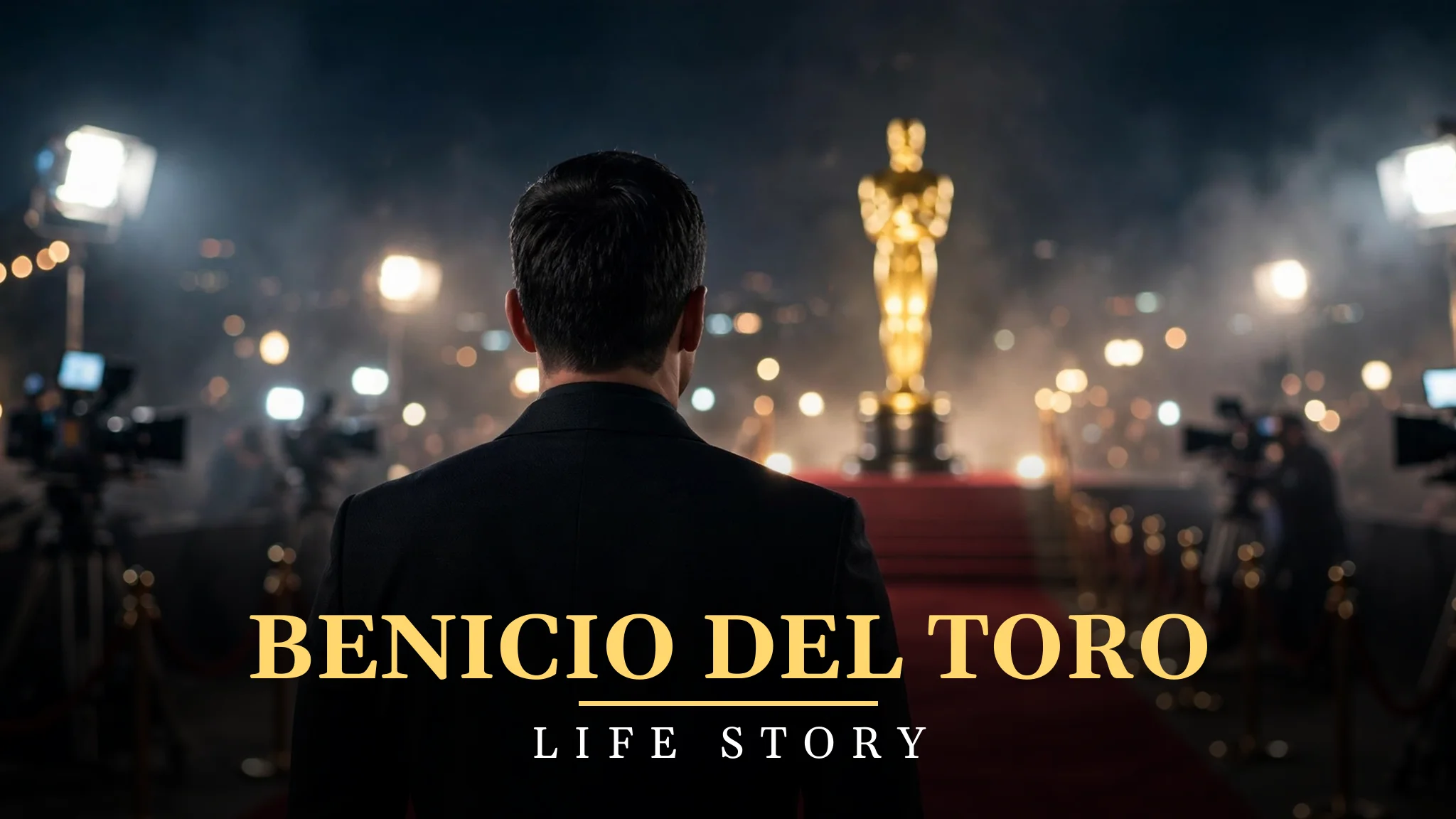
I think about the red carpet image, with Benicio in a black suit, facing a giant Oscar statue, and I find it very fitting. He is a man who has won the highest honour in film, and yet he remains quiet, humble, and focused on his work. The Oscar is behind him, but his work is in front of him, and he keeps going, film after film, role after role. That is a beautiful image, and it is a reminder that an award is not the end. It is a recognition, and it is a reason to keep working with even greater care. Benicio understands that, and his career shows it.
I also think about his daughter, and about the way he protects her privacy, and I admire that. He is a father who loves his child, and who wants her to have a normal life, away from fame. That is a lesson about family. Fame is not more important than family, and a star who protects his child is a star who understands what matters. Benicio does that, and it makes me respect him even more. He is not only a great actor. He is a good father, a proud Puerto Rican, and a quiet man who lets his work speak. That is a life to admire, and a story to remember for a long time.
I also think about the way Benicio’s films are watched by students of acting, and how his quiet performances are used as examples in acting schools. Teachers show Traffic, they show Che, and they tell their students to watch how Benicio listens, how he pauses, and how he lets a character grow slowly. That is a great honour for an actor, to be a teacher even when he is not in a classroom. His work teaches, and it will keep teaching young actors for many years.
When I watch Benicio del Toro now, I see a man who has given his life to acting, who has chosen his roles with care, and who has stayed true to himself in a world that often asks for noise. His quiet power is a reminder that strength does not need to shout, that truth does not need to be loud, and that a great performance can be found in a look, in a pause, and in a silence. That is a lesson I will carry with me, and a story I will remember.
Frequently Asked Questions
When was Benicio del Toro born?
Benicio del Toro was born on 19 February 1967 in San Germán, Puerto Rico, and he moved to the United States with his family when he was twelve years old.
What is Benicio del Toro best known for?
He is best known as an Oscar-winning actor, for his roles in The Usual Suspects, Traffic, Che, 21 Grams, and Sicario, and for his quiet, intense acting style.
What Oscar did Benicio del Toro win?
He won the Academy Award for Best Supporting Actor for his role as Javier Rodríguez in the film Traffic in 2000, speaking mostly in Spanish.
Who did Benicio del Toro play in Che?
He played the revolutionary leader Che Guevara in the two-part film Che in 2008, and his performance won him the Best Actor Award at the Cannes Film Festival.
What was Benicio del Toro’s breakthrough role?
His breakthrough role was Fred Fenster in The Usual Suspects in 1995, a small but unforgettable criminal role that made Hollywood notice his talent.
Did Benicio del Toro appear in Star Wars?
Yes, he appeared in Star Wars: The Last Jedi in 2017, playing a mysterious character, and he brought his usual care and truth to the role.
Is Benicio del Toro still acting?
Yes, he has continued to act in major films and independent films, choosing his roles carefully and giving each character his full attention.


