Bérénice Bejo: The Life Story Behind the Silent Film Star
In this post
- A Girl from Buenos Aires in Paris
- A Knight’s Tale and the First Steps Abroad
- The Artist: Silence, Dance, and a Star Is Born
- Le Passé and the Cannes Best Actress Prize
- A Life in Film, in Two Languages, and at Home
- OSS 117: Comedy, Charm, and a Great Partnership
- Le Redoutable and Playing a Real Woman
- A Life Between Two Countries
- The Artist on Stage: Theatre and the Love of Performance
- A Star in Two Languages
- The Smile That Crossed the World
- My Take:
Bérénice Bejo is an actress who can say everything without saying a word. That is not a small talent. In The Artist, a silent film made in the twenty-first century, she played Peppy Miller, a young dancer who becomes a star, and she did it without speaking a single line. She used her face, her body, and her smile, and she won the hearts of audiences around the world. She was nominated for an Academy Award, she won the César for Best Actress, and she became a star in a film that had no sound.
She was born in Buenos Aires, in Argentina, and she came to France as a small child. She grew up in Paris, in a family of film makers, and she learned to act in French, in English, and in silence. She has played women in comedies, in dramas, and in historical films, and she has done it all with a grace and a warmth that make her one of the most loved actresses in France.
Her story is about crossing borders, about learning new languages, and about finding your voice, even when you do not speak. It is a story about a girl from Argentina who became a star of French cinema, and who did it by being herself.
A Girl from Buenos Aires in Paris
Bérénice Bejo was born on 7 July 1976 in Buenos Aires, Argentina. Her father, Miguel Bejo, was a film maker, and her mother was also involved in the arts, so she grew up in a home where cinema was a part of everyday life. When she was three years old, her family moved to France, settling in Paris. She was a small child in a new country, learning a new language, and trying to fit into a new world. She grew up speaking French, but she kept her Argentine roots, and she carried both cultures with her.
As a child, she was drawn to acting, and she began to take classes and to appear in small roles. She was a lively, curious girl, with a talent for performance, and she loved the feeling of being on a set. She learned to act in French, and she also learned English, because she wanted to work in films in many languages. She was not a child star in the usual sense. She was a young actress who was learning her craft, step by step, and who was determined to do it well.
Her early roles were small, but they showed her talent. She appeared in French television and in films, playing young women who were charming, funny, and full of life. She had a natural gift for comedy, for timing, and for making an audience smile. She was building a career, and she was doing it without rushing, learning from each role, and growing as an actress.
By her twenties, she was already a respected young actress in France. She had worked with good directors, she had learned from older actors, and she had begun to think about what kind of actress she wanted to be. She wanted to play women who were strong, who were funny, and who were real. That wish would guide her choices, and it would lead her to some of the most important roles of her career.
A Knight’s Tale and the First Steps Abroad
Bejo’s first major international role came in 2001, when she appeared in A Knight’s Tale, a film starring Heath Ledger, about a young man in the Middle Ages who pretends to be a knight. Bejo played Christiana, a lady-in-waiting, in a film that was funny, romantic, and full of modern music in a medieval setting. It was a big Hollywood production, and it gave her a chance to work in English, in front of a large audience. She was a young French actress in an American film, and she held her own.
The film was a success, and it showed that Bejo could work in English as well as in French. She was not limited to one language, or to one country. She was an actress who could cross borders, and who could make audiences laugh and care in any language. That ability would become one of her greatest strengths, and it would open doors for her in France, in America, and in many other countries.
After A Knight’s Tale, she returned to France, and she continued to work in French films. She starred in OSS 117: Le Caire, nid d’espions in 2006, a spy comedy directed by Michel Hazanavicius, in which she played Larmina, a woman who helps the bumbling spy OSS 117. The film was a huge success in France, and it showed Bejo’s gift for comedy. She played her role with wit, with charm, and with a lightness that made audiences love her. She was a comic actress, and a very good one.
She also appeared in other French films, building a reputation as a versatile actress who could play comedy and drama, who could work in French and in English, and who could make any role her own. She was a star in the making, and she was ready for a role that would change everything.
The Artist: Silence, Dance, and a Star Is Born
In 2011, Bejo starred in The Artist, directed by Michel Hazanavicius, the same director who had made OSS 117. The film was a silent film, made in black and white, about the end of the silent era in Hollywood. Bejo played Peppy Miller, a young dancer who becomes a star, while the silent film star George Valentin, played by Jean Dujardin, loses his fame with the coming of sound. The film was a bold, beautiful, and risky idea: a silent film in the age of sound, with no dialogue, only music and images. It became a worldwide phenomenon.
Bejo played Peppy with a joy, an energy, and a grace that made audiences fall in love with her. She danced, she smiled, she cried, and she did it all without speaking. She used her face, her body, and her eyes to tell the story, and she did it so well that the audience forgot that the film had no sound. Her performance was praised by critics everywhere, and she was nominated for the Academy Award for Best Supporting Actress. She won the César Award for Best Actress in France, and she became a star around the world.
The Artist won the Academy Award for Best Picture, and it won many other awards, including Best Actor for Jean Dujardin. It was a triumph for French cinema, and for Bejo. She had gone from a young actress in Paris to a world star, and she had done it in a silent film. That is a remarkable thing, and it shows her talent in a way that no other film could. She could act without words, and she could make the audience feel everything.
The film also changed her life. She was now known in America, in Britain, and in many other countries, and she was offered roles in Hollywood and in other film industries. She chose carefully, taking on films that interested her, and not taking on films only for fame. She had proved that she could do anything, and she was ready to do it on her own terms.
Le Passé and the Cannes Best Actress Prize
After The Artist, Bejo continued to take on serious and interesting roles. In 2013, she starred in Le Passé, directed by Asghar Farhadi, a film about a woman in Paris whose past returns to haunt her. Bejo played Marie, a woman who is trying to rebuild her life, to care for her children, and to deal with the man she once loved. The film was a complex, emotional drama, and Bejo gave a performance that was raw, honest, and deeply moving. She won the Best Actress prize at the Cannes Film Festival for her role, one of the highest honours for an actress in the world.
Le Passé showed a different side of Bejo: not the dancing, smiling Peppy Miller, but a woman in pain, a mother, a lover, and a person trying to make sense of her life. She played the role with a depth and a truth that surprised even those who had loved her in The Artist. She was not only a comic actress, and she was not only a silent film star. She was a serious dramatic actress, capable of great emotion, and capable of carrying a complex film on her own.
She also starred in Le Redoutable in 2017, playing Anne Wiazemsky, the wife of the director Jean-Luc Godard, in a film about the great film maker’s life in the late 1960s. The film was about cinema, about love, and about the changes in France, and Bejo played her role with intelligence and with grace. She was an actress who could play real people, historical figures, and complex women, and who could do it all with honesty.
Through these years, Bejo built a career that was both popular and respected. She was a star, but she was also an artist, and she chose her roles with care. She worked with great directors, she took on difficult subjects, and she gave her best to each film. She was growing, film by film, and she was becoming one of the most respected actresses in France.
A Life in Film, in Two Languages, and at Home
Bejo has continued to act in French and in international films, taking on roles that interest her, and working with directors she admires. She has appeared in comedies, in dramas, and in historical films, and she has shown that she can do it all. She is an actress who is comfortable in French and in English, who can play a silent star and a modern mother, and who can make any role feel real.
She is married to the director Michel Hazanavicius, with whom she made OSS 117 and The Artist, and they have two children together. Their partnership is one of the great partnerships in French cinema, a director and an actress who have made some of the most loved French films of recent years together. They keep their private life mostly private, but they have spoken about their love of cinema, their family, and their work. They are a couple who have built a life around film, and around each other.
Today, Bérénice Bejo is still active, still acting, and still taking on new roles. She is one of the most loved actresses in France, a woman who came from Argentina as a child, who learned French, who learned to act in silence, and who became a star. Her story is not finished, and French cinema, and world cinema, are better for it.
OSS 117: Comedy, Charm, and a Great Partnership
In 2006, Bejo starred in OSS 117: Le Caire, nid d’espions, a spy comedy directed by Michel Hazanavicius, the man who would later direct The Artist and become her husband. She played Larmina, a woman who helps the bumbling French spy OSS 117, played by Jean Dujardin, on a mission in Cairo. The film was a huge success in France, and it showed Bejo’s gift for comedy. She played her role with wit, with charm, and with a lightness that made audiences love her. She was not only a beautiful woman in a spy film. She was a clever, funny actress who could hold her own with the best comics in France.
The film was a parody of old spy films, full of jokes about France, about Egypt, and about the arrogance of the hero. Bejo played the straight woman, the one who sees through the hero’s foolishness, and who helps him anyway. She did it with grace, and she made the audience laugh without trying too hard. Her partnership with Jean Dujardin was a delight, and it showed that she could be part of a great comic team. The film became a classic of French comedy, and it is still watched and quoted today.
OSS 117 also began a creative partnership that would change her life. Michel Hazanavicius, the director, saw her talent, and he would cast her again in The Artist, the film that made her a world star. He also became her husband, and the father of her children. Their partnership, on screen and in life, is one of the great partnerships in French cinema. They trust each other, they understand each other, and they make great films together. Bejo’s work in OSS 117 was the start of that partnership, and it is a film that deserves to be remembered, not only for its jokes, but for the love story behind it.
Le Redoutable and Playing a Real Woman
In 2017, Bejo starred in Le Redoutable, playing Anne Wiazemsky, the wife of the great director Jean-Luc Godard, in a film about Godard’s life in the late 1960s. The film was about cinema, about love, about politics, and about a marriage falling apart. Bejo played Anne with intelligence, with grace, and with a deep understanding of what it feels like to love a difficult genius. She showed a woman who is young, who is in love, and who is slowly realising that the man she loves is changing, and that their life together is changing too. It was a performance of great subtlety, and it showed Bejo’s talent for playing real people.
Playing a real person is hard, because the audience knows who she was, and they judge the performance against the truth. Bejo did not imitate Anne Wiazemsky. She found the woman inside the story, and she played her with honesty. She showed her youth, her intelligence, and her pain, and she made the audience care about her. The film was praised by critics, and Bejo’s performance was one of its highlights. It showed that she was not only a comic actress, and not only a silent film star. She was a serious dramatic actress, capable of playing complex, real women.
The film also showed her love of cinema history. She was playing a woman from the world of French New Wave cinema, a world she had grown up in, through her father’s work as a film maker. She understood that world, and she brought that understanding to her performance. She was not only acting. She was honouring a time in French cinema, and a woman who had lived through it. That respect, for the past and for the people in it, is part of what makes her a great actress.
A Life Between Two Countries
Bejo has lived her whole life between two countries: Argentina, where she was born, and France, where she grew up and became a star. She speaks French, she speaks Spanish, and she speaks English, and she carries all three languages with her. She is an actress who can work in many countries, and who can make audiences in many languages feel at home. That ability, to cross borders, is one of her greatest strengths, and it is one that comes from her childhood, from moving to a new country at the age of three, and from learning to belong in a new place.
She has spoken about her Argentine roots, about her family, and about the love she has for the country of her birth. She has also spoken about her love for France, for Paris, and for the cinema that made her a star. She does not have to choose between the two. She is both Argentine and French, and she is proud of both. That double identity gives her a depth that shows in her acting, in her face, and in the way she carries herself. She is a woman of two homes, and she belongs to both.
Her story is a hopeful one for anyone who has moved to a new country, who has learned a new language, and who has tried to fit in. Bejo shows that it is possible to belong without forgetting who you are, and that your two homes can make you richer, not poorer. She carries Argentina and France with her, in every film she makes, and that is a gift that she gives to her audiences, in France, in Argentina, and around the world.
The Artist on Stage: Theatre and the Love of Performance
Bejo began her career on stage, and she has never forgotten the theatre. She learned to act in front of a live audience, to use her voice, her body, and her face, and to hold a room with her presence. The theatre taught her discipline, patience, and respect for the audience, and those lessons have stayed with her throughout her film career. She is an actress who understands the stage, and who brings that understanding to every film she makes. When she played Peppy Miller in The Artist, she used her theatre training to dance, to move, and to perform without words, and the audience felt the joy of a live performance in a silent film.
She has returned to the theatre throughout her career, performing on stage and working with directors who love the live arts. She believes that theatre is important, that it teaches an actor to be honest, and that it keeps an actor close to the audience. She is not an actress who only works in front of a camera. She is a performer in the fullest sense, a woman who loves the stage, the screen, and the shared experience of a story told live. That love of performance is at the heart of everything she does, and it is why her work feels so alive.
A Star in Two Languages
Bejo works in French and in English, and she does both with ease. She played in A Knight’s Tale in English, she played Peppy Miller without speaking at all, and she has worked in French films for most of her career. That ability to cross languages is rare, and it comes from her childhood, from moving between Argentina and France, and from learning to belong in more than one place. She is an actress who can make audiences laugh and cry in any language, and that is a gift that few actors have. She carries her languages with her, and she uses them to tell stories that cross borders.
The Smile That Crossed the World
Bejo’s smile is one of the most loved smiles in French cinema. In The Artist, she smiles, she dances, and she makes the audience smile with her, without saying a word. That smile is not only a part of her performance. It is a part of who she is, a warm, generous smile that makes people feel welcome. She has carried that smile from Buenos Aires to Paris, from silent films to modern dramas, and it has never faded. Audiences around the world remember it, because it is honest, because it is joyful, and because it is true. A smile like that is a gift, and Bejo has shared it with the world.
My Take:
When I think about Bérénice Bejo, I think about silence. Not the silence of having nothing to say, but the silence of an actress who can say everything without speaking. In The Artist, she plays Peppy Miller, and she does it without a single word of dialogue. She dances, she smiles, she cries, and the audience understands everything. I admire that, because so much of acting today is about words, about long speeches, about talking. Bejo shows that acting is also about the face, about the body, and about the eyes. She reminds me that silence can be more powerful than speech, and that a look can say more than a paragraph. That is a rare gift, and it is one that she has in abundance.
I admire her journey from Buenos Aires to Paris, because it is a journey about belonging. She was three years old when her family moved to France, and she grew up learning French, learning a new culture, and trying to fit in. She did not forget where she came from, but she also became French, and she became a star of French cinema. I think about the children who move to a new country, who learn a new language, and who try to belong. Bejo shows that it is possible to belong without forgetting who you are. She carries Argentina and France with her, and she is richer for it. That is a hopeful story, and it is one that many people in the world today need to hear.
What moves me most is Le Passé, and her performance as Marie, a woman trying to rebuild her life. It is a film about the past, about the mistakes we make, and about the difficulty of starting again. Bejo plays Marie with a raw, honest emotion that makes the audience feel her pain. She won the Best Actress prize at Cannes for that role, and she deserved it. I think about the women who have to rebuild their lives after a divorce, after a loss, after a mistake, and I see them in Marie. Bejo does not play a perfect woman. She plays a real woman, with flaws, with anger, and with love, and that is why we believe her. That is a gift, and it is a gift that comes from understanding people.
I think about her partnership with Michel Hazanavicius, and about the films they have made together. They made OSS 117, a comedy, and The Artist, a silent film, and both were successes. That is a rare partnership, a director and an actress who trust each other, who understand each other, and who make great films together. I think about my own partnerships, and about the people I trust, and I see how important it is to work with someone who believes in you. Hazanavicius believed in Bejo, and he gave her the role of Peppy Miller, a role that changed her life. She believed in him, and she gave him a performance that made his film a triumph. That is a beautiful partnership, and it is a model for any creative work.
There is something I respect about the way Bejo has handled fame. She became a world star, she was nominated for an Oscar, and she won the César, and she could have moved to Hollywood and chased bigger roles. She did not. She stayed in France, she chose her films carefully, and she built a career that includes comedy, drama, and historical films. She did not let fame decide her life. She decided her own life, and she did it with a quiet strength. I think about the pressures of fame, and about how easy it is to lose yourself. Bejo did not lose herself. She stayed herself, and that is a kind of strength that I admire.
I also think about her as a mother, and as a woman who balances work and family. She has two children, she is married to a director, and she keeps working, film after film. That is not easy, and it takes a lot of energy, a lot of love, and a lot of organisation. She does it, and she does it with grace. I respect that, because it shows that a woman does not have to choose between her work and her family. She can do both, if she is willing to work hard, and if she is honest about the difficulty. Bejo does both, and she does them well.
For a young reader, I think the lesson of Bejo’s life is to find your voice, even when you do not speak. She found her voice in silence, in dance, in her face, and in her eyes. She shows that you do not need words to be heard, and you do not need to shout to be seen. If you are honest, if you are true, and if you give your best, people will see you, and they will hear you, even in silence. That is a powerful lesson, and it is one that I want to remember.
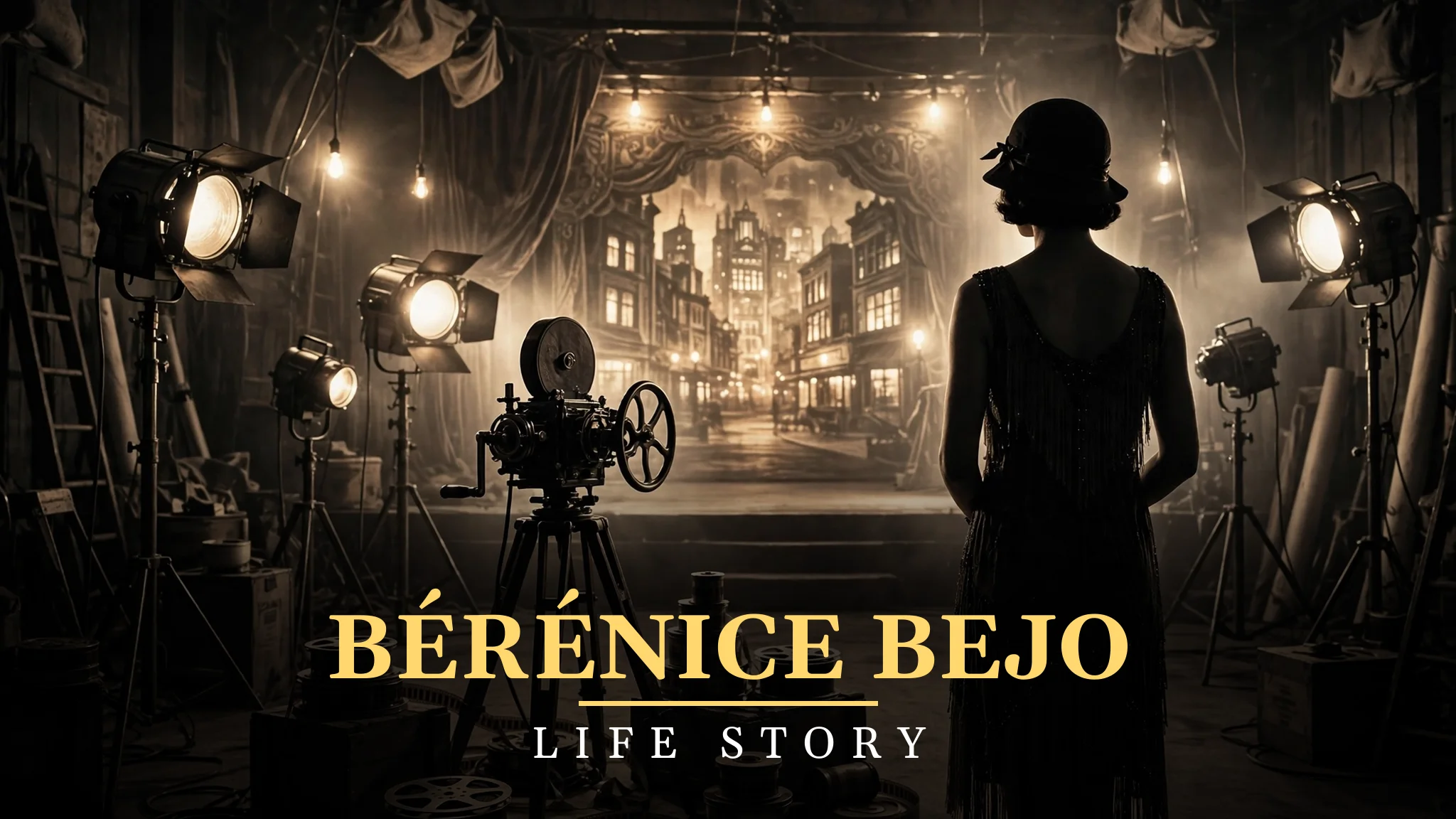
I keep thinking about the old film studio, the vintage camera, the film reels, the spotlights, and the woman in the fringed dress looking at a painted city. It is a picture of the past, of silent cinema, and of a woman who brings that past to life. That is Bejo for me: a woman who looks at the past, who learns from it, and who makes it live again. She is not afraid of silence. She embraces it, and she makes it sing. In the end, I think that is her gift: she shows us that silence is not empty. It is full of feeling, full of life, and full of love.
I also think about her work in OSS 117, and about the comedy that made her famous in France before The Artist. She played Larmina, a clever woman who helps a foolish spy, and she did it with wit and with charm. I think about the comic actresses who are often overlooked, who play the straight woman while the men get the big laughs. Bejo shows that the straight woman is just as important, and just as funny, in her own way. She listens, she reacts, and she makes the comedy work. That is a skill, and it is one that she has in abundance. She does not need to shout to be funny. She only needs to be clever, and to let the audience see her intelligence.
I think about Le Passé, and about her performance as Marie, a woman trying to rebuild her life. It is a film about the past, about the mistakes we make, and about the difficulty of starting again. Bejo plays Marie with a raw, honest emotion that makes the audience feel her pain. She won the Best Actress prize at Cannes for that role, and she deserved it. I think about the women who have to rebuild their lives after a divorce, after a loss, after a mistake, and I see them in Marie. Bejo does not play a perfect woman. She plays a real woman, with flaws, with anger, and with love, and that is why we believe her. That is a gift, and it is a gift that comes from understanding people, and from caring about them.
There is something I respect about the way Bejo has handled fame. She became a world star, she was nominated for an Oscar, and she won the César, and she could have moved to Hollywood and chased bigger roles. She did not. She stayed in France, she chose her films carefully, and she built a career that includes comedy, drama, and historical films. She did not let fame decide her life. She decided her own life, and she did it with a quiet strength. I think about the pressures of fame, and about how easy it is to lose yourself. Bejo did not lose herself. She stayed herself, and that is a kind of strength that I admire more than any award.
I also think about her as a mother, and as a woman who balances work and family. She has two children, she is married to a director, and she keeps working, film after film. That is not easy, and it takes a lot of energy, a lot of love, and a lot of organisation. She does it, and she does it with grace. I respect that, because it shows that a woman does not have to choose between her work and her family. She can do both, if she is willing to work hard, and if she is honest about the difficulty. Bejo does both, and she does them well, and that is a powerful example.
Finally, I think about the old film studio, the vintage camera, the film reels, the spotlights, and the woman in the fringed dress looking at a painted city. She is not afraid of silence. She embraces it, and she makes it sing. She shows us that silence is not empty. It is full of feeling, full of life, and full of love, and that is a gift that will last as long as people watch her films.
I also think about her life between two countries, and about what it means to belong in two places at once. Bejo was born in Argentina, she grew up in France, and she carries both with her. She speaks French, Spanish, and English, and she can work in many countries. I think about the people who move to a new country, who learn a new language, and who try to fit in, and I see them in Bejo. She shows that you can belong in a new place without forgetting where you came from, and that your two homes can make you stronger, not weaker. That is a hopeful message, and it is one that many people in the world today need to hear.
I think about her partnership with Michel Hazanavicius, and about the films they have made together. They made OSS 117, a comedy, and The Artist, a silent film, and both were successes. That is a rare partnership, a director and an actress who trust each other, who understand each other, and who make great films together. I think about my own partnerships, and about the people I trust, and I see how important it is to work with someone who believes in you. Hazanavicius believed in Bejo, and he gave her the role of Peppy Miller, a role that changed her life. She believed in him, and she gave him a performance that made his film a triumph. That is a beautiful partnership, and it is a model for any creative work.
Finally, I think about the old film studio, the vintage camera, the film reels, the spotlights, and the woman in the fringed dress looking at a painted city. She is not afraid of silence. She embraces it, and she makes it sing. She shows us that silence is not empty. It is full of feeling, full of life, and full of love.
I also think about her theatre training, and about how it shaped her film acting. She learned to act on stage, in front of a live audience, and that training gave her a presence that the camera loves. When she played Peppy Miller, she used her body, her face, and her dance to tell a story without words, and that is a skill that comes from the theatre. I think about the actors who learn only in front of a camera, and I see that Bejo has something more: the discipline of the stage, the patience of a live performance, and the joy of an audience that laughs and cries with you. That is a gift, and it is one that she carries into every film she makes.
I also think about her languages, and about the gift of speaking French, Spanish, and English. She can work in many countries, and she can make audiences in many languages feel at home. I think about the people who speak more than one language, and about how each language gives them a new way to see the world. Bejo has three languages, and three ways of seeing, and that richness shows in her acting. She is a woman of many worlds, and she brings all of them to her films.
Frequently Asked Questions
When and where was Bérénice Bejo born?
Bérénice Bejo was born on 7 July 1976 in Buenos Aires, Argentina. Her father was the film maker Miguel Bejo, and her family moved to France when she was three years old, settling in Paris.
How did Bérénice Bejo start acting?
She began acting as a young woman in France, taking classes and appearing in small roles on television and in films. She learned to act in French and in English, and she built her career step by step, working with good directors and learning from each role.
What role did Bérénice Bejo play in A Knight’s Tale?
In A Knight’s Tale, released in 2001 and starring Heath Ledger, she played Christiana, a lady-in-waiting in a medieval adventure film. The role gave her a chance to work in English in a major Hollywood production.
What is The Artist, and who did Bérénice Bejo play in it?
The Artist, released in 2011 and directed by Michel Hazanavicius, is a silent black-and-white film about the end of the silent era in Hollywood. Bejo played Peppy Miller, a young dancer who becomes a star, without speaking a single line, and she was nominated for an Academy Award.
What awards did Bérénice Bejo win for The Artist?
She won the César Award for Best Actress in France for her performance as Peppy Miller, and she was nominated for the Academy Award for Best Supporting Actress. The Artist itself won the Academy Award for Best Picture.
What prize did Bérénice Bejo win at Cannes for Le Passé?
She won the Best Actress prize at the Cannes Film Festival for her performance in Le Passé, released in 2013 and directed by Asghar Farhadi, in which she played Marie, a woman trying to rebuild her life after her past returns.


