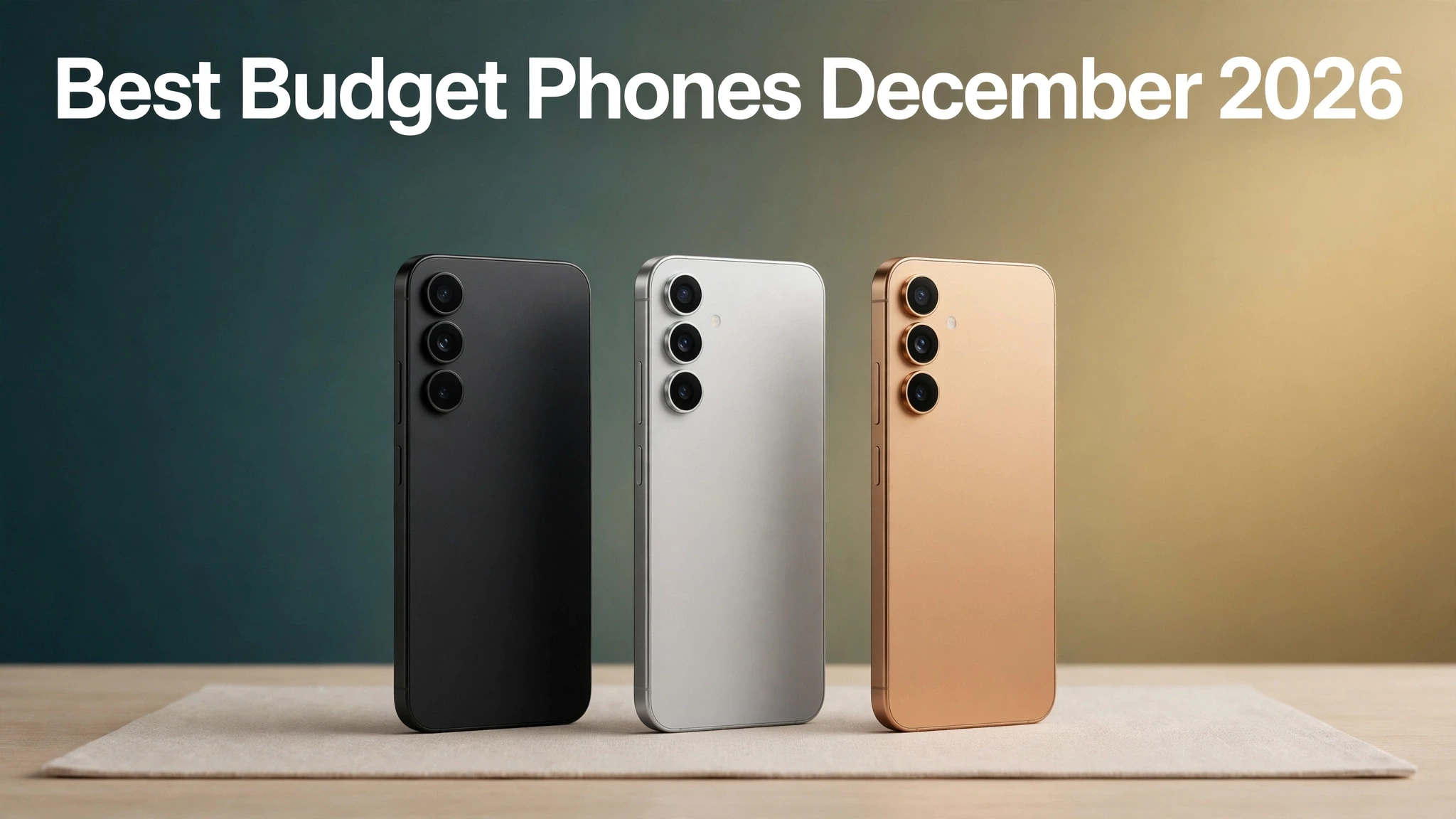
Best Budget Phones December 2026
In this post
- What “Budget” Means in December 2026, and Why It Is Better Than Before
- The All-Round Value Picks: Where Most Buyers Should Start
- Best for Battery, Camera, Gaming, and Design
- Screen, Storage, RAM, and 5G: The Specifications That Actually Matter
- Software Updates: The Hidden Cost of a Cheap Phone
- Buying in December: Sales, Refurbished, and What to Avoid
- My Take:
What “Budget” Means in December 2026, and Why It Is Better Than Before
Budget in December 2026 does not mean a phone that barely works. It means a phone that covers calls, messaging, social apps, video, maps, and decent photos, without flagship extras such as the fastest chip, the most advanced zoom camera, or premium materials. Recent guides cap budget lists around £400 or $400, with strong options near $200 to $300 and entry options below that, though prices vary by country, store, and memory size, so check the current price for the exact variant before buying. The improvement is real: many budget phones now offer bright OLED screens, large batteries, 5G, and several years of software updates, features that were once reserved for expensive phones.
The reason is competition and component costs. Samsung, Motorola, Xiaomi, Google, Nothing, and OnePlus all compete in the same price bands, and each tries to win on a different strength: Samsung on updates and display, Motorola on battery and clean software, Xiaomi and Poco on performance per price, Google on camera and long support, Nothing on design and clean software. That competition benefits buyers, but it also makes a single “best” phone impossible. The best budget phone for a gamer is not the best for a photographer, and neither is best for someone who wants the longest software support. Start with your priority, then choose the phone that wins on that priority, rather than chasing a phone that is average at everything.
December is a useful time to buy because holiday sales, clearance of earlier models, and carrier offers can reduce prices, but it is also a time of misleading discounts. A phone advertised as heavily discounted may have been priced higher only briefly, or the discount may apply to a lower storage variant. Compare the December price with the price from a few weeks earlier, check whether the offer includes a trade-in or a contract, and confirm the exact model, storage, and carrier compatibility. A budget phone bought on a contract that locks you into an expensive plan for two years is not a budget phone; it is a financed phone with a higher total cost.
The All-Round Value Picks: Where Most Buyers Should Start
For most buyers, the safest all-round budget phone in 2026 guides is a Samsung Galaxy A-series model, such as the Galaxy A56 or A26, depending on budget and region. The A56 is highlighted in recent guides for a 120 Hz AMOLED screen and six years of updates, with a 50 MP main camera and a 5,000 mAh battery as reported specifications, though its list price sits near the top of the budget range and street prices vary. The A26, at a lower price, offers a similar Samsung experience with a large AMOLED screen and long support, making it a strong choice for buyers who want reliability, a familiar interface, and a phone that will still receive updates in several years. Samsung’s strength is not raw speed; it is consistency, availability, and support.
Motorola’s Moto G series remains the battery and value champion for many buyers. Models such as the Moto G56 are reported with two-day battery life in some guides and strong water resistance for the price, while the Moto G Power line is known for multi-day endurance. Motorola’s software is close to stock Android, with few duplicate apps, which many users prefer. The trade-off is usually camera quality in low light and a shorter update promise than Samsung or Google, so check the update policy for the exact model sold in your country. If battery and clean software matter more than camera or updates, Motorola is often the better buy.
Google’s Pixel 8a, often found refurbished or discounted in 2026, and the newer Pixel 10a at a higher price, offer a different value: computational photography that beats many more expensive phones, and seven years of updates for the 8a as reported. The Pixel’s camera, especially in low light and for portraits, is its main reason to choose it, and its software is clean and timely. Its weaknesses, as reported, are slower charging and a tendency to run warm under heavy load. If photos and long support matter most, and you can find the Pixel within budget, it is a strong pick. If fast charging or gaming matters most, another brand may serve you better.
Best for Battery, Camera, Gaming, and Design
Battery champions in the budget range are usually Motorola and OnePlus models with very large batteries. The OnePlus Nord CE 5 is highlighted in expert testing for outstanding battery life, with a reported 33 hours in one in-house test compared with 24 to 28 hours for most budget phones, though test methods differ between labs, so treat that as a comparative example, not a guarantee for your use. Large batteries, such as 5,000 mAh and above, plus efficient screens and chips, matter more than the headline capacity alone. A phone with a large battery but a power-hungry screen and chip may still drain quickly. Check real-world battery tests from a lab you trust, and consider your own use: video streaming and gaming drain far faster than calls and messaging.
Camera champions at budget prices are usually Google Pixel models, followed by Samsung A-series and Motorola Edge models. The Pixel wins on software processing: it produces balanced, detailed photos in varied light, even with modest hardware. Samsung produces vivid, social-ready photos that many users prefer straight from the camera. Motorola Edge models, such as the Edge 60 Neo in recent guides, are highlighted as budget camera phones, offering a versatile camera set at a lower price. Before choosing on camera alone, check sample photos in daylight and low light, check video stabilisation if you record video, and check whether the ultra-wide or macro camera is genuinely useful or merely a specification filler. A good main camera matters far more than three weak cameras.
Gaming and performance champions are usually Poco and OnePlus models. The Poco X7 Pro and Poco F7 are highlighted in guides for hardware that competes with phones costing twice as much, with fast chips and high-refresh screens suited to games. The trade-off is often camera consistency, software polish, or update length, so a gaming phone is a specialist choice, not an all-round choice. Design champions include Nothing Phone models, with a distinctive light design and clean software, and Motorola Edge models with slim builds and water resistance. Design is personal, but it should not override battery, updates, or camera if those affect daily use. A beautiful phone that dies by evening or stops receiving updates early is a poor long-term buy.
Screen, Storage, RAM, and 5G: The Specifications That Actually Matter
Screen quality affects every use, so it deserves priority. Look for an OLED or AMOLED screen for deep blacks and bright colours, a refresh rate of 90 Hz or 120 Hz for smooth scrolling, and brightness high enough for outdoor use. Resolution matters less than brightness and refresh rate at budget prices, because most budget screens are already sharp enough for normal viewing. A large screen is good for video and reading, but it makes the phone harder to hold and pocket, so try the size in a store if possible. A screen protector and case, bought at purchase, protect the most expensive part to replace, and they cost far less than a repair.
RAM and storage determine how long a phone feels fast. In December 2026, 8 GB of RAM is a safer minimum than 4 GB, especially for multitasking and for software updates over several years. Some entry phones with 4 GB are reported as laggy, even when other specifications look good. Storage of 128 GB is a practical minimum for most users, because apps, photos, and videos grow quickly, and many budget phones no longer offer a microSD slot. If the phone you want has no microSD slot, choose the larger storage variant if you keep many photos or games. Check whether the price difference for more storage is reasonable, or whether a cloud subscription would cost more over two years than the larger variant.
5G, water resistance, and charging are the remaining practical checks. 5G is now standard on most budget phones above entry level, and it matters for future network coverage, though 4G remains usable for most tasks today. Water resistance varies widely: some budget phones offer IP68 or IP69 protection, others offer only splash resistance or none, so check the exact rating for the model, not the brand. Charging speed varies from slow 15 W to fast 80 W and above on some models; fast charging is convenient, but it also generates heat, so a phone with a large battery and moderate charging may last longer over years than a phone with very fast charging used daily. Choose the balance that fits your routine, not the largest number on the box.
Software Updates: The Hidden Cost of a Cheap Phone
Software updates are the most overlooked budget factor, and they determine whether a cheap phone stays cheap over time. A phone with six or seven years of updates, as reported for some Samsung and Google models, will receive security fixes and new features long after a phone with two years of updates has stopped. A phone that stops receiving security updates becomes riskier to use for banking, email, and shopping, even if its hardware still works. That risk is not abstract; it is the reason many cheap phones are replaced early, which erases the initial saving. Always check the update promise for the exact model and region before buying, because the same model name can carry different promises in different markets.
Software experience also matters daily. Samsung’s One UI, Motorola’s near-stock Android, Google’s Pixel software, and Nothing’s clean interface each feel different, and preference is personal. Samsung offers more features and customisation, but also more pre-installed apps. Motorola and Google offer cleaner, simpler software, with fewer duplicate apps. Nothing offers a distinctive design with clean software, but with shorter support than Samsung or Google on some models. If possible, try the software in a store, or watch a short hands-on video for the exact model, focusing on the home screen, settings, and camera app, which are the parts you will use daily. A phone whose software annoys you daily is not a good buy, however good its specifications look on paper.
Carrier and region differences can change the phone you actually receive. A model sold in one country may have different bands, different charging, different storage, or a different update policy than the same name sold elsewhere. An imported phone may lack warranty support, may not support local 5G bands, or may not work fully on your carrier. Check carrier compatibility, warranty terms, and return policy before buying an imported or refurbished phone. For refurbished phones, such as a refurbished iPhone 13 or Pixel 8a highlighted in some budget guides, check battery health, condition grading, seller return terms, and remaining support period. A refurbished flagship can be excellent value, but only from a reputable seller with a clear return policy.
Buying in December: Sales, Refurbished, and What to Avoid
December sales can offer real savings, but they require comparison. Track the price of your shortlisted phone for at least two weeks before buying, using a price history tool or by noting prices manually. A genuine sale reduces the price below the recent average; a fake sale raises the price first, then “discounts” it back to normal. Check whether the sale price is for the same storage and colour, whether a trade-in is required, and whether the phone is new, refurbished, or a carrier-locked model. A carrier-locked phone may be cheaper upfront but restricts your choice of network and may cost more to unlock later.
Refurbished phones deserve serious consideration in December, especially for buyers who want a flagship camera or software experience at a budget price. A refurbished iPhone 13 or Pixel 8a, as an example, can offer a premium feel and long support at a price near $250 in some marketplace snapshots, though prices vary by condition, storage, and seller, and should be checked at purchase. The risks are battery health, hidden damage, and shorter remaining support. Mitigate them by buying from a seller with a warranty, a return window, and a battery health report, and by testing the phone thoroughly in the first days: battery drain, camera, speakers, buttons, and network. If anything fails, return it within the window, rather than accepting a fault on a phone you will use daily.
Avoid three common December traps. First, do not buy a phone based on a single specification, such as megapixels or charging watts, without checking real-world tests. Second, do not buy the cheapest phone available if it has 4 GB of RAM, no 5G, and a short update promise, because it will likely feel slow and insecure within a year, and replacing it will cost more than buying a slightly better phone now. Third, do not sign a long, expensive contract for a “free” budget phone without calculating the total contract cost. The cheapest total cost is usually an unlocked phone bought outright, paired with a SIM-only plan that suits your data use, though a contract can be sensible if you already need that plan and the phone discount is genuine.
My Take:
I think budget phones in 2026 have reached a point where the question has changed. It is no longer, “can a cheap phone work?” It can, and for most people it works well. The question now is, “will this cheap phone still work well in three years, and will it still be safe to use?” That question is answered not by the chip or the camera, but by updates, battery health, and storage. I have seen people buy the cheapest phone, save $100 today, and replace it in eighteen months because it became slow, stopped receiving security updates, or ran out of storage. That is not saving. That is paying twice, with the added cost of transferring data, learning a new phone, and disposing of the old one. A slightly better budget phone, with 8 GB of RAM, 128 GB of storage, and a long update promise, is usually the cheaper phone over three years, even if its sticker price is higher.
I also believe the budget market exposes a useful truth about flagship phones. For most users, the flagship extras, a titanium frame, a 10x zoom, a chip that benchmarks higher than anyone needs for messaging and video, do not change daily life. What changes daily life is a bright screen outdoors, a battery that lasts the day, a camera that takes a good photo of a child in low light without fuss, and software that does not get in the way. Budget phones now deliver those things, often at a third of the flagship price. That does not mean flagships are pointless; for professional photographers, heavy gamers, and power users, they still offer real advantages. It means most buyers should stop feeling that a budget phone is a compromise they must apologise for. It is a rational choice, made by someone who knows what they actually use a phone for.
My practical judgement is to choose by priority, not by brand loyalty or by a single review ranking. If you want the longest support and a great camera, accept slower charging and choose a Pixel. If you want the best all-round reliability, choose a Samsung A-series model and accept that it will not be the fastest. If you want battery above all, choose a Motorola or OnePlus model with a very large battery, and accept a weaker low-light camera. Each choice involves a trade-off, and pretending otherwise leads to disappointment. The best budget phone is not the phone with the highest score in a lab. It is the phone whose trade-offs you notice least, because they fall in areas you do not care about, while its strengths fall exactly where you live your digital life.
Finally, I think December buying should be calm, not rushed. Holiday sales create urgency, but a phone is a two- or three-year purchase, and a rushed choice in December can cost more than a patient choice in January. Track prices, check the exact variant, check updates and carrier compatibility, and buy from a seller with a return policy. If the sale ends before you are ready, another sale will come. A phone bought calmly, with the right storage, RAM, and support, will serve you quietly every day. A phone bought in panic, because a countdown timer said the offer ends tonight, will remind you of that panic every time it lags, dies early, or stops receiving updates. Choose the calm phone, not the countdown phone.
Another practical angle is accessories and repair. A budget phone’s total cost includes a case, a screen protector, and possibly a charger, because many phones now ship without a charger in the box. Budget for those items at purchase, and choose a case that protects corners and a raised screen edge, rather than a thin fashion case that looks good but protects little. Check repair costs for screen and battery in your country before buying, because a phone with cheap, available repairs is cheaper to own than a phone with expensive, scarce parts, even if the second phone was cheaper to buy. A phone you can repair affordably is a phone you can keep, and keeping a phone is the ultimate budget strategy.
Trade-in and resale also affect the real price. A phone from a brand with strong resale value, such as Samsung or Google, may return more money when you upgrade, reducing the net cost over three years. A phone from a lesser-known brand may be cheaper upfront but worth little second-hand, making its total cost higher. That does not mean you should buy only for resale, but it does mean you should check second-hand prices for the model you are considering, as a guide to its long-term value. A phone that holds value usually does so because it has good support, a good camera, and a reputation for reliability, which are the same qualities that make it good to use. Resale, in that sense, is a market signal about quality, not just a financial trick.
Finally, consider who will use the phone and how they will get help. An older relative, a child, or a first-time smartphone user needs a simple interface, large text options, and a support route they can actually use, such as a local store or a family member who knows the brand. A technically excellent phone with a confusing interface, or with no local support, will cause more problems than a slightly weaker phone that is easy to use and easy to get help with. For a gift, or for a family member, simplicity and support may outweigh specifications entirely. The best budget phone for a person is the one they can use confidently, without calling for help every week, because confidence is what turns a device into a useful tool rather than a source of frustration.
One last check is the charger and cable in the box, and the cost of replacing them. Many budget phones now ship without a charger, so a phone that looks cheap may need a separate charger, cable, case, and screen protector before it is usable. Add those costs to the phone price before comparing, and buy a charger rated for the phone, not the cheapest unbranded charger available, because a poor charger can charge slowly, overheat, or damage the battery. The honest total, phone plus essential accessories, is the price that should be compared, not the headline phone price alone.
Frequently Asked Questions
What are the best budget phones December 2026 for most buyers? For most buyers, a Samsung Galaxy A-series model offers the safest all-round balance of screen, camera, and long software support, while Motorola Moto G models offer strong battery and clean software at a lower price. Choose by priority: Samsung for support and reliability, Motorola for battery, Google Pixel for camera.
Which best budget phones December 2026 have the longest battery life? Motorola Moto G Power models and the OnePlus Nord CE 5 are highlighted in guides for multi-day or outstanding battery life, with large batteries above 5,000 mAh. Check real-world battery tests, not just capacity, because screen and chip efficiency also affect how long a phone lasts on your typical use.
Which best budget phones December 2026 take the best photos? Google Pixel models, including the Pixel 8a refurbished and Pixel 10a, are usually strongest for computational photography, especially in low light. Samsung A-series phones produce vivid social-ready photos, while Motorola Edge models offer versatile cameras at a lower price. Check daylight and low-light samples before choosing.
How much RAM and storage should a best budget phone December 2026 have? Aim for 8 GB of RAM and 128 GB of storage as a practical minimum for smooth use over several years, because 4 GB models are reported as laggy in some guides. If the phone has no microSD slot, choose the larger storage variant if you keep many photos, videos, or games.
Are refurbished phones a good best budget phones December 2026 option? Yes, from a reputable seller with a warranty, return window, and battery health report. A refurbished iPhone 13 or Pixel 8a can offer flagship feel and long support near $250 in some marketplace snapshots, but check battery health, condition, carrier compatibility, and remaining support before buying.
What should I check before buying a best budget phone December 2026 on sale? Confirm the exact model, storage, colour, and carrier compatibility, compare the sale price with recent prices, check whether a trade-in or contract is required, and check the software update promise for your region. Calculate total contract cost, not just the upfront phone price, before signing.