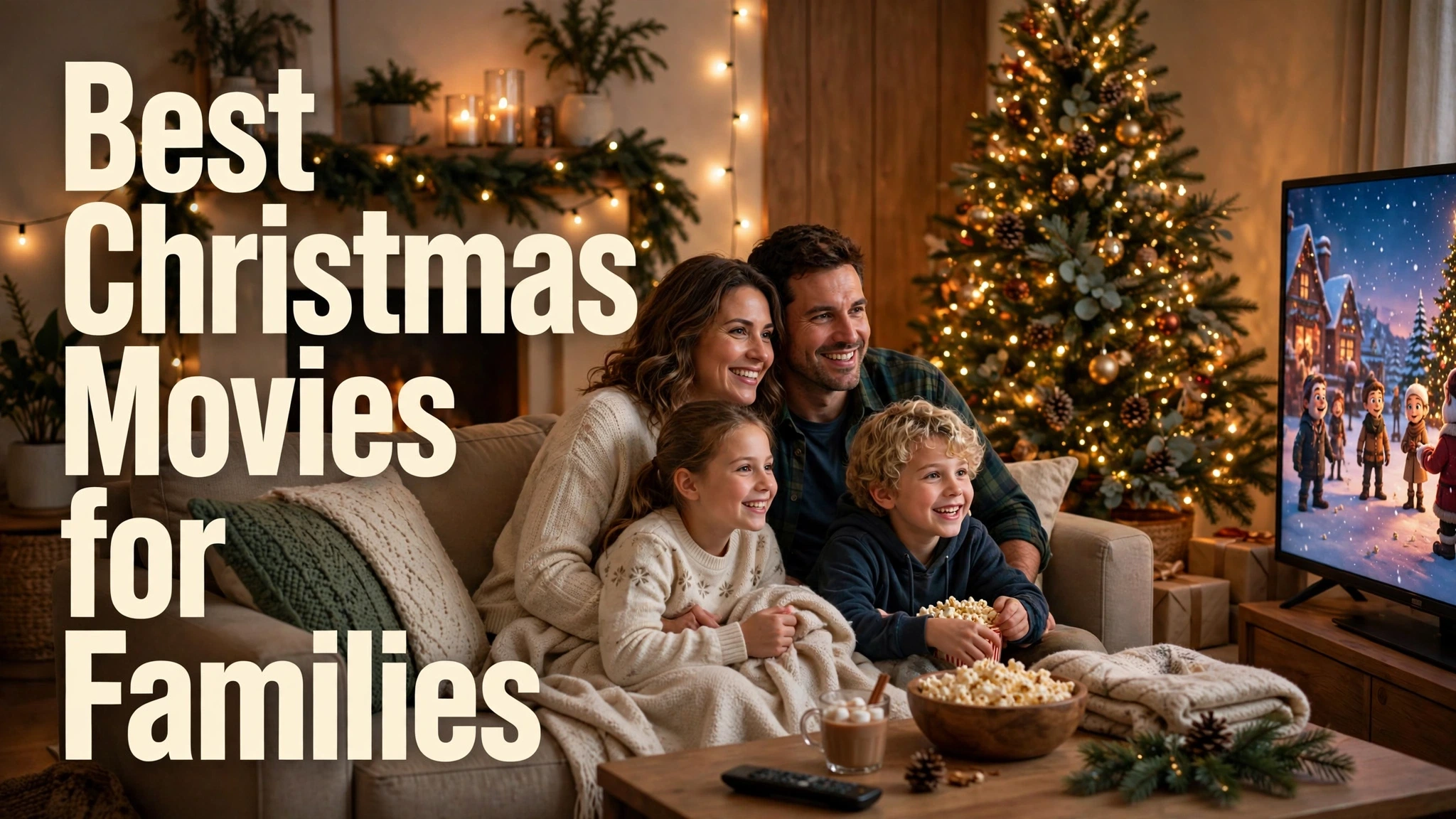
Best Christmas Movies for Families 2026
In this post
- Pick by Age First, Not by Fame
- The Classics That Still Earn Their Place
- Animated Films That Adults Do Not Have to Endure
- A Simple Age Guide You Can Use Tonight
- Streaming Changes, So Check Before You Promise
- Build the Night Around the Film, Not Around Snacks
- How to Build a Balanced List Without Repeating the Same Mood
- What to Skip, Delay, or Watch With Care
- My Take:
Pick by Age First, Not by Fame
The fastest way to ruin a family movie night is to pick a famous film for the wrong age. A five-year-old, a nine-year-old, and a teenager do not want the same pace, the same jokes, or the same level of tension. Start with the youngest person who will actually watch, then check the oldest person’s patience. If the youngest child will be frightened by a villain or bored by a slow drama, the film fails even if adults love it. Age-first choosing also saves arguments, because the rule is decided before anyone opens a streaming app.
For children under six, choose short, bright, and gentle films. The 1964 Rudolph the Red-Nosed Reindeer, the 1969 Frosty the Snowman, and short specials work better than a two-hour story with a long middle. Children in this group remember songs, colours, and one clear character, not plot twists. Keep the total running time under an hour when possible, and keep the room lights low but not dark, so a child who feels nervous can still see familiar faces. A short film watched happily beats a long classic watched through tears.
For ages six to nine, story and humour start to matter. The Grinch in its 2018 animated form, The Santa Clause from 1994, and The Muppet Christmas Carol from 1992 fit this group well, because the jokes are visual, the villains are softened by comedy, and the endings are warm and clear. Children here enjoy spotting details, repeating lines, and asking why a character acted badly. Pause once or twice to answer a question, rather than treating the film as a test of silence. A family film is also a conversation, especially at this age.
The Classics That Still Earn Their Place
Home Alone from 1990 remains the most reliable family comedy for older children, not because it is new, but because its structure is easy to follow. Kevin is left behind, two burglars arrive, and a child uses household objects in clever ways. The comedy is physical, the danger is never realistic, and the ending returns to family. Parents should still note the slapstick: some younger children copy traps, so a short talk before the film helps. Say clearly that the traps are pretend, that real injuries hurt, and that no one should try them at home.
Elf from 2003 works for a different reason. Will Ferrell plays Buddy as sincere rather than clever, and that sincerity makes the jokes safe for mixed ages. Adults notice the New York workplace humour, children notice the snowball fights, spaghetti, and elf world, and both groups understand the same message: belonging matters more than fitting in. The film also gives families a useful test. If a child laughs at kindness rather than cruelty, Elf will land. If a child only laughs when someone falls down, Home Alone may land first, and Elf can wait a year.
It’s a Wonderful Life from 1946 and Miracle on 34th Street from 1947 are slower, and that slowness is the point for teenagers and adults. The first film asks what a town would lose without one ordinary person. The second asks whether belief can survive a courtroom. Neither film needs fast action, because both rely on character choices. Watch these after younger children are in bed, or split them across two nights, so older viewers can follow the dialogue without a younger child asking for a different film every ten minutes.
Animated Films That Adults Do Not Have to Endure
Klaus from 2019 is the strongest newer animated Christmas film for families, because it explains Santa’s story without relying only on magic. A selfish postman meets a lonely toymaker, small acts of kindness change a feuding town, and the legend grows from those acts rather than from a single miracle. The hand-drawn style looks warm on a television, the humour is gentle, and the story gives parents a natural opening to talk about how kindness spreads. It also avoids the loud, frantic pace that makes some modern animation exhausting for adults.
Arthur Christmas from 2011 solves a question children always ask: how can Santa deliver so many gifts in one night? Its answer is a huge, high-tech operation run by a family, with one clumsy son who cares about a single missed child. That contrast matters. The film shows efficiency and care in conflict, and care wins. Children enjoy the gadgets and the chase, adults enjoy the family argument about what Christmas is for, and the ending is satisfying without being sentimental in a cheap way.
The Nightmare Before Christmas from 1993 needs a warning label in a family guide, even though many lists include it. Its songs are excellent and its design is famous, but its tone is spooky, and its hero mistakes another holiday for his own. For children who love Halloween, it can be a bridge film in December. For children who dislike skeletons, dark colours, or anxious music, it can feel wrong for Christmas. Judge by the child’s reaction to spooky images, not by the film’s reputation. A film is not family-friendly merely because adults call it a classic.
A Simple Age Guide You Can Use Tonight
For toddlers and preschoolers, choose one short special, one song, and an early bedtime. A Trash Truck Christmas from 2020, a short Paw Patrol Christmas special, or a classic short fits this plan. Do not start a feature film at 8 p.m. and expect a calm child at 10 p.m. The goal is a happy memory, not a completed film. If the child falls asleep during the credits, the night still worked.
For primary-school children, build a three-film weekend rather than one long marathon. Night one can be funny, night two can be animated, and night three can be a classic. That spread gives children time to talk about each film, sing its songs, and look forward to the next night. A marathon sounds exciting, but after the second film children stop watching and start fidgeting, and adults stop enjoying and start checking the time. Three good nights beat one tired marathon.
For tweens, add one film with a real problem. The Christmas Chronicles from 2018, Jingle Jangle from 2020, or The Best Christmas Pageant Ever from 2024 all give older children a hero who must make a choice, not merely survive a joke. Tweens also enjoy behind-the-scenes facts, such as where a film was shot or how an effect was made. Give them one fact before the film and let them spot it during the story. That small task turns passive watching into active attention.
Streaming Changes, So Check Before You Promise
Streaming availability changes by country, by month, and sometimes by week, so this guide deliberately avoids promising that a film is on one named service in your home. A film that is on one service in December may move in January, and a film available in the United States may sit on a different service in the United Kingdom, Pakistan, or elsewhere. Check your own service on the night you plan to watch, and have a second choice ready. A backup choice prevents the familiar twenty-minute search that kills the mood before the film starts.
If you rent or buy a film, check the version as well as the title. Miracle on 34th Street exists in a 1947 black-and-white version and a 1994 colour version, and children react very differently to each. The Grinch exists as a 1966 short, a 2000 live-action film with Jim Carrey, and a 2018 animated film. Each version has a different tone, length, and villain. Searching only the title can lead to the wrong version, especially when a child has a clear favourite from school or from a friend. Confirm the year before you press play.
Parental controls also matter more than most guides admit. A child’s profile can hide adult rows, but it cannot judge whether a PG film’s villain will frighten a particular child. Watch the trailer together, read a short parent review, and trust what you know about your child over a rating letter. Ratings describe broad content, not a child’s fears, and a film rated G can still contain a loud storm, a separation scene, or a sad song that upsets a sensitive viewer.
Build the Night Around the Film, Not Around Snacks
A good movie night needs a start time, a pause plan, and an end time. Start early enough that the film ends before the youngest viewer becomes overtired. Plan one pause for drinks, bathroom breaks, and a quick stretch, ideally at a natural scene change rather than in the middle of a tense moment. End with five minutes of talk, not with everyone scattering to phones. Ask one question: which character would you want as a friend, and why? That question gives children language for what they felt, and it gives adults a clue about what the child actually noticed.
Snacks should support the film, not compete with it. Hot chocolate, popcorn, and a small plate of biscuits are enough. A large, messy meal during a film distracts from dialogue and creates cleaning work afterwards. If you want a special food moment, serve it before the film as a small ritual, such as decorating one biscuit each, then move to the sofa with simple snacks. The ritual becomes part of the memory, while the film remains the main event.
Decorations can also help, but only if they are ready before the film starts. A blanket for each person, one string of lights, and the tree in view are enough. Do not spend the first half hour of the night fixing lights, searching for blankets, or arguing about seats. Set the room before children arrive, choose seats quickly, and keep phones in another room during the film. Adults set the tone: if adults check phones, children will ask for tablets, and the shared experience breaks apart.
How to Build a Balanced List Without Repeating the Same Mood
A balanced family list mixes laughter, wonder, and one quiet moment, because a list of only comedies becomes noisy and a list of only sentimental films becomes heavy. Start with a comedy that everyone can laugh at, add an animated film that gives children a visual world to remember, and finish with a film that asks a slightly harder question. That order matters. Comedy first relaxes the family, animation second keeps children engaged, and a thoughtful film last works because trust has already been built. Reversing the order, with the heaviest film first, often makes children ask to stop before the fun begins.
Also mix old and new deliberately. An old film teaches children that stories do not expire, while a new film teaches them that Christmas stories are still being made. If every film is from before 2000, children may feel Christmas belongs only to the past. If every film is new, they miss the shared language adults grew up with, such as the music of The Muppet Christmas Carol or the traps of Home Alone. One old, one recent, and one in between gives a family three different styles to compare, and comparison itself becomes a useful conversation about how filmmaking, humour, and family life have changed.
Finally, leave one slot empty. A family list with no empty slot cannot absorb a child’s sudden request, a guest’s suggestion, or a film discovered at school. An empty slot also removes pressure: if one planned film disappoints, the family still has room to replace it without breaking a perfect plan. The best Christmas lists are not complete in November. They are frameworks that leave room for December itself, for a rainy afternoon, for a visiting cousin, and for a child who suddenly wants to watch the same film again.
What to Skip, Delay, or Watch With Care
Not every Christmas film suits every family, and skipping a film is not a failure of taste. Gremlins from 1984 is often listed as a Christmas film, but its horror and violence make it wrong for young children, even though its setting is Christmas. Die Hard from 1988 is debated every year as a Christmas film, but its action and language make it an adults-only choice, not a family compromise. A film set at Christmas is not automatically a film for children at Christmas, and that distinction saves many awkward nights.
Scary villains deserve special care. The Grinch in live-action form is louder and more intense than the animated version, and some children find his face frightening even when they understand the story. The same applies to the burglars in Home Alone for very young children, and to the darker scenes in The Polar Express from 2004, where the train journey can feel tense and strange. If a child covers their eyes, pause the film, explain what will happen next in simple words, and offer a choice: continue, skip ahead, or stop. Giving a child control does not spoil the film; it teaches the child that fear can be managed.
Sad scenes also need planning. Films about loss, separation, or a parent working far away can touch a real family situation. That is not a reason to avoid every sad film, but it is a reason to choose the moment well. Do not introduce a film about a missing parent on a night when a family member is travelling, ill, or recently lost. Watch it when the family feels steady, talk afterwards, and let the child lead the conversation. A film can help a child name a feeling, but only if the adult listens after the credits.
My Take:
My first rule for family Christmas films is simple: the youngest viewer decides the film, and the adults decide the timing. I have seen too many guides rank films by fame, as if a famous title automatically works for a four-year-old. It does not. A film that frightens a small child does not become a good choice because adults remember it fondly. Start with the child in the room, not with the list in your head, and the night already improves.
My second rule is that one great film beats a long list. Families often collect twenty titles, argue about all twenty, and then watch none of them properly. I would rather pick one film, watch it fully, and talk about it afterwards. That single shared story becomes a reference for years: the year we watched Klaus, the year a child quoted Elf for a week, the year a teenager finally understood It’s a Wonderful Life. Lists are useful for choosing, but they are not the experience. The experience is one film, watched together, without rushing to the next title.
I also believe parents should stop pretending that every classic suits every age. I love The Nightmare Before Christmas, but I would not show it to a child who dislikes dark images simply because a list calls it essential. I love Die Hard debates, but I would not use a debate to justify showing an action film to children. Taste is not proven by forcing a film on the wrong audience. Taste is shown by matching a film to the people watching it, and by admitting when a beloved film must wait a year or two.
My own ranking, for a mixed family with children aged six to twelve, starts with Klaus, then Home Alone, then Elf, then The Muppet Christmas Carol. Klaus comes first because it teaches kindness without lecturing, and because its story rewards attention. Home Alone comes second because its comedy is physical and easy to share, even across language differences. Elf comes third because its warmth is genuine, and The Muppet Christmas Carol comes fourth because Michael Caine plays Scrooge seriously, which teaches children that a story can be funny and serious at once.
For teenagers, I would reverse the order and start with It’s a Wonderful Life. Teenagers often dismiss old films before watching them, so the adult’s job is to give them a reason to stay past the first twenty minutes. Tell them the film is darker than they expect, that its hero considers giving up, and that the ending is earned rather than easy. That honest warning respects a teenager’s intelligence. If the teenager still dislikes the slow pace, do not argue. Offer Miracle on 34th Street or The Holdovers from 2023, which are also thoughtful but move differently.
I also think families should protect the talk after the film. The best question is not whether the film was good, because children will answer good to please adults. Ask which character made the hardest choice, which scene felt unfair, or which song stayed in their head. Those questions reveal what the child valued, and they often reveal worries adults missed. A child who says the burglars were scary needs reassurance, not a lecture about pretend violence. A child who says Kevin was lonely needs a conversation about family, not a joke about traps.
Finally, I would keep Christmas films separate from Christmas pressure. A film night should not become another task to complete perfectly, with matching pyjamas, a photographed snack table, and a strict schedule. The memory children keep is rarely the perfect table. It is the blanket, the shared laugh, the parent who paused to explain a scene, and the feeling that everyone was in the same room for the same story. Choose one film well, start on time, put phones away, and let the story do the rest. That is enough, and it is also the hardest part to protect in a busy December.
I also want to challenge the idea that a family must finish every film it starts. Stopping a film is not failure; it is a decision about the people in the room. If a child is frightened, if a teenager is genuinely bored, or if an adult realises the film’s message conflicts with a family value, stopping protects the night. The family can talk about why it stopped, choose something else, or simply play a game instead. A stopped film, discussed honestly, teaches more about taste and respect than a finished film watched in resentment. Children learn that their feelings count, and adults learn that authority does not require forcing entertainment.
Another point I care about is rewatching. Adults often chase novelty in December, searching for a film no one has seen, while children want the same film again because repetition feels safe. I would honour that wish at least once. Rewatching Home Alone or Elf lets a child notice jokes they missed, predict scenes, and feel clever for remembering lines. That confidence matters more than discovering an obscure title. Novelty impresses guests; repetition builds family tradition. A tradition, by definition, is a film watched again, not a film ticked off a list once.
I also think grandparents should be given a real choice, not merely invited to watch a children’s film. Ask a grandparent which Christmas film they remember from their own childhood, and watch that film with them if it suits the youngest viewer, or watch it after children are asleep and tell children about it the next day. That link between generations is the deepest value of a Christmas film. It turns a streaming choice into a family history lesson, without any lecture, because the film itself carries the memory. When a grandparent explains why a black-and-white film mattered to them, children listen in a way no guide can force.
I would also change how families handle a child who wants the same film every year while a sibling wants something new. Alternate years, or alternate nights: one night for the repeated favourite, one night for a new choice, with the child who chose the new film explaining why they picked it. That rotation teaches compromise without making either child feel ignored. It also prevents the repeated film from becoming a battleground. A tradition that causes annual arguments is not a tradition worth protecting in its exact form; a tradition that adapts to growing children is stronger, because it survives change.
Another specific rule I use is to separate film choice from snack choice. Children who lose the film vote should still choose the snack, the blanket, or the seating order. That small compensation matters, because it gives a child who did not get their film a real decision elsewhere. Adults often dismiss that as bribery, but it is actually fairness: a family night has many decisions, and sharing them prevents one decision from deciding the whole evening. A child who chose popcorn and a seat by the window will watch a sibling’s film more generously than a child who lost every choice.
I also think schools and friends influence film taste more than parents admit, and parents should use that influence rather than fight it. If a child comes home asking for a film classmates watched, ask what they liked about it, what scared them, and what they want to watch next. That conversation turns peer pressure into a discussion about taste. Banning a popular film outright often increases its appeal, while watching it together, with a pause for discussion, reduces its mystery. Parents do not need to approve every popular film, but they do need to understand why it appeals before deciding.
Finally, I would keep a simple family film log: title, date, who chose it, and one line about what everyone thought. After three Christmases, that log becomes a family history, showing how taste changed as children grew. A child who loved a short special at five may love a classic at ten and a thoughtful drama at fifteen, and the log makes that growth visible. It also prevents repeating the same argument every year about which film was watched last time. A log is not homework; it is a memory, written in one line, and it turns scattered movie nights into a story a family can retell.
Frequently Asked Questions
Which Christmas movie is best for a family with a 5-year-old in 2026?
For a 5-year-old, choose a short, gentle special such as Frosty the Snowman or Rudolph the Red-Nosed Reindeer, rather than a long feature film. Keep the film under an hour, keep the lights low but not fully dark, and stop if the child becomes frightened. A short film watched happily is better than a famous film watched through tears.
Is Home Alone suitable for children under 8?
Home Alone suits many children aged eight and above, but younger children may copy its traps or find the burglars frightening. Before watching, explain that the traps are pretend, that real injuries hurt, and that no one should try them at home. If a younger child is sensitive to shouting or physical comedy, choose the animated Grinch or The Santa Clause first.
Which animated Christmas movie is best for adults as well as children in 2026?
Klaus is a strong choice for adults and children together, because its story about kindness changing a town is clear, its humour is gentle, and its hand-drawn style looks warm on television. Arthur Christmas is another good shared choice, because adults enjoy the family argument about Santa’s operation while children enjoy the gadgets and chase.
Should families watch the 1947 or 1994 version of Miracle on 34th Street?
Choose the 1947 black-and-white version for teenagers and adults who enjoy classic dialogue, and the 1994 colour version for younger children who may struggle with black-and-white films. Check the year before pressing play, because streaming services often list both versions under the same title.
Is The Nightmare Before Christmas a good family Christmas movie for young children?
The Nightmare Before Christmas suits older children who enjoy spooky images and Halloween, but it can frighten younger children who dislike skeletons, dark colours, or anxious music. Judge by the child’s reaction to spooky images, not by the film’s fame. If in doubt, watch the trailer together first and let the child decide.
Why do Christmas movies change streaming services so often in 2026?
Christmas movies move between services because streaming rights are licensed for limited periods and by country, so a film available in one place in December may sit elsewhere in January. Check your own service on the night you plan to watch and keep a second choice ready, rather than promising children one title in advance.