Best Marathons in the World to Run in 2027
In this post
- London Marathon: The Greatest Party in Running
- Boston Marathon: The Oldest and the Hardest to Enter
- Berlin Marathon: The Fastest Course in the World
- New York and Chicago: The American Giants
- Tokyo, Paris and the Other World Majors
- How to Train for a Marathon
- Race Day: What to Expect and How to Finish
- Valencia, Rotterdam and the Fast European Marathons
- The Six Star Medal and the World Marathon Majors
- Marathon Myths and Mistakes to Avoid
- The Joy of Finishing
- My Take:
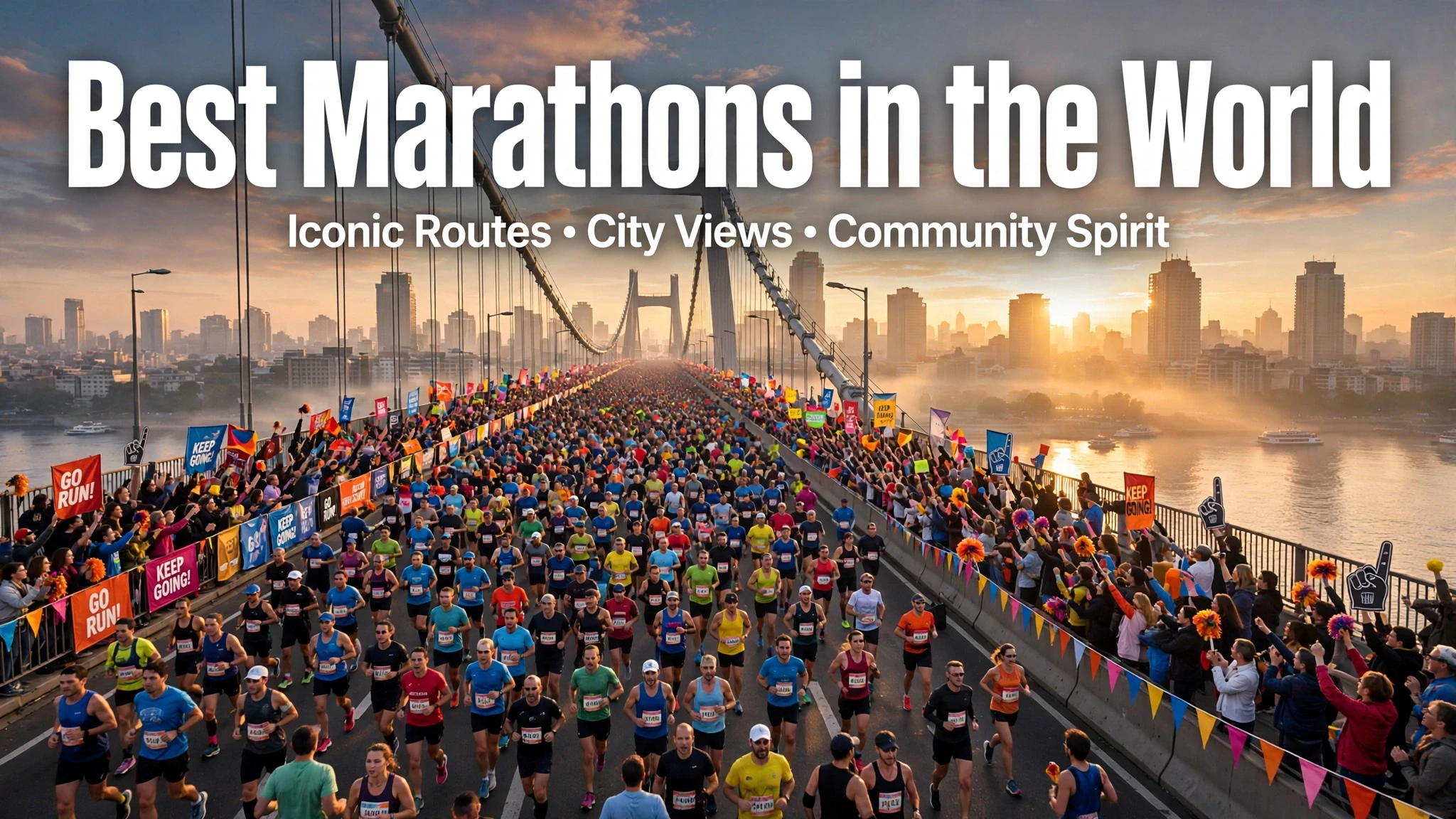
Running a marathon, forty-two point two kilometres, is one of the greatest challenges in sport, and the best marathons in the world are not only races, they are festivals, with crowds, music, and cities that come alive for a day. The London Marathon, with its route past the Tower of London, Big Ben and Buckingham Palace, is the most popular marathon in the world, with more than fifty thousand runners. The Boston Marathon, the oldest in the world, first run in 1897, is the one every serious runner wants to qualify for. The Berlin Marathon, with its flat, fast course, is where world records are broken. The New York Marathon, with its five boroughs and a million spectators, is the biggest. This guide looks at the marathons every runner should aim for, explains how to enter, how to train, and what to expect on race day, because a marathon is not only about running, it is about the city, the crowd, and the feeling of crossing the finish line.
London Marathon: The Greatest Party in Running
The London Marathon, first run in 1981, is the most popular marathon in the world, with more than fifty thousand runners and more than a million spectators, and it is a race that every runner should do once. The course starts in Greenwich, runs past the Cutty Sark, through Docklands, past the Tower of London, along the Thames, past Big Ben, and finishes on the Mall, in front of Buckingham Palace, and the crowds, who line the whole route, are the best in the world, with bands, with cheering, and with a party atmosphere that carries runners through the hardest miles. The London Marathon is also the biggest charity fundraising event in the world, with runners raising more than a billion pounds since 1981, and many runners get their place through a charity, by promising to raise a set amount. Entry is through a ballot, which is oversubscribed, with more than half a million people applying for fifty thousand places, so getting in is part of the challenge. The 2027 race is expected to be held in April, and it will be, as always, a celebration of running.
Boston Marathon: The Oldest and the Hardest to Enter
The Boston Marathon, first run in 1897, is the oldest annual marathon in the world, and it is the one that serious runners respect most, because you cannot buy a place, you must qualify by running a fast time in another marathon. The qualifying times depend on age and gender, but for a man under thirty-five, it is three hours, and for a woman under thirty-five, it is three hours and thirty minutes, which means only the fastest runners get in. The course, from Hopkinton to Boston, is not flat, it has the Newton Hills, including Heartbreak Hill at mile twenty, which has broken many runners, and the finish, on Boylston Street, is one of the most famous in sport. Boston is also a race with history, because it was the first marathon to allow women, with Kathrine Switzer running in 1967 despite being told women could not run marathons, and it was the site of the bombing in 2013, after which the city and the running community came together in a way that showed the best of the sport. Running Boston is a badge of honour, and it is the marathon that runners train for for years.
Berlin Marathon: The Fastest Course in the World
The Berlin Marathon is the fastest marathon in the world, because the course is flat, the weather in September is cool, and the organisation is perfect, which is why world records are broken there. Eliud Kipchoge, the greatest marathon runner ever, broke the world record in Berlin in 2018, running two hours, one minute and nine seconds, and then broke it again in 2022, running two hours, one minute and nine seconds, and the women’s world record was also broken in Berlin. The course starts and finishes near the Brandenburg Gate, runs through the city, past the Reichstag, the Berlin Cathedral, and the Potsdamer Platz, and the crowds, who line the route, are enthusiastic and supportive. Berlin is a popular marathon for first-timers and for runners chasing a personal best, because the flat course and the cool weather make it the best place to run fast. Entry is through a ballot, with a lottery, and the race is held in September, which gives runners the summer to train.
New York and Chicago: The American Giants
The New York City Marathon, first run in 1970, is the biggest marathon in the world, with more than fifty thousand finishers, and it runs through all five boroughs of New York: Staten Island, Brooklyn, Queens, the Bronx and Manhattan, finishing in Central Park. The course starts on the Verrazzano-Narrows Bridge, with the skyline behind, and it runs through neighbourhoods where a million spectators cheer, with bands, with music, and with a diversity that reflects the city itself. The New York Marathon is a lottery, with hundreds of thousands applying for fifty thousand places, and it is expensive, but it is the marathon that every runner wants to do, because running through New York, with a million people cheering, is an experience like no other. The Chicago Marathon, held in October, is the other great American marathon, with a flat, fast course, with a million spectators, and with a reputation for being well organised, and it is where many runners set their personal bests. Chicago is also a lottery, but it is slightly easier to get into than New York or Boston.
Tokyo, Paris and the Other World Majors
The Tokyo Marathon, held in March, is the newest of the World Marathon Majors, and it is a race that combines Japanese organisation, with perfect timing, with a course that runs past the Imperial Palace, the Tokyo Tower, and the Asakusa Temple, and with crowds who are polite, enthusiastic, and supportive. Tokyo is a lottery, and it is popular with international runners, because Japan is a beautiful country, and the marathon is a great way to see it. The Paris Marathon, held in April, is one of the most beautiful marathons in the world, with a course that starts on the Champs-Élysées, runs past the Eiffel Tower, the Louvre, and the Bastille, and finishes on the Avenue Foch, and it is popular with runners who want a scenic race. Other great marathons include the Valencia Marathon, in Spain, which is flat and fast, the Rotterdam Marathon, in the Netherlands, which is also fast, and the Sydney Marathon, which became a World Major in 2025, and which runs past the Opera House and the Harbour Bridge. The World Marathon Majors are the six biggest marathons: Tokyo, Boston, London, Berlin, Chicago and New York, plus Sydney, and running all of them earns a Six Star medal, which is the ultimate achievement for a marathon runner.
How to Train for a Marathon
Training for a marathon takes sixteen to twenty weeks, and it is a serious commitment, with four or five runs a week, a long run that builds up to thirty-two kilometres, and rest days that are as important as the runs. The long run is the most important session, because it teaches the body to burn fat, to stay hydrated, and to keep going when it is tired, and it should be done slowly, at a pace that allows conversation. The other runs include a tempo run, which is faster, an interval session, which is short and fast, and an easy run, which is slow and recovery. Nutrition matters, because a runner needs carbohydrates for energy, protein for recovery, and water for hydration, and they must practise eating and drinking during the long run, because the body needs fuel after about ninety minutes. The most common mistake is running too fast, too soon, and getting injured, so the rule is to increase mileage by no more than ten percent per week, and to listen to your body. A marathon is not run on race day, it is run in the months of training before it, and the race is the reward.
Race Day: What to Expect and How to Finish
Race day is the culmination of months of training, and it is a day of excitement, nerves, and, for many runners, the hardest physical challenge of their lives. The race starts early, the runners gather in the start area, they warm up, they use the toilet, and they wait for the gun, and the first few kilometres are crowded, slow, and exciting, with the crowd cheering and the adrenaline flowing. The middle of the race, from ten to thirty kilometres, is about rhythm, about eating and drinking, and about staying patient, because the race does not begin until thirty kilometres, when the body runs out of glycogen, the fuel it stores, and hits the wall, the moment when every step feels hard. The last twelve kilometres are about mental strength, about breaking the race into small pieces, about focusing on the next kilometre, and about the crowd, who carry runners to the finish. Crossing the finish line, with a medal, with a time, and with the knowledge that you have run forty-two kilometres, is one of the greatest feelings in sport, and it is why runners come back, year after year, to do it again.
Valencia, Rotterdam and the Fast European Marathons
Valencia, in Spain, is one of the fastest marathons in the world, with a flat course, cool weather in December, and a reputation for personal bests, and it has become popular with runners chasing a fast time. Rotterdam, in the Netherlands, is also flat and fast, with a course that runs through the city, and it is known for its organisation and its crowds. These marathons are not as famous as London or Boston, but they are better for a fast time, because they are flat, they are less crowded, and they are held in good weather. A runner who wants a personal best should consider Valencia or Rotterdam, because the course will help them, and the experience, while not as famous, is still excellent. The best marathon for a fast time is not always the most famous, and the smart runner chooses the course that suits their goal.
The Six Star Medal and the World Marathon Majors
The World Marathon Majors are the six biggest marathons in the world, Tokyo, Boston, London, Berlin, Chicago and New York, plus Sydney, which joined in 2025, and running all of them earns a Six Star medal, which is the ultimate achievement for a marathon runner. The Six Star medal is rare, because it requires running seven marathons, in different countries, over several years, and it costs thousands of dollars in travel and entry fees. Runners who earn it are celebrated, because they have run the best marathons in the world, and they have the medal to prove it. The Majors are also a community, with runners sharing stories, tips, and encouragement, and the Six Star finishers are a club, with a shared experience that few people understand. For a runner who loves marathons, the Six Star is the goal, and it is worth the effort.
Marathon Myths and Mistakes to Avoid
There are many myths about marathons, and the most common is that you must run a marathon to be a real runner, which is not true, because running is for everyone, and a five-kilometre run is as valid as a marathon. Another myth is that you must carb-load the night before, eating a huge pasta dinner, which is not necessary, because the body stores glycogen over days, not in one meal. A common mistake is wearing new shoes on race day, which can cause blisters, and the rule is to wear shoes you have trained in, and to wear nothing new on race day. Another mistake is starting too fast, because the adrenaline and the crowd make runners go out too quickly, and they pay for it later, when they hit the wall. The best advice is to run your own race, to stick to your plan, and to enjoy the day, because a marathon is a celebration, not a punishment.
The Joy of Finishing
Finishing a marathon is one of the greatest feelings in sport, because it is the result of months of training, of early mornings, of long runs, and of a commitment that few people understand. The finish line, with the crowd cheering, with the medal, and with the knowledge that you have run forty-two kilometres, is a moment that stays with you forever. Many runners cry at the finish, not because they are sad, but because they are proud, because they have done something they thought was impossible. That pride is the reward for the training, and it is why runners come back, year after year, to run another marathon, because the feeling of finishing is addictive, and it is worth every step.
My Take:
I think the London Marathon is the greatest marathon in the world, and I think the reason is the crowd, because no other marathon has a million people cheering for every runner, from the fastest to the slowest, for the whole forty-two kilometres. I have run marathons, and I know that the crowd can carry you when your legs cannot, and London’s crowd is the best, because they cheer for everyone, they shout your name if it is on your shirt, and they make you feel like a hero, even if you are running at the back. I also love that London is a charity marathon, because runners raise more than a billion pounds, and that money changes lives, which means the marathon is not only a race, it is a force for good. I would run London again, even though it is hard to get into, because it is the one marathon that feels like a party, and a party that raises money for charity is the best kind of party.
My strongest feeling is about Boston, because it is the marathon that runners respect most, and I think that respect is earned, because Boston does not let you buy a place, you must earn it by running fast. That is a powerful idea, that a race can be a reward for hard work, and that only the fastest get in, and it makes Boston special. I have not qualified for Boston, and I may never qualify, but I respect it, and I train for it, because having a goal that is hard to reach makes you a better runner. I think every sport needs a Boston, a standard that is high, that is fair, and that rewards effort, because without standards, there is no excellence, and without excellence, there is no inspiration. Boston is the standard for marathon running, and I hope it never changes, because the day Boston lets anyone in is the day it stops being Boston.
I also believe Berlin is the best marathon for a personal best, because the course is flat, the weather is cool, and the organisation is perfect, and those three things are what a runner needs to run fast. I have seen runners set personal bests in Berlin that they could not set anywhere else, because the course does not fight them, it helps them, and the crowd, who are enthusiastic and supportive, carry them through the last kilometres. I think Berlin is also a beautiful city, with history, with culture, and with a marathon that runs past the Brandenburg Gate, which is a symbol of freedom, and that makes the race more meaningful. I would recommend Berlin to any runner who wants to run fast, because it is the best place to do it, and I would recommend it to any runner who wants a beautiful race, because Berlin is both fast and beautiful, and that combination is rare.
Another thing I care about is the charity runners, because they are the heart of the London Marathon, and they are often forgotten in the stories about elite runners. A charity runner is someone who has never run a marathon, who trains for months, who raises thousands of pounds, and who runs for a cause, for a loved one, for a charity, and their story is more inspiring than any elite runner’s story. I have seen charity runners finish the London Marathon in six hours, with the crowd cheering, with tears in their eyes, and with a medal around their neck, and that moment is more emotional than any world record. I think we should celebrate charity runners more, because they show that a marathon is not only for the fast, it is for everyone, and that running can change lives, not only for the runner, but for the people their fundraising helps.
Finally, I think running a marathon changes you, because it teaches you that you can do something you thought was impossible, and that lesson stays with you for life. I remember my first marathon, I remember the wall at thirty kilometres, I remember wanting to stop, and I remember finishing, and that finish changed how I saw myself. I realised that I was capable of more than I thought, that I could endure, that I could keep going when it was hard, and that is a lesson that applies to everything in life, not only running. I hope everyone runs a marathon once, not to be fast, not to win, but to learn that lesson, because it is the most valuable lesson sport can teach, and it is a lesson that will stay with you long after the medal is hung on the wall.
There is one more thing I want to say, and it is about the volunteers, because a marathon cannot happen without them, and they are the unsung heroes of the race. The volunteers hand out water, they direct runners, they cheer, they clean up, and they do it for free, for hours, in all weather, because they love the sport and they love their city. I have been a volunteer, and I have been a runner, and I know that a volunteer who hands you water at thirty kilometres, with a smile, can make the difference between finishing and giving up. I am grateful to them, and I think the next time you run a marathon, you should thank a volunteer, because they are part of your race, and they deserve to be thanked.
I also think the Six Star medal is a wonderful goal, because it gives runners a reason to travel, to see the world, and to run in cities they would never visit otherwise. I have met runners who have run all six Majors, and they talk about Tokyo, Boston, London, Berlin, Chicago and New York, not as races, but as experiences, with stories, with friends, and with memories that last a lifetime. I think that is what running is about, not the time, not the medal, but the experience, and the Six Star is the ultimate experience, because it takes you around the world, and it shows you that running is a global community, with people in every country, who share your passion, and who will cheer for you, even if they have never met you.
Frequently Asked Questions
What is the best marathon in the world to run?
The London Marathon is often ranked first for its crowds and atmosphere, with Boston, Berlin, New York and Tokyo also among the best, each offering a different experience.
How do I get into the London Marathon?
Entry is through a ballot, which is heavily oversubscribed, or through a charity place, by promising to raise a set amount for a charity.
What time do I need to qualify for Boston?
For a man under thirty-five, the qualifying time is three hours, and for a woman under thirty-five, it is three hours and thirty minutes, with times varying by age group.
Which marathon is the fastest?
The Berlin Marathon is the fastest, with a flat course and cool weather, and it is where the men’s and women’s world records have been broken.
How long does it take to train for a marathon?
Training usually takes sixteen to twenty weeks, with four or five runs a week, a long run building to thirty-two kilometres, and rest days as important as the runs.
What are the World Marathon Majors?
The World Marathon Majors are Tokyo, Boston, London, Berlin, Chicago, New York and Sydney, and running all of them earns a Six Star medal.