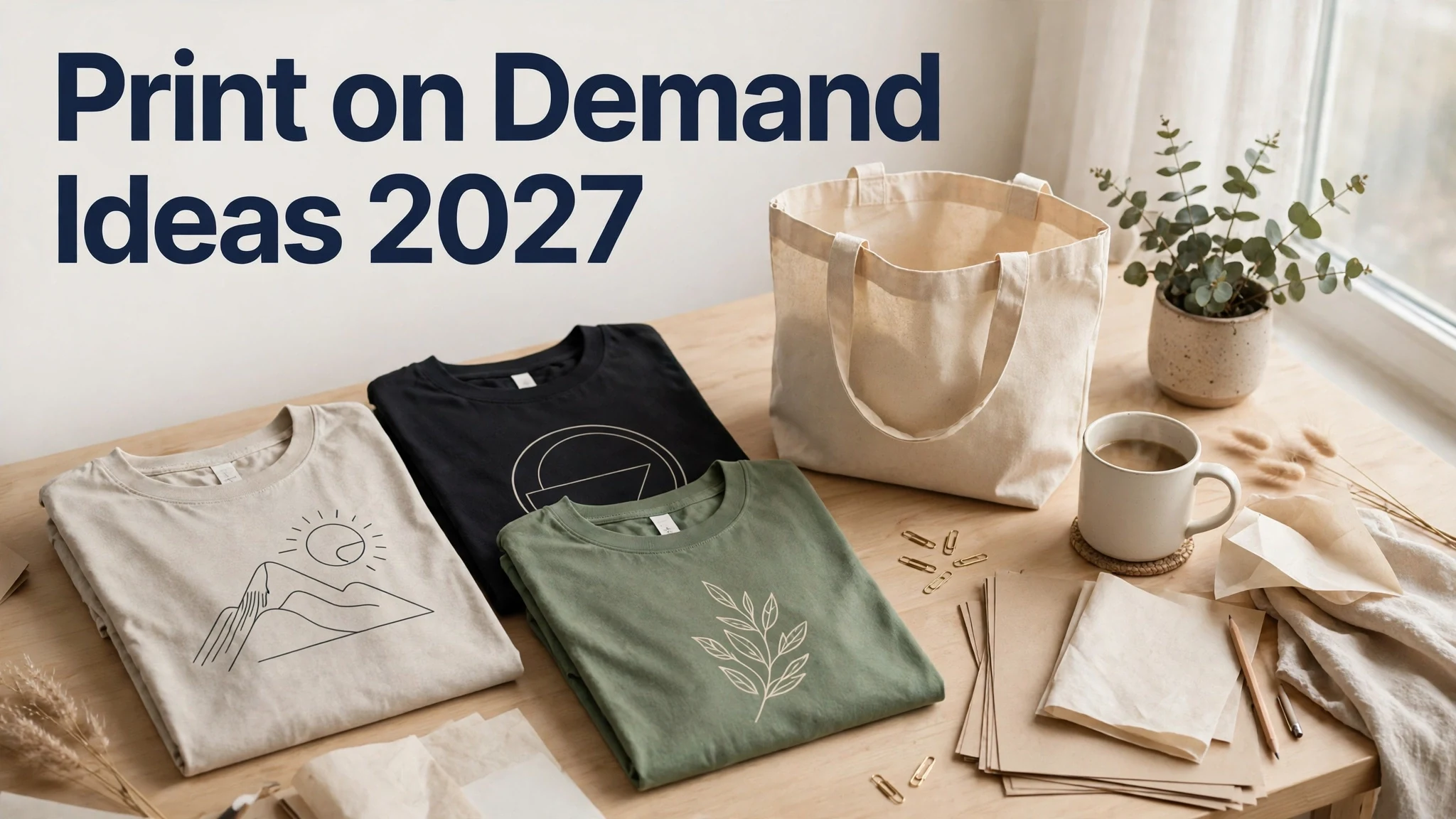
Best Print on Demand Ideas 2027
In this post
- How Print on Demand Actually Works
- Why Niche Beats General in 2027
- Idea 1: Everyday Wear With a Personal Twist
- Idea 2: Home, Desk and Everyday Objects
- Idea 3: Gifts, Occasions and Seasonal Designs
- Idea 4: Community, Fandom and Identity Designs
- Pricing, Profit and Realistic Expectations
- How to Start Without Inventory or Experience
- Idea 5: Digital Products, Bundles and Repeat Buyers
- My Take:
How Print on Demand Actually Works
Print on demand is a business model in which a product is only printed after a customer orders it. A seller creates a design, places it on a product such as a t-shirt or a mug in an online shop, and a printing partner makes and ships that single item directly to the buyer. The seller never buys stock in advance, never stores boxes at home, and never packs parcels. That structure is what makes print on demand attractive to beginners, because the main upfront cost is time: time to research a niche, time to make good designs, and time to bring visitors to the shop.
The trade-off is margin. Because each item is printed one at a time, the production cost per item is higher than bulk manufacturing, and the seller keeps only the difference between the selling price and the combined production, printing and shipping costs, minus any marketplace fees. A t-shirt that sells for twenty-five dollars might leave only a few dollars of profit after all costs, depending on the platform and the product. That does not make the model bad, but it does mean volume and pricing discipline matter. Sellers who succeed usually sell designs that people feel strongly about, rather than generic designs that compete only on price.
Another important point is control. The seller controls the design and the listing, but the printing partner controls print quality, packaging and delivery speed. If a print fades or a parcel arrives late, the customer blames the shop, even though the seller never touched the product. Choosing a partner with consistent quality, ordering samples before launch, and writing honest delivery expectations in the listing are therefore not optional extras. They are the basic quality control of a business that outsources its factory.
Why Niche Beats General in 2027
A common beginner mistake is opening a shop for everyone. A shop that sells funny shirts, dog shirts, travel mugs and baby clothes all at once gives a visitor no reason to remember it, and search engines and marketplaces have no clear idea who the shop is for. A niche shop, by contrast, speaks to one group of people with shared interests, humour, language and identity. That group is more likely to buy, to share the product, and to return for a second design.
A good niche is specific enough to feel personal, but large enough to have buyers. For example, instead of “cat lovers”, a sharper niche might be “people who foster rescue cats”, “veterinary nurses”, or “owners of a particular breed”. Each of those groups has its own jokes, frustrations and pride, and a design that uses their exact language will outperform a generic cat picture. The test is simple: if a stranger in that group would say “this was made for me”, the niche is working. If they would say “this could be for anyone”, it is too broad.
Niches also protect a seller from direct price competition. A generic motivational t-shirt competes with thousands of identical shirts, so the only way to win is to be cheaper. A design for a small community competes with very few alternatives, so buyers judge it on whether it expresses them, not on whether it is a dollar cheaper elsewhere. That is why experienced sellers advise beginners to pick one niche, learn its culture deeply, and build twenty or thirty designs for that one audience before jumping to a second niche.
Idea 1: Everyday Wear With a Personal Twist
Apparel remains the largest print on demand category, and for good reason: people wear identity. T-shirts, hoodies and sweatshirts sell because they let the wearer say something about themselves without speaking. In 2027, the strongest apparel ideas are not loud, mass-market slogans, but designs that feel personal and wearable in daily life. Minimal line art, small chest prints, vintage-style typography and soft, muted colours tend to age better than huge, bright graphics that look dated after one season.
Personalisation is a powerful variation. Designs that include a name, a date, a city, a family role or a pet’s name turn an ordinary product into a gift. A hoodie that says a family surname and an established year, for example, becomes a Christmas or anniversary present rather than an impulse buy. Personalised products do require more care: the seller must check spelling, set clear character limits, and allow extra production time. But they also command higher prices and lower return rates, because the buyer chose the details themselves.
A further angle is profession and hobby pride. Nurses, teachers, bakers, gardeners, musicians and amateur athletes all enjoy products that recognise work that is often invisible. The key is accuracy. A design for bakers should use correct baking terms and tools, and a design for musicians should show instruments correctly. Audiences notice errors instantly, and a single wrong detail can destroy trust. Researching the niche properly, ideally by reading its forums and groups, is what separates a design that sells from one that merely looks nice.
Idea 2: Home, Desk and Everyday Objects
Not every print on demand product is clothing. Mugs, tote bags, posters, cushions, notebooks and wall art sell to people who want their home or desk to reflect their taste. These products have practical advantages: they are easier to photograph, they make natural gifts, and they often have lower return rates than clothing because sizing is not an issue. A mug does not need a size chart, and a poster does not need to fit a body.
Wall art and posters deserve special attention. Original illustration, typography art, botanical prints, abstract landscapes and motivational quotes in a distinctive style can sell repeatedly, because buyers redecorate and buy for different rooms. The seller’s advantage is that one artwork can be offered in several sizes and formats, which multiplies listings without multiplying design work. The risk is copyright: using famous characters, song lyrics or copied artwork can lead to a shop being closed. Original work, even if simpler, is safer and builds a recognisable style over time.
Tote bags, notebooks and desk accessories suit eco-friendly and organisation niches. A tote bag with a clever library, market or travel design appeals to people who already carry bags daily, and a notebook with a thoughtful cover appeals to planners, writers and students. These products also photograph well in lifestyle settings, which helps on visual platforms. A seller who shows the product in real use, on a desk or in a kitchen, will usually outperform a seller who shows only a flat mockup.
Idea 3: Gifts, Occasions and Seasonal Designs
Gifts are a major driver of print on demand sales, because buyers searching for a birthday, anniversary, wedding or holiday gift are motivated and time-pressed. They are not browsing for fun; they need something that feels thoughtful by a deadline. Designs tied to occasions therefore convert well, provided the seller plans ahead. Seasonal designs should be listed weeks before the occasion, because production and shipping take time and buyers order early for gifts.
The most durable occasion ideas are personal and repeatable: birthdays by age or birth month, anniversaries by year, new jobs, graduations, new homes and new babies. Each occasion has its own language, and a design that names the occasion and the relationship — for example, a gift from a daughter to a father — feels more considered than a generic celebration design. Sellers should also consider the “hard to buy for” person: grandparents, fathers, colleagues and teachers are frequent searches precisely because buyers struggle to choose for them.
Seasonal designs carry a warning as well. A shop that depends entirely on one holiday will have quiet months, and a design tied to a passing trend can become unsellable within weeks. The safer approach is a core range of evergreen occasion designs that sell all year, plus a smaller seasonal collection that adds peaks without creating dependence. That balance keeps income steadier and reduces the pressure of a single season.
Idea 4: Community, Fandom and Identity Designs
Some of the strongest print on demand ideas come from communities rather than products. Running clubs, gaming groups, book clubs, local sports fans, hobby societies and online communities all want merchandise that marks belonging. A design that uses a group’s inside jokes, landmarks, phrases or shared experiences can sell steadily within that community, even if it means nothing to outsiders. That exclusivity is a strength, not a weakness.
Sellers must be careful with intellectual property here. Real team names, logos, characters and trademarked phrases belong to their owners, and using them without permission risks removal or legal trouble. The safe path is original designs inspired by a theme, not copies of protected material. For example, a design celebrating a love of reading can use original book imagery and a general phrase, without using a specific author’s characters or a publisher’s logo. Originality also helps a shop stand out, because copied designs all look alike.
Another community angle is life identity: parenthood, grandparenthood, pet ownership, a profession, a hometown or a shared experience such as long-distance friendship. These identities are emotional, and emotional products are shared more often. A buyer who loves a design will often tag friends, post a photo, or buy a second item as a gift, which gives the seller free marketing. Designing for identity, rather than for a product category, is often the difference between a shop that gets occasional sales and one that builds a following.
Pricing, Profit and Realistic Expectations
Pricing a print on demand product starts with the base cost, not with a guess. The seller should add the product cost, printing cost and shipping cost, then add marketplace or platform fees, payment fees and any advertising cost, and only then decide on a profit margin. Many beginners set prices by copying competitors, without knowing whether those competitors are profitable. A price that looks competitive but leaves one dollar of profit after fees will not sustain a business once advertising or returns are included.
A practical habit is to price in tiers. A basic product, such as a standard t-shirt, can be priced for volume, while a premium product, such as a hoodie or an all-over print item, can carry a higher margin. Limited or personalised designs can also be priced higher, because buyers expect to pay more for something made for them. Discounts should be used sparingly. Frequent deep discounts train buyers to wait for a sale, and they can destroy the margin that makes the business viable.
Expectations also need honesty. Print on demand is often presented online as passive income, but in practice it requires continuous work: researching niches, creating designs, writing listings, driving traffic and answering customers. Early sales are usually slow, and many shops need dozens of listings before the first regular sales appear. That is normal. The sellers who persist are those who treat it as a small business with a learning curve, not as a lottery ticket. Tracking which designs get views, favourites and sales, and making more of what works, matters more than launching a hundred random designs.
How to Start Without Inventory or Experience
Starting is simpler than many guides suggest, and it does not require a large budget. The first step is choosing one niche and one or two products, rather than trying to launch everything at once. A beginner might start with t-shirts and mugs for a single audience, learn how that audience responds, and only then expand. This narrow start makes design, listing and marketing manageable, and it produces clearer feedback about what works.
The second step is design quality. A seller does not need to be a professional artist, but designs must be clean, original and readable at the size they will be printed. Text should be spelled correctly, images should be high resolution, and the design should be checked on a mockup at actual size. Ordering a sample of the best design is strongly recommended, because a screen mockup can hide print problems such as faded colours or text that is too small. A sample also gives the seller real photographs for marketing.
The third step is traffic. A shop with no visitors will not sell, however good the designs are. Beginners can start with free traffic: search-optimised listings, social media posts showing the product in use, and content that serves the niche rather than only advertising. Paid advertising should wait until at least one design sells organically, because advertising a listing that does not convert will only waste money. Patience in this phase is not laziness; it is how a seller learns which designs deserve investment.
Idea 5: Digital Products, Bundles and Repeat Buyers
A further print on demand idea is to think beyond single products and design collections. A customer who buys one design from a cohesive set — for example, a series of posters in the same illustration style, or a matching mug, tote and notebook — is more likely to return for the rest of the set than a customer who buys an isolated item. Collections also give a shop a recognisable visual identity, which helps on social media, where a consistent style is easier to remember than a random assortment. Sellers should plan collections in groups of five to ten designs, released together, rather than dropping unrelated designs one at a time.
Bundling is a related strategy, though it works differently on different platforms. Some platforms allow a buyer to purchase several products together at a combined price, while others require the seller to create a listing that represents a set. Where bundling is available, it can raise average order value, because a buyer who intended to buy one gift may add a matching item for themselves. Where it is not available, the seller can still suggest matching products in the listing description and in shop announcements. The principle is the same: make the second purchase easy and obvious, rather than hoping the buyer will search for it.
Repeat buyers are the most valuable asset a print on demand shop can build, because acquiring a new customer through advertising is usually more expensive than selling again to someone who already trusts the quality. Email lists, where permitted by the platform, social media followings, and consistent new releases for the same niche all encourage repeat purchases. A seller who releases a new design for the same community every few weeks gives past buyers a reason to return, while a seller who jumps between niches gives them no reason to follow. Loyalty in print on demand is loyalty to a niche and a style, not to a platform.
My Take:
My view is that print on demand is a good beginner business precisely because it punishes the wrong lessons gently and rewards the right ones slowly. A seller who launches generic designs learns quickly that nobody cares, but loses little money in the process. A seller who studies one community, makes original work for it, and listens to what actually sells learns a skill that transfers to any product business: how to find people who care and give them something that expresses who they are. That skill matters more than any single platform trick, because platforms change their rules and fees regularly, while understanding an audience does not expire.
I am sceptical of the way print on demand is often sold online, as easy money from a laptop with no effort. The reality I see is closer to a craft business: the first designs will be weak, the first listings will be ignored, and the first sales will feel surprisingly small after the work involved. That is not a reason to avoid it, but it is a reason to start honestly, with a niche you actually understand or enjoy learning about. If you choose a niche only because a video said it was profitable, you will run out of ideas and enthusiasm before you run out of competitors. If you choose a niche whose jokes you already get, you will keep making designs long after the novelty fades.
I also think originality is becoming more valuable, not less, as design tools become easier to use. When anyone can generate a generic image in seconds, the designs that stand out are those with a point of view, a specific audience, and a human touch — a hand-drawn detail, a phrase that only insiders understand, a style that is recognisably yours. Sellers who build that style slowly, design by design, will have something competitors cannot copy by typing the same prompt. That is the long-term advantage in a market where copying is easy and attention is scarce.
Finally, I would advise beginners to measure success in learning, not only in sales, for the first months. Did you find a niche that responds? Did you learn which colours and phrases your audience prefers? Did you get a sample, check the quality, and improve a listing because of it? Those answers are worth more than a single sale, because they compound. A shop with thirty thoughtful designs for one audience and a clear understanding of its buyers is in a far stronger position than a shop with three hundred random designs and no idea who buys them. Print on demand rewards focus, patience and originality, and those qualities are available to any beginner willing to practise them.
I would also warn beginners against chasing every trending product at once. Trends can be profitable, but they are also crowded, and a shop that follows trends will always be late, competing with sellers who arrived earlier and with larger audiences. A better use of trend information is to ask whether a trend fits your existing niche: if it does, adapt it in your own style; if it does not, let it pass. Discipline in ignoring irrelevant trends is a business skill, and it protects the shop’s identity, which is harder to rebuild than a single missed sale.
Another lesson concerns pricing and self-worth. Many beginners underprice their work, fearing that no one will pay a fair price for a design. Underpricing, however, leaves no margin for advertising, samples, or mistakes, and it attracts buyers who value cheapness over design, which is a difficult audience to satisfy. Pricing fairly — covering costs, fees and a reasonable profit — signals confidence in the work and funds the improvements that make the next design better. A seller who respects their own time will also respect their customers enough to deliver quality at a price that sustains it.
Finally, I think the most underrated habit in print on demand is talking to buyers, or at least listening to them carefully. Reviews, messages, favourites and questions reveal what buyers love, what confused them, and what they wish existed. A seller who reads that feedback and acts on it — clarifying a listing, fixing a colour description, or creating the variation buyers keep requesting — will improve faster than a seller who only watches sales numbers. Numbers tell you what happened; buyer words tell you why, and why is what guides the next good design.
There is also a longer-term point about building a brand rather than a collection of listings. A shop with a name, a consistent style, a clear niche and a voice that buyers recognise can survive platform changes, fee increases and algorithm shifts far better than a shop that is merely a set of unrelated products. Branding does not require a large budget; it requires consistency: the same quality standard, the same tone in listings, and the same care in packaging communication, design after design. Over time, that consistency becomes trust, and trust is what turns a one-time buyer into a customer who checks the shop first before searching elsewhere. That is the real asset a print on demand seller builds, and it is worth more than any single viral design, because it compounds while trends fade.
One more practical point is testing before scaling. Before spending on advertising or ordering large sample batches, a seller should test a design with a small audience: post it in the niche community, ask for honest feedback, and watch whether people save, share or ask where to buy it. A design that gets no reaction in its own community is unlikely to sell to strangers, while a design that sparks comments and requests has already passed the hardest test. Testing saves money and prevents the common mistake of promoting a weak design simply because effort was spent making it.
I also think sellers should keep clear records from the start, even for a small shop. Tracking which designs sell, which platforms drive traffic, what each sale cost in fees, and how much was spent on samples or advertising turns guesswork into decisions. A simple spreadsheet, updated monthly, reveals patterns that memory hides: a niche that sells steadily, a product type that always underperforms, or a season that consistently brings sales. That record becomes more valuable as the shop grows, because it prevents repeating expensive mistakes.
Copyright discipline deserves a final emphasis. Using a famous phrase, character, logo or artwork without permission may bring a quick sale, but it risks the entire shop, including original designs that took months to build. Platforms enforce intellectual property rules actively, and a single complaint can remove listings or close an account. Building only original work is slower at first, but it creates an asset no one can take away, and it allows the seller to build a brand with confidence. Originality is not just an ethical choice in print on demand; it is risk management.
Finally, patience should be framed correctly. Print on demand rewards sellers who keep learning, keep designing for one audience, and keep improving listings over months, not days. Early slow sales are not a verdict on talent; they are the normal cost of learning a market. A seller who treats the first six months as education — learning a niche, testing designs, understanding quality and pricing — will be in a far stronger position than one who expects immediate income and quits at the first quiet month. That patient, learning-first mindset is, in my view, the real secret behind most successful small print on demand shops.
Frequently Asked Questions
What is print on demand? Print on demand is a model where a product is printed only after a customer orders it, and a printing partner makes and ships it directly, so the seller holds no inventory.
How much money do I need to start print on demand? In many cases, very little upfront money is needed beyond design tools and sample orders, because there is no stock to buy; the main investment is time for research, design and marketing.
Which print on demand products sell best for beginners? T-shirts, hoodies, mugs, tote bags and posters are common beginner products, but the best choice depends on the niche, since a product that fits the audience matters more than the product alone.
Do I need to be an artist to sell print on demand? No, but designs should be clean, original and readable when printed, and ordering a sample helps check quality before a design is promoted widely.
Can I use famous characters or logos in my designs? No, trademarked characters, logos and protected phrases should not be used without permission, as that can lead to listings being removed or a shop being closed.
How long does it take to get print on demand sales? It varies widely, and many shops need dozens of listings and consistent traffic before regular sales appear, so early slow results are normal rather than proof the model cannot work.