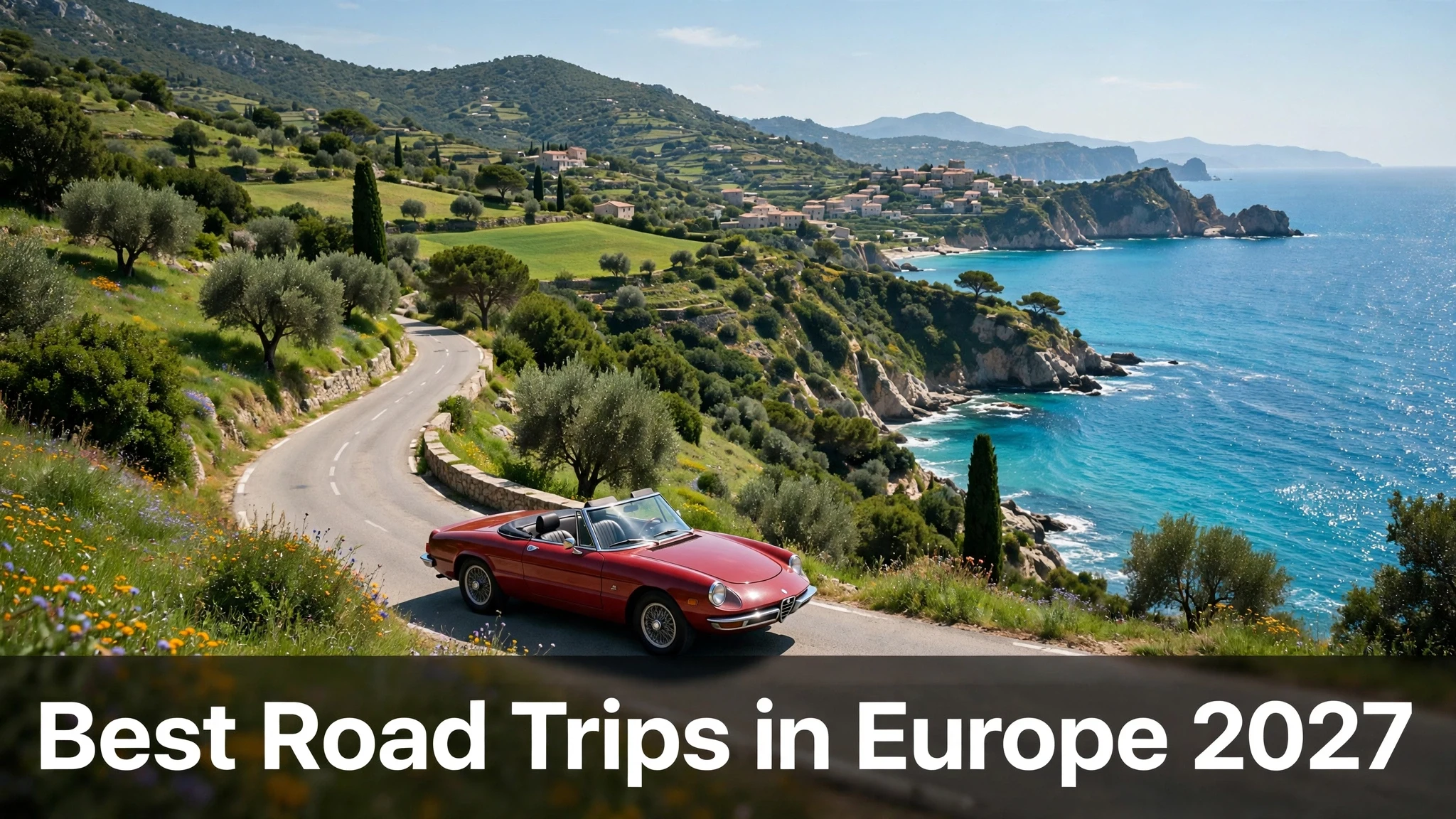
Best Road Trips in Europe for 2027
In this post
- The Amalfi Coast: Italy’s Most Beautiful Drive
- The North Coast 500: Scotland’s Wild Highland Loop
- The Romantic Road and Germany’s Fairytale Route
- Alpine Passes: The High Roads of France, Italy and Switzerland
- Portugal, Spain and the Atlantic Coast
- Planning, Costs and Driving Rules Across Europe
- The Best Road Trips by Season
- Renting a Car or Bringing Your Own
- My Take:
A road trip is the most free way to see Europe, because it lets you stop when you want, change your plan when you discover something wonderful, and reach the small villages, viewpoints, and beaches that trains and planes never touch. Europe is made for driving: the distances are short, the roads are good, the scenery changes every hour, and a week on the road can take you through several countries, languages, and landscapes.
Choosing a route is the hardest part, because every country has a famous drive, and the best route for you depends on what you love: the sea, the mountains, the wine, the history, or the food. This guide picks the best road trips in Europe for 2027, explains what makes each one special, and gives practical advice on planning, driving, and enjoying the journey without stress.
Driving in Europe has rules that vary by country, from tolls and vignettes to speed limits and low-emission zones, so check the requirements for each country on your route before you travel. With a little preparation, a European road trip is one of the most rewarding holidays you can take, and the road itself becomes the destination.
The Amalfi Coast: Italy’s Most Beautiful Drive
The Amalfi Coast, in southern Italy, is one of the most beautiful coastal drives in the world, with a narrow road that clings to cliffs above the Mediterranean, passing lemon groves, pastel villages, and views that stop traffic. The drive from Sorrento to Salerno, through Positano, Amalfi, and Ravello, is only about fifty kilometres, but it can take a whole day, because every bend offers a view worth stopping for. Positano, with its houses stacked down the cliff to the sea, is the most photographed village, while Ravello, high above the coast, offers gardens and views that feel like the top of the world.
Driving the Amalfi Coast needs care, because the road is narrow, the buses are large, and the traffic in summer is heavy. Drive early in the morning or late in the afternoon, be patient, and use the viewpoints and car parks rather than stopping on the road. Many visitors prefer to base themselves in Sorrento or Salerno and take a bus or a boat along the coast, driving only part of the route, which is a sensible compromise if you are nervous about the road.
The best time to drive the Amalfi Coast is late spring or early autumn, when the weather is warm, the light is beautiful, and the crowds are thinner than in summer. Stay in a small town, eat in local restaurants, swim in the sea, and take your time, because the Amalfi Coast is not a drive to rush; it is a place to linger.
The North Coast 500: Scotland’s Wild Highland Loop
The North Coast 500, known as the NC500, is a circular route around the Highlands of Scotland, starting and ending in Inverness, and it is one of the great road trips in the world. The route takes you through mountains, lochs, glens, and coastal villages, with castles, beaches, and whisky distilleries along the way, and the scenery changes from dramatic to peaceful and back again within an hour. The road is single-track in places, with passing places, and the driving is part of the adventure.
The NC500 is best done slowly, over five to seven days, with stops in villages such as Applecross, Ullapool, Durness, and John o’ Groats, and with time for walks, beaches, and castles. The weather in Scotland is changeable, so pack for rain and sun in the same day, and book accommodation in advance, because the small villages have limited rooms and the route is popular in summer. The road is free to drive, but the memories are priceless.
Driving in Scotland means driving on the left, and the single-track roads need patience and courtesy: use the passing places, let faster cars pass, and wave to thank other drivers. The NC500 is not a race; it is a journey through one of the wildest and most beautiful parts of Europe, and the slower you go, the more you will see.
The Romantic Road and Germany’s Fairytale Route
The Romantic Road, in southern Germany, is a route from Würzburg to Füssen, through medieval towns, castles, and countryside that looks like a fairytale. Rothenburg ob der Tauber, with its walls, towers, and Christmas shop, is the most famous stop, and Neuschwanstein Castle, at the end of the route, is the castle that inspired Disney’s castle. The road passes through vineyards, forests, and river valleys, and the towns along the way are beautiful and easy to explore on foot.
The Romantic Road is best done over three to five days, with a night in two or three towns, so you can walk the walls of Rothenburg, visit the castles, and eat in local restaurants without rushing. The road is well signed, the driving is easy, and the route is suitable for families and for drivers who prefer gentle roads to mountain passes. Book Neuschwanstein tickets in advance, because it is very popular and the queues are long.
Germany’s driving is straightforward, with good roads and clear signs, but check the rules for the autobahn, where some sections have no speed limit, and for environmental zones in cities, where you may need a sticker. The Romantic Road is a journey through history, and it is one of the most relaxing road trips in Europe.
Alpine Passes: The High Roads of France, Italy and Switzerland
The great Alpine passes are the most dramatic drives in Europe, with roads that climb to over 2,000 metres, through tunnels, hairpin bends, and views that stretch across the mountains. The Stelvio Pass in Italy, with its forty-eight hairpin bends, is the most famous, while the Grossglockner High Alpine Road in Austria offers views of the highest mountain in Austria and a glacier. The Col du Tourmalet in France and the Furka Pass in Switzerland are also legendary, and each one is a drive that stays with you.
Alpine passes are open only in summer, usually from June to October, because snow closes them in winter, so check opening dates before you travel. The driving is demanding, with steep climbs, narrow sections, and large drops, so take your time, use lower gears on descents, and stop at the viewpoints. The passes are popular with motorcyclists and cyclists, so share the road and be patient.
A road trip that links several passes, through France, Italy, Switzerland, and Austria, is one of the great journeys in Europe, and it can be done in a week, with nights in mountain villages. The scenery is extraordinary, the food is hearty, and the driving is a pleasure, but the weather in the mountains changes fast, so pack layers and check the forecast each morning.
Portugal, Spain and the Atlantic Coast
Portugal’s coast offers one of the most beautiful and affordable road trips in Europe, from Lisbon north to Porto, or south to the Algarve, with beaches, cliffs, fishing villages, and historic towns. The road from Lisbon to Porto passes through Óbidos, Nazaré, and Aveiro, while the Algarve offers golden cliffs, hidden beaches, and a relaxed, sunny atmosphere. Portugal’s roads are good, the driving is easy, and the food and wine are excellent and affordable.
Spain’s northern coast, from San Sebastián to Santiago de Compostela, is a greener, quieter Spain, with dramatic cliffs, fishing villages, and a famous pilgrimage route. The Picos de Europa mountains, inland from the coast, offer hiking and scenery that rivals the Alps, and the food in the Basque Country is among the best in the world. A road trip through northern Spain is a journey through a Spain that many visitors never see.
Driving in Portugal and Spain is straightforward, with toll motorways and good secondary roads, but check toll payment methods, because some tolls are electronic and need a device or online payment. The Atlantic coast is best in late spring and early autumn, when the weather is warm and the crowds are thinner, and a road trip here is a perfect combination of sea, food, and culture.
Planning, Costs and Driving Rules Across Europe
Planning a European road trip starts with the route and the time: a week is enough for one region, two weeks for a longer journey, and the best trips are those with time to stop, not just to drive. Plan your overnight stops in advance, especially in small villages and in summer, and leave some days flexible, so you can stay longer in a place you love or change your plan if the weather turns.
Costs vary by country: fuel, tolls, and accommodation are the main expenses, and some countries require a vignette, a sticker for motorway use, which you can buy at the border or online. France, Italy, Spain, and Portugal have toll motorways, while Austria, Switzerland, and Slovenia use vignettes, and the fines for driving without one are high. Check the requirements for each country on your route, and carry cash and a card, because tolls and fuel stations vary.
Driving rules also vary: speed limits, alcohol limits, and the need for headlights, warning triangles, and reflective jackets differ by country, and some cities have low-emission zones that restrict older cars. Check the rules for each country before you travel, carry your driving licence, insurance, and vehicle documents, and drive on the right in most of Europe, except in the UK and Ireland, where you drive on the left.
The Best Road Trips by Season
Spring is the best season for southern Europe, because the weather is warm, the flowers are out, and the crowds have not yet arrived. A road trip through Portugal, southern Spain, or the Amalfi Coast in April or May offers sunshine, green hills, and quiet roads, with accommodation that is cheaper and easier to book than in summer. The days are long enough for driving and sightseeing, and the light is soft and beautiful for photographs, which makes spring the favourite season of many experienced road trippers.
Summer is the season for the north and for the mountains, because the Alpine passes are open, the days are long, and Scotland, Norway, and the Alps are at their most accessible. A summer road trip through the Alps or around the North Coast 500 gives you long evenings, warm weather, and the chance to hike, swim, and eat outside, though you should book accommodation early, because summer is the busiest season and the most popular places sell out. Summer is also the season for festivals, markets, and long, lazy evenings in village squares.
Autumn is the most underrated season for a European road trip, because the crowds have gone, the prices have fallen, and the colours are extraordinary. A drive through the wine regions of France, Germany, or Italy in September or October offers harvest festivals, golden vineyards, and crisp, clear days, while a drive through Scotland in autumn offers red and gold hills and quiet roads. Winter is for the south, with mild weather in Portugal, southern Spain, and Sicily, and for the Christmas markets of Germany and Austria, which are a road trip of a different and wonderful kind.
Renting a Car or Bringing Your Own
Renting a car is the simplest option for most visitors, because it avoids the long drive to Europe and lets you pick up a car at the airport and return it at the end of the trip. Choose a car that fits your luggage and your passengers, not the largest or the cheapest, because a car that is too small will be uncomfortable and one that is too large will be hard to park in old towns. Book early for the best price, check what is included, and read the insurance carefully, because the cheapest rental can become expensive if you need to add insurance, a second driver, or a child seat.
Bringing your own car makes sense if you live close to Europe and want the comfort of your own vehicle, with your own belongings and no rental worries. Check that your insurance covers driving abroad, carry the required documents, and make sure your car is serviced before the trip, because a breakdown far from home is stressful and expensive. A car you know and trust is a pleasure on a long road trip, and it lets you pack more freely than a rental.
Whatever you choose, check the rules for driving in each country on your route, including tolls, vignettes, speed limits, and low-emission zones, and carry a warning triangle, a reflective jacket, and a first-aid kit, because these are required in many countries. A little preparation before you leave will save you time, money, and worry on the road, and it will let you enjoy the journey instead of worrying about it.
My Take:
My honest view is that a road trip is the most human way to travel in Europe, because it gives you freedom that no other form of travel offers. A train takes you from city to city, and a plane takes you over the landscape, but a car lets you stop in a village you have never heard of, eat in a restaurant with no tourists, and find a viewpoint that is not in any guidebook. Those unplanned moments are often the best memories of a trip, and they only happen when you are driving.
I also believe the Amalfi Coast is the most beautiful drive in Europe, but it is also the one that needs the most patience. The road is narrow, the traffic is heavy, and the views are so distracting that you will want to stop at every bend, and that is exactly what you should do. Drive early, drive slowly, and accept that the journey will take all day, because the Amalfi Coast is not a road to get somewhere; it is the destination itself, and rushing it would be a waste.
Another point I keep returning to is Scotland’s North Coast 500, because it shows a different kind of beauty from the Mediterranean: wild, empty, and dramatic, with mountains, lochs, and beaches that feel like the edge of the world. The single-track roads, the passing places, and the changeable weather are part of the experience, and the route rewards the driver who slows down and lets the landscape work on them. It is a road trip for people who love space and silence, and it is one of the great drives in the world.
I would also say that the Romantic Road is the best road trip for a first-time driver in Europe, because it is gentle, beautiful, and easy. The roads are good, the towns are charming, the castles are famous, and the driving is relaxed, which makes it perfect for families and for anyone who is nervous about driving abroad. It is a journey through history and fairytale, and it proves that a road trip does not need to be extreme to be wonderful.
My honest view is that the Alpine passes are the most thrilling drives in Europe, and they are worth the effort for anyone who loves driving. Climbing a pass on a clear summer morning, with hairpin bends, mountain views, and the air getting cooler as you rise, is an experience that stays with you, and the descent on the other side, through a different valley, feels like entering a new country. The passes are only open in summer, so plan carefully, check the dates, and drive them slowly, because the road is the adventure.
I also believe Portugal is the most underrated road trip country in Europe, because it offers sea, food, history, and sunshine at prices that are far lower than France or Italy. The coast from Lisbon to Porto, or the Algarve in the south, gives you beaches, cliffs, and villages that are as beautiful as anywhere in the Mediterranean, with fewer crowds and better value. Portugal is a country that rewards the driver who explores beyond Lisbon, and a road trip is the best way to do it.
Another point I keep returning to is planning, because a road trip without a plan can become stressful, while a road trip with a rigid plan can become a chore. The best approach is to book your overnight stops, know your route, and then leave the days flexible, so you can stay longer where you love it and skip what does not interest you. A road trip should feel free, but freedom works best with a little structure, and a loose plan is the best kind.
I would also say that driving rules matter, because Europe is not one country and the rules change at every border. Tolls, vignettes, speed limits, and low-emission zones are easy to check and expensive to ignore, and a fine or a missed toll can spoil a day. Check the rules for each country before you travel, carry your documents, and drive carefully, because a road trip is a pleasure when you are prepared and a problem when you are not.
My honest view is that the car itself matters less than the company and the attitude, because a road trip is about the people you travel with and the way you travel. A small car, a good playlist, snacks, and a willingness to stop will take you further than a large car and a rigid schedule. Talk, laugh, stop often, and let the road set the pace, because the best road trips are the ones where the journey is the holiday, not just the way to get there.
Finally, I believe a European road trip is a reminder that the continent is small enough to explore and large enough to surprise you, and that is a rare combination. In a week you can cross several countries, hear several languages, eat different food, and see landscapes that change completely, all from the same car. That variety is Europe’s gift, and a road trip is the best way to receive it, one road, one village, and one view at a time.
My honest view is that autumn is the most underrated season for a European road trip, and I say that because the travellers who only go in summer miss the best of it. In autumn the crowds have gone, the prices have fallen, the light is golden, and the vineyards and forests turn colours that summer never shows, and the roads are quiet enough to enjoy driving again. A drive through France or Italy in October, with harvest festivals, warm days, and cool evenings, is a different and better experience than the same drive in August, when the roads are crowded and the heat is relentless. If you can choose your season, choose autumn, and let the road belong to you.
Another point I keep returning to is the people you meet on the road, because a road trip is not only about places; it is about the conversations in a village café, the advice from a hotel owner about a hidden beach, and the fellow traveller who tells you about a viewpoint you would never have found alone. Those encounters are unplanned and unplannable, and they are often the moments you remember most, because they turn a drive through a landscape into a journey through people’s lives. A road trip that leaves room for strangers, for detours, and for conversations is a richer trip than one that follows a rigid schedule, and the people are as much a part of the journey as the road itself.
Frequently Asked Questions
What is the best road trip in Europe for first-timers?
The Romantic Road in Germany is a good first road trip, with easy driving, beautiful towns, and famous castles. The Amalfi Coast is more beautiful but harder to drive, while the North Coast 500 in Scotland is wilder and needs more time.
Do I need a vignette to drive in Europe?
Some countries, including Austria, Switzerland, and Slovenia, require a vignette for motorway use, which you can buy at the border or online. France, Italy, Spain and Portugal use tolls instead, so check the requirements for each country on your route before you travel.
When is the best time for a road trip in Europe?
Late spring and early autumn are the best times, with pleasant weather, fewer crowds, and lower prices. Summer is busy and hot, especially on coastal routes, while Alpine passes are open only from about June to October.
Can I drive in Europe with my licence?
Most visitors can drive in Europe with their home licence, though some countries require an international driving permit as well. Check the rules for each country you will drive in, and carry your licence, insurance, and vehicle documents at all times.
How long does the North Coast 500 take?
The North Coast 500 is about 500 miles around the Scottish Highlands, and most people take five to seven days to drive it slowly, with stops for walks, beaches, and villages. It can be driven faster, but the pleasure is in taking your time.
Is it expensive to drive the Amalfi Coast?
Driving the Amalfi Coast is not expensive in itself, but accommodation, parking, and food in Positano and Amalfi are costly in summer. Travelling in late spring or autumn, staying in Sorrento or Salerno, and using buses or boats for part of the route can reduce the cost.