Best Things to Do in London in 2027
In this post
- The Icons You Should See First
- Free Museums That Rival Any in the World
- Markets, Food and London’s Neighbourhoods
- Parks, the River and the Best Views
- West End Theatre and an Evening in London
- Hidden Gems Most Tourists Miss
- Planning Your Days and Saving Money
- A Three-Day Plan for a First Visit to London
- Day Trips From London: Castles, Coast and Countryside in Under Two Hours
- My Take:
London is one of those cities that can overwhelm a first-time visitor, not because it is difficult, but because it offers too much: two thousand years of history, world-famous museums that cost nothing to enter, royal palaces, markets, parks, theatres, and neighbourhoods that each feel like a different city. A visitor with three days cannot see it all, and a visitor with a week still cannot, so the real skill is choosing well.
This guide picks the best things to do in London in 2027 for a first-time visitor, balanced between the iconic sights you have seen in photographs and the experiences that make London feel alive. You will find the famous landmarks, the free museums, the markets and parks, and the quieter corners that many tourists miss, along with practical advice on how to plan your days so you see more and queue less.
London is expensive, but many of its best attractions are free, and a well-planned day can cost very little beyond transport and food. Check opening times and ticket prices on official websites before you travel, because times change, popular attractions need booking in advance, and the city rewards those who plan ahead.
The Icons You Should See First
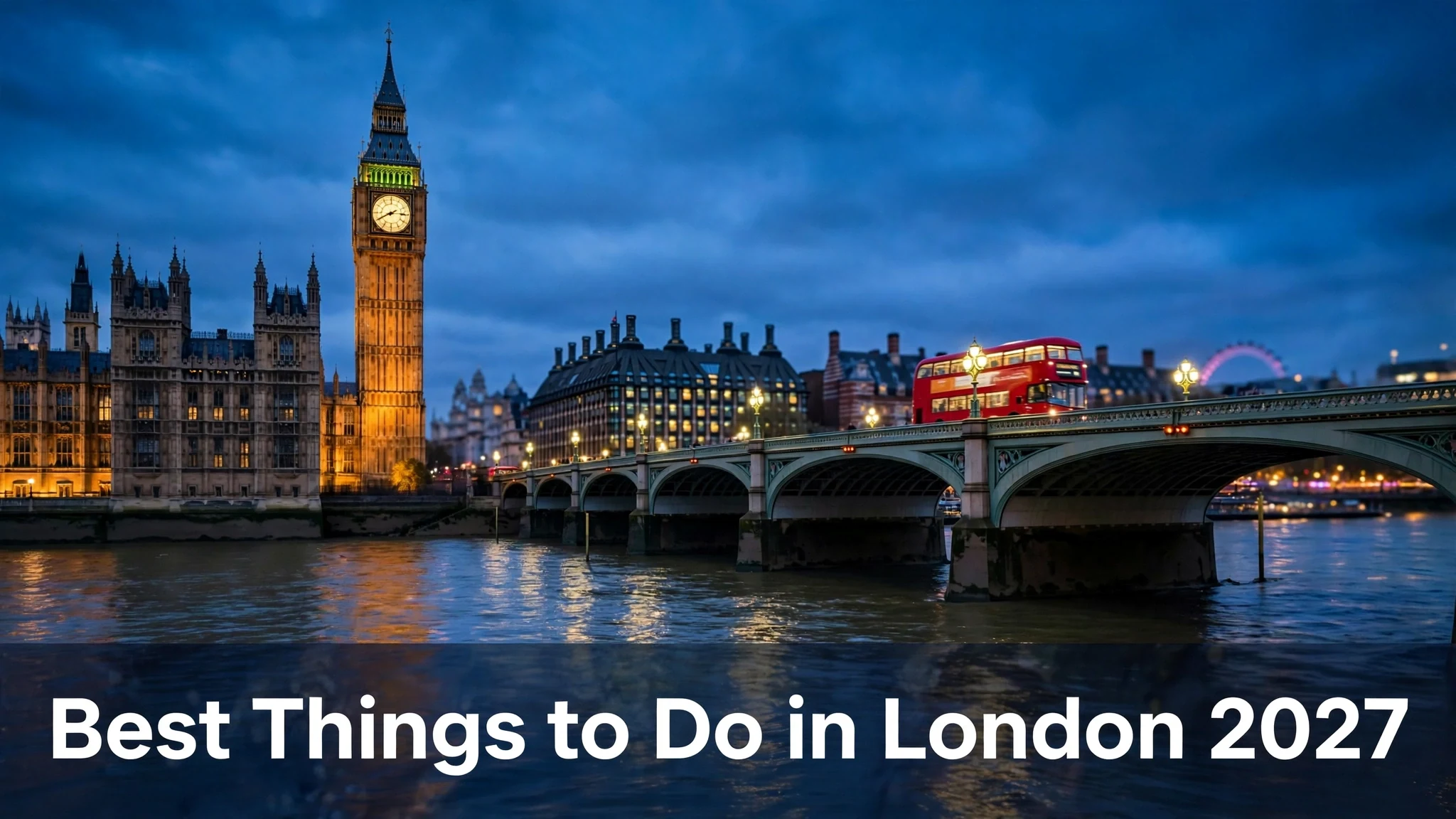
Big Ben and the Houses of Parliament are the image of London, and the best way to see them is on foot along the River Thames, where the view opens up across the water. Walk across Westminster Bridge in the morning, when the light is good and the crowds are thinner, and take time to look at the detail of the building rather than rushing past for a photograph. The London Eye, just across the river, offers a slow, high view over the city, and it is worth booking a timed ticket in advance to avoid the longest queues.
The Tower of London is one of the most rewarding sights in the city, because it is a castle, a prison, a royal palace, and the home of the Crown Jewels all in one place. The Yeoman Warders, known as Beefeaters, give tours that bring nine hundred years of history to life, and the Crown Jewels themselves are extraordinary. Give the Tower at least half a day, arrive early, and see the Jewels first, before the queues build.
Buckingham Palace is the working home of the monarch, and the Changing of the Guard is a free ceremony that draws crowds every morning in summer. The palace itself opens to visitors for a limited period in summer, when the State Rooms can be toured, and the surrounding area, including St James’s Park and The Mall, is one of the most pleasant walks in London. Check the official calendar for guard times and palace opening dates before you plan your day.
Free Museums That Rival Any in the World
London’s national museums are free to enter, which is one of the great gifts of the city, and the British Museum is the most famous of them. Its collection spans the world, from the Rosetta Stone to Egyptian mummies and the Parthenon sculptures, and it is so large that you should choose a few galleries rather than trying to see everything. Arrive early, pick a theme, and give yourself two hours rather than a rushed tour of the whole building.
The Natural History Museum and the Victoria and Albert Museum sit beside each other in South Kensington, and both are free. The Natural History Museum, with its great hall, dinosaurs, and blue whale skeleton, is wonderful for families, while the V&A holds one of the world’s great collections of art, design, and fashion, and its building itself is beautiful. The National Gallery in Trafalgar Square is free too, with paintings by Van Gogh, Turner, and Leonardo da Vinci, and it is a perfect stop between other sights.
Smaller free museums are often the most memorable: the Museum of London tells the story of the city itself, the Tate Modern offers modern art in a vast former power station on the Thames, and the National Portrait Gallery holds faces from British history. Free entry means you can visit for an hour, leave, and return another day, which is the best way to enjoy a museum without exhaustion.
Markets, Food and London’s Neighbourhoods
London’s markets are where the city feels most alive, and each one has a different character. Borough Market, near London Bridge, is the most famous food market, with stalls selling bread, cheese, street food, and produce from around Britain and the world. Go hungry, go early, and try small portions from several stalls rather than one large meal, because the pleasure is in the variety.
Camden Market is loud, colourful, and young, with stalls selling clothes, crafts, and street food from every continent, while Portobello Road Market in Notting Hill is famous for antiques and has a wonderful Saturday atmosphere. Columbia Road Flower Market, on Sunday mornings, is a joyful, crowded street of flowers and plants, and Greenwich Market offers crafts and food in a historic riverside setting. Each market is a different London, and visiting two or three gives you a better sense of the city than any single attraction.
Beyond the markets, London’s neighbourhoods are worth exploring on foot: Soho for restaurants and theatres, Shoreditch for street art and cafés, Notting Hill for colourful streets, and Greenwich for the park, the observatory, and the Cutty Sark. Walk slowly, look up at the buildings, and stop in a café, because London rewards the visitor who wanders as much as the one who follows a list.
Parks, the River and the Best Views
London’s parks are among the finest in the world, and they are free, green, and central to the city’s life. Hyde Park and Kensington Gardens form a vast green space in the centre, with the Serpentine lake, Speaker’s Corner, and Kensington Palace, while Regent’s Park has beautiful gardens and a boating lake. St James’s Park, beside Buckingham Palace, is smaller and more formal, with views of the palace and the London Eye, and it is one of the most beautiful walks in the city.
The River Thames is the spine of London, and a walk along the South Bank, from Westminster Bridge to Tower Bridge, is one of the best free experiences in the city. You will pass the London Eye, the Tate Modern, Shakespeare’s Globe, and Borough Market, with street performers, food stalls, and views of the river all along the way. A river boat is a pleasant way to see the city from the water, and the public river bus is cheaper than a tourist cruise.
For views, the Sky Garden is a free public garden at the top of a skyscraper, with panoramic views over the city, though you need to book a free ticket in advance. Primrose Hill offers a classic, free view over the skyline, and Greenwich Park, from the Royal Observatory, gives you a view across the river to the City. London looks different from above, and a viewpoint is worth including in any visit.
West End Theatre and an Evening in London
The West End is London’s theatre district, and it offers some of the best theatre in the world, from long-running musicals to new plays. Shows such as the great musicals that have run for decades sit alongside new productions, and the quality of performance is consistently high. Book tickets in advance for the most popular shows, but check for same-day tickets and discounts, because good seats are sometimes available at lower prices on the day.
If a full-price ticket is beyond your budget, look for matinee performances, which are often cheaper, or for plays in smaller theatres, which can be excellent and far less expensive. London also has a rich world of music, from classical concerts to live gigs in pubs, and an evening walk through Soho or Covent Garden, with its street performers and restaurants, is a pleasure in itself.
Covent Garden is one of the best places to spend an evening, with its market, shops, restaurants, and street performers, while the South Bank comes alive at night with lights, food, and music. London after dark is a different city from London by day, and an evening out is an essential part of any visit, even if it is only a walk and a meal.
Hidden Gems Most Tourists Miss
Beyond the famous sights, London has quiet corners that reward the curious visitor. Leadenhall Market, a beautiful Victorian covered market in the City, feels like a film set and is far less crowded than the main attractions. The canal towpath from Little Venice to Camden offers a peaceful walk through the city, past houseboats and gardens, and it feels a world away from the traffic.
Highgate Cemetery, with its overgrown paths and Victorian monuments, is a hauntingly beautiful place, and the nearby village of Highgate feels like a country town inside London. The Wallace Collection, a free museum in a historic house, holds an extraordinary collection of art and armour in a beautiful setting, and it is rarely crowded. These places are not on every list, which is exactly why they are worth visiting.
Bookshops, too, are part of London’s hidden life: the bookshops of Charing Cross Road, the second-hand stalls of the South Bank, and the famous Daunt’s Books in Marylebone, with its beautiful galleried interior, are worth a visit even if you buy nothing. London is a city of readers, and its bookshops are as much a part of its character as its museums.
Planning Your Days and Saving Money
London is large, so plan your days by area rather than by attraction, and group nearby sights together. A day in Westminster, a day in South Kensington and the museums, and a day in the City and the Tower will cover far more than a day spent crossing the city between distant sights. Use the Tube and buses, but walk when you can, because the centre is more compact than it looks and walking shows you the city between the sights.
Transport is the main daily cost, so use a contactless card or a travel pass, which caps your daily spending, and avoid buying single paper tickets, which are far more expensive. The daily cap means you can travel as much as you like once you reach it, and walking and buses are often more pleasant than the crowded Tube at rush hour. Check the Transport for London website for current fares and caps before you travel.
Many attractions need booking in advance, especially the Tower of London, the London Eye, and the Sky Garden, so book timed tickets online before you arrive. Free museums do not need tickets, but they can be busy at weekends, so visit them early on a weekday if you can. A little planning saves hours of queuing and leaves you more time to enjoy the city itself.
A Three-Day Plan for a First Visit to London
On your first day, stay in Westminster and the West End: walk across Westminster Bridge to see Big Ben and the Houses of Parliament, stroll through St James’s Park to Buckingham Palace, and spend the afternoon in Trafalgar Square and the National Gallery, which is free and full of masterpieces. End the day in Covent Garden, with its market, street performers, and restaurants, and you will have seen the London everyone recognises, all on foot, with only the cost of food and transport.
On your second day, cross the river and walk the South Bank from Westminster Bridge to Tower Bridge, passing the London Eye, the Tate Modern, and Borough Market, where you should stop for lunch from the food stalls. Visit the Tower of London in the afternoon, arriving early if you can, and see the Crown Jewels before the queues build, then walk across Tower Bridge as the light fades. This day shows you the river, the markets, and the history, and it is one of the best walks in any city in the world.
On your third day, choose your own London: spend the morning in the British Museum, picking two or three galleries rather than trying to see everything, then explore a neighbourhood in the afternoon, such as Notting Hill, Camden, or Greenwich, and end the day with a West End show if you have booked one. A third day that follows your own interests, rather than a list, is the day you will remember most, because it is the day London becomes yours rather than a place you visited.
Day Trips From London: Castles, Coast and Countryside in Under Two Hours
London is a good base for leaving London, because some of England’s best sights are a short train ride away and make an easy day trip. Windsor, with its castle and riverside streets, is under an hour from Paddington, while Brighton offers a pebbled beach, a pier, and lanes full of independent shops in about the same time from Victoria. Oxford and Cambridge, both reached in around an hour, give a completely different picture of England: colleges, chapels, punting on the river, and quiet streets that feel a world away from the capital. Canterbury, with its cathedral, and the white cliffs near Dover are also possible in a day. The practical trick is to take an early train, buy tickets in advance where they are cheaper, and plan one town properly rather than trying to see two. A day trip like this breaks up a city stay and shows a visitor the England beyond London.
My Take:
My honest view is that London is best enjoyed slowly and by neighbourhood, not by racing between famous sights with a checklist. The visitors who try to see everything in two days come home exhausted and remember very little, while the visitors who spend a morning in one area, walk, eat, and look around, come home with real memories. London is a city that rewards attention, and the best thing you can do is give it some.
I also believe the free museums are London’s greatest gift to visitors, and they change what a trip can be. In most great cities, the museums are the most expensive part of the visit, but in London you can walk into the British Museum, the National Gallery, and the V&A for nothing, and spend as long as you like. That freedom means you can visit for an hour, leave when you are tired, and return another day, which is how museums should be enjoyed. I would plan a London trip around the free museums and treat the paid attractions as extras, not the other way around.
Another point I keep returning to is the river, because the Thames is the thread that ties London together and the South Bank walk is the best free experience in the city. From Westminster to Tower Bridge, you pass the Eye, the Tate Modern, the Globe, and Borough Market, with the river beside you and the city opening up at every turn. It is a walk that shows you London’s history, its present, and its daily life all at once, and it costs nothing. I would put it at the top of any first visit.
I would also say that the Tower of London deserves its reputation, because it is not a single attraction but a thousand years of history in one place. The Crown Jewels, the Beefeaters, the walls, and the stories of prisoners and kings make it the most rewarding paid sight in the city, and it is worth half a day rather than a rushed hour. Arrive early, see the Jewels first, and let the place tell its story slowly, because the Tower rewards patience in a way that few attractions do.
My honest view is that London’s markets are where the city feels most alive, and they are a better introduction to London than any single landmark. Borough Market, Camden, Portobello Road, and Columbia Road each show a different London, and the food, the colours, and the crowds tell you more about the city than a guidebook can. Go hungry, try small portions, talk to the stallholders, and let the market set the pace of your morning, because a market morning is a London morning at its best.
I also believe the West End is worth the money, but only if you choose well and book smartly. A great musical in a beautiful theatre is an experience that stays with you, and London’s theatre is among the best in the world. But a bad seat at a high price for a show you did not really want is a waste, so check reviews, consider a matinee, and look for discounts before you pay full price. The theatre should be a highlight, not a regret.
Another point I keep returning to is the parks, because London without its parks would be a different and lesser city. Hyde Park, Regent’s Park, Greenwich Park, and St James’s Park are not just green spaces; they are where Londoners live their lives, walk their dogs, run, picnic, and rest. A visitor who spends an afternoon in a park, watching the city go by, has understood London better than one who spent the same hours in a queue. The parks are free, beautiful, and essential.
I would also say that London’s hidden corners matter, because the famous sights are crowded and the quiet places are where you find the city for yourself. Leadenhall Market, the canal to Camden, the Wallace Collection, and the bookshops of Charing Cross Road are not on every list, and that is their charm. Seek out one or two hidden places on each trip, because the memory of a quiet, beautiful corner you found yourself will last longer than the photograph of a crowded landmark.
My honest view is that transport planning makes or breaks a London trip, because the city is large and the costs add up quickly. A contactless card with a daily cap, a plan that groups sights by area, and a willingness to walk will save you money and time, while single tickets and random journeys across the city will waste both. London is more walkable than it looks, and the walk between two sights is often as enjoyable as the sights themselves.
Finally, I believe London is a city to return to, not a city to finish, and the best first visit is one that leaves you wanting more. Do not try to see everything; see the icons, enjoy the free museums, walk the river, visit a market, spend an afternoon in a park, and see a show if you can. Leave the rest for next time, because London will still be there, and the city you return to will feel familiar in the best possible way.
My honest view is that London is a city you should visit twice in one trip: once for the famous sights, and once for yourself, because the second visit is the one that makes the city yours. The first day gives you Big Ben, the Tower, and the river, and those sights matter, but the third day, when you choose a neighbourhood, a market, or a museum that interests you personally, is the day you stop being a tourist and start being a traveller. I would plan every first visit with that third day kept free, with no fixed list, so you can follow what you loved most in the first two days, whether that is a museum, a park, or a street you want to walk again. A trip that ends with a day of your own choosing is a trip that feels complete, and it is the reason you will want to return, because London always leaves something undiscovered, and that undiscovered part is the invitation to come back.
I would also say that London in the rain deserves its own defence, because visitors who arrive to grey skies often feel cheated, and they should not. Rain is part of the city’s character, and some of London is at its best in it: the Thames looks moodier, the parks smell of wet earth, and the museums, markets, and pubs are all indoors anyway. A good rain plan is simple, a waterproof jacket rather than an umbrella that fights the wind, a list of indoor places to duck into, and a willingness to walk between showers instead of waiting for a clear day that may not come. I have had some of my best London days in the rain, when the crowds thin out and the city feels like it belongs to the people who stayed. Do not let the weather decide your trip; let it change the trip, and enjoy the version of London that only appears when it rains.
Frequently Asked Questions
How many days do I need in London?
Three to four days is enough for the main sights, including the Tower, the British Museum, and a walk along the Thames. Five to seven days lets you explore neighbourhoods, markets, and day trips such as Greenwich or Windsor without rushing.
What is free to do in London?
The British Museum, National Gallery, Victoria and Albert Museum, Natural History Museum, Tate Modern, and many parks and markets are free. Walking along the South Bank, visiting the Sky Garden with a free booked ticket, and watching the Changing of the Guard are also free.
What is the best area to stay in London?
Central areas such as Westminster, South Kensington, Covent Garden and Bloomsbury are convenient for first-time visitors, with good transport and walkable sights. Staying near a Tube station matters more than the exact neighbourhood, and areas just outside the centre are often cheaper.
Do I need to book London attractions in advance?
Yes, book timed tickets in advance for the Tower of London, the London Eye, the Sky Garden, and popular West End shows, because they sell out and queues are long. Free museums do not need tickets, but visiting early on a weekday avoids the biggest crowds.
What is the cheapest way to get around London?
A contactless bank card or a travel pass is the cheapest way to travel, because daily caps limit what you pay. Single paper tickets are far more expensive, and walking is free and often the most pleasant way to travel in central London.
Is London safe for tourists?
London is generally safe for tourists, especially in central areas and during the day. Keep your belongings secure on the Tube and in crowded places, be careful at night in unfamiliar areas, and use licensed taxis or ride-hailing apps after dark.