Best Train Journeys in Europe in 2027
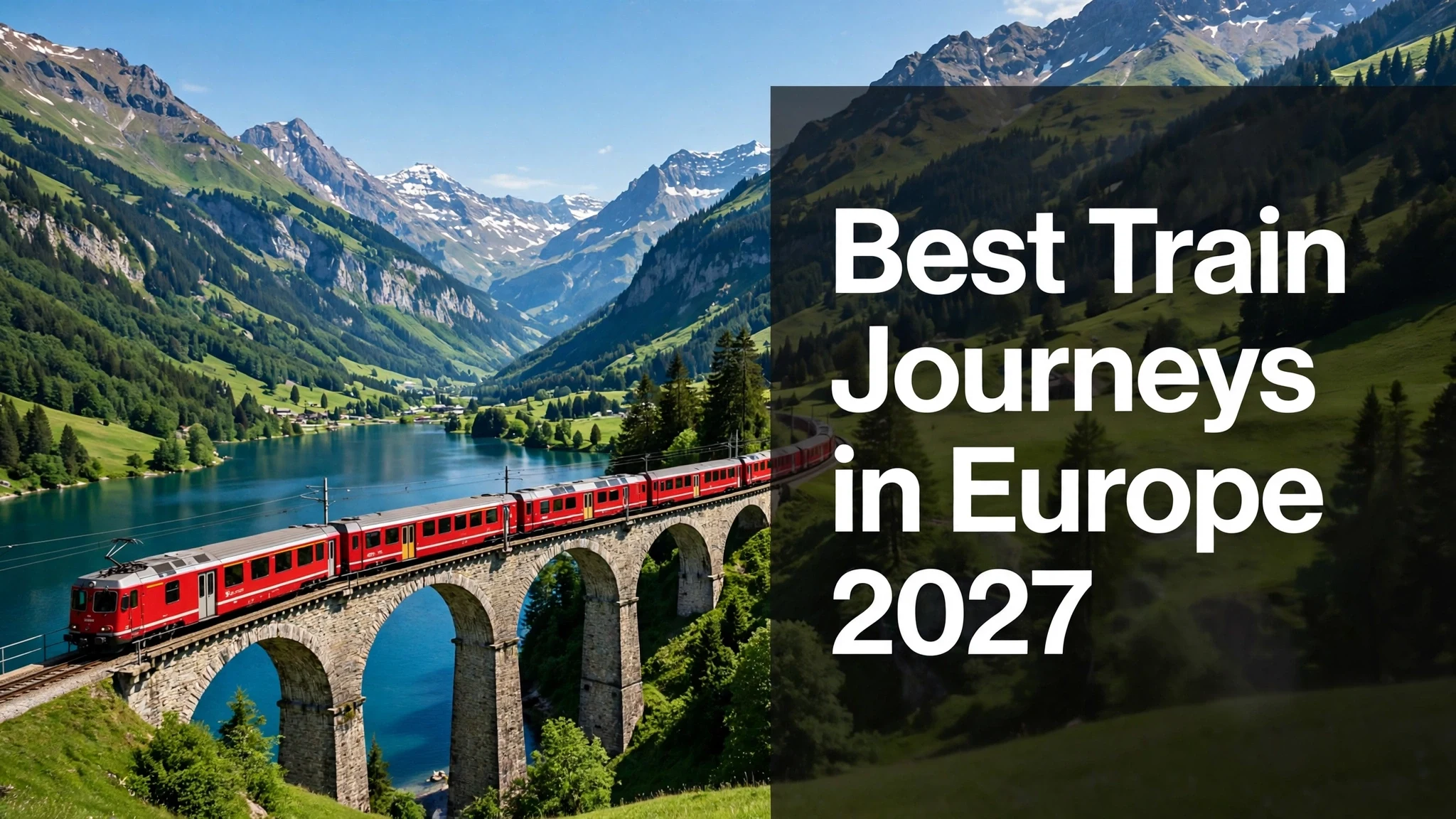
In this post
- Why Travel Europe by Train in 2027
- The Alps: Glacier Express and Bernina Express
- Night Trains: Sleep While You Travel
- Coastal and Island Trains in Europe
- The Arctic and the North: Trains to the Top of Europe
- High-Speed Trains: Fast, But Still Scenic
- How to Plan and Book a European Train Trip in 2027
- My Take:
A train journey in Europe is not just a way to get from one place to another. It is a way to see the continent slowly, through a window, as mountains, lakes, coasts, and villages pass by. A plane gets you there faster, but a train lets you see the journey itself, and the journey is often the best part. In 2027, Europe’s trains are better than ever, with new night trains, faster high-speed lines, and scenic routes that have been famous for a hundred years.
This guide looks at the best train journeys in Europe in 2027, from the Alps to the Arctic, from coastal lines to night trains. It explains each route, when to go, what to see, and how to book, so you can plan a trip that is about the train as much as the destination.
Why Travel Europe by Train in 2027
Trains are comfortable, scenic, and better for the environment than flying, and they let you see Europe at a human pace.
In practice, A train lets you see the landscape, not just the airport and the hotel. You pass through villages, valleys, and mountains, and you see a country as it really is. That slow view is a different kind of travel, and it is one that many travellers prefer. So the train is not just transport; it is sightseeing, and the window is your guide. The slow Alpine line is the train traveller’s quiet reward, and once I understood that, eight hours through the mountains stopped looking like a waste of time and started looking like the point of the journey.
Look closer and Trains are also comfortable: you can walk around, eat in a dining car, and stretch your legs. That comfort matters on a long journey, and it is a contrast to a cramped plane seat. A train journey can be relaxing, not tiring, which is a good start to a holiday. So the train is a comfortable way to travel, and it is a good choice for travellers who want to arrive rested. A European train trip is not one journey; the Alps, the night trains, and the coast work together, and the way the Glacier Express crosses 291 bridges proves a slow train can be the best way to see a continent.
The key point is that Trains are better for the environment than flying, because they produce less carbon per passenger. That matters to many travellers in 2027, who want to travel responsibly. Choosing a train is a practical way to reduce your travel footprint, without giving up the trip. So the train is a greener choice, and it is one that fits a growing concern about climate change. Up close, travelling by train looks less like getting somewhere and more like seeing the distance, meeting people, and feeling the land change outside the window.
The Alps: Glacier Express and Bernina Express
The Swiss Alps have two of the most famous scenic trains in the world, and both are worth the trip.
What makes this work is that The Glacier Express runs from Zermatt to St Moritz, through the Swiss Alps, in about eight hours. It crosses 291 bridges and goes through 91 tunnels, with panoramic windows that let you see the mountains. The journey is slow, by design, so you can enjoy the view. So the Glacier Express is a day of scenery, not a fast trip, and it is best taken slowly, with a camera and a good lunch. People fly over Europe and miss the point, yet the panoramic windows, the night train, and the coastal line are what actually let you see the place you are crossing.
Step back for a moment and The Bernina Express runs from Chur in Switzerland to Tirano in Italy, crossing the Alps and the Bernina Pass. It is a UNESCO World Heritage route, and it passes glaciers, lakes, and the famous Landwasser Viaduct. The train climbs to over 2,200 metres, then descends to Italy, which is a dramatic change in landscape. So the Bernina Express is a journey through two countries and many landscapes, in a single day. One rail pass packs mountains, coasts, and Arctic forests into a single ticket, and the traveller spends their time so carefully that sleeping on a night train saves both a hotel night and a day.
The surprising part is that Both trains need reservations, and they are popular, so book early, especially in summer. A seat on the right side of the train can give you a better view on some sections. That planning is worth it, because a good seat makes a good journey better. So the Alps trains reward planning, and a little preparation can improve the view. Link the Alps to the night train to the coast, and the separate journeys join into one story about travelling slowly and well across Europe.
Night Trains: Sleep While You Travel
Night trains let you travel while you sleep, saving a hotel night and waking up in a new city.
In practice, The Nightjet, run by Austrian Railways, connects Vienna, Munich, Paris, Rome, and other cities, with sleeper cars and couchettes. You board in the evening, sleep in a cabin, and wake up in a new city in the morning. That is an efficient way to travel, and it saves time and hotel costs. So the night train is a hotel on wheels, and it is a smart way to travel long distances in Europe. The slow Alpine line is the train traveller’s quiet reward, and once I understood that, eight hours through the mountains stopped looking like a waste of time and started looking like the point of the journey.
Look closer and Other night trains run in Sweden, Norway, and the UK, including the Caledonian Sleeper from London to Scotland. That train takes you from London to the Highlands overnight, with a cabin and a view of the Scottish landscape in the morning. It is a romantic way to travel, and it is popular with travellers who want a unique experience. So night trains are not just practical; they are also a special experience, and they are worth trying once. A European train trip is not one journey; the Alps, the night trains, and the coast work together, and the way the Glacier Express crosses 291 bridges proves a slow train can be the best way to see a continent.
The key point is that Book a sleeper cabin if you can, for privacy and comfort, or a couchette if you want a cheaper option. A sleeper cabin has a bed, a washbasin, and privacy, while a couchette is a shared cabin with bunks. That choice depends on your budget and your need for privacy. So the night train has options for different budgets, and the sleeper is the most comfortable, while the couchette is the most social. Up close, travelling by train looks less like getting somewhere and more like seeing the distance, meeting people, and feeling the land change outside the window.
Coastal and Island Trains in Europe
Some of Europe’s best train journeys follow the coast, with views of the sea that are hard to forget.
What makes this work is that The train from Nice to Ventimiglia, along the French and Italian Riviera, follows the coast with views of the Mediterranean. It is a short journey, but it is beautiful, with blue sea on one side and colourful towns on the other. It is also cheap and easy, and it can be combined with a visit to Nice or to the Italian coast. So the Riviera train is a short, beautiful journey, and it is a good example of how a train can be a highlight, not just a transfer. People fly over Europe and miss the point, yet the panoramic windows, the night train, and the coastal line are what actually let you see the place you are crossing.
Step back for a moment and The train to the Isle of Skye, via the West Highland Line in Scotland, is one of the most scenic in the UK. It crosses the Glenfinnan Viaduct, made famous by films, and it passes lochs, mountains, and moors. The journey ends at Mallaig, where you can take a ferry to Skye. So the West Highland Line is a journey to an island, and it is a trip that feels like an adventure, even though it is just a train. One rail pass packs mountains, coasts, and Arctic forests into a single ticket, and the traveller spends their time so carefully that sleeping on a night train saves both a hotel night and a day.
The surprising part is that The train along the Douro Valley in Portugal follows the river through vineyards and hills. It is a slow, scenic journey, with views of terraced vineyards and the river below. It is best in autumn, when the vineyards change colour. So the Douro train is a wine-country journey, and it is a good choice for travellers who love food, wine, and scenery. Link the Alps to the night train to the coast, and the separate journeys join into one story about travelling slowly and well across Europe.
The Arctic and the North: Trains to the Top of Europe
Northern Europe has trains that go to the Arctic, with views of snow, forests, and the midnight sun.
In practice, The train from Stockholm to Narvik, in Norway, crosses the Arctic Circle and passes through Lapland. It is a long journey, with forests, lakes, and mountains, and it ends in Narvik, a port on the Norwegian coast. In summer, you can see the midnight sun, while in winter, you can see the Northern Lights. So the Arctic train is a journey to the top of Europe, and it is a trip that feels remote and special. The slow Alpine line is the train traveller’s quiet reward, and once I understood that, eight hours through the mountains stopped looking like a waste of time and started looking like the point of the journey.
Look closer and The Bergen Railway in Norway, from Oslo to Bergen, is one of the most scenic in Europe. It crosses the Hardangervidda plateau, the highest mountain plateau in Northern Europe. In winter, it is a snow-covered wonderland, while in summer, it is green and full of lakes. So the Bergen Railway is a classic, and it is a good choice for a first scenic train journey in Norway. A European train trip is not one journey; the Alps, the night trains, and the coast work together, and the way the Glacier Express crosses 291 bridges proves a slow train can be the best way to see a continent.
The key point is that The train in Finland, from Helsinki to Lapland, takes you to Rovaniemi, the home of Santa Claus, and beyond to the Arctic. It is a comfortable overnight train, with sleeper cabins and a restaurant car. That journey is a good way to reach Lapland, especially in winter, when the snow is deep. So the Finnish train is a practical way to reach the Arctic, and it is also a scenic journey in its own right. Up close, travelling by train looks less like getting somewhere and more like seeing the distance, meeting people, and feeling the land change outside the window.
High-Speed Trains: Fast, But Still Scenic
High-speed trains are fast, but they can also be scenic, especially on routes through mountains and countryside.
What makes this work is that The TGV in France, the ICE in Germany, and the AVE in Spain are fast, comfortable, and frequent. They connect major cities in hours, and they are a good alternative to flying. A TGV from Paris to the south of France takes about three hours, with views of the countryside. So high-speed trains are a practical choice, and they are also a pleasant way to travel, with space and comfort. People fly over Europe and miss the point, yet the panoramic windows, the night train, and the coastal line are what actually let you see the place you are crossing.
Step back for a moment and The train from Paris to Barcelona, via high-speed lines, takes about six hours and passes through southern France. It is a good way to travel between two great cities, without the hassle of an airport. That journey is a reminder that high-speed does not mean boring, and the view from a fast train can still be beautiful. So the high-speed train is a modern way to travel, and it is a good option for city-to-city trips. One rail pass packs mountains, coasts, and Arctic forests into a single ticket, and the traveller spends their time so carefully that sleeping on a night train saves both a hotel night and a day.
The surprising part is that Book high-speed trains early, because prices rise as the departure gets closer. A ticket bought months in advance can be much cheaper than one bought on the day. That early booking is the key to affordable high-speed travel. So the high-speed train rewards early planners, and a little foresight can save a lot of money. Link the Alps to the night train to the coast, and the separate journeys join into one story about travelling slowly and well across Europe.
How to Plan and Book a European Train Trip in 2027
Planning a train trip is different from planning a flight, and it needs a different approach.
In practice, Use a rail pass if you plan to take many trains, such as an Interrail or Eurail pass. A pass can save money if you travel a lot, but it may not be worth it for a single journey. Compare the cost of a pass to the cost of individual tickets, before you buy. So a rail pass is a tool, not a must, and it should be chosen based on your itinerary. The slow Alpine line is the train traveller’s quiet reward, and once I understood that, eight hours through the mountains stopped looking like a waste of time and started looking like the point of the journey.
Look closer and Book scenic trains early, because they need reservations and they sell out. The Glacier Express and Bernina Express are popular, and their panoramic cars fill up in summer. Book as soon as you know your dates, to get the seat you want. So early booking is essential for scenic trains, and it is the difference between a good seat and no seat. A European train trip is not one journey; the Alps, the night trains, and the coast work together, and the way the Glacier Express crosses 291 bridges proves a slow train can be the best way to see a continent.
The key point is that Leave time between trains, especially if you have a connection, because delays happen. A tight connection can be stressful, while a longer connection gives you time to relax and to see the station city. That buffer is a kindness to yourself, and it makes the trip more enjoyable. So planning a train trip is about leaving space, not about filling every hour, and that space is where the journey happens. Up close, travelling by train looks less like getting somewhere and more like seeing the distance, meeting people, and feeling the land change outside the window.
My Take:
I love trains, and I have loved them since I was a child. A train is not just a way to get somewhere. It is a way to see a place, to meet people, and to feel the distance between two cities, not just the time it takes to fly over it. This guide is my attempt to share that love, by looking at the best train journeys in Europe, from the Alps to the Arctic, from night trains to coastal lines. If it helps one person choose a train instead of a plane, then it has done its job.
I think the Glacier Express is the journey I would choose first. Eight hours through the Alps, with panoramic windows and 291 bridges, sounds like a day well spent. It is slow by design, and that slowness is its point: it is a journey to enjoy, not a journey to rush. The Glacier Express is the journey I keep coming back to, because eight hours through the Alps, with panoramic windows and 291 bridges, sounds like a day well spent. Trains are no longer just transport for me; they are a way to see a place, to meet people, and to feel the distance, and I think about that whenever I plan a journey.
The night train idea is the one I find most practical. Sleeping while you travel saves a hotel night and a day of travel, which is efficient and clever. It is also a romantic idea, waking up in a new city, and that romance is part of its appeal. For me, the honest test for choosing the best train journeys in Europe in 2027 is simple. I have stopped being impressed by clever train talk; I only keep advice that would change which ticket I actually buy. I trust train advice when it lets me predict the journey, like knowing a night train will save a hotel night, and this guide kept predicting well. A train detail of that kind is one I would share with a friend planning Europe, so the rail pass becomes a practical tool, not just a romantic idea.
I also like the coastal trains, because they are short and beautiful. The train from Nice to Ventimiglia is a short journey, yet it gives you the Mediterranean, colourful towns, and a sense of the Riviera. That is a reminder that a train journey does not need to be long to be memorable. Understanding European trains took me longer than a timetable, because the Alps, the night trains, and the high-speed lines all have to be weighed, and they do not all suit the same traveller. For me, learning about choosing the best train journeys in Europe in 2027 was not one dramatic moment. An Alpine line here, a night train there, a coastal hop in between, and the separate journeys gradually added up to a trip I could actually imagine taking. I ask simple train questions without embarrassment now, because wondering how a rail pass works took me to booking, timing, and the real cost of travelling slowly.
The Arctic train is the one that feels most like an adventure. Crossing the Arctic Circle by train, with forests, lakes, and the midnight sun, is a trip to the top of Europe. It is remote, it is special, and it is a journey I would remember for a long time. If a friend asked about European trains, I would tell them to take their time, because a train lets you stop, walk, eat, and then take the next one, and that is the pleasure of it. Ask what rushing costs a journey, who gains from a night train, and what a high-speed line misses, and the train turns into a set of choices about pace. My old view of trains was a slow way to get somewhere, and the journey itself, the best part of the trip, that replaced it is gentler and far more appealing to me.
If I planned a European train trip, I would use a rail pass and take my time. I would not rush from city to city, but I would stop, walk, eat, and then take the next train. That slow pace is the point of train travel, and it is the opposite of a rushed, checklist holiday. Learning about train journeys has made me slower to fly by default, because a plane gets you there faster, but a train lets you see the journey, and the journey is often the best part. The more I learn about trains, the less I trust speed as the only measure of a good journey, and that shift feels like a useful correction. The best train journeys in Europe reward travellers who look twice every time. What I would carry from this is a single image: a slow train crossing the Alps, and the mountains passing slowly outside a panoramic window.
The lesson I take from train journeys is about the journey itself. A plane gets you there faster, but a train lets you see the journey, and the journey is often the best part. I think that is true of life too: the destination matters, but the way you get there matters as well, and a slow, scenic way is often better than a fast, forgettable one. If I could keep one train lesson, it would be to slow down, because stopping, walking, and eating along the way are what turn a route into a memory. Trying to explain train travel without the guide showed me where I was still hazy, above all about how rail passes actually work across different countries.
Going back to the opening section about why travel Europe by train, I saw how a single idea, that the journey is worth seeing, shapes everything that follows. The famous high-speed trains are less telling than the slow Alpine line, because speed saves time while slowness gives you the mountains, and the mountains are the point. Slowness, of all things, turned out to be the hero, and that surprises me because it is the opposite of what travel usually promises.
The Alps section changed how I talk about trains, because it gave me a concrete journey, Glacier Express and Bernina Express, to describe instead of a vague romance. My train conversations now start with the Alps, move through night trains and coasts, and finish with booking, in that order. Alps first, booking last: that sequence lets the listener see the journey before hearing what I would pay for it. It also lets the listener pick a different line, and a train discussion that welcomes that choice beats one that demands a single route.
Night trains, read last, showed me a shape in the whole piece that I had missed when I first read it. Slowness kept appearing in different guises, in the Alps, in the night trains, and on the coast, until the whole journey felt like a single, deliberate pace. Slowness is a habit that matters beyond trains, so I will keep this guide and look at it again before I plan my next European trip. I will use a rail pass and take my time on my next European trip, and I expect that slow pace to change how the whole journey feels.
Frequently Asked Questions
What is the best train journey in Europe in 2027?
The Glacier Express and Bernina Express in Switzerland are among the best, for Alpine scenery. Other strong choices include the Bergen Railway in Norway, the West Highland Line in Scotland, and night trains such as the Nightjet.
Do I need a rail pass for Europe in 2027?
It depends on how many trains you plan to take. An Interrail or Eurail pass can save money if you travel a lot, but for a single journey, individual tickets may be cheaper. Compare costs before you buy.
How do I book the Glacier Express?
Book early, especially in summer, because the Glacier Express needs a reservation and its panoramic cars sell out. You can book through the official Glacier Express website or through Swiss rail sites.
Are night trains in Europe comfortable?
Yes, night trains with sleeper cabins are comfortable, with a bed, privacy, and a washbasin. Couchettes are cheaper and shared, with bunks. Book a sleeper for the most comfort, especially on long journeys.
What is the best time to take a scenic train in Europe?
Summer is best for Alpine trains, when the weather is clear and the days are long. Autumn is best for the Douro Valley, when vineyards change colour. Winter is best for Arctic trains, for snow and Northern Lights.
Can I travel Europe by train instead of flying?
Yes, Europe has an excellent train network, with high-speed trains between major cities and scenic trains in the mountains. Trains are comfortable, scenic, and better for the environment than flying, although they take longer on some routes.