Best Wedding Destinations in the World for 2027
In this post
- Why Couples Choose a Destination Wedding
- Island Weddings: Sea, Sun and Simplicity
- Historic Cities With Old-World Charm
- Vineyards, Gardens and Countryside
- Mountain and Lakeside Ceremonies
- Planning the Practical Side Abroad
- Choosing the Place That Fits You Both
- The Practical Side: Legal Papers, Guests, and Weather
- My Take:
A destination wedding is a promise and a problem, both at once. The promise is a wedding in a place that is beautiful, that means something to you, and that your guests will remember for the rest of their lives. The problem is the logistics: the travel, the legal paperwork, the guests who cannot come, and the weather that does not care about your plans. A destination wedding can be the best decision a couple makes, or the most stressful, and the difference is almost always in the planning.
This guide looks at the best wedding destinations in the world for 2027, from Santorini to Tuscany, from Bali to the Caribbean, from Paris to Scotland, and it explains how to choose the place that fits you, how to handle the practical side, and how to plan a wedding abroad without losing your mind, or your budget.
Why Couples Choose a Destination Wedding
Couples choose a destination wedding for reasons that are both practical and romantic. Practically, a destination wedding often means a smaller guest list, because not everyone can travel, and a smaller guest list means a more intimate day, and often a lower total cost, even with travel included. It also means that the wedding and the honeymoon can be in the same place, which saves time, and money, and makes the whole trip feel like a celebration, rather than a single day.
Romantically, a destination wedding offers something a local wedding cannot: a place that is beautiful in itself, and that becomes part of the memory. A ceremony at sunset, on a cliff above the sea, or in a vineyard, or in a castle, is a memory that will stay with you, and with your guests, in a way that a local hall cannot match. But it is important to be honest about the trade-off: a destination wedding asks more of your guests, in time, and in money, and it asks more of you, in planning. Choose it because you want it, not because it seems fashionable, and you will not regret it.
Island Weddings: Sea, Sun and Simplicity
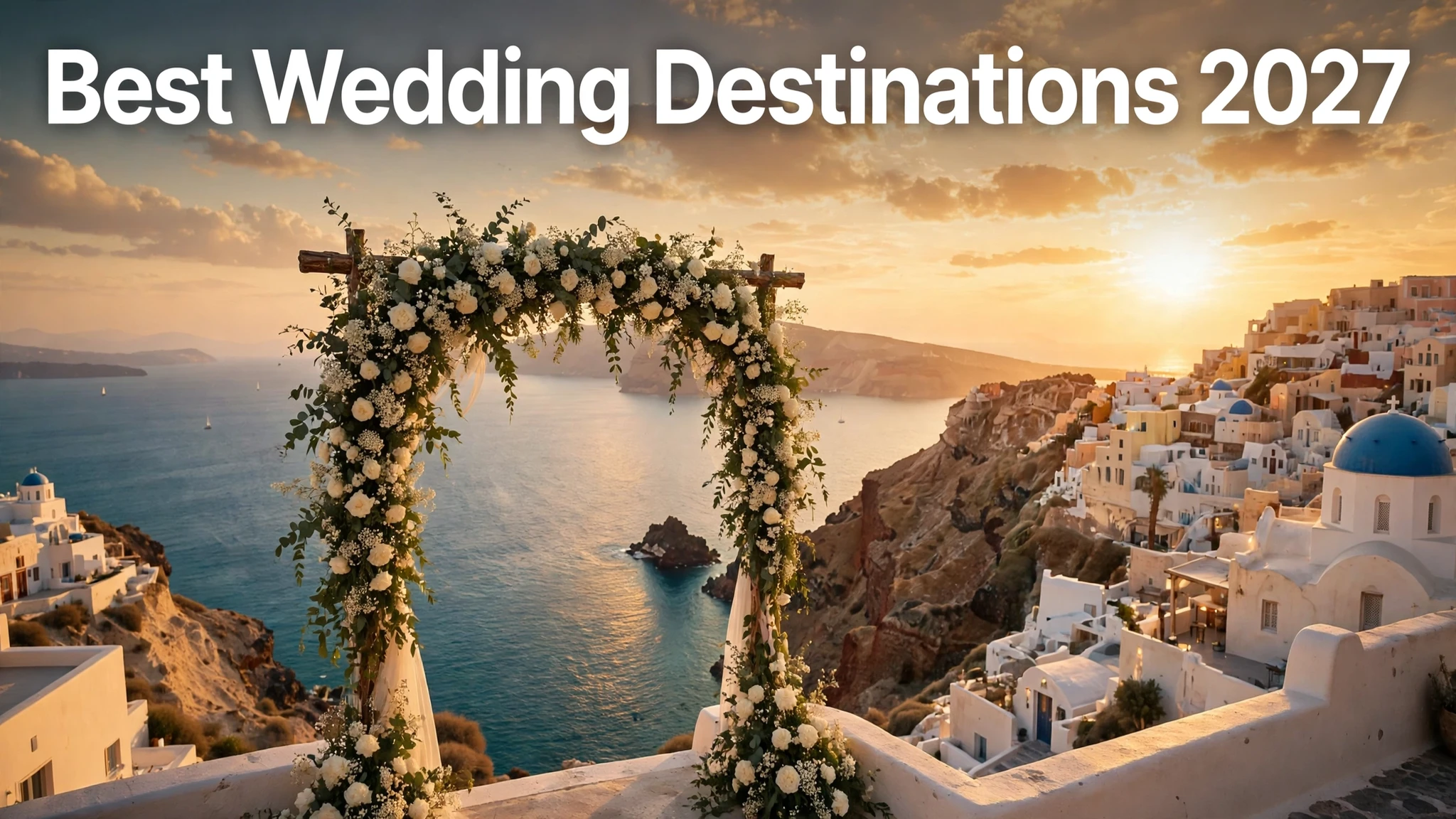
Island weddings are popular because they are simple, beautiful, and relaxed. Santorini, in Greece, is the most famous, with its white buildings, blue domes, and sunsets over the sea, and it is a place that looks like a postcard, even on an ordinary day. A wedding there is often small, outdoors, and focused on the view, and the photographs are extraordinary. But Santorini is also popular, and expensive, and it is best for couples who want a small, intimate wedding, and who are willing to book early, and to pay for the location.
The Caribbean offers a different kind of island wedding: warmer, more casual, and often more affordable, with beaches, palm trees, and resorts that handle the planning for you. A Caribbean wedding is a good choice for couples who want a relaxed day, and who do not want to manage every detail themselves. Bali, in Indonesia, offers a third option: tropical beauty, temples, and a culture that is welcoming, and distinctive, at a cost that is often lower than in Europe, or the Caribbean. Each island is different, and the right one depends on your budget, your style, and the experience you want for your guests.
Historic Cities With Old-World Charm
Some couples want a wedding in a city with history, where the streets, the buildings, and the atmosphere are part of the celebration. Paris is the most famous choice, and it is famous for a reason: the city is beautiful, romantic, and full of places for a ceremony, from a small chapel, to a garden, to a restaurant with a view of the Eiffel Tower. A Paris wedding is elegant, and it is a good choice for couples who love the city, and who want a sophisticated, urban celebration.
Other historic cities offer a different charm. Rome, with its ancient ruins, and its piazzas, is dramatic, and full of history. Prague, with its castle, and its old town, is fairytale-like, and more affordable than Paris. Edinburgh, with its castle, and its closes, is atmospheric, and full of character. These cities are best for couples who want a wedding that is part of a trip, in which guests can explore, and enjoy the city, as well as the wedding. They are also best for smaller weddings, because a city wedding is more complex to organise, and a large group in a historic city can be difficult to manage.
Vineyards, Gardens and Countryside
A countryside wedding, in a vineyard, a garden, or a rural estate, offers a different kind of beauty: green, peaceful, and natural, with space for guests to relax, and for children to play. Tuscany, in Italy, is the most famous vineyard wedding destination, with its rolling hills, its cypress trees, and its villas, where a wedding can last a whole weekend, with long lunches, and wine, and a sense of timelessness. It is a good choice for couples who want a relaxed, generous celebration, and who love food, and wine, and the Italian way of life.
The English countryside, the French Loire, and the wine regions of Portugal, and Spain, offer similar beauty, at a lower cost, and with a different character. A garden wedding, in particular, is a good choice for a small, intimate day, because a garden is naturally beautiful, and it needs little decoration. The key to a countryside wedding is the weather: choose a season when it is likely to be fine, and have a backup plan, such as a barn, or a marquee, in case it rains. A countryside wedding, done well, is one of the most memorable kinds, because it feels personal, and unhurried, and close to nature.
Mountain and Lakeside Ceremonies
Mountain and lakeside weddings are for couples who love the outdoors, and who want a ceremony that is dramatic, and awe-inspiring, without being formal. The Swiss Alps, the Scottish Highlands, and the lakes of Italy, such as Lake Como, and Lake Garda, all offer stunning settings, where a ceremony can take place with mountains, or water, as a backdrop, and where the photographs will be extraordinary. These weddings are often small, because the locations are remote, and because the logistics are more complex, but that smallness is part of their appeal.
A mountain or lakeside wedding requires more planning than a city, or a beach wedding, because of the weather, the access, and the facilities. Guests may need to travel further, and to stay overnight, and the ceremony may need to be timed around the light, and the temperature. But for couples who love the outdoors, that effort is worth it, because the setting is unforgettable, and because it reflects who they are. Choose a mountain, or a lake, if it means something to you, and if your guests will enjoy the journey, as well as the destination, and you will have a wedding that is truly yours.
Planning the Practical Side Abroad
Planning a wedding abroad requires attention to practical details that do not arise at home. The first is the legal side: each country has different requirements for marriage, including residency periods, documents, and translations, and you should start this process early, with advice from your embassy, or from a local planner. The second is travel: give your guests at least a year’s notice, provide clear information about flights, accommodation, and costs, and be understanding if some cannot come.
The third is the local suppliers: a photographer, a caterer, and a florist who know the area will be more reliable than ones you bring with you, and a local wedding planner, who speaks the language, and knows the law, is invaluable. They will handle the details you cannot, and they will warn you about risks, such as the weather, or local customs, that you might not know about. A destination wedding is a team effort, and the local team matters as much as your own planning. Choose them well, communicate clearly, and trust them to do their job.
Choosing the Place That Fits You Both
The most important question in choosing a destination is not which place is most beautiful, or most popular, but which place fits you, as a couple. A place that means something to you, because you met there, or because you travelled there together, or because it reflects your tastes, will make a better wedding than a place chosen only for its photographs. Talk together about what you want: sea, or mountains, or a city, or countryside, and about what your guests will enjoy, and what you can afford.
It also helps to visit, if you can, before you decide, because a place that looks perfect in photographs may feel different in person, and a visit will tell you whether it is right. If you cannot visit, ask for recent photographs, and talk to couples who have married there, or to a planner who knows it well. And remember that the place is the setting, not the wedding. The wedding is the marriage, and the people, and the place should serve them, not the other way around. Choose a place that fits you, and the wedding will fit the place, and you will have a day that is truly yours.
The Practical Side: Legal Papers, Guests, and Weather
A destination wedding is romantic, but it is also practical, and the practical side is what determines whether it succeeds or fails. The most important practical issue is the legal one: getting married in another country involves paperwork, and that paperwork varies by country, and by your nationality. Some countries require you to be resident for a certain number of days before the wedding, others require specific documents, such as birth certificates, passports, and proof that you are free to marry, and some require those documents to be translated, or legalised. That process takes time, and it should be started early, with advice from your embassy, or from a wedding planner who knows the local law. Do not assume that it will be simple, and do not leave it until the last minute.
Guests are the second practical issue, and they are often the most difficult. A destination wedding means asking your guests to travel, to take time off work, and to spend money, and not all of them will be able to, or will want to. That is normal, and it should be expected. Be honest with your guests, give them plenty of notice, and do not pressure them to attend. Provide clear information about travel, accommodation, and costs, and be understanding if someone cannot come. It is also important to think about who you really want there, and to keep the guest list small, because a small, intimate wedding is often better than a large one, especially abroad, where logistics are more complex.
Weather is the third issue, and it is one that is often underestimated. A beach wedding sounds perfect, but a beach in the rainy season, or in extreme heat, is not. Research the climate of your destination, find out when the rainy season is, what the temperatures are like, and whether there are risks such as hurricanes, or monsoons. Choose a date that gives you the best chance of good weather, and have a backup plan, such as an indoor venue, in case the weather changes. A wedding planner who knows the destination can help, and they will be honest about the risks. Do not choose a date based only on price, or on availability, because a cheap date in the rainy season is not a bargain if it rains on your wedding day.
There are also practical issues such as language, currency, and local customs, which should be considered. If you do not speak the language, you will need help, and a local planner is invaluable. If the currency is different, you will need to budget carefully, and to understand the costs. And if the local customs are different, you should respect them, and learn about them, so that your wedding is appropriate, and welcome. A destination wedding is a privilege, and it should be planned with respect for the place, and for the people who live there. That respect will make your wedding better, and it will be appreciated by everyone involved.
Finally, remember that a destination wedding is still a wedding, and the same principles apply: plan honestly, budget carefully, communicate clearly, and focus on what matters, which is the marriage, not the location. A beautiful place does not make a beautiful wedding, unless the planning is good, and the people are happy. Choose a destination you love, plan it well, and enjoy it, but do not let the destination become more important than the wedding itself. The place is the setting. The marriage is the story, and the story is what you will remember.
My Take:
The practical side is the part I would stress most, because it is the part that is easiest to ignore, and the part that causes the most problems. A destination wedding is romantic, but it is also a logistical challenge, and it requires planning, patience, and honesty. I would urge any couple considering one to start with the practical questions: Can we legally marry there? Can our guests afford to come? What is the weather like? Those questions are not romantic, but they are essential, and answering them early will save you a great deal of stress later. A wedding that is well planned is a wedding that is enjoyed, and a wedding that is poorly planned is a wedding that is endured. Choose the first.
I also think we should be honest about the cost, because a destination wedding is often presented as cheaper than a wedding at home, but that is not always true. The wedding itself may be cheaper, but the travel, the accommodation, and the time off work can make it more expensive, for you and for your guests. Be honest about the total cost, and do not assume that your guests can afford it. Some will be able to, and some will not, and that is fine, but you should not pressure them, or make them feel guilty for not coming. A wedding is a celebration, not an obligation, and the people who love you will celebrate with you, whether they are there in person, or in spirit. That understanding is a sign of a mature couple, and it is worth more than a large guest list.
Another point I would make is about the guest list, and the courage to keep it small. A destination wedding is an opportunity to have an intimate wedding, with the people who matter most, and that is a gift. Do not waste it by inviting everyone, out of obligation, or out of fear of offending someone. Invite the people you love, the people who have supported you, and the people you want to share the day with. The rest will understand, or they will not, and that is their choice. A small wedding, in a beautiful place, with the people you love, is more memorable than a large wedding, in a beautiful place, with people you barely know. Choose intimacy, and you will not regret it.
And the final thing I would say is to enjoy the place, and to respect it. A destination wedding is a chance to experience another culture, another landscape, and another way of life, and that is a wonderful thing. Learn about the place, respect its customs, and be a good guest, not only on your wedding day, but throughout your stay. The memories you make will not only be of the wedding, but of the place, the people, and the experience, and those memories will last a lifetime. Plan well, be honest, keep it small, and enjoy every moment. That is the best destination wedding, and it is available to anyone who plans it with care.
The guest experience is the part of a destination wedding that couples most often forget, because they are focused on the place, and on the photographs. Your guests will need to travel, to stay somewhere, and to pay for it, and for some of them that will be a real burden. Being honest about the cost, giving them plenty of notice, and helping where you can, will make a large difference to how they feel about the day. A wedding that your guests resent is not a good wedding, however beautiful the setting.
It is also worth thinking about the legal side early, because a wedding abroad is not always legally recognised at home, and the paperwork can take months. Some couples have a legal ceremony at home first, and a celebration abroad, and that is a sensible approach, because it removes the worry. And consider the environment: a destination wedding means flights, and travel, and that has a cost beyond money. Some couples offset it, or choose a place closer to home, and that is a thoughtful choice. A destination wedding can be wonderful, and the setting can make it unforgettable, but it is worth planning it with your guests, and with the practical details, in mind, not only with the photographs.
Frequently Asked Questions
What is the best wedding destination in the world?
It depends on what you want. Santorini is best for views, Tuscany for food and villas, Bali for tropical beauty on a budget, and Paris for classic romance. The best destination is the one that fits your budget, your guest list, and the atmosphere you want.
Where is the cheapest place for a destination wedding?
Bali and parts of the Caribbean are often the most affordable, because venues, food, and services cost less than in Western Europe. Costs still depend on guest numbers and travel, so get quotes for the whole trip, not just the venue, before deciding.
How do I plan a wedding abroad?
Start with the legal requirements, since each country has different paperwork, residency rules, and documents. Then hire a local wedding planner, give guests at least a year’s notice, and visit the venue beforehand if you can.
What are the best destination wedding locations in 2027?
The most popular remain Santorini, Tuscany, Bali, the Caribbean, Paris, and Scotland, as covered in this guide. Each suits a different style, so choose by atmosphere and budget rather than by trend, and check travel and weather for your dates.
How many guests should a destination wedding have?
Most destination weddings have 20 to 50 guests, because travel limits who can come. A smaller list keeps costs down and the day intimate, and it is kinder to guests, who are spending time and money to be there.