BigBang: The Life Story Behind K-Pop's Kings
In this post
- A Documentary, an Audition, and Five Very Different Boys
- Lies, Haru Haru, and the Song That Changed Everything
- Tonight, Alive, and the Fantastic Baby Years
- MADE, Bang Bang Bang, and the Longest Goodbye
- Seungri, the Scandal, and a Group That Lost Its Youngest
- Still Life and the Four Men Who Sang Again
- My Take:
In the summer of 2007, a song came out of Seoul that did not sound like anything else on Korean radio, and within weeks, everybody in the country seemed to know it. The song was called Lies, and the group that sang it was called BigBang, five young men who had been put together by a small hip-hop company called YG Entertainment. The song was written by the group’s leader, G-Dragon, who was only eighteen at the time, and it told a story of love and regret in words that were simple, direct, and honest. The music was electronic and sad, the chorus was impossible to forget, and the dance was loose and confident, as if the members were not performing for a camera but enjoying themselves at a party. Lies went to the top of the charts and stayed there, and BigBang went from being a new group to being the group that everyone else had to catch up with.
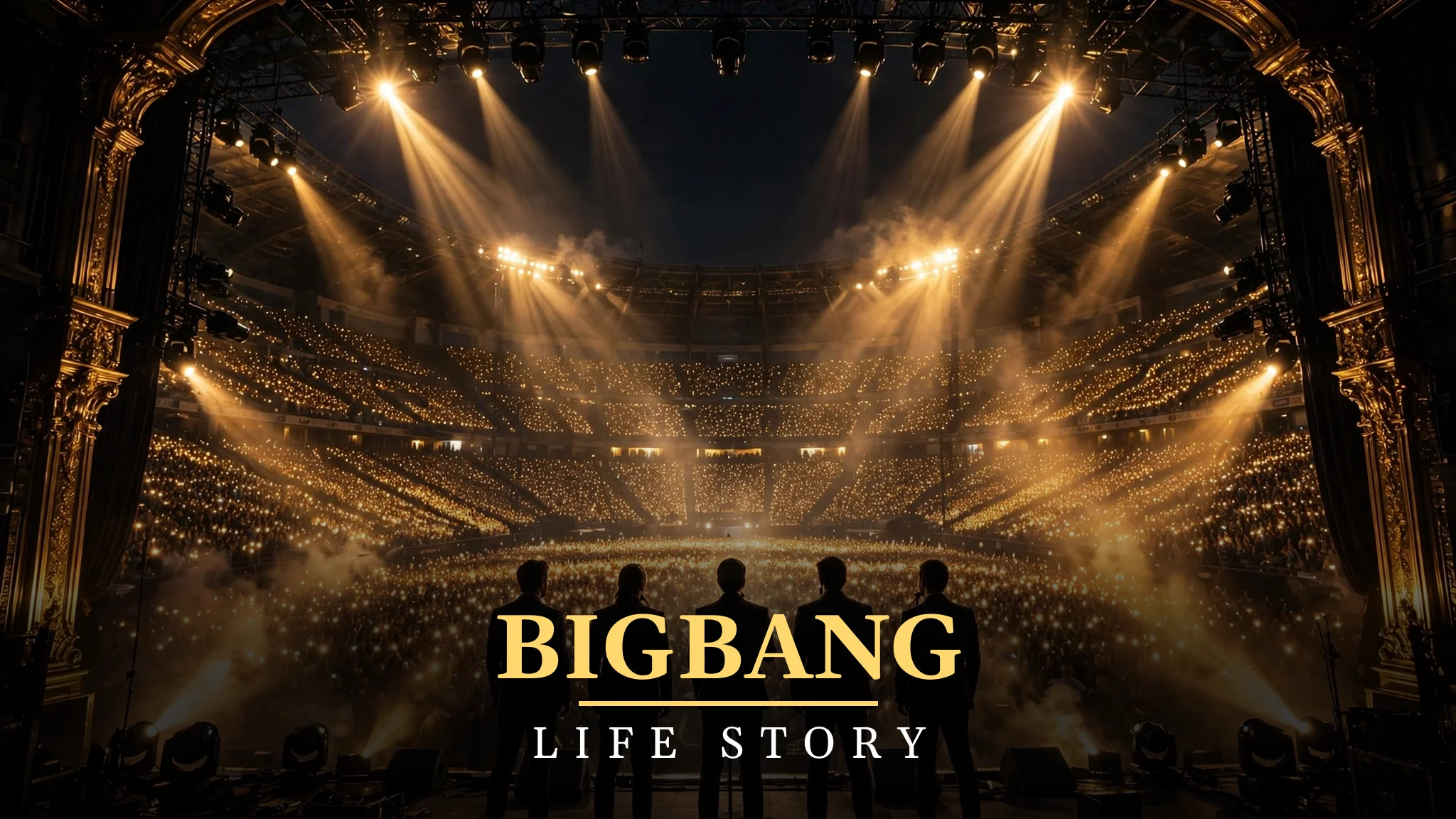
What set BigBang apart was not only the songs. It was the attitude. Other boy groups in Korea were polite, neat, and careful, and they sang songs that their companies had chosen for them. BigBang wrote its own music, wore clothes that looked like street fashion rather than stage costumes, and performed with a swagger that made the group look like it owned every stage it stood on. The members were not afraid to be loud, to be funny, or to be strange, and the fans loved them for it. The group’s fans held crown-shaped light sticks at concerts, and the halls turned yellow, the group’s colour, and the crown became one of the most famous symbols in Korean pop, because it fitted the group so well. BigBang were called the kings of K-pop, and for more than a decade, the title fitted.
The story that follows is a story of a group that changed Korean music, that filled stadiums from Seoul to Los Angeles, that made its own songs when other groups were handed theirs, and that faced hard years when the music stopped and the members went their separate ways. It is also a story about friendship, about growing up in public, and about what happens when five young men who once sang together on a small stage become men in their thirties with lives of their own. This is how BigBang became the kings of K-pop, and how the crown, though it is worn less often now, has never really been taken away.
A Documentary, an Audition, and Five Very Different Boys
YG Entertainment was a small company in Seoul, known for hip-hop and rhythm and blues, and its founder, Yang Hyun-suk, wanted to build a boy group that was different from the polished groups of the bigger companies. He did not want singers who only sang what they were told to sing. He wanted artists who could write, rap, and perform with their own style, and he was willing to let the public watch the group being built, in a television documentary series that showed the trainees working, struggling, and growing. The series, called Big Bang Documentary, ran in 2006, and it let fans see the members before they were famous, which made the fans feel that they knew them, and that feeling stayed with the group for years.
The five who were chosen could hardly have been more different. G-Dragon, whose real name is Kwon Ji-yong, was the leader, a songwriter and rapper who had been training since he was a child, and who had a gift for writing songs that sounded like hits the first time you heard them. T.O.P, whose real name is Choi Seung-hyun, was the oldest, a rapper with a deep voice and a love of art and film, who had been an underground rapper before he joined YG. Taeyang, whose real name is Dong Young-bae, was the main singer, a dancer and a vocalist whose voice was smooth and soulful, and who had trained alongside G-Dragon for years. Daesung, whose real name is Kang Dae-sung, was the bright, smiling singer, a man whose warmth and humour made him beloved, and whose voice was strong and clear. Seungri, whose real name is Lee Seung-hyun, was the youngest, a dancer and singer who was known for his energy and his ambition, and who wanted to be a star more than anything.
The training was hard, and the documentary showed it. The members practised singing, dancing, and rapping for hours each day, and they lived together, argued with each other, and learned to work as a team. G-Dragon and Taeyang had been trainees for years, and they knew the company’s ways, but the others were newer, and they had to learn fast. The company also made the members compete for their places, and one trainee, who had been part of the early line-up, was cut before the debut, a moment that the documentary showed openly, and that made the fans understand how serious the company was. The five who remained were the five who would become BigBang, and they were ready, though none of them knew how big the group would become.
The debut came on 19 August 2006, at a concert in Seoul, with the group’s first album, BigBang Vol. 1, released at the end of that year. The album carried the song We Belong Together, and it sold well for a new group, but it did not yet make BigBang stars. The members performed on music shows every week, appeared on television, and worked through a schedule that left them little rest. They were young, G-Dragon and Taeyang were eighteen, Seungri was fifteen, and they were learning how to be famous while they were still learning how to be a group. The company believed in them, and the fans who had watched the documentary believed in them too, and the group kept working, waiting for the song that would change everything.
Lies, Haru Haru, and the Song That Changed Everything
The song that changed everything came in August 2007, when BigBang released the mini-album Always, with the title song Lies. G-Dragon had written the song, and it was unlike anything the group had done before. The music was electronic, with a slow, sad beat, and the lyrics told a story of a man who had lied to the woman he loved, and who was sorry, and who wanted her back. The chorus was simple and haunting, and it stayed in people’s minds long after the song ended. Lies went to the top of the charts in Korea, and it stayed there for weeks, and it won the Song of the Year award at the Mnet Asian Music Awards. BigBang was suddenly the most talked-about group in the country, and G-Dragon, at eighteen, was suddenly known as one of the best songwriters in Korean pop.
The group followed Lies with more hits. Last Farewell, released in November 2007, was another success, with a bright and catchy chorus that became a favourite at concerts. Haru Haru, released in August 2008 on the mini-album Stand Up, was a sad and beautiful song about a love that had ended, and its music video, which told a story of friendship and loss, became famous across Korea. The song topped the charts, and it showed that BigBang could sing about sadness as well as about joy, and that the group’s music had a depth that other groups did not have. The members were still teenagers, but they were writing and singing songs that sounded like they had been written by people much older.
In 2008, the group also released the album Remember, and the song Sunset Glow, a remake of an old Korean song, became a hit, showing that BigBang could take a song from the past and make it sound new. The group toured Japan, where its music was well received, and it performed in concerts that sold out, and the Japanese fans, who loved the group’s style and its music, became some of its most loyal followers. BigBang was no longer only a Korean group. It was becoming an Asian group, and its songs were being sung in countries where Korean was not spoken, by fans who had learned the words by heart.
The success brought new work, and the members began to build solo careers alongside the group. G-Dragon released his first solo album, Heartbreaker, in August 2009, and the title song became a huge hit, though it was also the subject of a dispute about whether it sounded too much like another song, a dispute that was later settled. Taeyang released his first solo album, Solar, in July 2010, with the song Wedding Dress, and it showed that his voice, smooth and soulful, could carry a record on its own. T.O.P acted in films and dramas, and became known as an actor as well as a rapper. Daesung became a popular face on television, and Seungri worked in Japan and in business. The solo work made the members stronger, but it also meant that the group could not always be together, and the fans learned to wait for the times when all five stood on one stage.
Tonight, Alive, and the Fantastic Baby Years
In February 2011, BigBang released the mini-album Tonight, and the title song became another hit, with a bright and confident sound that suited the group’s style. The album showed that the group had grown up, and that the music had grown with it. The members were in their early twenties now, and they were no longer the teenagers who had sung Lies. They were men, and the songs were about love, about parties, and about life in the city, and they sounded like the work of artists who knew exactly who they were.
The year 2012 brought the album Alive, and with it, the song Fantastic Baby, which became one of the most famous Korean songs of all time. The video was wild and colourful, full of strange costumes, bright lights, and dancing that looked like a party that had gone out of control, and the song’s chorus, with its shout of wow, fantastic baby, became known around the world. Fantastic Baby was played in clubs, in schools, and on television in many countries, and its video became one of the most watched Korean music videos ever. The song showed that BigBang could be fun, loud, and strange, and that it could do it better than anyone else.
The Alive tour that followed was the group’s first world tour, and it played in Seoul, in Japan, in China, in Southeast Asia, in Europe, and in North America. The concerts were huge, with stages that were built like small cities, and the fans filled the halls in every country, holding their crown light sticks and singing along in Korean. The tour showed that Korean pop could fill stadiums in London and in Los Angeles, and BigBang was one of the first groups to prove it. The members performed with a confidence that came from years on stage, and the concerts became famous for their energy, their humour, and their joy.
The group also released the album Still Alive in June 2012, with the song Monster, and the members continued to work on solo projects. G-Dragon released the album One of a Kind in September 2012, with the song Crayon, and it became a hit. T.O.P acted in the film The Commitment in 2013, and won praise for his performance. Taeyang released the album Rise in June 2014, with the song Eyes, Nose, Lips, a ballad that became one of the most loved Korean songs of the decade, and that won Song of the Year at the Mnet Asian Music Awards. The solo work was strong, but the fans always asked the same question: when would the five come back together?
MADE, Bang Bang Bang, and the Longest Goodbye
The answer came in 2015, when BigBang announced a project called MADE, a series of singles that would be released month by month, from May to August, with a full album to follow. The first single, Loser, released in May 2015, was a sad and honest song about feeling lost, and it became a hit, showing that the group could still write songs that touched people’s hearts. Bae Bae, released in the same month, was playful and strange, and it became a favourite at concerts. Bang Bang Bang, released in June 2015, was loud, wild, and full of energy, and it became one of the group’s biggest hits, with a video that was watched hundreds of millions of times.
The MADE tour that followed was the group’s largest, and it played in more than thirty cities around the world, from Seoul to Shanghai to Los Angeles to London. The concerts were huge, and the fans filled the stadiums, and the group performed with a joy that made every show feel like a celebration. The full MADE album, released in December 2016, carried the songs Fxxk It and Last Dance, and it became a bestseller, and the group won awards for it. MADE was BigBang at its best: five men who had grown up together, who knew each other’s strengths, and who could make music that was both popular and personal.
But MADE was also a goodbye, though nobody knew it at the time. In February 2017, T.O.P enlisted for army service, and the other members followed, one by one, in the years that followed. G-Dragon enlisted in February 2018, Taeyang in March 2018, and Daesung in March 2018. Seungri, who was due to enlist in 2019, never did, because his career ended in a different way, and that is the subject of the next part of this story. For more than two years, the group was silent, and the fans waited, and the crown light sticks stayed in their boxes, waiting for the day when the five would stand on stage again.
The waiting was hard, because the group had been so loud, so present, and so full of life, and the silence felt strange. The fans listened to the old songs, watched the old concerts, and counted the days until each member’s discharge. T.O.P finished his service in July 2019, and the others followed in October and November of that year. The group was free again, and the fans hoped for a new album, a new tour, and a new beginning. What came instead was quieter, and more complicated, than anyone had hoped.
Seungri, the Scandal, and a Group That Lost Its Youngest
In early 2019, Seungri, the youngest member of BigBang, became the centre of a scandal in Korea, after reports that a nightclub he was involved with had been used for illegal activity, and that he had been involved in wrongdoing. The reports grew, the police investigated, and Seungri announced his retirement from the entertainment industry in March 2019, saying that he wanted to protect the group and its fans. He was later tried, and in 2021, a military court found him guilty of several charges, including arranging prostitution and gambling, and sentenced him to prison. He was released in February 2023, after serving his sentence, but his career as a singer was over, and his name became a subject that BigBang’s fans found painful to talk about.
The scandal was a shock to the group and to its fans, because Seungri had been the youngest, the most energetic, and the member who had always wanted to be a star. The other members did not speak about him in public, and the company, YG Entertainment, removed him from the group’s records, and the fans had to accept that BigBang would never be five again. It was a sad ending for a member who had once been loved, and it was a reminder that fame can bring trouble as well as joy, and that a group is only as strong as the choices its members make.
The group also faced other hard times in those years. Daesung had been in a car accident in May 2011, in which a man died, and though Daesung was not found to have caused the accident, the event haunted him, and he took time away from the group to recover. G-Dragon had faced a drug investigation in 2011, though he was not charged, and the event was a difficult time for the group. T.O.P had faced a drug case in 2017, and had been given a suspended sentence, and the event had delayed his army service. Each of these events was painful, and each one was reported widely, and the group had to carry on through them, with the fans watching, and with the public judging. BigBang survived them, but the scars stayed, and the group’s story became more complicated than the bright songs suggested.
In the years that followed, the four remaining members, G-Dragon, T.O.P, Taeyang, and Daesung, worked on solo projects and lived quieter lives. T.O.P left YG Entertainment in February 2022, and said that he had left BigBang as well, though the other members did not confirm it in the same way. G-Dragon left YG in December 2023, and signed with a new company. Taeyang stayed with YG, and Daesung left YG in December 2022, and signed with a new company. The four men were no longer in the same company, and they were no longer a group in the old sense, but the fans still hoped that they would sing together again, one day, on one stage.
Still Life and the Four Men Who Sang Again
In April 2022, BigBang released a song called Still Life, its first new music in four years, and the first as a group of four, without Seungri. The song was quiet, gentle, and sad, with lyrics about the seasons changing, about friends who had gone, and about the past that could not be brought back. The video showed the four members in separate places, in fields, in rooms, and on empty stages, and the song became a hit, topping the charts in Korea, and the fans listened to it again and again, because it sounded like a farewell, and like a thank you, all at once. Still Life was not a loud comeback. It was a soft one, and it was honest, and the fans loved it for that.
The song’s success showed that BigBang’s music was still loved, even after years of silence, and even after the scandal that had taken a member away. The fans bought the record, streamed it, and sang it, and the group was reminded that its audience had not gone away. The members did not tour after Still Life, and they did not release a full album, and the fans accepted that, because the song itself was a gift, and because the four men had given it to them with care. It was a song about growing older, about looking back, and about the beauty of a life that has been lived fully, and it fitted the group that had once sung Fantastic Baby, because the same men were singing, but they were singing as men now, not as boys.
Since Still Life, the members have worked on their own. G-Dragon released the album Übermensch in February 2025, his first full album in more than a decade, and he toured the world with it, playing to crowds that had waited years to see him. Taeyang released the album Down to Earth in April 2023, with the song Vibe, sung with Jimin of BTS, and it became a hit. Daesung released solo music in Japan and in Korea, and performed in concerts that showed his voice was as strong as ever. T.O.P acted in the television series Squid Game season two, released in December 2024, and his performance was talked about around the world. Each member has a life of his own now, and the group is a memory, and a hope, rather than a working band.
BigBang’s place in Korean pop is now secure, and it rests on more than sales figures. The group showed that a Korean act could write its own music, that it could fill stadiums in London and Los Angeles, and that it could change the sound of Korean pop, from the electronic sadness of Lies to the wild joy of Fantastic Baby to the quiet honesty of Still Life. The crown light sticks are still there, in the hands of fans who remember the concerts, and the songs are still played, in clubs, in schools, and on the radio, in Korea and around the world. The kings may not wear the crown every day now, but the crown is still theirs, and the music is still theirs, and the story is still worth telling.
My Take:
I think BigBang is the most important boy group in the history of Korean pop, and I say that not because it sold the most records, but because it changed what a boy group was allowed to be. Before BigBang, boy groups in Korea were polite, neat, and careful, and they sang songs that their companies had chosen for them. BigBang wrote its own music, wore its own clothes, and performed with a swagger that made the group look like it owned every stage it stood on. That freedom changed the industry, because it showed other groups that they could write, that they could choose, and that they could be artists, not only performers. Every group that writes its own songs today owes something to BigBang, whether it knows it or not.
What I admire most about this group is G-Dragon’s songwriting, because it is rare for a teenager to write a song like Lies, and it is rarer still for that teenager to keep writing hits for more than a decade. Lies was written when G-Dragon was eighteen, and it is a song about love and regret that sounds like it was written by someone much older. Fantastic Baby was written when he was in his early twenties, and it is a song about joy and madness that sounds like it was written by someone who had never been sad. Still Life was written when he was in his thirties, and it is a song about growing older that sounds like it was written by someone who had lived a full life. That range, from sadness to joy to quiet reflection, is the mark of a real songwriter, and G-Dragon is one of the best that Korean pop has ever had.
I also admire Taeyang’s voice, because it is one of the most beautiful voices in Korean music, and because it carried the group’s ballads with a warmth that no other member could match. When Taeyang sang Eyes, Nose, Lips, the whole country listened, and the song became one of the most loved Korean songs of the decade. His voice is smooth and soulful, and it makes a simple love song sound like a prayer. I think Taeyang is underrated, because G-Dragon’s songwriting and T.O.P’s rapping often got more attention, but the group’s music would not have been the same without Taeyang’s voice, and the fans knew it, because they sang his songs at every concert, in every country, in Korean, even when they did not speak the language.
T.O.P is another member I admire, for a different reason. He was the oldest, a rapper with a deep voice, and a man who loved art and film, and who became an actor as well as a singer. His performance in the film The Commitment showed that he could act, and his work in Squid Game season two showed that he could still surprise people, even after years away from the stage. I like artists who have interests outside music, because those interests make the music richer. T.O.P collected art, watched films, and thought about the world, and that thinking came through in his rapping, which was always thoughtful and strange, never only loud. He was the member who made BigBang feel like a group of artists, not only a group of pop stars.
Daesung is the member I feel most fondly about, because he was the group’s warmth. He smiled, he laughed, he made jokes, and he sang with a voice that was strong and clear, and his presence made the group feel human. The car accident in 2011, in which a man died, was a terrible time for him, and he took time away to recover, and the fans waited for him, because they loved him, and because they knew that he was a kind man who had been through a frightening experience. I admire the way he came back, quietly, and sang again, and the way he built a solo career in Japan and in Korea, with concerts that showed his voice was as strong as ever. Kindness is not a small thing in pop music, and Daesung had it in abundance.
The story of Seungri is the saddest part of this story, and I want to be honest about it. He was the youngest member, the most energetic, and the one who wanted most to be a star, and his career ended in a scandal that hurt the group, hurt the fans, and hurt the people who were harmed by the crimes he was found guilty of. I do not want to excuse what he did, and I do not want to pretend that it did not happen, because it did, and the court’s judgment was clear. What I will say is this: the group’s story is better without him, not because the music is better, but because the group is honest now about what happened, and because the four men who remain have carried on with dignity. A group that loses a member to a scandal can either hide or face it, and BigBang faced it, by releasing Still Life, a song about loss and about growing older, and by singing it with care.
I think Still Life is one of the most beautiful songs in Korean pop, because it is honest in a way that few comeback songs are. It does not pretend that the past was perfect. It does not pretend that the group is the same as it was. It says, in simple words, that the seasons have changed, that friends have gone, and that the past cannot be brought back, and it says it with a melody that is gentle and sad. I listened to it many times, and each time, I felt that the four men were singing to the fans, and to each other, and to the years that had passed. That is a brave thing to do, and it is a kind thing to do, because it tells the fans that they are not alone in their sadness, and that the group feels it too.
If I had to choose one BigBang song to play for someone who had never heard the group, I would choose Lies, because it is the song that explains everything. It is sad, it is electronic, and it shows off G-Dragon’s songwriting in its purest form. I would also play Fantastic Baby, because it is the song that shows the group’s joy, its madness, and its ability to make a whole stadium dance. Between those two songs, you can hear the whole journey, from the teenagers who sang about love and regret to the men who sang about growing older, and that journey is worth hearing in full.
I think BigBang’s influence on Korean pop is larger than people admit. The group showed that a Korean act could write its own music, that it could fill stadiums in London and Los Angeles, and that it could change the sound of Korean pop. The Alive world tour, which played in more than thirty cities, proved that Korean pop could be a global music, and the MADE project, with its month-by-month singles, showed that a group could release music in a new way, and that the fans would follow. Every group that tours the world today owes something to BigBang, because BigBang was one of the first to prove that it could be done, and that the audiences were there, waiting.
There is a lesson in the army years that I find quietly moving. Four members went away, one by one, and the group was silent for more than two years, and the fans waited, and the crown light sticks stayed in their boxes. That waiting was hard, because the group had been so loud, so present, and so full of life, and the silence felt strange. But the waiting also showed how strong the bond between the group and its fans was, because the fans did not leave, and the group did not forget them. When Still Life came out, the fans were there, and the song was a hit, and the waiting had been worth it. That is a lesson for anyone who thinks that success must come quickly. Sometimes, waiting is part of the work, and the return is sweeter for it.
If I am honest, I do not love every BigBang record equally. Some of the early songs feel dated now, and some of the later ones are too loud for my taste. I also think the group was sometimes pushed too hard by its company, and that the members worked long hours when they were still young. I say this not to be unkind, but because I think it is important to be honest about the cost of a career that starts in your teens. The music was wonderful, but it was made by young men who were tired, who missed their families, and who lived under constant pressure. That cost should be part of the story too, and it is part of the reason I admire the group for lasting so long.
In the end, what I take from BigBang is a simple lesson about freedom. The group did not become the kings of K-pop because it was the biggest, or because it had the most members, or because it had the cleverest plan. It became the kings because it wrote its own music, because it wore its own clothes, because it performed with its own style, and because it refused to be polite when it wanted to be loud. That freedom is rare in pop music, and it is precious, and it is the reason the group’s songs are still played, in clubs, in schools, and on the radio, in Korea and around the world. The crown may not be worn every day now, but it is still theirs, and the music is still theirs, and the story is still worth telling, one song at a time.
I also think about the crown light stick when I think about this group, because it is a small object that tells a large story. A crown is a symbol of kings, and the fans held crowns in their hands at every concert, and the halls turned yellow, and the group looked out at a sea of crowns and knew that it was loved. That image stayed with me, because it shows how a fan group can become part of the music, not only an audience for it. The fans did not only listen. They held up their crowns, they sang every word, and they made the concert into something that belonged to them as much as to the group. That is a beautiful kind of loyalty, and it is one of the reasons BigBang lasted.
I hope the four men sing together again, one day, on one stage, because that is the concert the fans have been waiting for, and it is the ending this story deserves. Even if that day never comes, the music will still be there, and the fans will still sing it, and the summer of Lies will still be remembered as the summer when Korean pop learned that a group could write its own songs, and that the songs could be better than anything a company could choose. That is a legacy worth having, and it is one that BigBang earned, one song at a time, one concert at a time, one year at a time.
One last thought stays with me. BigBang began as five boys in a documentary, boys who were learning to sing and dance in front of a camera, and they became kings, not because they were given a crown, but because they earned it, song by song, concert by concert, year by year. The crown was never the point. The music was the point, and the freedom was the point, and the friendship was the point. When I hear Lies now, I do not only hear a hit from 2007. I hear five young men who believed that they could write their own songs, and who were right, and that belief is still worth hearing today.
Frequently Asked Questions
When did BigBang debut and how many members did it have?
BigBang debuted in August 2006 with five members, after a documentary series that showed the trainees working towards their debut. The group was formed by YG Entertainment.
What is BigBang’s most famous song?
BigBang’s most famous songs include Lies from 2007, Fantastic Baby from 2012, and Bang Bang Bang from 2015. Lies was the group’s first big hit, while Fantastic Baby became one of the most famous K-pop songs of all time.
What was the MADE project?
MADE was a series of singles released month by month in 2015 and 2016, including Loser, Bae Bae, and Bang Bang Bang. The project was a huge success and was followed by a world tour.
Why is BigBang called the kings of K-pop?
BigBang is called the kings of K-pop because of its long success, its influence on other groups, and its ability to write its own music and set trends. The group dominated K-pop for more than a decade.
Is BigBang still active today?
BigBang returned in 2022 with the song Still Life, but its members have since pursued solo careers and some have left the group and its agency. The group’s music remains widely loved.
What is BigBang’s fan light called?
BigBang’s fans hold a crown-shaped light stick at concerts, which turns stadiums into seas of yellow light. The crown light has become one of the most famous symbols in K-pop.


