Bill Nighy: The Life Story Behind the Charming Character Star
In this post
- A Boy From Caterham Who Found School Hard
- Drama School, the Stage, and Years of Hard Work
- Love Actually and the Moment Fame Arrived
- Davy Jones, Underworld, and the Big Films
- About Time, Living, and the Oscar Nomination
- A Private Life, a Daughter, and a Style of His Own
- A Legacy of Patience, Humour, and Quiet Power
- My Take:
Bill Nighy is one of those actors who can walk into a scene and change it completely without ever raising his voice, and his long, lean figure, his sharp suits and his dry, quiet way of speaking have made him one of the most recognisable faces in British film. He is the kind of performer who can be funny in one moment and deeply sad in the next, and he does both with the same calm control, so that the audience never quite knows what he will do next. Millions of people know him as Billy Mack, the ageing rock star in Love Actually who sings a Christmas song and wins back the public, and millions more know him as Davy Jones in Pirates of the Caribbean, a creature of the sea with a face made of tentacles. Behind those famous roles lies a long and patient career in the theatre, where he learned his craft in small parts and in hard years before the film world discovered him.
He was born in Caterham, a town in Surrey, and he grew up in a family where money was not plentiful and where his father worked as a garage manager. He was not a child who was pushed toward the stage by a famous family, and he did not have an easy path into acting. He struggled at school, he found reading hard because of dyslexia, and he left school with little idea of what he wanted to do. Yet he had a love of words, a love of music, and a sharp eye for people, and those gifts slowly led him toward the theatre, where he found a place that made sense to him for the first time in his life.
What makes his story worth telling is the length of the road he travelled and the late arrival of his fame. He was in his fifties when Love Actually made him a star, and he had already spent decades working in the theatre and in small television parts. He did not give up when the big roles did not come, and he did not change who he was to fit what the film world wanted. This is the story of how a boy from Surrey who found school hard became one of Britain’s most loved actors, and how he did it by staying patient, staying honest, and letting his talent speak for itself.
A Boy From Caterham Who Found School Hard
William Francis Nighy was born on 12 December 1949 in Caterham, Surrey, England. His father, Alfred, managed a car garage, and his mother, Catherine, was a nurse who had come to England from Glasgow. The family was working class, and money was tight, but there was warmth in the home and a love of music and of stories. Bill grew up listening to records, watching films, and noticing the way people spoke and moved, and he stored those observations away without knowing that they would one day become the tools of his trade.
At school he found reading and writing difficult, and he later learned that he had dyslexia, a condition that makes it hard to read words on a page. For a boy who loved stories, that was a painful thing, and it made school feel like a place where he did not belong. He was not lazy, and he was not stupid, but the words would not stay still on the page, and teachers did not always understand why he struggled. He left school at fifteen with few qualifications and with no clear plan for his future, and he drifted for a time, working in different jobs and trying to find his way.
He worked for a while as a messenger for a newspaper, and he tried other kinds of work, but none of them felt right. He had a restless energy and a sharp mind, and he needed something that would use both. He began to read more, he began to listen to music with a deeper attention, and he began to think about the theatre, which had always drawn him. It was not a sudden decision, but a slow realisation that the stage was the place where he could use his love of words and his eye for people.
Those early years mattered because they taught him how to keep going when things are hard. He knew what it felt like to be judged as a failure at school, and he knew what it felt like to have no clear path. That experience gave him a sympathy for outsiders and for people who do not fit in, and it is one of the reasons his performances often have a quiet sadness underneath the humour. The boy from Caterham who could not read easily grew up to become a man who speaks some of the most beautiful lines in British film, and that is a remarkable journey.
Drama School, the Stage, and Years of Hard Work
Nighy decided to train as an actor, and he went to the Guildford School of Acting, where he learned the basics of voice, movement and the study of plays. The training was demanding, and it asked students to work hard on their bodies and their voices, but Nighy took to it with a hunger that came from having found his place at last. He learned how to stand on a stage, how to speak so that every word could be heard, and how to build a character from the words on the page, and he discovered that the discipline of the theatre suited him far better than the discipline of school.
After drama school he began his professional career on the stage, and he worked for many years in the theatre, taking on a wide range of parts. He appeared in plays at the Royal National Theatre and at other leading theatres, and he became known as a reliable and thoughtful actor who could play both comedy and drama. He played in plays by Harold Pinter, Tom Stoppard and other great writers, and he learned how to handle the long speeches and the silences that make those plays so powerful. The stage taught him patience, because a play is built over weeks of rehearsal, and it taught him to trust his fellow actors.
He also worked in television during these years, taking on small parts in dramas and comedies, but the big film roles did not come quickly. He was in his thirties and forties, and he was still playing supporting roles, often as a clever or difficult man who appears for a few scenes and then leaves. He did not complain about that, and he did not try to force his way into leading roles. He took each part seriously, he made it real, and he waited for the right moment to come.
By the end of this long period of work, Nighy had built a reputation within the theatre world as an actor of great skill and great style. He was known for his tall figure, his sharp suits, and his dry way of speaking, and directors liked working with him because he was prepared, he listened, and he brought a fresh and intelligent reading to every part. He was not yet famous to the wider public, but he had earned the respect of the people who knew the theatre best, and that respect would carry him into the next stage of his career.
Love Actually and the Moment Fame Arrived
Nighy’s great breakthrough in film came in 2003, when he was cast as Billy Mack in Love Actually, the romantic comedy written and directed by Richard Curtis. Billy Mack is an ageing rock star who records a Christmas version of an old love song, and who tries to win back the public and the charts with a mixture of charm, rudeness and honesty. Nighy played him with a wonderful sense of comedy, singing badly on purpose, making jokes about his own age, and showing a softer side underneath the swagger. The film was a huge success around the world, and Billy Mack became one of its most loved characters.
He won the BAFTA Award for Best Supporting Actor for his performance, and the award changed his life. Suddenly, film directors who had never noticed him before were calling, and he was offered bigger and more interesting parts. He was fifty-three years old, and he had waited a long time for this moment, but he handled it with the same calm that he brought to his acting. He did not become loud or showy, and he did not try to be a different kind of actor. He simply kept doing what he had always done, but now more people were watching.
The success of Love Actually also showed the world what Nighy could do with comedy. He had always been funny on stage, but film audiences had not seen that side of him before. His timing, his face, and his voice made Billy Mack unforgettable, and the film is still watched every Christmas by millions of people. For many viewers, Nighy is Billy Mack, the man in the leather jacket who sings about Christmas and who learns that love is all around, and that is a fine thing to be remembered for.
The years after Love Actually were busy ones, and Nighy took on a wide range of film roles, from comedy to drama to fantasy. He had waited decades for fame, and when it came he used it well, choosing parts that interested him and working with directors who respected his talent. He did not waste the chance, and he did not take it for granted, because he knew how long he had waited for it to arrive.
Davy Jones, Underworld, and the Big Films
After Love Actually, Nighy became a familiar face in big international films. He played Viktor, the powerful vampire elder, in the Underworld films, bringing a cold and elegant menace to the part. He played Davy Jones in Pirates of the Caribbean: Dead Man’s Chest and At World’s End, a role that used computer effects to turn his face into a mass of tentacles, yet his voice and his movements made the character feel real and terrifying. He worked with Johnny Depp and the rest of the cast, and the films were huge successes around the world.
He also appeared in the film Shaun of the Dead, playing the stepfather of the hero, and in Hot Fuzz, both films by Edgar Wright that have become cult favourites in Britain. In those films he showed a different side of his talent, playing ordinary men in extraordinary situations with a dry humour that made audiences laugh. He could be a vampire, a sea monster, a stepfather or a policeman, and each time he made the character feel true, even when the story was wild and funny.
He played Rufus Scrimgeour, the Minister for Magic, in Harry Potter and the Deathly Hallows: Part 1, a small but important part in one of the biggest film series ever made. He also appeared in The Best Exotic Marigold Hotel, in About Time, and in many other films that showed his range. He moved easily between big Hollywood films and small British films, and he brought the same care to each one, whether he was covered in computer effects or simply sitting in a room talking to another actor.
These big film roles made him known to audiences around the world, and they gave him a financial security that he had not known in his early years. Yet he never lost his love of the theatre, and he kept returning to the stage when a part called to him. He understood that film fame can fade, but the craft of acting lasts, and he kept his craft sharp by working in both worlds.
About Time, Living, and the Oscar Nomination
In 2013, Nighy appeared in About Time, a romantic fantasy film written and directed by Richard Curtis, playing the father of the hero, a man who can travel in time and who teaches his son how to live a good life. His performance was warm, funny and deeply moving, and many viewers said that his scenes with Domhnall Gleeson were the heart of the film. He played a father who is wise without being perfect, and who loves his son without making a show of it, and that quiet love made the film unforgettable for many people who saw it.
His greatest critical success came in 2022, when he starred in Living, a film based on the Japanese classic Ikiru, about a man who learns that he is dying and decides to use his remaining time to do something good. Nighy played Mr Williams, a quiet civil servant in 1950s London who has spent his life pushing papers and who finally decides to build a playground for children. His performance was praised around the world for its stillness, its sadness and its beauty, and he was nominated for the Academy Award for Best Actor, the first Oscar nomination of his long career.
The nomination was a remarkable moment, because it came when he was seventy-two years old, after more than fifty years of acting. He did not win the award, but the nomination itself was a recognition of a lifetime of work, and it brought him to the attention of a new generation of film lovers. Critics wrote about his voice, his face, and his ability to say so much with so little, and audiences who saw Living were moved by the story of a man who finds meaning at the end of his life.
Living showed what Nighy had always known: that the best acting is often the quietest, and that a small change in the face can say more than a long speech. He played Mr Williams as a man who has lived a small life, and who finds a large purpose in his final months, and he did it with a grace that made the film feel like a gift. It was the crowning achievement of his film career, and it proved that his talent had only grown with age.
A Private Life, a Daughter, and a Style of His Own
Nighy’s private life has been kept largely out of the public eye, and he has always preferred to let his work speak for itself. He was in a long relationship with the actress Diana Quick, and they have a daughter, Mary Nighy, who has become a director and an actress in her own right. He has spoken with pride about his daughter, and he has shown in his roles a deep understanding of family, of fathers and of the bonds between parents and children.
He is known for his style, for his sharp suits, his long coats and his careful way of dressing, and he has become a fashion icon in his own quiet way. He has said that he likes clothes because they help him to feel like himself, and because they are part of how a character is built. His style is not loud or showy, but it is precise, and it matches the precision of his acting. He knows that how a person dresses can tell a story, and he uses that knowledge both on screen and in life.
He has also spoken about his dyslexia, and about how it made school hard for him, and he has shown that a difficulty with reading does not have to stop a person from loving words. He learned to work with his dyslexia, to prepare carefully, and to trust his memory and his ear for language. That honesty about his own struggles has helped other people who find reading hard, and it has shown that talent can come in many different forms.
Through all the years of fame, Nighy has kept a quiet and private life, living in London and working when a part interests him. He does not seek attention, he does not court the press, and he does not try to be a celebrity in the modern sense. He is an actor, and he lets his work do the talking, and that is one of the reasons audiences trust him and love him.
A Legacy of Patience, Humour, and Quiet Power
Bill Nighy’s legacy is not measured in one famous film or one hit television show. It is measured in the many performances he has given, the many audiences he has moved, and the many younger actors who have learned from his example. He has shown that a career can be built slowly, that fame can come late, and that talent does not fade with age. He has been a leading light of British theatre and film, and he has helped to keep the tradition of careful, intelligent acting alive for new generations.
His work in Love Actually, in Living, in Pirates of the Caribbean and in many other films will be watched for years to come, and each new audience will discover a performer who is funny, sad, stylish and true. His stage work, though less widely seen, is just as important, because it is where his craft was made, and where he learned the discipline that has carried him through a long career. He has left a body of work that is rich, varied and deeply human.
He is also remembered for his honesty about dyslexia, for his style, and for his refusal to change who he was to fit the film world. He stayed himself, he kept his dry humour, and he kept his quiet way of working, and that is why his performances feel so real. He did not try to be a star in the loud sense. He tried to be a good actor, and he became a star by doing that well.
Today Bill Nighy stands as one of the great British actors of his time, a BAFTA winner, an Oscar nominee, and a performer whose work has touched audiences in theatres, cinemas and living rooms around the world. His story is one of patience, humour and quiet power, and it shows that a long career built on real skill can be more lasting than a short burst of fame. He did the work, he did it well, and he kept doing it, and that is a legacy any actor would be proud to leave.
My Take:
When I think about Bill Nighy, the first thing I feel is a kind of admiration for a person who waited a long time and never gave up. I have seen many people who want fame at twenty, and who feel that life has failed them if it does not come quickly. Nighy waited until he was in his fifties, and he kept working in the theatre, in small television parts, and in roles that most people would have forgotten. I admire that patience, because it is not easy to keep going when the big chance does not come. He kept going, and when the chance finally came, he was ready for it, and that is a lesson I think about often.
I think his performance as Billy Mack in Love Actually is one of the funniest and most honest things I have ever seen on film. He plays an ageing rock star who knows he is past his best, who makes jokes about his own age, and who still wants to be loved. I laughed at his scenes, but I also felt sad for him, because underneath the jokes there is a man who is afraid of being forgotten. Nighy shows both sides at once, and that is a rare skill. He does not make Billy Mack a simple joke, and he does not make him a sad old man. He makes him a real person, and that is why audiences still love him every Christmas.
I also think about his work in Living, and I feel that it is the best performance of his career. He plays a man who learns that he is dying, and who decides to use his remaining time to build a playground for children. I watched that film and I felt tears in my eyes, not because the film is loud or sad in a simple way, but because Nighy is so quiet and so still. He does not cry, he does not shout, and he does not make a big speech. He just looks at the world with new eyes, and he decides to do something good. I think that is a powerful lesson for all of us: we do not need a long life to do something that matters. We need to use the time we have well.
What moves me most in his story is his dyslexia, and the way he turned a difficulty into a strength. He found school hard, he found reading hard, and he left school with few qualifications, yet he became a man who speaks some of the most beautiful lines in British film. I think that is an important message for young people who find school hard. It does not mean you are stupid, and it does not mean you cannot succeed. It means you learn in a different way, and you find a path that works for you. Nighy found his path in the theatre, and he walked it with patience and with courage.
I also admire his style, not because clothes are the most important thing in life, but because his style tells me something about his character. He dresses with care, he wears sharp suits and long coats, and he looks like a man who knows who he is. I think that is a form of self-respect, and it is a form of honesty. He does not dress to impress other people. He dresses to feel like himself, and that is a good lesson for all of us. We should take care of how we present ourselves, not to show off, but to show that we respect ourselves and the work we do.
I think about his role as Davy Jones, and I find it fascinating that a man who is known for his voice and his face could play a character whose face is covered in computer effects. Yet even in that role, you can hear Nighy, and you can feel his presence. He brings a cold and sad power to Davy Jones, and he makes a monster feel human. I think that shows how strong his acting is, because it does not depend on his face or his looks. It depends on his voice, his movements, and his understanding of a character, and those things cannot be taken away by special effects.
I also think about his private life, and I respect the way he has kept it private. He has a daughter, Mary, who has become a director, and he has spoken with pride about her, but he has not turned his family into a show. He has kept his home life separate from his work, and that is a wise choice in a world where so many people share everything. I think that privacy has helped him to stay grounded, and it has helped him to keep his work honest. He does not need the press to tell him who he is. He knows who he is, and he lets his work speak for itself.
I think his story teaches us about the value of the theatre, and about the value of working in small parts. Many young actors want to be stars at once, and they are disappointed when they are given a small role. Nighy played small roles for decades, and he made each one count. He learned from each part, he built his skill, and he waited for the right moment. I hope young actors look at his career and understand that a small part played well is better than a big part played badly, and that the theatre is the best school for an actor.
I also feel that his work in About Time is one of the most moving things he has done, because he plays a father who teaches his son how to live. I have thought about my own father, and about the lessons he taught me, and I think Nighy’s performance captures something true about fathers: they do not always say the right thing, and they do not always know how to show their love, but they try, and their love is real. When I watch those scenes, I feel a warmth that stays with me long after the film ends, and I think that is because Nighy plays a father with honesty and with love.
I think his Oscar nomination for Living was well deserved, and I also think it came at the right time. He was seventy-two, and he had spent a lifetime doing the work, and the nomination was a recognition of that lifetime. I am glad he was nominated, even though he did not win, because it showed the world that great acting does not have to come from a young star. It can come from an older man who has lived, who has learned, and who has something to say. That is a hopeful message for older people everywhere.
I also think about his humour, and how important it is in his work. He is funny without trying too hard, and his dry way of speaking makes people laugh even when the subject is serious. I think humour is a form of intelligence, and Nighy has it in abundance. He uses it to make difficult characters likeable, to make sad scenes bearable, and to make audiences feel at ease. That is a gift, and it is one of the reasons his performances are so loved.
In the end, I think Bill Nighy’s story is about patience, humour, and quiet power. He did not chase fame, he did not chase money, and he did not chase the easy roles. He chased good work, and he found it, again and again, for more than fifty years. He waited for his moment, he used it well, and he kept working with the same care he had as a young man in the theatre. I admire him for that, and I think his life is a lesson for anyone who wants to do something well: learn your craft, be patient, be honest, and keep doing the work even when no one is watching. That is how a real career is made, and that is how a real legacy is left.
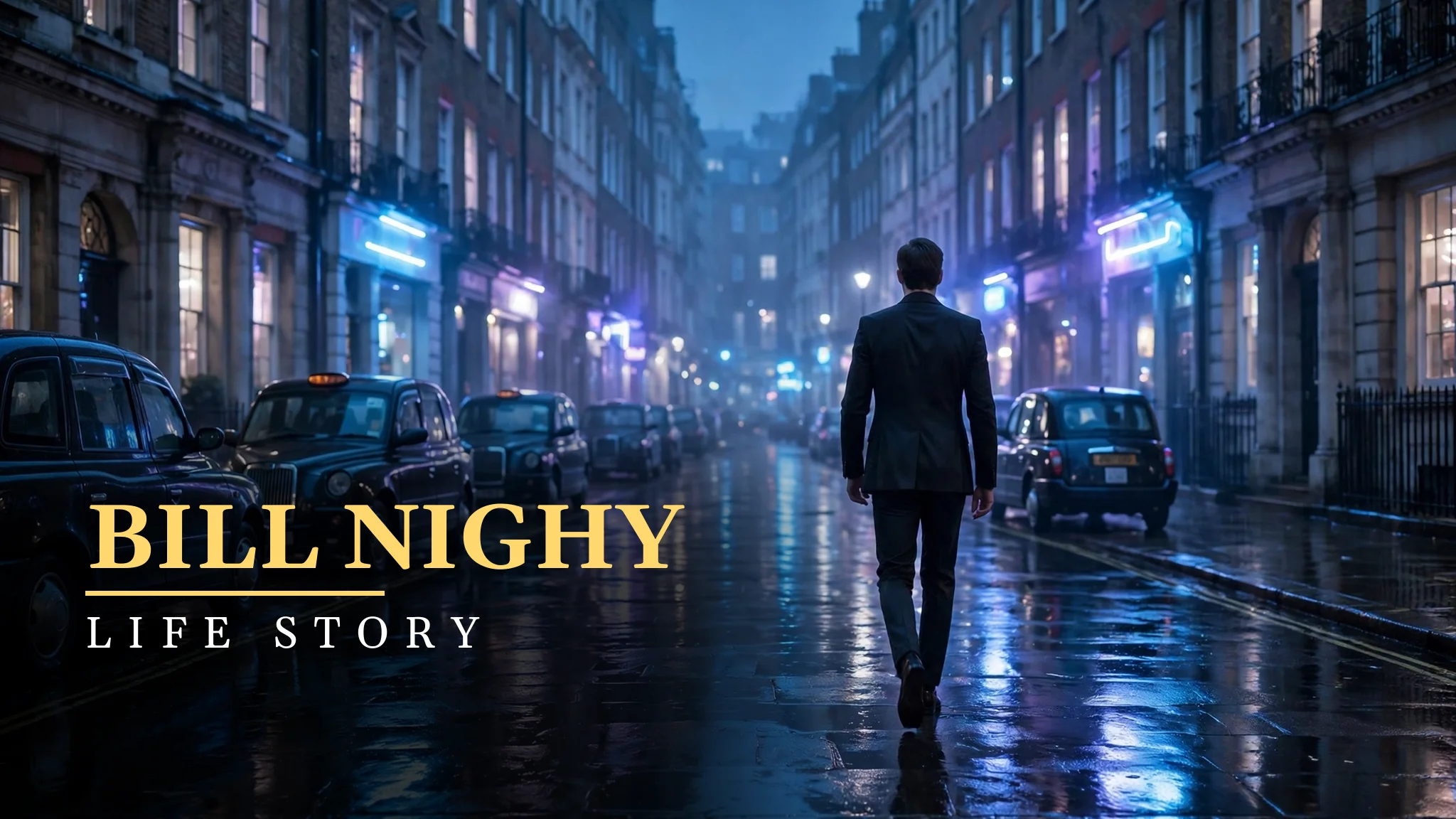
One more thought stays with me, and it is about the quiet power of his voice. I have heard many loud actors, and I have forgotten most of them. Nighy’s voice is calm and clear, and it stays with you. It is the voice of a person who has read the words, understood them, and made them his own. I think that is the best kind of acting, and the best kind of life: not loud, not showy, but true. When I think of him walking down a rain-wet London street at dusk, in a dark suit, with black cabs around him, I think of a man who belongs in that city, and who has earned his place there by a lifetime of honest work.
I also think about how he has shown that an actor can get better with age, and that is a hopeful message for all of us. Many people think that life gets smaller as you get older, but Nighy’s best work has come in his sixties and seventies. He has played fathers, civil servants, rock stars, and sea monsters, and he has done it with a depth that only comes from living a full life. I hope that gives hope to older actors, and to older people in general, because it shows that life does not end at sixty. It can get richer, deeper, and more meaningful, if you keep learning and keep working.
Finally, I think his story is a reminder that the best work is often the quietest. Living is a quiet film, About Time is a quiet film, and many of his best performances are quiet, yet they stay with me longer than loud films. I think we need more quiet work in the world, more stories told with care and with patience, and more actors like Bill Nighy who understand that a small change in the face can say more than a long speech. His career is a long and beautiful example of what happens when talent meets patience, and when hard work meets humour, and I am glad that I have had the chance to learn from it.
I also think about the years he spent in small parts, and how easy it would have been to give up. He could have left the theatre, he could have taken a different job, and no one would have blamed him. He stayed, and he kept learning, and he kept believing that his moment would come. That belief is a kind of faith, and it is one that I admire deeply, because it is the faith of a person who trusts his own talent even when the world does not yet see it.
Another lesson I take from him is about humour in hard times. Billy Mack is funny because he laughs at himself, Mr Williams is moving because he finds hope in a sad situation, and Nighy himself has used humour to get through a life that was not always easy. I think humour is not just a way to make people laugh. It is a way to survive, to keep going, and to find light in dark places, and Nighy has shown that better than almost anyone.
I also think about his daughter Mary, and how proud he must be of her work as a director. It is a wonderful thing when a parent sees a child follow a creative path, and it shows that the love of stories can run through a family. Nighy did not push his daughter into acting, but he gave her an example of how to work with care and with honesty, and that example is a gift that lasts a lifetime.
One more thing stays with me, and it is the image of a man who found school hard and who still became a master of words. I think about all the children who struggle at school, and I hope they hear his story. It tells them that a hard start does not mean a hard end, and that the path to a good life is not always the one that school lays out. Sometimes the path is longer, and sometimes it goes through the theatre, through music, and through hard work, but it can still lead to a place that is good and true.
Frequently Asked Questions
Why did Bill Nighy become famous so late in his career?
He spent decades working in the theatre and in small television parts, and his breakthrough came at fifty-three with Billy Mack in Love Actually, which won him a BAFTA and brought him to a wide film audience.
What did Bill Nighy play in Pirates of the Caribbean?
He played Davy Jones, the captain of the Flying Dutchman, in Dead Man’s Chest and At World’s End, using his voice and movement to bring the computer-created character to life.
Was Bill Nighy nominated for an Oscar?
Yes, he was nominated for the Academy Award for Best Actor for Living in 2022, playing a quiet civil servant who decides to build a playground after learning he is dying.
How did dyslexia affect Bill Nighy’s school years?
He found reading and writing hard at school and left at fifteen with few qualifications, but he later learned to work with dyslexia and built a career on his love of words and language.
What was Bill Nighy’s role in About Time?
He played the father of the hero, a man who can travel in time and who teaches his son how to live a good and happy life, in the 2013 film by Richard Curtis.
Who is Bill Nighy’s daughter?
His daughter is Mary Nighy, who has become a director and actress, and he has spoken with pride about her work in film and theatre.
What award did Bill Nighy win for Love Actually?
He won the BAFTA Award for Best Supporting Actor for playing Billy Mack, the ageing rock star who records a Christmas song in the 2003 film.


