Birgit Minichmayr: The Life Story Behind the Austrian Stage Star
In this post
- A Girl From Linz Who Loved the Stage
- The Max Reinhardt Seminar and Early Theatre Work
- The Burgtheater and a Home on Stage
- Downfall, The White Ribbon, and Film Breakthrough
- Everyone Else and the Silver Bear in Berlin
- Television, Singing, and a Career That Keeps Growing
- A Legacy of Honest Acting and Stage Power
- A Modern Woman on Stage and Screen
- My Take:
Birgit Minichmayr is one of the most respected actresses in Austria today, and she is a woman who has worked on stage, in film, and on television for more than twenty-five years. She was born in Linz, she studied acting in Vienna, she became a star of the Burgtheater, and she went on to win the Silver Bear for Best Actress at the Berlin Film Festival for Everyone Else in 2009. She has worked in films such as The White Ribbon, Downfall, and The Bone Man, and she has become known as an actress who can play complex, intelligent, and often troubled women with great honesty and great power. She is a stage actress at heart, a film actress by talent, and a woman who has built a career that is both serious and varied.
Her story is a story about a young woman from Linz who became a star of the Burgtheater, who won awards in Berlin, who worked with some of the best directors in Europe, and who continues to work today. She is not a star who became famous overnight. She is an actress who learned her craft, who worked in theatre, who waited for the right roles, and who then gave performances that moved audiences and critics. She is a woman who is known for her intelligence, her humour, and her ability to play women who feel real, and she is still at the peak of her career.
This is the story of a girl from Linz who became a Burgtheater star, a Berlin winner, and a film actress who is still working today. It is a story about talent, about hard work, about the stage, and about a woman who has never stopped learning, never stopped working, and never stopped believing in the power of acting.
A Girl From Linz Who Loved the Stage
Birgit Minichmayr was born on 3 April 1977 in Linz, Austria, a city on the Danube, known for its industry, its culture, and its history. She grew up in a family that valued learning and the arts, and she was a girl who liked to perform, who liked to tell stories, and who had a natural gift for acting. She was lively, she was curious, and she was drawn to the theatre from an early age. She watched plays, she listened to stories, and she imagined herself on a stage. She was a young woman who wanted to act, and who was willing to work hard to do it.
As a teenager, she began to think seriously about acting, and she decided to study at the Max Reinhardt Seminar in Vienna, one of the most famous acting schools in the German-speaking world. She was a student who took her craft seriously, who studied, who rehearsed, and who learned from her teachers. She was not a young woman who wanted quick fame. She wanted to learn how to act, how to use her voice, how to move on stage, and how to tell a story with truth. She worked hard, she learned, and she built a strong foundation for her career. She was a student who was ready to work, and who was ready to become a professional actress.
After her studies, she worked in theatres in Vienna and in other cities, and she began to build a reputation as a talented and serious young actress. She played in plays by classical and modern writers, and she was praised for her intelligence, her humour, and her ability to play complex women. She was a young actress with a strong presence, and directors noticed her. She was on her way to becoming a star, and she was doing it with hard work and with talent. She was a girl from Linz who had become a woman of the theatre, and she was just beginning.
The most important thing about those early years is that Minichmayr did not rush. She studied, she worked in theatre, and she formed her own view of acting. She believed that an actor should understand the character, should be honest, and should work hard. That belief stayed with her for the rest of her career, and it is why her performances feel so real and so human. The girl from Linz had become a woman of the stage, and that stage training would guide her work in film and television.
The Max Reinhardt Seminar and Early Theatre Work
Birgit Minichmayr studied at the Max Reinhardt Seminar in Vienna, a school that has trained many of the greatest German-speaking actors, and she learned the craft of acting from some of the best teachers in Austria. She studied voice, movement, and text, and she began to perform in plays while she was still a student. She was a young woman who was serious about her work, who rehearsed a great deal, and who wanted to be the best actress she could be. She was not afraid to work hard, and she was not afraid to take on difficult roles. She was a student who was ready to learn, and who was ready to grow.
After graduating, she worked at the Burgtheater in Vienna, one of the most prestigious theatres in the German-speaking world, and she also worked at the Volkstheater in Vienna. She played in plays by Shakespeare, by Chekhov, by Ibsen, and by modern writers, and she was praised for her power, her intelligence, and her ability to play women who are both strong and vulnerable. She was a stage actress in the truest sense, a woman who could fill a theatre with her presence, and who could make a play feel alive and real. She was learning her craft step by step, and that slow learning gave her a strong foundation.
She also began to work in film and television, and she appeared in small roles that gave her experience. She was a young actress who was building a career, who was working hard, and who was waiting for a bigger role. She was not in a hurry. She wanted to learn, to work, and to become a better actress with each play and each film. She was a woman who believed that acting is a craft that must be learned, practised, and respected, and she lived that belief in her early years. She was a student of acting, and she remained a student throughout her career.
During those years, she also learned about the history of Vienna, about its theatre, and about its culture, and she carried that knowledge into her work. She was a Viennese actress, a woman who knew her city, who walked its streets, and who understood its people. That sense of place is part of her acting, and it makes her performances feel rooted and real. She was not an actress who came from nowhere. She was an actress from Linz who had become a woman of Vienna, and Vienna was in her work, in her voice, and in her way of being.
The Burgtheater and a Home on Stage
In the 2000s, Birgit Minichmayr became one of the leading actresses at the Burgtheater in Vienna, and she also worked at the Volkstheater and at other theatres in Austria and Germany. The Burgtheater is a theatre with a long history, a theatre where the greatest German-speaking actors have worked, and Minichmayr became one of its stars. She played in plays by classical and modern writers, and she was praised for her intensity, her humour, and her ability to play complex women. She was a stage actress who could play queens, mothers, lovers, and fools, and who could make each one feel real.
She worked with great directors, she worked with great actors, and she learned more with each play. She was known as an actress who rehearsed a great deal, who studied her roles, and who gave everything to a performance. She was not an actress who relied on charm alone. She relied on hard work, on discipline, and on a deep understanding of the text. She was a woman who loved the theatre, and who believed that theatre is the most important form of acting, because it is live, it is direct, and it cannot hide. The Burgtheater became her home, and she returned to it again and again throughout her career, even after she became a film star.
She also worked as a singer, performing in concerts and in theatre productions that mixed music and acting. She has a beautiful voice, and she has used it in plays and in concerts, showing that she is not only an actress, but also a singer. She is a woman who loves music, who loves to sing, and who brings that musicality into her acting. She is a complete theatre artist, a woman who can act, sing, and perform, and who does each one with skill. Her work at the Burgtheater gave her a reputation as one of the great stage actresses of her time, and it remains the heart of her career.
Her stage work has won her awards, including the Nestroy Theatre Prize in Austria, one of the highest honours for theatre in the German-speaking world. She is a woman who has been honoured for her stage work, and who is respected by her colleagues. She is a star of the Burgtheater, a woman who has filled its stage with her presence, and a actress who has made theatre her home. That is a remarkable achievement, and it is a legacy that she is proud of.
Downfall, The White Ribbon, and Film Breakthrough
Birgit Minichmayr became known to film audiences when she appeared in Downfall, made in 2004, a film about the last days of Adolf Hitler in Berlin. She played Gerda Christian, one of Hitler’s secretaries, and she gave a quiet and powerful performance in a film that was watched around the world. The film was a success, it was nominated for an Oscar, and it showed that Minichmayr could work in a big international film, in a difficult historical story, and hold her own with great actors. She was a stage actress who had become a film actress, and she was ready for more.
She followed that with The White Ribbon, made in 2009 and directed by Michael Haneke, a black-and-white film about a small German village before the First World War. She played Frieda, a midwife, and she gave a performance that was praised for its honesty and its power. The film won the Palme d’Or at Cannes, and it was nominated for an Oscar, and it made Minichmayr known to audiences around the world as an actress who could work with one of the greatest directors in Europe. She was a woman who had worked with Haneke, a director known for his serious and challenging films, and she had succeeded. That is a sign of a great actress.
In the same year, she starred in Everyone Else, directed by Maren Ade, a film about a young couple on holiday in Sardinia, whose relationship is tested by jealousy, by insecurity, and by the pressure to be happy. Minichmayr played Gitti, a woman who is lively, funny, and also vulnerable, and her performance won the Silver Bear for Best Actress at the Berlin Film Festival in 2009. It was a huge honour, and it made her a star in world cinema. The film is a quiet and honest look at a relationship, and Minichmayr’s performance is at its centre, full of life, full of feeling, and full of truth. It remains one of her most famous roles, and it is still praised today.
These films made her a film star, and they showed that she could play many kinds of women, in many kinds of films, with great skill. She was not a simple film star. She was a serious actress who chose roles that mattered, who worked with great directors, and who gave performances that were honest and powerful. Her film breakthrough was not based on one film. It was based on a series of films that showed her range, her talent, and her ability to play real women in real situations. She was a Burgtheater actress who had become a world-famous film actress, and she had done it with talent and with hard work.
Everyone Else and the Silver Bear in Berlin
Everyone Else, made in 2009, is the film that won Birgit Minichmayr the Silver Bear for Best Actress at the Berlin Film Festival, and it is a film that deserves to be remembered. It tells the story of Gitti and Chris, a young couple on holiday, who are happy at first, but who begin to argue, to feel insecure, and to test each other. Minichmayr plays Gitti with a warmth, a humour, and a vulnerability that makes the character feel real. She is a woman who wants to be loved, who wants to be happy, and who is also afraid of losing what she has. Her performance is funny, sad, and honest, all at the same time, and it is a masterclass in acting.
The film was directed by Maren Ade, a German director known for her honest and funny films about relationships, and it was praised by critics for its realism. It is a film that does not use tricks or effects. It uses two actors, a simple story, and a quiet camera, and it tells the truth about love. Minichmayr’s performance won the Silver Bear, one of the highest honours at Berlin, and it made her a star in European cinema. It was a recognition of her talent at a time when she was at her peak, and it showed that the film world had accepted her as one of its great actresses.
The win also showed her ability to play a modern woman, a woman of today, not only a historical figure. She could play Gitti, a young woman on holiday, with the same skill that she played a secretary in Downfall or a midwife in The White Ribbon. That range is rare, and it is a sign of a great actress. She is not limited to one kind of role. She can play many kinds of women, in many kinds of films, and she can make each one feel real. Everyone Else is a film about love, about jealousy, and about the difficulty of being happy, and Minichmayr’s performance is the heart of it.
After Everyone Else, she continued to work in film and television, and she became known as an actress who could carry a film, who could play a leading role, and who could win awards. She was a woman who had won at Berlin, who had worked with Haneke, and who had become a star, but she did not let that fame change her. She returned to the Burgtheater, she continued to work on stage, and she chose roles that mattered to her. She was a film star who remained a theatre actress, and that balance made her special.
Television, Singing, and a Career That Keeps Growing
In recent years, Birgit Minichmayr has worked in television, in film, and on stage, and she has continued to build a career that is varied and interesting. She has appeared in television series and films in Austria and Germany, she has played in comedies, dramas, and thrillers, and she has shown that she can do it all. She is a versatile actress, a woman who is not afraid to try new things, and who is willing to take on roles that challenge her. She has played mothers, wives, detectives, and women in many different jobs, and she has played them all with warmth and with honesty.
She has also performed as a singer, in concerts and in theatre productions, and she has shown that she has a beautiful voice and a love of music. She has sung in plays, in concerts, and in recordings, and she has combined music and acting in a way that is rare. She is a woman who loves to perform, whether on stage, on screen, or in a concert hall, and that love shows in her work. She is a complete artist, a woman who can act, sing, and perform, and who does each one with skill and with joy.
She lives in Vienna, she works, and she continues to be a presence in Austrian culture. She is a woman who has spent her life in art, who has worked on stage, in film, and on television, and who is still working today. She is in her forties, she is at the peak of her career, and she has many more years of work ahead of her. She is a star who is still growing, still learning, and still finding new roles. Her story is still going on, and her work is still being made. She is a testament to the power of patience, of hard work, and of a love of art that never fades.
Her later work includes films such as The Bone Man, a crime film based on the novel by Wolf Haas, and many other films in Austria and Germany. She has worked with directors in many countries, and she has become known as an actress who is reliable, talented, and professional. She is a woman who is respected by her colleagues, loved by audiences, and honoured with awards. She is a star who has built a career that is both serious and varied, and who continues to build it with each new role.
A Legacy of Honest Acting and Stage Power
Birgit Minichmayr’s legacy is a legacy of honest acting, of stage power, and of a career that is still growing. She is one of the great stage actresses of her time, a woman who has filled the Burgtheater with her presence, and a film actress who has won the Silver Bear in Berlin. She showed that a stage actress can become a film star, and that a film star can return to the stage, and that both are part of the same art. She is a woman who has worked in theatre, film, and television, and who has succeeded in all three, and that is a legacy that matters.
Her legacy is also in the roles she has played, in Gitti in Everyone Else, in Frieda in The White Ribbon, in Gerda in Downfall, and in many other women who feel real. She has played women who are funny, sad, strong, and vulnerable, and she has played them with honesty. That honesty is her true legacy, and it is a lesson for young actors: be honest, be real, and the audience will feel it. She is a woman who has given her heart to her work, and her work shows it.
She is remembered in Austria as a great actress, a singer, and a cultural figure. Her name is associated with the Burgtheater, with the Silver Bear, and with a long career that is still going on. She is a daughter of Linz who became a star of Vienna, and a star of the world, and she did it with talent, with hard work, and with a love of acting. That is a legacy worth celebrating, and a life worth honouring, even as it continues.
A Modern Woman on Stage and Screen
Birgit Minichmayr is known for playing modern women, women of today, who are funny, sad, strong, and vulnerable, all at the same time. Her role as Gitti in Everyone Else is a perfect example: Gitti is a young woman on holiday, who wants to be loved, who is insecure, who is jealous, and who is trying to be happy. Minichmayr plays her with an honesty that makes the character feel real, because she does not hide Gitti’s flaws. She shows them, and she shows that a woman can be imperfect and still be loved. That honesty is a rare gift, and it is why her performance won the Silver Bear in Berlin. She is an actress who is not afraid to show a woman as she really is, with all her feelings, and that courage makes her work powerful.
Her work in theatre also shows that modern sensibility. She plays in plays by contemporary writers, she plays women who are dealing with modern life, with work, with love, and with family, and she does it with a humour and a intelligence that makes her performances feel fresh. She is not an actress who only plays historical figures. She plays women of today, and she does it with a skill that makes audiences recognise themselves in her characters. That recognition is a gift, because it makes theatre and film feel relevant, not distant. She is a woman who speaks to her time, and who does it with honesty.
Her singing also shows that modern sensibility. She performs in concerts, she sings songs that are both classical and modern, and she combines music and acting in a way that is fresh and exciting. She is a complete artist, a woman who can act, sing, and perform, and who does each one with skill and with joy. She is a star who is still growing, still learning, and still finding new ways to express herself, and that growth is a part of her legacy. She is not stuck in the past. She is a woman of today, and she is still making work for today.
My Take:
When I think about Birgit Minichmayr, I think about honesty, and I think about a woman who plays real women, not perfect women. She played Gitti in Everyone Else with a warmth, a humour, and a vulnerability that made me feel like I knew her. Gitti is not a perfect woman. She is funny, she is insecure, she is jealous, she is loving, and she is trying to be happy. Minichmayr played her with all of those feelings, without hiding any of them, and that honesty is a rare gift. I admire her for not trying to be perfect on screen, for showing a woman as she really is, with all her flaws and all her strengths. That is a brave way to act, and it is a way that makes audiences feel less alone, because they see themselves in her.
I think about her stage work, about the Burgtheater, and I am struck by how important theatre is to her. She studied at the Max Reinhardt Seminar, she worked at the Burgtheater, she won the Nestroy Theatre Prize, and she returns to the stage again and again, even after she became a film star. That loyalty to theatre tells me that she is a woman who cares about her craft, not only about fame. Theatre is live, it is honest, and it cannot hide. It asks an actor to be present, to be real, and to work with other actors in real time. Minichmayr understands that, and she stays true to it. I respect that, because it shows that she is a serious artist, not only a star. She is a woman who loves the stage, and who will not leave it.
What moves me most is Everyone Else, and the Silver Bear she won in Berlin. It is a film about a couple on holiday, about love, about jealousy, and about the difficulty of being happy. It is a simple story, but Minichmayr makes it feel profound, because she plays Gitti with such honesty. She shows a woman who wants to be loved, who is afraid of losing love, and who tries to be happy even when it is hard. That is a story that many people know, because we have all been in a relationship that is both happy and hard. Minichmayr’s performance reminds us that love is not simple, that it takes work, and that it is worth working at. I think that is a beautiful and important lesson, and it is why her performance won the Silver Bear.
I also think about her work with Michael Haneke in The White Ribbon, and I am impressed that she could work with a director known for his serious and challenging films. Haneke is a director who asks a great deal of his actors, who wants them to be quiet, to be real, and to trust silence. Minichmayr did that, and she gave a performance that was praised. That shows that she is an actress who can work with the best directors, who can meet a challenge, and who can succeed. I respect her for taking on difficult roles, for working with difficult directors, and for not choosing only easy work. She chooses work that matters, and that choice makes her career richer.
There is something else I keep thinking about, and it is her singing. She is not only an actress. She is also a singer, a woman with a beautiful voice who performs in concerts and in theatre. That musicality is a gift, and it makes her acting more musical, with a sense of rhythm, a sense of timing, and a sense of flow. She is a complete artist, a woman who can act, sing, and perform, and who does each one with skill. I think that is a lesson: your other talents can make your main work better. Minichmayr’s singing makes her acting better, and her acting makes her singing better. That is a beautiful combination, and it is a sign of a true artist.
I think about her background, about a girl from Linz who became a star of Vienna, and I find it inspiring. She did not come from Vienna. She came from Linz, a city on the Danube, and she had to work her way up. She studied, she worked in theatre, she built her career step by step, and she became a leading actress at the Burgtheater. That is a long journey, and it took hard work, discipline, and a love of acting. I respect that, because it shows that talent can come from anywhere, and that hard work matters more than where you were born. She was a girl from Linz who became a woman of the stage, and that story is inspiring for anyone who comes from a small place and dreams of a bigger stage.
If I compare Minichmayr with other actresses, I think what makes her special is her honesty. She does not pretend to be perfect. She plays women who are flawed, who are funny, who are sad, and who are trying their best, and she plays them with an honesty that makes you care for them. That honesty is rare, and it is why her performances are so moving. In a world where many actresses try to be glamorous and perfect, Minichmayr is real, and real is refreshing. I think that is a lesson for all of us: be real, be honest, and people will love you for it, even if you are not perfect.
For a young reader, I think the lesson is to be honest in your work, to learn your craft, and to stay true to the stage, to the theatre, and to the art that you love. Minichmayr learned her craft at the Max Reinhardt Seminar, she worked in theatre, she won awards, and she became a film star, but she never left the stage. She stayed true to theatre, even after film made her famous. That tells me that if you love something, you should stay with it, even when other opportunities come. Theatre was her first love, and it remains her first love, and that loyalty has made her career stronger, not weaker. That is a lesson worth remembering.
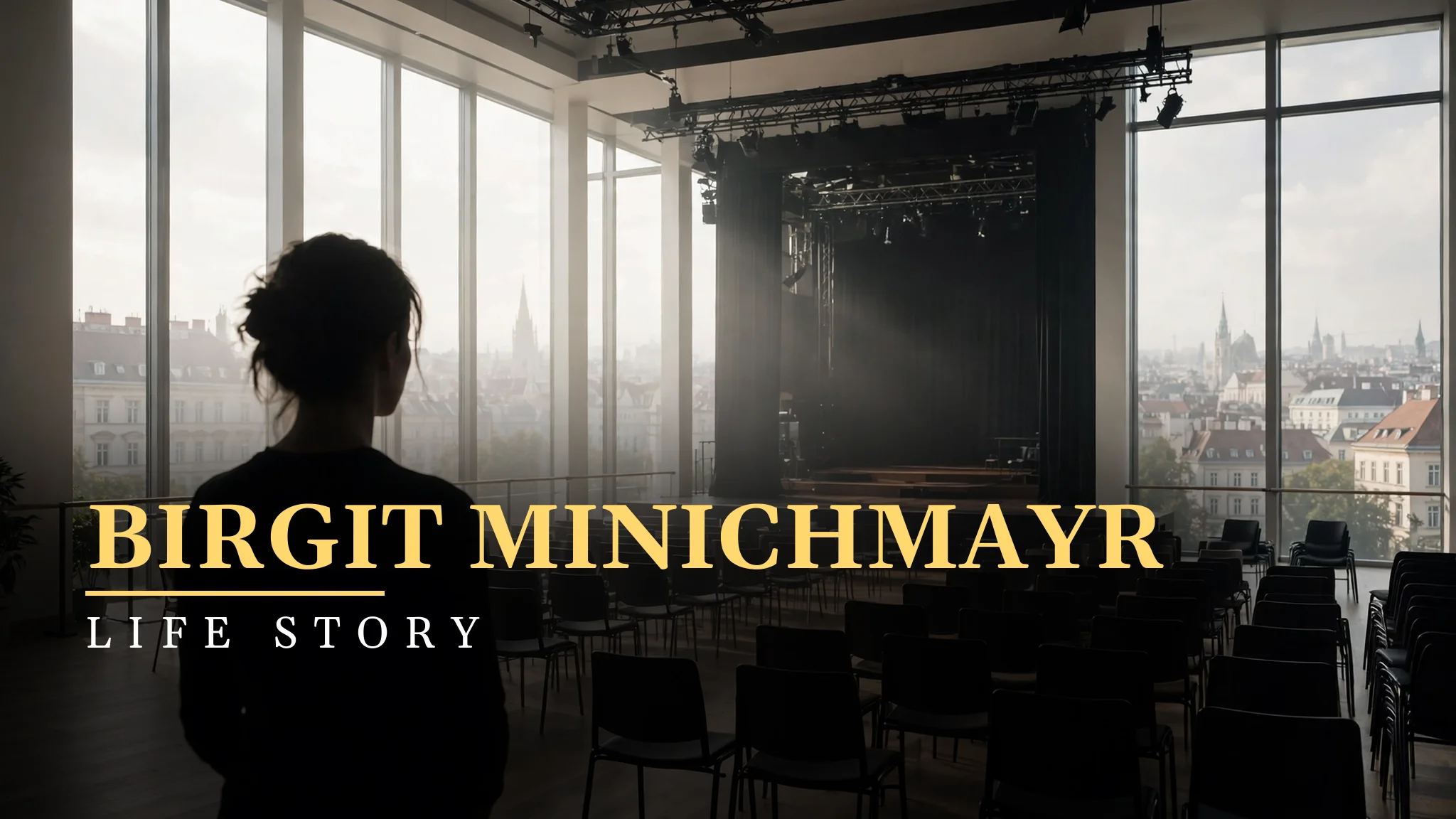
I keep thinking about the image of Minichmayr standing in a bright modern theatre hall, looking at an empty stage, and I think it fits her. She is a woman who looks at a stage and sees possibilities, who stands in a hall full of chairs and imagines an audience, and who is not afraid to be alone with her thoughts before a performance. That image is a symbol of her life: a woman who has spent her life on stage, who has faced audiences, who has told stories, and who has done it with honesty and with power. I wish her well, I wish her more work, and I wish her a life where she can continue to act, to sing, and to be herself. She is a star who is still growing, and she deserves to be celebrated for that.
In the end, I think Birgit Minichmayr teaches us that honesty is the most powerful tool an actor can have, that theatre matters, and that a life spent in art, with discipline, with honesty, and with a love of the stage, is a good life. She was a girl from Linz who became a star of the Burgtheater, a Berlin winner, and a film actress who is still working today. She did not have a short or simple career. She had a long, rich, and varied career, and she is still living it. That is a legacy I respect, and a life I want to honour.
One more thought stays with me, and it is about Gitti in Everyone Else, about a woman who wants to be happy, who is afraid, and who keeps trying. That is a story that many of us know, because we all want to be happy, we are all afraid sometimes, and we all keep trying. Minichmayr’s performance reminds us that it is okay to be imperfect, to be insecure, and to keep trying. That is a comforting thought, and it is a gift from an actress who understands what it means to be human. I am grateful for her honesty, and for the work she has given us.
I think about Birgit Minichmayr’s honesty, and I realise how much it matters. She plays women who are imperfect, who are funny, sad, strong, and vulnerable, and she does it without hiding their flaws. Gitti in Everyone Else is not a perfect woman. She is insecure, jealous, loving, and trying to be happy, and Minichmayr shows all of that. That honesty is a brave way to act, and it is a way that makes audiences feel less alone, because they see themselves in her. I admire her for not trying to be perfect on screen, for showing a woman as she really is. That is a gift, and it is a lesson: be real, be honest, and people will love you for it.
I also think about her stage work, about the Burgtheater, and about how important theatre is to her. She studied at the Max Reinhardt Seminar, she worked at the Burgtheater, she won the Nestroy Theatre Prize, and she returns to the stage again and again, even after she became a film star. That loyalty to theatre tells me that she is a woman who cares about her craft, not only about fame. Theatre is live, it is honest, and it cannot hide. It asks an actor to be present, to be real, and to work with other actors in real time. Minichmayr understands that, and she stays true to it. I respect that, because it shows she is a serious artist, not only a star.
There is a musicality in her work that I love, a musicality that comes from her singing. She has a beautiful voice, she performs in concerts, and she brings that music into her acting, with a sense of rhythm, timing, and flow. She is a complete artist, a woman who can act, sing, and perform, and who does each one with skill. I think that is a lesson: your other talents can make your main work better. Minichmayr’s singing makes her acting better, and her acting makes her singing better. That combination is rare and beautiful, and it is a sign of a true artist.
I think about her background, about a girl from Linz who became a star of Vienna, and I find it inspiring. She did not come from Vienna. She came from Linz, a city on the Danube, and she had to work her way up. She studied, she worked in theatre, she built her career step by step, and she became a leading actress at the Burgtheater. That is a long journey, and it took hard work, discipline, and a love of acting. I respect that, because it shows that talent can come from anywhere, and that hard work matters more than where you were born. She was a girl from Linz who became a woman of the stage, and that story is inspiring.
Another thought stays with me, and it is about her work with Michael Haneke in The White Ribbon. Haneke is a director who asks a great deal of his actors, who wants them to be quiet, to be real, and to trust silence. Minichmayr did that, and she gave a performance that was praised. That shows she is an actress who can work with the best directors, who can meet a challenge, and who can succeed. I respect her for taking on difficult roles, for working with difficult directors, and for not choosing only easy work. She chooses work that matters, and that choice makes her career richer.
I keep thinking about the image of Minichmayr standing in a bright modern theatre hall, looking at an empty stage, and I think it fits her. She is a woman who looks at a stage and sees possibilities, who stands in a hall full of chairs and imagines an audience, and who is not afraid to be alone with her thoughts before a performance. That is a symbol of her life: a woman who has spent her life on stage, who has faced audiences, who has told stories, and who has done it with honesty and power. I wish her well, and I hope she continues to act, to sing, and to be herself for many more years.
Frequently Asked Questions
When was Birgit Minichmayr born?
Birgit Minichmayr was born on 3 April 1977 in Linz, Austria, and she studied acting at the Max Reinhardt Seminar in Vienna.
What film won Birgit Minichmayr the Silver Bear?
She won the Silver Bear for Best Actress at the Berlin Film Festival in 2009 for Everyone Else, directed by Maren Ade, in which she played Gitti, a young woman on holiday with her partner.
What role did Birgit Minichmayr play in The White Ribbon?
In The White Ribbon, made in 2009 and directed by Michael Haneke, she played Frieda, a midwife in a small German village before the First World War. The film won the Palme d’Or at Cannes.
What role did Birgit Minichmayr play in Downfall?
In Downfall, made in 2004, she played Gerda Christian, one of Hitler’s secretaries, in a film about the last days of Adolf Hitler in Berlin that was nominated for an Oscar.
Where does Birgit Minichmayr work in theatre?
She is a leading actress at the Burgtheater in Vienna, and she has also worked at the Volkstheater in Vienna and at other theatres in Austria and Germany, winning the Nestroy Theatre Prize.
Is Birgit Minichmayr also a singer?
Yes, she has a beautiful voice and has performed as a singer in concerts and in theatre productions, combining music and acting in her work.
Is Birgit Minichmayr still acting today?
Yes, she continues to act on stage, in film, and on television in Austria and Germany, and she remains one of Austria’s most respected actresses.


