Bob Geldof: The Life Story Behind the Live Aid Star
In this post
Bob Geldof is one of those rare people whose name means two very different things at once. To some, he is the sharp-tongued singer of the Boomtown Rats, a Dublin band that made loud, clever rock songs in the late 1970s. To many more, he is the man who looked at pictures of starving children on the evening news and decided that doing nothing was not an option. He picked up a telephone, called the biggest pop stars in Britain, and built Band Aid and Live Aid out of nothing but anger, energy, and a stubborn belief that music could feed people.
His story is not a smooth climb from fame to fame. It is a story of a boy who lost his mother young, a young man who left Ireland to find work, a singer who had a number one song and then watched his band fade, and a campaigner who was praised, mocked, honoured, and doubted, often in the same week. He has been called a saint and a show-off, a hero and a nuisance. The truth is simpler and more interesting. He is a man who feels things loudly and acts on them quickly, and who has spent most of his life trying to turn that feeling into something useful.
What follows is the full arc of that life, from a seaside town near Dublin to the biggest concert the world had ever seen, and then into the long years afterwards, when the cameras moved on but the work did not stop. It is a story about music, about grief, about family, and about what happens when one person refuses to accept that a terrible thing is simply the way the world is.
Growing Up in Dublin
Robert Frederick Zenon Geldof was born on 5 October 1951 in Dun Laoghaire, a seaside town just south of Dublin in Ireland. His father, Robert, worked in the catering business, and his mother, Evelyn, kept the home. The family was not wealthy, and life in post-war Ireland was plain and often hard. Bob was still a small boy when his mother died, and that early loss left a mark on him that he has spoken about many times since. A home without a mother changes a child. It makes the world feel less safe, and it can make a person grow up faster than they should.
As a boy, he went to Blackrock College, a well-known school in Dublin. He was not a quiet pupil who sat at the back and did as he was told. He was restless, funny, argumentative, and full of opinions. Teachers found him bright but difficult, and he found school dull and narrow. He liked music, he liked words, and he liked the feeling of being in a room where something exciting was happening. The Ireland of his youth was a small, careful place in many ways, and a boy with big ideas could feel trapped by it. Bob Geldof did not want a small life. He wanted noise, travel, and a stage.
When he left school, he did not follow a straight path into a job or a university course. He drifted, as many young people do, and he tried different kinds of work. He was drawn to music and to writing, and he was drawn to the idea of leaving Ireland to see the wider world. In the early 1970s, he travelled and worked abroad, including a spell in Canada, where he worked as a music journalist. That job mattered more than it might seem. It taught him how the music business worked from the inside, it taught him how to write clearly and quickly, and it put him close to the bands and singers he admired. He was learning the trade from the other side of the stage.
By the middle of the 1970s, he was back in Dublin, and the city was changing. Punk music was arriving from London and New York, and young Irish bands were starting to play louder, faster, and more honestly than before. Geldof had the voice, the looks, and the nerve to stand at the front of a band, and he had a group of friends who wanted the same thing. In 1975, he formed the Boomtown Rats with a group of Dublin musicians. The name was bold, the attitude was bolder, and the band set out to make music that would not be ignored. The boy from Dun Laoghaire had found his direction at last.
The Boomtown Rats Take Off
The Boomtown Rats began as a Dublin pub and club band, playing hard and building a following the slow way, one gig at a time. Geldof was the frontman, and he was not a shy one. He prowled the stage, he argued with the audience, he spat out lyrics, and he made every show feel like an event. The band mixed punk energy with a love of melody and a sharp, clever way with words. They were not trying to sound like everyone else. They were trying to sound like themselves, and in the late 1970s, that was enough to get noticed.
Their break came when they moved to London and signed a record deal. In 1978, their song Rat Trap reached number one in the British charts, making them the first Irish band to have a number one single in Britain. It was a huge moment for a group from Dublin, and it changed their lives overnight. They were no longer a club band. They were chart stars, they were on television, and they were being asked to tour, to record, and to keep the hits coming. Geldof, who had always wanted a bigger life, now had one, and he threw himself into it with everything he had.
The band followed Rat Trap with more hit songs, and their live shows became famous for their energy. Geldof wrote lyrics that were angry, funny, and observant, and he sang them as if he meant every word. He was not a smooth pop star. He was a rough-edged, plain-speaking Irishman, and audiences liked that honesty. The Boomtown Rats toured Britain, Europe, and America, and for a few years they were one of the most talked-about bands in the country. The young man who had once written about other bands was now the one other people wrote about.
But fame in the music business is never simple, and the Rats were already learning that lesson. Hits are hard to repeat, tastes change fast, and a band that feels new one year can feel old the next. Geldof was also starting to think about things beyond the next single. He acted in the film version of Pink Floyd’s The Wall in 1982, playing the lead role of Pink, and the experience showed him that he could work outside music. It also showed him a different kind of audience, and a different kind of pressure. The band was still going, but the world around it was shifting, and Geldof was shifting with it.
I Don’t Like Mondays and a New Kind of Fame
The Boomtown Rats’ most famous song arrived in 1979, and it came from a terrible event on the other side of the world. In San Diego, in the United States, a sixteen-year-old girl had opened fire at a school, and when she was asked why she had done it, she said she did not like Mondays. Geldof read the story and wrote a song around that chilling line. I Don’t Like Mondays became a number one hit in Britain, and it is still the song most people think of first when they hear his name. It was a strange kind of success, because the song was built on a tragedy, and Geldof knew it. He did not treat it as a joke. He treated it as a way of looking at a senseless act and trying to understand it.
The song showed what Geldof did best as a writer. He took a real event, he found the human detail inside it, and he turned it into something people could not forget. It also showed the limits of pop fame. A song about a school shooting could be a hit, but it could not explain the shooting, and it could not bring anyone back. Geldof was learning that music could catch people’s attention, but attention on its own was not enough. That lesson would matter a great deal a few years later, when a different kind of tragedy filled the television news.
By the early 1980s, the Boomtown Rats were fading from the charts. Their later records sold less, the tours grew smaller, and the band finally broke up in 1986. Geldof began a solo career, releasing albums such as Deep in the Heart of Nowhere in 1986, but his solo records never reached the same heights as the band’s best work. For many singers, that would have been the end of the story, a slow slide from the charts into nostalgia. For Geldof, it was the start of a second life, one that would make him far more famous than any song ever had.
The change began in October 1984, when the BBC broadcast a report by Michael Buerk about a terrible famine in Ethiopia. Geldof watched pictures of starving children, of mothers holding babies who were too weak to cry, and he was furious. He did not turn the television off and forget about it. He began to ask what could be done, and he began to call people. He had spent years in the music business, he knew the biggest stars in Britain, and he knew how to make a record. The idea that formed in his mind was simple and bold. Get the biggest names in pop music into one studio, record one song, and give every penny to famine relief.
Band Aid and the Christmas Song That Changed Everything
Geldof’s first call was to Midge Ure, the singer and musician from the band Ultravox, and together they wrote a song called Do They Know It’s Christmas? It was a Christmas song, but it was not a comfortable one. It asked listeners to think about people who had no food, no water, and no Christmas at all, and it asked them to give. Geldof then spent days on the telephone, calling singers, managers, and record companies, begging, bullying, and charming them into taking part. Some said yes at once. Some needed more persuading. A few said no. But by late November 1984, an extraordinary group of stars had agreed to gather in a London studio for one day.
The recording session took place on 25 November 1984 at Sarm West Studios in London. The list of singers who turned up reads like a roll call of British pop in the 1980s, including Paul McCartney, David Bowie, Phil Collins, George Michael, Sting, Bono, and many more. Geldof ran the day with a mix of energy and impatience, and the recording was finished in a single day. The record was released in early December, and it went straight to number one in Britain, where it stayed for five weeks over Christmas. It became one of the biggest-selling singles in British history, and it raised millions of pounds for famine relief in Ethiopia.
The success of Band Aid changed Geldof’s life completely. He was no longer just a singer. He was a public figure, a campaigner, and a man who was expected to have an answer to every question about Africa, aid, and poverty. He travelled to Ethiopia himself, and what he saw there stayed with him for the rest of his life. He met families who had lost everything, he saw aid workers doing their best with far too little, and he came home more determined than ever. He was not a politician, and he was not an aid expert, but he had a gift that politicians and experts often lacked. He could make millions of ordinary people care, and he could make them act.
In 1986, he was made an honorary Knight Commander of the Order of the British Empire, a rare honour for an Irish citizen. He could not use the title Sir, because he was not a British citizen, but the honour showed how far his work had reached. By then, however, Geldof was already thinking about something even bigger than a single record. A song could raise money, but a concert watched by the whole world could raise far more, and it could put pressure on governments as well as on ordinary listeners. The idea that would become Live Aid was already forming in his mind.
Live Aid: One Day, Two Stages, the Whole World
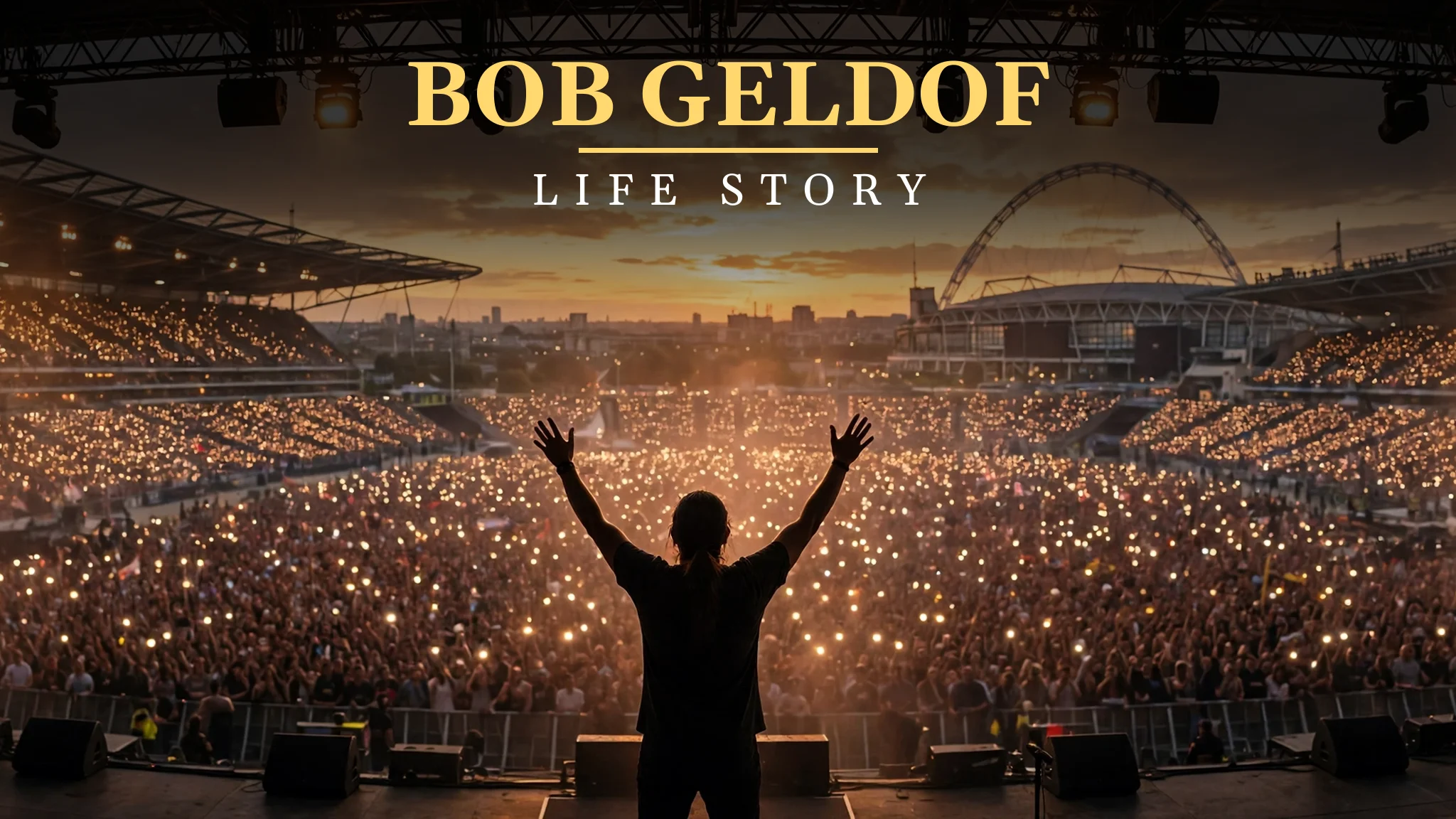
Live Aid took place on 13 July 1985, and it was the biggest live music event the world had ever seen. There were two main concerts, one at Wembley Stadium in London and one at the John F. Kennedy Stadium in Philadelphia in the United States, linked by satellite so that audiences in both cities, and viewers around the world, could watch the same day unfold. The list of performers was extraordinary, from Queen and U2 to David Bowie, Elton John, Madonna, and Paul McCartney. Millions of people watched on television, and millions more listened on the radio, in an age before the internet made such shared moments common.
Geldof was at the centre of it all, not as a singer, but as the driving force. He had spent months organising the event, arguing with promoters, begging stars to take part, and dealing with the huge practical problems of staging two stadium concerts on the same day. On the day itself, he was everywhere, introducing acts, talking to the cameras, and pleading with viewers to give money. His most famous moment came during the BBC broadcast, when he spoke directly to the audience at home and asked them to send money, in language that was blunt, urgent, and impossible to ignore. People responded, and the phones rang all day.
The concert raised tens of millions of pounds, and the exact total grew as money kept coming in afterwards. But the money was only part of the story. Live Aid changed the way the world thought about famine and about aid. It showed that ordinary people, moved by music and by pictures, could raise huge sums, and it showed that governments could be pushed to do more. It also made Geldof a global figure. He was now known in every country that had a television, and he was expected to keep campaigning for the rest of his life. That expectation would bring him praise, but it would also bring criticism, exhaustion, and a sense that his own life had been taken over by a cause.
For Geldof, the day itself was a blur of noise, heat, and pressure. He has said since that he barely had time to enjoy the music, because he was always thinking about the next problem, the next act, the next appeal for money. But when Queen played their famous set at Wembley, and when the crowd sang along to the final songs, even he must have known that something extraordinary had happened. A Dublin singer who had once played in pubs had helped to build a day that the whole world watched, and the world had answered.
Love, Loss, and a Campaigner Who Would Not Stop
Away from the stage, Geldof’s personal life was full of love and pain in equal measure. In 1986, he married the television presenter Paula Yates, and the couple had three daughters together, Fifi, Peaches, and Pixie. The marriage was lively and public, and for a time it seemed like a glamorous match. But it ended in divorce in 1996, and the years that followed were difficult. Paula Yates later became involved with Michael Hutchence, the singer of INXS, and after both Yates and Hutchence died, Geldof took on the care of their daughter, Tiger Lily, raising her alongside his own children. It was a generous and difficult thing to do, and it showed a side of him that the public rarely saw.
The hardest blow came in April 2014, when his daughter Peaches died at the age of twenty-five. Her death, from a drug overdose, was a shock to the family and to the public, and Geldof spoke about it with a raw honesty that moved many people. He had already lost his mother young, he had seen terrible suffering in Africa, and now he had lost a child. Grief became part of his story, not as a headline, but as a private wound that he carried into his public work. He did not hide from it, and he did not pretend that fame or money could protect a family from pain.
Through all of this, he kept campaigning. In 2005, twenty years after Live Aid, he helped to organise Live 8, a series of concerts held around the world to put pressure on world leaders meeting at the G8 summit in Scotland. The aim was not just to raise money, but to change policy, to cancel the debts of poor countries, and to increase aid. The concerts were watched by millions, and the campaign, known as Make Poverty History, became one of the biggest public movements of its time. Geldof was again at the centre, older now, greyer, but just as direct and just as impatient with delay.
In his later years, he has continued to work as a musician, a writer, and a businessman, and he has continued to speak out on poverty, on Africa, and on the duties of rich countries to poor ones. He has been praised for his energy and criticised for his style, and he has accepted both. The Boomtown Rats have reunited from time to time, and Geldof has toured with them, returning to the songs that first made him famous. The boy from Dun Laoghaire is now an older man, but the restless energy is still there, and so is the belief that one person, properly angry, can change the conversation.
The Solo Years and a Life in the Public Eye
After the Boomtown Rats broke up, Bob Geldof had to work out who he was without a band behind him. He released solo albums, he toured as a solo artist, and he played smaller venues than the ones he had filled with the Rats. The crowds were smaller, the money was less, and the attention was different. Some singers would have found that hard to accept, and Geldof did find it hard at times, but he kept working. He wrote songs, he played them live, and he reminded himself that he had started as a singer in Dublin pubs, and that a small room with a good audience was still a good place to be.
His solo records, including Deep in the Heart of Nowhere and The Vegetarians of Love, showed a different side of his songwriting. The songs were more reflective, more personal, and less angry than the Rats’ best work. They were about love, about getting older, about home, and about the world as he saw it in his thirties and forties. They did not sell in the numbers his old band had sold, but they mattered to the people who heard them, and they showed that Geldof was still a writer, not just a campaigner who happened to have been in a band.
He also worked as a writer and as a businessman, and he appeared on television and in the press, often talking about Africa, about aid, and about politics. He was a familiar face on British television, a man with strong opinions and a direct way of expressing them. Some people loved that directness. Others found it abrasive. Geldof did not seem to mind either way. He had learned, during the Band Aid years, that if you want to change something, you have to be willing to annoy people, and he was willing.
In the 1990s and 2000s, he reunited with the Boomtown Rats from time to time, playing festival shows and reunion concerts that were greeted with warmth by old fans. The band’s songs, Rat Trap and I Don’t Like Mondays, still sounded good, and Geldof still sang them with energy. Those reunion shows were a reminder that, before he was a campaigner, he was a singer, and that the singer was still there, under the campaigner, waiting for a stage and a crowd.
My Take:
When I think about Bob Geldof, the first thing I feel is respect, and the second thing is a kind of tiredness on his behalf. Respect, because he saw something terrible on television and did not look away. Tiredness, because I can imagine how heavy it must be to carry a cause for forty years, to be asked about it at every interview, to be praised one day and attacked the next, and to keep going anyway. Most people have a strong feeling about something and then move on. Geldof had a strong feeling and built his whole life around it, and that takes a different kind of strength.
I admire the way he used what he had. He was not a rich man, he was not a politician, and he was not an expert on Africa. He was a singer with a telephone and a list of contacts, and he used those two things to do something no government had done. That is a useful lesson for anyone who feels too small to make a difference. You do not need to be the most powerful person in the room. You need to know what you can do, and you need to do it with everything you have. Geldof knew he could make a record, he knew he could fill a stadium, and he knew how to talk to a camera. He used all three, and millions of people lived because of it.
I also admire his honesty as a songwriter, especially in I Don’t Like Mondays. It would have been easier to write a simple love song or a party song, and he had done plenty of those. Instead, he took a frightening news story and turned it into a song that made people stop and think. I think that is what good songwriting should do. It should not just entertain you for three minutes. It should leave something in your mind that stays there after the music stops. That song has stayed in people’s minds for more than forty years, and it still feels uncomfortable to hear, which is exactly the point.
What I find hard in his story is the price he paid for his fame as a campaigner. After Live Aid, he could never go back to being just a singer. Every interview became about famine, about aid, about politics, and about whether he was doing enough. That is a heavy burden to carry, and I think it is unfair in some ways. He was a pop star who tried to help, not a head of state. He could not fix Africa on his own, and no one person could. Yet people expected him to have answers to problems that had defeated governments for decades. I think he handled that pressure with remarkable patience, but it must have been exhausting, and I suspect it cost him parts of his private life that he would have liked to keep.
His family story moves me a great deal, especially the way he took in Tiger Lily after the deaths of Paula Yates and Michael Hutchence. That was not a public gesture. It was a private decision to look after a child who had lost both parents, and to raise her alongside his own daughters. I think that tells me more about the man than any award or concert ever could. It is easy to be generous on a stage, in front of cameras, when everyone is watching. It is much harder to be generous at home, day after day, when no one is watching, and to give a child a stable life after tragedy. That choice shows a kindness that is quiet and real.
The death of Peaches is the saddest part of his story, and I do not want to treat it lightly. A father should not have to bury his daughter, and no amount of fame or money can change that. I respect the way Geldof spoke about her death, because he did not hide behind fine words. He spoke plainly about his grief, and he spoke about the dangers of drugs, and he let people see that his family, for all its fame, was as fragile as any other. That honesty helped other families, I believe, because it showed them that they were not alone, and that even a famous family could be broken by loss.
I also think about his relationship with Paula Yates, and I try not to judge it. Their marriage was public, their divorce was public, and the years afterwards were painful for everyone involved. I think it is easy to look at a famous couple and decide who was right and who was wrong, but real marriages are more complicated than that. What I take from it is that fame puts a terrible strain on a family, and that two people who love each other can still fail to live together. Geldof and Yates had three daughters, and those daughters are the lasting part of their marriage, whatever else happened. I hope the girls know that both parents loved them, even when the adults around them could not make things work.
There is something I keep returning to, which is the question of whether Live Aid actually worked in the long term. Some people say it saved lives, and it did. Some people say the money did not always reach the right people, and that is also true. Aid is complicated, governments are complicated, and good intentions do not always lead to good results. I think Geldof understands that now, and I think that is why he moved from raising money to trying to change policy with Live 8. He learned that feeding people for a week is not enough if the system that keeps them poor does not change. That willingness to learn, to change his approach, and to admit that the first answer was not the final answer, is something I admire a great deal.
I also respect the fact that he never pretended to be an expert. He has always said, in effect, that he is a singer who got angry, not a professor with a plan. That honesty is refreshing in a world full of people who pretend to know everything. He used his fame to open doors, he listened to people who knew more than he did, and he kept asking questions. I think that is a good model for anyone who wants to help with a big problem. You do not need to know everything before you start. You need to care enough to start, and you need to be willing to learn as you go.
His music career is sometimes forgotten because his campaigning became so big, and I think that is a pity. The Boomtown Rats made real, energetic, clever records, and Geldof was a genuine frontman, not a man who was carried by his band. Rat Trap and I Don’t Like Mondays are still good songs, and they still sound fresh today. I hope people who only know him from Live Aid go back and listen to the Rats, because they will find a band that was funny, angry, and full of life. That band was the starting point for everything else, and without it, there would have been no telephone calls, no Band Aid, and no Live Aid.
I think about what his story teaches a young reader, and the lesson I take is a simple one. If you see something wrong, do something about it, even if you are not sure what to do. Geldof did not have a perfect plan when he watched that BBC report in 1984. He had a telephone, a song idea, and a lot of anger. He started there, and the rest grew from that start. Most people wait until they feel ready, and they wait forever. Geldof did not wait. He acted, he made mistakes, he learned, and he kept acting. That is a better way to live than waiting for the perfect moment that never comes.
I also take a quieter lesson from his life, which is about staying power. It is easy to care about something for a week, or a month, or even a year. It is much harder to care about it for forty years, through praise and criticism, through personal loss, through changing fashions, and through the slow realisation that the problem is bigger than you thought. Geldof has kept caring, and he has kept working, and that long, stubborn care is the most impressive thing about him. Fame fades, songs fade, but a person who keeps showing up, year after year, leaves a mark that does not fade.
In the end, I think Bob Geldof will be remembered for Live Aid, and that is right, because Live Aid was an extraordinary thing. But I hope he is also remembered as a father who took in a child who needed a home, as a singer who wrote a song that made people think, and as a man who lost his mother young and never stopped trying to make the world a little less cruel. That is a full life, and it is a life that asks something of the rest of us. Not to be Bob Geldof, but to look at the news, to feel angry, and to do something, however small, instead of turning away.
I also think about the way Geldof’s anger works, because anger is often treated as a bad thing, and in his case it was the starting point for something good. He was angry when he watched that BBC report, and he stayed angry long enough to do something about it. That is a useful kind of anger, the kind that does not burn out in a day, but that turns into work, into telephone calls, into a record, into a concert. I think many of us feel angry about the news and then forget it by the next day. Geldof did not forget, and that is why his story matters. He shows that anger, directed properly, can feed people.
There is another side to his public life that I want to mention, which is how often he was mocked. Comedians made jokes about him, newspapers called him self-important, and some aid workers said he did not understand the problems he was trying to solve. Some of that criticism was fair, and some of it was not, but I think it is worth remembering how hard it is to keep going when people are laughing at you. Geldof kept going, and he kept showing up, and that takes a thick skin and a strong belief in what you are doing. I respect that, even when I think his manner could have been gentler.
I also wonder what his life would have looked like if he had never watched that BBC broadcast in October 1984. He would probably have remained a singer, a former pop star with a few hits, playing reunion tours and living a quieter life. He would have been happier, perhaps, and less tired, and less criticised. But millions of people would have had less help, and the world would have had one less example of what a single person can do. I am glad he watched it, and I am glad he acted, even though it cost him so much of his private life. That is the trade he made, and I think it was worth making.
When I look at his later work with Live 8, I see a man who had learned from his earlier campaigning. Band Aid and Live Aid were about raising money quickly, and they did that well. Live 8 was about changing the rules, about debt, about trade, about aid, and about putting pressure on governments. That shift, from charity to justice, is an important one, and it shows that Geldof was thinking, learning, and growing as a campaigner. He was not just repeating the same trick. He was trying to do something harder, and something more lasting. I admire that willingness to learn in public, where everyone can see your mistakes.
Frequently Asked Questions
Where was Bob Geldof born and when?
Bob Geldof was born on 5 October 1951 in Dun Laoghaire, a seaside town near Dublin in Ireland. He grew up in Ireland, went to Blackrock College in Dublin, and later worked abroad, including a spell as a music journalist in Canada, before returning to Dublin to form the Boomtown Rats.
What band did Bob Geldof sing in before Band Aid?
He was the lead singer of the Boomtown Rats, a Dublin band formed in 1975. The band had a British number one with Rat Trap in 1978 and another with I Don’t Like Mondays in 1979. The group broke up in 1986, and Geldof then began a solo career.
What was I Don’t Like Mondays about?
The song was inspired by a school shooting in San Diego in the United States, where a sixteen-year-old girl said she carried out the attack because she did not like Mondays. Geldof wrote the song around that line, and it became a number one hit in Britain in 1979, though it remains a song built on a real tragedy.
How did Band Aid begin?
Band Aid began after Geldof watched a BBC report by Michael Buerk in October 1984 about a terrible famine in Ethiopia. He and Midge Ure wrote Do They Know It’s Christmas?, gathered many of Britain’s biggest pop stars in a London studio on 25 November 1984, and released the record to raise money for famine relief. It became one of the biggest-selling singles in British history.
When was Live Aid and where did it happen?
Live Aid took place on 13 July 1985, with main concerts at Wembley Stadium in London and the John F. Kennedy Stadium in Philadelphia, linked by satellite. Millions of people watched around the world, and the event raised tens of millions of pounds for famine relief in Africa.
Was Bob Geldof knighted?
He was made an honorary Knight Commander of the Order of the British Empire in 1986 for his charity work. Because he is an Irish citizen rather than a British citizen, he does not use the title Sir, but the honour itself was a rare recognition of his campaigning work.
What happened to Bob Geldof’s daughter Peaches?
Peaches Geldof died in April 2014 at the age of twenty-five, from a drug overdose. Her death was a great shock to her family, and her father spoke openly about his grief. He had three daughters with his former wife Paula Yates, and he later also raised Tiger Lily, the daughter of Paula Yates and Michael Hutchence.


