Bobi Wine: The Life Story Behind Uganda's Ghetto President
In this post
Bobi Wine is a man who has lived two lives in one. In the first, he was a singer from the slums of Kampala, known as the Ghetto President, a musician whose songs spoke to the poor and the young of Uganda. In the second, he became a politician, a member of parliament, and a candidate for president, a man whose name is known around the world. Both lives are connected by the same thing: a voice that speaks for people who feel forgotten, and a determination to be heard.
His real name is Robert Kyagulanyi Ssentamu, and he was born in 1982 in Ggaba, near Kampala, the capital of Uganda. He grew up in Kamwokya, a poor neighbourhood of the city, and he learned about hardship early. He became a singer, he made hit songs, and he built a career that made him famous across East Africa. Then he entered politics, and his life changed again. He was arrested, he was hurt, and he became a symbol for many Ugandans who wanted change. His story is still being written, and it is one of the most talked-about stories in Africa today.
This is the story of Bobi Wine, the singer and the politician, the Ghetto President and the presidential candidate. It is a story of music, of poverty, of fame, and of a man who decided that singing was not enough, and that he had to try to change his country. Whether you agree with his politics or not, his life is a remarkable one, and it deserves to be told with care.
Growing Up in Kamwokya
Robert Kyagulanyi Ssentamu was born on 12 February 1982 in Ggaba, a suburb of Kampala, Uganda. He grew up in Kamwokya, a poor, crowded neighbourhood in the city, where life was hard and where many young people struggled to find work or hope. His family was not wealthy, and he learned early what it meant to live with little. He has spoken about growing up in the ghetto, about the dust, the noise, and the struggle, and about how that life shaped him. Kamwokya was his home, and it became the centre of his identity as an artist.
As a boy, he went to school in Kampala, and he began to show a talent for music and performance. He sang, he danced, and he entertained his friends. Music was a way out of the hardship around him, a way to dream of a better life. He listened to the music of Uganda, to the reggae of Jamaica, and to the hip hop of America, and he began to imagine a sound that could speak to the young people of Kamwokya. He did not have money or connections, but he had a voice, and he had a story to tell.
He later studied at Makerere University in Kampala, one of the most important universities in East Africa, where he studied music, dance, and drama. That education gave him a formal training in the arts, and it showed that he was serious about his craft. He was not just a street singer. He was a trained performer, a man who had studied his art and who wanted to make it his career. Makerere was a turning point, a place where he learned discipline and where he met other young artists who shared his dreams.
Kamwokya stayed with him, even as he studied and began to perform. He took the name Bobi Wine, and he called himself the Ghetto President, a name that said he spoke for the people of the ghetto, for the poor and the young who felt ignored by those in power. That name was not just a stage name. It was a statement, a claim that the ghetto had a voice, and that he was that voice. It would become the most famous name in Ugandan music, and later, in Ugandan politics.
Music, Kiwani, and the Ghetto President
Bobi Wine’s music career began in the early 2000s, when he started to record songs that spoke to the life of Kampala’s young people. His early hits, like “Kiwani” and “Bada”, were danceable, energetic songs that were played in clubs and on the radio across Uganda. They made him famous, and they made him a star among young Ugandans. He sang in Luganda, the language of the Baganda people, and his lyrics spoke of life in the ghetto, of love, of struggle, and of hope. His audience recognised themselves in his songs, and they loved him for it.
He became known as the Ghetto President, and the title fitted him. He was not a singer for the rich or the powerful. He was a singer for the poor, for the young, for the people who lived in Kamwokya and in other slums of Kampala. He sang about their lives, and he performed in their neighbourhoods. He built a loyal following, a fan base that was not just about music but about identity. To be a fan of Bobi Wine was to say that you were proud of where you came from, even if where you came from was poor.
His music mixed reggae, dancehall, and Afrobeat, and it had a sound that was modern and African at the same time. He worked with other Ugandan artists, and he became part of a generation of singers who were changing Ugandan music. He was not the only star, but he was one of the most distinctive, because his songs had a message. They were not just about dance. They were about life, about the ghetto, and about the need for young people to be heard. That message would later become the heart of his politics.
As his fame grew, he performed across East Africa, and his songs were heard in Kenya, Tanzania, and beyond. He became a regional star, and his name was known far beyond Uganda. He also built a business, with a studio and a brand, and he became a successful artist in the commercial sense. But he never forgot Kamwokya. He kept his home there, he kept singing about it, and he kept his identity as the Ghetto President. That loyalty to his roots is a large part of why his fans have stayed with him for so many years.
From Stage to Parliament
In 2017, Bobi Wine’s life changed when he entered politics. He stood for election as a member of parliament for Kyadondo East, a constituency near Kampala, and he won. It was a remarkable victory, because he was a singer, not a career politician, and he had beaten established candidates. His win showed that his fame as a musician could translate into political support, and that many Ugandans, especially young ones, wanted a new kind of leader. He took his seat in parliament, and he began to speak about the issues that mattered to his supporters: poverty, unemployment, and the need for change.
His time in parliament was marked by a direct and outspoken style. He spoke in a way that was different from other politicians, using the language of the ghetto and the directness of a singer. He criticised the government, he spoke about the struggles of young Ugandans, and he became a voice for the opposition. His supporters loved him for it, and his critics said he was inexperienced. He did not back down. He continued to speak, and his profile grew, in Uganda and around the world.
He also founded a political movement, the National Unity Platform, which became his political home. The movement drew support from young people, from the urban poor, and from Ugandans who wanted a change from the long rule of President Yoweri Museveni, who has been in power since 1986. Bobi Wine became the face of that movement, and his name became synonymous with the hope for a new Uganda. It was a big step, from singer to political leader, and it brought him both admiration and danger.
His entry into politics was not just a career change. It was a continuation of his music. He had always sung about the ghetto, about the poor, and about the need to be heard. Politics was, in his view, another way to be heard, another stage on which to speak for the people he had always sung for. Whether that view is right or wrong is a matter for Ugandans to decide, but it is the view that has guided his life since 2017, and it is the reason his story is so closely watched around the world.
The 2021 Election and Hard Times
In 2021, Bobi Wine stood for president of Uganda, challenging President Museveni in a national election. It was one of the most closely watched elections in African history, and it drew attention from around the world. Bobi Wine campaigned across the country, drawing large crowds of young supporters who saw in him a hope for change. His campaign was energetic, joyful, and full of music, and it felt like a continuation of his concerts. But it was also a time of great tension, and his campaign faced many difficulties.
During the campaign, he was arrested several times, and his supporters were also arrested. There were reports of violence, and Bobi Wine himself was hurt. He has spoken about being beaten and about the fear he felt for his life and for his family. His supporters say that the election was not free or fair, and that the government used its power to stop him. The government says that it acted to keep order and that the election was lawful. The result was that President Museveni was declared the winner, and Bobi Wine disputed the result. The truth of what happened is a matter of debate, and this article will not take a side. What is clear is that the election was a difficult and painful time for Bobi Wine and for many Ugandans.
After the election, he was placed under house arrest for a time, and his movements were restricted. He continued to speak out, and he continued to be a voice for the opposition. He travelled abroad, he spoke to the media, and he told his story to the world. He became a symbol for many people outside Uganda, a singer turned politician who had challenged a long-ruling president and paid a price for it. His story was told in newspapers, in documentaries, and in a film about his life, and it made him famous far beyond East Africa.
The hard times did not end with the election. He has continued to face pressure, and his supporters have continued to face difficulties. He has kept going, and he has kept speaking. Whether he will run for president again, and what will happen next in Uganda, is not yet known. His story is still being written, and it is one that many people are watching with hope and with worry. What is certain is that Bobi Wine has already changed Ugandan politics, by showing that a young singer from the ghetto can become a national leader, and that the voice of the poor can be heard at the highest level.
Songs That Became Anthems
Bobi Wine’s songs are not just music. For many Ugandans, they are anthems, songs that speak to their lives and their hopes. His early hits, like “Kiwani”, “Bada”, and “Tuliyambala Engule”, are still played at parties and on the radio, and they are loved for their energy and their danceability. But his later songs, like “Freedom”, became something more. They became songs of protest, songs that spoke about the need for change, and songs that his supporters sang at rallies and at gatherings. Music and politics became one in his work, and his songs became the soundtrack of a movement.
He has used music throughout his political career, singing at rallies, recording songs about freedom, and using his voice to reach people who might not listen to a speech. A song can reach a listener in a way that a speech cannot, and Bobi Wine understands that. He has always been a singer first, and he has brought that singer’s skill to his politics. His rallies feel like concerts, with music, dancing, and joy, and that joy is a large part of his appeal. He does not just ask people to vote for him. He invites them to sing with him, and that invitation is powerful.
His songs have also been heard outside Uganda, and they have introduced many listeners to Ugandan music. He is one of the best-known Ugandan artists in the world, and his music is part of the story of East African pop. He has worked with other artists, he has performed at festivals, and he has shown that Ugandan music can be heard far beyond its borders. That musical legacy is important, even as his political life has become more prominent. He is, at heart, a singer, and his songs will outlive any election.
The anthems he has made are also a record of a time in Uganda, a time when young people began to demand a voice. Whether that demand leads to change or not, the songs will remain as a memory of that moment. They will be played in Kamwokya, in Kampala, and in Ugandan homes around the world, and they will remind listeners of a singer who became a leader, and of a movement that began with a song.
Family, Barbara, and a Life in the Public Eye
Bobi Wine is married to Barbara Itungo Kyagulanyi, and their family life is an important part of his story. Barbara is a strong figure in her own right, and she has supported him through his music career and his political life. They have children together, and they have built a home in Kampala. Their family has lived through the difficulties of his political career, including arrests, house arrest, and fear for their safety. Barbara has spoken about those difficulties, and she has stood by him with a courage that many people admire.
Their family life is lived in public, in a way that few families experience. When Bobi Wine was under house arrest, his family was with him, and the world watched. When he travelled abroad, his family was part of the story. That public life is hard, especially for children, and Bobi Wine has spoken about the need to protect his family while also living his public life. He has tried to keep a balance, to be a father and a husband as well as a singer and a politician. That balance is not easy, and it is one of the reasons his supporters respect him. He is not just a public figure. He is a family man, and he has tried to live both lives with care.
He has also built a home in Kamwokya, and he has kept his roots there. He did not move away from the ghetto when he became famous. He stayed, and he built a house, a studio, and a community there. That staying is a statement. It says that he has not forgotten where he came from, and that he will not leave the people he sings for. His home in Kamwokya is a symbol, a place where the Ghetto President lives among his people, and it is a large part of his identity.
His life in the public eye has brought him fame, but it has also brought him danger. He has been hurt, he has been arrested, and he has lived with the fear that his work could cost him his freedom or his life. He has kept going, and his family has kept going with him. That resilience is a central part of his story, and it is one that his supporters admire. They see a man who is willing to risk a great deal for what he believes, and they respect him for it.
What His Story Means for Uganda
Bobi Wine’s story means a great deal for Uganda, and it is a story that is still being debated. For his supporters, he is a hero, a man who gave a voice to the young and the poor, and who challenged a president who has ruled for decades. For his critics, he is an inexperienced politician, a singer who should stick to music. Both views are held by many Ugandans, and the debate about him is a debate about Uganda itself: about its future, about its young people, and about what kind of country it should be.
What is not in doubt is that he has changed Ugandan politics. Before Bobi Wine, few people thought that a young singer from the ghetto could become a serious candidate for president. After him, that idea is no longer unthinkable. He has shown that young Ugandans can be political, that they can organise, and that they can demand a voice. He has also shown that music can be political, that a song can become a movement, and that a singer can become a leader. Those are lasting changes, whatever happens next in his career.
His story also matters for Africa as a whole. Across the continent, young people are asking for a voice, for jobs, and for a future. Bobi Wine is one of the most visible symbols of that demand, and his story is watched by young Africans in many countries. He is not the only one, but he is one of the most famous, and his life shows both the hope and the difficulty of trying to change a country from the inside. That is a story that resonates far beyond Uganda.
Whether he becomes president one day, or whether he returns to music full time, his place in Ugandan history is already secure. He is the Ghetto President, the singer who became a politician, and the man who made young Ugandans believe that their voice mattered. That is a legacy that will last, and it is one that will be remembered long after the elections are over.
The Documentary and the World Watches
Bobi Wine’s story reached a global audience through a documentary film about his life, which followed his campaign and his family. The film showed the world what it was like to be a singer turned politician in Uganda, to campaign, to be arrested, and to live with fear. Audiences in many countries watched it, and they were moved by his story. It was nominated for major awards, and it brought his name to people who had never heard Ugandan music or Ugandan politics before. The film did not settle the debates about him. It showed his life, and it let viewers decide for themselves what to think.
The documentary also showed the role of his wife Barbara, and of his family, in a way that news reports could not. It showed the human side of politics, the fear, the hope, and the love that sustains a person through hard times. That human side is important, because politics is often discussed in abstract terms, in numbers and in policies. The film reminded viewers that politics is about real people, real families, and real lives. Bobi Wine’s story, told in that human way, reached many hearts, and it made his cause known far beyond Uganda.
My Take:
When I think about Bobi Wine, the first thing I feel is a kind of awe at how far he has travelled. He started in Kamwokya, a poor neighbourhood in Kampala, and he became a famous singer. Then he became a member of parliament. Then he became a candidate for president. That is a journey that few people ever make, and it is a journey that takes a remarkable amount of courage. I do not know if I could do it. I think most people could not. He did, and he did it with a voice that never stopped singing for the people he came from. That is a story that deserves respect, whatever you think about his politics.
What I admire most about him is that he never forgot where he came from. He calls himself the Ghetto President, and he lives in Kamwokya, and he sings about the ghetto. He could have moved away when he became famous, he could have lived in a rich neighbourhood and forgotten the poor. He did not. He stayed, and he kept singing about the life he knew. That loyalty is rare, and it is powerful. It tells his fans that he is one of them, not just a singer who talks about them from far away. I think that is why his supporters love him so deeply. They do not just like his music. They trust him, because he has stayed with them.
I think his story teaches a lesson about the power of music. A song can be more than entertainment. It can be a voice for people who have no voice. Bobi Wine’s songs gave young Ugandans a way to say what they felt, to sing about their lives, and to feel proud of where they came from. When he entered politics, he brought that same power with him. His rallies felt like concerts, because they were concerts, with music and dancing and joy. That joy is a political force, and it is one that many politicians do not understand. Bobi Wine understands it, because he is a singer first, and he knows how music moves people.
I also feel a real sadness when I think about the hard times he has faced. He has been arrested, he has been hurt, and he has lived with fear for his family. I do not know the full truth of what happened during the 2021 election, and I will not pretend to know it. But I know that he suffered, and that his supporters suffered, and that is a sad thing for any country. A democracy should be a place where people can speak, vote, and disagree without fear. When that does not happen, it is a loss for everyone, not just for one candidate. I hope that Uganda finds a way to have peaceful politics, where singers and politicians can disagree without violence.
If I am honest, I also have questions about his political career. He is a great singer, but is he ready to be a president? That is a fair question, and it is one that many Ugandans ask. Being a president is a very different job from being a singer. It requires experience, knowledge, and a plan for running a country. Bobi Wine has passion, and he has the support of young people, but passion alone is not enough to run a government. I do not say that to criticise him. I say it because it is a serious question, and it deserves a serious answer. I hope he continues to learn, to build a team, and to show that he can do more than sing. His supporters deserve that, and Uganda deserves that.
What I learn from his life is that a person can change, and that a career can change. He was a singer, and he became a politician. That change was not easy, and it was not safe, but he made it because he believed it was necessary. That belief, that willingness to risk a comfortable life for a cause, is a kind of courage that I admire. Many people talk about change. Few people risk their safety for it. Bobi Wine did, and whether you agree with him or not, that risk deserves respect.
I also think about his family, and about Barbara, his wife, who has stood by him through very difficult times. It must be hard to be the wife of a man who is arrested, who is hurt, and who is in danger. She has shown a strength that is easy to overlook, because the cameras are usually on Bobi Wine. But she is part of his story, and she deserves to be recognised. A man who takes risks needs a family that supports him, and Bobi Wine has that. I respect them both for the life they have built together, in public and in private.
When I think about Uganda’s future, I think about the young people who support Bobi Wine. They are the majority of the country, and they want jobs, they want education, and they want a voice. Bobi Wine gave them a voice, and that is a powerful thing. Whether he becomes president or not, those young people will not go back to being silent. They have found their voice, and they will keep using it. That is a lasting change, and it is one that Bobi Wine helped to create. I think that is his greatest achievement, greater than any song or any election result.
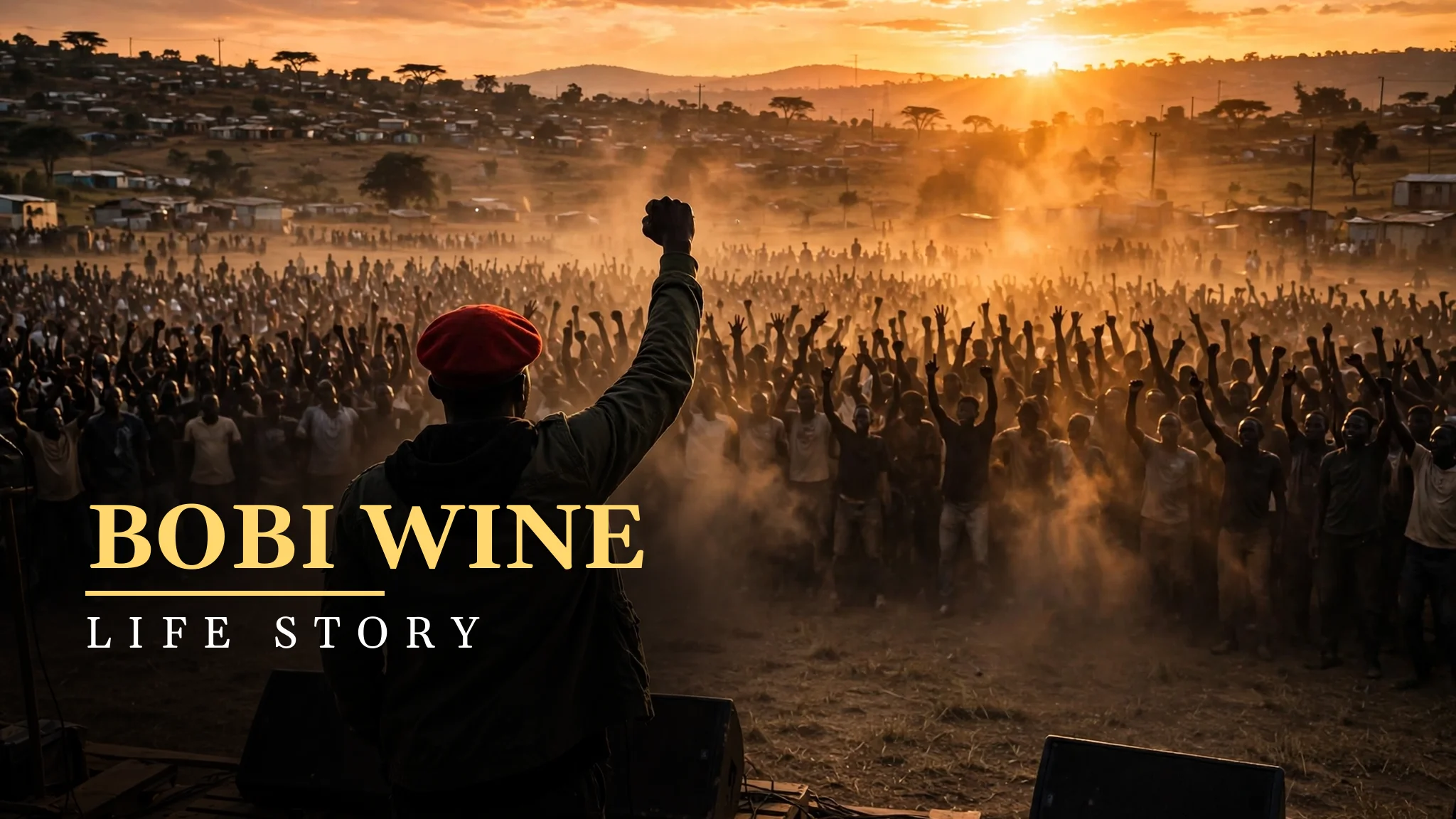
In the end, I come back to the image of a singer from Kamwokya, standing on a stage, singing for his people. That image is the heart of his story. He is a singer, a politician, a husband, and a father, and he is a man who has tried to use his voice for something bigger than himself. I do not know what will happen next in his life, and I will not pretend to know. But I know that his story matters, that it has already changed Uganda, and that it will be remembered for a long time. I hope that his future is peaceful, and that he finds a way to keep singing, whether as a musician, as a politician, or as both.
I also want to say something about the name Ghetto President, because it tells me a lot about him. It is a name that claims dignity for a place that many people look down on. The ghetto is often seen as a place of poverty and crime, but Bobi Wine calls it a place with a president, a place with a voice, a place that matters. That is a powerful act, to take a word that is used to insult people and turn it into a title of pride. It shows that he understands the power of language, and that he uses it to give dignity to people who are often denied it. That is a gift, and it is one that I admire.
I also think about the documentary film about his life, and how it brought his story to the world. A film can show what a news article cannot, the fear in a person’s eyes, the love in a family, and the hope in a crowd. The film about Bobi Wine did that, and it made his story real for millions of viewers who had never been to Uganda. I think that is a powerful thing, and it shows how art can carry a political story. A song can do it, a film can do it, and Bobi Wine has used both. That is a smart and effective way to be heard, and it is one that I respect.
Another thought that stays with me is about the young people who support him, and what they want for Uganda. They want jobs, they want education, and they want a voice. Those are simple wants, but they are also profound. A country that cannot give its young people jobs and a voice is a country in trouble, and Bobi Wine has given those young people a way to say so. Whether he becomes president or not, those young people will not go back to being silent. They have found their voice, and they will keep using it. That is a lasting change, and it is one that Bobi Wine helped to create. I think that is his greatest achievement.
I also admire the way he has kept his music alive, even as his political life has grown. He is still a singer, and his songs are still played across Uganda. He has not abandoned music for politics. He has brought music into politics, and he has shown that a song can be a political act. That is a beautiful idea, and it is one that I think about often. A rally that feels like a concert is a different kind of politics from a rally that feels like a lecture. It is joyful, it is energetic, and it brings people together. Bobi Wine understands that, because he is a singer first, and he knows how music moves people.
When I think about his future, I do not know what will happen, and I will not pretend to know. He may run for president again, he may return to music, or he may do both. What I do know is that his story is not finished, and that Uganda is watching. I hope that whatever happens next is peaceful, and that he finds a way to keep singing, whether as a musician, as a politician, or as both. His voice matters, and the world needs to hear it, in song and in speech, for many years to come.
In the end, I think Bobi Wine matters because he gave a voice to people who felt forgotten. He sang for the ghetto, he spoke for the young, and he challenged a president who has ruled for decades. That is a remarkable journey, and it is one that deserves to be told with care and with respect. Whether you agree with his politics or not, his life is a story of courage, of music, and of a man who refused to stay silent. I am glad I have told it, and I hope that readers will think carefully about it, and about what it means for Uganda and for Africa.
I also want to say something about the name Ghetto President one more time, because it is a name that claims dignity for a place that many people look down on. The ghetto is often seen as a place of poverty, but Bobi Wine calls it a place with a president, a place with a voice, a place that matters. That is a powerful act, to take a word that is used to insult people and turn it into a title of pride. It shows that he understands the power of language, and that he uses it to give dignity to people who are often denied it. That is a gift, and it is one that I admire deeply.
When I think about Uganda’s future, I think about the children in Kamwokya who hear Bobi Wine’s songs and who dream of a better life. Those children are the future, and they deserve a country that gives them jobs, education, and a voice. Bobi Wine has tried to give them that voice, and whether he succeeds or not, he has shown them that it is possible to dream, to sing, and to speak. That is a hopeful message, and it is one that I hope those children carry with them for the rest of their lives.
I also think about the way his songs are played in Kamwokya, in the streets where he grew up, because that is where his music lives most fully. A song that is played in the place where it was born carries a special feeling, and Bobi Wine’s songs carry Kamwokya with them wherever they go. When young people in the ghetto hear his music, they hear their own lives, their own hopes, and their own pride. That is a powerful thing, and it is why his fans have stayed loyal through music and through politics, through good times and hard times alike.
Another thought that stays with me is about the future of Uganda, and about the young people who will decide it. They are the majority of the country, and they want jobs, education, and a voice. Bobi Wine gave them a voice, and that voice will not go silent, whatever happens to one man. That is a lasting change, and it is one that he helped to create with his songs and with his courage. I think that is his greatest achievement, greater than any hit or any election result, because it belongs to a whole generation, not just to him.
In the end, I think Bobi Wine will be remembered as a singer who became a leader, and as a man who refused to stay silent. His journey from Kamwokya to parliament to a presidential campaign is remarkable, and it shows what a voice can do when it is used with courage. I do not know what will happen next in his life, but I know that his story matters, and that it will be told for a long time, in Uganda and around the world, as a story of music, of hope, and of a people who found their voice.
Frequently Asked Questions
What is Bobi Wine’s real name and when was he born?
Bobi Wine was born Robert Kyagulanyi Ssentamu on 12 February 1982 in Ggaba, near Kampala, Uganda. He grew up in Kamwokya, a poor neighbourhood of the capital, and took the stage name Bobi Wine.
Why is Bobi Wine called the Ghetto President?
He is called the Ghetto President because he sang for the people of Kamwokya and other poor areas of Kampala, and he presented himself as their voice. The name became his stage identity and later his political identity.
What are Bobi Wine’s most famous songs?
His best-known songs include “Kiwani”, “Bada”, and “Tuliyambala Engule” from his early music career, and later songs like “Freedom” that became anthems for his political movement.
When did Bobi Wine enter politics?
He entered politics in 2017, when he won election as a member of parliament for Kyadondo East, a constituency near Kampala. He later founded the National Unity Platform and stood for president in 2021.
Did Bobi Wine run for president of Uganda?
Yes, he stood for president in the 2021 election, challenging President Yoweri Museveni. President Museveni was declared the winner, and Bobi Wine disputed the result. The election was marked by arrests and tension.
Who is Bobi Wine’s wife?
He is married to Barbara Itungo Kyagulanyi, who has supported him through his music and political careers. They have children together and live in Kampala.
Is Bobi Wine still a singer as well as a politician?
Yes, he is still known as a singer, and music remains central to his public life. His songs are still played across Uganda, and he uses music at his rallies and in his political work.


