Bong Joon-ho: The Life Story Behind the Parasite Director
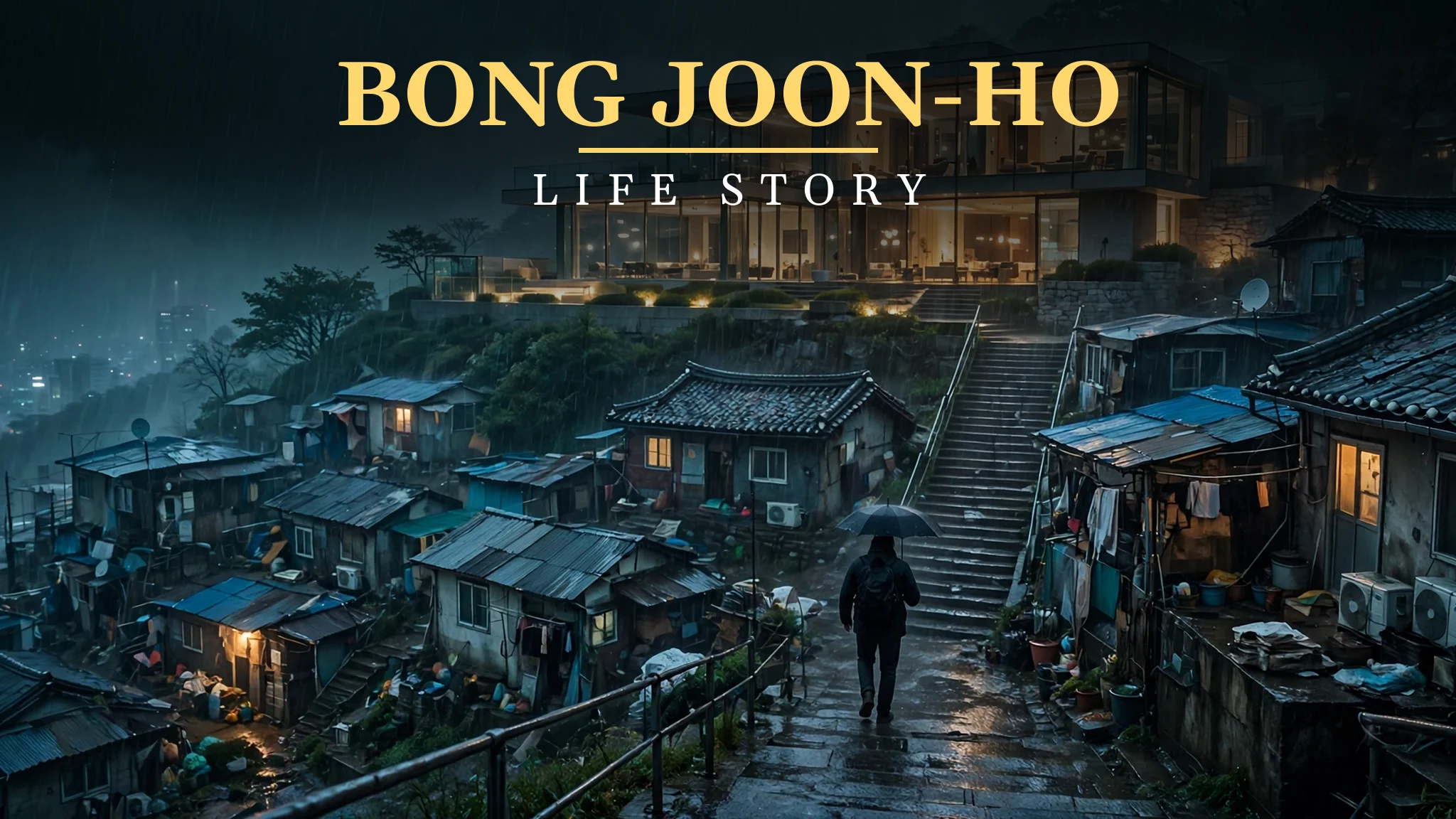
In this post
- Daegu, Books, and a Boy Who Watched Everything
- Ten Years of Learning Before a Single Feature
- Barking Dogs and the First Small Film
- The Host and a Monster in the River
- Mother, Snowpiercer, and Stories That Cross Borders
- Parasite and the Night the World Changed
- Mickey 17 and the Work After the Oscars
- My Take:
The night Parasite won the Academy Award for Best Picture, the cameras found Bong Joon-ho in the crowd, smiling in a way that looked almost shy. He was not a Hollywood insider. He was a film lover from Daegu who had spent years making strange, funny, angry films in Korean, and now the biggest prize in American cinema had gone to a film with subtitles about a poor family sneaking into a rich family’s house. It felt like a joke from one of his own films, the kind where the world turns upside down for a moment and nobody is quite sure whether to laugh or hold their breath.
Bong was born on 14 September 1969 in Daegu, South Korea, and he grew up in a country that was changing fast. South Korea in the 1970s and 1980s was a place of fast growth, strict rules, student protests, and deep gaps between rich and poor. His father worked as a graphic designer, and his grandfather had been a well-known author, so books and pictures were part of the house he grew up in. He was a quiet boy who loved films, and he watched them the way other children collected stamps or played football, with total focus and a hunger to see more.
What sets Bong apart is that he never learned to make only one kind of film. His work slides from comedy to horror to sadness inside a single scene, and the audience slides with it, laughing one minute and feeling uneasy the next. That restless mix did not come from a film school formula. It came from a young man who studied sociology, joined student protests, worked on film sets for years without directing, and slowly learned how the world really works before he ever pointed a camera at it.
Daegu, Books, and a Boy Who Watched Everything
Bong Joon-ho spent his early years in Daegu, a large city in the south-east of South Korea, far from the film studios of Seoul. His family later moved to Seoul, and the move mattered, because Seoul was where the protests, the universities, and the film clubs were. As a boy he was not loud or showy. He was the kind of child who noticed things other people missed, the way a house was built, the way a rich neighbourhood sat next to a poor one, the way adults said one thing and did another. That habit of watching would become the centre of his films.
His grandfather, Park Tae-won, was a respected Korean novelist, and the family had a respect for stories that went deeper than simple entertainment. Bong read a great deal, and he drew as well, filling notebooks with ideas. He did not grow up dreaming of red carpets. He grew up in a time when South Korea was ruled by military governments, and young people who thought about society often found themselves in trouble for it. Films were one place where those thoughts could be explored, and Bong began to see cinema as a way to talk about real life without writing a lecture.
At school he was a good student, and he went on to Yonsei University in Seoul, where he studied sociology. Sociology is the study of how societies work, how groups of people live together, who holds power, and who is left out. It was the perfect subject for the director he would become, because almost every film he later made is about people from different classes colliding. At Yonsei he also joined the student film club, and that was where his love of cinema turned into something practical. He watched films, argued about them, and began to learn how they were put together.
University in South Korea in the late 1980s was also a political place. Students marched, debated, and protested against the government of the time, and Bong took part in that life. He was arrested at one point during the student movement, as many young people were, and the experience stayed with him. He did not become a political speaker. He became a filmmaker who carried those questions into his stories, asking again and again who gets to live well and who has to climb stairs in the rain to get home.
Ten Years of Learning Before a Single Feature
After university, Bong did not become a director straight away. He spent years working in the Korean film industry in smaller jobs, and those years taught him more than any classroom could. He worked as an assistant director, he wrote scripts, and he watched how films were made from the inside, from the long days on set to the arguments about money. It was slow, hard work, and it did not bring fame, but it gave him a full education in how a film actually gets made.
He also spent time in the film club world, where young directors shared ideas and helped each other. In the 1990s, Korean cinema was beginning to change. A new group of directors was emerging, people who wanted to tell Korean stories in fresh ways, and Bong was part of that energy. He wrote scripts that were funny and strange, and he kept learning from every job he took. Some of his early scripts were never filmed, but they taught him how to build a story, how to write a character who feels real, and how to mix humour with something darker.
One of his most important early steps was writing the script for a short film, and then working as a writer on other people’s projects. He learned that a good idea is not enough. A film needs a shape, a rhythm, and a reason for every scene. He also learned to be patient. Many young directors rush to make a first film before they are ready, and the result shows it. Bong waited, and when he finally got his chance, he was ready to use it properly.
That chance came at the end of the 1990s, when Korean cinema was opening up and new directors were being given more freedom. Bong had spent nearly a decade preparing, and he had a clear idea of the kind of films he wanted to make. He did not want to copy Hollywood. He wanted to make films that felt Korean, that were funny and frightening at the same time, and that said something true about the country he lived in.
Barking Dogs and the First Small Film
Bong’s first feature film as a director was Barking Dogs Never Bite, released in 2000. It was a dark comedy about a university lecturer who is annoyed by a neighbour’s barking dog, and the story spirals into a strange and funny mess involving a young woman who works in the same apartment building. The film was not a big commercial hit, but it showed everything that would later make Bong famous. The humour was sharp, the characters were ordinary people pushed into odd situations, and the film had a clear eye for the small cruelties of everyday life.
The film also showed Bong’s skill with actors and his love of detail. He paid attention to the way an apartment building works, the way people live close together without really knowing each other, and the way a small annoyance can grow into something much bigger. Critics noticed the film, even if audiences were slow to find it, and they saw a director with a fresh voice. Bong had arrived, even if the world had not yet noticed.
He followed it with Memories of Murder in 2003, a film based on a true case, the Hwaseong serial murders that had shocked South Korea in the late 1980s. The film follows two detectives, one from Seoul and one from the local area, trying to catch a killer in a small town. The film is funny in places, frightening in others, and deeply sad at the end, when the case remains unsolved. It was a huge success in South Korea, and it made Bong one of the most talked-about directors in the country.
Memories of Murder mattered because it showed that Bong could take a real crime and turn it into a film about a whole society. The detectives are not heroes in the usual sense. They make mistakes, they fight with each other, and they are out of their depth. The film is really about a country that was changing too fast for its own police, its own towns, and its own people to keep up. It is a crime film, but it is also a portrait of South Korea, and that double vision would become Bong’s trademark.
The Host and a Monster in the River
In 2006, Bong made The Host, a monster film that broke box office records in South Korea. The story begins when a creature rises from the Han River in Seoul and snatches a young girl, and her family, a group of ordinary, messy, loving people, sets out to get her back. The monster is frightening, but the film is really about the family, about a father who sells snacks by the river, a sister who is an archer, a brother who has lost his job, and a grandfather who holds them together.
The Host was a huge hit, and it showed that Bong could make a big, popular film without losing his own voice. The monster scenes were exciting, but the heart of the film was the family, with all its arguments, its warmth, and its stubbornness. Audiences laughed and cried in the same film, and that was exactly what Bong wanted. He had proved that a Korean film could be a blockbuster and still be smart, funny, and sad at the same time.
The film also carried a quiet anger about authority. The government in the film handles the crisis badly, spreading fear and making mistakes, and the family is left to save the girl themselves. That theme, of ordinary people let down by the people in charge, runs through much of Bong’s work. He does not preach about it. He shows it through a family trying to do the right thing while everything around them goes wrong.
After The Host, Bong was no longer a promising young director. He was one of the biggest names in Korean cinema, and the world outside Korea was beginning to pay attention. His next films would take him further, into new kinds of stories and new countries, but the centre of his work stayed the same: ordinary people, caught in a world that is bigger and stranger than they are.
One reason The Host reached so many people was that it never treated its family as simple or perfect. The father, Gang-du, is sleepy and slow, and his own family teases him for it, yet he is the one who refuses to give up on his daughter. His sister Nam-joo is a talented archer who freezes at the worst moment, and his brother Nam-il is a former student protester who now drinks too much and has no job. Bong lets each of them be weak and brave in turn, and that mix makes the family feel like a real family rather than a team of heroes from a poster. When they finally fight the monster together, the scene works because the audience already knows their flaws, their jokes, and their love for each other. The monster is frightening, but the family’s courage matters more, and that choice shows what Bong values most in a story.
The film also showed how well Bong works with the actor Song Kang-ho, who played Gang-du and would become one of his most important collaborators. Song has a face that can be funny and heartbreaking in the same shot, and Bong understood how to use that gift. Their partnership would continue through Memories of Murder, Snowpiercer, and Parasite, and it became one of the great director-actor partnerships in modern cinema. Bong writes roles that give Song room to be clumsy, warm, angry, and tender, often within a single scene, and Song repays that trust with performances that feel lived in rather than performed.
Mother, Snowpiercer, and Stories That Cross Borders
Bong’s next film, Mother, released in 2009, was a much smaller and darker story. It is about a mother who tries to prove that her son, a young man with learning difficulties, did not commit a murder. The mother is played by Kim Hye-ja, one of Korea’s most loved actresses, and her performance carries the whole film. She is not a hero in the usual sense. She is a woman who will do anything, including terrible things, to protect her child, and the film asks the audience to sit with that uncomfortable truth.
Mother won praise around the world, and it showed a different side of Bong. The Host had been big and loud, but Mother was quiet, slow, and painful. It showed that he could make a film with almost no spectacle at all, just a woman walking through a town, asking questions, and slowly uncovering a truth she does not want to find. The film’s ending is one of the most haunting in modern cinema, and it stays with the viewer long after the credits end.
In 2013, Bong made his first English-language film, Snowpiercer, based on a French graphic novel. The story takes place on a train that carries the last survivors of humanity after the world freezes, with the rich living in luxury at the front and the poor living in filth at the back. A group of people from the back of the train fight their way forward, carriage by carriage, and each carriage is a different world. The film starred Chris Evans, Tilda Swinton, and Song Kang-ho, and it was a bold, strange, exciting film that mixed action with a clear message about class.
Snowpiercer was a risk, because it was made in English with an international cast, and it cost far more than Bong’s earlier films. It worked, and it found an audience around the world. The train became a perfect image for Bong’s way of seeing the world, a long, narrow space where the rich and the poor are stuck together, and where moving forward means fighting through every layer of the system. The film also showed that Bong could work with Hollywood stars without losing his own style.
Two years later, he made Okja in 2017, a film for Netflix about a young girl in Korea and her giant genetically modified pig, Okja, who is taken away by a big company that wants to turn her into meat. The film is funny, sad, and angry, and it is one of the most unusual films ever made about animals, food, and big business. It starred Ahn Seo-hyun as the girl, with Tilda Swinton and Jake Gyllenhaal in supporting roles, and it showed that Bong was willing to use a huge platform to tell a story about kindness and greed.
Parasite and the Night the World Changed
Everything Bong had learned came together in Parasite, released in 2019. The film tells the story of the Kim family, who live in a small basement flat in Seoul, and the Park family, who live in a beautiful modern house on a hill. The Kims slowly trick their way into working for the Parks, one by one, as a tutor, a driver, a housekeeper, and an art teacher. At first the film is a clever comedy about clever poor people fooling rich people. Then, slowly, it turns into something much darker, and the ending is shocking and sad.
Parasite won the Palme d’Or at the Cannes Film Festival in 2019, the top prize at the most famous film festival in the world. That alone would have been a huge honour, but the film went further. It became a hit around the world, and at the Academy Awards in 2020 it won four Oscars, including Best Picture and Best Director. It was the first film not in English to win Best Picture, and the first Korean film to win in that category. Bong’s speech that night, in which he spoke about his love of cinema and thanked other directors, was warm, funny, and humble, and it made him loved by audiences everywhere.
What made Parasite so powerful was that it was not a simple story about good poor people and bad rich people. The Parks are not monsters. They are polite, kind in their own way, and blind to the lives of the people who serve them. The Kims are not saints either. They lie, they cheat, and they make terrible choices. The film shows a system that pits people against each other, and it asks the audience to see themselves in both families. That honesty is why the film worked in so many countries, because the gap between rich and poor exists everywhere.
The success of Parasite changed Bong’s life, but it did not change his work. He was suddenly one of the most famous directors in the world, with offers from every studio, but he took his time. He did not rush into a big Hollywood film. He thought carefully about what to do next, and he kept his focus on the stories that mattered to him. The film had also changed Korean cinema, proving to the world that a Korean film could win the biggest prizes without changing itself to fit Hollywood.
Mickey 17 and the Work After the Oscars
After Parasite, Bong spent several years working on his next film, Mickey 17, which was released in 2025. The film is based on a novel, and it stars Robert Pattinson as a man who signs up to be an expendable worker on a space mission, someone who can be killed and then printed again in a new body. The film is funny and strange, and it uses science fiction to ask the same questions Bong has always asked, about work, about power, and about what a human life is worth when it can be replaced.
Mickey 17 was a much bigger film than Parasite, with a large budget and a Hollywood studio behind it, and it faced the pressure that comes with following a huge success. Some viewers loved its dark humour, and some found it messy, but it showed that Bong was still willing to take risks and to make films that were not easy to put in a single box. He did not try to repeat Parasite. He tried something new, and that choice said a great deal about him as an artist.
Bong has also worked in television, as a producer on the television version of Snowpiercer, and he has continued to support Korean cinema, speaking up for young directors and for the value of films in languages other than English. He lives a quiet life for a famous director, and he is known for being thoughtful, funny, and generous in interviews. He often talks about other directors he admires, and he has said that he learned a great deal from watching films as a young man, which is why he takes the work of other filmmakers so seriously.
Today, Bong Joon-ho stands as one of the most important directors of his generation, a filmmaker who moved from a small first film about a barking dog to the top of world cinema, without ever losing the mix of humour, anger, and sadness that made his early work so fresh. His films are funny, frightening, and deeply human, and they have changed the way the world sees Korean cinema. The boy from Daegu who watched everything is now watched by everyone, and his stories still ask the same simple question he first asked at university, who gets to live well, and who has to climb the stairs in the rain.
My Take:
I think about Bong Joon-ho more than I think about almost any other living director, and the reason is simple. He makes me laugh and then he makes me feel guilty for laughing, and then he makes me think, and I am still thinking about the film days later. That is a rare gift. Most films give you one feeling and then they end. Bong’s films give you several feelings at once, and they do not sort themselves out neatly when the credits roll. I have walked out of his films unsure whether I should be amused or sad, and I have come to see that uncertainty as the point. Life is like that too, funny and unfair in the same hour, and Bong is one of the few directors who films life the way it actually feels.
What I admire most is his courage with tone. Parasite starts as a clever comedy, and a less brave director would have kept it a comedy, because comedies are safer and audiences love them. Bong lets the film turn dark, and he lets good people do bad things, and he lets the ending hurt. That takes nerve, because it risks losing the audience. I respect a director who trusts the audience enough to follow him into a darker room. The same is true of Memories of Murder, which is funny in its first half and then slowly becomes a film about failure and grief. He does not protect the viewer from the hard part. He walks straight into it.
I also admire his eye for class. I grew up knowing that rich and poor live in different worlds, even when they live in the same city, but I had rarely seen that truth filmed as clearly as Bong films it. In Parasite, the rich house sits on a hill and the poor flat sits below the street, and rain that is a small annoyance for one family is a disaster for the other. That is not a speech. It is a picture, and it stays in my mind longer than any speech could. I think that is his great skill, turning a big idea about society into a small, concrete image, a staircase, a flooded flat, a train carriage, a basement. He makes an abstract problem visible, and once you have seen it, you cannot unsee it.
His background in sociology matters to me, and I wish more directors had that kind of training. Bong does not just film characters. He films systems. He shows how a family, a police force, a company, or a train works as a whole, and how ordinary people get squeezed by it. That is why his films feel bigger than their plots. The Host is not only about a monster. It is about a family and a government. Snowpiercer is not only about a train. It is about a whole society packed into a narrow space. I find that kind of filmmaking generous, because it treats the audience as adults who can think about the world, not just watch a story.
I love the way he writes families. The family in The Host argues, eats together, fails together, and loves each other in a messy, believable way. The family in Parasite works as a team, and that teamwork is both their strength and their downfall. The mother in Mother is not a saint. She is a woman who will cross lines for her son, and the film does not let her off the hook. Bong writes people who are good and bad at the same time, and I think that is honest. I am tired of films where the poor are pure and the rich are evil, or the other way round. Bong gives me people who are complicated, and I believe them more because of it.
There is also something I find deeply moving about his patience. He spent ten years learning before he directed his first feature, and he did not rush after Parasite either. In a world where everyone wants to be famous fast, Bong took the slow road, and the slow road shows in the work. His films feel careful, like every scene was thought about, every joke was tested, every sad moment was earned. I think young people who want to make films should learn from that. You do not need to be famous at twenty-five. You need to learn your craft, watch the world, and wait until you have something real to say.
I have to be honest about the parts that are harder for me. Some of his films are uncomfortable to watch, and that discomfort is not always pleasant. The ending of Parasite is brutal, and the ending of Mother is bleak, and I have sat in silence after both films, not sure what to say. I do not think that is a flaw. I think it is the price of his honesty. But I also understand why some viewers prefer lighter films. Bong does not offer comfort, and he does not offer simple answers. If you want a film that makes you feel good and then lets you go home happy, his films are not always the right choice. I value them precisely because they do not let me go home happy. They make me carry the questions with me.
Mickey 17 is the film I think about when I consider his future. It is messy and strange, and not everyone loved it, and I find that reassuring. A director who has won four Oscars could easily play it safe, making the same kind of film again and again. Bong chose to make a science fiction comedy about a man who can be killed and printed again, and that choice tells me he is still curious. I would rather watch a curious director fail in an interesting way than a careful director succeed in a boring way. I hope he keeps taking those risks, even if not every one of them works.
I also think about what Parasite did for Korean cinema, and for cinema in other languages. Before Parasite, many people in the English-speaking world treated subtitled films as homework, something serious and worthy but not fun. Parasite was fun, and it was also serious, and it proved that a film in Korean could be a global hit without changing itself. That opened doors for other filmmakers, and I think Bong knows that. He has used his fame to talk about other directors and other films, and that generosity matters. Fame can make people selfish. Bong has used his to shine a light on the cinema he loves.
One thing I keep returning to is his humour. People talk about his politics and his class themes, but they sometimes forget how funny he is. The Host has scenes that made me laugh out loud, and Parasite has moments of pure comedy, like the family pretending to be strangers at a job interview. That humour is not a decoration. It is part of how he sees the world. He knows that people laugh even in hard times, and that a joke can be a way of surviving. I think that is why his films reach so many people. They are not lectures. They are stories told by someone who knows that life is funny and painful at the same time.
If I could ask him one question, I would ask him how he keeps his balance, how he makes a film that is angry without becoming bitter, and funny without becoming cruel. I think the answer would be in his years of watching, his sociology training, and his patience. He does not rush to judge his characters. He watches them, he lets them make mistakes, and he lets the audience decide what to feel. That restraint is what makes his films feel wise rather than preachy, and I wish more filmmakers had it.
In the end, Bong Joon-ho teaches me that a film can be many things at once, a comedy and a tragedy, a monster story and a family story, a Korean film and a world film. He teaches me that you do not need to choose between entertainment and meaning, because the best films are both. And he teaches me that where you come from matters, not as a limit, but as a source. He came from Daegu and Seoul, from student protests and small film clubs, and he turned all of that into stories the whole world now watches. That is a journey worth admiring, and a body of work worth returning to again and again.
I also think about his use of space, because it is something I notice more every time I watch one of his films. Bong builds worlds where the layout of a place tells you the story before anyone speaks. The basement flat in Parasite is below the street, so the family looks up at the world from a hole in the ground. The rich house sits high on a hill, with wide windows and clean light. The train in Snowpiercer is a straight line from poor to rich, and every door the characters open takes them into a different kind of life. Even the river in The Host is a line between ordinary life and danger. I think this is a skill that comes from years of watching carefully, and it is why his films reward a second viewing. The first time you watch the plot. The second time you watch the rooms, the stairs, and the doors, and you see how much of the story was already there in the space itself.
His collaboration with Song Kang-ho deserves a longer thought too, because it reminds me how much a director needs actors he trusts. Song is not a glamorous star in the usual sense. He looks like an ordinary man, and that ordinariness is his power. In Memories of Murder he plays a detective who is rough, funny, and out of his depth, and the audience believes him because Song never tries to look clever. In Parasite he plays a father who has lost his job and his pride, and his face carries the whole weight of that loss without a single speech about it. Bong writes for that kind of actor, and Song gives those roles a warmth that no script alone could provide. I think their partnership is one of the reasons Bong’s films feel so human, because the faces on screen feel like people you might meet on a bus, not stars on a poster.
I also want to say something about the way Bong treats women in his films, because it is easy to miss. The mother in Mother is the centre of the film, and she is allowed to be fierce, foolish, loving, and frightening all at once. The sister in The Host is a woman who fails in public and keeps going anyway. The housekeeper in Parasite is a woman with her own secrets and her own plans, not a background figure. Bong does not write women as symbols or as rewards for men. He writes them as people with their own wants, and I think that is part of why his films feel so complete. A story that only understands half of its people is a story that is only half true.
Another lesson I take from him is about language. Parasite proved that audiences will read subtitles if the story is good enough, and that simple fact changed the film world for many people. I remember a time when a subtitled film felt like work to many viewers in English-speaking countries. Bong’s film made it feel like pleasure, like a thriller you could not stop watching, and the subtitles stopped mattering after ten minutes. That is a victory not just for Korean cinema but for all cinema in languages other than English. It tells young filmmakers everywhere that they do not have to change their language to be heard. They have to tell a story that is strong enough to cross the border on its own.
I think about the young Bong, too, the student who was arrested during protests and who spent ten years in small jobs before directing a feature. That young man could have become bitter. He could have decided the world was closed to him and stopped trying. Instead he kept watching, kept writing, and kept learning how films are made. When his chance finally came, he was ready, not because he was lucky, but because he had spent a decade getting ready. I find that deeply encouraging. It tells me that a slow start is not a failed start, and that the years when nobody is watching you are the years when you build the skill that will matter later. His career is proof that patience is not the same as doing nothing.
Finally, I think his films ask me to look at my own life more carefully. After watching Parasite, I found myself noticing the stairs in my own city, the basement flats, the houses on the hill, and the people who clean and drive and serve without being seen. That is what great art does. It does not just entertain you for two hours. It changes the way you see the street the next morning. Bong’s films have done that for me, and I believe they have done it for millions of others. That is why I will keep watching his work, and why I will keep recommending it to anyone who wants to see what cinema can do when a director trusts the audience, respects his characters, and refuses to make a film that is only one thing.
Frequently Asked Questions
Where was Bong Joon-ho born and when?
Bong Joon-ho was born on 14 September 1969 in Daegu, South Korea. He later moved to Seoul, where he studied sociology at Yonsei University and joined the student film club that shaped his love of cinema.
What was Bong Joon-ho’s first feature film?
His first feature film as a director was Barking Dogs Never Bite, released in 2000. It was a dark comedy about a lecturer annoyed by a neighbour’s barking dog, and it showed the mix of humour and unease that later defined his work.
Why is Memories of Murder so well known?
Memories of Murder, from 2003, is based on the true Hwaseong serial murder case in South Korea in the late 1980s. It follows two very different detectives trying to solve the case, and it became a huge success in Korea and a landmark of Korean cinema.
How many Oscars did Parasite win?
Parasite won four Academy Awards in 2020, including Best Picture and Best Director for Bong Joon-ho. It was the first film not in English to win Best Picture, and it also won the Palme d’Or at Cannes in 2019.
What is Snowpiercer about?
Snowpiercer, from 2013, is set on a train carrying the last survivors of humanity after the world freezes. The rich live at the front and the poor at the back, and a group from the back fights its way forward, carriage by carriage.
What is Mickey 17 about?
Mickey 17, released in 2025, stars Robert Pattinson as a worker on a space mission who can be killed and then printed again in a new body. It is a science fiction comedy that asks what a human life is worth when it can be replaced.


