BTS: The Story of Global Fame Explained
In this post
- Beginnings in Seoul
- Early Struggles and a Different Sound
- Breakthrough in South Korea and the World
- ARMY: The Fanbase That Changed the Industry
- Music Evolution and Individual Work
- Cultural Impact Beyond Music
- The Korean Music System: Training, Pressure and Change
- Language, Translation and Global Connection
- BTS, Military Service and the Next Chapter
- BTS and the Future of Pop Groups
- BTS, Dance and Performance Craft
- BTS and Social Media: A Direct Line to Fans
- My Take:
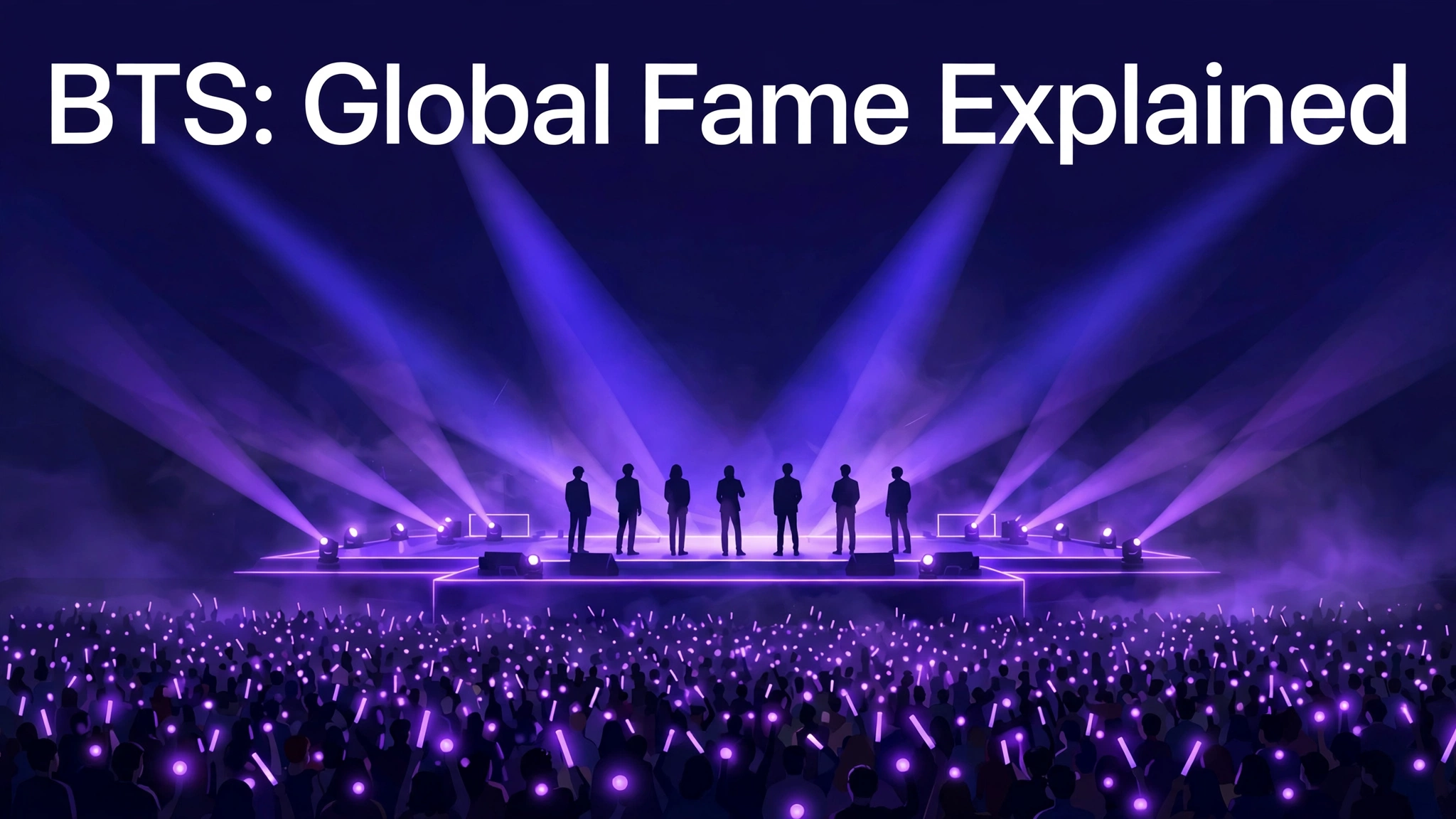
BTS is one of the most successful music groups in history, not only because of record sales and stadium tours, but because of how they built a global audience from a small company in South Korea. Their story is often told as a sudden explosion, yet the reality is slower: years of training, early struggles, a close relationship with fans through social media, and music that combined hip-hop, pop, and personal storytelling. Understanding BTS means understanding both the group and the system that created them, as well as the fans who carried them worldwide.
Beginnings in Seoul
BTS, known in Korean as Bangtan Sonyeondan, which translates roughly as Bulletproof Boy Scouts, was formed by the small agency Big Hit Entertainment in Seoul, South Korea. The group debuted in 2013 with seven members: RM, Jin, Suga, J-Hope, Jimin, V, and Jung Kook. Unlike groups from large entertainment companies, BTS came from a company with limited money and connections, which meant they had to work harder for attention and could not rely on a famous agency name to open doors.
Before debut, the members trained for years in singing, dancing, and performance, a standard practice in the Korean music industry known as the trainee system. RM and Suga had backgrounds in underground hip-hop, while others came through auditions and training programs. The group lived together, practised for long hours, and built the teamwork that later became visible on stage. That shared struggle created a bond that fans often cite as a reason for the group’s authenticity: they were not assembled overnight, but shaped by years of common effort.
Early Struggles and a Different Sound
BTS’s early music drew heavily on hip-hop and addressed themes such as school pressure, youth frustration, and dreams, topics that resonated with young listeners in South Korea. Their debut single album and early releases did not immediately top charts, and the group faced scepticism from parts of the Korean music industry, which favoured larger agencies. They performed on small stages, appeared on variety shows, and built an audience gradually through live performance and online content.
What set BTS apart early was their use of social media. At a time when many Korean groups relied mainly on television, BTS posted behind-the-scenes videos, vlogs, and personal messages directly to fans. This direct communication created a sense of closeness: fans felt they knew the members as people, not only as performers. The group also wrote and produced much of their own music, with RM, Suga, and J-Hope involved in songwriting, which gave their lyrics a personal quality that stood out in a system where songs are often written entirely by outside producers.
Breakthrough in South Korea and the World
BTS’s breakthrough came gradually through a series of successful releases in the mid-2010s, including the Most Beautiful Moment in Life series, which explored youth, growth, and loss. Songs such as I Need U, Run, and later Blood Sweat and Tears brought wider attention in South Korea and growing interest abroad. Their performances, known for precise choreography and high energy, earned them awards and television exposure, and their fanbase, known as ARMY, began to organise online across countries.
The global breakthrough accelerated with the Love Yourself series and the single DNA in 2017, followed by Mic Drop and Fake Love. BTS began to appear on American television, perform at major award shows, and top charts in the United States and other countries, achievements that were historic for a Korean-language group. In 2020, Dynamite, their first fully English-language single, reached number one on the Billboard Hot 100, a milestone widely reported as a first for a South Korean group. Later, Butter and Permission to Dance repeated that chart success, bringing BTS to an even wider mainstream audience.
ARMY: The Fanbase That Changed the Industry
No explanation of BTS is complete without ARMY, the group’s official fanbase. ARMY is not only a large audience; it is an organised, global community that streams music, translates content into many languages, raises money for charity, and promotes the group through social media campaigns. Fans have organised birthday projects, donated to causes supported by the members, and coordinated chart campaigns with remarkable discipline. This organisation helped BTS succeed in countries where their agency had little marketing presence, because fans themselves became promoters, translators, and distributors of information.
The relationship between BTS and ARMY is also emotional. Members regularly thank fans in speeches, mention them in lyrics, and share personal reflections about pressure, mental health, and growth. Songs and albums in the Love Yourself and Map of the Soul series explicitly address self-acceptance and the difficulties of fame, themes that resonated with young listeners facing their own pressures. Critics sometimes dismiss fandom as obsession, but for many ARMY members, the community provides friendship, language learning, and a sense of belonging across borders, benefits that extend beyond music.
Music Evolution and Individual Work
BTS’s music has evolved from hip-hop-influenced tracks to a broader pop sound that includes R&B, electronic dance music, rock influences, and ballads. Albums such as Map of the Soul: 7 and BE show that range, from energetic dance tracks to quiet, reflective songs recorded during the pandemic period. BE, released in 2020, included Life Goes On, a song about coping with disruption and uncertainty that resonated during a difficult global period. The group’s ability to change sound while keeping a recognisable identity is one reason they have lasted longer than many pop groups.
In recent years, members have also pursued solo work, including albums, singles, and collaborations, while the group has taken a hiatus from full group activities partly because of mandatory military service in South Korea, which applies to male citizens. Solo projects have allowed each member to explore a personal style: RM’s reflective hip-hop, Jin’s ballads, Suga’s production-led work, J-Hope’s dance and hip-hop, Jimin’s pop and R&B, V’s jazz-influenced sound, and Jung Kook’s mainstream pop. These solo efforts have kept fans engaged and shown that the group’s talent is individual as well as collective.
Cultural Impact Beyond Music
BTS’s impact extends beyond charts. They have spoken at the United Nations about youth empowerment, partnered with UNICEF on an anti-violence campaign, and been discussed in academic and media studies about soft power, globalisation, and fandom. South Korea’s government and tourism industry have recognised their role in promoting Korean culture worldwide, a phenomenon often called the Korean Wave or Hallyu. Economists and cultural commentators have debated the scale of that impact, but the visibility of Korean language, food, and fashion among global youth owes something to BTS’s reach.
Their story also raises questions about the pressures of fame. Members have spoken about exhaustion, anxiety, and the difficulty of living under constant attention. The Korean entertainment industry’s training system, while producing highly skilled performers, has also been criticised for its intensity and its effects on young trainees. BTS’s openness about mental health has helped normalise those conversations among fans, even as the industry itself continues to be debated. A fair account celebrates their achievements while acknowledging those pressures.
The Korean Music System: Training, Pressure and Change
To understand BTS fully, readers need to understand the Korean idol system. Young trainees are selected, trained intensively in singing, dancing, and languages, and then debuted in groups managed by agencies that control music, image, and schedules. This system produces exceptionally skilled performers, but it has also been criticised for long hours, strict diets, limited personal freedom, and contracts that favour agencies. BTS’s agency was smaller than the major companies, which gave the group some flexibility, but the members still experienced the system’s pressures, including exhaustion and constant public scrutiny.
In recent years, the system has begun to change, partly because of global attention and partly because artists themselves have spoken about mental health and rest. BTS members have discussed therapy, burnout, and the need for time away, conversations that would have been rarer a decade earlier. Their openness has helped shift expectations, at least for established groups, even though younger trainees still face intense competition. A fair account of BTS should celebrate their skill while asking whether the system that produces such skill is sustainable and humane for the next generation.
Language, Translation and Global Connection
One of BTS’s most remarkable achievements is global success in Korean. For decades, the assumption in Western music was that global hits had to be in English. BTS challenged that by singing mainly in Korean, with English phrases and choruses, and by relying on fans to translate lyrics, interviews, and social media posts into dozens of languages. Fan translators, often volunteers, became essential bridges, and many fans report learning Korean, or improving English through translation communities, because of BTS. Language, in this story, was not a barrier to be removed, but a feature to be explored.
This has broader implications for global culture. If a Korean-language group can top charts worldwide, then audiences are more open to other languages and cultures than the music industry previously assumed. Streaming platforms, social media, and video subtitles have lowered the cost of crossing languages, and BTS benefited from those tools at the right moment. Their success suggests that future global stars may come from any language, provided they build a community that translates and shares their work with care. That is an optimistic message for creators outside English-speaking countries.
BTS, Military Service and the Next Chapter
Mandatory military service in South Korea is a significant chapter in BTS’s story. All male citizens are generally required to serve, and BTS members began enlisting in the early 2020s, pausing full group activities while pursuing solo work. This period tested the group’s relationship with fans, because a hiatus can weaken a pop group’s momentum, yet BTS’s solo projects and the loyalty of ARMY kept their presence strong. It also sparked public debate in South Korea about whether globally successful artists should receive exemptions, a debate that involved government, media, and fans, and that ultimately reflected broader questions about fairness and national service.
Military service also offers a humanising perspective. For all their fame, BTS members faced the same obligation as other young South Korean men, living in barracks, following routines, and stepping away from celebrity life. That shared experience may deepen their connection with Korean fans, who understand service as a normal part of life. For international fans, it is a reminder that Korean pop stars live within a specific national context, with duties and laws that differ from those in other countries. Understanding that context makes fandom more informed and more respectful.
BTS and the Future of Pop Groups
BTS’s future, as a group, will depend on how members reunite after solo work and service, what music they choose, and how the industry changes around them. Pop groups rarely last forever at peak intensity, and BTS has already lasted longer than most at the highest level. A reunion, when it happens, will be judged not only by sales but by whether the music feels fresh and honest after years apart. Solo growth may actually help a reunion, because members return with new skills, perspectives, and confidence, rather than only repeating an earlier sound.
Their legacy, regardless of future releases, already includes a changed global music landscape, a model for fan communities, and a body of music that ranges from hip-hop to ballads to dance-pop. Future groups will study their social media strategy, their songwriting involvement, and their relationship with fans, even if they choose different sounds. For readers, BTS’s story is therefore not only about seven performers, but about how pop music itself changed in the streaming era, and how audiences, rather than only labels, now shape global success.
BTS, Dance and Performance Craft
BTS’s live performances are central to their reputation, because their choreography is exceptionally precise and physically demanding. Songs such as DNA, Fake Love, and Dynamite feature synchronised routines that require months of rehearsal, stamina, and teamwork. Dance in K-pop is not decoration; it is a core part of the song’s identity, and fans learn routines, cover them online, and judge performances by synchronisation and energy. BTS’s dance practice videos, which show routines without stage effects, are popular precisely because they reveal the craft behind the spectacle.
Performance craft also includes vocals under movement, a difficult skill that BTS has developed over years. Singing while dancing intensely requires breath control, fitness, and rehearsal, and live performances inevitably vary in vocal quality. Fans and critics debate those variations, but the overall standard BTS maintains on tour is high, especially given the length of their concerts. For readers new to K-pop, watching a dance practice video alongside a music video is a good way to appreciate how much work lies behind a three-minute performance.
BTS and Social Media: A Direct Line to Fans
Social media was central to BTS’s rise, and their use of it differed from many groups at the time. Rather than only posting polished promotional material, members shared practice videos, meals, jokes, and personal reflections, creating a sense of daily closeness with fans. Platforms such as Twitter, YouTube, and later Weverse allowed fans to respond, translate, and organise in real time, turning a one-way broadcast into a conversation. That conversation built trust: fans felt invested in the group’s journey because they had followed its difficult early years, not only its successful later ones.
That direct line also carried risks, including constant scrutiny, rumours, and pressure to share personal life. BTS members have spoken about the difficulty of living under that attention, and about learning to set boundaries as they matured. For future artists, their social media story offers both a model and a warning: direct communication can build a loyal global community, but it requires boundaries to protect health and privacy. The most sustainable approach, which BTS increasingly adopted, is selective sharing: enough to maintain connection, but not so much that personal life disappears entirely.
My Take:
I think BTS’s story is less about a miracle and more about a system working in a new way. The old model of global fame required a large Western label, radio dominance, and English-language songs from the start. BTS broke that model by building a direct relationship with fans online, singing mainly in Korean, and letting fans translate, promote, and organise. That is a genuinely important shift, not only for music but for any creator. It shows that an audience can be built from the edges, through trust and consistency, rather than only from the centre through money and gatekeepers. For independent artists reading this, that lesson is more valuable than any chart record.
I also think ARMY deserves respect as a cultural force, not dismissal as a teenage craze. Yes, fandom can be intense, and online fan wars are real and sometimes unpleasant. But ARMY’s charity work, translation efforts, and global friendships show what a fan community can do when it organises around shared values rather than only around consumption. I have seen fan groups dismissed because their members are young or female, a bias that would not be applied to sports fans who travel, organise, and spend similarly. Judging BTS only by sales misses the community they built, and that community is arguably their most lasting creation.
There is a more critical angle I want to keep in view. The trainee system that shaped BTS is demanding, and fame at their scale brings pressures that no amount of success removes. When members speak about exhaustion or the need for rest, I believe them, and I think fans and media should take those statements seriously rather than treating a hiatus as a marketing pause. Sustainable fame, if such a thing exists, requires rest, solo growth, and the freedom to step back. BTS’s recent chapter, with solo work and military service, may actually be healthier than endless group activity, even if it feels slower to fans. Longevity, again, comes from pacing, not from constant output.
Finally, I believe BTS’s cultural impact will outlast any single song. They made Korean-language pop a mainstream global force, they showed that vulnerability can be a strength in pop music, and they proved that fans, when trusted, can carry an artist further than traditional marketing alone. Whether you love their music or not, that shift in how global fame works is worth understanding. It is a story about music, yes, but also about the internet, youth, language, and community, and that is why it belongs in a serious biography, not only in a fan magazine.
I also want to reflect on what BTS means for young listeners who feel pressure at school, at work, or at home. Their early songs about youth frustration, and later songs about self-acceptance, speak directly to those pressures without offering simple solutions. They do not promise that loving yourself fixes everything; they describe the difficulty of that process honestly. That honesty is why many fans say BTS helped them through difficult periods. Music cannot replace professional support for mental health, and fans should seek help when needed, but a song that names a feeling accurately can be a first step toward talking about it, and that step matters.
Another angle is economic. BTS’s success has been studied for its effect on South Korea’s tourism, exports, and cultural image, with estimates that vary widely and should be treated cautiously. What is clear, without needing exact figures, is that a music group can become a national cultural asset, influencing how a country is seen abroad. That raises interesting questions about government support for culture, the role of private companies, and who benefits from a group’s success. BTS members, their agency, fans, and the wider Korean economy all play roles, and the distribution of benefits is rarely equal. A thoughtful reader should enjoy the music while asking who gains, and whether creators themselves are fairly rewarded.
Finally, I believe BTS’s most enduring contribution may be a model of fandom as community. ARMY is not only a market; it is a network of friendships, learning, and charity that exists across borders. In a time when online life is often described as divisive, ARMY shows that online communities can also be supportive and organised. That model will outlast any single album, because it shows future artists and fans how to build something together, rather than only consuming something made for them. BTS gave fans songs; fans gave BTS a world. That exchange, at its best, is what global fame should be.
I also want to reflect on solo work as a sign of maturity, not division. When BTS members released solo albums, some fans worried the group was ending, but solo work is normal for long-running groups. It allows individual growth, prevents burnout, and gives fans new music during a group pause. The Beatles, and many other groups, showed that solo work can coexist with group identity, even when reunions are uncertain. For BTS, solo projects have revealed distinct artistic voices that were sometimes hidden in group songs, and that revelation enriches, rather than diminishes, the group’s legacy.
Another thought is about language learning as a byproduct of fandom. Many ARMY members report learning Korean words, improving English through translations, or discovering Korean culture through BTS. That educational side effect is often overlooked in discussions of pop music, but it is real and valuable. Learning a language through songs is enjoyable, and it builds cross-cultural understanding in a way textbooks alone cannot. BTS’s global success, therefore, has an educational dimension: it motivated millions of young people to learn, translate, and connect across borders, skills that last longer than any chart run.
Finally, I believe the best way to appreciate BTS is to listen to their music chronologically, from early hip-hop tracks to later reflective albums, and to notice the growth. You will hear young men becoming artists, learning to write about themselves, and gradually speaking to a global audience without losing their Korean identity. That growth, more than any award, is the story. It shows that global fame, when built on craft, community, and honesty, can be more than a moment. It can be a journey, and BTS’s journey, still unfolding, is one of the most interesting journeys in modern pop.
Frequently Asked Questions
When did BTS debut?
BTS debuted in South Korea in 2013 under Big Hit Entertainment, with seven members: RM, Jin, Suga, J-Hope, Jimin, V, and Jung Kook.
What does BTS stand for?
BTS stands for Bangtan Sonyeondan in Korean, which translates roughly as Bulletproof Boy Scouts, and the group also uses the English phrase Beyond the Scene.
How did BTS become famous worldwide?
BTS built fame gradually through Korean releases, social media, and fan organisation, then broke globally with the Love Yourself series, US television and award appearances, and Billboard Hot 100 number ones including Dynamite in 2020.
Who are BTS ARMY?
ARMY is BTS’s official global fanbase, known for streaming, translating content, charity projects, and organised social media support that helped the group reach audiences worldwide.
Why did BTS take a hiatus from group activities?
The group paused full group activities in recent years partly because members began mandatory military service in South Korea, while pursuing solo projects in the meantime.
What kind of music does BTS make?
BTS’s music began with hip-hop influences and evolved into a broad pop sound including R&B, electronic dance music, ballads, and rock influences, with many songs written or co-written by members.