Bump of Chicken: The Life Story Behind Japan's Rock Band
In this post
- Four Friends at School in Sakura
- Diamond, Tentai Kansoku and the First Hits
- Albums That Grew With Their Audience
- A Quiet Band in a Loud Industry
- The Songs People Carry With Them
- Aurora Arc, Ray and the Later Albums
- Music for Films, Games and Everyday Moments
- Stars, Space and the Words of Motoo Fujiwara
- Hello World, Aurora and Songs for New Listeners
- My Take:
Bump of Chicken are a Japanese rock band who have been together since they were schoolboys, and who have never really changed. That is not a criticism. It is the most remarkable thing about them. In a music world where bands change members, change sounds, and change images every few years, Bump of Chicken have kept the same four members, the same quiet approach, and the same belief that a good song, played well, is enough. Their fans love them for that steadiness, and their songs have become part of everyday life in Japan.
The band is made up of Motoo Fujiwara, who sings and plays guitar and writes the songs, Hiroaki Masukawa on guitar, Yoshifumi Naoi on bass, and Hideo Masu on drums. They met at school in Sakura, in Chiba, near Tokyo, and they formed the band in 1994, when they were still teenagers. They were not stars, and they were not trying to be. They were four friends who liked music, who liked playing together, and who wanted to see how far that could take them. It took them a very long way.
Their music is rock, but it is not loud in the way that some rock is loud. It is melodic, thoughtful and often gentle, with lyrics that talk about the sky, the stars, the sea, and the small moments of a life. Fujiwara writes in a way that is both simple and deep, and his songs are easy to sing along to, even when they are about big ideas. That combination, simple music and deep words, is why Bump of Chicken have lasted for thirty years, and why their audience has grown older with them.
Four Friends at School in Sakura
Bump of Chicken began in Sakura, a city in Chiba prefecture, in 1994. Motoo Fujiwara, Hiroaki Masukawa, Yoshifumi Naoi and Hideo Masu were school friends, and they started playing music together in the way that many school bands do. They practised after school, they played at school events, and they learned how to be a band by doing it, not by reading about it. The early years were not glamorous. They were a time of learning, of making mistakes, and of finding a sound that felt like their own.
The name Bump of Chicken is unusual, and it has become a talking point for fans. It is a strange, memorable name, and it fits a band that has never tried to be ordinary. The members have kept the name for their whole career, and it has become a symbol of their identity. It tells you, before you hear a note, that this is not a band that follows the rules. It is a band that does things its own way, and that has always been true of their music as well.
In the late 1990s the band began to play in small venues in Tokyo and in Chiba, and they began to build a following. They released independent records, and they toured in the way that young Japanese bands tour: in small clubs, in front of small audiences, with long journeys between shows. They were not making a lot of money, and they were not famous, but they were learning how to perform, how to write, and how to work together. Those years were the foundation of everything that came later, because they taught the four friends how to be a band that could last.
Fujiwara was the main songwriter from the start, and his songs were already different from the usual rock songs of the time. He wrote about the night sky, about stars, about the feeling of looking up and wondering what is out there, and he wrote in a way that was both poetic and direct. His lyrics were not about fame or money. They were about the world, about nature, and about the feelings that everyone has but finds hard to put into words. That honesty is what drew the first fans to the band, and it is what has kept them.
Diamond, Tentai Kansoku and the First Hits
Bump of Chicken made their major debut in 2000, with the single Diamond, and it was the start of a new chapter. The single did not make them stars overnight, but it gave them a place in the Japanese music industry, and it showed that a major label believed in them. The band continued to tour, to write, and to release singles, and their audience grew steadily. They were not a band that exploded. They were a band that grew, year by year, show by show.
The breakthrough came with the song Tentai Kansoku, released in 2001, which means astronomical observation, or watching the sky. The song was about looking at the stars, about the feeling of being small in a large universe, and about the hope that comes from looking up. It became a hit, and it is still one of the band’s best-known songs. People in Japan know the chorus, they sing it at concerts, and they associate it with the feeling of a clear night sky. The song showed that Fujiwara could write about big ideas in a way that was simple enough for anyone to understand, and that is a rare skill.
After Tentai Kansoku, the band released their album Jupiter in 2002, and it did well in Japan. The album collected the singles they had released, and it showed a band with a clear sound: melodic rock, with strong choruses, thoughtful lyrics, and a warm, human feeling. The band also began to play in larger venues, and they began to appear on television and in magazines. They were becoming known, not as a novelty, but as a serious band with serious songs.
In the years that followed, Bump of Chicken released more hit singles, including Karma, which was used as a theme song for the video game Tales of the Abyss, and which became popular with game fans as well as music fans. The song showed that the band’s music could work in different contexts, and that their songs were strong enough to carry a story. They also released albums such as Yggdrasil, Orbital Period and Cosmonaut, each of which tried new ideas while keeping the core sound that fans loved.
Albums That Grew With Their Audience
One of the most interesting things about Bump of Chicken is that their audience has grown older with them. The fans who first heard Tentai Kansoku as teenagers are now adults, with jobs, families and lives of their own, and they still listen to the band. The band have grown with them, writing songs that reflect adult life as well as teenage life, and that is a hard thing to do. Many bands lose their audience when that audience grows up, because the songs no longer match the listeners’ lives. Bump of Chicken have kept their audience, because their songs have grown up too.
The albums from the 2000s and 2010s show this growth. Yggdrasil, released in 2004, was named after the world tree in Norse mythology, and it showed Fujiwara’s interest in big, mythic ideas. Orbital Period, released in 2007, was about time, space and the feeling of moving through life. Cosmonaut, released in 2010, was about travel, about going far from home, and about the feeling of being alone in a large world. Each album had a theme, and each one showed the band thinking about life in a serious, thoughtful way.
The band also became known for their live shows, which are warm, emotional and communal. At a Bump of Chicken concert, the audience sing along to every song, and the band play with a quiet confidence that comes from years of working together. The shows are not flashy, and they do not rely on special effects. They rely on the songs, the playing, and the connection between the band and the audience. That connection is strong, because the band and the audience have known each other for a long time.
In 2019 the band released the album Aurora Arc, and it showed that they were still writing, still touring, and still finding new ideas. The album was well received, and it proved that Bump of Chicken were not a band of the past. They were still a living band, with new songs to share, and new stories to tell. They have continued to tour in Japan, playing in arenas and stadiums, and their concerts are still a major event for their fans.
A Quiet Band in a Loud Industry
Bump of Chicken are unusual in the Japanese music industry because they are so quiet. They do not appear in gossip magazines, they do not make a show of their private lives, and they do not chase trends. They release music when they are ready, they tour when they are ready, and they let the work speak for itself. That quietness is part of their appeal. Fans trust them, because they know the band will not change for fashion, and will not disappear for a year and then come back with a completely different sound.
The band have also kept the same four members for their whole career, which is rare in rock music. Most bands lose a member, or add a new one, or split up and reform, but Bump of Chicken have stayed together since 1994. That is more than thirty years, and it is a testament to the friendship between the four men. They met as schoolboys, they grew up together, and they have built a career together, without the kind of public fights that end many bands. That friendship is at the heart of their music, and the audience can feel it.
Fujiwara’s songwriting is the other key to their longevity. He writes songs that are about the world, about nature, about the sky and the sea, and about the feelings that come from looking at those things. His lyrics are not about the music industry, and they are not about fame. They are about life, and that is why they last. A song about the stars will still mean something in ten years, in a way that a song about a trend will not. Fujiwara understands that, and he writes for the long term, not for the moment.
The band have also worked on music for films, games and television, including songs for the Pokemon films and for other projects. These collaborations have introduced their music to new audiences, including children who first heard Bump of Chicken in a cinema, and then went on to listen to their albums. The band have handled these collaborations with care, choosing projects that fit their sound, and writing songs that work both in the film and on their own.
The Songs People Carry With Them
The songs of Bump of Chicken are songs that people carry with them through their lives. Tentai Kansoku is a song about looking at the stars, and it is often played at school graduations and at other moments when people are thinking about the future. Karma is a song about fate and about the choices we make, and it is popular with fans of the game it was written for, as well as with music fans. Other songs, such as Hello World, Ray and Aurora, have become favourites at concerts, where the audience sing every word.
What makes these songs last is that they are both personal and universal. Fujiwara writes about his own feelings, but he writes in a way that lets the listener put their own feelings into the song. A song about the night sky can be about a specific night, or it can be about any night when you looked up and felt small and hopeful at the same time. That openness is a gift, and it is why Bump of Chicken songs are so loved. They do not tell you what to feel. They give you a space to feel it yourself.
The band’s live shows are a key part of this. At a concert, thousands of people sing the same words, and for a few hours they share the same feeling. That shared feeling is powerful, and it is why fans come back to see the band again and again. The band know this, and they play with a warmth and a generosity that makes the audience feel welcome. They are not stars on a distant stage. They are four friends, playing songs that they wrote together, for people who have known those songs for years.
Today Bump of Chicken are still together, still touring, and still writing. They have been a band for more than thirty years, and they have done it without changing their core. They are a reminder that a band does not need to be loud, flashy or constantly changing to last. It needs good songs, good friends, and the patience to keep going, year after year, until the work speaks for itself.
Aurora Arc, Ray and the Later Albums
Ray, released in 2014, was an album that showed Bump of Chicken at a mature stage, with songs that were both personal and universal, with a sound that was warm, melodic and confident. The album included the title song Ray, which became a favourite at concerts, with a chorus that the audience sing together, and with a feeling of hope, of light, and of moving forward. Ray was not a loud album. It was a thoughtful one, with songs about love, about time, and about the small moments that make up a life, and it proved that the band could still write songs that mattered, even after twenty years together.
Aurora Arc, released in 2019, was the band’s most recent studio album for many years, and it showed that they were still writing, still touring, and still finding new ideas. The album was named after the aurora, the lights in the northern sky, and its songs were about travel, about distance, and about the feeling of looking up at a sky that is both beautiful and far away. Aurora Arc was well received by fans, who had waited for new music, and it proved that Bump of Chicken were not a band of the past. They were still a living band, with new songs to share, and with a story that was still being written.
The later albums are important because they show a band that has grown older with its audience, and that has not tried to stay young by pretending to be something it is not. Bump of Chicken write about adult life, about the passing of time, about the people we love and the people we lose, and they do it in a way that feels honest, because they have lived those things themselves. Their fans, who first heard them as teenagers, are now adults, and they hear their own lives in the later songs, just as they heard their teenage lives in the early songs. That shared growth is rare, and it is why the band’s audience has stayed loyal for so long.
Music for Films, Games and Everyday Moments
Bump of Chicken have written music for films, for games, and for television, and those songs have introduced their music to new audiences, including children who first heard them in a cinema, and then went on to listen to their albums. Hello World, for example, was written for a film, and it became a popular song in its own right, with a melody that is both joyful and thoughtful, and with lyrics about the world, about the future, and about the hope that comes from meeting someone new. The song works both in the film and on its own, and that is a sign of Fujiwara’s skill as a songwriter, because he can write for a story, and also for a listener who has never seen the film.
Karma, which was used for the video game Tales of the Abyss, is another example, with a song about fate, about choices, and about the consequences of those choices, that became popular with game fans as well as music fans. The song showed that Bump of Chicken’s music could work in a game, in a film, and in a concert, and that their songs were strong enough to carry a story, whether that story was in a game, on a screen, or in a listener’s own life. That versatility is one of their strengths, and it is why their music is heard in so many different places.
Their songs are also played at graduations, at weddings, and at other moments in everyday life in Japan, where people turn to music to mark a change, to say goodbye, or to celebrate a new beginning. Tentai Kansoku is often played at graduations, because it is about looking at the stars, about the future, and about hope, and it fits a moment when young people are leaving school and starting a new life. That use, in everyday life, is a sign of how much the band’s music means to people, because it is not only for concerts. It is for life, for the moments that matter, and for the feelings that are hard to put into words.
Stars, Space and the Words of Motoo Fujiwara
If there is one image that belongs to Bump of Chicken, it is the night sky. Their most loved song, Tentai Kansoku, takes its title from the Japanese words for watching the stars, and the song is about looking up, about the future, and about the hope that a young person feels when life is about to change. That image of stars and sky runs through the band’s whole career. Their albums carry names like Jupiter, Yggdrasil, Orbital Period and Cosmonaut, and their songs return again and again to space, to light, to distance, and to the feeling of being small under a large sky. It is not a trick or a theme chosen for one album. It is the way the band’s main songwriter, Motoo Fujiwara, sees the world, and it has stayed with him from the first records to the latest ones.
Fujiwara writes most of the band’s words, and his writing is different from the writing of many rock bands. He does not write short, loud slogans, and he does not write about fame or about being a rock star. He writes about ordinary people in quiet moments, about a friend who has left, about a road at night, about a memory that will not fade, and about the wish to be kinder than you were yesterday. His sentences are long and careful, and his songs often take their time, building slowly from a soft guitar to a full, warm sound. A listener who wants a quick, loud chorus may have to wait, but the wait is part of the point. The songs are built like stories, and a story needs time to reach its ending.
That patience is also in the music itself. Bump of Chicken play rock music, but they play it gently, with space between the notes, and with a clear, clean guitar sound that lets Fujiwara’s voice sit at the front. The other members, Hiroaki Masukawa on guitar, Yoshifumi Naoi on bass and Hideo Masu on drums, have played together since they were schoolboys, and they know each other’s playing so well that they do not need to show off. They hold the song steady, they let it breathe, and they step forward only when the song needs them. It is a modest kind of musicianship, and it is easy to miss, because it does not draw attention to itself. But it is the reason the band’s songs feel warm rather than loud, and close rather than distant.
The space imagery has also followed the band into other kinds of work. Their song Karma was used as a theme for the game Tales of the Abyss, and Hello, World! was written for the anime film Blood Blockade Battlefront, and in both cases the band’s sound fitted a story about a large world and a small person trying to find a place in it. That fit is not an accident. Fujiwara writes about the same things whether he is writing for an album or for a film, and those things are distance, hope, and the quiet courage of carrying on. When a fan hears a Bump of Chicken song at a graduation, or on a train at night, or on a walk under the stars, the song feels as if it was written for that moment, and that feeling, more than any chart position, is the band’s real success.
There is also something in the band’s name itself, though the members have joked about it over the years. Bump of Chicken is a strange name, and it does not sound like the name of a serious rock band, but the band have never tried to change it or to explain it away. They have carried it from a school band in Sakura to some of the largest stages in Japan, and the name now sounds natural to their fans, because it belongs to them. That is a small lesson in itself. A name does not need to be grand to last. It needs to be honest, and it needs to be carried with care, year after year, until it means something.
Hello World, Aurora and Songs for New Listeners
Hello World was written for a film, and it became a song that many new listeners discovered first, before they knew Bump of Chicken’s earlier work, because it was played in cinemas, on television, and on streaming services, where a young audience, who had never heard Tentai Kansoku, heard Hello World, and wanted to know who had made it. The song is about meeting someone new, about the world opening up, and about the hope that comes from a new beginning, and it is a joyful, bright song, with a melody that is easy to remember, and with lyrics that are both simple and deep. Hello World showed that Bump of Chicken could write a song for a new generation, for a new audience, and for a new story, without losing the sound that had made them famous, and without pretending to be a different band.
Aurora, another later song, is about the lights in the northern sky, about a natural wonder that is both beautiful and far away, and about the feeling of looking up, and wondering what is out there, beyond the world we know. The song is quiet, thoughtful, and emotional, and it shows Fujiwara’s continuing interest in the sky, in the stars, and in the natural world, as a source of inspiration, and as a way to talk about big feelings, in simple words. Aurora is a song that many fans play when they want to feel calm, when they want to think, and when they want to remember that the world is larger than their own worries, and that there is beauty in it, even when life is hard.
These later songs are important because they show that Bump of Chicken are still finding new listeners, still writing for a new generation, and still able to make a song that speaks to someone who has never heard them before, as well as to a fan who has followed them for thirty years. A band that can do both, that can welcome a new listener, and also keep an old fan, is a rare band, and it is one that will last, because it is not only looking back, at its past, but also looking forward, at its future, at new audiences, new stories, and new songs, that are still to be written, and still to be heard.
The band’s ability to write for films, for games, and for everyday life, is also a key part of their later career, because it means that their music is heard in many different places, by many different people, and that it becomes part of many different lives, not only the lives of their fans. A child who hears Hello World in a cinema, a gamer who hears Karma in a game, a graduate who hears Tentai Kansoku at a ceremony, all of them are hearing Bump of Chicken, and all of them are finding something in the music, something that speaks to them, something that helps them, and something that they will remember, long after the moment has passed.
My Take:
I think Bump of Chicken are a band for quiet people, and I mean that in the best way. Their music is not loud and showy, and it does not demand your attention. It waits for you, it speaks softly, and it stays with you long after you have heard it. I have listened to Tentai Kansoku many times, and each time I hear something new in it, a line I had missed, a feeling I had not noticed before. That is the mark of a good song, and it is why I keep coming back to this band.
What I love most is that they have stayed together. Four school friends, forming a band in 1994, and still playing together more than thirty years later, with no change in members, is almost unheard of in rock music. Bands split up over money, over fame, over creative differences, over nothing at all. Bump of Chicken did not split up. They kept going, and they kept their friendship intact. I think that says something important about them as people, not just as musicians. They must have learned how to disagree without breaking apart, how to give each other space, and how to put the band first. That is a human achievement as much as a musical one, and I admire it deeply.
Fujiwara’s writing is the part I think about when I am not listening to the music. He writes about the sky, about stars, about the sea, about the feeling of being small in a large world, and he does it in simple words that anyone can understand. I like that simplicity, because it is not easy to write simply about big things. It is easy to write in a complicated way, to hide behind big words, but it is hard to write clearly about the night sky and make it feel new. Fujiwara does that, again and again, and I think that is a rare talent. His songs remind me to look up, to notice the world, and to remember that my own worries are small compared to the sky above me. That is a useful reminder, and I need it often.
I also think about the audience, and about how they have grown older with the band. The teenagers who first heard Tentai Kansoku are now adults, and they still go to Bump of Chicken concerts, now with their own children, or with their partners, or alone, remembering who they were when they first heard the song. I find that moving, because it shows that music can be a thread through a life, connecting who you were to who you are now. A band that can do that, that can stay with people for thirty years, has done something more than make hits. It has become part of people’s lives, and that is a bigger achievement than any chart position.
There is a sadness in their story too, but it is a gentle sadness, not a dramatic one. The sadness is in the passing of time, in the feeling that the years go quickly, and that the people we were when we were young are gone. Fujiwara writes about that feeling often, about time, about distance, about the stars moving, and about the hope that something lasts. I feel that sadness when I listen, and I also feel hope, because the songs suggest that even though time passes, the feeling of looking at the stars does not change. That is a comforting thought, and I think it is why so many people love this band.
I do not think Bump of Chicken are a perfect band, and I do not think they would claim to be. Their music can feel too gentle at times, too quiet, too careful, and some listeners want more energy, more anger, more noise. I understand that, and I think it is a fair point. There are days when I want loud music, and Bump of Chicken are not the band I turn to on those days. But there are also days when I want quiet music, when I want to think, when I want to feel calm, and on those days they are exactly right. A band does not have to be everything to everyone. It has to be itself, and Bump of Chicken are themselves, fully and honestly.
I wonder what it must be like to be in a band for thirty years and to still be writing new songs. It must be hard to find new things to say, and hard to keep the work fresh, when you have already written so many songs about the sky, the stars and the sea. I think the band have managed it by staying curious, by looking at the world with fresh eyes, and by trusting that the audience will follow them. Their later albums, including Aurora Arc, show that they are still trying, still writing, and still finding new ways to say old things. That curiosity is what keeps a long career alive, and I hope they keep it for many more years.
If a young musician asked me what to learn from Bump of Chicken, I would say this: find friends you can trust, and stay with them. Write about what you really see and feel, not about what you think will sell. Be patient, because a career built slowly, show by show, is stronger than a career built on one hit. And do not be afraid to be quiet. In a loud world, a quiet song can be heard more clearly than a loud one, if it is honest. That is what Bump of Chicken have taught me, and it is a lesson I will carry with me.
In the end, I think their story is about steadiness. They did not chase fame, they did not change for fashion, and they did not break apart when things got hard. They stayed together, they wrote good songs, and they played them well, year after year. That steadiness is not glamorous, and it does not make headlines, but it is a kind of greatness, and it is why I respect this band so much. They are a reminder that a long, quiet, honest career is a worthy goal, and that the best work is often the work that lasts, not the work that shouts loudest.
I also think about their songs being played at graduations, and about what it means for a band to be part of a moment like that, when young people are leaving school, saying goodbye to friends, and starting a new life. To have your song chosen for that moment is a great honour, because it means that the song has become part of people’s lives, not only part of their record collection. Tentai Kansoku is a song about looking at the stars, about the future, and about hope, and it fits a graduation perfectly, because a graduation is also about looking at the future, and about hope. I find that moving, because it shows that a song can be more than entertainment. It can be a companion, a friend, a voice that says, you are not alone, and the future is worth looking at.
I think about Ray and Aurora Arc, and about the way they show a band that is still writing, still growing, and still finding new ways to say old things. It is easy to repeat yourself after thirty years, to write the same song again, to use the same images, to play the same chords, but Bump of Chicken do not do that, or at least they try not to. They look for new images, new feelings, new ways to talk about the sky, the stars, and the sea, and they find them, even after all these years. That curiosity is what keeps a long career alive, and I hope they keep it, because the moment a band stops being curious, it starts to repeat itself, and the audience can feel it.
I wonder what it must be like to be in a band with the same three friends for thirty years, to have grown up together, to have seen each other change, to have seen each other marry, to have seen each other become fathers, and to still play together, night after night. That must be a deep friendship, a friendship that is more like family, and I think that is the real story of Bump of Chicken. It is not only about music. It is about four friends who stayed together, who trusted each other, and who built a life together, through music. That is a rare thing, and it is a beautiful thing, and it is why I respect this band so much.
I also think about the quietness of their music, and about how it fits a world that is often too loud. In a world of noise, of shouting, of fast news, a quiet song can be a relief, a place to rest, a moment to think. Bump of Chicken give their listeners that rest, not by being boring, but by being calm, by being thoughtful, and by being honest. I need that rest, and I think many people do, and that is why I will keep listening to them, when I want to think, when I want to feel calm, and when I want to look up at the sky, even if I am indoors, and remember that the stars are still there, above the noise, waiting to be seen.
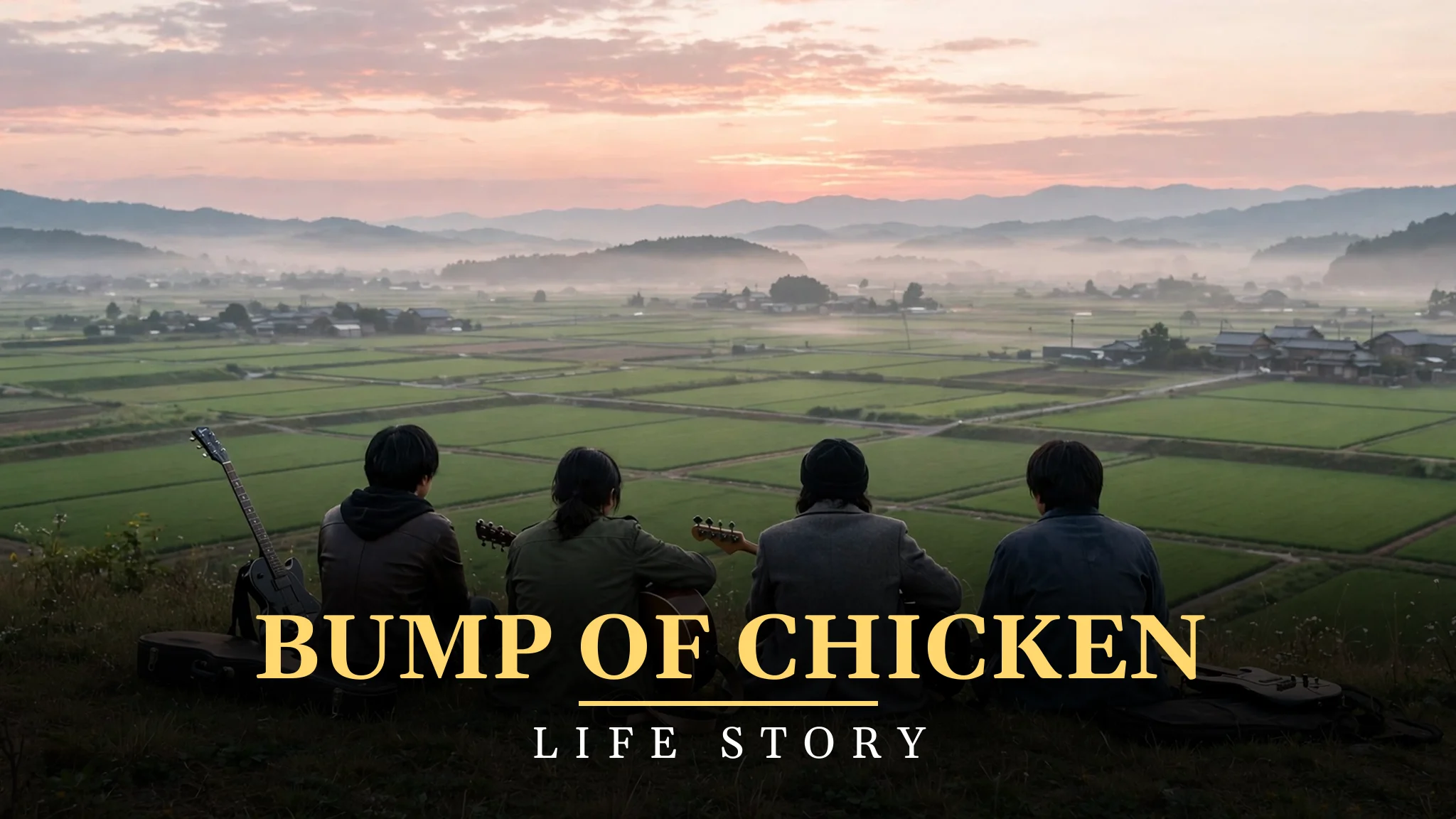
In the end, I come back to the hillside in the image, to four young men sitting with guitars, looking over green fields, at dawn, with mist in the valleys, and with a pink sky above. That image is a good picture of Bump of Chicken: quiet, thoughtful, together, and looking at a large, beautiful world, with hope. I hope they keep looking, and I hope they keep playing, because the world needs quiet bands, bands that remind us to look up, to listen, and to be patient, and Bump of Chicken are one of the best quiet bands I know.
I want to write about quietness itself, because it is the quality that first drew me to this band and the quality I keep coming back to. The music world rewards the loudest voice, the biggest show, and the most dramatic story, and a band that refuses to shout can easily be missed. Bump of Chicken have never shouted. They do not make headlines with scandals, they do not change their image every year, and they do not chase every new trend. They write songs, they practise them, they play them, and they go home. That sounds simple, and it is simple, but it is also very hard to keep doing for thirty years, because the pressure to be louder is always there. I admire a band that can hear that pressure and still choose to be quiet, because quietness, done well, is not weakness. It is a choice, and it takes strength to keep making it.
I have also noticed that their songs change as I change. A song I first heard as a young person meant one thing to me then, and it means something different now. Tentai Kansoku was once a song about leaving school and facing the future, and now it is a song about looking back at the people I left behind, and about the friends I still carry with me. The words did not change. I changed, and the song was wide enough to hold both versions of me. That is a rare quality in a song. Most songs belong to one moment in a life, and then they fade. A few songs are built so honestly that they can grow with the listener, and those are the songs people keep for decades. Bump of Chicken have written more than one of those, and I think that is why their fans do not leave them, even when years pass between albums.
There is one more thing I carry from this band, and it is the habit of looking up. It sounds small, but it matters. When life is busy, I look down, at my phone, at my work, at the next thing I have to do. A Bump of Chicken song reminds me to lift my eyes, to notice the sky, to remember that the world is larger than my worries, and that tomorrow is still coming. That is not a grand philosophy, and the band would probably laugh if I called it one. But it is a useful habit, and it is one I learned from a song about stars. A band that can teach a listener to look up, even for a few minutes, has done something real, and I am grateful to them for it, in a way that is hard to put into words, which is perhaps why their songs exist at all.
I also think about Hello World, and about what it means to meet someone new, to have the world open up, and to feel hope, even when you are afraid, and I find that song hopeful, because it suggests that a new beginning is possible, even after a difficult time, even after a loss, and even after many years. That is a message I need to hear, and I think many people do, because we all have moments when we feel stuck, when we feel that nothing will change, and a song that says, hello world, I am here, and I am ready, is a brave song, and a hopeful one, and it is one that Bump of Chicken write well, with a melody that is bright, and with words that are simple, and true.
I think about Aurora, and about the lights in the northern sky, and about the feeling of looking up, and wondering what is out there, and I find that song calming, because it reminds me that the world is large, that my worries are small, and that there is beauty in the sky, even on a dark night, even when I cannot see it from where I am. Fujiwara writes about the sky often, and I think he does it because the sky is a reminder, a reminder to look up, to notice, and to remember that we are part of something larger than ourselves, and that is a useful reminder, and one I need often, when I am caught up in small worries, and in the noise of everyday life.
I wonder what it must be like to be a new listener, hearing Bump of Chicken for the first time, through Hello World, or through a film, or through a friend, and then going back, listening to Tentai Kansoku, to Karma, to Ray, and realising that there is a whole history behind that one song, a history of thirty years, of four friends, of albums, of tours, and of a band that started in Sakura, and that is still going. That discovery must be exciting, and I hope those new listeners feel welcomed, because Bump of Chicken’s music is welcoming, even when it is quiet, even when it is thoughtful, and even when it is about the sky, the stars, and the sea. Inside that music, there is warmth, there is hope, and there is a sense that it is okay to be quiet, to think, and to feel.
I also think about the four friends, and about how they have stayed together, through thirty years, through changes in music, through changes in Japan, and through changes in their own lives, and I find that friendship inspiring, because it shows that a group of people can stay together, can trust each other, and can build something that lasts, if they are willing to work, to listen, and to put the group first, even when it is hard. That is a lesson for any group, in music or in life, and it is one I will remember, because it is rare, and because it is beautiful, and because it is true.
In the end, I come back to the sky, to the stars, and to the feeling of looking up, and I think that is the best image for Bump of Chicken: four friends, looking up, together, at a large, beautiful sky, with hope, with patience, and with a song in their hearts. I hope they keep looking up, and I hope they keep playing, because the world needs quiet bands, bands that remind us to be patient, to be thoughtful, and to be hopeful, and Bump of Chicken are one of the best quiet bands I know, and one I will keep listening to, for many years to come.
Frequently Asked Questions
When and where did Bump of Chicken form?
Bump of Chicken formed in 1994 in Sakura, a city in Chiba prefecture near Tokyo, when the four members were still at school. The members are Motoo Fujiwara, Hiroaki Masukawa, Yoshifumi Naoi and Hideo Masu, and they have stayed together ever since. They built their following slowly through small venues and independent releases before their major debut.
What is Bump of Chicken’s most famous song?
Tentai Kansoku, released in 2001, is one of their most famous songs, about watching the stars and feeling small in a large universe. The song became a hit in Japan and is still sung at concerts and played at graduations. Other well-known songs include Karma, Hello World, Ray and Aurora.
Who writes the songs for Bump of Chicken?
The songs are mainly written by Motoo Fujiwara, the singer and guitarist, who writes about the sky, the stars, the sea and the small moments of life. His lyrics are known for being both simple and deep, and for using images from nature to talk about big feelings. His songwriting is central to the band’s identity.
What does the name Bump of Chicken mean?
The name is unusual and memorable, and it has become a talking point for fans, but it is not a phrase with a simple everyday meaning. The band have kept the name for their whole career, and it fits their identity as a group that does things its own way. It is now a symbol of their long, steady career.
Have Bump of Chicken written music for films or games?
Yes, they have written songs for films, games and television, including Karma for the video game Tales of the Abyss and songs for Pokemon films. These collaborations have introduced their music to new audiences, including younger listeners who first heard them in a cinema. They choose projects that fit their sound.
Are Bump of Chicken still together today?
Yes, the same four members are still together, and they have been a band for more than thirty years. They continue to release albums, including Aurora Arc in 2019, and to tour in large venues in Japan. Their concerts remain popular, with audiences who have grown older with the band.


