Burt Reynolds: The Life Story Behind Hollywood's Mustache Star
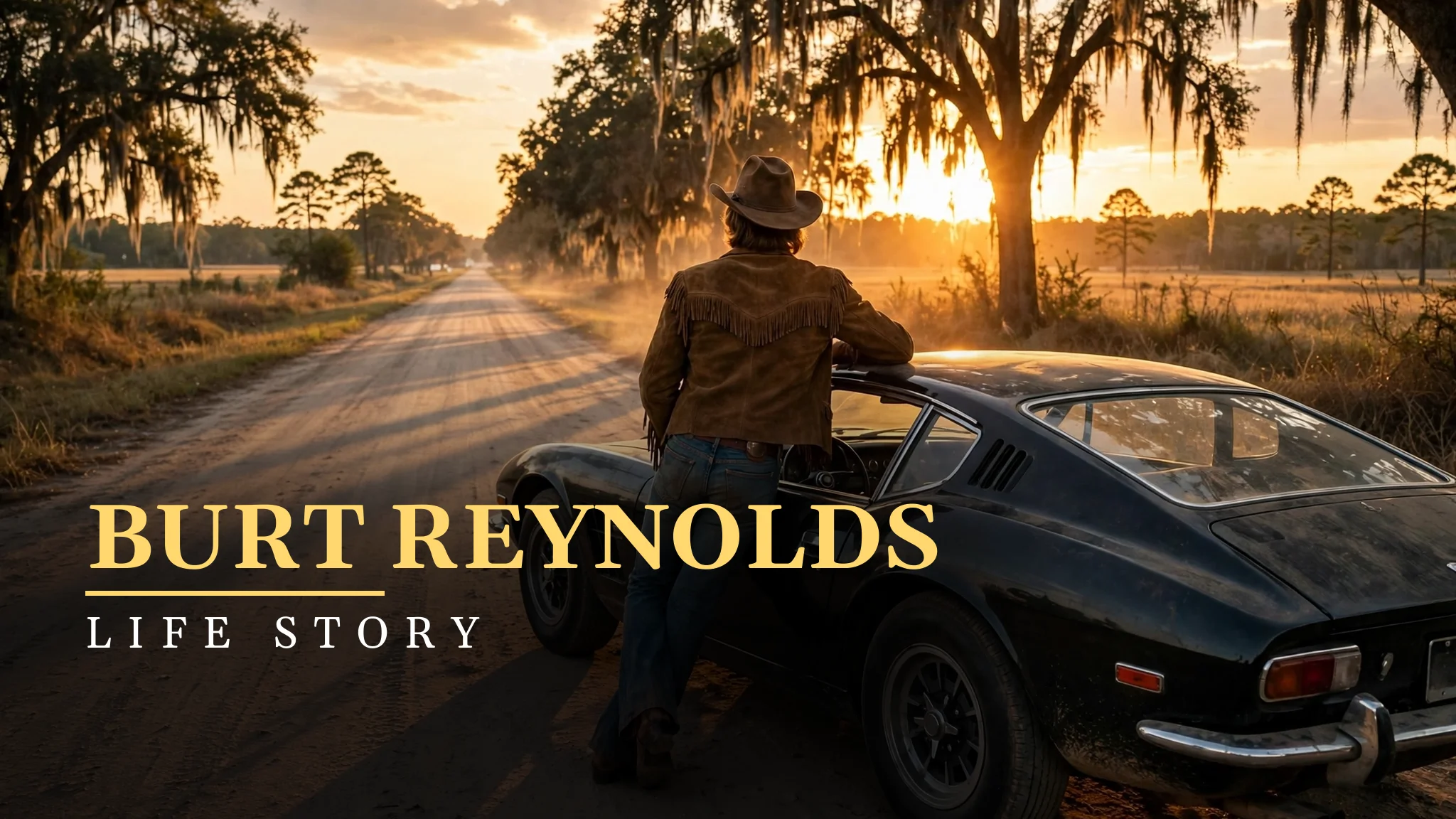
In this post
- A Florida Childhood and a Football Dream
- New York, Television, and Years of Small Parts
- Deliverance and the Breakthrough Nobody Expected
- Smokey and the Bandit and the King of the Box Office
- Fame, Money, and the Hard Years That Followed
- Boogie Nights and a Late Comeback
- The Ranch, the Fans, and a Life Beyond the Screen
- My Take:
Burt Reynolds was the kind of star who made the whole cinema feel like a good time. He had a big laugh, a thick mustache, and a way of looking at the camera as if he was sharing a joke with everyone in the room. In the 1970s, he was one of the biggest box office stars in the world, and his films were the ones people went to see when they wanted to forget their troubles for two hours. Yet behind that easy smile there was a man who had worked hard for everything, who had lost a sporting career to injury, and who had spent years in small television roles before Hollywood finally noticed him.
He was born Burton Leon Reynolds Jr. on 11 February 1936 in Lansing, Michigan, and he grew up mainly in Florida, where his father worked as a police chief in the town of Riviera Beach. Florida in those years was a place of sun, sport, and open space, and young Burt loved to be outside, to play football, and to test himself against other boys. He was strong, fast, and competitive, and his teachers and coaches saw in him a natural athlete who could go far if he stayed focused and worked hard.
The road to acting was not a straight one, and it began with a hard loss. He won a football scholarship to Florida State University, and he played as a running back with real promise, but a knee injury, and then a serious car accident, ended his hopes of a professional football career. That kind of loss can break a young man, because it takes away the future he had planned for himself. For Reynolds, it forced him to look for a new path, and that path led, slowly and unexpectedly, to the stage and then to the screen.
A Florida Childhood and a Football Dream
Burt Reynolds grew up in Riviera Beach, Florida, after his family moved there from Michigan, and the town gave him a childhood full of sun, sea, and sport. His father, Burton Reynolds Sr., was the chief of police, a strong and respected man who believed in discipline and hard work, and his mother, Fern, kept a warm and steady home. Young Burt admired his father, and he learned from him that a man should stand up for himself, keep his word, and look after the people around him. Those lessons stayed with him, even when his life later became very different from the life of a small town policeman’s son.
At school, he was known as a talented athlete, and football was the sport where he shone brightest. He was fast, brave, and willing to take a hit, and his coaches believed he had the talent to play at a high level. He also showed an early interest in acting, taking part in school plays and enjoying the attention that came with being on stage. At that time, acting was a side interest, not a career plan, and football was the dream that mattered most to him and to his family.
He went to Florida State University on a football scholarship, and for a time it looked as if his future was set. He played well, he was part of a strong team, and professional scouts began to notice him. Then came the injuries that changed everything. A bad knee injury slowed him down, and a car accident soon after made it clear that his body would not let him play professional football at the level he had hoped for. He had to accept that the dream was over, and that acceptance was painful for a young man who had built his whole identity around sport.
The end of football forced Reynolds to think again about what he could do. He took classes, he worked in different jobs, and he began to spend more time in the theatre department at university, where he found that acting gave him some of the same excitement as football. On stage, he could be brave, he could take risks, and he could feel the energy of an audience, just as he had felt the energy of a crowd at a football game. It was not the same as sport, but it was a new way to use his talent, and it gave him a reason to keep going.
New York, Television, and Years of Small Parts
After university, Reynolds went to New York to try his luck as an actor, and he found that the city was full of young men with the same dream. He studied acting, he took small parts in plays, and he worked in jobs that paid the rent while he waited for a break. He appeared in a touring production of Mister Roberts, a play about life on a Navy ship, and the experience taught him how to work with a company of actors night after night, in different towns, in front of different audiences. It was hard work, but it was the kind of training that no classroom could give.
Television in the late 1950s and early 1960s gave him his first steady work. He appeared in many of the Western series that were popular at the time, playing cowboys, outlaws, and young men in trouble, and he learned how to act in front of a camera, how to hit his marks, and how to work fast. He was a regular on the series Riverboat, and later he played Quint Asper, a blacksmith, in the long running Western Gunsmoke. That role lasted for several years, and it gave him a steady income and a face that television audiences began to recognise.
Those years were not glamorous, and Reynolds often said that he took any job he could get, because he needed to pay his bills and to keep learning. He played villains, he played heroes, and he played men who were somewhere in between, and each part taught him something new about how to build a character. He was not yet a star, and the big film roles were still far away, but he was becoming a professional actor, a man who could be trusted to do the work well and to turn up on time.
By the late 1960s, he was ready for a bigger chance, and he began to get small film roles that showed what he could do. He appeared in films such as Navajo Joe and 100 Rifles, and he worked with directors who saw his energy and his charm. He was still learning how to use his natural warmth on screen, and he was still trying to find the kind of role that would let him be himself. That search would soon lead him to a film that changed everything, a film about four men on a river in the American South.
Deliverance and the Breakthrough Nobody Expected
The breakthrough for Burt Reynolds came with Deliverance, released in 1972 and directed by John Boorman. The film told the story of four friends from the city who go on a canoe trip down a wild river in Georgia, and who face danger from the land and from the people they meet. Reynolds played Lewis Medlock, the strongest and most confident of the four men, a man who loves the outdoors and who believes that nature will test a man and show what he is made of. It was a serious, dark, and powerful film, and it was very different from the light comedies that would later make him famous.
Deliverance was a difficult film to make, and the actors had to do much of their own work on the river, in cold water and in dangerous conditions. Reynolds threw himself into the part, and his physical strength and his love of the outdoors made the role feel real. The film was a critical and box office success, and it earned several Academy Award nominations. For Reynolds, it was proof that he could be a serious actor, not just a handsome face on television, and it opened the door to leading roles in major films.
After Deliverance, he was in demand, and he chose a mix of serious dramas and lighter films. He starred in The Longest Yard in 1974, a film about a former football player in prison who leads a team of prisoners against the guards, and the role used his football past in a powerful way. The film was a success, and it showed that audiences liked to see Reynolds as a tough, funny, and rebellious man who would not be pushed around. That image, of a man who stood up to authority with a smile, would become his trademark.
In the years that followed, he became one of the most popular stars in America, and his name on a poster was enough to bring people into a cinema. He worked with some of the best directors of the time, and he made films that were both entertaining and well made. He was no longer the young man from Florida who had lost his football career. He was a movie star, and he was enjoying every minute of it, even as he worked hard to keep his career going.
Smokey and the Bandit and the King of the Box Office
The film that made Burt Reynolds a true box office king was Smokey and the Bandit, released in 1977. He played Bo Darville, known as the Bandit, a cheerful truck driver who takes on a bet to bring a load of beer across state lines while being chased by a determined sheriff played by Jackie Gleason. The film was fast, funny, and full of car chases, and it became one of the biggest hits of the year. Audiences loved the Bandit, with his black Trans Am car, his cowboy hat, and his easy laugh, and the film made Reynolds the most popular star in America.
Smokey and the Bandit was not a serious drama, and Reynolds knew it. He made the film to entertain people, and he did it with a joy that was clear on screen. He laughed, he joked, and he drove fast, and the audience laughed with him. The film spawned sequels, and it made the Trans Am car famous around the world. For a time, it seemed as if Reynolds could do no wrong, and every film he made was a hit. He was the top box office star in America for several years in a row, a rare achievement for any actor.
He followed that success with other popular films, including The Cannonball Run in 1981, a comedy about a wild cross country car race, and Sharky’s Machine in 1981, a crime film that he also directed. He also starred in Hooper in 1978, a film about Hollywood stuntmen, which was a tribute to the brave men who did the dangerous work that stars often got credit for. These films were not all great art, but they were made with energy and humour, and they gave audiences exactly what they wanted, which was a good time at the cinema.
During these years, Reynolds was everywhere. He was on magazine covers, he was on television talk shows, and he was one of the most recognisable faces in America. He enjoyed the fame, he bought a ranch in Florida, and he lived the life of a big star. Yet he also worked hard, making several films a year, and he took his work seriously, even when the films were light comedies. He knew that the audience paid to see him, and he wanted to give them their money’s worth, every single time.
Fame, Money, and the Hard Years That Followed
Success on that scale can be hard to manage, and the late 1980s and early 1990s were difficult years for Reynolds. The big box office hits became less frequent, and some of his films did not do well. He also faced money problems, and he had to deal with the cost of a large lifestyle, a ranch, and a divorce from his second wife, the actress Loni Anderson. The couple had married in 1988 and adopted a son, Quinton, but the marriage ended in divorce in the early 1990s, and the split was widely reported in the press.
He also had health problems, and he went through a difficult period when he was not working as much as he had before. He appeared in the television series Evening Shade in the early 1990s, a warm comedy about a former football coach in a small town in Arkansas, and the show was a success, winning him an Emmy Award. That role showed a softer, older Reynolds, a man who could be funny and kind, and it reminded audiences that he still had a great deal to offer as an actor, even if the big film roles were fewer.
The hardest part of those years was not the loss of fame, but the loss of money and the feeling that the industry had moved on. Reynolds had been the biggest star in America, and now younger actors were taking the roles he once would have played. He did not hide from that truth, and he spoke openly about his mistakes, about spending too much money and about making bad choices in his career. That honesty was refreshing, because many stars pretend that everything is fine when it is not, and Reynolds was willing to say that he had made errors and that he was trying to learn from them.
He kept working, taking smaller roles in films and on television, and he never fully gave up on acting. He appeared in many different projects, and he was always professional, always prepared, and always willing to work. That persistence mattered, because it kept him in the business, and it set the stage for a late career comeback that surprised many people who thought his best years were behind him.
Boogie Nights and a Late Comeback
The comeback came with Boogie Nights, released in 1997 and directed by Paul Thomas Anderson. Reynolds played Jack Horner, a director of adult films in the 1970s who builds a kind of family around the people who work for him. The role was complex and sad, a man who wants to be an artist but who is trapped in a world that is changing around him. Reynolds played it with a quiet dignity that surprised many critics, and the performance earned him an Academy Award nomination for Best Supporting Actor, his first Oscar nomination.
Boogie Nights reminded the film world that Reynolds was a serious actor, not just a star of car chase comedies. He was older, his face showed the years, and his voice had a tired warmth that suited the character perfectly. The film was a critical success, and it brought him back to the centre of attention, with new offers and new respect from directors and actors who had grown up watching his films. It was a second chance, and he took it with both hands.
In the years that followed, he continued to work in films and on television, taking roles that suited his age and his experience. He appeared in films such as The Dukes of Hazzard in 2005, and he worked on television shows, always bringing his trademark charm and his professional attitude to the set. He also wrote a memoir, But Enough About Me, published in 2015, in which he looked back on his life with humour and honesty, talking about his successes, his failures, and the people he had loved along the way.
His health became more fragile in his later years, and he lived in Florida, close to the place where he had grown up. He stayed in touch with friends, he supported young actors, and he remained a beloved figure for fans who had grown up with his films. When he died on 6 September 2018, at the age of eighty two, after suffering a heart attack, tributes came from all over the world, from fans who remembered Smokey and the Bandit and from actors who had worked with him and who spoke of his kindness and his humour.
The Ranch, the Fans, and a Life Beyond the Screen
Burt Reynolds loved Florida, and he loved the ranch he built there, a place where he could ride horses, work outdoors, and live like the country boy he had once been, even when he was one of the most famous men in America. He bought land, he built a home, and he created a place where friends, family, and fellow actors could come to relax, to fish, to eat, and to tell stories. That ranch was important to him, because it was a reminder of where he came from, and because it gave him a life that was not about cameras, premieres, or box office numbers, but about simple pleasures, fresh air, and good company.
He was also a man who loved his fans, and who understood that without them he would have nothing. He signed autographs, he posed for photographs, and he talked to people who had grown up watching his films, and he did it with a warmth that made people feel as if they were meeting an old friend, not a distant star. He knew the names of the towns where his films had done well, he knew the jokes that audiences loved, and he never forgot that it was ordinary people, paying for a ticket, who had made him a star. That gratitude was real, and it showed in the way he treated people, even when he was tired or in pain.
In his later years, he also became a mentor to younger actors, sharing what he had learned about acting, about Hollywood, and about how to survive in a business that can be cruel to people who are no longer young or fashionable. He told them to work hard, to be professional, to turn up on time, and to never forget that the audience is the reason you are there. Those are simple lessons, but they are the ones that matter most, and they came from a man who had lived them, who had been on top, who had lost much of what he had, and who had come back with dignity and humour.
He also kept his sense of humour about himself until the end, laughing at his own image, at the mustache, at the Trans Am, and at the films that had made him famous. He knew that some critics had dismissed those films as lightweight, but he also knew that millions of people had loved them, and that love was worth more than a good review in a newspaper. That is a healthy way to look at a career, and it is one that I think more actors should adopt, because the audience’s love is the real prize, not the praise of a few critics.
My Take:
When I think about Burt Reynolds, the first thing I feel is warmth, because he was a star who made people feel good. I did not grow up in America in the 1970s, but I can still understand why audiences loved him so much. He was not a distant, serious actor who made you feel small. He was a man who laughed, who drove fast, and who invited you to laugh with him. That is a rare gift, and it is one that many serious actors never learn. Reynolds had it from the start, and he used it to give millions of people a good time at the cinema.
I admire the way he handled the loss of his football career, because that loss could have destroyed him. He was a young man with a clear dream, and that dream was taken away by injury and by an accident that was not his fault. Many people in that position give up, or they spend the rest of their lives angry about what might have been. Reynolds found a new dream, and he worked at it with the same energy he had once given to football. That takes courage, and it takes a willingness to start again when you are still young enough to feel the pain of what you have lost.
What I find most impressive about Deliverance is that it showed a different Reynolds, a serious actor who could carry a dark and difficult film. He did not hide behind jokes in that film. He played a man who was strong and confident, but who was also afraid, and who had to face the fact that nature and other people could be far more dangerous than he had thought. That performance proved that he was not just a comedian. He was an actor who could handle real drama, and I think that film deserves to be remembered as one of the best of his career.
Smokey and the Bandit is a very different kind of film, and I love it for a different reason. It is not a great work of art, and it does not try to be. It is a film about freedom, about driving fast on an open road, and about laughing at authority. In the 1970s, when many people felt trapped by their jobs and by the rules of life, that kind of film felt like a breath of fresh air. Reynolds understood that, and he gave the audience exactly what they needed, which was a hero who did not take life too seriously and who always found a way to win.
I also think about the hard years, because they make his story feel human. It is easy to admire a star when he is on top, with money, fame, and hit films. It is harder, and more important, to see how he behaves when those things are gone. Reynolds lost money, he lost a marriage, and he lost his place at the top of the box office, but he did not stop working, and he did not stop being honest about his mistakes. He talked about spending too much, about making bad choices, and about learning from them. That honesty is rare in Hollywood, and I respect it a great deal.
His comeback in Boogie Nights is one of my favourite parts of his story, because it shows that a career is never truly over until you decide it is over. He was sixty one years old when he made that film, and many people thought his best work was behind him. Instead, he gave one of the best performances of his life, playing a man who was also trying to hold on to a world that was changing around him. There is a sadness in that role that feels real, because Reynolds knew what it was like to be famous and then to feel the world move on. He used that knowledge, and he turned it into art.
I think about his television work in Evening Shade too, because it showed a softer side of him that many people had not seen before. He played a former football coach who had come home to a small town, and he played it with warmth and humour, not with the big, loud energy of his film roles. That role won him an Emmy, and it proved that he could be a different kind of actor when he was given the chance. It also showed that he was willing to work on television, which many film stars at the time looked down on, and that willingness kept his career alive.
There is a sadness in his story as well, which is that he never quite got the respect he deserved as a serious actor until very late in his life. He was the biggest box office star in America, but he was often dismissed by critics as a lightweight, a man who made car chase films and comedies. I think that was unfair, because making people laugh is hard, and because his best performances, in Deliverance and in Boogie Nights, show a real actor at work. He deserved more credit, and I am glad that he finally got some of it before he died.
I also admire his sense of humour about himself. He was willing to laugh at his own image, to appear in films and on television that made fun of the Bandit and the mustache, and to admit that he had enjoyed the fame while it lasted. That kind of self knowledge is rare, and it makes him easier to like. He did not pretend to be a tortured artist. He was a man who loved to entertain, and he was honest about that love.
What I learn from Burt Reynolds is that a career can have more than one act. He was a football player, then a television actor, then a serious film actor, then a box office king, then a man who lost much of what he had built, and then, finally, a respected older actor who gave a great performance in Boogie Nights. Each act was different, and each one taught him something new. That is a good lesson for anyone who thinks that one failure means the end. It does not have to be the end. It can be the start of the next act, if you are willing to keep working.
I think about the way he lived in Florida, close to where he grew up, and I like that he never fully left his roots behind. He bought a ranch, he lived among people who knew him as a local boy, and he stayed connected to the place that had shaped him. Fame can pull a person away from home, and many stars never go back. Reynolds went back, and that tells me that he knew where he belonged, even when the whole world knew his name.
If I could ask him one question, I would ask him what he felt when he watched Smokey and the Bandit with a young audience, many years after it was made, and saw them laugh at the same jokes that had made their parents laugh. I think he would have smiled, because that is the real test of a popular film. It is not whether the critics liked it, but whether it still makes people happy, years later, when the cars and the clothes look old fashioned. His films still do that, and that is a lasting achievement.
In the end, I see Burt Reynolds as a man who gave people joy, and who paid a price for his fame, and who came back from that price with dignity and humour. He was not a perfect man, and he did not pretend to be one. He was a man who loved to laugh, who loved to work, and who loved to entertain, and I think that is a good way to be remembered. His mustache, his laugh, and his black Trans Am will stay in the memory of film lovers for a long time, and so will the serious actor who was always there underneath the smile.
I also keep thinking about how his story shows the difference between being famous and being loved. Reynolds was famous, of course, but he was also loved, because audiences felt that he liked them, and that he was having as much fun as they were. That love did not disappear when the hits stopped coming, and it did not disappear when he got older. It stayed with him until the end, and it is still there now, in the way people talk about him with a smile. That is a rare kind of success, and it is one that money cannot buy.
I also think about the way he treated his fans, because that is a part of stardom that many actors forget. Reynolds never forgot that it was ordinary people who paid for tickets, who bought posters, and who made him a star, and he treated those people with warmth and respect. He signed autographs, he posed for photographs, and he talked to fans as if they were friends, not as if they were a nuisance. That is a good way to be famous, and it is one of the reasons people still talk about him with a smile, years after his death.
Another thing that stays with me is how he handled his money problems with honesty. He did not pretend that everything was fine when it was not, and he did not blame other people for his mistakes. He said that he had spent too much, that he had made bad choices, and that he was trying to learn from them. That honesty is rare in Hollywood, where many stars hide their financial troubles behind a perfect image. Reynolds was willing to say, I made a mistake, and that takes courage, and it also helps other people who have made the same mistakes to feel less alone.
I think about his ranch in Florida, and how it gave him a place to be himself, away from the cameras. He loved horses, he loved the outdoors, and he loved the simple life of a country boy, even when he was a rich and famous star. That connection to home is important, because fame can pull a person away from their roots, and many stars never go back. Reynolds went back, and that tells me that he knew where he belonged, and that he valued the place that had shaped him more than the glamour of Hollywood.
There is also a lesson here about humour as a way to survive hard times. Reynolds laughed through his career, he laughed at himself, and he laughed with his audiences, and that laughter helped him through the difficult years when the hits stopped coming and the money ran out. Humour does not solve every problem, but it makes problems easier to bear, and it reminds you that life is still worth living, even when things go wrong. I think that is one of the most important things he taught us, without ever saying it in so many words.
Finally, I think about the black Trans Am, and how a car became a symbol of freedom for a whole generation. That car, that mustache, and that laugh will stay in the memory of film lovers for a long time, not because they were great art, but because they made people happy. Happiness is a simple thing, but it is also a valuable thing, and Reynolds gave it to millions of people. That is a legacy to be proud of, and it is one that I hope we do not forget when we talk about serious films and serious actors.
I also think about how his laugh made people feel welcome, because laughter is a gift, and Reynolds gave it freely, on screen and off it. He laughed at himself, he laughed with his friends, and he invited audiences to laugh with him, and that laughter made hard times easier to bear, both for him and for the people who watched his films.
In the end, I will remember him as a man who loved to entertain, who worked hard, who made mistakes, and who came back with dignity. That is a human story, and it is one that deserves to be told with warmth, because Burt Reynolds was, above all, a warm and generous man.
Frequently Asked Questions
How did Burt Reynolds lose his football career?
He won a football scholarship to Florida State University, but a knee injury and then a serious car accident ended his hopes of playing professional football, forcing him to find a new path in acting.
What film made Burt Reynolds a serious actor?
Deliverance, released in 1972, made him a serious actor, because his role as Lewis Medlock in a dark river adventure showed critics that he could carry a powerful drama.
Why was Smokey and the Bandit such a big hit?
Smokey and the Bandit, released in 1977, was a big hit because it was fast, funny, and full of car chases, with Reynolds as the cheerful Bandit in a black Trans Am outrunning a determined sheriff.
Did Burt Reynolds win an Oscar for Boogie Nights?
He did not win, but he was nominated for the Academy Award for Best Supporting Actor for Boogie Nights in 1997, playing Jack Horner, a director of adult films in the 1970s.
Who was Burt Reynolds married to?
He was married twice, first to the actress Judy Carne and later to the actress Loni Anderson, with whom he adopted a son, Quinton, and the second marriage ended in divorce.
When did Burt Reynolds die?
He died on 6 September 2018 in Florida, at the age of eighty two, after suffering a heart attack, and he was mourned by fans and actors around the world.


