Cabir Was First Phone Worm
In this post
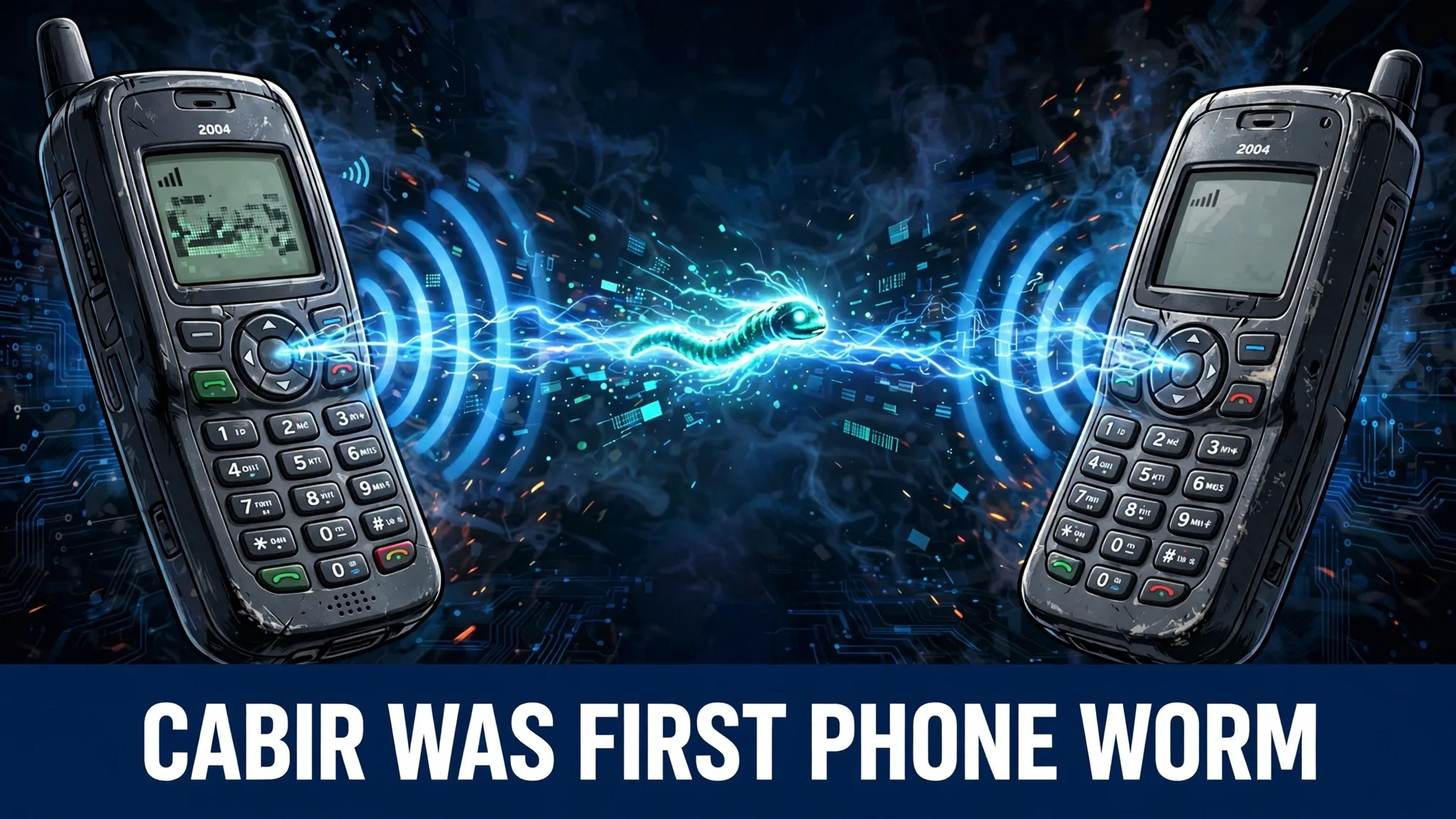
Picture a café table in 2004. Two chunky Nokia phones sit side by side, the kind with real buttons and a little antenna bump, the kind you charged once and used all week. Nothing about them looks dangerous. And yet, quietly, invisibly, something very small is trying to travel from one of them to the other — not through a wire, not through the internet, but straight through the air between the coffee cups. On the second phone, a polite little question appears on the screen. A file is offering itself. Caribe, it is called. One tap on “Accept,” and the journey is complete. That tiny moment — a stranger’s file, a curious finger — was the doorway into a brand-new age. The phone had just caught its first worm, and its name was Cabir.
What Cabir is, and what it actually does
Cabir appeared in June 2004, and it holds a permanent place in history: it is known as the first worm ever written for mobile phones. Before Cabir, computer viruses were a problem for big grey boxes that sat under desks. They travelled on floppy disks, then on CDs, then through email. Cabir proved that the same sickness could live inside the small computer warming your pocket.
It was created by a virus-writing group known as 29A, and it was not made to rob anyone. It was a proof of concept — a demonstration, built to show that the thing could be done at all. The group sent it to antivirus companies so their experts could examine it, the way a locksmith might show a bank a new kind of lock-pick before any thief ever uses one.
Cabir was written for phones running the Symbian operating system, which was the software inside Nokia’s hugely popular smartphones of that era. If your phone was one of those — and millions of phones were — it was the kind of phone Cabir could live in.
And what did it do once inside? Remarkably little, and that is part of its strange charm. Once installed, the worm simply displayed the word “Caribe” on the screen whenever the phone started up, like a tiny signature scribbled on the wallpaper. It stole nothing. It deleted nothing. It sent no bills, locked no files, and read no messages. Its one genuinely annoying habit grew out of the way it travelled, which brings us to the cleverest and weakest part of its design.
How Cabir spreads: a worm that had to ask permission
Cabir moved through Bluetooth, the short-range wireless link phones use to swap photos and connect to headsets. An infected phone never rested. Day and night, it kept searching the air around it for other Bluetooth phones within reach — in the same café, the same bus, the same office floor — and to every phone it found, it politely offered a file named caribe.sis.
Here is the detail that makes Cabir different from almost every villain in malware history: it could not force its way in. The receiving phone showed a prompt asking its owner whether to accept the file. If the owner said no, the journey ended right there. Cabir could only cross from one phone to the next when a human being looked at that unexpected little question and, out of curiosity or confusion, tapped “Accept.”
That single tap was both its engine and its brake. It slowed the worm enormously compared with the email worms of the same years, which could flood a continent before lunch. But phones gather in crowds, Bluetooth reaches across rooms, and curiosity is one of the most reliable forces on Earth. The taps kept coming, one stranger at a time, and so the little worm kept travelling — through cafés, trains, airports and pockets — one act of trust after another.
For an ordinary person, the lesson hides in plain sight: Cabir never attacked anybody. It knocked, and waited, and needed to be invited in.
The damage story: a small harm and a very large shock
Judged by destruction, Cabir barely misbehaved. Its endless Bluetooth searching drank the battery of infected phones faster than normal, leaving owners puzzled about why a trusty Nokia suddenly seemed tired by evening. Beyond flat batteries and the odd start-up message, there was nothing — no emptied bank accounts, no vanished photographs, no ransom notes. In a family tree that includes worms which wrecked hospitals and pipelines, Cabir is almost innocent.
But judged by what it announced, Cabir was enormous. From its laboratory beginnings, it escaped into the real world. Researchers recorded Cabir infections in more than a dozen countries, and it was reported in the United States in early 2005 — a proof of concept, built to sit quietly on experts’ desks, hopping happily between strangers’ phones on another continent within months.
That escape delivered the true damage, and it was done to an idea. Until Cabir, most people believed viruses were something that happened to computers — heavy machines, in offices, looked after by other people. The phone felt personal and safe, more like a camera or a watch than a computer. Cabir ended that innocence with one word on a start-up screen: Caribe. The thing in your pocket was a computer too, and everything that hunts computers would eventually come hunting it. I find something almost gentle in the way history chose to teach us this — the warning arrived as a harmless little worm rather than a thief, and phones were never innocent again.
How to protect your phone today
Cabir itself is long retired, but the road it opened is busier than ever, and the protections that would have stopped it are the same ones that stop its modern descendants.
Turn Bluetooth off when you are not using it. Cabir’s entire world depended on Bluetooth quietly searching and being searched. A phone with Bluetooth switched off in public places is invisible to that whole class of trick. Switch it on when you need your earbuds, and off again when you are done.
Never accept a file from a device you do not recognise. This was the whole game in 2004 and it still is. If your phone ever asks whether to receive a file you did not request, from a sender you cannot see, the answer is no — however interesting the name looks. Cabir survived purely on people saying yes to a mystery.
Be just as strict with apps. The modern version of the caribe.sis file is the strange app offered outside the official store, or the link in a message begging you to install something. Install apps only from the official app store for your phone, and treat any download offered by text message, chat or random website as the same polite knock Cabir used to make.
Keep your phone’s software updated. Updates quietly close the little doors that malware walks through. A phone that updates itself is a phone whose locks keep changing for the better.
Slow down for the tap. Every protection above ends at the same place: one human decision. Fake parcel texts, smiling poisoned apps, mystery files — all of them are still waiting for exactly the tap Cabir waited for. Refuse the tap, and the worm starves.
Common questions
Was Cabir really the first phone virus?
Yes — Cabir, which appeared in June 2004, is recognised as the first worm written for mobile phones. Earlier malware existed for computers and handheld organisers, but Cabir was the first to target ordinary mobile phones and spread between them wirelessly.
Did Cabir steal money or personal information?
No. Cabir stole nothing and deleted nothing. It displayed the word “Caribe” when an infected phone started, and its constant Bluetooth searching drained batteries faster than usual. Its importance is what it proved, not what it took.
How did Cabir spread if it needed permission?
An infected phone used Bluetooth to offer a file called caribe.sis to nearby phones. The receiving phone asked its owner whether to accept, so every new infection required a person to tap “Accept” — which happened often enough, through curiosity, for researchers to record infections in more than a dozen countries.
Who made Cabir, and why?
It was created by a virus-writing group known as 29A as a proof of concept — an experiment to demonstrate that a mobile phone worm was possible. It was sent to antivirus companies for examination, but it later escaped into the wild and spread between real phones.
Could something like Cabir infect my phone today?
Not Cabir itself — it targeted the old Symbian system inside Nokia phones of its era, which modern phones no longer use. But its method is alive everywhere: unexpected files, links and apps that need one trusting tap. Keeping Bluetooth off when unused, refusing unknown files and installing apps only from official stores defeat the entire family of tricks.
Sources
- Wikipedia — Cabir (computer worm): https://en.wikipedia.org/wiki/Cabir_(computer_worm)
There is a long, strange road behind that little worm. It began with jokes passed around on floppy disks between school friends, grew teeth in the email floods that drowned offices, learned to lock up hospitals and argue over ransoms — and then, one quiet afternoon in 2004, it shrank itself down to the size of a phone and learned to travel on nothing but thin air and curiosity. The machines have changed beyond recognition since then, and so have the tricks, but the smallest and most important part of the story has never changed at all. Somewhere between the danger and you, there is always one small moment of choice — a prompt, a link, an offered file — and a person deciding whether to tap. Cabir asked the whole world that question first, gently, with a worm that did no harm. The ones asking today are not so kind. So keep your phone close, keep your finger patient, and let the knock go unanswered.