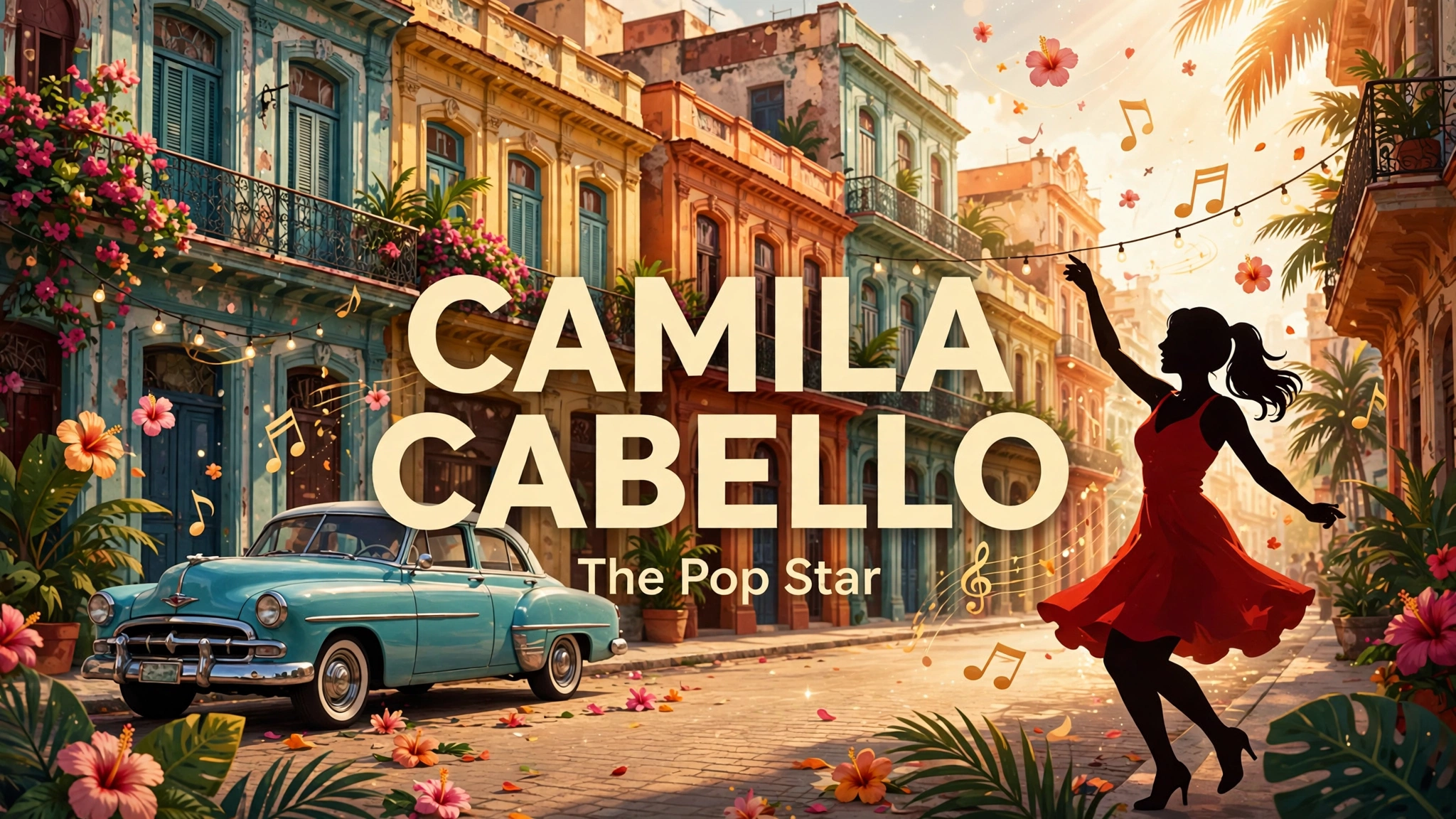
Camila Cabello: The Life Story Behind the Pop Star
In this post
Growing Up in Havana and Miami
Karla Camila Cabello Estrabao was born on March 3, 1997, in Cojimar, Havana, Cuba, and was raised in a household that was, by her own account, loving, musical, and full of family, with a mother, Sinuhe Estrabao, who was an architect, and a father, Alejandro Cabello, who owned a car wash, and with a younger sister, Sofia, who would become her best friend, and her biggest supporter. She has spoken about her childhood in Cuba with fondness, about the music, about the streets, about the sense of community, and about the feeling of belonging, in a place where everyone knew each other, where family was everything, and where music was a part of everyday life, from the radio, from the neighbours, and from the celebrations that filled the streets. She was a girl who loved to sing, who loved to perform, and who was, by her own account, shy, anxious, and a little bit different, a girl who found her voice in music, in singing, and in the privacy of her own room, where she could be herself, without judgement, without fear, and without the need to be anyone other than who she was.
When Camila was six years old, her family moved to Miami, Florida, in search of a better life, a journey that involved leaving behind her home, her friends, and her extended family, and that was, by her own account, difficult, frightening, and transformative, a move that taught her about sacrifice, about resilience, and about the importance of family, and that shaped her understanding of herself, as an immigrant, as a Latina, and as a person who belongs to two worlds, Cuba and America, and who carries both with her, wherever she goes. She has spoken about the move with honesty, about the fear, about the loneliness, and about the way she clung to music, to singing, as a way to cope, to connect, and to find her place in a new country, in a new school, and in a new life, where she did not speak English fluently, where she was the new girl, and where she had to learn, quickly, how to adapt, how to survive, and how to thrive, in a world that was both exciting and overwhelming.
She attended Miami Palmetto High School, where she was a good student, but also a girl who was already dreaming of becoming a singer, who was posting videos of herself singing on YouTube, and who was auditioning for talent shows, in the hope of being discovered, of being given a chance, and of making a career out of the thing she loved most, music. She has said that she was inspired by the singers she heard growing up, by Celia Cruz, by Alejandro Fernandez, and by the pop stars of the 2000s, and that she wanted to be a singer, a performer, and a storyteller, a person who could make music that touched people, that made them feel, and that told the truth about who she was, where she came from, and what she dreamed of becoming. That dream, that ambition, would lead her to an audition, in 2012, that would change her life, and that would make her a star, in a way that no one, including Camila herself, could have predicted.
The X Factor, Fifth Harmony, and the Girl Group Years
In 2012, when Camila Cabello was fifteen years old, she auditioned for The X Factor USA, a television talent show, singing Aretha Franklin’s Respect, and though she did not make it through as a solo artist, she was grouped together with four other girls, Ally Brooke, Normani, Dinah Jane, and Lauren Jauregui, to form a girl group, Fifth Harmony, a decision that was made by the judges, including Simon Cowell, and that would change all five of their lives, forever. The group finished third on the show, but they were signed to a record deal, and they went on to become one of the biggest girl groups in the world, with hits like Worth It, Work from Home, and BO$$, and with a fanbase, the Harmonizers, that was among the most passionate in music. Camila was the youngest member of the group, and she was also, by many accounts, the most recognisable, with a voice that was distinctive, a personality that was warm, and a stage presence that was unmistakable, and she quickly became a fan favourite, a person who was loved by audiences, and who was seen as a future star, even within the group.
Fifth Harmony’s success was extraordinary, with the group selling millions of records, touring the world, and becoming a phenomenon, but it was also demanding, with constant touring, constant recording, and constant attention from the media, and Camila has spoken about the pressures of those years, about the fame, about the scrutiny, and about the desire to do something more, to be more than a girl group member, to make music that was her own, and to tell her own story, in her own voice, and on her own terms. She was a teenager, living away from home, working in a group, and learning the business of entertainment from the inside, and the experience prepared her for the fame that was to come, but it also taught her about the difficulties of being in a group, about the compromises, about the conflicts, and about the need to be true to yourself, even when it means leaving something that is successful, that is comfortable, and that is safe, for something that is uncertain, that is risky, and that is entirely your own.
In December 2016, Camila Cabello announced that she was leaving Fifth Harmony, to pursue a solo career, a decision that was met with surprise, with sadness, and with speculation, from fans, from the media, and from the other members of the group, who issued a statement saying they were hurt by her decision, and that they had learned about it through her representatives, rather than from Camila herself. The departure was controversial, and it led to a public rift, with the remaining members continuing as a four-piece, and with Camila embarking on a solo career that would, within a year, make her one of pop’s biggest names. She has spoken about the decision with honesty, about the difficulty, about the pain, and about the necessity of it, saying that she needed to follow her own path, to make her own music, and to be herself, and that the group, while it was a wonderful experience, was not where she belonged, not anymore, and that she had to leave, in order to grow, to learn, and to become the artist she was meant to be.
Havana and the Solo Breakthrough
Camila Cabello’s solo breakthrough came in 2017, with the song Havana, featuring Young Thug, a track that topped charts in dozens of countries, reaching the Hot 100 summit, and becoming a global phenomenon, played everywhere, from radio to clubs to social media, and that made Camila a superstar, a solo artist who could top the charts, who could fill arenas, and who could do it with a song that was entirely her own, a mix of Latin pop, hip-hop, and R&B, that celebrated her Cuban heritage, that told the story of a girl from Havana, and that was both personal and universal, a song that resonated with audiences around the world, who recognised something of themselves in its story, in its melody, and in its joy. Havana was not just a hit; it was a statement, a declaration that Camila Cabello was not just a former girl group member, but a star in her own right, a person who could make music that was both commercial and meaningful, both fun and serious, and that was a perfect introduction to who she was, as a solo artist, as a Latina, and as a storyteller.
Her debut solo album, Camila, was released in January 2018, and it opened at the top of the Billboard 200, featuring the hits Havana, Never Be the Same, and Real Friends, and it won over both the charts and the critics, praised by critics as a strong debut, a album that showcased Camila’s talent as a singer, as a songwriter, and as a pop star, and that proved she was not a one-hit wonder, but an artist who could make an album, from start to finish, that was worth listening to. The album’s sound was a mix of pop, Latin, and R&B, with songs that were personal, that dealt with themes of love, of heartbreak, of identity, and of the search for belonging, and that showed Camila as a writer who was willing to be honest, to be vulnerable, and to tell the truth about her life, her relationships, and her experiences, in a way that was both relatable and inspiring. The album was a triumph, and it made Camila Cabello one of the biggest pop stars in the world, a person who had arrived, after years in a group, and who was finally getting the recognition she deserved, as a solo artist, on her own terms.
The success of Havana and Camila was also significant because it came at a time when Latin pop was becoming mainstream, when artists like Luis Fonsi, Daddy Yankee, and Bad Bunny were topping the charts, and when the music industry was finally recognising the power of Latin music, of Spanish-language songs, and of artists who celebrated their heritage, rather than hiding it. Camila Cabello was a part of that movement, a Latina star who sang in English and in Spanish, who celebrated her Cuban roots, and who made music that was both Latin and pop, both personal and universal, and that opened doors for other Latina artists, who saw in her a model, a proof that it was possible to be successful, to be proud of where you came from, and to make music that reflected who you are, fully and unapologetically. That is a legacy worth celebrating, and it is a story that continues to inspire young Latina artists, who are following in her footsteps, and who are building on the foundation she laid.
Romance, Señorita, and Pop Stardom
Camila Cabello’s second studio album, Romance, was released in December 2019, and it debuted at number three on the Billboard 200, featuring the hits Señorita, a collaboration with Shawn Mendes, Liar, Shameless, and My Oh My, featuring DaBaby, and it was a commercial success, though it was also a more personal album, dealing with themes of love, of a relationship, and of the complexities of being in love in the public eye. Señorita, in particular, became one of the year’s defining hits, reaching number one on the Billboard Hot 100, and becoming a cultural phenomenon, with its music video, featuring Camila and Shawn Mendes, who were in a relationship at the time, becoming one of the most-watched videos of the year, and with the song’s success proving that Camila could still top the charts, could still write hits, and could still stay relevant, even after the breakthrough of Havana. The song was a duet, a love song, and a collaboration, and it showed Camila as an artist who could work with others, who could share the spotlight, and who could make music that was greater because of the collaboration, a sign of a generous artist, a person who understands that music is better when it is made together.
Romance was also a personal album, reflecting Camila’s relationship with Shawn Mendes, a relationship that began in 2019, that was highly publicised, and that ended in 2021, and the album’s songs, with their themes of love, of passion, and of heartbreak, were, in many ways, a diary of that relationship, a story told in songs, that was both intimate and public, and that resonated with audiences who had experienced similar relationships, who heard their own story in its words, and who felt less alone, because Camila was singing about what they were feeling. The album was praised for its honesty, its production, and its songwriting, and it established Camila as a pop star who was not just a hitmaker, but a songwriter, a person who could write about love, about life, and about the complexities of being young, famous, and in love, in a way that was both relatable and inspiring. She toured the world, performing in arenas, and her live shows became known for their energy, their joy, and their sense of celebration, with Camila dancing, singing, and engaging with the audience, in a way that was both theatrical and intimate.
During this period, Camila Cabello also became known for her acting, with a starring role in the film Cinderella in 2021, a modern retelling of the classic fairy tale, in which she played Cinderella, a young woman who dreams of becoming a fashion designer, and who sings, dances, and falls in love, in a film that was released on Amazon Prime Video, and that was a commercial success, watched by millions of people, and that showed Camila as an actress, a person who could carry a film, who could sing, who could act, and who could do it with a charm, a humour, and a talent that were unmistakable. The film was a new chapter in her career, a sign that she was not just a singer, but an entertainer, a person who could do it all, and who was willing to take risks, to try new things, and to build a career that was diverse, that was interesting, and that was entirely her own.
Familia, C,XOXO, and Reinvention
In 2022, Camila Cabello released Familia, her third studio album, a work that was a love letter to her family, to her Cuban heritage, and to the Latin music she had grown up with, featuring the hits Bam Bam, featuring Ed Sheeran, and Psychofreak, featuring Willow, and that debuted in the top ten, and that was praised for its honesty, its warmth, and its celebration of family, of culture, and of home. The album was a return to her roots, a album that was more Latin, more personal, and more intimate than Romance, and that showed Camila as an artist coming into her own, unafraid to change direction, to celebrate where she came from, and to make music that reflected who she is, as a Cuban-American, as a daughter, and as a sister. Familia was a commercial success, and it was a critical one, and it proved that Camila could still write hits, could still top the charts, while still staying relevant, even after years at the top, and that she was no passing fad, but an artist with staying power, with a career that was built on talent, on honesty, and on a connection with her audience that was deep, real, and lasting.
She followed Familia with C,XOXO in 2024, her fourth studio album, a work that was a departure, with a more experimental, more hip-hop-influenced sound, featuring the hits I Luv It, featuring Playboi Carti, and He Knows, featuring Lil Nas X, and that debuted in the top thirty, and that was praised for its ambition, its creativity, and its willingness to take risks, even when those risks did not always pay off commercially. The album was a bold move, a sign of an artist who was not content to repeat herself, who was willing to try new sounds, to collaborate with new artists, and to push herself, even when the audience did not always follow, and that boldness is a part of what makes Camila Cabello interesting, a person who is not afraid to fail, to experiment, and to grow, even when growth means leaving behind what worked, and trying something new, something different, and something entirely her own. The album was also a personal work, dealing with themes of love, of heartbreak, and of the search for identity, in a world that is constantly changing, and that showed Camila as a writer who was still learning, still growing, and still finding new ways to tell stories.
In recent years, Camila Cabello has continued to work, to record, and to perform, with new music in development, and with a reputation as one of the most respected and admired pop stars in the world. She is a Grammy-nominated artist, a chart-topping singer, and a cultural figure, with hits that defined a moment, from Havana to Señorita to Bam Bam, and with fans who sing every word in two languages.Her story, of a girl from Havana who became a pop star, is still being written, and the next pages will be hers to choose.
The Voice, the Heritage, and the Activism
Camila Cabello is known as much for her voice as for her songs, with a singing style that is distinctive, that is both powerful and vulnerable, that is influenced by Latin music, by pop, and by R&B, and that is unmistakable, a voice that sounds like no one else, and that is instantly recognisable, even after a single line. She sings with a honesty that is rare, with a phrasing that is conversational, and with an emotion that is palpable, and that combination makes her music feel intimate, like a conversation with a friend, like a secret shared in confidence. She is not a singer who belts, who shows off, but a singer who whispers, who confides, and who invites the listener into her world, and that invitation, that intimacy, is what makes her music so powerful, so beloved, and so lasting. Her voice is a major part of her appeal, a sign of a talent that is natural, that is trained, and that is entirely her own, a voice that she has honed, through years of performing, of recording, and of singing, in groups and as a solo artist, and that continues to grow, to mature, and to surprise, with every album she releases.
She has also become an activist, speaking out about issues she cares about, including immigration, climate change, and the rights of women, of Latinos, and of young people, and using her platform to encourage her fans to vote, to get involved, and to make their voices heard. She has spoken about her own experience as an immigrant, about the journey from Cuba to Miami, about the fear, about the hope, and about the importance of welcoming immigrants, of treating them with dignity, and of recognising their contributions to America, and that advocacy is a part of her identity, a sign that she is not just a pop star, but a citizen, a person who cares about the world, and who wants to make it better, and that activism has earned her respect, even from people who do not listen to her music, who see in her a person who is using her fame for good, who is speaking out, and who is not afraid to take a stand, even when it is unpopular, even when it is difficult, and even when it means facing criticism.
Her heritage, as a Cuban-American, is also a central part of her story, and she has spoken about it with pride, about the music, about the food, about the family, and about the culture that shaped her, and that she carries with her, wherever she goes. She sings in English and in Spanish, she celebrates her roots, and she makes music that reflects who she is, as a Latina, as an immigrant, and as a person who belongs to two worlds, Cuba and America, and who is proud of both, and that pride is infectious, it makes her fans proud too, even if they are not Cuban, even if they are not Latina, because the feeling, of pride in who you are, is universal, and Camila Cabello gives voice to it, in her music, in her interviews, and in her life, and that is a powerful thing, and one that deserves to be celebrated, as a part of her legacy, and as a part of who she is.
Legacy: From Havana to the World
Camila Cabello’s legacy is that of a singer who walked out of the biggest girl group in the world and built a solo career that was entirely her own, in two languages. She is a Grammy-nominated artist, a chart-topping singer, and a cultural figure, with songs that have defined a moment, from Havana to Señorita to Bam Bam, and with fans who sing every word in two languages. Her albums, from Camila to Romance to Familia to C,XOXO, are a body of work that is diverse, that is creative, and that reflects her growth as an artist, from a teenager in Fifth Harmony to a global superstar who fills arenas, and who is in control of her own career, her own music, and her own future. She is a link between Latin pop and mainstream pop, a bridge between Cuba and America, and that bridge is a testament to her talent and her vision, a vision that is both personal and universal, a story about a girl from Havana who dreamed of becoming a star, and who did, against all odds, and on her own terms.
Camila’s influence is clearest in the doors she opened: a Cuban-born singer who moves between English and Spanish without apology showed younger Latina artists that they never have to choose one world or the other. She is a trailblazer, not in the sense of being the first, but in the sense of being the most successful, the most visible, and the most influential Latina pop star of her generation, and that is a legacy worth celebrating, a legacy that will be remembered as long as people listen to pop, as long as girls from Havana dream of becoming stars, and as long as music is a bridge between cultures, between languages, and between worlds.
Camila Cabello’s next chapter will be written in two languages and on her own terms, because she has learned that the most powerful thing she can do is be herself, in Spanish and in English, in pop and in something stranger. She has already left a group, built a solo career, and reinvented her sound, and each move has been a risk that paid off, because it was honest. What her career proves is that a singer does not have to choose between her roots and her ambitions; she can carry both, and the music is better for it. The girl from Havana who sang in her bedroom became a star who bridges worlds, and the bridge she built is one that other artists will walk across for years to come.
My Take:
Havana and the Song That Brought Cuba to the World
When I think about Camila Cabello, I think about Havana, not just as a song, but as a moment, a time in 2017 when a song about a city, about a girl from Havana, about a love affair, became a global phenomenon, reaching number one, and becoming one of the biggest songs of the year, played everywhere, from radio to clubs to social media, and that made Camila Cabello a superstar, a solo artist who could top the charts, who could fill arenas, and who could do it with a song that was entirely her own, a mix of Latin pop, hip-hop, and R&B, that celebrated her Cuban heritage, and that told a story that was both personal and universal. I remember hearing Havana for the first time, with its piano riff, its Latin beat, and its catchy hook, and thinking that this was a song that was going to be everywhere, that it was impossible not to dance to, and that Camila Cabello had made a pop song that was both a hit and a statement, a declaration that she was proud of where she came from, and that she wanted the world to know it, and that pride, that joy, is what makes the song so powerful, so infectious, and so lasting, more than seven years after it was released.
What impresses me most about Havana is its authenticity. Camila Cabello did not make a Latin song because it was trendy; she made it because it is who she is, because she is from Havana, because she grew up listening to Latin music, and because she wanted to honour that, to celebrate it, and to share it with the world. The song’s success, its place on the charts, and its love from audiences, are a testament to the power of authenticity, to the fact that audiences respond to music that is real, that is personal, and that is true, even if it is different from what is on the radio, even if it is in a different language, and even if it is about a place that many listeners have never been to. Havana is about a city, but it is also about a feeling, about home, about longing, and about love, and those feelings are universal, they transcend language, culture, and geography, and that is why the song resonated with millions of people, who may never have been to Havana, but who recognised something of themselves in its story, in its melody, and in its joy.
I also think about the music video for Havana, with its telenovela-inspired story, with Camila playing multiple characters, with a sense of humour, a sense of drama, and a visual style that was both glamorous and playful, and about the way the video became as famous as the song, a work of art that was both a short film and a pop video, and that showcased Camila as a visual artist, a person who thinks about every aspect of her work, from the sound to the visuals to the fashion, and who creates a experience that is immersive, that is total, and that is unforgettable. The video is a perfect complement to the song, a visual representation of its themes, and it shows Camila as a performer, an actress, and a storyteller, a person who can do it all, and who does it with a charm, a humour, and a talent that are unmistakable. Havana is not just a song; it is a world, a film, and a feeling, all at once, and that completeness is why it became a hit, and why it will be remembered.
One more thing about Havana stays with me, and it is the piano riff, that opening, with its Latin rhythm, its melody, and its sense of place, that immediately tells the listener where they are, in Havana, in Cuba, in a world that is warm, that is vibrant, and that is full of life, and that riff, more than any other part of the song, is what makes it unforgettable, what makes it instantly recognisable, even after a single note. That is the mark of a great song, a melody that sticks, a riff that defines, and a sound that is unmistakable, and Havana has all of that, and more, a song that will be played for years to come, whenever people need to be reminded of the joy, the beauty, and the power of Latin music, and of a girl from Havana who brought it to the world.
Leaving Fifth Harmony and the Courage to Go Solo
Camila Cabello’s decision to leave Fifth Harmony in December 2016, to pursue a solo career, is in my opinion one of the bravest and most important decisions in recent pop music, because she left a successful group, a group that was selling millions of records, touring the world, and becoming a phenomenon, for an uncertain future, as a solo artist, with no guarantee of success, and with the risk of failure, of being forgotten, and of being seen as a traitor, by fans, by the media, and by the other members of the group. She did it anyway, because she needed to, because she had to follow her own path, to make her own music, and to be herself, and that courage, that willingness to risk everything, for the chance to be herself, is the most important part of her story, because it shows that success is not about playing safe, but about being brave, about trusting your own vision, and about being willing to fail, in order to succeed. She did not fail; she succeeded, with Havana, with Camila, and with a solo career that is remarkable for its longevity, its versatility, and its impact, and that success is a proof that her decision was right, that she was meant to be a solo star, and that the group, while it was a wonderful experience, was not where she belonged, not anymore.
What I find most admirable about the decision is the timing. Camila left Fifth Harmony at a moment when the group was at the peak of its success, when they were touring, when they were selling records, and when it would have been easy, and safe, to stay, to keep the money, the fame, and the security, and to not take a risk. Instead, she left, she bet on herself, and she won, with a solo career that has been even more successful than her time in the group, and that is a rare achievement, a sign of a person who is not afraid to leave something good, for something better, and who trusts her own talent, her own vision, and her own ability to succeed, on her own terms. That trust, that self-belief, is a powerful thing, and it is a lesson for anyone who is in a situation that is comfortable, but not right, and who is afraid to leave, to change, and to grow: sometimes, the bravest thing you can do is to walk away, and to bet on yourself, and Camila Cabello did that, and it paid off, in a way that few people could have predicted, and in a way that will be remembered as one of the great career moves in pop music.
I also think about the way she handled the departure, with a statement, with honesty, and with a grace that was remarkable, given the controversy, the public rift, and the media coverage, and about the way she has spoken about Fifth Harmony since, with gratitude, with fondness, and with a recognition that the group was a part of her journey, a chapter, and not the whole story. She does not trash the group, she does not speak ill of the other members, and she acknowledges that they were a part of who she became, and that maturity, that generosity, is a part of what makes her special, a person who can leave, who can grow, and who can still be grateful for what came before, without being bitter, without being angry, and without letting the past define her. That is a difficult balance, and Camila handles it with a grace that is admirable, and that is a sign of a person who is not just talented, but wise, and who understands that a career is not a single moment, but a series of chapters, each one different, each one important, and each one a part of who you are.
Señorita and the Duet That Defined a Summer
Señorita, Camila Cabello’s collaboration with Shawn Mendes in 2019, is in my opinion one of the great pop duets of the last decade, not just because it was a number one hit, but because it was a moment, a time when two pop stars, who were in a relationship, made a song together, that was both a love song and a cultural phenomenon, played everywhere, from radio to clubs to social media, and that defined a summer, a summer of love, of passion, and of pop music at its best. The song, with its Latin guitar, its catchy hook, and its chemistry between Camila and Shawn, became an instant classic, a track that was both romantic and sexy, both playful and serious, and that resonated with audiences who recognised something of themselves in its story, in its melody, and in its joy. The music video, featuring Camila and Shawn as lovers, in a story that was both glamorous and intimate, became one of the most-watched videos of the year, and the song’s success, its place on the charts, and its love from audiences, are a testament to the power of a great duet, a song that is greater because it is shared, because two voices, two personalities, come together to make something that neither could make alone.
What I love most about Señorita is the chemistry, the way Camila and Shawn’s voices blend, the way they play off each other, and the way the song feels like a conversation, a flirtation, and a love affair, all at once, and that chemistry is real, because at the time, they were in a relationship, and that realness, that authenticity, is audible in the song, in the way they sing, in the way they interact, and in the way the song feels less like a performance, and more like a moment, a private moment, shared with the world. That is a rare thing in pop music, a song that feels real, that feels like it is about real people, with real feelings, and that is why it resonated with so many people, who recognised something of themselves in it, who had been in love, who had felt that chemistry, and who wanted to hear a song that captured it, perfectly, and Señorita does, with a melody, a production, and a performance that are all perfect, in a way that few pop songs are.
I also think about the fact that Señorita was a collaboration, and about the way Camila has collaborated throughout her career, with artists like Ed Sheeran, Young Thug, DaBaby, and many others, and about the generosity behind those collaborations, the willingness to share the spotlight, to work with others, and to make music that is better because of the collaboration. She is not a solo star who is afraid to share; she is a collaborator, a person who understands that music is better when it is made together, when artists support each other, and when the focus is on the song, not on the ego, and that generosity is a part of what makes her a great artist, and a great person, a sign of a musician who is confident enough to share, and who is secure enough to let others shine, alongside her. Señorita is a perfect example of that, a song that is both Camila’s and Shawn’s, that belongs to both, and that is greater because of the partnership, and that is a lesson worth learning, for any artist, in any genre, that collaboration, when it is done well, can create something magical, something that lasts, and something that defines a moment, a summer, and a generation.
What I Take Away From Her Story
When I look at Camila Cabello’s whole career, from a girl in Havana who moved to Miami, who auditioned for The X Factor, who joined Fifth Harmony, and who became a solo superstar, what stays with me is the journey, the fact that it took her years, from a group to a solo career, from Havana to the world, to become a star, and that she did it by working, by singing, by writing, and by believing in herself, even when the odds were against her, even when she was told that she was too young, too Latina, and too different to be a pop star. She proved them wrong, again and again, with songs, with albums, and with a fanbase that is among the most passionate in music, and that proof is a testament to her talent, her persistence, and her belief in herself, a belief that has carried her from Havana to Miami to the world, and that will continue to carry her forward, into the next chapters of her career, as she continues to grow, to learn, and to find new ways to make music that matters.
I also think her story is a reminder that heritage matters, that being proud of where you come from, of your culture, of your language, and of your family, is not a weakness, but a strength, and that audiences respond to authenticity, to music that is real, that is personal, and that is true, even if it is different from what is on the radio, even if it is in a different language, and even if it is about a place that many listeners have never been to. Camila Cabello is proud of her Cuban heritage, she sings in English and in Spanish, she celebrates her roots, and she makes music that reflects who she is, as a Latina, as an immigrant, and as a person who belongs to two worlds, and that pride is infectious, it makes her fans proud too, even if they are not Cuban, even if they are not Latina, because the feeling, of pride in who you are, is universal, and Camila gives voice to it, in her music, in her interviews, and in her life, and that is a powerful thing, and one that deserves to be celebrated, as a part of her legacy, and as a part of who she is.
Finally, I want to say that I am looking forward to what comes next for her, because she is an artist who is still growing, still learning, and still finding new ways to make music. Her album C,XOXO, her acting, and her work as an activist all suggest a person who is not content to rest on her past successes, but who is looking forward, to the next song, the next album, the next project, and who is doing it with a curiosity and a creativity that are infectious. Her story is one of the great stories in modern pop music, a story about a girl from Havana who became a pop star, and it is a story that is still being written. I will be watching, and listening, because if her past is any guide, the next chapters will be as vibrant, as honest, and as compelling as the ones that came before, and that is a promise worth holding on to.
One last thought stays with me, and it is about the move, about the six-year-old girl who left Havana, who moved to Miami, who did not speak English, and who dreamed of becoming a singer, and about the courage it took, for her family, to leave everything behind, for a better life, for a dream, and for a future that was uncertain, but that was worth the risk. That move, that journey, is the foundation of Camila Cabello’s story, a story about immigration, about sacrifice, and about the power of a family who believed in a dream, and who was willing to risk everything for it, and that is a story that resonates with millions of immigrants, with millions of families, who have made similar journeys, who have sacrificed, and who have dreamed, and who have built new lives, in new countries, with new hopes, and that is a legacy worth celebrating, a story that will be remembered, long after the charts have changed, and long after the awards have been won, because it is about more than music, it is about the human experience, about leaving home, and about finding a new one, in a new world, with a new song.
Frequently Asked Questions
How did Camila Cabello become famous?
Camila Cabello became famous as a member of Fifth Harmony, formed on The X Factor USA in 2012. She left the group in 2016 and became a solo star with Havana in 2017, which reached number one.
What is Camila Cabello’s biggest song?
Her biggest songs include Havana featuring Young Thug, Señorita with Shawn Mendes, Never Be the Same, and Bam Bam featuring Ed Sheeran. Havana was her first number one hit as a solo artist.
Where is Camila Cabello from?
Camila Cabello was born Karla Camila Cabello Estrabao in Cojimar, Havana, Cuba, on March 3, 1997. Her family moved to Miami, Florida, when she was six years old.
Why did Camila Cabello leave Fifth Harmony?
Camila Cabello left Fifth Harmony in December 2016 to pursue a solo career, saying she needed to follow her own path and make her own music. The remaining members continued as a four-piece group.
Is Camila Cabello married?
Camila Cabello is not married. She was in a relationship with Shawn Mendes from 2019 to 2021, and she keeps much of her personal life private.
What are Camila Cabello’s best albums?
Her best albums include Camila from 2018, Romance from 2019, Familia from 2022, and C,XOXO from 2024. Camila debuted at number one and featured Havana.