Camilo Sesto: The Life Story Behind Spain's Romantic Ballad Star
In this post
- A Boy From Alcoy
- Madrid, Los Primos, and the First Records
- Jesucristo Superstar and a Theatrical Triumph
- Vivir Así Es Morir de Amor and the Golden Years
- Later Years, Health, and a Quiet Goodbye
- A Voice That Still Sings
- A Songwriter for Other Voices
- The Voice That Defined Romance
- Latin America and the Ballad’s Second Home
- My Take:
Camilo Sesto had a voice that could fill a theatre without ever shouting. It was high, clear, and full of feeling, and when he sang a love song, the audience felt as if he were singing about their own hearts. He was the king of the romantic ballad in Spain, a singer whose songs were played at weddings, on the radio, and in homes across the Spanish-speaking world. His music was not fashionable or modern. It was timeless, and it spoke about love in a way that never goes out of style.
He was born in Alcoy, a small town in the province of Alicante, and he came to Madrid as a young man with a dream of becoming a singer. He worked hard, he sang in small venues, and he slowly built a career that would make him one of the most successful Spanish singers of all time. His songs, like “Vivir así es morir de amor”, “Algo de mí”, and “Perdóname”, are still sung today, and his voice is still recognised by millions of people.
He also brought the musical “Jesus Christ Superstar” to Spain, playing the role of Jesus in a production that became a landmark in Spanish theatre. He was a singer, a songwriter, and a performer, and his life was full of success, of fame, and of sadness. He died in 2019, and his death was mourned across the Spanish-speaking world. This is the story of Camilo Sesto, a boy from Alcoy who became the golden voice of Spanish romance.
A Boy From Alcoy
Camilo Blanes Cortés was born on 16 September 1946 in Alcoy, a town in the province of Alicante, in the east of Spain. His family was ordinary, and his childhood was simple. He grew up in a small town, he went to school, and he listened to the music of the time. He was a quiet boy, but he loved to sing, and his voice was already clear and strong. His family noticed his talent, and they encouraged him to sing, even though a career in music seemed like a distant dream for a boy from Alcoy.
As a teenager, he began to perform in local events, singing songs that were popular at the time. He was not a trained singer, but he had a natural gift, and people who heard him began to say that he had a special voice. He dreamed of going to Madrid, the capital, where the music business was, and where a young singer could find a chance. He knew that Alcoy was too small for his dreams, and that he would have to leave home to make them come true.
He left Alcoy as a young man and went to Madrid, where he worked hard to build a career. He sang in small venues, he took part in competitions, and he tried to get the attention of record companies. Life in Madrid was not easy for a young man from a small town. He had little money, he lived simply, and he worked hard. But he did not give up, and he kept singing, kept writing, and kept hoping that his chance would come.
His early years in Madrid were a test of his patience and his faith. He could have gone back to Alcoy, and many young singers did, but he stayed. He believed in his voice, and he believed that his songs would find an audience. That belief, and that stubbornness, would carry him through the hard years and into success.
Madrid, Los Primos, and the First Records
In Madrid, Camilo Sesto began his career by singing in a group and by performing in small shows. He joined a band, he sang backing vocals, and he learned how the music business worked. He also began to write his own songs, and he developed a style that was romantic, melodic, and full of feeling. His voice was high and clear, and it suited the kind of ballads that were popular at the time.
He released his first records in the late 1960s and early 1970s, and they began to sell. His song “Algo de mí”, released in 1971, became a hit, and it introduced his voice to a wide audience. The song was a romantic ballad, with a gentle melody and words about love and longing, and it showed what he could do. He followed it with more songs, and his fame grew steadily. He was no longer a young man from Alcoy singing in small bars. He was a singer with hits on the radio, and his name was becoming known across Spain.
He also began to write songs for other singers, and his songwriting talent was recognised by the music business. He wrote songs that were covered by other artists, and he showed that he was not only a singer, but also a songwriter with a gift for melody and for words. His songs were simple, but they were beautiful, and they spoke to people in a direct and honest way.
By the mid-1970s, he was a star in Spain, and his records were selling well in Latin America as well. He toured, he appeared on television, and his concerts were full of fans who loved his voice. He had made it, and he had done it through hard work, through good songs, and through a voice that was truly his own.
Jesucristo Superstar and a Theatrical Triumph
In 1975, Camilo Sesto took on a challenge that changed his career. He brought the rock musical “Jesus Christ Superstar” to Spain, and he played the role of Jesus himself. The musical, written by Andrew Lloyd Webber and Tim Rice, was famous around the world, but it had never been performed in Spain. Camilo produced the Spanish version, he translated the songs, and he starred in it, and the production became a huge success.
The show ran in Madrid for many months, and it was seen by hundreds of thousands of people. It was a bold and risky project, because the musical was controversial, and because it was expensive to produce. But Camilo believed in it, and his performance as Jesus was praised for its power and its emotion. His voice, which was perfect for the role, filled the theatre, and the audience was moved by the story.
The success of “Jesucristo Superstar” showed that Camilo was more than a pop singer. He was a performer who could carry a whole musical, a producer who could take a risk, and an artist who was willing to try something new. It also showed his ambition. He did not want to be just a singer of ballads. He wanted to do something bigger, something that would leave a mark on Spanish culture, and he did.
The musical also made him famous in a new way. People who had never listened to his records came to see the show, and they discovered his voice. His name became known to a wider audience, and his career reached a new level. The show is still remembered as one of the great moments in Spanish theatre, and Camilo’s role in it is a central part of his legacy.
Vivir Así Es Morir de Amor and the Golden Years
The late 1970s and the 1980s were the golden years of Camilo Sesto’s career. He released album after album, and his songs became hits across Spain and Latin America. His most famous song, “Vivir así es morir de amor”, which means “Living Like This Is Dying of Love”, was released in 1978, and it became one of the most loved Spanish ballads of all time. The song is a dramatic, emotional ballad about a love that is painful and beautiful at the same time, and Camilo’s voice, high and full of feeling, made it unforgettable.
He also had hits with songs like “Perdóname”, “El amor de mi vida”, and “Si me dejas ahora”, and his albums sold in huge numbers. He toured Latin America, where his concerts were major events, and his fans in Mexico, Argentina, Colombia, and other countries loved him as much as his fans in Spain. He was a star across the whole Spanish-speaking world, and his voice was known everywhere.
His concerts were famous for their emotion. He sang with his whole heart, and his audience sang with him. His ballads were not just songs. They were experiences, and they made people cry, smile, and remember their own loves. He was a romantic singer in the truest sense, a man who sang about love as if it were the most important thing in the world, because for him, it was.
During these years, he also continued to write songs for other artists, and his songwriting was admired by his fellow musicians. He was a complete artist: a singer, a songwriter, and a performer, and his work was respected by everyone in the business. He had reached the top, and he stayed there for many years.
Later Years, Health, and a Quiet Goodbye
As the years passed, Camilo Sesto slowed down, but he never stopped singing. He continued to record new albums, to perform special concerts, and to appear at events that honoured his career. His voice changed a little with age, as all voices do, but it kept its warmth and its power, and his fans still came to hear him. He was a legend, and his concerts were a chance to hear the songs that had been part of people’s lives for decades.
His health became a concern in his later years, and he faced problems that made performing harder. He spoke about his health openly, and he tried to take care of himself, but the years of touring and performing had taken their toll. He retired from regular touring, but he still recorded, and he still appeared in public when he could. His fans understood, and they loved him all the more for his honesty.
He died on 8 September 2019 in Madrid, at the age of seventy-two, after being taken to hospital. His death was a shock to the Spanish-speaking world, and it was mourned by millions of people. Tributes came from singers, from actors, and from fans, all of whom had been touched by his music. His funeral was attended by many famous people, and his songs were played on the radio for days after his death.
His son, Camilo Blanes Jr., who is also a singer, spoke about his father with love, and about the legacy he left behind. The death of Camilo Sesto was the end of an era, the end of the golden age of the Spanish romantic ballad, and his passing was felt deeply by everyone who had grown up with his songs.
A Voice That Still Sings
Camilo Sesto’s legacy is his voice and his songs. His ballads are still played on the radio, still sung at weddings, and still loved by people who were not even born when he was at his peak. His songs have become part of the culture of Spain and Latin America, and they are passed from one generation to the next. A young person today can hear “Vivir así es morir de amor” and feel the same emotion that their parents felt when they first heard it.
He showed that a romantic ballad could be a work of art, and that a singer could build a career on love songs alone. He did not need to follow fashion, and he did not need to change his style to fit the times. He sang love songs, and he sang them beautifully, and that was enough. His voice was his gift, and he shared it generously with the world.
He also showed that a boy from a small town could become a star, if he worked hard, believed in his voice, and never gave up. He came from Alcoy, he went to Madrid, and he became one of the most successful Spanish singers of all time. His story is a reminder that talent can come from anywhere, and that a good song can travel further than its singer ever dreamed.
Today, Camilo Sesto is remembered as the golden voice of Spanish romance, a singer whose ballads will be sung for generations to come. His music is still alive, and his voice, high and clear, still fills the air whenever one of his songs is played.
A Songwriter for Other Voices
Camilo Sesto was not only a great singer. He was also a gifted songwriter, and his songs were recorded by many other artists. He wrote ballads that suited different voices, and his melodies were so strong that they worked in the hands of other singers as well as in his own. That is a rare talent, because a song written for one voice does not always work for another. Camilo’s songs did, because they were built on clear melodies, honest words, and feelings that everyone understands.
He began writing songs early in his career, and he continued to write throughout his life. He wrote for Spanish singers, for Latin American artists, and for performers in many countries, and his work was respected by his fellow musicians. Songwriters know how hard it is to write a good ballad, and they admired Camilo’s ability to do it again and again, year after year. His songs were not accidents. They were the result of careful work, of trying many versions, and of choosing the one that felt right.
His songwriting also showed his generosity. He was willing to give his best songs to other singers, and to let them make the songs their own. That generosity is a mark of a confident artist. An insecure songwriter holds on to his work and refuses to share it. A confident songwriter shares it, because he knows that sharing makes the music stronger, and that a good song will always find its singer. Camilo’s songs found many singers, and each one added something new to them.
That work as a songwriter is a central part of his legacy, and it is one that is sometimes forgotten, because his own voice was so famous. But his songs, sung by others, are also part of his story, and they show that his talent was not only in his throat. It was also in his pen, in his imagination, and in his understanding of the human heart. He was a complete artist, and his songwriting proves it.
The Voice That Defined Romance
There are singers who sing love songs, and then there is Camilo Sesto, whose voice seemed to define what a love song should sound like. His voice was high, clear, and full of feeling, and when he sang a ballad, the listener felt as if the song had been written for them. He sang about love in all its forms: the love that begins, the love that ends, the love that hurts, and the love that lasts. His voice carried each of those feelings with a power that few other singers could match.
His style was dramatic, and he never apologised for it. He sang with his whole heart, he held long notes, and he let his voice rise and fall with the emotion of the song. Some critics said he was too dramatic, but his fans loved it, because they felt the emotion too. A ballad is not a quiet song. It is a song about big feelings, and it needs a big voice to carry it. Camilo had that voice, and he used it fully, without holding back.
His concerts were famous for their emotion. He sang, and his audience sang with him, cried with him, and remembered their own loves. His ballads were not just entertainment. They were experiences, and they gave people a chance to feel their own feelings, in the company of thousands of others who felt the same. That shared feeling is a powerful thing, and it is the reason his concerts were so loved.
That voice, and that style, have become a model for romantic singers in Spain and Latin America. Many young singers try to copy him, and they learn from his example. They learn that a ballad needs honesty, that it needs feeling, and that it needs a voice that is not afraid to be dramatic. Camilo taught them that, and his influence is still heard in the romantic music of today. His voice defined romance for a generation, and it still does.
Latin America and the Ballad’s Second Home
Camilo Sesto’s fame was not limited to Spain. He was also a star in Latin America, where his concerts were major events, and where his songs were loved by millions of people. He toured Mexico, Argentina, Colombia, Venezuela, and many other countries, and his audiences there welcomed him with warmth and with tears. His voice, his style, and his songs suited the taste of Latin American audiences, who love romantic ballads, and who appreciate a singer who sings with his whole heart.
His tours in Latin America were long and tiring, but they were also joyful, because he knew that his music was reaching people far from home. He sang in large venues, he appeared on television, and his records sold in huge numbers. He became a familiar face in Latin America, and his name was known in every Spanish-speaking country. He was not just a Spanish singer. He was a singer for the whole Spanish-speaking world, and Latin America was his second home.
His success there also showed the power of his voice to cross borders. He did not need to change his style, or to sing in a different language. He sang in Spanish, in the way he had always sung, and Latin American audiences loved him for it. That is a testament to the universality of his music. Love, loss, and longing are feelings that everyone understands, in every country, and Camilo sang about them in a way that everyone could feel.
His Latin American fans mourned his death as deeply as his Spanish fans, and his songs are still played there today. His legacy is not only Spanish. It is Latin American too, and it is a reminder that music can travel further than its singer, and that a voice from a small town in Alicante can be heard across an ocean, and loved on the other side. That is a beautiful thing, and it is one of the best parts of his story.
His ballads also became part of the everyday life of Latin America, played at weddings, on the radio, and in homes across the continent. A young person in Mexico today can hear “Vivir así es morir de amor” and feel the same emotion that their parents felt when they first heard it. That passing of a song from one generation to the next is the true measure of a singer’s success, and Camilo achieved it, in Spain and in Latin America, for more than forty years.
My Take:
When I think about Camilo Sesto, the first thing I hear in my mind is his voice. It is high, clear, and full of feeling, and it is a voice that you recognise at once. There are many singers with good voices, but there are few with a voice that is truly unique, and his was one of them. When he sang a ballad, he did not just sing the notes. He lived the song, and you could feel it. I think that is why his music has lasted so long. A voice like that does not go out of fashion, because it is not about fashion. It is about feeling, and feeling is always in style.
I also think about his most famous song, “Vivir así es morir de amor”, and how dramatic it is. The song is about a love that hurts, about living in a way that feels like dying, and it is not a happy song. But it is a beautiful song, and it is honest. It says that love is not always easy, that it can be painful, and that it is still worth feeling. I think that honesty is what makes the song so powerful. Many love songs pretend that love is simple and happy. Camilo’s song says that love is complicated, and that is a braver thing to say. His audience understood that, because they had lived it themselves.
What I admire most about him is the risk he took with “Jesucristo Superstar”. He was a pop singer, and he could have stayed safe, singing ballads and selling records. Instead, he produced a big musical, he played Jesus, and he put his own money and his own reputation on the line. That takes courage, and it shows that he was not just a singer. He was an artist with ambition, and he wanted to do something that mattered. The show was a success, and it proved that he was right to take the risk. I think that is a lesson for anyone who is afraid to try something new. Sometimes the biggest risk is the one that brings the biggest reward.
I also think about his life in Madrid, and how hard it must have been for a young man from Alcoy to make it in the capital. He had little money, he lived simply, and he worked hard for years before he became famous. That is a story that many young artists know, and it is a hard story. It takes patience, it takes faith, and it takes a willingness to keep going when no one is listening. Camilo kept going, and in the end, the world listened. I find that hopeful, because it means that talent and hard work can still win, even when the odds are against you.
I have to be honest about the sadder parts of his story. His later years were marked by health problems, and his death in 2019 was a loss for the whole Spanish-speaking world. It is sad to think that a voice like his is gone, and that there will be no new songs. But I also think that his music is still alive, and that it will outlive him. A good song does not die with its singer. It lives on in the people who sing it, and Camilo’s songs are still being sung by millions of people. That is a kind of immortality, and it is the best kind a singer can hope for.
I also think about his son, and about the pressure of growing up with a famous father. It must be hard to be the child of a legend, to carry a famous name, and to try to build your own career. I hope his son finds his own way, and I hope he knows that his father’s legacy is not a burden, but a gift. The gift is not the fame. It is the music, and the music belongs to everyone who loves it.
What I learn from his story is that a love song, done well, is a work of art. It is easy to dismiss a ballad as simple or sentimental, but a great ballad is not simple. It takes a good melody, honest words, and a voice that can carry feeling, and Camilo had all three. He showed that romantic music can be serious, that it can be beautiful, and that it can last for decades. That is a lesson for young songwriters. Do not be afraid to write about love. Love is the oldest subject in the world, and it is still the most important one, if you write about it honestly.
In the end, I think Camilo Sesto matters because he gave the Spanish-speaking world a voice for its heart. His ballads are the songs that people play when they fall in love, when they lose a love, and when they remember a love that has gone. His voice is still with us, in every radio, in every wedding, and in every quiet evening when someone plays one of his songs. He is gone, but his music is not, and that is the most beautiful thing a singer can leave behind.
I also think about Alcoy, and how the town shaped him. It is a small town, not a big city, and growing up there gave him a sense of community, of knowing your neighbours, and of being part of something small and warm. I think that small-town feeling is still with him, even in his greatest songs, because his ballads are not about grand, distant things. They are about love, about a person, about a feeling, and those are small, human things. He carried Alcoy with him to Madrid, and his music is better because of it. A singer who remembers where he came from is a singer who stays honest.
I think about his early years in Madrid, and how hard they must have been. He had little money, he lived simply, and he worked for years before he became famous. That is a story that many young artists know, and it is a hard story. It takes patience, it takes faith, and it takes a willingness to keep going when no one is listening. Camilo kept going, and in the end, the world listened. I find that hopeful, because it means that talent and hard work can still win, even when the odds are against you, and even when the city is big and you are small.
I also think about the musical “Jesucristo Superstar”, and how brave it was to bring it to Spain. He was a pop singer, and he could have stayed safe, singing ballads and selling records. Instead, he produced a big musical, he played Jesus, and he put his own money and his own reputation on the line. That takes courage, and it shows that he was not just a singer. He was an artist with ambition, and he wanted to do something that mattered. The show was a success, and it proved that he was right to take the risk. I think that is a lesson for anyone who is afraid to try something new. Sometimes the biggest risk is the one that brings the biggest reward.
I want to say something about his voice, because it is a voice that is easy to love and hard to describe. It is high, clear, and full of feeling, and it is a voice that you recognise at once. There are many singers with good voices, but there are few with a voice that is truly unique, and his was one of them. When he sang a ballad, he did not just sing the notes. He lived the song, and you could feel it. I think that is why his music has lasted so long. A voice like that does not go out of fashion, because it is not about fashion. It is about feeling, and feeling is always in style.
I also think about his son, and about the pressure of growing up with a famous father. It must be hard to be the child of a legend, to carry a famous name, and to try to build your own career. I hope his son finds his own way, and I hope he knows that his father’s legacy is not a burden, but a gift. The gift is not the fame. It is the music, and the music belongs to everyone who loves it. A father’s songs are a gift to his children, and to the world, and Camilo’s songs are a generous gift.
I think about his later years, and about his health, and I feel sad that a voice like his is gone. He faced health problems, he slowed down, and he died in 2019, at the age of seventy-two. It is a loss, and it was felt across the Spanish-speaking world. But I also think that his music is still alive, and that it will outlive him. A good song does not die with its singer. It lives on in the people who sing it, and Camilo’s songs are still being sung by millions of people. That is a kind of immortality, and it is the best kind a singer can hope for.
I also think about the weddings, the parties, and the quiet evenings where his songs are played. His ballads are the songs that people play when they fall in love, when they lose a love, and when they remember a love that has gone. That is a real place in people’s lives, and it is a place that few singers ever reach. Camilo reached it, because his songs spoke to the heart, and because his voice carried them there. I think that is the best measure of his work: not the number of records he sold, but the number of hearts he touched.
I think about the young singers who try to copy him, and what they learn. They learn that a ballad needs honesty, that it needs feeling, and that it needs a voice that is not afraid to be dramatic. They learn that a love song, done well, is a work of art, and that it can last for decades. That is a lesson worth learning, and Camilo taught it well. His influence is still heard in the romantic music of today, and it will be heard for many years to come.
I also think about the simple idea that love is the oldest subject in the world, and that it is still the most important one. Camilo wrote about love for his whole career, and he never ran out of things to say about it, because love is different every time, for every person, in every moment. His songs show that, and they remind us that love is not a simple thing. It is complicated, it hurts, and it is beautiful, all at once. That is a truth worth singing about, and he sang about it better than almost anyone.
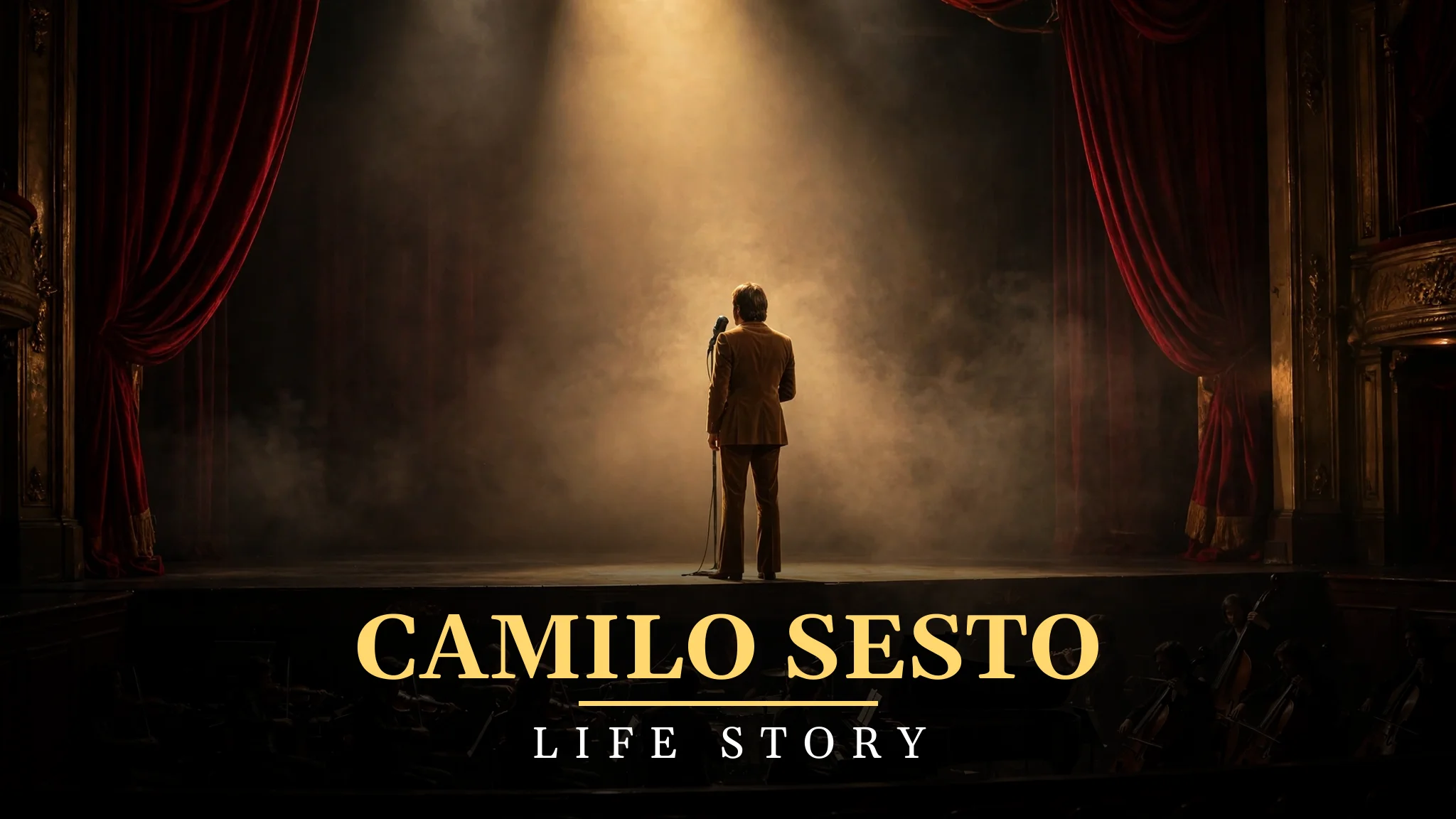
In the end, I come back to the image of a man in a brown suit, standing alone on a theatre stage, under a single spotlight, singing to an orchestra and to an audience that is listening in silence. That image is the heart of his story, because it shows a singer who needs nothing but a microphone, a song, and a voice. He had all three, and he used them to give the world some of its most beautiful ballads. He is gone, but his voice is not, and whenever one of his songs is played, he is with us again, singing with power, with feeling, and with love.
I also think about the album “Un hombre solo”, which won him a Grammy, and what its title means. It means a man alone, and it is a fitting title for a singer who often sang about loneliness, about love that is lost, and about the feeling of being on your own. I think that album shows a more thoughtful side of Camilo, a man who was not just singing love songs, but thinking about life, about solitude, and about what it means to be alone. That depth is part of why the album won an award, and it is a reminder that his music was not only romantic. It was also reflective, and it spoke to people who felt alone.
I think about the future, and about how his songs will be remembered. They are already classics, and they will be sung for generations to come. A young person today can hear “Vivir así es morir de amor” and feel the same emotion that their parents felt when they first heard it. That passing of a song from one generation to the next is the true measure of a singer’s success, and Camilo achieved it. I hope his songs are sung for many more years, because the world needs more of that beauty, more of that feeling, and more of that love.
Frequently Asked Questions
Where was Camilo Sesto born?
Camilo Sesto was born on 16 September 1946 in Alcoy, a town in the province of Alicante in eastern Spain. He grew up there before moving to Madrid as a young man to pursue a singing career.
What is Camilo Sesto’s most famous song?
His most famous song is “Vivir así es morir de amor”, released in 1978. It is one of the most loved Spanish ballads of all time, and it is still played on the radio and sung at weddings and parties today.
Did Camilo Sesto play Jesus in Jesucristo Superstar?
Yes, in 1975 he produced the Spanish version of the musical “Jesus Christ Superstar” and played the role of Jesus himself. The production was a huge success in Madrid and became a landmark in Spanish theatre.
What other songs is Camilo Sesto known for?
He is also known for songs like “Algo de mí”, “Perdóname”, “El amor de mi vida”, and “Si me dejas ahora”. These ballads were hits in Spain and Latin America and remain popular today.
When did Camilo Sesto die?
He died on 8 September 2019 in Madrid, at the age of seventy-two. His death was mourned across the Spanish-speaking world, and tributes came from singers, actors, and millions of fans.
How many albums did Camilo Sesto record?
He recorded more than forty albums during his career, along with many singles and songs written for other artists. His work made him one of the most successful Spanish singers of all time.


