Carmen Maura: The Life Story Behind Spain's Great Actress
In this post
- A Madrid Childhood and a Love of Theatre
- Meeting Almodóvar and the Early Films
- Mujeres al Borde and International Fame
- A Break, a Return, and Work in France
- Volver and a Triumphant Reunion
- A Great Actress Still Working
- ¡Ay, Carmela! and the Films Beyond Almodóvar
- Goya Awards and a Lifetime of Recognition
- Theatre Roots and a Life on Stage
- My Take:
Carmen Maura is one of the greatest actresses in the history of Spanish cinema, a woman whose face, voice, and talent have defined Spanish film for more than forty years. She is not a star who depends on beauty alone, although she is beautiful. She is an actress who can be funny, sad, angry, and tender, sometimes in the same scene, and who makes every character she plays feel real. Her work with the director Pedro Almodóvar made her famous around the world, but her career is much bigger than those films. She has worked in Spain, in France, and in many other countries, and she has won the highest honours in European cinema.
She was born in Madrid, and she began her career in theatre and on television, before moving into film. She was a mature actress when she became famous, not a young starlet, and her success was built on talent, on hard work, and on a willingness to take risks. She played women who were strong, funny, and complicated, and her performances gave a voice to Spanish women at a time when the country was changing fast.
Her most famous films include “Pepi, Luci, Bom”, “Mujeres al borde de un ataque de nervios”, and “Volver”, and her awards include multiple Goya Awards, the highest honour in Spanish film. This is the story of Carmen Maura, a woman from Madrid who became the great actress of Spanish cinema, and who is still working, still acting, and still surprising her audience.
A Madrid Childhood and a Love of Theatre
Carmen García Maura was born on 15 September 1945 in Madrid, the capital of Spain. Her family was educated and cultured, and she grew up in a home where books, theatre, and music were valued. She was a bright child, and she loved to read, to act, and to perform. She studied at school in Madrid, and she was a good student, but her heart was in the theatre, and she dreamed of becoming an actress.
As a young woman, she studied theatre and began to perform on stage. She worked in small theatre companies, she took part in plays, and she learned her craft in the way that actors have always learned it: by doing it, night after night, in front of a live audience. She was not a film star. She was a theatre actress, and she took her work seriously. She learned how to use her voice, how to move on stage, and how to make a character feel real.
She also worked in television, appearing in series and in shows that were popular in Spain. Her work on television made her known to a wider audience, and it gave her experience in front of a camera. She was a versatile performer, able to do comedy and drama, and she was respected by her fellow actors for her talent and her professionalism.
Madrid stayed in her heart, and she often speaks about her home city with love. She is a woman from Madrid, and she carries the spirit of the city with her: its humour, its energy, and its honesty. Her acting is full of those qualities, and they are part of what makes her performances so memorable.
Meeting Almodóvar and the Early Films
In the late 1970s and early 1980s, Carmen Maura met a young director named Pedro Almodóvar, and their meeting changed both of their lives. Almodóvar was a new voice in Spanish cinema, a man who made bold, funny, and colourful films about modern Spain, and Maura became his muse, his leading lady, and his friend. She starred in his early films, including “Pepi, Luci, Bom y otras chicas del montón” in 1980, a wild and funny film about young women in Madrid, and “Entre tinieblas” in 1983, a dark comedy about nuns.
Their collaboration was a perfect match. Almodóvar wrote strong, complicated women, and Maura played them with honesty, humour, and warmth. She was not afraid to be funny, to be silly, or to be sad, and she brought a humanity to his films that made them more than just comedies. She was the heart of his early work, and her performances helped to make his films famous.
Spain in the early 1980s was a country in transition, moving from dictatorship to democracy, and Almodóvar’s films captured that moment. They were about freedom, about sex, about drugs, and about the new life that young Spaniards were living. Maura was at the centre of that moment, playing women who were free, who were funny, and who were not afraid to live. Her performances gave a voice to a generation of Spanish women, and they made her a star.
She also worked with other directors during these years, and she built a reputation as one of the best actresses in Spain. She was not just Almodóvar’s muse. She was an actress in her own right, with a talent that was recognised by everyone in the business.
Mujeres al Borde and International Fame
In 1988, Carmen Maura starred in Pedro Almodóvar’s film “Mujeres al borde de un ataque de nervios”, known in English as “Women on the Verge of a Nervous Breakdown”. The film was a huge success, in Spain and around the world, and it made Maura famous internationally. She played Pepa, a woman whose lover has left her, and who spends two days trying to find him, meeting a series of funny and strange characters along the way. Her performance was brilliant: funny, sad, and deeply human, and it won her awards and praise.
The film was nominated for an Academy Award for Best Foreign Language Film, and it was shown in cinemas around the world. Maura’s face became known to audiences in Europe, in America, and in many other countries. She was no longer just a Spanish actress. She was an international star, and her work was admired by critics and by audiences everywhere.
She won a Goya Award for Best Actress for the film, the highest honour in Spanish cinema, and she went on to win more Goya Awards in the years that followed. Her performance in “Mujeres al borde” is still regarded as one of the greatest in Spanish film, and it is studied by acting students and loved by audiences. It showed what she could do: make a comedy that was also a drama, and make a character who was funny and sad at the same time.
After the film, her career grew even larger. She worked with directors in Spain and in other countries, and she became one of the most respected actresses in Europe. She had proved that she could carry a film, that she could make an audience laugh and cry, and that she was one of the great actresses of her time.
A Break, a Return, and Work in France
After “Mujeres al borde”, Carmen Maura and Pedro Almodóvar had a falling out, and they did not work together for many years. The reasons for their split were personal and professional, and both of them have spoken about it with sadness. Maura continued her career without him, working in Spain and in France, and proving that she was a star in her own right, not just Almodóvar’s muse.
She worked in French cinema, where she was welcomed warmly, and she appeared in many French films. She learned to act in French, she worked with French directors, and she built a new audience in France. Her work there showed her versatility, and it proved that her talent was not limited to Spanish cinema. She was an actress who could work in any language, in any country, and who could make any character feel real.
She also continued to work in Spain, appearing in films, in television, and in theatre. She won more Goya Awards, including for her work in “¡Ay, Carmela!” in 1990, a film about a theatre troupe during the Spanish Civil War, in which she gave a powerful and moving performance. Her career was long, varied, and successful, and she was respected by everyone in the business.
Her ability to work in two countries, in two languages, and in many different kinds of films showed her range. She was not an actress who played one type of role. She played many types, from comedy to drama, from a housewife to a singer, and she played them all with honesty and skill. That range is what makes her one of the great actresses of European cinema.
Volver and a Triumphant Reunion
In 2006, after many years apart, Carmen Maura and Pedro Almodóvar worked together again, in the film “Volver”, which means “To Return”. The film was a huge success, and it won awards at the Cannes Film Festival, one of the most important film festivals in the world. Maura played Irene, the mother of the main character, a woman who returns from the dead, or so it seems, to help her daughters. Her performance was warm, funny, and deeply moving, and it won her praise from critics around the world.
The film was a reunion, not only for Maura and Almodóvar, but for Spanish cinema. It showed that their collaboration, which had been so important in the 1980s, was still alive, and that they could still make great films together. Maura shared the Best Actress award at Cannes with the other actresses in the film, including Penélope Cruz, and the award was a recognition of her long and brilliant career.
“Volver” was also a personal film for Maura, because it was about mothers, daughters, and family, and it spoke to her own life. Her performance was full of love, of humour, and of the warmth that has always defined her work. It was a triumphant return, and it reminded the world why she is regarded as one of the great actresses of her generation.
After “Volver”, she continued to work, appearing in films in Spain, in France, and in other countries. She has never stopped acting, and she has never lost her passion for the work. Her career, which began in the theatre in Madrid, has lasted for more than fifty years, and it is still going strong.
A Great Actress Still Working
Today, Carmen Maura is in her eighties, and she is still acting. She appears in films, in television series, and in theatre, and her performances are still praised by critics and loved by audiences. She has won many awards, including four Goya Awards, and she has been honoured in Spain and in France for her contribution to cinema. Her career is one of the longest and most successful in European film, and her place in Spanish culture is secure.
Her legacy is not only about her awards. It is about the characters she has played, the women she has given a voice to, and the films she has made. She played women who were strong, funny, and complicated, and she made them feel real. She gave Spanish cinema a face, a voice, and a heart, and her work has inspired generations of actresses who came after her.
She is also a reminder that an actress can have a long career, if she is talented, hard-working, and willing to take risks. She did not become famous as a young starlet, and she did not fade when she grew older. She grew as an actress, she took on new roles, and she kept working. That longevity is rare, and it is a testament to her talent and her professionalism.
Today, Carmen Maura is remembered as one of the greatest actresses in Spanish cinema, a woman who worked with Almodóvar, who won Goya Awards, and who gave life to some of the most memorable characters in Spanish film. Her story is still being written, and her fans are waiting to see what she does next.
¡Ay, Carmela! and the Films Beyond Almodóvar
Carmen Maura’s career is often linked to Pedro Almodóvar, but her work beyond his films is just as important, and it shows her range as an actress. One of her greatest performances came in “¡Ay, Carmela!” in 1990, a film by Carlos Saura about a theatre troupe during the Spanish Civil War. She played Carmela, a singer and performer who tries to survive in a time of war, and her performance was powerful, moving, and deeply human. The film won awards, and Maura won a Goya Award for Best Actress, her second, for a role that was very different from her work with Almodóvar.
The film showed that she could carry a serious drama, not just a comedy, and that her talent was not limited to one director’s style. She played a woman who was brave, funny, and sad, all at once, and she made the audience feel the pain of war, and the power of art to survive it. Her performance is still regarded as one of the finest in Spanish cinema, and it is studied by acting students who want to learn how to play a complex character with honesty.
She also worked with many other directors, in Spain and in France, and each film showed a different side of her talent. She played mothers, wives, singers, and workers, and she played them all with the same care. She was not an actress who played one type of role. She was an actress who could play any woman, and make her feel real. That range is what makes her one of the great actresses of European cinema, and it is why her career has lasted for so long.
Her work beyond Almodóvar is a reminder that a great actress is not defined by one collaboration, however important it is. Maura’s talent is her own, and it has been shown in many films, with many directors, in many countries. She is a star in her own right, and her films beyond Almodóvar prove it, again and again.
Goya Awards and a Lifetime of Recognition
Carmen Maura has won three Goya Awards for Best Actress, the highest honour in Spanish cinema, and each one was for a different kind of performance. She won for “Mujeres al borde de un ataque de nervios” in 1988, for “¡Ay, Carmela!” in 1990, and for “Volver” in 2006, and each win recognised a different side of her talent: comedy, drama, and the warmth of a mother. She later also received an Honorary Goya, a lifetime achievement honour, which places her among the most honoured actresses in Spanish film history.
She has also received honours in France, where she is regarded as one of the great European actresses, and she has been celebrated at film festivals around the world. Her work at Cannes, where she shared the Best Actress award for “Volver”, was a moment of international recognition, and it showed that her talent was appreciated far beyond Spain. She is not just a Spanish actress. She is a European actress, and her work belongs to the whole world.
Those honours are well deserved, but Maura herself has always said that the greatest honour is the work itself, and the love of the audience. She acts because she loves it, not because she wants awards, and that love is clear in every performance. An actress who works for love, rather than for prizes, is a rare thing, and it is one of the reasons her performances feel so honest.
Her lifetime of recognition is also a recognition of a career that has lasted for more than fifty years, and that is still going strong. She has worked in theatre, in television, and in film, in Spain and in France, and she has never stopped learning, never stopped growing, and never stopped surprising her audience. That is a legacy worth celebrating, and it is one that will last for generations.
Theatre Roots and a Life on Stage
Carmen Maura’s career began in the theatre, and the stage has always been her home. She learned her craft in small theatre companies, performing night after night, in front of live audiences, and that training shaped everything she did afterwards. Theatre teaches an actor to use her voice, to move with purpose, and to make a character feel real, even from the back row. Maura learned those lessons well, and she carried them into her film work, where her performances feel alive in a way that few film actors can match.
She has returned to the theatre throughout her career, even after becoming a film star, because she loves the stage, and because it keeps her craft sharp. A film performance is recorded, and it can be edited, but a theatre performance is live, and it demands everything from the actor, every night. Maura thrives on that demand, and her stage work is a reminder that she is an actress first, and a film star second. Her theatre performances are praised by critics, and they are loved by audiences who see her live.
Her theatre work also shows her range. She has played comedy, drama, and everything in between, on stage, and she has done it with the same honesty that defines her film work. She is not an actress who plays one type of role. She is an actress who can play any woman, and make her feel real, on stage or on screen. That range is the mark of a great actress, and it is why her career has lasted for so long.
The stage is also where she learned discipline. A theatre actor rehearses for weeks, performs eight shows a week, and takes care of her voice, her body, and her energy. Maura has done that for more than fifty years, and that discipline is one of the reasons she is still working in her eighties. She takes her craft seriously, and she treats every performance, on stage or on screen, as if it were her first. That professionalism is a large part of her legacy.
Her life on stage is also a life of collaboration. She has worked with great directors, with talented actors, and with writers who have shaped Spanish theatre and cinema. Those collaborations have made her better, and they have made Spanish culture richer. She is not just a star. She is a member of a community of artists, and her work is part of a larger story, the story of Spanish theatre and film in the last fifty years.
Today, her theatre roots are still visible in her film work, in the way she uses her voice, in the way she moves, and in the way she connects with her audience. She is an actress who learned her craft on stage, and who has never forgotten it. That is a gift, and it is one that she has shared generously, with audiences in Spain, in France, and around the world, for more than five decades.
My Take:
When I think about Carmen Maura, the first thing I admire is her courage as an actress. She was not afraid to be funny, to be silly, or to look foolish, and that is a rare thing for an actress. Many actresses want to look beautiful all the time, and they choose roles that make them look good. Maura chose roles that made her characters feel real, even if that meant looking tired, angry, or upset. I think that is a braver choice, and it is the reason her performances are so memorable. When she plays Pepa in “Mujeres al borde”, she is not trying to be glamorous. She is trying to be a woman who has been left by her lover, who is upset, and who is trying to cope. That honesty is what makes the performance great, and it is what makes the audience love her.
I also think about her work with Pedro Almodóvar, and how important it was for both of them. He wrote strong, complicated women, and she played them with a humanity that made his films more than just comedies. Their collaboration was a perfect match, and it produced some of the best films in Spanish cinema. I think it is sad that they fell out, and that they did not work together for many years, but I also think it is wonderful that they came back together for “Volver”. That film was a reunion, and it showed that their creative partnership was still alive. It takes maturity to return to a collaboration after a long break, and I admire both of them for doing it.
What I find most moving about her story is that she became famous as a mature actress, not as a young starlet. She was in her forties when “Mujeres al borde” made her an international star, and that is unusual in a business that often values youth above all else. She proved that talent does not have an age, and that a woman in her forties can be funny, sexy, and brilliant on screen. I think that is an important message, especially for women who are told that their time has passed. Maura’s time had not passed. It had just begun, and her best work was still ahead of her. That is a hopeful thing, and it is a lesson for anyone who feels that they are too old to start something new.
I also admire her work in France, and the way she built a second career in another country, in another language. It is one thing to be a star in your own country. It is another thing to go to France, to learn to act in French, and to win the respect of a new audience. She did that, and she did it well. I think that shows her versatility, her hard work, and her willingness to take risks. She did not stay in Spain, where she was already famous, and rest on her success. She went to France, she learned, and she grew. That is a lesson for anyone who feels comfortable. Comfort is nice, but growth comes from leaving comfort behind, and Maura left it behind, more than once.
I have to be honest about one thing, and that is that her films are not for everyone. Almodóvar’s films, in particular, are bold, colourful, and sometimes shocking, and some people find them too much. I understand that, but I do not think it is a fair criticism to say that a film is bad because it is bold. Boldness is a choice, and it is a brave choice, because it risks offending people. Maura and Almodóvar took that risk, and they made films that were honest about modern Spain, about women, about love, and about freedom. Those films mattered, because they told the truth about a country that was changing, and they gave a voice to people who had not been heard before.
I also think about her Goya Awards, and what they mean. She has won three of them for Best Actress, plus an Honorary Goya, which is a remarkable achievement, and each one was for a different kind of performance. That shows her range, and it shows that she is not an actress who plays one type of role. She plays many types, and she plays them all well. I think that range is the mark of a great actress. A good actress can play one role well. A great actress can play many roles well, and Maura is a great actress.
What I learn from her story is that acting is not about looking good. It is about being true. Maura is true in every role she plays, and that truth is what makes her performances last. A beautiful face fades, but a true performance does not. Her performances are still watched, still studied, and still loved, decades after they were made, because they are true. That is a lesson for any young actor. Do not worry about looking perfect. Worry about being honest, and the audience will remember you.
In the end, I think Carmen Maura matters because she gave Spanish cinema a face, a voice, and a heart. Her work with Almodóvar changed Spanish film, her performances gave a voice to Spanish women, and her career has lasted for more than fifty years. She is still working, still acting, and still surprising her audience, and I hope she keeps going for many more years. Her story is a reminder that talent, hard work, and honesty can build a career that lasts a lifetime, and that a great actress is not made in a day. She is made over decades, one role at a time.
I also think about Madrid, and how the city shaped her. She was born there, she studied theatre there, and she built her career there. Madrid is a city of humour, of energy, and of honesty, and her acting is full of those qualities. She is a woman from Madrid, and she carries the spirit of the city with her, in her voice, in her timing, and in her warmth. I think that is a large part of her appeal. She is not an actress who comes from nowhere. She comes from a real place, with real traditions, and she honours those traditions in everything she does.
I think about her early work in theatre, and how it taught her craft. Theatre is a hard school, because the audience is live, they are close, and they will not forgive a false performance. Maura learned to be true on stage, night after night, and that training stayed with her when she moved into film. A theatre actress knows how to use her voice, how to move, and how to make a character feel real, and Maura does all three with a skill that few film actors have. I think that is why her film performances feel so alive. She learned her craft in front of a live audience, and she never forgot it.
I also think about the Spain of the early 1980s, and how Almodóvar’s films captured it. The country was changing fast, moving from dictatorship to democracy, and young people were living in a new way, with new freedoms, new ideas, and new lives. Maura was at the centre of that moment, playing women who were free, funny, and unafraid. Her performances gave a voice to a generation of Spanish women, and they helped to define what modern Spain looked like. That is a large achievement, and it is one that goes beyond acting. She was part of a cultural change, and her work helped to make it real.
I want to say something about her humour, because it is a central part of her art. She is funny, in her films and in her interviews, and her humour is warm, not cruel. She jokes about herself, about her characters, and about life, and her audience laughs with her, not at her. That kind of humour is a gift, because it makes people feel comfortable, and it makes hard truths easier to hear. An actress who can make you laugh and cry in the same scene is a rare thing, and Maura is one of them.
I also think about the falling out with Almodóvar, and how sad it must have been. To work so closely with someone, to create great films together, and then to part ways, is a painful experience. Both of them have spoken about it with sadness, and I think that sadness is honest. But I also think it is wonderful that they came back together for “Volver”, after many years apart. That reunion took maturity, and it took a willingness to forgive, and it produced a great film. I admire both of them for doing it, because it shows that a creative partnership can survive a break, if both people are willing to try.
I think about her work in France, and how brave it was to go there. To learn to act in French, to work with new directors, and to win the respect of a new audience takes courage, and it takes a belief in yourself. She did it, and she did it well. I think that shows her versatility, her hard work, and her willingness to take risks. She did not stay in Spain, where she was already famous, and rest on her success. She went to France, she learned, and she grew. That is a lesson for anyone who feels comfortable. Comfort is nice, but growth comes from leaving comfort behind.
I also think about her age, and about the fact that she became famous as a mature actress. She was in her forties when “Mujeres al borde” made her an international star, and that is unusual in a business that often values youth above all else. She proved that talent does not have an age, and that a woman in her forties can be funny, sexy, and brilliant on screen. I think that is an important message, especially for women who are told that their time has passed. Maura’s time had not passed. It had just begun, and her best work was still ahead of her.
I think about her Goya Awards, and what they mean. Three Best Actress awards, plus an Honorary Goya, is a remarkable achievement, and each one was for a different kind of performance. That range is the mark of a great actress. A good actress can play one role well. A great actress can play many roles well, and Maura is a great actress. I think that range is one of the reasons her career has lasted so long, because she never got stuck in one type of role, and she never stopped learning.
I also think about the young actresses who watch her films today, and what they learn. They learn that acting is not about looking good. It is about being true. Maura is true in every role she plays, and that truth is what makes her performances last. A beautiful face fades, but a true performance does not. Her performances are still watched, still studied, and still loved, decades after they were made, because they are true. That is a lesson for any young actor: do not worry about looking perfect. Worry about being honest, and the audience will remember you.
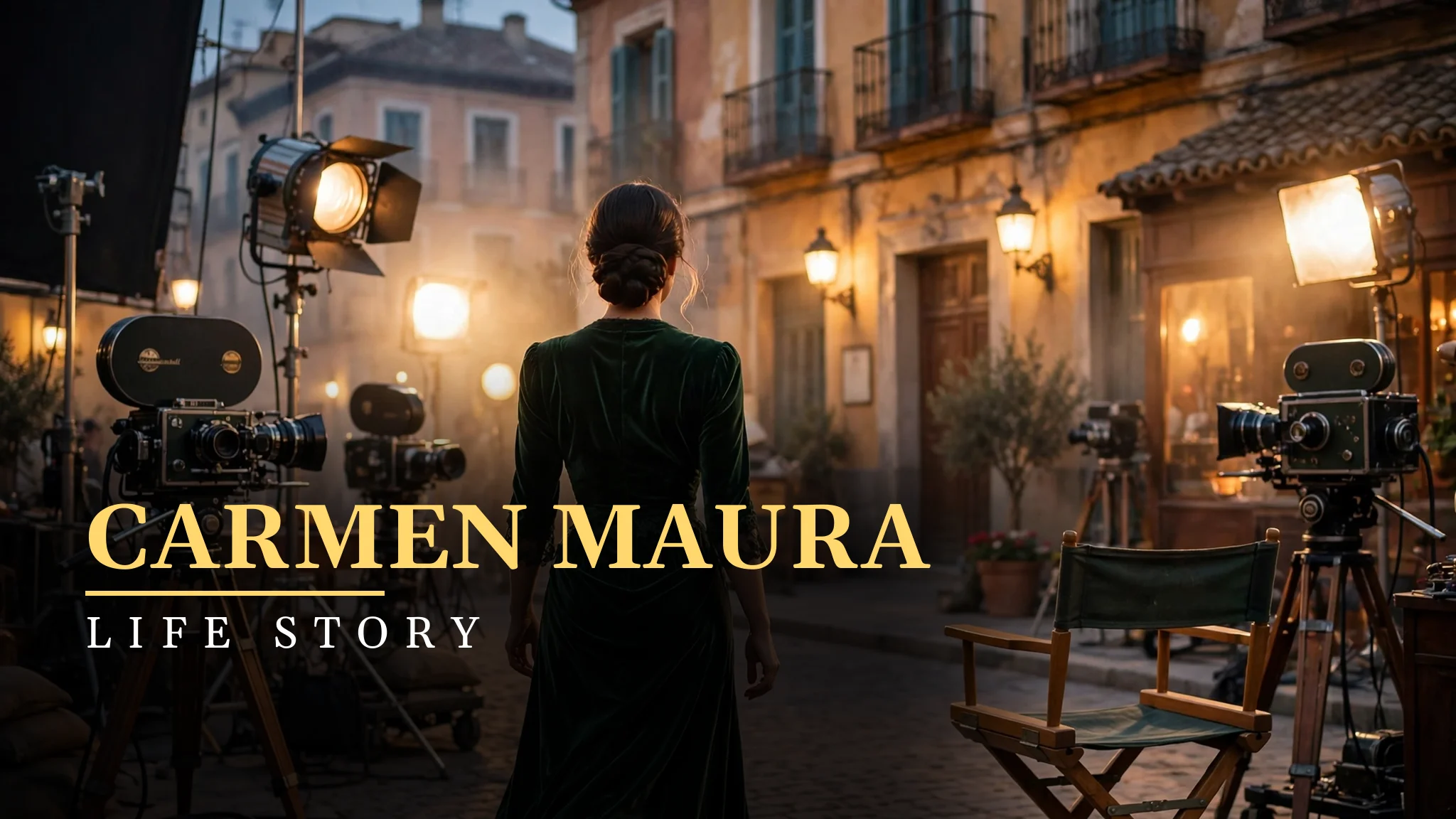
In the end, I come back to the simple image of a woman in a green velvet dress, walking down a cobbled street on a film set, past cameras and lights. That image is the heart of her story, because it shows an actress who is at work, who is at home on a set, and who is doing what she loves. She is not shouting, she is not showing off, and she is not trying to impress anyone. She is acting, and her acting is enough. I hope she keeps acting for many more years, because the world needs more of her honesty, more of her humour, and more of her warmth.
I also think about the film “¡Ay, Carmela!”, and how it showed a different side of her talent. The film is about a theatre troupe during the Spanish Civil War, and Maura played a singer who tries to survive in a time of war. Her performance was powerful, moving, and deeply human, and it won her a Goya Award. I think that film is important, because it shows that she could carry a serious drama, not just a comedy, and that her talent was not limited to one director’s style. She was an actress who could do anything, and she proved it, again and again.
I think about the future, and about what is next for her. She is in her eighties, and she is still acting, still working, and still surprising her audience. I do not know how long she will continue, but I hope it is for many more years, because her work is a treasure, and the world is better with it. When she finally stops, it will be the end of an era, and her absence will be felt deeply, by her fans, by her fellow actors, and by everyone who loves Spanish cinema.
Frequently Asked Questions
Where was Carmen Maura born?
Carmen Maura was born on 15 September 1945 in Madrid, Spain. She grew up there, studied theatre, and began her career on stage before moving into television and film.
What is Carmen Maura’s most famous film with Almodóvar?
Her most famous film with Pedro Almodóvar is “Mujeres al borde de un ataque de nervios” (Women on the Verge of a Nervous Breakdown), released in 1988. She played Pepa, and the film made her famous around the world.
How many Goya Awards has Carmen Maura won?
She has won three Goya Awards for Best Actress, the highest honour in Spanish cinema, for “Mujeres al borde de un ataque de nervios”, “¡Ay, Carmela!”, and “Volver”. She later also received an Honorary Goya for her lifetime contribution to Spanish film.
Did Carmen Maura work in French cinema?
Yes, she worked extensively in French cinema, appearing in many French films and building a large audience in France. She learned to act in French and worked with French directors, proving her versatility as an actress.
What is the film Volver about?
“Volver” (2006) is a film by Pedro Almodóvar in which Carmen Maura plays Irene, the mother of the main character, who returns to help her daughters. The film won awards at Cannes, and Maura shared the Best Actress award with her co-stars.
Is Carmen Maura still acting?
Yes, she is still acting in her eighties, appearing in films, television series, and theatre. Her career has lasted for more than fifty years, and she remains one of the most respected actresses in European cinema.


