Casper Ruud: The Life Story Behind Norway's Clay King
In this post
- Oslo: A Father’s Shadow and a Son’s Dream
- Mallorca: Learning Clay at Nadal’s Academy
- Three Grand Slam Finals and World Number Two
- The Forehand, the Calm, and the Norwegian Way
- The Chase Continues: Still Hunting a First Major
- The 2022 Season: Two Finals and the Top of the World
- Norway’s Tennis Pioneer: A Country Wakes Up to Tennis
- My Take:
Casper Ruud comes from a country where tennis is not a big sport, where the winters are long and dark, and where the clay courts he loves are covered in snow for half the year. Norway has never produced a great tennis player before him. It has produced skiers, and footballers, and explorers, but it has never produced a man who reached the final of the French Open, and the final of the US Open, and who became the world number two. Ruud did all of that, and he did it quietly, and calmly, and with a smile, and he did it by leaving home as a teenager, by training in Spain, and by building a game, piece by piece, until it was good enough to beat the best players in the world.
His story begins in Oslo, where his father, Christian Ruud, was a professional tennis player, and where young Casper grew up with a racket in his hand, and with a dream that seemed impossible for a Norwegian boy. It is a story of a son who followed his father, and then went further than his father ever did, of a young man who trained at Rafael Nadal’s academy in Mallorca, of a clay-court specialist who learned to play on every surface, and of a player who reached three Grand Slam finals, and who is still chasing the first title, with the patience and the calm that have defined his whole career.
This is the life of Casper Ruud, the clay king of Norway, the quiet champion, and the man who put his country on the tennis map.
Oslo: A Father’s Shadow and a Son’s Dream
Casper Ruud was born on 22 December 1998 in Oslo, Norway, the son of Christian Ruud, a former professional tennis player who had been one of the best players in Norway, and who had reached the top forty in the world, and of Lele Ruud, his mother, who supported the family, and who raised Casper and his sisters with love and with discipline. Tennis was a part of family life from the start, because Christian had played the game, and because he knew it well, and because he wanted his son to have the chance to play it, if that was what his son wanted. Casper grew up on the courts of Oslo, hitting balls with his father, and learning the game from a man who had lived it, and who understood it from the inside.
He was a quiet boy, and a thoughtful one, and he was not loud, and he was not showy, and he did not seek attention. He was a boy who loved to play, and who loved to practise, and who was willing to work hard, because he understood, from watching his father, that tennis is a game that rewards work, and that the work has to be done every day, even when it is cold, and even when it is dark, and even when you would rather be doing something else. He played junior tournaments in Norway and in Europe, and he won them, and the tennis world began to notice the quiet Norwegian boy with the big forehand, and the calm manner, and the game that was built for clay.
Norway was not an easy place to become a tennis player. The winters are long, and the courts are indoors, and the competition is small, and a young player who wants to be the best in the world has to leave home, and to train in a warmer place, with better coaches, and with stronger opponents. Ruud understood that, and when he was a teenager, he left Oslo, and he went to Spain, to the Rafael Nadal Academy in Mallorca, a place where the sun shines, and where the clay courts are everywhere, and where the best young players in the world train together. It was a brave decision for a young boy, and it was a decision that changed his life, because it gave him the chance to become the player he wanted to be.
He was coached, in his early years, by his father, and by the coaches at the Nadal Academy, and he learned to play on clay, a surface that suited his game, because he had a big forehand, and because he could run, and because he was patient, and because he was willing to play long rallies, and to wait for the right moment to attack. He turned professional in 2015, when he was sixteen years old, and he began his journey to the top of the game, a journey that would take him to Paris, to New York, and to the world number two ranking, and that would make him the best Norwegian tennis player who ever lived.
Mallorca: Learning Clay at Nadal’s Academy
The Rafael Nadal Academy in Mallorca was the perfect place for Ruud to learn his craft, because it was built by the greatest clay-court player in history, and because it taught the game in the way that Nadal had learned it: with hard work, with discipline, and with a belief that no point is ever lost until it is over. Ruud trained there as a teenager, and he learned to hit his forehand with topspin, to move on clay, to slide, and to play the long rallies that clay demands, and he learned it from coaches who had worked with Nadal himself, and who understood the surface better than anyone.
He also learned, in Mallorca, what it means to be a professional, and what it takes to succeed at the highest level. He trained for hours every day, he worked on his fitness, and he played against the best young players in the world, and he improved quickly, because he was a hard worker, and because he was a quick learner, and because he wanted to be the best. He was not the most talented player at the academy, but he was one of the hardest working, and the hard work paid off, because by the time he was eighteen, he was already one of the best young players in the world, and he was ready to play on the professional tour.
He won his first ATP title in Buenos Aires in 2020, on clay, beating Pedro Sousa in the final, and it was a victory that announced him as a player to watch, and that showed that the years of training in Mallorca had paid off. He won more titles in the years that followed, in Geneva, in Bastad, in Gstaad, and in other clay-court tournaments, and he became known as a clay-court specialist, a player who was at his best on the red dirt, and who was hard to beat there, even by the best players in the world. He was, by 2021, one of the top ten players in the world, and he was still only twenty-two years old, and the future seemed bright.
He also learned, in Mallorca, to be humble, and to be respectful, and to treat people well, because Nadal himself is a humble man, and because the academy teaches its players that character matters as much as talent. Ruud took that lesson to heart, and he has carried it with him for his whole career, and he is known, today, as one of the nicest men in tennis, a player who is polite, and kind, and who never complains, and who is respected by everyone who plays against him. It is a reputation that he earned in Mallorca, and that he has kept ever since.
Three Grand Slam Finals and World Number Two
The year 2022 was the greatest of Ruud’s career, and it was a year that made him a star, and that put Norway on the tennis map. He reached the final of the French Open, in Paris, beating Marin Cilic in the semi-final, and losing to Rafael Nadal in the final, in straight sets, a defeat that was painful, but that was also an honour, because he had lost to the greatest clay-court player in history, on the court where Nadal had won fourteen times, and because he had reached the final at all, a feat that no Norwegian had ever achieved before. It was a moment that the whole of Norway celebrated, because they had never seen one of their own play in a Grand Slam final, and because Ruud had done it with a calm and a grace that made them proud.
Later that year, he reached the final of the US Open, in New York, beating Karen Khachanov in the semi-final, and losing to Carlos Alcaraz in the final, in four sets, in a match that was played for the world number one ranking, as well as for the title. It was another painful defeat, but it was also another sign of how far he had come, because he was playing for the top ranking in the world, and because he had reached two Grand Slam finals in a single year, a feat that very few players ever achieve. He finished the year as the world number two, the highest ranking ever achieved by a Norwegian player, and he was, at twenty-three years old, one of the best players in the world.
In 2023, he reached the French Open final again, beating Alexander Zverev in the semi-final, and losing to Novak Djokovic in the final, in straight sets, a third Grand Slam final, and a third defeat, but also a third sign that he belonged at the very top of the game. He has not yet won a Grand Slam title, and the three finals are a reminder of how hard it is to win one, and of how close he has come, and of how much he still wants it. He has won more than a dozen ATP titles, and he has been one of the most consistent players in the world, but the Grand Slam title is the one prize he has not yet won, and it is the prize that he dreams of most.
He has also played well on hard courts, and on other surfaces, and he has shown that he is not only a clay-court player, but a complete player, who can compete anywhere, and who can beat anyone, on his day. He reached the final of the ATP Finals in 2022, losing to Djokovic, and he has won titles on hard courts as well as on clay, and he has proved that the boy from Oslo, who trained in Mallorca, has become a player for all surfaces, and for all seasons.
The Forehand, the Calm, and the Norwegian Way
Ruud’s game is built around his forehand, a shot that he hits with heavy topspin, and with great power, and that is one of the best forehands in the world. He hits it from the back of the court, and he uses it to push his opponents back, and to open up the court, and to finish points, and he does it with a consistency that is remarkable, because he rarely misses, and because he can hit it again and again, for hours, without getting tired. It is a shot that was built on clay, in Mallorca, and that works on every surface, because it is a shot that is based on spin, and on placement, and on patience, and not only on power.
He is also known for his calm, and for his sportsmanship, and for the way he behaves on the court. He does not shout, he does not argue, and he does not show his feelings, and he plays with a quiet focus that makes him hard to read, and hard to beat. He is a player who respects his opponents, and who respects the game, and who is respected in return, because the tennis world values players who behave well, and who play fairly, and who do not make a fuss. He is, in the words of many people who know him, a true gentleman, and a credit to his country, and to the sport.
He is also known for his love of golf, a game that he plays in his spare time, and that he enjoys, because it is a game that requires patience, and precision, and calm, the same qualities that make him a good tennis player. He has played in celebrity golf events, and he has spoken about how golf helps him to relax, and to think, and to enjoy life away from the tennis court. It is a hobby that suits him, because he is a calm man, and golf is a calm game, and the two go together well.
He lives in Oslo, and he is a hero in Norway, a country that has never had a tennis star before him, and that has embraced him as one of its own. He is on the front page of the newspapers when he plays in a Grand Slam final, and he is cheered by crowds in Oslo who watch his matches on television, and he has inspired a generation of young Norwegian children to pick up a racket, and to dream of playing tennis, in a country where tennis was once a small and forgotten sport. That is a legacy that matters, and it is a legacy that will last, even if he never wins a Grand Slam title, because he has changed the game in his country forever.
The Chase Continues: Still Hunting a First Major
Ruud is still playing, and he is still chasing the Grand Slam title that has eluded him three times, and he is doing it with the same patience and the same calm that have defined his career. In 2024, he reached the semi-final of the French Open again, losing to Alexander Zverev, and he won the Geneva title again, and he remained one of the best players in the world, even as younger players, like Carlos Alcaraz and Jannik Sinner, began to dominate the game. He has not given up, and he has not changed his game, and he has not lost his belief, because he knows that a Grand Slam title is still possible, and because he knows that he has the game to win one, if everything comes together on the right day.
He has also become a leader in the tennis world, speaking out on issues that matter to him, and using his fame to help others, and he is known as a thoughtful and intelligent man, who cares about the game, and about the world, and who wants to make both better. He is a player who thinks, and who reads, and who is interested in more than tennis, and that makes him a more interesting person, and a better ambassador for the sport. He is, in many ways, the ideal modern tennis player: talented, hard-working, humble, and kind, and the game is lucky to have him.
His story is not over yet, and it will be a long time before anyone can say what his final legacy will be. He may win a Grand Slam title, and he may not, but he has already achieved more than any Norwegian player before him, and he has already inspired a generation, and he has already shown the world that a boy from Oslo, who trained in Mallorca, can reach the top of the game, and can stay there, with calm, and with grace, and with a smile. That is a story worth telling, and it is a story that is still being written, one match at a time.
The 2022 Season: Two Finals and the Top of the World
The 2022 season was the year when everything came together for Ruud, and it was a year that he will never forget, because it was the year when he became a star, and when the whole tennis world learned his name. He started the year well, winning titles on clay, and playing with a confidence that grew with every match, and by the time he arrived in Paris for the French Open, he was one of the favourites to go far, even though no one expected him to reach the final. He played his way through the draw, beating players who were ranked above him, and he reached the semi-final, where he faced Marin Cilic, a former Grand Slam champion, and he won in four sets, and he was in the final of a Grand Slam for the first time in his life.
The final was against Rafael Nadal, the king of clay, a man who had won the French Open thirteen times before, and who was playing on the court where he had never lost a final. Ruud lost in straight sets, and the defeat was painful, but it was also an honour, because he had played the greatest clay-court player in history, in the final, in Paris, and because he had reached the final at all. He did not hide after the loss, and he did not make excuses, and he spoke well of Nadal, and he said that he had learned a great deal from the match, and that he would come back stronger. It was a gracious defeat, and it made people respect him even more.
Later that year, at the US Open in New York, he did it again. He played his way to the final, beating Karen Khachanov in the semi-final, and he faced Carlos Alcaraz, the young Spanish star, in a final that was played for the world number one ranking as well as for the title. He lost in four sets, and Alcaraz became the youngest world number one in history, but Ruud had played in two Grand Slam finals in a single year, a feat that very few players ever achieve, and he had finished the year as the world number two, the highest ranking ever achieved by a Norwegian. It was a season that changed his life, and that made him a hero in Norway, and a star in the tennis world.
Norway’s Tennis Pioneer: A Country Wakes Up to Tennis
Before Ruud, tennis was a small sport in Norway, a game played by a few people, in a few clubs, in a country where the winters are long, and where skiing is the national sport. After Ruud, everything changed. Children picked up rackets, clubs filled up, and television showed his matches, and the whole country watched, and cheered, and learned about a game that they had never cared about before. He became a national hero, not only because he won, but because he was humble, and because he was kind, and because he represented the best of Norway: hard work, humility, and respect for others.
He has inspired a generation of young Norwegian players, and he has shown them that it is possible to come from a small country, and to reach the top of the world, if you are willing to work hard, and to leave home, and to train in a warmer place, and to believe in yourself. He has also spoken about the need for better tennis facilities in Norway, and about the need for more indoor courts, so that young players can train all year, and he has used his fame to help the game grow in his country, in a way that will last long after he has retired. It is a legacy that matters, and it is a legacy that he is proud of, because it is a legacy built on giving, not only on winning.
He is also a role model for young people in Norway, because he shows them that success does not have to change you, and that you can be the best in the world, and still be humble, and still be kind, and still be yourself. He lives in Oslo, he plays golf, he spends time with his family, and he is a normal young man, who happens to be one of the best tennis players in the world. That normality is a part of his appeal, and it is a part of why the people of Norway love him, because he is one of them, and because he has not forgotten where he came from.
My Take:
I think Casper Ruud is the nicest man in tennis, and I say that because I have never heard anyone say a bad word about him, and because everyone who plays against him speaks of him with respect, and with affection. He is calm, he is polite, and he is kind, and he plays the game with a grace that is rare in modern sport, where so many players are loud, and angry, and selfish. He is a Norwegian, and he carries the values of his country with him: humility, hard work, and respect for others, and those values have made him a better player, and a better person, and I admire him for it, because it is easy to be loud, and hard to be quiet, and Ruud is quiet, and he is great.
What I admire most about Ruud is his forehand, and I want to talk about it, because it is a beautiful shot, and because it is the foundation of his whole game. He hits it with topspin, and with power, and he can hit it again and again, for hours, without missing, and without getting tired. I have watched his matches, and I am amazed by the consistency, and by the patience, and by the way he builds a point, shot by shot, until his opponent makes a mistake. It is not a flashy game, and it is not a game that makes the highlight shows, but it is a game that wins matches, and that is what matters, and Ruud wins matches, because his forehand is one of the best in the world.
I also think about his father, Christian, because it is a special thing for a son to follow his father, and then to go further than his father ever did. Christian was a good player, and he reached the top forty, and he was proud of that, but his son has reached the world number two, and has played in three Grand Slam finals, and has done things that his father never dreamed of. I think about how proud Christian must be, and about how hard it must have been for him to coach his son, and to watch him grow, and to let him go to Mallorca, and to trust that he would be alright. That is a father’s love, and it is a beautiful thing, and I am glad that Ruud has his father with him, as his coach, and as his friend, and as the man who started it all.
The three Grand Slam finals are the part of his career that I think about most, because they are a story of coming close, and of losing, and of coming back again. He lost to Nadal in Paris, and he lost to Alcaraz in New York, and he lost to Djokovic in Paris again, and each time, he lost to a great champion, and each time, he came back, and he tried again, and he did not give up. I think about that when I think about my own life, and about the times when I have come close to something, and lost, and I know how painful it is, and how hard it is to try again. Ruud tried again, three times, and he will try again, and that takes a courage that I respect deeply, because it is easy to quit after losing a final, and hard to come back and risk losing another one.
I also think about Norway, and about what Ruud has done for his country, because it is a remarkable achievement. Norway has never had a tennis star, and now it has one, and the whole country watches him, and the children pick up rackets because of him, and the game grows because of him. He has put Norway on the tennis map, and he has done it with a calm and a humility that makes his country proud. I think about all the small countries in the world, and about the children in those countries who dream of being great, and I want them to see Ruud, and to know that it is possible, even if you come from a place where no one has done it before. He is a proof that geography does not decide destiny, and that hard work can take you anywhere.
If I could speak to a young player who is calm, and quiet, and who feels that they are not loud enough to be a star, I would tell them to watch Ruud, and to learn from him. I would tell them that you do not have to shout to be great, and that you do not have to be angry to win, and that calm is a kind of strength, and that patience is a kind of power. Ruud is calm, and he is patient, and he is great, and he proves that the quiet ones can reach the top, if they work hard, and if they believe in themselves. That is a message that every quiet child needs to hear, and Ruud is the messenger.
In the end, I think Casper Ruud will be remembered as the best Norwegian tennis player ever, and as a man who reached three Grand Slam finals, and who became the world number two, and who did it all with grace, and with humility, and with a smile. I will remember the forehand, and the calm, and the clay, and I will remember the boy from Oslo who went to Mallorca, and who came back a champion, and who put his country on the map. That is Ruud, and that is why I admire him, and why I will keep watching him, hoping that one day, he wins the Grand Slam title he deserves.
I also think about his golf, because it tells me something about the man that tennis never does. He loves golf, and he plays it well, and he enjoys it, because it is a game that requires patience, and precision, and calm, the same qualities that make him a good tennis player. I think it is important for athletes to have something else in their lives, something that is theirs alone, and that gives them peace, and Ruud has golf, and golf gives him peace, and that peace helps him to play better tennis. I hope every athlete finds something like that, because the game will end one day, and the peace will remain.
One more thought stays with me, and it is about the Nadal Academy, because it is a place that taught Ruud not only how to play, but how to live. Nadal is a humble man, and a hard worker, and a champion, and the academy teaches those values to every player who trains there. Ruud learned them, and he carries them with him, and he is a better man for it. I think that is a beautiful thing, and I think it shows that a good coach, and a good academy, can change a life, not only by teaching tennis, but by teaching character. Ruud is the proof of it, and I am glad he went to Mallorca, because it made him who he is today.
And finally, I want to say that I am rooting for Ruud, and I will keep rooting for him, because I want him to win a Grand Slam title, and because I think he deserves it, after three finals, and after all the hard work, and after all the patience. I do not know if he will win one. The game is hard, and the young players are strong, and the window is closing, but I hope he does, because it would be a fitting reward for a man who has done everything right, and who has never complained, and who has always played the game the right way. If he wins, I will cheer, and if he does not, I will still admire him, because he has already won something more important: the respect of the whole tennis world, and the love of his country, and those are prizes that no final can take away.
I also think about the 2022 season once more, because it is a season that shows what a young player can do when everything comes together. He reached two Grand Slam finals, and he became the world number two, and he did it in a single year, and he did it with a calm that surprised everyone. I think about that when I think about my own life, and about the years when everything comes together, and I know how rare those years are, and how precious. Ruud had one, and he used it well, and I hope he has another one, because he deserves it, and because the tennis world is better when he is playing well.
There is one more lesson in Ruud’s life that I want to name, and it is about leaving home. He left Oslo as a teenager, and he went to Mallorca, far from his family, and far from his home, because he knew that he had to leave to become the player he wanted to be. That takes courage, and it takes a belief in yourself, and it takes a willingness to be lonely, for a long time, in a strange place. I think about all the young people who leave home to chase a dream, and I admire them, because it is hard, and because it is lonely, and because it is the only way to grow. Ruud left home, and he grew, and he became a champion, and that is a lesson for every young person who is thinking about leaving home to chase a dream: go, and work, and believe, and you will find your way.
I also think about his mother, Lele, because she raised him, and his sisters, and she supported the family, and she was there for him, through every match, and every tournament, and every disappointment. A mother’s love is a powerful thing, and Ruud has spoken about how much his mother means to him, and about how she kept the family together while his father travelled with him, and while he trained in Spain. I think about all the mothers who support their children in sport, and who sacrifice their own time, and their own dreams, for their children, and I want to thank them, because without them, there would be no champions, and Ruud is a proof of that.
I also want to say something about his sisters, because he grew up with them, and because they taught him to be kind, and to share, and to be a good brother, and those lessons stayed with him, and made him a better man. He is a quiet man, and a kind man, and I think his sisters had a part in that, because growing up with sisters teaches a boy to listen, and to care, and to be gentle, and Ruud is all of those things. I hope his sisters are proud of him, because they should be, and because he is a brother who has made his family proud, in Norway, and in the whole world.
I also think about the future, and about what Ruud will do after tennis, because he is a thoughtful man, and because he cares about the game, and about his country, and I believe he will keep working for Norwegian tennis, and for young players, long after he has stopped playing. He has already started, by speaking about facilities, and by inspiring children, and I hope he keeps doing it, because Norway needs him, and because the game needs people like him, who care about more than winning. He is a man who will leave the game better than he found it, and that is the finest legacy any athlete can hope for.
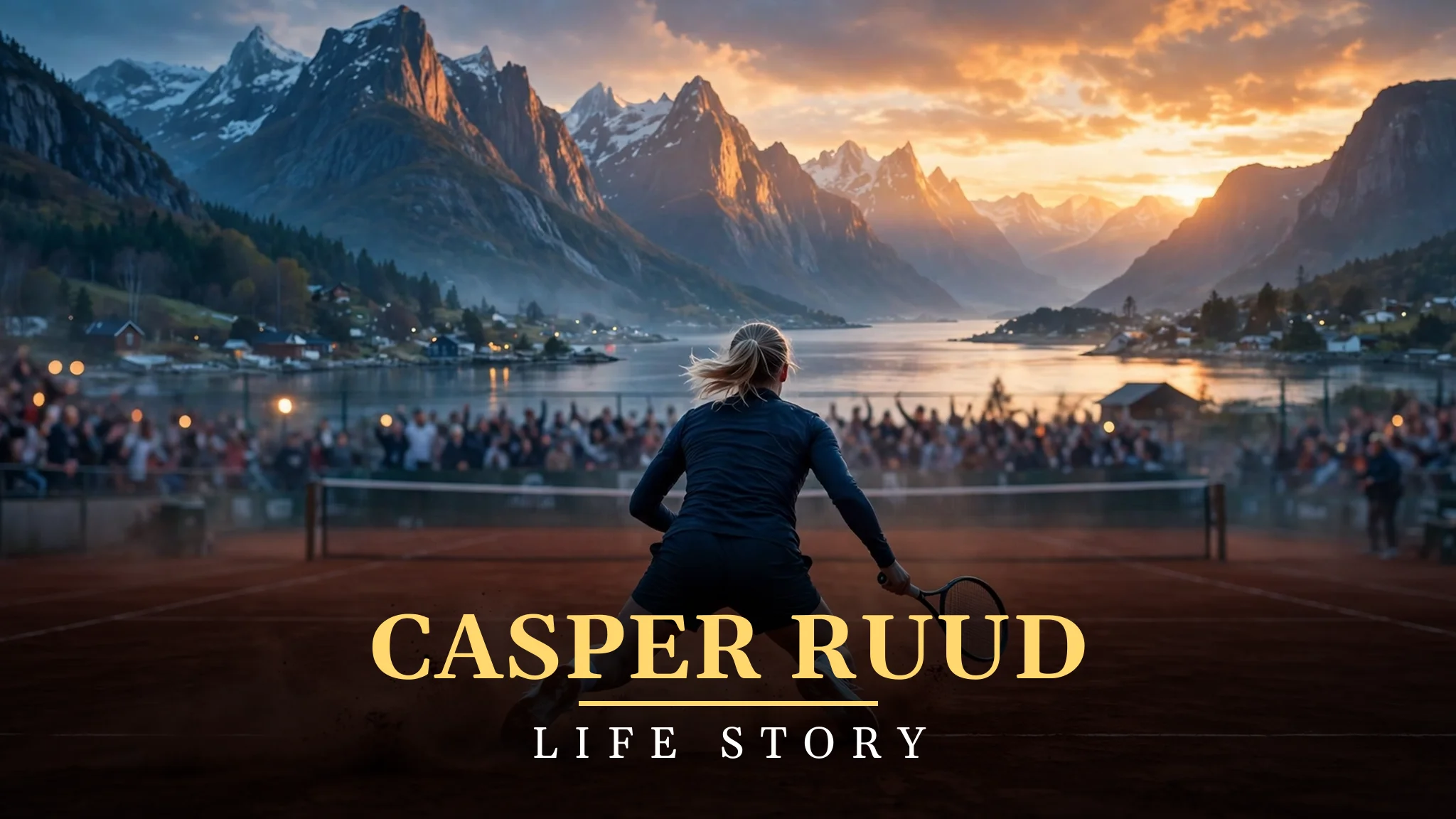
And I want to finish with a thought about the fjord in the picture, and about the mountains, and about Norway itself, because Ruud comes from a beautiful country, and a hard country, and a country that makes tough people, and kind people, and he is both. He is tough, because he fights, and he is kind, because he cares, and those two things together make him a champion, and a hero, and a man worth admiring. I will keep watching him, and I will keep rooting for him, and I hope that one day, he lifts a Grand Slam trophy, and the whole of Norway cheers, and the fjords echo with the sound of it.
Frequently Asked Questions
How many Grand Slam finals has Casper Ruud reached?
He has reached three Grand Slam finals: the French Open in 2022 and 2023, and the US Open in 2022, losing to Nadal, Alcaraz, and Djokovic.
What is Casper Ruud’s highest ranking?
His highest ranking is world No. 2, which he reached in 2022 after his runs to the French Open and US Open finals.
Where did Casper Ruud train as a teenager?
He trained at the Rafael Nadal Academy in Mallorca, Spain, where he learned to play on clay and developed his powerful forehand.
Who is Casper Ruud’s father?
His father is Christian Ruud, a former professional tennis player who reached the top 40 in the world and has coached his son throughout his career.
Is Casper Ruud the best Norwegian tennis player ever?
Yes, he is widely regarded as the best Norwegian tennis player in history, as the first from his country to reach a Grand Slam final and the world No. 2 ranking.
What is Casper Ruud’s best shot?
His forehand is his best shot, hit with heavy topspin and great power, and it is one of the most feared forehands on the professional tour.


