Catriona Gray: The Life Story Behind Miss Universe
In this post
- Growing Up Between Australia and the Philippines
- Miss World and the First Taste of the Pageant Stage
- Binibining Pilipinas and the Road to Bangkok
- Miss Universe 2018 and the Lava Walk
- Advocacy, Education and the Work of a Queen
- Music, Modelling and Life After the Crown
- A Voice for Young Women Everywhere
- My Take:
When Catriona Gray walked across the Miss Universe stage in Bangkok in December 2018, wearing a red gown and moving with a slow, deliberate turn that the world would soon call the lava walk, she was not only competing for a crown. She was completing a journey that had begun in Cairns, Australia, continued through the Philippines, and passed through a Miss World competition, a national pageant, and years of preparation that most of the world never saw. Born Catriona Elisa Magnayon Gray on 6 January 1994, to an Australian father and a Filipino mother, she grew up between two countries, learned to sing before she learned to compete, and became one of the most admired Miss Universe winners in history. Her victory was celebrated not only for its beauty but for its intelligence, because her answers in the competition showed a young woman who thought deeply about education, about poverty, and about the responsibility of a title. This is the story of how a girl from Cairns became the queen of the universe, and what she did with the crown once she had it.
Growing Up Between Australia and the Philippines
Catriona Gray was born on 6 January 1994 in Cairns, Queensland, Australia, to an Australian father and a Filipino mother, and her childhood was shaped by the blend of those two worlds. She grew up in Australia, where she attended school, learned to play music, and developed the interests that would define her life: singing, martial arts, and a love of learning. Her mother, who was from the Philippines, kept her connected to Filipino culture, and the family visited the Philippines regularly, giving Catriona a sense of belonging to both countries. She was a bright and curious child, interested in music from an early age, and she began singing and performing while she was still young. She also trained in martial arts, earning a black belt in Choi Kwang-Do, a discipline that taught her focus, discipline and confidence. Her childhood was not only about talent; it was also about the values of her family, who encouraged her to work hard, to be kind, and to use her abilities to help others. The dual heritage gave her a perspective that many of her peers did not have, an awareness that the world is larger than one country and that a person can carry more than one culture with pride. That awareness would later shape her advocacy work, her public statements, and the way she represented the Philippines on the world stage.
Her education also played a central role in shaping the person she became, because she studied at the Berklee College of Music in Boston, one of the most prestigious music schools in the world, where she pursued a degree in music theory. The choice is telling, because it shows a young woman who was serious about music as a discipline, not only as a hobby, and who was willing to invest years in studying it at the highest level. She also worked as a model in Australia, appearing in campaigns and learning how to work in front of a camera, and she began to think about pageantry as a way to combine her interests in performance, advocacy and public service. Her time at Berklee gave her a musical education that few pageant contestants possess, and it gave her a confidence in her own abilities that showed in every interview she gave. She was not only beautiful; she was educated, articulate and musically gifted, and that combination set her apart from the moment she entered the pageant world. Her childhood in Cairns and her education in Boston together formed a foundation of talent and discipline, and that foundation is the reason her Miss Universe victory felt earned rather than lucky.
Miss World and the First Taste of the Pageant Stage
Before she became Miss Universe, Catriona Gray first competed on the international pageant stage as Miss World Philippines, representing her country at Miss World 2016 in Washington, D.C. She performed strongly in the competition, finishing in the top five, and the experience taught her lessons that would prove invaluable two years later. Miss World is a different kind of competition from Miss Universe, with a greater emphasis on charity work, talent and the Beauty with a Purpose project, and Catriona’s participation in it showed her commitment to using pageantry as a platform for service. She worked on projects that supported education and community development, and she learned how to present herself as an advocate as well as a contestant. The top-five finish was a significant achievement, and it made her a familiar face in the Philippine pageant community, but it also left her with unfinished business, because she had come close to a world title without winning it. The experience taught her about the pressures of international competition, about the importance of preparation, and about the need to stay composed when the stakes are high. She returned to the Philippines with a clearer sense of what she wanted and what she needed to improve, and she spent the next two years preparing for another attempt at a world title. The Miss World experience was not a failure; it was a rehearsal, and the lessons she learned there would make the difference at Miss Universe.
What made her Miss World experience so valuable was that it taught her to think about pageantry as more than a beauty contest. The Beauty with a Purpose project, which is central to Miss World, asks contestants to identify a cause and to work on it in their communities, and Catriona took that work seriously, focusing on education and on supporting children in need. Her work on these projects gave her a sense of purpose that went beyond the competition, and it shaped the advocacy that would define her Miss Universe reign. She also learned how to handle the media, how to speak about her causes, and how to present herself as a thoughtful and articulate young woman rather than only as a beautiful one. The top-five finish showed that she was a serious contender, and it built her reputation in the Philippines, where pageant fans began to see her as a future Miss Universe. The two years between Miss World and her Miss Universe win were spent in preparation, working on her walk, her styling, her answers and her advocacy, and that preparation was thorough and deliberate. When she finally entered Binibining Pilipinas in 2018, she was not a newcomer but a veteran, and her victory there felt like the natural next step in a journey that had begun at Miss World.
Binibining Pilipinas and the Road to Bangkok
In 2018, Catriona Gray entered Binibining Pilipinas, the national pageant that selects the Philippines’ representative to Miss Universe, and her victory there was one of the most anticipated in the pageant’s history. She was the favourite from the start, because her Miss World experience, her education, her musical talent and her poise made her a formidable competitor, and she lived up to those expectations with a performance that was polished and confident. She won the title of Binibining Pilipinas Universe, earning the right to represent the Philippines at Miss Universe 2018 in Bangkok, Thailand, and her victory was celebrated across the country as the beginning of a campaign that many Filipinos believed would end with a fourth Miss Universe crown for the Philippines. The months between her national win and the international competition were spent in intense preparation, working with trainers, designers and coaches to perfect every aspect of her performance. She worked on her walk, which would become famous as the lava walk, on her gowns, on her interview answers, and on her advocacy for education. The preparation was not only physical; it was also intellectual, because she studied the issues she wanted to speak about, from education to poverty to the rights of children, and she prepared answers that were thoughtful and specific. Her team understood that Miss Universe is won not only on stage but in the interview room, and Catriona’s intelligence and articulation were among her greatest strengths. By the time she arrived in Bangkok, she was ready, and the Philippine audience, which follows pageants with extraordinary passion, was behind her.
The road to Bangkok was also a test of her ability to handle pressure, because the expectations placed on her were enormous. The Philippines had not won Miss Universe since Pia Wurtzbach in 2015, and the country’s pageant fans were eager for another victory. Catriona was seen as the best hope, and that expectation could have been a burden, but she handled it with a calm that reflected her experience and her preparation. She spoke openly about her advocacy, about her love for the Philippines, and about her determination to represent her country well, and her sincerity won her supporters. Her social media following grew rapidly, and her journey to Bangkok was followed by millions of Filipinos who saw in her a representative of their hopes. The preparation period also included her famous lava walk, a slow, deliberate turn that she developed with her trainer, inspired by the lava flows of the Mayon Volcano in the Philippines. The walk was designed to be distinctive, to stand out from the other contestants, and it became one of the most talked-about moments of the competition. When she arrived in Bangkok, she was not only prepared; she was also carrying the hopes of a nation, and she carried them with grace.
Miss Universe 2018 and the Lava Walk
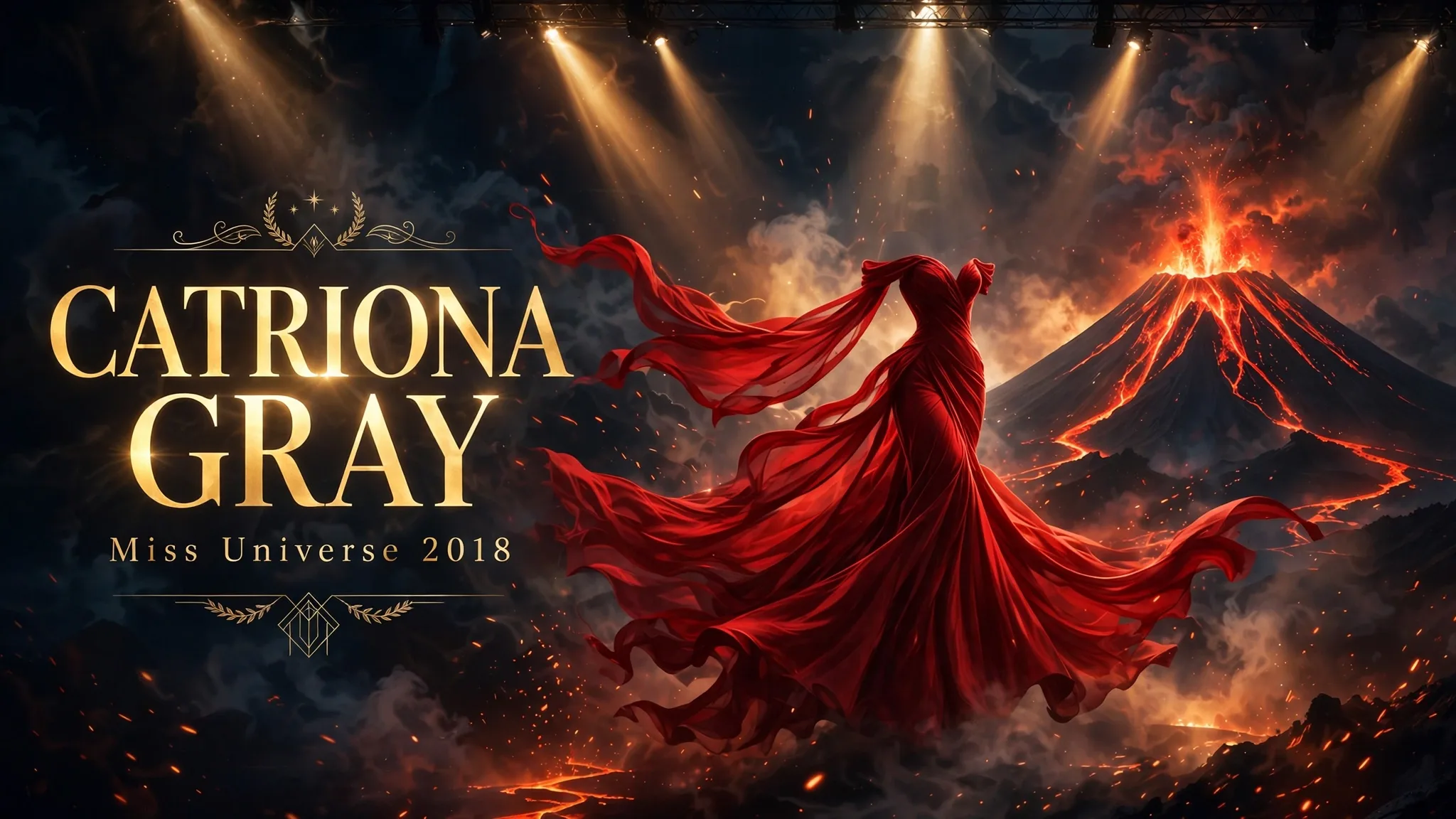
The Miss Universe competition in December 2018 was held in Bangkok, Thailand, and Catriona Gray arrived as one of the favourites, a status she had earned through her preparation and her reputation. She performed strongly throughout the competition, impressing judges with her confidence, her intelligence and her poise, and she advanced through the rounds to the final three, alongside Miss South Africa and Miss Venezuela. Her performance in the evening gown competition became legendary, when she walked the stage in a red gown designed by Mak Tumang, inspired by the Mayon Volcano, and performed the slow, deliberate turn that became known as the lava walk. The walk was a masterpiece of pageant performance, a moment of theatre that captured the audience’s attention and became instantly iconic. It was not only beautiful; it was meaningful, because it referenced a Philippine landmark and told a story about the country’s natural power. Her final answer, in which she spoke about the importance of education and about the children in the slums of Manila, was equally powerful, showing a young woman who thought deeply about the issues facing her country. When she was crowned Miss Universe 2018, becoming the fourth Filipina to win the title, the celebration in the Philippines was enormous, with Filipinos around the world rejoicing at the victory. Her win was not only a personal triumph; it was a national celebration, and it confirmed her status as one of the most admired Miss Universe winners in history.
What made her victory so memorable was the combination of beauty, intelligence and purpose that she brought to the competition. Her answers were not generic; they were specific, thoughtful and grounded in her experience working with children in the Philippines. When she spoke about education, she spoke about the children she had met in the slums of Manila, and her words carried the weight of real experience. Her lava walk was not only a performance; it was a statement about Filipino identity, about the power of a volcano and the beauty of a country that is often overlooked. Her reign as Miss Universe took her around the world, where she spoke about education, about HIV awareness and about the rights of children, using the platform that the title gave her to do work that mattered. She visited many countries, met with leaders and organisations, and represented the Philippines with a dignity and a professionalism that won her admirers everywhere. Her victory is remembered not only for the crown but for the way she won it, with a combination of preparation, intelligence and artistry that set a new standard for the competition. The lava walk, the red gown and the final answer have all become part of pageant history, and they are the reason her win is still discussed years later.
Advocacy, Education and the Work of a Queen
Throughout her reign and afterwards, Catriona Gray has been defined by her advocacy for education, a cause that is rooted in her own experience and in the work she did in the Philippines before she won the crown. She has spoken passionately about the importance of education for children in poor communities, drawing on her visits to the slums of Manila, where she met children who had little access to schooling. Her advocacy is not abstract; it is grounded in the faces and the stories of the children she met, and her words carry the weight of that experience. During her reign, she worked with organisations that support education, visited schools and communities, and used her platform to bring attention to the barriers that prevent children from learning. She has also spoken about the need for quality education, not only access to it, and about the role that education plays in breaking the cycle of poverty. Her work as an advocate is the reason her reign is remembered as more than a year of glamour, and it is the part of her story that will last longest. She understood that a Miss Universe title is a platform, and she used it to speak about something that mattered, with a sincerity that won her respect from people who had never followed a pageant. Her advocacy continues today, through her work with charities, her public statements and her support for educational projects in the Philippines.
Her advocacy extends beyond education to other causes, including HIV awareness, children’s rights and the empowerment of young women, and her public statements on these issues have been thoughtful and informed. She has used her social media following to promote causes she cares about, and she has spoken at events and conferences about the importance of using one’s platform responsibly. Her background in music and her education at Berklee have also shaped her advocacy, because she understands the power of art and culture to change minds and to inspire action. She has released music that reflects her values, and she has used her performances to support charitable causes. Her work as an advocate is not a separate part of her career; it is woven into everything she does, from her modelling to her hosting to her public appearances. She has shown that a beauty queen can also be a serious advocate, and that a title can be used to make a real difference in the world. Her legacy as Miss Universe is not only about the crown or the lava walk; it is about the work she did while she wore the crown, and the work she continues to do today. That legacy is a reminder that the most important part of a title is not the glamour but the responsibility that comes with it.
Music, Modelling and Life After the Crown
After her reign as Miss Universe ended, Catriona Gray built a career that draws on all of her talents, from music to modelling to hosting and advocacy. She released music as a singer-songwriter, drawing on her education at Berklee and her lifelong love of music, and her songs reflect a personal and artistic sensibility that sets her apart from other former titleholders. Her music is not a side project; it is a serious part of her identity, and her performances have been praised for their sincerity and their musical quality. She has also worked as a model, appearing in fashion campaigns and on magazine covers, and her image, which blends Australian and Filipino features, has made her appealing to international brands. She has become a television host, using her experience in front of a camera and her natural warmth to connect with audiences, and she has become a trusted presence on Philippine television. Her work as a host and as a public figure has been marked by a professionalism that reflects her years of experience, and she has become a role model for young Filipinos who admire her intelligence, her talent and her grace. Her post-crown career is a model for how a pageant winner can build a lasting professional life, not by clinging to the title but by using it as a foundation for a varied and independent career.
Her personal life and her public image have also been followed closely, and she has handled the attention with a balance of openness and privacy that reflects her maturity. She has spoken about her family, her relationships, and her happiness, sharing her life with her fans while protecting the details that matter most to her. She is known for her love of music, her interest in art and culture, and her active lifestyle, and she often shares glimpses of those interests with her followers. Her influence reaches beyond entertainment, because millions of young Filipinos follow her choices, learn from her example, and see in her a model of what preparation can achieve. As she moves forward, her career continues to evolve, with new projects in music, modelling and advocacy, and with a public profile that remains strong years after her Miss Universe win. What her life proves, more than anything, is that preparation, education and purpose can carry a person further than beauty alone, and that a crown is not an ending but a beginning. The girl from Cairns who studied music at Berklee, competed at Miss World, and won Miss Universe has become one of the most admired Filipinas in the world, and her journey is far from over. For anyone who dreams of a title, her life is a reminder that the title is won through years of work, and that the work after the title matters just as much.
A Voice for Young Women Everywhere
Catriona Gray’s influence extends far beyond the pageant stage, because she has become a voice for young women who see in her an example of what is possible when talent, education and purpose come together. She has spoken at events and on social media about the importance of education, about the need for young women to believe in themselves, and about the value of hard work, and her words carry weight because she has lived the story she tells. Her fans, many of whom are young Filipinas, look up to her not only for her beauty but for her intelligence, her musical talent and her commitment to helping others. She has shown that a woman can be glamorous and serious at the same time, that she can compete in a pageant and study at Berklee, that she can wear a red gown and speak about the children in the slums of Manila. That combination is powerful, because it challenges the idea that a woman must choose between beauty and brains, between glamour and substance. Her example has inspired young women to pursue their education, to develop their talents, and to use their voices for causes they believe in. Her influence is not measured in crowns or in followers, but in the young people who have been encouraged by her story to aim higher, to work harder, and to believe that their dreams are achievable. That is a legacy that will outlast any title.
Her work as a public figure also reflects a deep understanding of the responsibility that comes with fame. She has used her platform to promote education, to support children’s charities, and to speak about issues that matter, and she has done it with a sincerity that has won her respect. She has also been open about her own journey, about the challenges of competing, about the pressure of expectations, and about the importance of staying true to oneself. That openness has made her relatable, and it has given her fans a sense that she is not only a star but a person who understands their struggles. As she continues her career in music, modelling and advocacy, her influence is likely to grow, because she has built a foundation of trust with her audience that is rare in public life. Her story is a reminder that the most powerful thing a public figure can do is to be honest, to be purposeful, and to use her platform to make the world a little better. Catriona Gray has done that, and her legacy will be measured not only in the crown she won but in the lives she has touched.
My Take:
When I think about Catriona Gray, the first thing that comes to mind is preparation, because her Miss Universe victory was not an accident but the result of years of deliberate work. She competed at Miss World, she studied music at Berklee, she trained in martial arts, and she spent months preparing for Bangkok, and every one of those experiences contributed to her win. I think her story is a powerful reminder that success is rarely the result of a single moment; it is the result of a long series of choices, each one building on the last. The lava walk, which looked effortless on stage, was the product of hours of practice, and her final answer, which sounded spontaneous, was the product of years of thinking about education and about the children she had met. That is the kind of success that lasts, because it is built on a foundation that cannot be taken away.
What impresses me most about her final answer is its specificity. She did not speak in general terms about the importance of education; she spoke about the children in the slums of Manila, about the faces she had seen, and about the need to give those children a chance. That specificity is what made her answer powerful, because it showed that she was not repeating a slogan but speaking from experience. I think this is a lesson for anyone who wants to be heard: the most persuasive words are the ones that come from real life, not from a script. Catriona’s answer worked because she had done the work, she had visited the communities, and she had listened to the people she was speaking about. That is a standard that more public figures should meet.
The lava walk is another part of her story that I find fascinating, because it shows how a single creative choice can define a career. The walk was not an accident; it was designed, practised and inspired by the Mayon Volcano, and it told a story about the Philippines in a few seconds of movement. I admire the intelligence behind that choice, because it turned a pageant walk into a piece of theatre, and it made Catriona stand out from every other contestant. Too many performers try to stand out by being louder or more dramatic, but Catriona stood out by being more thoughtful, by giving her walk a meaning that the audience could feel. That is a lesson in creativity: the most memorable moments are often the ones that are most carefully planned.
Her advocacy for education is the part of her career that I respect most, because it is rooted in real experience and sustained over years. She did not adopt education as a cause because it sounded good; she adopted it because she had met the children who needed it, and she had seen the difference that schooling could make. Her work on this issue, both during her reign and afterwards, has been consistent and sincere, and it has given her a purpose that goes beyond glamour. I believe that her advocacy will be remembered longer than her crown, because a crown is a moment but education changes lives, and the lives she has helped are the real measure of her reign. That is the best use of a platform that I can imagine.
I also think about her dual heritage, Australian and Filipino, and how it shaped her perspective. She grew up knowing that she belonged to two countries, and that awareness gave her a broad view of the world that many of her peers did not have. She represents the experience of millions of people who live between cultures, and her success shows that a mixed background is a strength, not a disadvantage. Her ability to move comfortably between Australia and the Philippines, between music and pageantry, between advocacy and entertainment, is a reflection of that background. I think her story is a reminder that identity is not a single thing, and that the people who embrace their complexity are often the ones who achieve the most.
Her education at Berklee College of Music is another aspect of her story that deserves attention, because it shows a young woman who took her talent seriously enough to study it at the highest level. Many performers are content to rely on natural ability, but Catriona invested years in learning music theory, in understanding her craft, and in building a foundation that would support her for the rest of her life. That investment paid off, not only in her music career but in her confidence, her discipline and her ability to speak intelligently about her work. I think her example is important for young people who are told that talent is enough; talent is a beginning, but education is what turns talent into a career, and Catriona’s career is proof of that.
The way she handled the pressure of being the favourite is also worth noting, because the expectations placed on her before Miss Universe were enormous. The Philippines had not won since 2015, and Catriona was seen as the best hope for another victory. That kind of pressure can crush a performer, but she handled it with a calm that reflected her experience and her preparation. She did not let the expectations overwhelm her; she used them as motivation, and she delivered a performance that exceeded even the highest hopes. I think that composure under pressure is one of her greatest strengths, and it is a quality that will serve her well in whatever she does next. A person who can stay calm when a whole country is watching has learned something valuable about herself.
Her music career is another part of her story that I find genuinely interesting, because it shows a side of her that pageants do not reveal. She is a trained musician, a singer-songwriter, and her songs reflect a personal and artistic sensibility that is distinctively hers. Her music is not a commercial afterthought; it is a serious part of her identity, and it gives her a creative outlet that does not depend on a crown or a title. I hope she continues to develop as a musician, because the combination of pageantry, advocacy and music is rare, and it gives her a range of expression that most public figures do not have. A performer who can sing, speak and advocate has more ways to reach an audience, and Catriona has used all of them.
Looking at her Miss World experience, I am struck by how valuable a near-miss can be. She finished in the top five at Miss World, which was a significant achievement, but it was not a win, and that experience taught her lessons that a victory might not have. She learned about the pressures of international competition, about the importance of preparation, and about the need to keep improving. When she returned to compete for Miss Universe, she was not a newcomer; she was a veteran who had learned from her first attempt. I think this is a useful lesson for anyone who has come close to a goal without reaching it: the near-miss is not a failure, it is a rehearsal, and the lessons it teaches can make the difference the next time.
Her influence on young Filipinos is another aspect of her career that I think about often. She is a role model not because she is perfect, but because she is educated, articulate, talented and purposeful, and those qualities are more useful than perfection. Young people who look up to her see a woman who has built her success on hard work, on education, and on a commitment to helping others, and that example is powerful. She has shown that beauty and intelligence are not opposites, and that a woman can be both glamorous and serious, both a performer and an advocate. That message matters, because it challenges the idea that a beauty queen is only a pretty face, and it shows young women that they can be many things at once.
I also reflect on the way she has used her platform after her reign, because many titleholders fade from public life once the crown is gone. Catriona has not faded. She has built a career in music, modelling, hosting and advocacy, and she has done it by treating the crown as a foundation rather than as a peak. That is a wise approach, and it is one that more public figures should follow. A single achievement, however great, should be the beginning of a career, not the end of it, and Catriona’s post-crown work is proof that it is possible to keep growing after the biggest moment of your life. Her story is still being written, and the chapters that come next may be the most interesting ones.
Her martial arts training is a small detail that I find telling, because it shows a person who values discipline and physical strength. Earning a black belt is not easy; it requires years of practice, focus and perseverance, and those qualities show in everything Catriona does. The discipline she learned in martial arts is the same discipline that carried her through Berklee, through Miss World, and through the months of preparation for Miss Universe. I think this is a reminder that the skills we learn in one part of our lives often support us in another, and that a well-rounded person is usually a successful one. Catriona’s varied background, music, martial arts, education and pageantry, is the reason she is so interesting, because each part of it has contributed to the whole.
Looking ahead, I believe Catriona Gray’s legacy will be defined not only by her crown but by the standard she set for what a Miss Universe winner can be. She showed that a titleholder can be educated, articulate, musical and purposeful, and that a pageant performance can be a work of art. The lava walk, the red gown and the final answer have all become part of pageant history, but the real legacy is the example she set: that preparation matters, that advocacy matters, and that a crown is a responsibility as well as a prize. Future contestants will be measured against her, and that is a fitting tribute to a performer who raised the bar for everyone who follows.
Finally, I think Catriona’s story is ultimately about the power of being fully yourself. She did not try to be a generic beauty queen; she brought her music, her education, her martial arts, her dual heritage and her advocacy to the stage, and she won because she was herself, fully and confidently. That is a lesson that applies far beyond pageantry: the people who succeed are often the ones who stop trying to fit a mould and start bringing their whole selves to the work. Catriona did that, and the world noticed. Her story is a reminder that authenticity is not a weakness; it is a strength, and it is the strength that made her Miss Universe.
One more thought on Catriona is about the power of education to change a life. Her time at Berklee was not a detour from her pageant career; it was the foundation of it, because it gave her the knowledge, the discipline and the confidence to speak intelligently about the issues she cared about. Her final answer at Miss Universe worked because she had done the work, she had studied, and she had thought deeply about education. That is a lesson for any young person: the time you spend learning is never wasted, and it will show when it matters most.
Her story also reminds me that a near-miss can be a gift. Her top-five finish at Miss World was not a win, but it taught her lessons that a victory might not have, and those lessons made the difference at Miss Universe. The ability to learn from a disappointment, rather than being defined by it, is one of the most valuable skills a person can develop, and Catriona has it in abundance. Her career is proof that the path to success is rarely straight, and that the detours often teach us the most.
Finally, I think about the lava walk as a symbol of her whole approach: deliberate, meaningful and beautifully executed. She did not rush, she did not show off, and she did not try to be like everyone else. She took her time, she told a story, and she let the moment speak for itself. That patience, that confidence, and that sense of purpose are the qualities that made her Miss Universe, and they are the qualities that will carry her through whatever she does next. Her story is a reminder that the best performances are the ones that are planned with care and delivered with grace.
Frequently Asked Questions
How old is Catriona Gray?
Catriona Gray was born on 6 January 1994, which makes her 32 years old in 2026. She was born Catriona Elisa Magnayon Gray in Cairns, Queensland, Australia.
What is the lava walk?
The lava walk is the slow, deliberate turn Catriona Gray performed in her red evening gown at Miss Universe 2018. It was inspired by the lava flows of the Mayon Volcano in the Philippines and became one of the most famous moments in pageant history.
Did Catriona Gray compete at Miss World?
Yes, Catriona Gray represented the Philippines at Miss World 2016, where she finished in the top five. The experience helped prepare her for her Miss Universe win two years later.
What did Catriona Gray study?
Catriona Gray studied music theory at the Berklee College of Music in Boston, one of the most prestigious music schools in the world. She is also a trained singer and a black belt in martial arts.
What is Catriona Gray known for after Miss Universe?
After her reign, Catriona Gray built a career in music, modelling, hosting and advocacy, with a particular focus on education for children in poor communities in the Philippines.
What is Catriona Gray’s net worth?
No official figure for Catriona Gray’s net worth has been published, and online estimates vary widely. Her income has come from modelling, hosting, music, endorsements and advocacy work.