Celia Cruz: The Life Story Behind Cuba's Queen of Salsa
In this post
There are singers who sing a song, and there are singers who become the song, and Celia Cruz belongs to the second kind. Known as the Queen of Salsa, she was one of the most loved singers in the Spanish-speaking world, a woman with a powerful voice, with bright dresses, with colourful wigs, and with a shout, “Azucar!”, sugar, that became her signature, and that made audiences smile before she had even sung a note. She sang for more than fifty years, she recorded dozens of albums, and she made salsa a music for the whole world.
Celia Cruz was born on 21 October 1925, in Havana, Cuba, in a poor neighbourhood called Santos Suarez, and she died on 16 July 2003, in Fort Lee, New Jersey, in the United States, at the age of seventy-seven. In between those two dates, she sang with La Sonora Matancera, one of Cuba’s most famous bands, she left Cuba in 1960 and never returned, she built a new life in the United States, and she became a symbol of Cuban music, of exile, and of joy in the face of loss. Her voice was strong, her spirit was stronger, and her music made people dance even when their hearts were sad.
What makes her story worth telling is how she turned loss into music, and how she carried Cuba with her wherever she went. She left her home, she lost her family, she lived far from the island she loved, and yet she sang with a joy that never faded. Her songs, “Quimbara”, “La Vida Es Un Carnaval”, and “La Negra Tiene Tumbao”, are still played at parties, at weddings, and on the radio, and they are still sung by people who were not born when she first recorded them. This is the story of how a poor girl from Havana became the Queen of Salsa, and how she made the whole world dance.
Her shout of “Azucar!” was not only a word. It was a promise, that life, even when it is hard, can still be sweet.
Havana, Santos Suarez, and a Girl Who Loved to Sing
Celia Cruz was born in Havana, in the neighbourhood of Santos Suarez, in 1925, into a large and poor family. She was one of many children, and she grew up in a house full of music, where neighbours sang, where the radio played, and where a young girl could hear the rhythms of Cuba, of rumba, of son, and of the songs that came from Africa and from Spain, mixed together in a sound that was uniquely Cuban. She loved to sing, and she sang at home, at school, and in her neighbourhood, and people noticed that her voice was special, strong, clear, and full of feeling.
As a child, she was not a rich girl, and she did not have a formal musical education at first. She learned to sing by listening, by copying the singers she heard on the radio, and by singing in the street, where a crowd would gather to hear her. She also sang in school, and her teachers encouraged her, telling her that she had a gift. She took that gift seriously, and she began to think that singing could be more than a hobby. It could be a life.
She studied to be a teacher, and she also studied music at a conservatory in Havana, where she learned about voice, about rhythm, and about the theory behind the songs she loved. That training gave her a discipline that stayed with her for the rest of her career. She was not only a natural singer. She was a trained singer, who understood her voice, and who knew how to use it, night after night, without losing its power. That combination, of a natural gift and a learned skill, made her voice last for more than fifty years.
Havana in the 1940s was a city of music, with bands playing in clubs, on the radio, and at parties, and a young singer with a strong voice could find work if she was good enough. Celia began to sing in public, in small venues, and in radio contests, and she won prizes, and she began to be noticed. It was a slow start, but it was a real one, and it was built on a voice that people remembered, even after hearing it once. She was on her way, and she did not yet know how far that voice would take her.
The band’s tours also took Celia to countries she had never seen, and to audiences who spoke Spanish with different accents, and who danced to her songs in different ways. She learned to sing for all of them, and to make each audience feel as if she were singing only for them. That skill, learned on the road with La Sonora Matancera, stayed with her for the rest of her career, and it made her a global star.
La Sonora Matancera and the Voice That Filled Cuba
In 1950, Celia Cruz joined La Sonora Matancera, one of the most famous bands in Cuba, and that decision changed her life. La Sonora Matancera was a large band, with a strong brass section, with percussion, and with a sound that was known across Cuba and Latin America. It needed a singer, and Celia became that singer, the first woman to sing with the band as a regular member, and her voice became the sound of the group for the next fifteen years.
With La Sonora Matancera, Celia recorded many songs, and she toured Cuba, Latin America, and the United States, singing in large halls, on the radio, and on television. Her songs, such as “Burundanga” and “Yerbero Moderno”, became hits, and her voice became known across the Spanish-speaking world. She was no longer a young singer from Santos Suarez. She was a star, and she was the voice of one of Cuba’s greatest bands. It was a remarkable achievement for a woman in a world run by men, and it was a sign of how strong her talent was.
The years with La Sonora Matancera were happy ones, and they were also hard ones, because the band toured constantly, and Celia lived much of her life on the road, away from her family, and away from home. But she loved the work, and she loved the band, and she gave it her best, night after night. She learned how to hold a stage, how to work with a large group of musicians, and how to make an audience dance, even when she was tired. Those lessons stayed with her for the rest of her career.
In those years, she also met Pedro Knight, a trumpet player in La Sonora Matancera, who would become her husband, her manager, and her partner for the rest of her life. Pedro was a kind and steady man, and he supported Celia in her career, and he loved her deeply. Their marriage, which lasted for more than forty years, was one of the great love stories of Latin music, and it was a partnership in every sense, on stage and off it. He was her trumpet, her manager, and her best friend.
By the late 1950s, Celia Cruz was one of the most famous singers in Cuba, and her future seemed bright. But Cuba was about to change, and that change would force her to leave her home, and to start a new life far away, in a country she did not know, with a language she was still learning. That new life would be hard, but it would also make her a queen.
She also learned to live in a new language, to speak English in daily life, while singing in Spanish on stage. That double life, English outside and Spanish inside, is a common experience for immigrants, and Celia lived it with grace. She never lost her Spanish, and she never lost her Cuban accent, and that accent became a part of her identity, a sign that she had not forgotten where she came from.
Leaving Cuba and a Life in Exile
In 1960, Celia Cruz left Cuba with La Sonora Matancera, for a tour in Mexico, and she never returned. The Cuban Revolution had changed the island, and the new government, led by Fidel Castro, had taken control of the music business, and of many other parts of life. Celia, who had been a star in Cuba, found that she could not go home, and that her family, her mother, and her home were now far away, across a sea she could not cross. It was a painful separation, and it lasted for the rest of her life.
She moved to the United States, first to New York, where many Cubans had settled, and she began to rebuild her career in a new country. It was not easy. She was a Cuban singer in a city where salsa was still a new sound, and where she had to prove herself again, to a new audience, in a new language. But she had her voice, she had her husband Pedro, and she had a determination to keep singing, and she did, in clubs, in theatres, and on records, building a new following, one show at a time.
The exile was a deep wound, and it never fully healed. Celia missed Cuba, she missed her mother, who died in Cuba while Celia was in exile, and she missed the streets of Havana where she had grown up. She spoke about that loss in interviews, with a sadness that was clear, even as she smiled. But she also turned that loss into music, singing with a joy that was all the more powerful because it came from a heart that knew sorrow. Her shout of “Azucar!” was a way of saying that life, even in exile, could still be sweet.
In the United States, she worked with new bands, including the Fania All-Stars, a group of salsa musicians in New York, and she recorded with Tito Puente, a legendary bandleader, and with other stars of salsa. Those collaborations gave her a new sound, a New York salsa sound, that was faster, louder, and more modern than the Cuban sound she had known, and it brought her to a new audience, of Puerto Ricans, Dominicans, and other Latinos in the United States, who loved her voice and her spirit.
By the 1970s, Celia Cruz was a star in the United States, and in Latin America, and her exile had become a part of her story, a story that many Latinos understood, because they too had left home, and they too missed the place they came from. She sang for them, and she sang for Cuba, and she became a symbol of a people who had lost a home, but who had not lost their music.
The Fania All-Stars were a group of the best salsa musicians in New York, and to sing with them was a high honour. Celia held her own among them, with a voice that could rise above the brass and the percussion, and with a stage presence that made the audience look at her. She was the only woman in a world of men, and she was its queen, and no one doubted it.
Salsa, Fania, and the Queen in New York
In the 1970s, salsa became a major music in New York, and Celia Cruz became its queen. She recorded with the Fania label, she performed with the Fania All-Stars, and she sang songs that became classics of salsa, including “Quimbara”, a song about a woman who is strong and proud, and “La Vida Es Un Carnaval”, a song about life as a carnival, with its joys and its sorrows. Those songs were played at parties, on the radio, and in clubs, and they made Celia a name that every Latino knew.
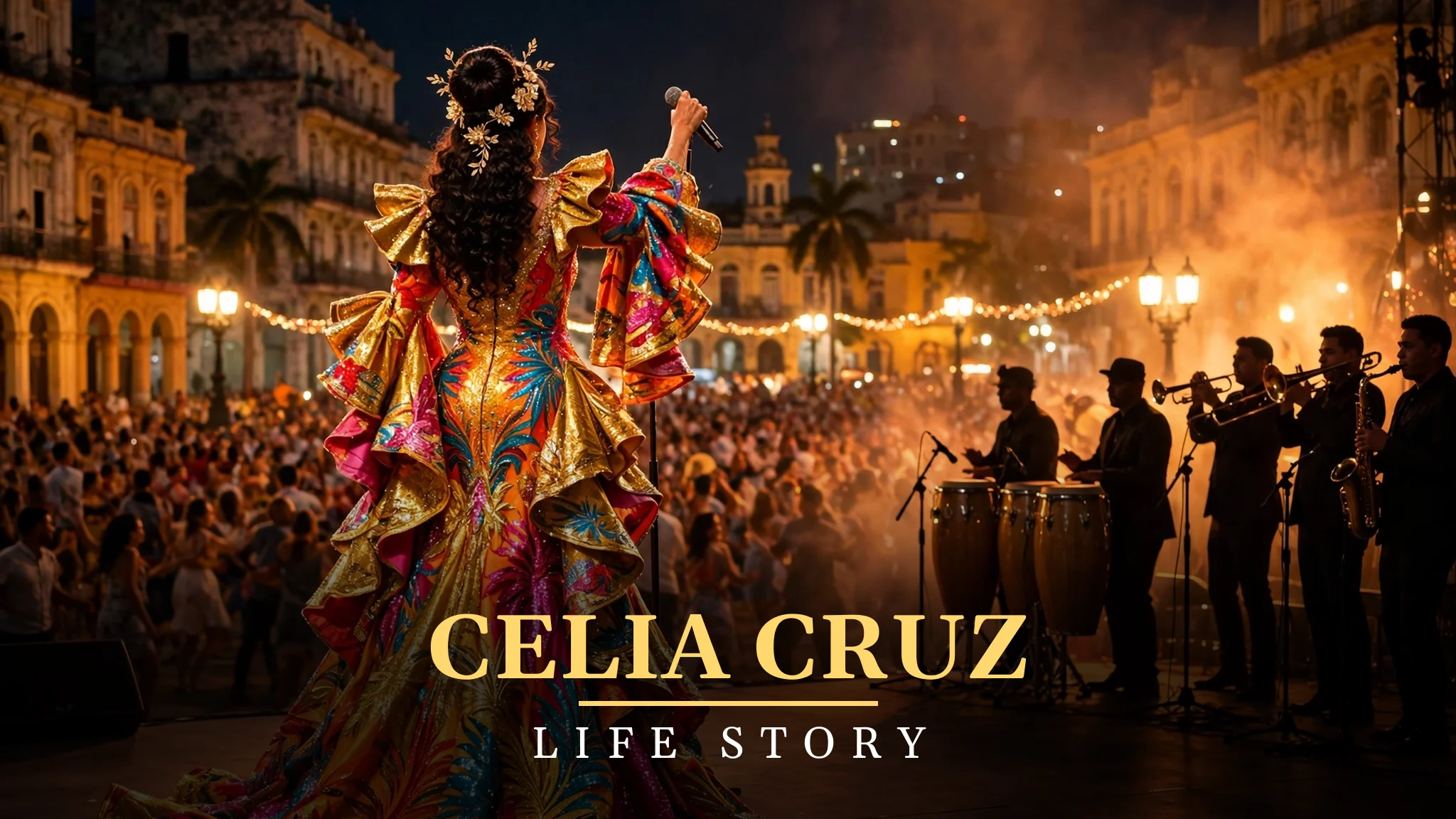
Her stage presence was a large part of her success. She wore bright, colourful dresses, with ruffles and with sequins, she wore large wigs, in many colours, and she moved with a joy that made the audience want to dance. She was not a quiet singer. She was a performer, and she gave her whole heart to every show, singing, dancing, and shouting “Azucar!” to the crowd, who shouted it back to her. It was a celebration, and it was a show that people remembered long after it ended.
She also won awards, including Grammy Awards, and she was honoured by the United States, receiving the National Medal of Arts in 1994, a high honour for an artist. Those awards mattered, but they were not the main measure of her success. The main measure was the love of her fans, who came to her concerts in large numbers, who bought her records, and who sang her songs at every party. She was a queen, not because of a crown, but because of the love of her people.
The 1970s and 1980s were a golden time for Celia, with many albums, many tours, and many collaborations, with Tito Puente, with Johnny Pacheco, and with other salsa stars. She toured the world, singing in Europe, in Latin America, and in the United States, and her voice became known far beyond the Latino world. She was a global star, and she was still, at heart, a girl from Santos Suarez, singing the songs of Havana, with a joy that never faded.
La Vida Es Un Carnaval and the Later Years
In the 1990s, Celia Cruz recorded some of her most loved songs, including “La Vida Es Un Carnaval”, released in 1998, a song that became an anthem for life itself. It says that life is a carnival, that it has its ups and downs, that we should not cry, and that we should live with joy, because life is short. The song became a favourite at parties, at weddings, and at funerals, where it was played as a reminder that even in sadness, there is a reason to sing. It is one of the most loved Spanish songs of all time, and it is the song for which Celia is best remembered.
She also recorded “La Negra Tiene Tumbao”, in 2001, a song about a Black woman with style and with pride, and it became another hit, with a modern sound that brought her to a new generation of listeners. The song showed that Celia, even in her seventies, could still make a hit, and that her voice was still strong, and her spirit was still young. She was not a singer of the past. She was a singer of the present, and she kept working, kept recording, and kept touring, even as she grew older.
Her later years were also marked by honours, by tributes, and by a growing recognition of her place in music history. She was celebrated in the United States, in Latin America, and in Spain, and her name became a symbol of salsa, of Cuba, and of a life lived with joy. She continued to perform, even when her health began to fail, because singing was her life, and she did not want to stop. She sang until she could sing no more, and she did it with the same energy she had shown as a young woman in Havana.
Celia Cruz died on 16 July 2003, in Fort Lee, New Jersey, after a battle with a brain tumour, at the age of seventy-seven. Her death was mourned across the world, and tributes came from presidents, from singers, and from ordinary fans. In New York, thousands of people came to say goodbye, and in Miami, in Havana, and in many other cities, her songs were played in her honour. It was a farewell fit for a queen, and it was also a farewell full of sadness, because a voice that had made the world dance was now silent.
Her influence can also be seen in the singers who came after her, in women who wear bright dresses, who shout to their audiences, and who sing salsa with joy. They learned from Celia, and they carry her spirit forward, in clubs, in theatres, and on the radio, in many countries. That influence, passed from one generation to the next, is a living legacy, and it will go on for many years.
Why Celia Cruz Still Matters to Music
Celia Cruz matters because she was the Queen of Salsa, and because she made salsa a music for the whole world. Before her, salsa was a local music, played in New York and in the Caribbean, and after her, it was a global music, known in Europe, in Africa, and in Asia. She carried it with her voice, with her dresses, and with her shout of “Azucar!”, and she made it a celebration that everyone could join. That is a remarkable achievement, and it is one that will last.
She also matters because she was a symbol of exile, of a people who had lost a home, but who had not lost their culture. She left Cuba, and she never returned, but she carried Cuba with her, in her songs, in her voice, and in her heart, and she gave that Cuba to the world. For many Cubans in exile, she was a link to home, and a reminder that home, even when it is far away, can still be sung. That is a powerful legacy, and it is one that goes beyond music.
Her songs matter too, because they are about life, about joy, and about the strength to keep going, even when life is hard. “La Vida Es Un Carnaval” is not only a song. It is a philosophy, a way of living, and it has helped millions of people face hard times with a smile. That is the power of music, and Celia understood it, and she used it well, for more than fifty years.
Celia Cruz is still loved, still played, and still sung, and her place in music history is secure. She is the Queen of Salsa, the girl from Santos Suarez, and the voice that made the world dance. Her story is a reminder that a voice, a shout, and a song can change a life, and can change a whole culture.
My Take:
When I think about Celia Cruz, I think about a bright dress, a loud shout of “Azucar!”, and a room full of people dancing, even when their hearts are sad. That image stays with me, because Celia’s music was not only about happiness. It was about happiness in the face of sadness, about joy in the face of loss, and about a life that is sweet, even when it is hard. I admire that, because it takes a special kind of strength to sing with joy when you have lost your home, and Celia did it for more than fifty years.
I admire her voice more than anything else in this story. It was a strong voice, a clear voice, and a voice that could fill a hall without a microphone. When she sang “Quimbara”, you could hear the power in it, and when she sang “La Vida Es Un Carnaval”, you could hear the warmth. That voice was a gift, and she used it well, night after night, for decades, without losing its power. I think about the years of singing, the tours, the long nights, and I respect the discipline it took to keep that voice strong for so long.
What moves me most is her exile, and the way she carried Cuba with her. She left Havana in 1960, and she never went back, and she missed her mother, her family, and her home for the rest of her life. That is a deep pain, and it is one that many exiles know. Yet she sang with joy, and she made her exile into a kind of home, a home made of music, of friends, and of fans who loved her. I think that is a brave thing, to make a home out of a song, when your real home is far away. She did it, and she did it with a smile.
I also think about Pedro Knight, her husband, and about their love story. He was her trumpet player, her manager, and her partner for more than forty years, and he supported her in every way. I think about a marriage that lasts that long, in a world where fame often breaks marriages, and I feel respect for both of them. They built a life together, they worked together, and they loved each other, and that love was a foundation for Celia’s career. Without Pedro, her story might have been different, and I am glad she had him by her side.
There is a sadness in this story too, and it is the sadness of a woman who never saw her mother again, and who never returned to the streets where she grew up. I think about that loss, and I feel sympathy for her, because no amount of fame can make up for a mother, or for a home. She sang about joy, but she also knew sorrow, and that sorrow is in her voice, underneath the joy. I think that is why her songs feel so real. They are not only happy. They are happy and sad at the same time, and that is how life feels.
I have a particular respect for the way she dressed, and for the way she made her stage presence a part of her art. Her bright dresses, her colourful wigs, and her large jewellery were not only fashion. They were a statement, that a Black woman from Cuba could be a queen, and could shine on any stage in the world. I think that is a powerful message, and it is one that many young women, especially Black and Latina women, have taken to heart. Celia showed them that they could be bold, they could be bright, and they could be proud of who they are.
I have a criticism as well, and I will say it plainly. Celia’s music, beautiful as it is, can sometimes feel like a party that never stops, and a listener who wants a quieter, sadder song may not find it in her catalogue. She was a singer of joy, and she sang joy well, but she rarely sang a soft, intimate ballad, and I would have liked to hear that side of her voice more. Still, I understand the choice. When you are the Queen of Salsa, you sing for the dance floor, and you do it with all your heart. That was her gift, and she gave it fully.
What I learn from Celia is that life is a carnival, and that we should live it with joy, even when it is hard. That is the message of her most famous song, and it is a message worth remembering. Life has its ups and downs, it has its losses, and it has its joys, and the best way to face it is to sing, to dance, and to shout “Azucar!” to the world. I think that is a simple lesson, and it is a profound one, and it is one that Celia lived, not only sang.
I think about the future, and about whether a new Queen of Salsa will ever come. I do not think so, not in the same way, because Celia was unique, with a voice, a spirit, and a history that cannot be copied. But I think her songs will keep being sung, and that new singers will keep learning from her, and that salsa will keep dancing, because she made it a music for the world. That is a kind of immortality, and it is one that few singers ever reach. Celia reached it, and I am glad.
If I had to choose one song to explain Celia to a stranger, I would choose “La Vida Es Un Carnaval”. It is not her earliest song, and it is not her fastest, but it is the most honest. It says that life is a carnival, that we should not cry, and that we should live with joy. I think that song tells you everything you need to know about Celia Cruz, and about why her music still matters. It is a song about life, and it is a song for life.
I will end by saying that Celia Cruz’s story is a story about a voice, a home, and a joy that never faded. She left Cuba, she lived in exile, and she sang for more than fifty years, making the world dance, and making the world smile. That is a remarkable achievement, and it is one that deserves to be remembered. I am glad to have learned her story, and I will remember it, every time I hear “Azucar!”, and every time I think about the Queen of Salsa.
I think about Santos Suarez again, and about the poor neighbourhood where Celia grew up. It was a place with little money, but with a great deal of music, and that music was a gift to a young girl who loved to sing. I think about the neighbours who heard her, and who encouraged her, and I feel grateful for them, because without them, the world might never have heard her voice. A community that supports a young singer is a community that gives the world a gift, and Santos Suarez gave the world Celia Cruz.
I also think about the conservatory in Havana, and about how Celia studied music there, learning about voice and about theory. That training is often forgotten, because her voice sounds so natural, but it was important. It gave her the discipline to sing for fifty years, to take care of her voice, and to use it well, night after night. A natural gift is a wonderful thing, but a gift that is trained will last longer, and Celia’s gift lasted for a lifetime.
There is something I find moving about the way Celia sang for exiles, for people who had left home, and who missed the place they came from. She sang for Cubans in New York, in Miami, and in many other cities, and she gave them a piece of home, in a song, in a shout, and in a dance. That is a powerful thing to do, to give a home to people who have lost one, and Celia did it, night after night, for decades. I think that is one of the most important parts of her legacy.
I wonder what Celia felt when she won the National Medal of Arts in 1994, in the United States, a country that had become her home, but that was not the home she was born in. It must have been a proud moment, and also a sad one, because the honour came from a country that was not Cuba, and Cuba, the country she loved, could not honour her in the same way. I think about that mixed feeling, and I feel sympathy for her, because exile is a life of mixed feelings, of pride and of loss, lived together.
I also reflect on her wigs, her dresses, and her jewellery, and on how they were a kind of armour, and a kind of joy. She dressed brightly because she wanted to be seen, and because she wanted her audience to see a queen, not a poor girl from Santos Suarez. That transformation, from a poor girl to a queen, is a story that many people dream of, and Celia lived it, on stage, in front of thousands, with a smile that said, I am here, and I am proud.
I think about the young Black and Latina women who look at Celia today, and who see in her a woman who was bold, who was bright, and who was not afraid to be herself. That is a powerful example, and it is one that will inspire many young women for years to come. Celia did not try to be quiet, or to be small. She was loud, she was colourful, and she was proud, and she showed that a woman can be all of those things, and still be loved.
I have another thought about La Vida Es Un Carnaval, and about why it is played at funerals as well as at parties. It is a song about life, and it says that life is a carnival, with its joys and its sorrows, and that we should not cry, but should live with joy. At a funeral, that message is a comfort, because it says that the person who has died lived, and laughed, and danced, and that their life was a carnival, even if it has ended. I think that is a beautiful use of a song, and it shows how deep Celia’s music goes.
I also think about the future, and about whether salsa will keep dancing. I think it will, because Celia made it a music for the world, and because her songs are still played, still sung, and still danced to, by people of all ages. I hope young listeners keep discovering her, and keep shouting Azucar with her, because that shout is a part of music history, and it deserves to be heard for many years to come.
I want to say something about Pedro Knight again, and about how he cared for Celia in her last years, when she was ill. He was by her side, he held her hand, and he loved her until the end. That is a love story, and it is a part of Celia’s story that should not be forgotten. A queen needs a partner, and Celia had one, in Pedro, who was her trumpet, her manager, and her husband, and who loved her deeply.
Finally, I want to say that Celia Cruz’s story gives me hope about the power of joy. In a world that is often sad, and often hard, joy is a brave choice, and Celia chose it, again and again, for more than fifty years. She chose to sing, to dance, and to shout Azucar, even when she was far from home, even when she was sad, and even when she was ill. That choice is a lesson, and it is one I will remember, every time I hear her voice, and every time I need a reason to smile.
Frequently Asked Questions
Who was Celia Cruz and why was she called the Queen of Salsa?
Celia Cruz was a Cuban singer, born in 1925 in Havana, and she was called the Queen of Salsa because of her powerful voice, her long career, and her central role in salsa music.
What does Azucar mean and why did Celia Cruz shout it?
Azucar means sugar in Spanish, and Celia Cruz shouted it as her signature cry on stage, a joyful word that became her trademark and a symbol of her music.
What are the most famous songs by Celia Cruz?
Celia Cruz is best known for “Quimbara”, “La Vida Es Un Carnaval”, “La Negra Tiene Tumbao”, “Burundanga”, and “Yerbero Moderno”, songs that are classics of salsa.
When did Celia Cruz leave Cuba and why did she never return?
Celia Cruz left Cuba in 1960 with La Sonora Matancera for a tour in Mexico, and she never returned because of the political changes after the Cuban Revolution.
Who was Pedro Knight in Celia Cruz’s life?
Pedro Knight was a trumpet player in La Sonora Matancera, and he became Celia Cruz’s husband, manager, and partner for more than forty years.
When did Celia Cruz die and where?
Celia Cruz died on 16 July 2003 in Fort Lee, New Jersey, in the United States, at the age of seventy-seven, after a battle with a brain tumour.


