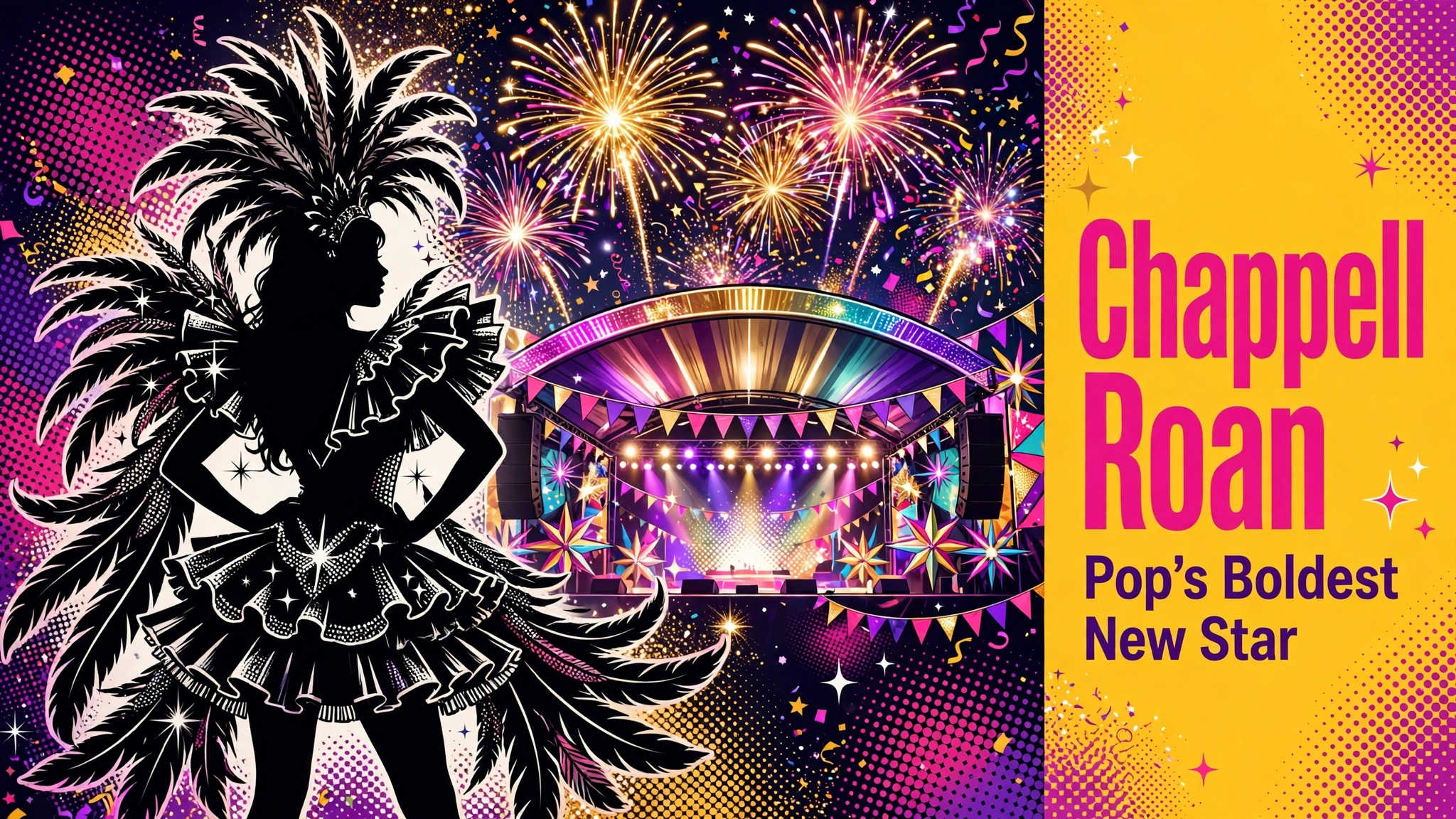
Chappell Roan: The Life Story of Pop's Boldest New Star
In this post
- Willard, Missouri and a Conservative Childhood
- YouTube, a Record Deal and Being Dropped
- Chappell Roan, Pink Pony Club and the Reinvention
- The Rise and Fall of a Midwest Princess
- Good Luck, Babe and the Breakthrough
- Festivals, Costumes and the Live Show
- Boundaries, Fame and Saying No
- The Grammy, the Future and the Boldest New Star
- The Fans, the Costumes and the Community She Built
- My Take:
Chappell Roan became a pop star by refusing to be a pop star, and that is the simplest way to understand her, because she spent years being dropped, being ignored, and being told to be someone else, and then she came back, on her own terms, with pink cowboy hats, with drag-inspired costumes, with songs about queer love and small-town escape, and with a refusal to apologise for any of it, and the world fell in love with her for exactly that refusal. Born Kayleigh Rose Amstutz in Willard, Missouri, in 1998, she grew up in a conservative, religious town, she left for Los Angeles, she was signed and dropped, she worked as a barista, she went back to Missouri, and then she returned, as Chappell Roan, and released Good Luck, Babe, and became, in a matter of months, the most exciting new star in pop music. Her life story is about authenticity, about boundaries, and about a woman who would rather be herself than be famous.
Willard, Missouri and a Conservative Childhood
Chappell Roan grew up in Willard, Missouri, a small town outside Springfield, in a conservative, religious family, and her childhood was, by her own account, sheltered, strict and confusing, because she was a queer kid in a place where being queer was not accepted, and she loved music, she loved performing, and she felt, from a young age, that she did not belong. That feeling of not belonging is the foundation of her art, because her songs are, again and again, about escape, about leaving a small town, about finding a place where you can be yourself.
Roan was born Kayleigh Rose Amstutz in Willard, Missouri, in 1998, and she grew up in a small, conservative town, in a family that was religious and that valued tradition, community and conformity. She began singing and playing piano as a child, and she has described herself as a kid who loved music, who performed in church and at school, and who felt, even then, that she was different from the other children around her. She has spoken about growing up queer in a conservative environment, about the difficulty of understanding her own identity, and about the sense of being an outsider in her own hometown, an experience that later shaped her songwriting. That childhood, with its church, its small town, and its sense of not fitting in, is the world her songs are about, particularly Pink Pony Club, which is, at its heart, a song about leaving Willard and finding a place, in West Hollywood, where she could be herself.
YouTube, a Record Deal and Being Dropped
Chappell Roan started by posting songs on YouTube as a teenager, under her real name, and she was signed to a major label, Atlantic Records, when she was still a teenager, and for a moment it looked as if her career had begun. Then the label dropped her, after her first EP did not sell, and she was left, at twenty-two, with no deal, no money, and no plan, and she went back to Missouri, and she worked in a drive-through, and she thought about giving up, and that period, of failure and of starting over, is the most important part of her story, because it taught her what she did not want, and what she did.
As a teenager she began posting original songs on YouTube under her birth name, Kayleigh Rose, and her music attracted the attention of Atlantic Records, which signed her when she was still a teenager. She released her debut EP, School Nights, in 2017, but the EP did not find a wide audience, and Atlantic dropped her in 2020, a devastating experience for a young artist who had believed her career had begun. She returned to Missouri, where she worked in a drive-through and in other service jobs, and she has spoken about that period as difficult but clarifying, because it forced her to decide whether she wanted to keep making music, and on what terms. What she decided was that she would only come back if she could do it as herself, as Chappell Roan, with the costumes, the drag, the queer songs, and the boldness that the label had tried to tame, and that decision is what made her second act possible.
Chappell Roan, Pink Pony Club and the Reinvention
The reinvention began when Kayleigh Rose became Chappell Roan, a name taken from her grandfather, and a persona that was bigger, bolder and more theatrical than anything she had done before. She moved back to Los Angeles, she started working with the producer Dan Nigro, the same producer who worked with Olivia Rodrigo, and she released Pink Pony Club, a song about a girl from a small town who goes to a gay bar in West Hollywood and finds herself, and the song became an anthem, not just for queer listeners, but for anyone who has ever left home to find themselves.
She adopted the stage name Chappell Roan, taking Chappell from her grandfather, Dennis K. Chappell, and Roan from his favourite song, The Strawberry Roan, a name that honoured her family while creating a new identity for herself. She began working with the producer Dan Nigro, and she released Pink Pony Club in 2020, a song about a young woman from a small town who discovers a gay bar in West Hollywood, a song that became a queer anthem and a fan favourite. She also released songs such as California, Naked in Manhattan and My Kink Is Karma, each one showcasing a different side of her, from the vulnerable to the funny to the angry, and each one building a fanbase that was loyal, passionate and growing. This reinvention mattered because it was not a label’s idea, it was hers, and it was built on authenticity, on drag, on camp, on queerness, and on a refusal to be anything other than herself, and that authenticity is what audiences responded to.
The Rise and Fall of a Midwest Princess
The Rise and Fall of a Midwest Princess, Chappell Roan’s debut album, was released in September 2023, and it was, at first, a slow burn, a cult favourite that critics loved and that fans adored, but that did not chart, did not sell, and did not make her famous. Then, over the next year, through touring, through TikTok, through word of mouth, the album grew, song by song, until it became one of the biggest albums in the world, and Roan, who had been dropped by a label, became a star, on her own terms, with an album that was exactly what she wanted it to be.
The Rise and Fall of a Midwest Princess was released in September 2023, and it includes songs such as Pink Pony Club, Red Wine Supernova, Hot to Go, Casual and Femininomenon, each one a different kind of pop song, from the anthemic to the confessional to the funny. The album was praised by critics as a bold, theatrical and deeply personal debut, but it did not initially chart highly, and Roan spent the months after its release touring small venues, building an audience one show at a time. Over the following year, the album grew through TikTok, through live performances, and through word of mouth, with songs going viral, with fans dressing up as Roan for concerts, and with the album climbing the charts long after its release. The slow rise mattered because it proved that an album could succeed without a hit single, without a label push, and without a traditional rollout, and that a fanbase, built slowly and honestly, could be more powerful than any marketing campaign.
Good Luck, Babe and the Breakthrough
Good Luck, Babe was released in April 2024, and it became the song that changed everything, a dramatic, emotional, furious pop song about a relationship with a woman who will not admit she is queer, and it became a global hit, topping charts, breaking streaming records, and making Chappell Roan a star, overnight, after years of work. The song is about compulsory heterosexuality, about denial, about the pain of loving someone who will not love you back honestly, and it resonated far beyond its specific story, because it was about truth, and about the cost of hiding it.
Good Luck, Babe was released in April 2024, and it became a massive hit, topping charts around the world, breaking streaming records, and becoming one of the biggest songs of the year. The song is about a relationship with a woman who is in denial about her sexuality, and its lyrics, which are direct, angry and heartbreaking, resonated with queer listeners and with anyone who has loved someone who could not be honest. The song’s success was driven by TikTok, by live performances, and by word of mouth, and it made Roan a global star, with performances on major television shows, with festival slots, and with a fanbase that grew exponentially. Good Luck, Babe mattered because it was not a safe pop song, it was a queer song, a specific song, and a song that refused to hide, and its success proved that a song about queer love could be a global hit, and that audiences were ready for it.
Festivals, Costumes and the Live Show
Chappell Roan’s live shows are legendary, not just for the music, but for the costumes, the drag, the theatricality, and the sense of community they create, because her concerts are not just concerts, they are parties, they are celebrations, they are places where queer fans, and straight fans, can dress up, can be themselves, and can belong. She performs in costumes inspired by drag, by the Statue of Liberty, by a pink pony, by a wrestler, and each one is a statement, that pop can be theatrical, that pop can be queer, and that pop can be fun.
Her live performances became famous for their theatricality, with Roan appearing in elaborate costumes, including a pink cowboy outfit, a Statue of Liberty costume, and a variety of drag-inspired looks, each one designed to make a statement. She performed at major festivals, including Coachella and Lollapalooza, where her sets drew huge crowds, with fans singing every word, dressing up as her, and creating a sense of community that is rare in pop music. Her shows are known for their energy, for their inclusivity, and for the way they make audiences feel welcome, particularly queer audiences, who see in Roan a star who is one of them, who speaks their language, and who celebrates their identity. This live reputation matters because it is the reason her fanbase is so loyal, because a concert is not just a performance, it is an experience, and Roan’s concerts are experiences that fans remember, and that they return to, again and again.
Boundaries, Fame and Saying No
What makes Chappell Roan different from almost every other pop star is how she has handled fame, because she has set boundaries, publicly and firmly, telling fans not to stalk her, not to harass her family, not to expect her to be available all the time, and she has done it in a way that is direct, honest and unapologetic. That stance has won her admirers and critics in equal measure, but it is a deliberate choice, and it reflects a belief that fame should not cost a person their safety, their privacy, or their sanity, and that a star has the right to say no.
After her breakthrough, Roan spoke publicly about the harassment she experienced from some fans, including stalking, invasive behaviour, and threats to her family, and she posted videos and statements setting clear boundaries about what she would and would not accept. She has said that she loves her fans, but that love does not mean she owes them constant access, and that she has the right to a private life, to safety, and to boundaries, a stance that has sparked a wider conversation about fan culture and celebrity. Her honesty about fame has been praised by many, particularly by other artists who have experienced similar pressures, and it has also drawn criticism from people who think stars should be grateful and accessible, no matter the cost. Whether you agree with her or not, her stance is a deliberate choice, and it is part of the same authenticity that defines her music, a refusal to pretend, to perform gratitude, or to accept behaviour that is harmful, simply because she is famous.
The Grammy, the Future and the Boldest New Star
In 2025, Chappell Roan won the Grammy for Best New Artist, a recognition that confirmed her as the most exciting new star in pop music, and that marked the end of a journey that had begun in Willard, Missouri, with a girl who did not belong, and ended, for now, on the biggest stage in music, with a woman who belongs exactly where she is. Her future is open, and the question is not whether she will keep making music, it is what kind of artist she will become, and whether she can keep the boldness, the authenticity and the boundaries that made her a star, as the fame grows, and as the pressure increases.
She won the Grammy Award for Best New Artist in 2025, a major recognition that came after a year in which she had gone from a cult favourite to a global star, and that confirmed her status as one of the most important new artists in music. She has spoken about her future music, about wanting to explore different sounds, about writing songs that are personal and political, and about continuing to be herself, even as the industry tries to shape her. Her fanbase, known for its loyalty and its creativity, continues to grow, with fans dressing up for concerts, making art, and building a community around her music, a community that is as much a part of her story as the songs themselves. Whatever she does next, she has already proved the point that matters most, that a queer kid from a small town in Missouri can become a pop star, on her own terms, without hiding, without apologising, and without losing herself, and that is a legacy that will last long after the charts have moved on.
The Fans, the Costumes and the Community She Built
Chappell Roan’s fans are not just an audience, they are a community, and they have built that community around her music, her costumes, and her message, dressing up for concerts, making art, sharing stories, and supporting each other, in a way that is rare in pop music. Her shows are places where queer fans, and straight fans, can be themselves, can dress up, can celebrate, and can belong, and that sense of belonging is the most important thing she has created, more important than any chart position, because it is real, it lasts, and it changes lives, particularly for young people who have never felt they belonged anywhere before.
Her fans are known for dressing up for her concerts, in costumes inspired by her looks, by drag, and by the pink cowboy aesthetic of Pink Pony Club, creating a visual spectacle that has become part of the experience of seeing her live. She has built a community, particularly among queer fans, who see in her a star who is one of them, who speaks their language, and who celebrates their identity, and that community is loyal, passionate and creative. Her relationship with her fans is complex, because she loves them and she has also set boundaries with them, and that complexity is honest, because love and boundaries are not opposites, they are partners, and Roan has shown that you can love your fans and still say no, and that saying no is a form of love, for yourself, and for them.
My Take:
My honest view is that Chappell Roan is the most important new pop star in years, and I say important rather than talented, because her talent is obvious, but her importance is about something bigger, about what she represents, about a queer kid from a small town in Missouri who refused to hide, who refused to be tamed, and who became a star by being exactly herself, loudly, theatrically, and unapologetically. That is not just a career, it is a statement, and it matters, because there are millions of kids in small towns, in conservative families, who feel like they do not belong, and Roan is proof that they do, that they can leave, that they can find their people, and that they can be loved for who they are, not despite it, but because of it.
What I love about her music is the theatricality, because pop music has become too safe, too polished, too afraid to be weird, and Roan is gloriously weird, with pink cowboy hats, with drag costumes, with songs about queer love, with lyrics that are funny, angry and heartbreaking, often in the same verse. Pink Pony Club is a song about a gay bar, Good Luck, Babe is a song about denial, Hot to Go is a song about dancing, and each one is a different kind of pop song, but each one is unmistakably Roan, because she does not write in generalities, she writes in specifics, about her life, her town, her loves, and that specificity is what makes her songs feel real.
I also think the boundaries she has set deserve more respect than they get, because she has been criticised for telling fans not to stalk her, not to harass her family, and not to expect constant access, and that criticism is absurd, because no one should be stalked, harassed or expected to be available all the time, famous or not. Roan has said, publicly and plainly, that fame does not mean she owes anyone her safety, and that is a brave thing to say, because the industry teaches stars to be grateful, to smile, to accept everything, and Roan has refused, and her refusal has started a conversation that needed to happen, about fan culture, about entitlement, and about the right of a person, even a famous person, to say no.
Being dropped is supposed to be the end, and for Roan it was the beginning, which is why this chapter matters most. She was signed as a teenager, released an EP, watched it not sell, and was dropped by the label, and she went back to Missouri, worked in a drive-through, and thought about giving up. Most people would have given up, and nobody would have blamed them, because the industry had given its verdict. She did not, she came back as Chappell Roan, with a new name, a new persona, and a new determination, and that second act is the real story, because it proves that a rejection is not a verdict on the artist, only on the fit, and a bad fit can be survived, if you are willing to start over on your own terms.
Authenticity is not a marketing strategy for Roan, it is a survival strategy, and the difference is everything. She tried to be what the label wanted, and it did not work; she tried to be safe, and it did not work; and then she decided to be herself, with the costumes, the drag, the queer songs, and the boldness, and it worked, because audiences can tell when someone is real and when someone is performing. Roan is real even when she is in a costume, because the costume is part of who she is, not a disguise for it, and that honesty is what the audience responds to. The lesson travels beyond pop music, to anyone who has ever felt they had to hide to be loved: the hiding is what fails, and the showing is what works.
More music, more touring, more acting, more activism: Roan could do any of it, and each one would be interesting, because she makes interesting choices. I hope she keeps setting boundaries, keeps being bold, keeps writing queer songs, and never lets the industry tame her, because the industry will try, it always does, and her job is to refuse, as she has refused before. The future is unpredictable, and that unpredictability is itself the point, because a star who can be predicted can be managed, and Roan has built her whole career on being unmanageable in the best sense. A girl from Willard, Missouri, became a pop star by being herself, and that is a story that will inspire people for years, not because it is a fairy tale, but because it is a record of a refusal that worked.
Bravery, in Roan’s case, is easy to miss, because it does not look like a film hero. It looks like honesty, said in public, day after day: saying what she thinks, setting boundaries, refusing to be tamed, knowing she will be criticised, misunderstood, and told to be quieter, nicer, more grateful, and doing it anyway. That is real bravery, not the kind you see on screen, but the kind you live, every day, when you refuse to hide. She does it with the whole world watching, which makes it harder, not easier, because the watching never stops and the criticism never stops either. The bravery is not a moment, it is a practice, and the practice is the career, because the career is built on the same refusal, repeated, until the refusal becomes the reputation.
Being yourself, loudly, is a victory, and Roan’s story shows how that victory spreads. Every time she is herself in public, she gives permission to someone else to be themselves in private, and that permission, passed from person to person, is how change happens, slowly, quietly, and then all at once. That is exactly how she became a star, slowly, then all at once, and the pattern is the message: the change does not arrive as a single event, it accumulates, one person at a time, until it cannot be ignored. The next time you are afraid to be yourself, remember that the fear is the tax, and the being is the reward, and the reward is not only yours, it belongs to everyone watching who needed to see it done first.
Frequently Asked Questions
Where is Chappell Roan from?
Chappell Roan was born Kayleigh Rose Amstutz in Willard, Missouri, in 1998, and she grew up in a small, conservative town outside Springfield. She has spoken about growing up queer in that environment and about the sense of not belonging that later shaped her songwriting.
What is Chappell Roan’s real name?
Her real name is Kayleigh Rose Amstutz. She adopted the stage name Chappell Roan, taking Chappell from her grandfather, Dennis K. Chappell, and Roan from his favourite song, The Strawberry Roan, when she reinvented herself after being dropped by her first label.
What is Chappell Roan’s breakthrough song?
Her breakthrough song is Good Luck, Babe, released in April 2024, which became a global hit, topping charts around the world. The song is about a relationship with a woman who is in denial about her sexuality, and it made Roan a global star overnight after years of work.
What is Pink Pony Club about?
Pink Pony Club, released in 2020, is about a young woman from a small town who discovers a gay bar in West Hollywood and finds herself there. The song became a queer anthem and a fan favourite, and it is, at its heart, a song about leaving home to find a place where you can be yourself.
Did Chappell Roan win a Grammy?
Yes, Roan won the Grammy Award for Best New Artist in 2025, a recognition that came after a year in which she had gone from a cult favourite to a global star, following the success of Good Luck, Babe and her debut album The Rise and Fall of a Midwest Princess.