Christopher Walken: The Life Story Behind Hollywood's Unforgettable Star
In this post
- A Child Performer in Queens
- The Stage Years and a New Name
- The Deer Hunter and the Oscar
- Villains, Comedy, and a Voice Like No Other
- A Long Marriage and a Private Life
- Severance and a New Generation
- Hairspray, Catch Me If You Can, and a Warmer Side
- The Dancer, the Music Video, and a Lasting Image
- Seven Psychopaths, Dune, and the Elder Statesman
- My Take:
Christopher Walken is the kind of actor you never forget once you have seen him. His voice stops and starts in unexpected places. His eyes seem calm and dangerous at the same time. He can make a simple line of dialogue sound strange, funny, and frightening all at once, and no other actor sounds quite like him. For more than sixty years, he has been one of the most unusual and most loved performers in American film.
He began as a child, dancing and acting in New York, long before anyone knew his name. He worked on the stage, in musicals, and on television, learning his craft the slow way. When films finally found him, he was already a complete performer, and he brought a dancer’s control and a stage actor’s patience to every part he played.
His story runs from the streets of Queens to an Academy Award, from war films to comedies, from villains to grandfathers, and from the big screen to one of the most talked-about television series of recent years. It is the story of a man who never tried to be normal, and who turned that choice into a long and remarkable career.
A Child Performer in Queens
Christopher Walken was born Ronald Walken on 31 March 1943 in Astoria, Queens, in New York City. His father, Paul, ran a bakery, and his mother, Rosalie, had once dreamed of a life in show business herself. She sent her sons to acting and dancing classes when they were still very young, hoping that one of them might find a career on the stage. For Christopher, the classes took hold, and he began to perform as a child.
He appeared on television as a boy, and he worked in the theatre, where he learned to sing and dance as well as act. He was a good dancer, and that training stayed with him for the rest of his life. He could move with a grace that most actors never learn, and that grace became part of his screen presence. Even when he played a frightening man, there was something light and controlled about the way he moved.
As a teenager, he studied dance seriously, and he appeared in stage productions that asked him to do many different things at once. He was not a child star in the usual sense. He did not become famous young, and he did not burn out. He worked steadily, learning the business from the inside, and he built a foundation that would carry him for decades. The boy from Queens who danced in the bakery’s shadow was slowly becoming a professional performer.
The family background mattered. His father worked hard in a small business, and his mother pushed her children toward the stage with a fierce belief that they could do better. Walken grew up between those two worlds: the ordinary life of a working family in Queens, and the bright, strange world of the theatre. That mix gave him a sense of discipline and a sense of performance, and both stayed with him.
The Stage Years and a New Name
In the 1960s, Walken worked on Broadway, where he appeared in musicals and plays and built a strong reputation. He danced in productions that demanded real skill, and he acted in plays that asked him to be serious and funny in turn. He won awards for his stage work, and he was respected by the people who saw him night after night. The stage was his first home, and it taught him how to hold an audience without a camera to help him.
During these years, he changed his first name from Ronald to Christopher. The story is often told that a friend suggested the name, and he kept it. It was a small change, but it marked a new stage in his life. He was no longer a child performer. He was a young adult actor, ready to make his own choices about where his career would go.
He began to appear in films in the late 1960s and early 1970s, taking small parts and learning how different film acting was from the stage. On film, a small movement of the eyes could say as much as a whole speech on stage, and Walken learned to use stillness as a tool. He appeared in The Anderson Tapes in 1971, and his quiet, watchful presence began to draw the attention of directors who wanted something different from the usual leading man.
The stage years were slow, and they were not glamorous, but they gave him something that many film actors never get: time to learn. He learned how to dance, how to sing, how to wait for a laugh, and how to fill a pause. When his big film chance finally came, he was ready for it in a way that a younger, less trained actor could never have been.
The Deer Hunter and the Oscar
Walken’s breakthrough came in 1978, when he played Nick Chevotarevich in The Deer Hunter, a film about a group of friends from a small steel town whose lives are broken by the Vietnam War. The film was long, painful, and powerful, and Walken’s performance as a man who loses himself in the war was at its centre. He played Nick as a gentle, quiet man who slowly falls apart, and the performance was heartbreaking to watch.
The film won the Academy Award for Best Picture, and Walken won the Academy Award for Best Supporting Actor. It was the moment that changed his life. He was no longer a stage actor who sometimes appeared in films. He was an Oscar winner, and directors around the world knew his name. The award opened doors, but it also set a pattern. People began to offer him intense, dark, and dangerous roles, and he took many of them, because they suited the strange power he had on screen.
In the years that followed, he appeared in Annie Hall in 1977, a small but memorable part, and in Heaven’s Gate in 1980, a large and troubled film that failed at the box office. He also played in The Dead Zone in 1983, based on a Stephen King story, where he played a man who wakes from a coma with the ability to see the future. The role asked him to be quiet, sad, and haunted, and he played it with a restraint that made the film far more moving than a simple thriller.
By the early 1980s, he was established as one of the most distinctive actors in Hollywood. He did not look like other stars, he did not sound like them, and he did not choose the same kinds of parts. That difference was his strength, and it meant that audiences always paid attention when he appeared on screen, even in a small role.
Villains, Comedy, and a Voice Like No Other
Through the 1980s and 1990s, Walken became famous for playing villains, but his villains were never simple. He played Max Zorin in A View to a Kill in 1985, a James Bond film, and he made the villain clever, funny, and oddly charming. He played a gangster in King of New York in 1990, and he gave the character a calm, almost gentle manner that made him more frightening, not less. He understood that a quiet villain is far more dangerous than a loud one.
He also showed a gift for comedy. In 1994, he appeared in Pulp Fiction, playing Captain Koons, a soldier who tells a young boy the long story of a gold watch. The scene lasts only a few minutes, but it is one of the most famous scenes in the film, because Walken delivers the story with a strange, careful rhythm that makes every word matter. People still quote that scene today, and it is a perfect example of how he can turn a small part into a moment nobody forgets.
He appeared in many other films in those years, from thrillers to comedies to family films, and he brought the same odd energy to each one. He danced in the music video for Fatboy Slim’s Weapon of Choice in 2001, and the video became famous around the world, because it showed a man in his late fifties dancing through a hotel with the skill of a young performer. It reminded audiences that he had been a dancer all along, and that his body was as much a part of his acting as his voice.
He also began to appear in lighter roles, playing fathers, grandfathers, and odd neighbours, and he showed that he could be warm as well as frightening. In Catch Me If You Can in 2002, he played the father of Leonardo DiCaprio’s character, and his performance brought him another Academy Award nomination. It was a sad, tender role, and it showed a side of him that many people had not seen before.
A Long Marriage and a Private Life
Away from the screen, Walken has lived a quiet and steady life. He married Georgianne Thon, a casting director, in 1969, and the marriage has lasted for more than fifty years. They have no children, and they have lived for many years in Connecticut, away from the centre of Hollywood. He has often said that his wife is the reason he has stayed grounded, and that their life together is the most important part of his story.
He is known for being private and for avoiding the usual Hollywood social life. He does not use a computer, and he is said to have no email, a fact that has become part of his legend. He prefers to live simply, to read, to cook, and to spend time at home. That private life stands in sharp contrast to the strange, dangerous characters he plays on screen, and it may be one reason he has lasted so long. He never let fame take over his daily life.
He has also been open about the hard parts of his life, including the death of his friend Natalie Wood in 1981, when he was on a boat with her and her husband Robert Wagner. He was questioned about the night, and the event has been talked about for many years. He has spoken about it rarely, and he has kept his distance from the speculation. It remains a sad and difficult chapter in his life, and one that he has handled with silence rather than with public argument.
Through all of this, he kept working. He did not take long breaks, and he did not retire. He took parts in films and television, large and small, and he kept his craft sharp. That steady work, year after year, is one of the most impressive things about him. Many actors fade after their biggest success. Walken kept going, and he kept finding new audiences.
Severance and a New Generation
In recent years, Walken has found a new audience through television. He appeared in the series Severance, which began in 2022, playing Burt Goodman, a gentle older man who works in a strange office where people’s memories are divided between work and home. The role is quiet, tender, and sad, and it has brought him some of the warmest praise of his career. Younger viewers who had never seen The Deer Hunter discovered him through this show, and they loved him for the same qualities that older audiences had always admired.
He has also continued to appear in films, including Dune: Part Two in 2024, where he played the Emperor, a role that suited his calm authority. He has worked well into his eighties, and he shows no sign of stopping. He still moves with a dancer’s control, and he still delivers lines in that strange, careful rhythm that no one else can copy.
His career now spans more than six decades, from child performer to Oscar winner to television star. Few actors can say that. He has worked with some of the greatest directors of his time, and he has left a mark on every kind of film, from war dramas to comedies to science fiction. His voice, his walk, and his way of pausing before he speaks have become part of popular culture, copied and parodied by many, but never truly matched.
Today, Christopher Walken stands as one of the most recognisable actors in the world. He is not a star in the ordinary sense. He is something stranger and more lasting: a performer whose oddness became his gift, and whose long career proves that being different can be a strength, not a problem.
Hairspray, Catch Me If You Can, and a Warmer Side
In the 2000s, Walken showed audiences a warmer side that many had not seen before. In Catch Me If You Can in 2002, directed by Steven Spielberg, he played Frank Abagnale Sr., the father of a young con man played by Leonardo DiCaprio. Frank is a charming, sad man who has lost his business and his marriage, and who still loves his son deeply. Walken played him with a tenderness that moved many viewers, and the performance brought him another Academy Award nomination. It was a reminder that behind the strange villains, there was a soft, human actor.
He also appeared in Hairspray in 2007, playing Wilbur Turnblad, the kind owner of a joke shop and the father of Tracy Turnblad, a teenage girl who dreams of dancing on television. The film is a bright, joyful musical, and Walken played Wilbur with a warmth and a humour that made audiences smile. He danced, he sang, and he showed that the dancer he had been as a young man was still inside him. It was a completely different kind of role from The Deer Hunter, and he played it with the same care.
In the same period, he appeared in Wedding Crashers in 2005, playing the Secretary of the Treasury, a powerful man whose daughters become involved with two wedding crashers. The film was a comedy, and Walken played his part with a straight face that made it funnier. He also appeared in Click in 2006, a comedy with Adam Sandler, playing a mysterious inventor who gives a man a remote control for his life. He moved between comedies and dramas with ease, and he brought the same odd energy to each one.
He also appeared in Seven Psychopaths in 2012, playing a gentle, dog-loving man caught up in a violent crime story, and in many other films that showed his range. He was in his sixties and seventies, and he was still taking on new kinds of roles. He did not settle into one easy image. He kept trying new things, and he kept surprising audiences. That willingness to change is one of the reasons his career has lasted so long.
What is striking about these later roles is how much warmth they show. The young Walken was often frightening, a man with a strange voice and a dangerous calm. The older Walken is often kind, a father, a husband, a friend, and he plays those roles with a gentleness that feels earned. It is as if he has grown softer with age, while keeping the same strange, careful style that made him famous.
The Dancer, the Music Video, and a Lasting Image
Walken’s dancing has always been a part of his story, but it became famous around the world in 2001, when he appeared in the music video for Fatboy Slim’s Weapon of Choice. The video, directed by Spike Jonze, shows Walken dancing through an empty hotel, starting with a slow, tired walk and building into a joyful, acrobatic dance. He dances on tables, he leaps through the air, and he ends by flying out of the building. It is a remarkable piece of work, and it won awards and became one of the most loved music videos ever made.
The video reminded audiences that Walken had been a dancer since childhood, and that his body was as much a part of his acting as his voice. He was fifty-eight years old when he made it, and he danced with the skill of a much younger man. It was a brave thing to do, because many actors would have been afraid to look silly. Walken did not care. He danced, and the whole world watched, and people loved him for it.
He had danced in films before, including Pennies from Heaven in 1981, a musical film in which he performed a famous tap dance. He had also danced on the stage in musicals, and he had used his dancer’s control in all of his acting. The way he walks, the way he stands, and the way he moves his hands all come from his dance training. It is a quiet part of his craft, but it is one of the most important.
He also became a figure in popular culture in other ways. He appeared on the comedy show Saturday Night Live many times, and one sketch, in which he plays a music producer who asks for “more cowbell” during a recording session, became one of the most famous comedy sketches in the show’s history. People still quote it today, and it shows that Walken has a sense of humour about himself. He is willing to be funny, and he is willing to let people laugh at him.
His image has been copied and parodied by many comedians, who imitate his voice and his way of pausing before he speaks. He has taken it all with good humour, and he has never complained. He knows that being parodied is a sign that you matter, and he has earned that honour. His voice, his walk, and his dance have become part of the culture, and they will be remembered long after his films are forgotten.
Seven Psychopaths, Dune, and the Elder Statesman
In 2012, Walken played Hans in Seven Psychopaths, a dark comedy about a writer whose friends steal a gangster’s beloved dog. Hans is a gentle, religious man who loves his wife and his dog, and Walken played him with a warmth and a sadness that made the character the heart of the film. It was a role that showed his softer side, and it reminded audiences that he could be tender as well as frightening. He was in his late sixties, and he was still finding new kinds of characters to play, and still surprising people with how much warmth he could bring to a dark story.
In the same year, he appeared in Stand Up Guys, playing Doc, an ageing criminal who reunites with his old friends for one last night, opposite Al Pacino and Alan Arkin. The film is about old men, old friendships, and the end of a life of crime, and Walken played Doc with a quiet dignity that made the character feel real. He was not a young gangster anymore. He was an old man who had lived a long life, and who was trying to make peace with it. That honesty is what made the performance work, and it showed that Walken had grown into a new kind of role, the elder statesman.
He also appeared in Nine Lives in 2016, a family comedy about a businessman who turns into a cat, and in The War with Grandpa in 2020, a comedy about a grandfather who fights with his grandson over a bedroom. These were light, funny films, and Walken played them with the same care he brought to serious dramas. He was not afraid to be silly, and he was not afraid to make children laugh. He was a working actor, and he took the parts that interested him, whether they were large or small.
In 2024, he appeared in Dune: Part Two, playing the Emperor Shaddam IV, the ruler of the known universe, a role that suited his calm authority perfectly. He was eighty years old, and he was still appearing in the biggest films in the world, alongside a new generation of stars. He also returned to Severance for its second season, continuing the story of Burt Goodman, a role that has brought him some of the warmest praise of his career. He has worked for more than sixty years, and he shows no sign of stopping, because he still loves the work and because the work still loves him.
My Take:
When I think about Christopher Walken, the first thing I hear is his voice. It is not a normal voice. It stops in the middle of sentences, it rises and falls in places where other people would keep going, and it makes you listen harder than you expect. I find that fascinating, because most actors try to sound natural, and Walken sounds like no one else. He does not try to hide his strangeness. He uses it, and he turns it into something that makes every scene he is in feel alive.
I admire how long he has worked. He started as a child, and he is still acting in his eighties. That is more than sixty years of work, and very few people in any job can say that. He did not become famous overnight. He spent years on the stage, dancing and acting, learning how to perform in front of a live audience. That slow start gave him a foundation that many film stars never get. When he finally won his Oscar for The Deer Hunter, he was already a complete actor, and the award did not change him. He just kept working.
The Deer Hunter is the film I think about most when I think about him. It is a hard film to watch, because it is about war and about what war does to ordinary people. Walken plays Nick, a gentle man who goes to Vietnam and never really comes back. His performance is quiet and heartbreaking. He does not shout or cry in a big way. He just slowly falls apart, and you can see it in his eyes. That kind of acting is very hard, because it asks the audience to watch closely and to feel the pain without being told how to feel. I think it is one of the great performances in American film, and it is the reason he won the Oscar.
What I find interesting is how he turned that serious start into such a strange and varied career. After The Deer Hunter, he could have played serious dramatic roles for the rest of his life. Instead, he played villains, gangsters, comedians, fathers, and even a dancing man in a music video. He played Max Zorin in a James Bond film, and he made the villain funny and odd. He played Captain Koons in Pulp Fiction, and he turned a few minutes of screen time into one of the most famous scenes in the film. That range is rare. Most actors find one thing they are good at, and they stay there. Walken tried everything, and he was good at most of it.
I think his dancing is an important part of his story, and people do not talk about it enough. He trained as a dancer when he was young, and that training is still visible in the way he moves. He walks with a lightness that other actors do not have. When he danced in the Weapon of Choice video, people were surprised, because they had forgotten that he could dance. But he had never forgotten. The dance was always there, inside his acting, in the way he used his body. I love that he showed it so late in his career, when most actors would have been afraid to look silly. He did not care. He danced, and the whole world watched.
There is something sad in his story too. The Deer Hunter is about loss, and his own life has had its share of loss and difficulty. The death of Natalie Wood in 1981 is a chapter that has followed him for many years, and he has handled it with silence. I respect that silence, because it is not his job to feed the public’s curiosity. But I also think about how hard it must be to carry a night like that for the rest of your life, with people asking questions and guessing at what happened. He has never made a show of it, and that restraint says a lot about him.
I admire his marriage more than almost anything else. He married Georgianne Thon in 1969, and they are still together more than fifty years later. In Hollywood, where marriages often last only a few years, that is remarkable. I think it tells me something about who he is. He is not a man who chases excitement for its own sake. He found a partner, he built a life with her in Connecticut, and he stayed. That steadiness is the opposite of the strange, restless characters he plays, and I think it is the reason he has been able to keep working for so long. He has a home to go back to, and that home keeps him sane.
Another thing I notice is how private he is. He does not use a computer. He does not live on social media. He does not talk about himself in interviews the way many stars do. In a world where famous people share everything, he shares almost nothing. I find that refreshing. It means that when I watch him on screen, I see the character, not the celebrity. His privacy protects his acting, and it protects his life. I think more actors should learn from that.
If I have a criticism, it is that some of his later film roles have been small and forgettable. He has taken many parts in his later years, and not all of them have given him much to do. Sometimes he appears for a few minutes, says a few strange lines, and then disappears. I understand why. He is a working actor, and he likes to work. But I sometimes wish directors would give him more to do, because when he has a real role, as in Severance, he is still extraordinary. The show gave him a quiet, tender part, and he made it one of the most loved performances on television. That proves he still has much more to give.
I think Severance is a wonderful late chapter in his story. He plays Burt, a gentle older man who falls in love in a strange office, and he plays the role with such warmth that it surprises people who only know him as a villain. It shows that he can be soft as well as frightening, and that his range is even wider than we thought. Younger audiences discovered him through that show, and they loved him. That is a rare gift: to find a new audience in your late seventies, and to win them over with the same qualities that made you famous fifty years earlier.
For a young reader, I think the lesson of his life is about training. He did not become great by accident. He trained as a dancer, he worked on the stage, he learned how to use his voice and his body, and he kept learning for decades. That training is what allows him to do so many different things. A person who trains well can adapt to any job. A person who skips the training can only do one thing. Walken’s career is proof that slow, careful preparation pays off in the long run.
I also think his story teaches something about being yourself. He has a strange voice, a strange way of moving, and a strange way of delivering lines. He could have tried to fix those things, to sound more normal, to act more like other people. He did not. He kept his oddness, and he turned it into his trademark. That takes courage, because the world often tells people to fit in. Walken refused to fit in, and the world came to him instead. That is a powerful lesson for anyone who feels different.
When I look at his whole life, I see a man who worked hard, loved quietly, and never stopped learning. He danced as a child, he acted on the stage, he won an Oscar, he played villains and fathers, he danced again in his fifties, and he found a new audience in his seventies. That is a full life, and it is a life built on craft, not on luck. I think that is why people still love him, and why they will keep loving him. He is not just a famous actor. He is a reminder that a long career is built one careful performance at a time.
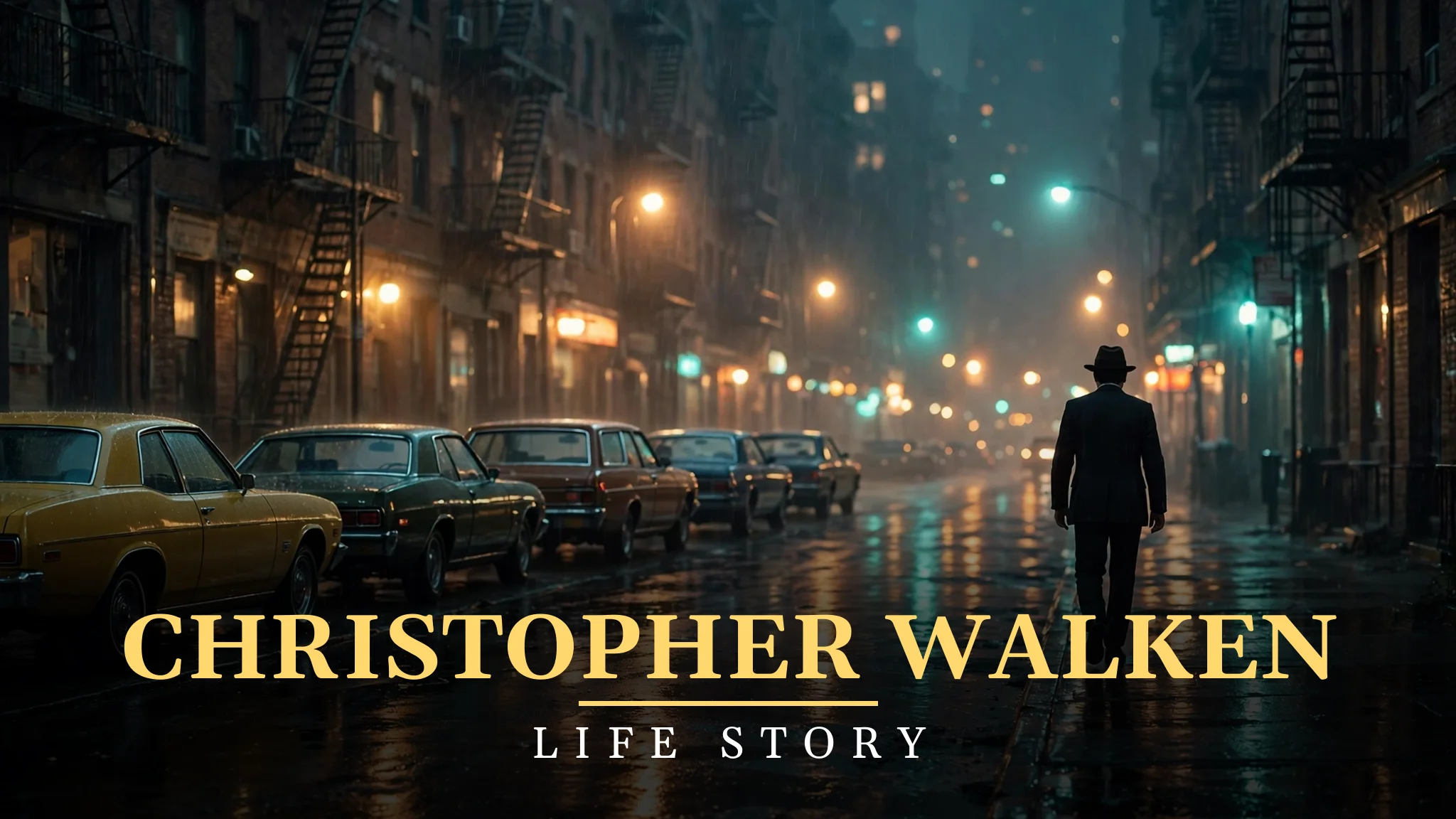
One more thought stays with me. When I picture him, I picture the rainy street in the image for this story: one man in a hat, walking alone through the night, with the city lights reflecting on the wet road. That is a good picture of his career, because he has always walked his own path, alone, in the dark, with no one to guide him. And yet people have followed him, for more than sixty years, because they want to see where that strange, careful walk will take him next.
I also think about his performance in Catch Me If You Can, because it shows a side of him that is easy to miss. He plays a father who has lost his business, his marriage, and his pride, and who still loves his son. It is a sad, tender role, and Walken plays it without any of the strangeness that marks his villains. He is just a man, a tired man, trying to hold his family together. That performance brought him an Oscar nomination, and it deserved it. It proves that he is not only a strange actor. He is a human one, and he can play a father’s love as well as a killer’s calm.
Another thing I notice is the “more cowbell” sketch, because it shows that he does not take himself too seriously. He appeared on Saturday Night Live, he played a music producer who wants more cowbell, and he made the sketch famous. Many serious actors would never do a comedy sketch like that, because they would worry about looking silly. Walken did it, and he did it with a straight face, and people still quote it today. I think that willingness to laugh at himself is part of why people love him. He is not protecting an image. He is just working, and enjoying it.
I think about his dancing again, because it is the key to his whole career. He trained as a dancer when he was a boy, and that training taught him how to use his body, how to wait, and how to move with control. When he dances in the Weapon of Choice video, at fifty-eight, he is showing the world what he learned as a child. That is a beautiful thing. It tells me that the work you do when you are young stays with you, and that it can come back to surprise people many years later. A person who trains well never really loses what they learned.
When I look at his later years, I see a man who has grown kinder on screen. The young Walken was frightening. The older Walken is often a father, a grandfather, or a gentle friend. In Severance, he plays Burt, a man who falls in love quietly, and he plays the role with a warmth that moves me. I think that change is real, and it is a good one. He has not lost his strangeness. He has added warmth to it, and that combination is even more powerful than either one alone.
I also think about his role as the Emperor in Dune: Part Two, because it shows that he is still working at the highest level in his eighties. He plays Shaddam IV, the ruler of the known universe, and he plays the part with a calm authority that makes the character feel powerful without ever raising his voice. He is eighty years old, and he is still appearing in the biggest films in the world, alongside actors who were not even born when he won his Oscar. That is a remarkable thing, and it tells me that his talent has not faded. He has simply grown into a new kind of role, the elder statesman, and he plays it as well as he played everything else.
Another thing I notice is how often he has hosted Saturday Night Live, and how much audiences love him there. He has hosted the show seven times, and each time he brings the same strange, careful energy that makes his films so memorable. He is willing to be funny, he is willing to look silly, and he is willing to let the audience laugh with him, not at him. That generosity is part of why people love him. He is not protecting an image. He is just working, and enjoying it, and that joy is infectious.
Frequently Asked Questions
What was Christopher Walken’s birth name and where was he born?
He was born Ronald Walken on 31 March 1943 in Astoria, Queens, in New York City, where his father ran a bakery. He later changed his first name to Christopher, and he began performing as a child in dance and acting classes arranged by his mother.
Which film won Christopher Walken his Academy Award?
He won the Academy Award for Best Supporting Actor for The Deer Hunter in 1978, playing Nick Chevotarevich, a gentle man whose life is broken by the Vietnam War. The film also won the Academy Award for Best Picture.
Why is his scene in Pulp Fiction so famous?
In Pulp Fiction from 1994, he plays Captain Koons, who tells a young boy the long story of a gold watch. The scene lasts only a few minutes, but his strange, careful way of delivering the story makes every word memorable, and people still quote it today.
Was Christopher Walken really a dancer?
Yes, he trained as a dancer from childhood and worked in stage musicals before his film career. His dancing is still visible in the way he moves on screen, and it became famous again when he danced in the music video for Fatboy Slim’s Weapon of Choice in 2001.
Who is Christopher Walken married to?
He has been married to Georgianne Thon, a casting director, since 1969, and the couple have lived for many years in Connecticut. They have no children, and he has often said that his wife and their quiet life together keep him grounded.
What is Christopher Walken’s role in Severance?
In the television series Severance, which began in 2022, he plays Burt Goodman, a gentle older man who works in a strange office where employees’ memories are split between work and home. The tender, quiet role has brought him warm praise and a new, younger audience.
Has Christopher Walken been nominated for other Oscars?
Yes, he was nominated again for Best Supporting Actor for Catch Me If You Can in 2002, where he played the father of Leonardo DiCaprio’s character. That sad, tender performance showed a warmer side of him that many viewers had not seen before.


