Clannad: The Life Story Behind the Irish Folk Band
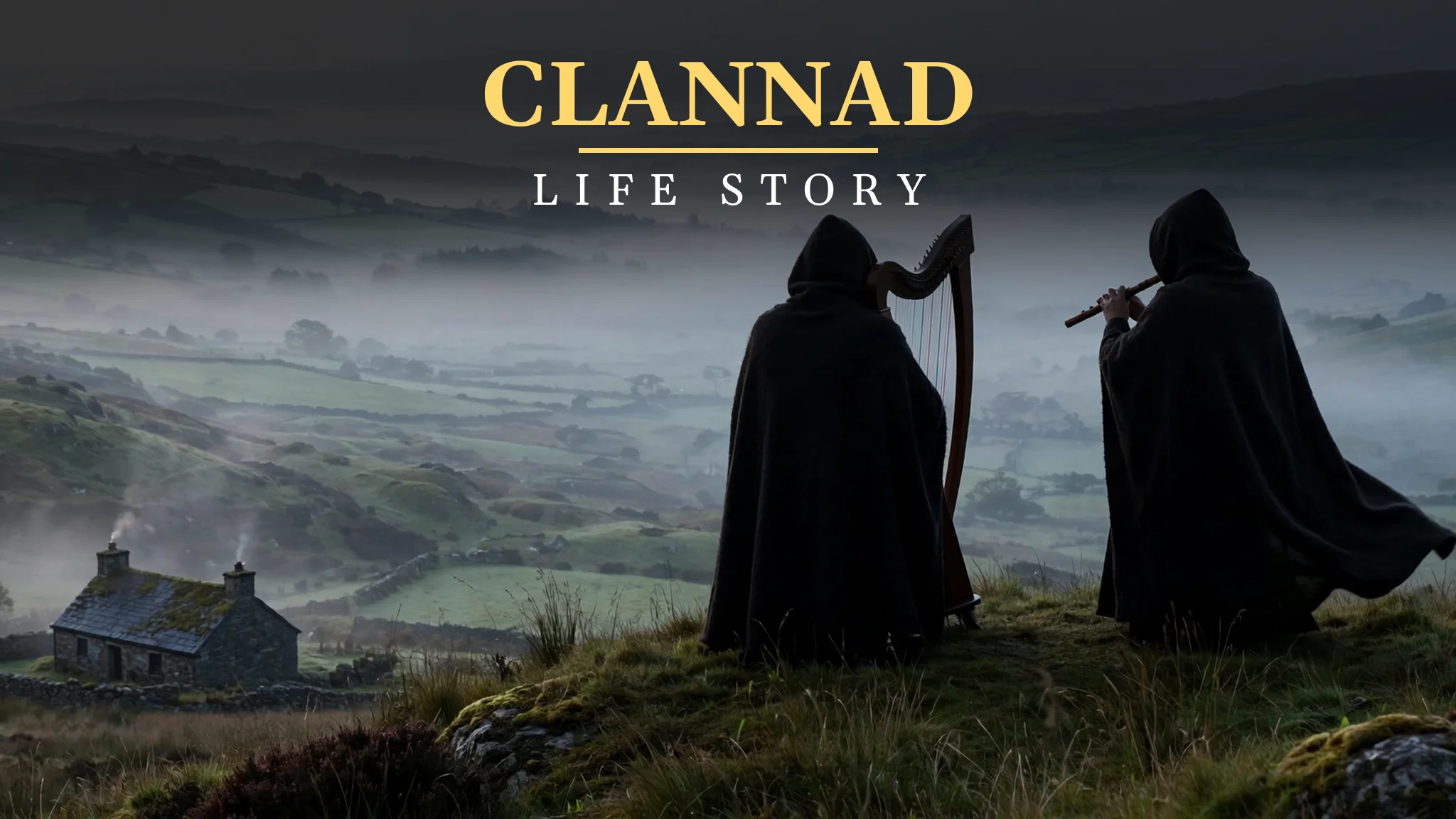
In this post
Clannad is a family band in the truest sense. They began as brothers, sisters, and uncles playing music together in a pub in Donegal, in the far northwest of Ireland, and they went on to become one of the most successful Irish folk groups in the world. Their music is soft, haunting, and beautiful, full of harps, flutes, and voices that seem to float over the landscape of their home. When you hear Clannad, you hear the mist over Donegal, the sea, the hills, and the old Irish language, all at once.
Their story is also the story of a family, the Brennans and the Duggans, who grew up with music in their blood. One of their early members was Enya, who left the band to become one of the most successful solo singers in the world. The rest of the band stayed together, through hits, through tours, through long breaks, and through a farewell tour that brought their story to a close after fifty years. They were never a loud band, and they never tried to be. They were a quiet band, and their quietness was their strength.
This is their story, from a small pub in Gweedore to the top of the British charts, to a Grammy Award, to songs for film and television, and to a legacy that still sounds like nowhere else on earth.
A Family Band in Gweedore
Clannad formed in 1970 in Gweedore, in County Donegal, Ireland, a Gaeltacht area where the Irish language is still spoken every day. The band was made up of members of the Brennan family, siblings Maire, Ciaran, and Pol Brennan, and their twin uncles, Noel and Padraig Duggan. The family ran a pub, Leo’s Tavern, in Gweedore, and the band began by playing music there, for locals and for visitors, in the evenings after work. Music was not a job for them at first. It was a family habit, something they did together because they loved it.
Gweedore is a beautiful, wild place, with mountains, sea, and mist, and the landscape shaped the band’s sound. Their music was not the fast, loud folk of Dublin pubs. It was slower, softer, and more atmospheric, with close harmonies, gentle harps, and flutes that seemed to drift like fog. They sang in Irish as well as in English, and their Irish-language songs gave them a sound that was different from any other band in Ireland. They were not trying to be different. They were simply singing the songs of their home, in the language of their home.
The band’s name, Clannad, comes from the Irish word clann, meaning family, and it was a fitting name. They were a family, and they played like one, listening to each other, supporting each other, and blending their voices in a way that only a family can. Maire Brennan was the lead singer, with a clear, pure voice that became the band’s signature. Her brothers played guitar, keyboards, and other instruments, and their uncles added harmonies and a deep sense of tradition. Together, they made a sound that was gentle, haunting, and unmistakably their own.
In the early 1970s, they began to record, and they began to tour in Ireland and in Europe. Their early albums were traditional in style, and they won a following among folk music fans who were drawn to their harmonies and their Irish-language songs. They were not a commercial band, and they did not expect to be. They were a family band, playing the music they loved, and they were happy to do that for as long as people would listen.
Enya Joins and Then Leaves
In 1980, a younger member of the Brennan family joined the band. Enya Brennan, Maire’s younger sister, became a member of Clannad, playing keyboards and singing backing vocals. Enya was talented, and she added a new layer to the band’s sound, but she was also restless, and she wanted to make her own music. After two years, in 1982, she left Clannad to begin a solo career, working with her manager and producer, Nicky Ryan, and his wife Roma. It was a difficult decision, but it was the right one for her, and it would change music history.
Enya went on to become one of the best-selling solo artists in the world, with albums such as Watermark and Shepherd Moons, and songs such as Orinoco Flow that were heard everywhere. Her sound, layered voices, synthesisers, and a dreamlike quality, owed something to her time in Clannad, but it was her own creation. Clannad, meanwhile, carried on without her, and they were about to have their own breakthrough, one that would make them famous in their own right.
The departure of Enya could have broken the band, but it did not. The family was strong, and the remaining members, Maire, Ciaran, Pol, Noel, and Padraig, were determined to keep going. They had a sound, they had songs, and they had an audience, and they believed in what they were doing. In the years that followed, they would prove that Clannad was not just a stepping stone for Enya. It was a great band in its own right, with its own hits, its own awards, and its own legacy.
The relationship between Clannad and Enya remained friendly, and the family stayed close. Enya’s success did not overshadow the band, and the band’s success did not diminish Enya’s. They were two branches of the same family tree, growing in different directions, and both reaching the sky. That is a rare and happy outcome for a family band, and it says a great deal about the Brennans and the Duggans.
Theme From Harry’s Game
Clannad’s breakthrough came in 1982, with a song called Theme from Harry’s Game. The song was written for a television drama, Harry’s Game, about the conflict in Northern Ireland, and it was sung in Irish by Maire Brennan. It was a haunting, beautiful song, with a slow, floating melody and a voice that seemed to come from another world. It became a hit in Britain and Ireland, reaching the top five in the British charts, and it introduced Clannad to a mass audience for the first time.
The success of the song was a surprise to the band, and to many people in the music business. A song in Irish, with no drums, no guitars, and no pop chorus, was not supposed to be a hit. But Theme from Harry’s Game was a hit, because it was beautiful, because it was different, and because people responded to its emotion. It was used in films, in advertisements, and on television, and it became one of the most recognisable Irish songs of the 1980s. It also won awards, and it gave Clannad a place in the charts that they had never expected.
The band followed the success with more albums, and their sound began to evolve. They added more modern instruments, they worked with producers, and they began to write songs in English as well as in Irish. Their music remained gentle and atmospheric, but it became more polished, more accessible, and more popular. They toured in Britain, in Europe, and in America, and they played to audiences who had first heard them through Harry’s Game and wanted to hear more.
In 1984, they released the album Legend, the soundtrack to the television series Robin of Sherwood, and it was another success. The music, with its medieval feel and its haunting vocals, suited the series perfectly, and it won the band a BAFTA award. Clannad were now known not just as a folk band, but as musicians who could create music for film and television, music that could carry a story and move an audience.
In a Lifetime and the Big Years
In 1986, Clannad released the song In a Lifetime, a duet between Maire Brennan and Bono, the singer of U2. The song was a beautiful, soaring ballad, and it became one of the band’s best-known recordings. It was a hit in Ireland and in other countries, and it was played on the radio for years afterwards. The collaboration with Bono was a natural one, because U2 and Clannad were both Irish bands with a love for their country and its music, and the song showed how well their sounds could work together.
The late 1980s were Clannad’s most successful years. They released the album Sirius in 1987, and they toured the world, playing in large concert halls and at festivals. Their concerts were calm, beautiful affairs, with the band playing in soft light, Maire’s voice floating over the audience, and the crowd sitting quietly, listening. They were not a band that made people dance. They were a band that made people listen, and dream, and remember.
In 1989, they released the album Pastpresent, a collection of their best songs, and it sold well. They continued to record and to tour through the 1990s, releasing albums such as Anam in 1990, Banba in 1993, and Lore in 1996. Their music continued to evolve, with more modern production, but it never lost its core, the harmonies, the Irish language, and the sense of place that had defined them from the start.
They also became known for their work on film soundtracks, including music for films such as The Last of the Mohicans, where their song was used to powerful effect. Their music, with its timeless quality, suited historical films, and it brought them to new audiences who had never heard of Clannad before. They were a band that could cross from folk to film, from Irish to English, from the past to the present, without losing themselves.
A Grammy and a Farewell
In 1999, Clannad won a Grammy Award for Best New Age Album, for their album Landmarks. It was a major honour, and it recognised the band’s long career and their unique sound. They had been making music for nearly thirty years, and they were now recognised by the American music industry as one of the finest groups in their field. The Grammy was a proud moment for the band, for their family, and for Donegal, and it showed that their quiet, gentle music had been heard around the world.
After the Grammy, the band continued to record and tour, but less often. They took long breaks, they spent time with their families, and they played reunion concerts from time to time. Pol Brennan left the band in 1990, and the remaining members carried on as a four-piece, and then, in later years, as a smaller group. Noel Duggan died in 2022, and Padraig Duggan had died in 2016, and the losses were felt deeply by the family and by the band.
In 2020, Clannad announced a farewell tour, to mark fifty years since the band formed. The tour was delayed by the pandemic, but when it finally happened, it was a celebration of their long career. They played their best-known songs, Theme from Harry’s Game, In a Lifetime, and many others, to audiences who had loved them for decades. It was a fitting end to a remarkable story, a family band from a small pub in Donegal, who had taken their music to the world and had been loved for it.
Today, Maire Brennan, now known as Maire Brennan, continues to perform, and Ciaran Brennan continues to work in music. The band’s recordings remain, and their songs are still played, still loved, and still recognisable. Clannad proved that a family, a language, and a landscape could make music that the whole world would want to hear, and that is a legacy that will last.
The Sound of Donegal
What makes Clannad matter is their sound. No other band sounds like them. Their harmonies, their use of the Irish language, their harps and flutes, and Maire Brennan’s voice, create a feeling that is hard to describe but easy to recognise. It is the sound of mist over a Donegal hill, of the sea on a quiet evening, of a family singing together in a pub. It is a sound that is both old and new, both Irish and universal, and it has touched people in every country where their records have been played.
They also matter because they showed that the Irish language could be a language of popular music. At a time when Irish was often seen as a language of the past, Clannad sang in Irish on the radio, on television, and in the charts, and they made it sound beautiful and modern. That was an important thing for the language, and for the Gaeltacht areas where it is still spoken. They gave Irish a voice on the world stage, and they did it without ever making a fuss about it. They just sang, and people listened.
Young Irish musicians still listen to Clannad, and they still try to capture something of their sound, the harmonies, the atmosphere, the sense of place. The band’s influence can be heard in the work of many artists who came after them, from Enya to other folk and new age musicians. Clannad did not just make records. They made a sound, and that sound is still alive today.
Clannad on Screen and on Stage
Clannad’s music was always visual, in the sense that it made listeners picture a place, a landscape, a story, and that quality made them natural choices for film and television. Their work on the series Robin of Sherwood, for which they wrote the music and won a BAFTA award, was a perfect match. The series was set in medieval England, with forests, castles, and legends, and Clannad’s haunting, timeless sound suited it beautifully. Their music did not just accompany the pictures. It helped to create the world of the series, and viewers remembered the music as much as the story.
They also contributed music to films, including The Last of the Mohicans, where their sound added a sense of history and of longing to the story. Film directors loved working with Clannad, because their music could carry emotion without words, and because it had a quality that felt both ancient and fresh. A Clannad song in a film could make a scene feel deeper, sadder, or more beautiful, and directors knew it. The band’s music became part of the language of cinema, a sound that audiences associated with history, with nature, and with the past.
On stage, Clannad’s concerts were quiet, beautiful events. They did not jump around, they did not shout, and they did not try to excite the audience with noise. They played in soft light, with Maire Brennan’s voice at the centre, and the audience sat and listened, often in silence, moved by the music. It was a different kind of concert from a rock show, and it attracted a different kind of audience, people who wanted to listen carefully, to dream, and to be moved. Those concerts were special, and the people who attended them never forgot them.
The Brennan Family and Leo’s Tavern
The story of Clannad cannot be told without Leo’s Tavern, the family pub in Gweedore where the band began. Leo Brennan, the father of Maire, Ciaran, and Pol, ran the pub, and it was a meeting place for musicians, for locals, and for visitors to Donegal. In the evenings, after work, the family would play music together, and the pub would fill with song. It was in that warm, informal setting that Clannad learned to play together, to harmonise, and to listen to each other, and those lessons stayed with them for the rest of their career.
Leo’s Tavern is still there today, and it is still a place where musicians gather, where visitors come to hear Irish music, and where the Brennan family story is remembered. It has become a place of pilgrimage for Clannad fans, who come to see where the band began, to hear music in the room where they first played, and to feel a connection to their story. The pub is a reminder that great music often begins in small, ordinary places, in a family home, in a local pub, with people who love to play together.
The Brennan family were not wealthy, and they were not famous when Clannad began. They were a working family in Donegal, running a pub, raising children, and making music because they loved it. That ordinariness is part of what makes their story so appealing. They did not come from a music school, or from a big city. They came from a pub in Gweedore, and they took their music to the world, one song at a time. That is a hopeful story for any family that makes music together.
Clannad’s Harmonies
The harmonies of Clannad are one of the most distinctive sounds in Irish music, and they are a key part of what makes the band special. Maire Brennan’s clear lead voice, blended with the voices of her brothers and uncles, created a sound that was rich, warm, and haunting, a sound that seemed to float above the instruments. Their harmonies were not simple. They were close, complex, and carefully arranged, with voices weaving in and out of each other in a way that only a family can achieve. When you hear Clannad sing in harmony, you hear a family singing together, and that is a beautiful thing.
Their harmonies were also influenced by the Irish language, and by the traditional songs they had grown up with, which often used close harmonies and a modal, ancient sound. Clannad took those traditions and made them their own, creating a modern, accessible sound that still felt old and timeless. Their harmonies gave their music a dreamlike quality, a feeling of floating, of mist, of a world that was both real and magical, and that quality is why their songs are so loved.
Young singers who try to learn Clannad’s harmonies find them difficult, because they require listening, patience, and a willingness to blend your voice with others, rather than standing out. That is a lesson in itself, that music is not always about being the star, but about being part of a whole, and Clannad taught that lesson beautifully, for fifty years.
Clannad and the Irish Language
Clannad’s use of the Irish language was one of the most important parts of their work, and it deserves to be celebrated. At a time when Irish was often seen as a language of the past, spoken only in Gaeltacht areas like Gweedore, Clannad sang in Irish on the radio, in the charts, and on television, and they made it sound beautiful, modern, and alive. Their hit, Theme from Harry’s Game, was sung entirely in Irish, and it reached the top five in Britain, proving that a song in Irish could be a pop hit, and that listeners would respond to it, even if they did not understand every word.
Their work helped to keep the Irish language alive, and to give it a new audience, especially among young people who heard Clannad and wanted to learn more about the language and the culture it came from. That is a significant achievement, and it is one that goes beyond music. A language lives when it is spoken and sung, and Clannad kept Irish singing for fifty years, in homes, in pubs, and on stages around the world.
My Take:
When I think about Clannad, I think about quiet. I think about a misty morning in Donegal, about a family singing together in a pub, and about a voice that seems to float rather than to shout. That quietness is what I admire most about them. In a music world that is often loud, fast, and desperate for attention, Clannad made music that was soft, slow, and confident. They did not need to shout to be heard. They trusted that people would listen if the music was good enough, and they were right.
I admire the fact that they were a family band, and that they stayed a family band. Brothers, sisters, and uncles, playing together, singing together, and building something together, is a beautiful idea, and it is a hard one to sustain. Families argue, families drift apart, and families change, but Clannad kept going for fifty years. That tells me that their bond was strong, and that their love for the music was stronger than any disagreement. I think that is a lesson for any family, to find something you love, to do it together, and to keep doing it, even when it is hard.
I also admire Maire Brennan’s voice. It is one of the most beautiful voices in Irish music, clear, pure, and full of feeling, and it is the sound that most people think of when they think of Clannad. She sang in Irish and in English, she sang ballads and she sang pop songs, and she always sounded like herself. That is a rare gift, and it is one that she used with great care. She did not show off, she did not try to sound like anyone else, and she let the songs speak for themselves. That humility is part of what makes her a great singer.
What I find most moving in their story is the connection to Donegal, to Gweedore, and to the Irish language. Clannad did not come from Dublin or London. They came from a small, Gaelic-speaking community in the far northwest of Ireland, and they carried that place with them wherever they went. Their music sounds like Donegal, and that is not an accident. It is because they grew up there, they learned the songs there, and they spoke the language there. I think that is a powerful reminder that where you come from matters, and that the best music often comes from a specific place, not from nowhere.
I think about Enya, and about her time in the band, and I am glad that both Clannad and Enya found their own paths. It would have been easy for Clannad to be bitter about Enya’s departure, or for Enya to forget the band that gave her a start. Neither happened. They remained family, they remained friends, and they both went on to great success. That is a generous and a mature outcome, and it says a great deal about the Brennan family. They understood that people need to grow, and that a family band can be a starting point, not a prison.
Theme from Harry’s Game is a song I keep returning to, because it is so strange and so beautiful. A song in Irish, with no drums, no guitars, and no chorus, became a top five hit in Britain. That should not have happened, according to the rules of the music business, but it did, because the song was beautiful and because people responded to it. I think that is a hopeful message for any musician who makes music that does not fit the rules. If the music is good enough, and if it is true enough, people will find it, even if it is in a language they do not speak, even if it is slow, even if it is different. Clannad proved that, and I am grateful to them for it.
I also think about In a Lifetime, and about the duet with Bono. It is a lovely song, and it shows how well Clannad could work with other artists. Bono is a big, loud, passionate singer, and Maire Brennan is a soft, gentle singer, and together they made something that was more than either of them could have made alone. That is the magic of collaboration, and Clannad understood it. They were not afraid to work with others, and they were not afraid to let their sound blend with someone else’s. That openness is something I admire.
Their Grammy Award in 1999 was a proud moment, and I am glad they received it. A band that had been making quiet, gentle music for thirty years, from a small pub in Donegal, won one of the biggest awards in music. That is a wonderful story, and it shows that the world is willing to listen to music that is different, if it is made with skill and with love. I hope young musicians who feel that their music is too quiet, too strange, or too different take heart from Clannad. They proved that quiet can win.
For a young reader, I think the lesson of Clannad is to stay true to where you come from, and to trust your own sound. They did not try to sound like a London pop band, or an American rock band. They sounded like a family from Gweedore, singing in Irish, with harps and flutes, and that was enough. It was more than enough. It was the reason people loved them. If you try to sound like everyone else, you will be forgotten. If you sound like yourself, and like the place you come from, you will be remembered.
In the end, I think Clannad will be remembered as one of Ireland’s most beautiful bands, and that is right. But I hope they are also remembered as a family who sang together for fifty years, who gave the Irish language a voice on the world stage, and who proved that quiet music can be powerful music. That is a legacy worth celebrating, and it is one that will last as long as people still listen to a soft voice singing in Irish over a misty Donegal hill.
I also think about their work for television and film, and about how well it suited them. Music for Robin of Sherwood, for The Last of the Mohicans, for Harry’s Game, all of it worked because Clannad’s sound is timeless. It does not belong to one decade, and it does not sound dated. It sounds like it could have been made a hundred years ago, or yesterday, and that timelessness is a rare gift. Film directors recognised it, and they used it to give their stories depth. I am glad Clannad said yes to those projects, because they brought their music to people who would never have heard it in a folk club.
I want to end my thoughts on Clannad with a simple image, because their music is full of images. I picture a misty morning in Gweedore, a family singing together in a pub, and a voice rising above the hills, clear and pure. That is Clannad to me, and it is a beautiful image to carry. It reminds me that music does not need to be loud to be powerful, that a family can make something wonderful together, and that a small place, far from the big cities, can produce music that the whole world wants to hear.
I also think about Leo’s Tavern, and about how important that small pub was, and I am struck by the idea that a world-famous band began in a family pub in Donegal. It is a reminder that great things often start small, in ordinary places, with ordinary people who love what they do. Clannad did not need a big studio or a record company to begin. They needed a pub, a family, and a love of music, and that was enough. I hope young musicians who feel that they need expensive equipment or a big break take heart from that story. You need a place to play, people to play with, and songs you love, and the rest can follow.
I think about the Irish language once more, and about how Clannad gave it a voice on the world stage, and I want to say how important that was. Irish is a beautiful language, but it is spoken by relatively few people, and it has often been treated as a language of the past. Clannad sang in Irish on the radio, in the charts, and on television, and they made it sound modern and alive. That was a gift to the language, and to the people who speak it, and it is one that will last. A language lives when it is sung, and Clannad kept Irish singing for fifty years.
I also think about Maire Brennan’s voice, and about how it has aged, and I am moved by the way it has grown richer and deeper over the years. A voice is a living thing, and it changes with age, with experience, and with life, and Maire’s voice today carries the weight of fifty years of singing. It is still clear, still beautiful, and still unmistakably hers, but it has a depth that it did not have when she was young. That is a beautiful thing to hear, and it is a reminder that a singer’s voice, like a person’s life, grows richer with time.
Finally, I want to say that Clannad’s music has given me a sense of peace, and that peace is something I carry with me after writing about them. Their songs are quiet, gentle, and beautiful, and they remind me to slow down, to listen, and to appreciate the world around me. In a noisy, hurried world, that is a precious gift, and I am grateful to Clannad for giving it to me, and to so many others, for fifty years.
I also think about their harmonies, and about how they were made by a family singing together, and I am moved by that idea. Harmony is not just a musical technique. It is a metaphor for family, for listening to each other, for blending your voice with others, and for creating something together that none of you could create alone. Clannad’s harmonies were beautiful because they were made by people who loved each other, who trusted each other, and who had sung together since childhood. That is a rare and precious thing, and it is why their sound is so distinctive.
I think about the future of Irish music, and about whether bands like Clannad will come again, and I hope they will. The world needs quiet, beautiful music, made by families, sung in old languages, and rooted in a place. Clannad proved that such music can succeed, can win Grammys, and can be loved around the world, and that proof matters for young musicians who want to make similar music. They do not need to be loud, or fashionable, or famous quickly. They need to be honest, to sing together, and to trust their sound, and Clannad showed them how.
I also think about the Irish language, and about how Clannad kept it alive through song, and I am grateful for that. A language is more than words. It is a way of seeing the world, a culture, and a history, and when a language is lost, something precious is lost with it. Clannad sang in Irish, and they made it beautiful, and they gave it to the world, and that is a gift that will last long after their final concert. I hope young Irish people keep learning the language, and keep singing in it, because it is part of who they are.
I think about Gweedore once more, and about the mist over the hills, and the sea, and the stone cottage, and I feel a sense of peace. Clannad’s music comes from that place, and it carries that place with it, wherever it is played. That is a beautiful thing, and it is why their songs still move me, even though I have never been to Donegal. Music can take you to a place you have never seen, and make you feel as if you belong there, and Clannad do that, every time I hear them.
Frequently Asked Questions
Where did Clannad come from?
Clannad formed in 1970 in Gweedore, County Donegal, in Ireland, a Gaeltacht area where Irish is spoken daily. The band was made up of members of the Brennan family, Maire, Ciaran, and Pol Brennan, and their twin uncles, Noel and Padraig Duggan, and they began playing in the family pub, Leo’s Tavern.
Was Enya a member of Clannad?
Yes, Enya Brennan, Maire’s younger sister, joined Clannad in 1980, playing keyboards and singing backing vocals. She left the band in 1982 to begin a solo career, and she went on to become one of the best-selling solo artists in the world, while Clannad continued without her.
What is Theme from Harry’s Game?
Theme from Harry’s Game is a song Clannad wrote for the television drama Harry’s Game in 1982, sung in Irish by Maire Brennan. It became a top five hit in Britain and Ireland, and it remains one of the band’s best-known songs, used in films, advertisements, and television ever since.
What is In a Lifetime?
In a Lifetime is a song released by Clannad in 1986, a duet between Maire Brennan and Bono of U2. It is a beautiful, soaring ballad, and it became one of the band’s most loved recordings, played on the radio for many years after its release.
Did Clannad win a Grammy Award?
Yes, Clannad won a Grammy Award in 1999 for Best New Age Album, for their album Landmarks. It was a major honour for the band, recognising nearly thirty years of music and their unique, gentle sound that had been heard around the world.
How long did Clannad last?
The band lasted for fifty years, from 1970 until their farewell tour in the early 2020s, which marked their fiftieth anniversary. The tour was delayed by the pandemic, but it gave fans a chance to see the band play their best-known songs one last time.
What does the name Clannad mean?
The name comes from the Irish word clann, meaning family, and it was chosen because the band was made up of family members. The name reflects the band’s roots in the Brennan and Duggan families of Gweedore, and their close, family way of making music together.


