Coco Chanel: The Life Story Behind the Fashion Revolutionary
In this post
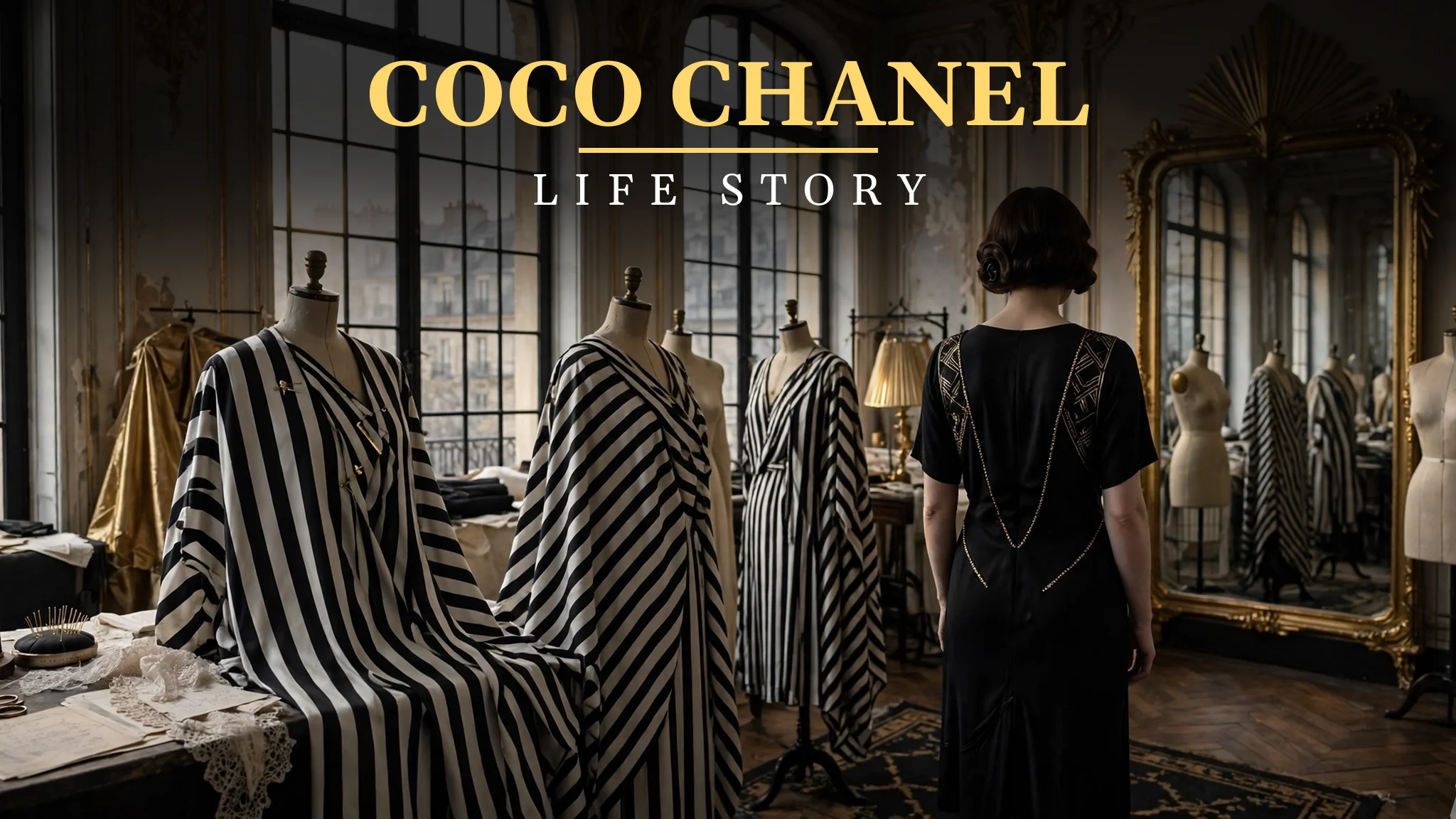
There is a photograph of Coco Chanel that tells her whole story in a single image. She is standing in her Paris atelier, dressed in black, with her hair pulled back, looking directly at the camera with a calm, certain expression. She does not smile. She does not need to. She is a woman who built an empire out of nothing, who changed the way women dressed, and who did it by trusting her own eye more than anyone else’s opinion. She was an orphan, a singer, a hat-maker, and then, quite simply, the most famous fashion designer in the world.
Gabrielle Bonheur Chanel was born on 19 August 1883 in Saumur, a town in western France, and she grew up in poverty, in a family that had little money and less stability. Her mother died when Gabrielle was eleven, and her father, a travelling salesman, left his children in the care of others, and Gabrielle spent her teenage years in a convent orphanage in Aubazine, where the nuns taught her to sew. That orphanage, with its black and white habits, its plain rooms, and its strict rules, would shape her sense of style for the rest of her life, in ways she may not have understood at the time.
What makes Chanel’s story so remarkable is that she did not come from wealth, she did not study fashion, and she did not have a family to support her. She had a needle, a pair of scissors, and a clear idea of what women wanted to wear, even before women themselves knew it. She freed women from corsets, she put them in jersey, she gave them trousers, she gave them a little black dress, and she gave them a perfume that became the most famous in the world. She changed fashion, and in doing so, she changed the way women lived.
Saumur, Aubazine, and a Childhood in Black and White
Gabrielle Chanel was born in Saumur, France, on 19 August 1883, the daughter of Albert Chanel, a travelling salesman, and Jeanne Devolle, a woman who worked as a laundrywoman. The family was poor, and they moved often, living in small, crowded rooms, and Gabrielle’s childhood was marked by instability and by a sense that the world was not a kind place for a girl with no money. When she was eleven, her mother died, and her father, unable or unwilling to care for his children, placed Gabrielle and her sisters in a convent orphanage in Aubazine, in central France, while her brothers were sent to live with other family members.
Aubazine was a strict, quiet place, run by nuns who wore black and white habits, and who taught the girls to sew, to embroider, and to keep their rooms clean. The orphanage was not a happy place, and Gabrielle later spoke about it with a mixture of sadness and gratitude, because it was there that she learned the skills that would make her famous. She learned to sew with precision, to handle fabric with care, and to understand that a simple, well-made garment could be more beautiful than a complicated, expensive one. The black and white of the nuns’ habits, the plain stone of the convent, and the simple lines of the clothes the girls wore all stayed in her mind, and they became the foundation of her style, black and white, simple, clean, and elegant.
Gabrielle left the orphanage when she was eighteen, and she went to live in Moulins, a town in central France, where she worked as a seamstress, sewing clothes for a living. She was a skilled worker, but she was not content to spend her life sewing other people’s designs. She wanted to make her own clothes, and she wanted to live a life that was her own, not one that had been chosen for her by poverty or by the nuns. She also began to sing in a cabaret in Moulins, La Rotonde, where she performed songs for soldiers and for the local audience, and it was there that she got the nickname Coco, from a song she sang about a lost dog named Coco, or, as some accounts say, from the French word for a kept woman, a term that was used for women who were supported by wealthy men. The nickname stuck, and Gabrielle Chanel became Coco Chanel, a name that would become famous around the world.
Her years in Moulins were hard, but they taught her about men, about money, and about the world outside the convent. She learned that a woman with no money had few choices, and that she would have to make her own way, and she began to think about how clothes could give a woman freedom, not just beauty. A woman in a corset could not move freely, could not work, and could not live an independent life, and Chanel, who had grown up with little freedom herself, understood that a dress was not just a piece of cloth. It was a statement about who a woman was and what she could do.
Hats, Boy Capel, and the First Shop in Deauville
In her early twenties, Chanel met Etienne Balsan, a wealthy man who kept horses and who lived in a chateau outside Paris, and she became his companion, living with him and learning about the world of the rich. Balsan gave her a home, and he introduced her to a world of parties, of hunting, and of elegant clothes, but he did not give her independence, and Chanel soon realised that she did not want to be a kept woman. She wanted to work, and she wanted to make her own money, and she began to make hats, simple, elegant hats that were very different from the large, feathered hats that fashionable women wore at the time.
Her hats were noticed, and they were praised, because they were simple, clean, and modern, and they suited the new kind of woman who was emerging in France, a woman who rode horses, who played sports, and who wanted clothes that allowed her to move. Chanel’s hats were a success, and they gave her the confidence to think about a business of her own. She met Arthur Capel, known as Boy, a wealthy Englishman who believed in her talent and who lent her the money to open her first shop, a hat shop in Paris on the Rue Cambon in 1910, and later a boutique in Deauville, a fashionable seaside resort, in 1913.
Deauville was a turning point. The shop was a success, and Chanel began to sell not just hats, but clothes, simple dresses made from jersey, a fabric that had previously been used only for men’s underwear, because it was cheap and stretchy. Chanel saw that jersey was perfect for women’s clothes, because it was comfortable, it moved with the body, and it did not need a corset underneath. She made dresses, skirts, and jackets from jersey, and the women of Deauville, who were rich, fashionable, and always looking for something new, loved them. Her clothes were a revelation, because they freed women from the tight, uncomfortable clothes they had worn for centuries, and they allowed them to live a modern life, to walk, to work, and to play sports without feeling trapped.
Boy Capel was the love of Chanel’s life, and his support was crucial to her early success, but their relationship was complicated, because Capel was married to another woman, and because he could not give Chanel the life she wanted. When he died in a car accident in 1919, Chanel was heartbroken, and she wore black for the rest of her life, a choice that became part of her image, and a sign of the grief she carried. She never married, and she never had children, and her work became her life, a life that was devoted to fashion, to her house, and to the women who wore her clothes.
Jersey, the Little Black Dress, and a New Way to Dress
In the 1920s, Chanel’s business grew rapidly, and she became one of the most famous designers in Paris. She opened a larger shop on the Rue Cambon, and she began to design clothes that would change fashion forever. Her most famous innovation was the little black dress, a simple, elegant black dress that she introduced in 1926, and that the magazine Vogue called the Ford of fashion, because, like the Ford car, it was simple, affordable, and available to many women, not just the rich. The little black dress was a revolution, because black had previously been worn only for mourning, and Chanel made it fashionable, elegant, and suitable for any occasion, from a dinner to a party to a day at work.
She also introduced the use of jersey for women’s clothes, and she designed trousers for women, a radical idea at a time when women were expected to wear skirts and dresses at all times. She designed the Chanel suit, a collarless jacket and a skirt made from tweed, a fabric that was soft, comfortable, and elegant, and the suit became a symbol of the modern, independent woman, a woman who worked, who travelled, and who did not need a man to define her. Her clothes were not just beautiful. They were practical, and they gave women a freedom that they had never had before, a freedom to move, to work, and to live as they chose.
In 1921, Chanel introduced her most famous perfume, Chanel No. 5, which she created with the perfumer Ernest Beaux. The perfume was unlike anything that had come before it, because it was not a simple floral scent, but a complex blend of many flowers, with a clean, modern smell that was both feminine and strong. The bottle was simple, a plain glass rectangle with a black and white label, and it became as famous as the perfume itself. Chanel No. 5 was a huge success, and it made Chanel a wealthy woman, because perfume, unlike clothes, could be sold in large quantities to women around the world, and it gave her house a source of income that did not depend on the seasons of fashion.
By the late 1920s, Chanel was one of the most successful designers in the world, with a large business, a house on the Rue Cambon, and a name that was known in every capital. She dressed the most famous women of her time, including actresses, royalty, and socialites, and her clothes were copied by designers around the world. She had come from an orphanage, and she had built an empire, and she had done it by trusting her own eye, and by understanding what women wanted before they knew it themselves.
Hollywood, the War, and a House Closed
In the 1930s, Chanel’s fame spread beyond Paris, and she was invited to Hollywood to design costumes for films, working with the producer Samuel Goldwyn to create clothes for the stars of the time. The Hollywood years were not a great success, because her simple, elegant style did not suit the glamorous, exaggerated clothes that Hollywood wanted, and she returned to Paris after a short time, but the experience showed how far her name had travelled, and how much the world wanted to be associated with her. She continued to design in Paris, and her house remained one of the most important in fashion, even as the world around her began to change.
In 1939, when the Second World War began, Chanel closed her fashion house, saying that it was not a time for fashion, and she lived in Paris during the war years, staying at the Ritz Hotel, where she lived for many years. Her wartime years remain controversial. She lived in Paris while it was occupied, and she was linked to a German officer, Hans Gunther von Dincklage, a relationship that has been widely reported and widely debated. After the war, she left France and lived in Switzerland for several years, and her reputation suffered, because many people in France saw her wartime life as a betrayal. The full story of those years is complex, and it is still discussed by historians, but what is clear is that the war marked a turning point in her life, and that she did not design for fifteen years, from 1939 to 1954, a long silence for a woman who had once been the most famous designer in the world.
During those years, fashion changed. New designers emerged, including Christian Dior, who introduced the New Look in 1947, with its full skirts, its tight waists, and its return to a more feminine, more restrictive style of dress. Chanel, watching from Switzerland, disagreed with Dior’s vision, because she believed that women should be free, not trapped in corsets and full skirts, and she began to think about a return to fashion, a comeback that would prove that her ideas were still relevant, and that the modern woman still wanted the clothes she had designed in the 1920s.
The Atelier, the Workers, and the House on Rue Cambon
Behind every Chanel design stood a team of skilled workers, the seamstresses, cutters, and embroiderers who turned her ideas into clothes, and Chanel’s atelier on the Rue Cambon was famous for the quality of its work. She demanded perfection from her staff, and she inspected every garment herself, checking the seams, the fit, and the way the fabric moved, because she believed that a dress was only as good as its making. Her workers respected her, even when she was difficult, because they knew that she understood their craft, having learned to sew in the orphanage herself, and because she never asked them to do something she could not do herself. The atelier was a place of hard work, long hours, and great skill, and it was the engine of her empire.
The house on the Rue Cambon was more than a shop. It was a world, with a staircase of mirrors, a salon where clients tried on clothes, and an atelier upstairs where the garments were made. Chanel lived above the shop, in an apartment that was full of objects she loved, including Chinese screens, crystal, and books, and she walked down the mirrored staircase every morning to begin work. The staircase was designed so that she could sit on the steps and watch her fashion shows without being seen, observing the audience’s reactions and the way the clothes moved on the models. That attention to detail, to the way a garment looked from every angle, was part of what made her clothes so successful.
Her relationship with her workers was complex. She was demanding, and she could be sharp, but she also paid them well, and she took pride in their skill. Many of her seamstresses worked for her for decades, and they spoke of her with a mixture of fear and admiration, because she was a woman who expected the best and who gave her best in return. The atelier was a place where a girl from an orphanage could become a master of her craft, and where the work of many hands came together to create a single, perfect garment. That collaboration, between a designer with a vision and workers with skill, is the heart of haute couture, and Chanel understood it better than anyone.
The Comeback at Seventy and the Final Years
In 1954, at the age of seventy, Chanel returned to Paris and reopened her fashion house, a decision that shocked the fashion world. Many people thought she was too old, and that her style was out of date, but Chanel did not care. She believed in her clothes, and she believed that women still wanted them, and she was right. Her comeback collection was not an immediate success in Paris, where critics were harsh, but it was a success in America, where women loved her suits, her simple dresses, and her practical elegance. Within a few years, she was once again one of the most important designers in the world, and her house was thriving.
Her comeback also introduced one of her most famous designs, the 2.55 handbag, named for the date of its creation, February 1955. The bag was a quilted, chain-strapped shoulder bag, designed to be worn over the shoulder so that a woman’s hands were free, a practical idea that became a fashion icon. The bag is still made today, and it is one of the most famous handbags in the world, a symbol of Chanel’s belief that fashion should be both beautiful and useful. She also continued to design her tweed suits, her little black dresses, and her jewellery, including the fake pearls that became a trademark of her style, because she believed that a woman should wear jewellery for pleasure, not for status. The 2.55 was not just a bag, it was a solution to a problem Chanel had noticed, that women were always losing their handbags, and that a bag with a chain, worn over the shoulder, would stay with its owner, and that practical thinking, applied to a luxury object, is the essence of her design philosophy.
Chanel worked until the end of her life, designing in her atelier on the Rue Cambon, and living in a suite at the Ritz Hotel in Paris. She was a demanding, difficult, and brilliant woman, who expected the best from the people who worked for her, and who never compromised on her vision. She died on 10 January 1971 in Paris, at the age of eighty-seven, after a long and remarkable life, and she was buried in Lausanne, Switzerland. Her house, Chanel, continued after her death, and it remains one of the most famous fashion houses in the world, a legacy that began in an orphanage in Aubazine and that changed the way women dressed forever.
Her final collection, shown shortly before her death, was a reminder that she never stopped working, and that she never stopped believing in her vision. She was eighty-seven, she was tired, and she was still designing, still checking seams, still thinking about how a jacket should fit. That dedication is a lesson in itself, that a person who loves their work does not stop because of age, and that the work itself can be a reason to keep going. Chanel’s life was her work, and her work was her life, and the two cannot be separated, because she put herself into every garment she made.
My Take:
I think Coco Chanel is one of the most important women of the twentieth century, and I do not say that lightly, because she was not a politician, she was not a scientist, and she was not a writer. She was a fashion designer, and yet she changed the way women lived, and that change matters as much as any political change. Before Chanel, women wore corsets, they wore long skirts that made it hard to walk, and they wore clothes that were designed to make them look like ornaments, not like people. After Chanel, women wore jersey, they wore trousers, they wore a little black dress, and they wore clothes that allowed them to move, to work, and to live as they chose. That is a revolution, and it was carried out not with a speech, but with a pair of scissors and a clear eye.
What I admire most is her independence. She was an orphan, she had no money, she had no family to support her, and she built an empire from nothing, by trusting her own judgement more than anyone else’s. She did not go to fashion school, she did not have a rich husband, and she did not wait for permission. She made hats, she made dresses, and she sold them to women who wanted them, and she kept going until the whole world knew her name. That is a story of self-reliance that I find deeply inspiring, because it shows that a person who has nothing can still make something, if they have a skill, a vision, and the courage to trust it.
I also admire her eye for simplicity. Her clothes were not covered in feathers, or beads, or complicated decoration. They were simple, clean, and elegant, and that simplicity was radical at a time when fashion was about excess. She understood that a simple dress, well made, in a good fabric, could be more beautiful than a complicated dress covered in ornament, and she was right. Her little black dress is the perfect example, a dress so simple that it can be worn by anyone, anywhere, and yet so elegant that it is still fashionable a century later. That is a design that lasts, because it is not about a trend. It is about a truth, that simplicity is beautiful, and that a woman does not need to be decorated to be elegant.
Her use of jersey is another idea that I think about a great deal. Jersey was a cheap fabric, used for men’s underwear, and no one thought it could be used for women’s fashion. Chanel saw that it was comfortable, that it moved with the body, and that it did not need a corset, and she made it into the fabric of modern fashion. That is a kind of genius, the ability to see value in something that others have dismissed, and to turn it into something new. It is the same kind of genius that makes a great artist or a great inventor, the ability to look at an ordinary thing and to see a new use for it. Chanel had that gift, and she used it to free women from clothes that had trapped them for centuries.
I think about her childhood in the orphanage, and how it shaped her style. The black and white habits of the nuns, the plain stone of the convent, the simple lines of the clothes the girls wore, all of that stayed in her mind, and it became the foundation of her work. That is a remarkable thing, that a painful childhood could produce a beautiful style, and that the colours of a convent could become the colours of the most famous fashion house in the world. I think it shows that our early experiences, even the hard ones, can become a source of creativity, if we are willing to look at them honestly and to turn them into something new. Chanel did that, and her work is a testament to the power of turning a difficult past into a beautiful future.
If I am honest, I think her wartime years are the hardest part of her story to admire. She lived in Paris during the occupation, she was linked to a German officer, and after the war she left France for many years, and her reputation suffered. I do not want to excuse that, because it matters, and because a person who is famous has a responsibility to think about the choices they make in difficult times. At the same time, I think the full story of those years is complex, and it is still debated by historians, and I do not think it is fair to reduce her whole life to those years alone. She was a great designer, and she was also a flawed person, and both of those things are true. I think an honest account of her life has to hold both together, to admire her work and to acknowledge her failures, without letting one erase the other.
I also think about Boy Capel, and how his death shaped her. He was the love of her life, and when he died in a car accident in 1919, she was heartbroken, and she wore black for the rest of her life. That grief became part of her image, and part of her style, because black, which had been a colour of mourning, became, in her hands, a colour of elegance. I find that moving, because it shows how a personal loss can become a creative force, and how a woman who lost the man she loved turned her grief into a style that the whole world adopted. She did not hide her sadness. She wore it, and she made it beautiful, and that is a brave and human thing to do.
Her comeback at seventy is the part of her story that I find most inspiring. At an age when most people retire, Chanel reopened her fashion house, and she proved that her ideas were still relevant, and that a woman of seventy could still change fashion. That takes a remarkable kind of courage, because it is easy to rest on past success, and it is hard to risk failure in front of the whole world. Chanel risked it, and she succeeded, and her comeback is a reminder that age is not a limit, and that a person who believes in their work can return to it at any age, and can still make a difference. I think that is a lesson for anyone who feels that their best years are behind them, which is that the best work can come late, if you are willing to try again.
I think about Chanel No. 5, too, because it is more than a perfume. It is a symbol of modern femininity, a scent that is both strong and soft, both simple and complex, and it became the most famous perfume in the world because it captured something true about the women who wore it. Chanel understood that a perfume was not just a smell. It was an identity, a way for a woman to say who she was without speaking, and she created a perfume that said, I am modern, I am independent, and I am elegant. That is a powerful idea, and it is one that has lasted for more than a century, because it is true.
What I learn from Chanel is that style is not about wealth, or about following trends, or about wearing what everyone else wears. It is about knowing who you are, and dressing in a way that expresses that knowledge. Chanel knew who she was, an orphan who had built an empire, a woman who wanted freedom, and a designer who believed in simplicity, and her clothes expressed that knowledge in every stitch. I think that is a lesson for anyone who cares about how they look, which is to dress for yourself, not for others, and to choose clothes that make you feel free, not trapped. That is a simple lesson, but it is a profound one, and it is one that Chanel taught the world.
In the end, I think Coco Chanel will be remembered as a revolutionary, a woman who changed fashion, and who changed the way women lived, by giving them clothes that were simple, comfortable, and elegant. She was not perfect, and her life included choices that are hard to admire, but her work is extraordinary, and her influence is everywhere, in every little black dress, in every tweed suit, in every bottle of perfume, and in every woman who dresses for herself rather than for others. That is a legacy that will last, because it is not about a single dress or a single perfume. It is about freedom, and freedom, once given, is not easily taken away.
I will remember her standing in her atelier, dressed in black, looking at the camera with a calm, certain expression, and I will remember that she was a woman who came from nothing and who made everything, and who did it by trusting her own eye. That image stays with me, because it is a reminder that a person does not need wealth, or family, or permission to change the world. They need a skill, a vision, and the courage to use it, and Chanel had all three, in abundance, for her whole life.
I also think about the women who worked in her atelier, the seamstresses who turned her ideas into clothes, because they are the forgotten part of her story. Chanel had a vision, but the seamstresses had the skill, and without them, her designs would have remained drawings on paper. I think a great designer is also a great collaborator, even if she does not always say so, and Chanel’s atelier was a place where many hands worked together to create something beautiful. That collaboration deserves to be remembered, because it shows that even the most independent person needs others to bring their ideas to life.
Her fake pearls are another small detail that tells me a great deal about her. She wore pearls that were not real, and she did not care, because she believed that jewellery should be worn for pleasure, not for status, and that a woman should not need a fortune to look elegant. That idea, that beauty does not have to be expensive, is a democratic idea, and it is one that runs through all of her work. She made clothes for women who wanted to look good, not just for women who were rich, and that is why her style reached so many people. A little black dress can be made by anyone, in any fabric, and it can still be beautiful, because its beauty comes from its shape, not from its price.
I also think about the mirrored staircase in her house on the Rue Cambon, where she sat and watched her fashion shows without being seen. That image, of a woman watching from the stairs, observing how her clothes moved and how the audience reacted, is a perfect picture of her way of working. She was always watching, always learning, and always thinking about how to make her work better. She did not design in isolation. She designed for real women, in real rooms, and she watched them carefully, because their reactions told her what worked and what did not. That attention to the real world is what made her clothes so successful.
Finally, I think Chanel teaches me that a difficult past does not have to define a future. She was an orphan, she was poor, and she was left by her father, and yet she became one of the most famous women in the world. She did not forget her past, and she did not pretend it had not happened. She turned it into a style, into a way of seeing, and into a business that changed the lives of millions of women. That transformation is not magic. It is work, and it is courage, and it is a belief that the future can be different from the past. I find that deeply hopeful, and I will carry it with me long after I finish writing about her.
I also think about the house on the Rue Cambon, and how it is still there, still making clothes, still selling perfume, more than a century after Chanel opened her first hat shop. That continuity is remarkable, because most fashion houses fade, but Chanel has lasted, because its founder built it on ideas that are timeless, simplicity, comfort, and elegance, and because the people who came after her, including Karl Lagerfeld, understood those ideas and kept them alive. A house that lasts for a century is a rare thing, and it is a testament to the strength of Chanel’s vision, a vision that began in an orphanage and that still shapes the way women dress today.
Frequently Asked Questions
When was Coco Chanel born?
Coco Chanel was born Gabrielle Bonheur Chanel on 19 August 1883 in Saumur, France. She grew up in poverty, and after her mother died when she was eleven, she was raised in a convent orphanage in Aubazine.
How did Coco Chanel get her nickname?
She got the nickname Coco while singing in a cabaret in Moulins, where she performed songs, including one about a lost dog named Coco. The name stuck, and she became known as Coco Chanel for the rest of her life.
What is the little black dress?
The little black dress is a simple, elegant black dress that Chanel introduced in 1926. The magazine Vogue called it the Ford of fashion, because it was simple and available to many women, and it made black, previously worn only for mourning, into a fashionable colour.
What is Chanel No. 5?
Chanel No. 5 is a perfume created by Chanel in 1921 with the perfumer Ernest Beaux. It was a complex blend of many flowers, with a clean, modern scent, and it became the most famous perfume in the world.
Why did Chanel close her fashion house in 1939?
Chanel closed her house in 1939 when the Second World War began, saying it was not a time for fashion. She lived in Paris during the war, and her wartime years remain controversial, before she left France and lived in Switzerland for several years.
When did Chanel make her comeback?
Chanel returned to fashion in 1954, at the age of seventy, reopening her house in Paris. Her comeback introduced the 2.55 handbag, named for February 1955, and her tweed suits became popular again, especially in America.


