Daft Punk: The Life Story Behind the Robots Who Changed Dance Music
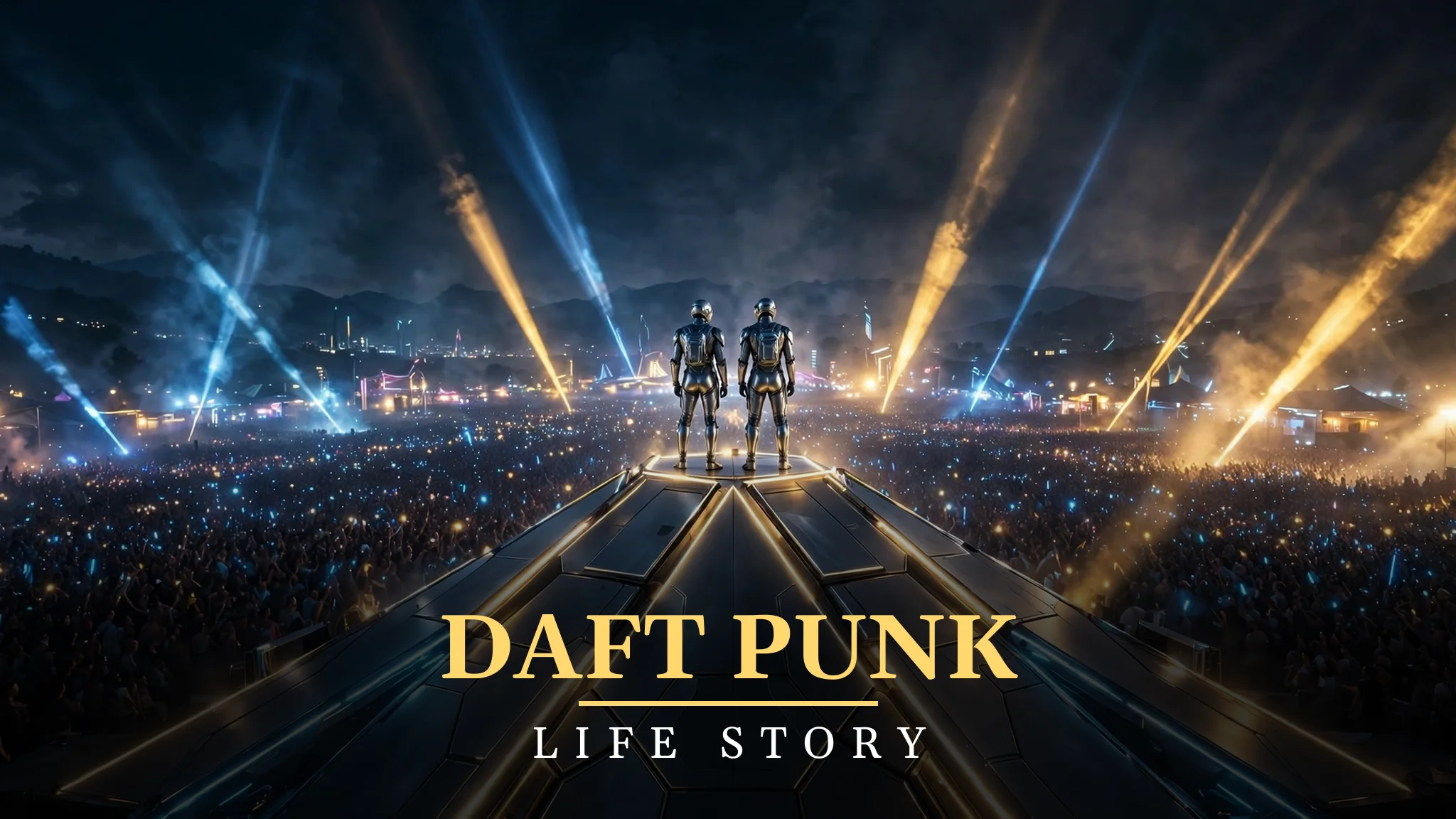
In this post
There are bands that make music, and there are bands that change music. Daft Punk belongs to the second kind. For nearly thirty years, two French musicians in robot helmets made some of the most loved dance music in the world, from “Around the World” to “One More Time” to “Get Lucky”, and they did it without ever showing their faces. They were mysterious, they were brilliant, and they were unlike anyone else. They turned electronic music into an art form, they turned a concert into a spectacle, and they turned two robots into the most famous figures in dance music.
The two men behind the helmets were Thomas Bangalter and Guy-Manuel de Homem-Christo, two school friends from Paris who met as teenagers and decided to make music together. They started in a rock band, they discovered house music, and they built a sound that mixed disco, funk, rock, and electronics in a way that no one had done before. They released four studio albums, they won Grammy Awards, they made the soundtrack for the film “Tron: Legacy”, and then, in 2021, they announced their split with a short video called “Epilogue”, leaving the world to wonder what would come next.
This is the story of two friends who became robots, and of robots who became legends. It is a story about a childhood in Paris, about a school band, about a first album that changed dance music, about a pyramid in the desert, and about a final album that won the biggest prize in music. It is also a story about friendship, about mystery, and about the courage to walk away at the top.
Two Schoolboys in Paris
Thomas Bangalter was born on 3 January 1975 in Paris, and Guy-Manuel de Homem-Christo was born on 8 February 1974 in Neuilly-sur-Seine, a suburb of Paris. They met as teenagers at the Lycée Carnot, a school in Paris, and they became friends through a shared love of music. They listened to rock, to disco, to funk, and to the electronic music that was coming from Chicago and Detroit, and they dreamed of making their own sound. They were not yet stars. They were two schoolboys with guitars, with records, and with a big idea.
In the early 1990s, they formed a rock band called Darlin’, with a third friend, Laurent Brancowitz, who would later join the band Phoenix. Darlin’ was a guitar band, inspired by the Beach Boys and by indie rock, and it was not a success. A music magazine in Britain called their music “a bunch of daft punk”, and the name stuck. When Darlin’ broke up, Thomas and Guy-Manuel took that insult and turned it into a name: Daft Punk. It was a joke, and it was also a statement. They were not going to be a normal band. They were going to be something else entirely.
They began to experiment with electronic music, with drum machines, with samplers, and with the sounds of house music that were coming from America. They were inspired by the disco of the 1970s, by the funk of George Clinton, and by the electronic pioneers of Kraftwerk, and they mixed those influences into a sound that was entirely their own. They were not trying to copy anyone. They were trying to build something new, and they worked in a small studio in Paris, late at night, with cheap equipment and big dreams.
Those early years were not easy. They had no money, no record contract, and no audience, but they had a friendship, a vision, and a stubborn belief that their music mattered. They played in small clubs, they released singles on small labels, and they waited for the world to notice. That patience, and that friendship, became the foundation of everything that followed, and it is why their story is as much about two friends as it is about two robots.
Homework and the Birth of a Sound
In 1997, Daft Punk released their first album, “Homework”, and it changed dance music. The album included the songs “Da Funk”, “Around the World”, and “Revolution 909”, and each one showed a different side of their sound. “Da Funk” was a funky and hypnotic track, built on a simple bass line and a saxophone, and it became a hit in clubs around the world. “Around the World” was a song with only a few words, repeated again and again, over a beat that made people dance, and it became one of the most famous dance songs of the decade.
The album was recorded in Thomas’s bedroom, with simple equipment, and it sounded raw, fresh, and alive. It was not polished like the pop music of the time. It was rough, it was funky, and it was full of energy. Critics praised it, DJs played it, and young people danced to it in clubs from Paris to London to New York. Daft Punk had arrived, and they had done it on their own terms, without a big studio, without a big budget, and without showing their faces.
The album also introduced the world to their image: two musicians who rarely appeared in public, who gave few interviews, and who let the music speak for itself. They were mysterious, and that mystery became part of their appeal. People wanted to know who they were, what they looked like, and why they hid. But Daft Punk did not answer. They let the music do the talking, and the music talked loudly enough.
“Homework” sold millions of copies, and it made Daft Punk one of the most important names in electronic music. They were no longer two schoolboys from Paris. They were stars, and their sound had changed the way people thought about dance music. They had proved that electronic music could be art, that it could be funky, and that it could move people in the same way that rock and soul had done before. That was a revolution, and it was only the beginning.
The album also introduced the world to their visual style, with music videos that were works of art, directed by famous filmmakers and animators. The video for “Around the World” showed dancers moving in perfect patterns, and it became one of the most famous dance videos of the decade. Those videos were not just promotions for a song. They were short films, with a clear vision, and they showed that Daft Punk were artists in every sense of the word, not just musicians.
They also became known for their remixes, reworking songs by other artists and turning them into dance hits, and for their work as producers, helping other musicians to find their own sounds. They were not just a duo. They were a creative force, and their influence spread far beyond their own records, into the work of countless artists who followed them.
Discovery, the Helmets, and One More Time
In 2001, Daft Punk released their second album, “Discovery”, and it was even bigger than the first. The album included the songs “One More Time”, “Digital Love”, and “Harder, Better, Faster, Stronger”, and each one became a hit. “One More Time” was a joyful and euphoric song, with a vocal by the singer Romanthony, and it became one of the most loved dance songs of all time. It was played at parties, at weddings, and in clubs around the world, and it is still one of the songs most associated with their name.
The album also introduced the world to the robot helmets. Thomas and Guy-Manuel began to wear silver and gold robot helmets in public, and they refused to show their faces. The helmets became their identity, a way of separating the music from the men, and a way of protecting their privacy. They said that the robots were the stars, not the men behind them, and that the music was more important than the faces. That idea was radical, and it became one of the most famous images in music.
“Discovery” was a different album from “Homework”. It was more polished, more melodic, and more influenced by disco and pop, and it showed that Daft Punk could make music that was both artistic and commercial. It sold millions of copies, and it won them a new audience, including people who had never listened to electronic music before. They had proved that dance music could be beautiful, and that it could be loved by everyone, not just by clubbers.
They toured with the album, but they did not tour in the usual way. They made a film, “Interstella 5555”, an animated musical based on the album, with the Japanese studio Toei Animation, and it became a cult classic. The film told the story of a band from another planet, kidnapped and brought to Earth, and it was a visual masterpiece. It showed that Daft Punk were not just musicians. They were artists, with a vision that went far beyond the record.
Human After All and the Pyramid
In 2005, Daft Punk released their third album, “Human After All”, a darker and more raw record that divided critics and fans. The album was made quickly, with a rougher sound, and it included the songs “Robot Rock” and “Technologic”. Some people loved it, others were confused by it, but it showed that Daft Punk were not afraid to take risks, and that they would not repeat the same formula again and again. They were artists, and artists must grow, even when growth is uncomfortable.
In 2006 and 2007, they took the album on tour, and the tour became legendary. They performed inside a giant pyramid, with lights, with lasers, and with a sound system that shook the ground, and the shows became some of the most famous in the history of electronic music. They played at Coachella in 2006, in front of tens of thousands of people, and the performance is still talked about today as one of the greatest festival sets ever. The pyramid became their symbol, a monument to their ambition, and a sign that electronic music could fill a stadium.
The tour was captured on the live album “Alive 2007”, which won a Grammy Award, and it showed the power of their music in a live setting. The songs from “Homework”, “Discovery”, and “Human After All” were mixed together into a single, continuous performance, and the audience danced for two hours without stopping. It was a triumph, and it proved that Daft Punk were not just studio artists. They were performers, and their shows were as important as their records.
After the tour, they took a break, and they worked on other projects, including the soundtrack for the film “Tron: Legacy” in 2010. The soundtrack was a beautiful and ambitious work, mixing orchestral music with electronics, and it showed a new side of their art. It was praised by critics, and it introduced their music to a new audience, including people who had never listened to dance music before. They were no longer just a dance act. They were composers, and their music could work in a cinema as well as in a club.
Random Access Memories and Get Lucky
In 2013, Daft Punk released their fourth album, “Random Access Memories”, and it became one of the biggest albums of the decade. The album was a tribute to the disco and funk of the 1970s and 1980s, recorded with live musicians, with real instruments, and with guest singers including Pharrell Williams, Nile Rodgers, and Julian Casablancas. It included the song “Get Lucky”, a joyful and funky track with Pharrell singing and Nile Rodgers playing guitar, and it became a worldwide hit, played everywhere, from the radio to the clubs to the stadiums.
“Get Lucky” was the song of the summer in 2013, and it won the Grammy Award for Record of the Year. The album won the Grammy for Album of the Year, the biggest prize in music, and it made Daft Punk the most celebrated electronic act in the world. They had done something remarkable: they had made an album that honoured the past, that sounded like the future, and that was loved by everyone, from teenagers to grandparents. It was a triumph, and it was the peak of their career.
The album also showed a new side of Daft Punk: a love of real musicians, of live playing, and of the human touch in electronic music. They had spent years making music with machines, and now they were making music with people, with guitars, with drums, and with voices. That change was a statement about what music is: not just a machine, but a collaboration between humans, and a celebration of the joy of playing together. It was a beautiful idea, and it made the album even more special.
They did not tour with the album, and they gave very few interviews, preferring to let the music speak for itself. That mystery, which had always been part of their image, became even stronger, and the world waited to see what they would do next. The album was a masterpiece, and it left the audience wanting more, but Daft Punk, true to their nature, did not rush. They waited, and they worked in silence, and the world waited with them.
Epilogue and the End of the Robots
On 22 February 2021, Daft Punk announced their split with a short video called “Epilogue”, taken from their film “Electroma”. In the video, one robot walks away into the desert, and the other explodes, and the words “1993-2021” appear on the screen. It was a quiet and dramatic ending, with no press conference, no farewell tour, and no explanation. The world was shocked, and fans around the world shared their sadness, their memories, and their love for the music. The robots were gone, but the music remained.
The split was a surprise, but it was also true to who Daft Punk had always been. They had always been mysterious, they had always done things on their own terms, and they had always refused to explain themselves. They ended the way they had begun: quietly, dramatically, and with art. They did not give a reason, and they did not need to. The music was the reason, and the music was enough.
Since the split, Thomas and Guy-Manuel have worked on their own projects, and their music continues to be played, streamed, and loved around the world. “Get Lucky”, “One More Time”, and “Around the World” are still played at parties, at weddings, and in clubs, and new generations discover them every year. Their influence on electronic music is immense, and it can be heard in the work of countless artists who followed them. They changed the sound of dance music, and that change will last.
The story of Daft Punk is, in the end, a story about friendship, about mystery, and about the courage to walk away at the top. They could have kept going, making more albums, more tours, more money, but they chose to stop, and that choice is part of their legend. They left the world with four great albums, with a pyramid, with two helmets, and with a legacy that will be remembered for a long time.
Their music has also been used in films, in advertisements, and in video games, bringing their sound to people who had never heard their name before. That reach, beyond the world of dance music, shows how universal their songs are, and how they speak to feelings that everyone shares, no matter where they come from or what kind of music they usually listen to.
They have also inspired a new generation of electronic artists who mix disco, funk, and house music, showing that a song can be both artistic and popular, and that a dance track can be a work of art. That influence is quiet, but it is real, and it can be heard in the music of young producers who came after them.
Their story is also a reminder that a band can come from anywhere, from a school in Paris to the biggest stages in the world, and that the journey itself is part of the music, giving every song a depth and a truth that cannot be faked. Two friends, two helmets, and four albums were enough to change dance music forever, and that is a legacy that few artists will ever match.
They have also shown that an artist can be successful without giving up privacy, without showing a face, and without explaining every decision. In a world where celebrities are expected to share everything, Daft Punk shared only their music, and that was more than enough to make them legends. Their silence was not emptiness. It was a choice, and it made the music speak even louder.
What Daft Punk Means Today
Today, Daft Punk is remembered as one of the most important and original acts in the history of electronic music, known for their songs, their helmets, their pyramid, and their mystery. They won Grammy Awards, they sold millions of records, they filled stadiums, and they changed the way people think about dance music. They are loved by fans of all ages, from teenagers who discovered them through “Get Lucky” to older listeners who danced to “Around the World” in the 1990s.
Their influence can be seen in the countless artists who followed them, in the way electronic music is made, performed, and presented, and in the idea that a musician can be a mystery, and that the music matters more than the face. They showed that dance music could be art, that it could be beautiful, and that it could be loved by everyone. That message has travelled far beyond music, and it has given hope to many young artists who feel different from the world around them.
Their music continues to be played, streamed, and loved, and their story is far from over, because every time a new listener hears “One More Time” for the first time, the robots live again. For anyone who dreams of a life in music, their story is a reminder that the best work comes from who you are, from your friendship, and from the courage to be different, and that no one can take that away from you.
My Take:
When I think about Daft Punk, the first thing that comes to me is mystery. Not the cold and distant kind of mystery, but the warm kind, the kind that makes you curious, that makes you want to know more, and that makes the music even more exciting. Two men in robot helmets, who never show their faces, who rarely give interviews, and who let the music speak for itself. I love that, because so much of pop music is about the face, about the image, about the celebrity. Daft Punk did the opposite. They hid their faces, and they made the music the star. That takes courage, and I admire it deeply.
I admire their friendship more than almost anything else in their story. Thomas and Guy-Manuel met as teenagers, they started a band together, they failed together, and they succeeded together. They stayed friends for nearly thirty years, through fame, through money, through pressure, and through the decision to split. That is rare in the music industry, where bands often break up over ego, over money, or over fame. They stayed together because they loved each other, and because they understood that the music was better when they made it together. I think that is a lesson for anyone who works with others: friendship is not a weakness. It is a strength, and it makes the work better.
What I love most about “One More Time” is that it is a song about joy, and it is sung with a feeling that is pure and simple. It is a song that makes you want to dance, to celebrate, to be alive, and it does it without any tricks. It is a beautiful melody, a driving beat, and a voice that says, one more time, we are going to celebrate. That is a powerful message, and it is one that millions of people have sung along to, at parties, at weddings, and in clubs around the world. When a whole crowd sings that song together, they are not just singing a pop song. They are sharing a moment of joy, and that joy is real.
I also think about the helmets, and about what they mean. They are not just a costume. They are a statement about identity, about privacy, and about the idea that the music matters more than the face. In a world where celebrities are expected to share everything, to show their homes, their families, and their feelings, Daft Punk hid their faces, and that choice was a form of freedom. They were saying, you can hear our music, you can see our shows, but you cannot see everything. Some things belong to us, and to our friendship. I respect that, and I think it is wise. A star who protects his privacy is a star who understands what matters.
There is something I find sad in their story, and it is the thought of the split. They were at the top, they had just won the biggest prizes in music, and they could have kept going for many more years. Instead, they walked away, quietly, with a short video and no explanation. I understand why they did it, because artists must know when to stop, and because a legacy is better when it ends well. But I also feel the sadness of it, because the world will not hear new Daft Punk songs, and we will never know what they could have made next. That is a real loss, and I feel it every time I listen to their albums and wish there were more.
I admire their album “Random Access Memories”, too, because it is a tribute to the past, and a celebration of the future, at the same time. They recorded with live musicians, with real instruments, and with guest singers, and they made an album that sounded like the disco of the 1970s and the pop of the future. That is a brave choice, because it would have been easy to make another electronic album, with machines and computers, and to follow the trend. They did the opposite. They went back to the human touch, to the joy of playing together, and they made a masterpiece. I think that is a lesson for any artist: sometimes, the way forward is to look back, and to remember what made music beautiful in the first place.
I think about the pyramid, and about the concerts in 2006 and 2007, because they were some of the most famous in the history of electronic music. They performed inside a giant pyramid, with lights, with lasers, and with a sound that shook the ground, and the audience danced for two hours without stopping. That is a powerful image, and it is one that has become part of music history. I wish I could have been there, to feel the bass, to see the lights, and to dance with tens of thousands of people. It must have been an unforgettable night, and it is a reminder that a concert can be more than a show. It can be a moment that people remember for the rest of their lives.
If I have a criticism, it is a small one, and it is really a wish. I wish they had toured with “Random Access Memories”, because the songs deserved to be heard live, in a stadium, with a band, and with the robots on stage. They chose not to tour, and I respect that choice, but I also feel the loss of it, because a live performance of “Get Lucky” would have been a moment of pure joy. I hope that one day, the music will be performed live again, by other artists, or by the men themselves, because the world needs that joy, and the songs deserve to be heard in a room full of people.
I also think about the young artists who watch Daft Punk and see a future for themselves. When a young person who loves electronic music sees two robots on stage, they see that it is possible to be different, to be mysterious, and to be loved for it. That is not a small thing. For a long time, the stars of pop music were all the same, and young people who were different learned to think that fame was for other people. Daft Punk broke that idea. They showed that a different artist can be a star, and that changes what young people believe is possible for them.
I sometimes think about the future, and I wonder if the robots will ever return. Will Thomas and Guy-Manuel make music together again, or will they stay apart, working on their own projects? I do not know, and I think that is part of the beauty of their story. They have kept us guessing, and they have kept us listening. Whether they return or not, their place in music is secure, because their songs will be played for generations, and their influence will be felt for a long time. That is a legacy that few artists achieve, and they achieved it with only four albums.
Another thing that stays with me is the name, Daft Punk, and how it came from an insult. A magazine called their early music “a bunch of daft punk”, and they took that insult and turned it into a name, into a brand, into a legend. That is a beautiful thing, and it is a lesson for anyone who has been insulted, or told that their work is not good enough. You can take that insult, and you can turn it into something great. You can prove the critics wrong, not with anger, but with art. That is what Daft Punk did, and it is one of the most inspiring parts of their story.
In the end, what I take from the story of Daft Punk is a simple idea: be yourself, be mysterious, and let the music speak. They did not try to be anyone else. They made their own sound, they wore their own helmets, they built their own pyramid, and the world came to them. That is the opposite of what most advice tells young artists, which is to follow the trend and to please the market. They pleased themselves first, and the market followed. I think that is the bravest and the wisest way to build a career, and I think it is a lesson that works far beyond music. In any job, in any life, the people who last are the people who know who they are and who refuse to pretend otherwise.
One last thought stays with me. When I hear “Get Lucky”, I hear two friends, playing music together, celebrating the joy of being alive, and inviting the world to join them. That is a simple thing, and it is a beautiful thing, and it is the reason their fans love them. They are not just robots. They are two friends who made music that makes people happy, and I think that is the best thing an artist can be.
I also think about the song “Harder, Better, Faster, Stronger”, because it is a song about improvement, about working hard, and about becoming better every day. That is a message that many people need to hear, and it is one that Daft Punk delivered with a beat that made people dance. The song was later sampled by Kanye West in “Stronger”, bringing it to a new audience, and showing how far their influence had travelled. That is a remarkable thing for a dance song, and it is a sign of how original their music was.
There is another thing I admire, and it is the way they handled fame. They could have become celebrities, appearing on every television show, giving interviews, and showing their faces. They did the opposite. They hid, they stayed quiet, and they let the music speak. That is a brave choice in a world that rewards visibility, and it is one that many artists are afraid to make. They made it, and it made their music even more powerful, because the mystery made people listen more carefully.
I sometimes think about the young Thomas and Guy-Manuel, two schoolboys in Paris, listening to records and dreaming of making their own sound. I wonder if they imagined that one day they would win Grammy Awards, fill stadiums, and become legends. I think they dreamed of it, but I do not think they knew how far it would go. They just kept making music, kept experimenting, kept believing, and the dream came true, one album at a time. That is a beautiful story, and it is a reminder that dreams do not come true all at once. They come true slowly, through hard work, through friendship, and through never giving up.
I also think about the future, and I wonder what will happen to their legacy. Will new artists continue to sample their songs, to copy their helmets, and to build on their sound? I think they will, because their music is timeless, and their influence is too deep to fade. Every time a young producer makes a dance track, they are standing on the shoulders of Daft Punk, whether they know it or not. That is a legacy that will last for generations.
Finally, I want to say that their story gives me hope about the future of music. In a world where pop music often sounds the same, Daft Punk showed that two friends with a vision can change everything. That is a hopeful thought, and it is one that I will carry with me. If they can do it, then other artists can do it too, and the world will be better for it.
I also think about the song “Digital Love”, because it is a song about dreaming, about a love that exists only in a dream, and it shows a softer and more romantic side of their music. It is a beautiful song, and it reminds us that even robots can dream, and that even dance music can be tender.
Frequently Asked Questions
Who were the members of Daft Punk?
Daft Punk were Thomas Bangalter, born on 3 January 1975 in Paris, and Guy-Manuel de Homem-Christo, born on 8 February 1974 in Neuilly-sur-Seine. They met as teenagers at the Lycée Carnot in Paris.
Where did the name Daft Punk come from?
The name came from a British music magazine that called their early rock band Darlin’ “a bunch of daft punk”. Thomas and Guy-Manuel took the insult and turned it into the name of their electronic duo.
What is Daft Punk’s most famous song?
Their most famous songs include “Around the World”, “One More Time”, “Harder, Better, Faster, Stronger”, and “Get Lucky”. “Get Lucky”, from 2013, won the Grammy for Record of the Year.
What albums did Daft Punk release?
Their studio albums are “Homework” from 1997, “Discovery” from 2001, “Human After All” from 2005, and “Random Access Memories” from 2013. They also released the live album “Alive 2007” and the “Tron: Legacy” soundtrack in 2010.
Why did Daft Punk wear robot helmets?
They wore silver and gold robot helmets to separate the music from the men behind it, to protect their privacy, and to make the robots the stars. They said the music was more important than their faces.
When and why did Daft Punk split up?
They announced their split on 22 February 2021 with a short video called “Epilogue”. They gave no detailed reason, and the split was in keeping with their mysterious style, ending the duo quietly at the top of their career.


