Daniela Mercury: The Life Story Behind Brazil's Axé Queen
In this post
- A Girl From Salvador
- O Canto da Cidade and the Birth of a Queen
- Carnival, Trio Elétrico, and the Streets of Salvador
- Decades of Music and a Voice for Bahia
- The Sound of Axé and the Pride of Bahia
- A Woman of Courage and a Life Lived Openly
- The Legacy of the Axé Queen
- The Voice That Carried Bahia to the World
- The Albums That Kept the Party Going
- My Take:
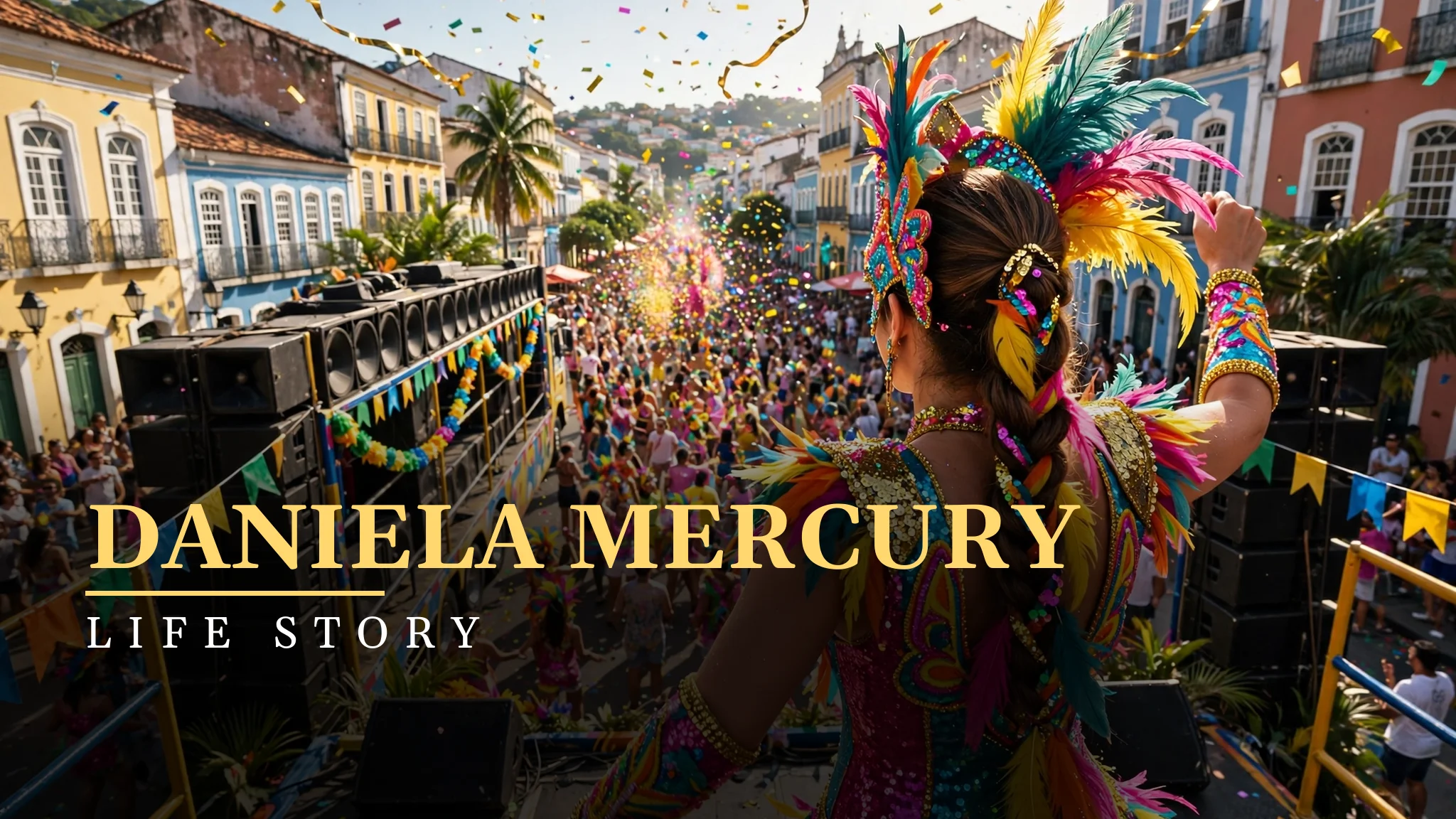
Daniela Mercury is the queen of axé, the joyful, beating music of Salvador, and the queen of carnival in Bahia. When she sings, people dance. When she steps onto a trio elétrico, the great sound truck that rolls through the streets of Salvador at carnival time, hundreds of thousands of people follow her, dancing in the streets until morning. Her voice is strong, her energy is endless, and her music is the sound of Bahia itself: African drums, samba, pop, and the joy of a people who know how to celebrate life.
She was born in Salvador in 1965, and she grew up in the most musical city in Brazil. She sang in bars, she worked as a backing singer, and she dreamed of a bigger stage. In 1992, she released the album O Canto da Cidade, and it changed her life. The title song became a huge hit, and the album sold in millions. Brazil had a new star, and Salvador had a new queen. Her songs “O Canto da Cidade”, “Swing da Cor”, and “Maimbê Dandá” are still played at every carnival in Bahia.
Her career has lasted more than thirty years. She has made many albums, she has won Latin Grammy Awards, and she has carried the music of Bahia to the world. She is also known for her work for the rights of women and for the Afro-Brazilian culture of her home. This is the story of a girl from Salvador who became the axé queen of Brazil.
A Girl From Salvador
Daniela Mercury was born Daniela Mercuri de Almeida on 28 July 1965 in Salvador, the capital of Bahia in north-eastern Brazil. Salvador is one of the most musical cities in the world, a city where African drums, samba, and carnival fill the streets. The young Daniela grew up hearing it all, and she loved to sing and to dance. She sang at home, she sang at school, and she dreamed of a life on the stage. Her voice was strong, and her energy was endless, even as a child.
As a teenager, she began to sing in bars and clubs in Salvador, and she worked as a backing singer for other artists. She learned the music of Bahia by living inside it: the axé music, the samba-reggae of the carnival groups, the songs of the Afro-Brazilian culture that is the heart of Salvador. She also studied dance, and she learned to move on stage with a freedom that would become her signature. She was a hard worker, and she took every chance to sing, even when the pay was small and the crowds were few.
She also studied at university, and she worked as a dance teacher, but music was always her first love. She sang in a group, she recorded songs, and she waited for her chance. Salvador in the 1980s was full of young musicians, and the axé music of Bahia was growing. The carnival of Salvador was becoming famous across Brazil, and the trio elétrico, the great truck with speakers that rolls through the streets, was the centre of it. Daniela dreamed of singing on a trio elétrico, of leading a crowd of thousands through the streets of her city. That dream would come true, and it would change her life.
In the late 1980s, she recorded her first album, a record of samba and axé music, but it did not make her famous. She kept working, she kept singing, and she kept believing. She knew that her voice was strong, and she knew that the music of Bahia deserved to be heard across Brazil. She was twenty-six years old, and she was ready. The next album would make her a star.
O Canto da Cidade and the Birth of a Queen
In 1992, Daniela Mercury released the album O Canto da Cidade, and Brazil changed its mind about the music of Bahia. The title song, “O Canto da Cidade”, was a joyful, beating song about Salvador, about its streets, its people, and its music. It became a huge hit, played on every radio in Brazil, and the album sold in millions. It was one of the best-selling records in Brazilian history, and it made Daniela Mercury a star overnight. She was twenty-seven years old, and she was the queen of axé.
The album was a new sound for Brazil. It mixed the drums of Bahia with pop music, with samba, and with the energy of carnival. Songs like “Swing da Cor” and “O Mais Belo dos Belos” became hits, and audiences across the country fell in love with the music of Salvador. Daniela’s voice was strong and joyful, and her stage shows were full of dance and colour. She did not stand still and sing. She moved, she danced, and she invited the audience to dance with her. Her concerts felt like a carnival, and people loved them.
The success of O Canto da Cidade brought the music of Bahia to the whole of Brazil. Before Daniela, axé music was known mainly in the north-east. After her, it was known everywhere. She became the face of a new sound, and she carried it with pride. She sang about Salvador, about its Afro-Brazilian culture, and about the joy of its people. She was not only a singer. She was an ambassador for her city, and for the culture that had raised her.
The album also changed the carnival of Salvador. Daniela became the queen of the trio elétrico, singing from the top of the great sound truck as it rolled through the streets, with hundreds of thousands of people dancing behind her. Her carnival performances became legendary, and they are still talked about today. She had dreamed of singing on a trio elétrico as a young woman. Now she was doing it, and the whole of Brazil was watching.
Carnival, Trio Elétrico, and the Streets of Salvador
The carnival of Salvador is one of the great parties in the world, and Daniela Mercury is one of its queens. Every year, at carnival time, she climbs onto a trio elétrico, a huge truck covered in speakers, and she sings as it rolls slowly through the streets of the city. Behind the truck, a crowd of thousands dances and sings along, following the music for hours. It is a wild, joyful, exhausting party, and Daniela leads it with an energy that seems endless.
Her carnival shows are famous for their power. She sings for hours, she dances, she talks to the crowd, and she never seems to tire. She wears bright, colourful clothes, and she moves with the freedom of a dancer. The crowd loves her for it, and they follow her year after year. She has led carnival parades for more than thirty years, and she is still one of the most loved figures of the Salvador carnival. For the people of Bahia, she is not only a singer. She is a part of carnival itself.
She has also worked to protect the culture of carnival and the music of Bahia. She has spoken about the importance of Afro-Brazilian culture, about the drums, the dance, and the songs that came from Africa to Brazil. She has used her fame to support the artists of Salvador, and to keep the traditions of her city alive. Her music is not only for dancing. It is also a celebration of a culture, and a reminder of where it came from.
In the years after O Canto da Cidade, she released more albums, including Música de Rua, Feijão com Arroz, and Sol da Liberdade, and each one showed a singer who was growing and changing. She sang axé, she sang samba, she sang pop, and she sang songs of love and of joy. Her voice stayed strong, her energy stayed high, and her audiences stayed loyal. She was the queen of axé, and she ruled with music, with dance, and with joy.
Decades of Music and a Voice for Bahia
In the 2000s and 2010s, Daniela Mercury kept working at a pace that few singers can match. She released albums, she gave concerts in Brazil and abroad, and she led the carnival of Salvador year after year. Her album Balé Mulato, released in 2005, won a Latin Grammy Award, and her album Canibália, released in 2009, showed a singer who was still trying new sounds. She worked with musicians from many countries, and she carried the music of Bahia to the world.
She also became known for her work beyond music. She has spoken out for the rights of women, for the rights of Afro-Brazilians, and for the culture of Bahia. She has used her fame to support good causes, and she has been honoured for her work. She is a singer who believes that music and life are connected, and that an artist has a duty to speak for the people who cannot speak for themselves. That belief has made her respected far beyond the world of music.
Her personal life has also been part of her public story. She has spoken openly about her life, about her family, and about her love, and she has done so with honesty. She has children, and she has balanced the life of a star with the life of a mother. She lives in Salvador, the city she loves, and she remains close to its music and its people. She is a daughter of Bahia, and she has never left it behind.
Today, she is one of the most loved singers in Brazil, a queen of carnival, and a voice for the culture of her home. She has sung for more than thirty years, and her energy has not faded. She still climbs onto the trio elétrico at carnival time, she still sings for hours, and she still makes hundreds of thousands of people dance. The girl from Salvador who dreamed of a bigger stage became the axé queen of Brazil, and she is still dancing.
The Sound of Axé and the Pride of Bahia
Axé music is the sound of Bahia, and Daniela Mercury is its queen. The word axé comes from the Afro-Brazilian religion of Candomblé, and it means a sacred energy, a force of life. The music that carries that name is joyful, beating, and full of drums. It mixes samba, reggae, pop, and the rhythms of Africa, and it is made for dancing. Daniela’s music carries that energy in every note. When she sings, you can feel the drums, you can feel the streets of Salvador, and you can feel the joy of a people who know how to celebrate.
Her pride in Bahia is at the heart of her work. She sings about Salvador, about its streets, its beaches, its churches, and its people. She sings about the Afro-Brazilian culture that is the soul of the city, about the drums, the dance, and the songs that came from Africa. She has said that her music is a gift from Bahia to the world, and she has carried that gift with pride. Her concerts are not only shows. They are celebrations of a culture, and audiences feel it.
She has also worked to keep that culture alive. She has supported the carnival groups of Salvador, the Afro-Brazilian artists, and the young musicians of Bahia. She has used her fame to open doors for others, and to make sure that the music of her city is not forgotten. That work matters, because the culture of Bahia is one of the great treasures of Brazil, and it needs voices like hers to carry it forward. Daniela Mercury is one of those voices, and she has carried it for more than thirty years.
A Woman of Courage and a Life Lived Openly
Daniela Mercury has lived her life openly, and she has done so with courage. She has spoken about her family, about her children, and about her love, and she has not hidden who she is. In a country where famous people are often expected to keep their private lives secret, she has been honest, and her honesty has earned her respect. She has shown that a singer can be a star and a real person at the same time, and that openness is a strength, not a weakness.
She has also spoken out for the rights of women and for the rights of people who are treated unfairly. She has used her stage to talk about equality, about respect, and about the need for a better Brazil. That courage has made her a figure beyond music. She is not only a singer. She is a voice for change, and her audiences love her for it. They know that when she sings, she sings with her whole heart, and that her heart is with the people of Bahia.
Her life has not been without hard times. She has faced the pressures of fame, the hard work of touring, and the challenge of raising a family while leading a career. But she has faced them with the same energy she brings to the stage: with joy, with strength, and with a refusal to give up. She has kept singing, kept dancing, and kept leading the carnival year after year. That is a remarkable achievement, and it is a testament to her spirit.
The Legacy of the Axé Queen
Today, Daniela Mercury is remembered as the queen of axé, the singer who brought the music of Bahia to the whole of Brazil. Her album O Canto da Cidade is one of the best-selling records in Brazilian history, and her songs are still played at every carnival in Salvador. She has won Latin Grammy Awards, she has filled concert halls around the world, and she has carried the culture of Bahia to new audiences. Her legacy is the sound of joy, of drums, and of a city that knows how to celebrate life.
Her influence on younger singers is very great. Many artists from Bahia have followed her path, singing axé music and leading carnival parades. She showed that the music of the north-east could reach the whole country, and that a singer from Salvador could become a national star. She opened doors for others, and she did so with pride in her home. Her legacy lives on in the music of Bahia, in the carnival of Salvador, and in every young singer who dreams of singing on a trio elétrico.
She is remembered today not only for her songs, but for the joy she has given Brazil. Her concerts, her carnival parades, and her records are part of the life of her country. The girl from Salvador who sang in bars became the axé queen of Brazil, and she is still dancing. Put on “O Canto da Cidade”, close your eyes, and you can hear it: the drums of Bahia, the streets of Salvador, and a voice that makes you want to dance.
The Voice That Carried Bahia to the World
Daniela Mercury’s greatest achievement, after her music itself, is that she carried the culture of Bahia to the whole world. Before her, the axé music of Salvador was known mainly in the north-east of Brazil. After her album O Canto da Cidade, it was known everywhere. She sang about Salvador, about its streets, its people, and its Afro-Brazilian culture, and she made the whole country love it. She was not only a singer. She was an ambassador for her city, and for the culture that had raised her.
She has taken that culture to many countries. She has performed in Europe, in America, and in Latin America, and audiences who did not speak Portuguese still danced to her music. Her concerts abroad are full of colour, of drums, and of joy, and they show the world the beauty of Bahia. She wears bright clothes, she dances, and she sings with a pride that is impossible to miss. She does not hide where she comes from. She celebrates it, and the world celebrates with her.
She has also worked to protect the culture she carries. She has supported the carnival groups of Salvador, the Afro-Brazilian artists, and the young musicians of Bahia. She has used her fame to open doors for others, and to make sure that the music of her city is not forgotten. That work matters, because the culture of Bahia is one of the great treasures of Brazil, and it needs voices like hers to carry it forward. Daniela Mercury is one of those voices, and she has carried it for more than thirty years.
Her pride in Bahia is not only about music. It is about identity, about history, and about the people who built the culture. The drums of Salvador came from Africa, carried across the ocean by people who were taken from their homes. That history is painful, and Daniela does not hide from it. She celebrates the culture that grew from it, and she honours the people who kept it alive. Her music is a celebration, but it is also a memory, and a statement: this culture matters, these people matter, and their joy matters.
The Albums That Kept the Party Going
Daniela Mercury has made many albums in her long career, and each one shows a singer who is growing and changing. After O Canto da Cidade, she released Música de Rua in 1994, Feijão com Arroz in 1996, and Sol da Liberdade in 2000, and each record brought new songs that became hits. Her album Balé Mulato, released in 2005, won a Latin Grammy Award, and her album Canibália, released in 2009, showed a singer who was still trying new sounds. She has never stopped recording, and she has never stopped giving her audiences new music.
Her albums are full of the sound of Bahia: the drums, the joy, and the energy of Salvador. But they are also full of variety. She sings axé, she sings samba, she sings pop, and she sings songs of love and of joy. Her voice stays strong from album to album, and her energy stays high. She works with fine musicians, she chooses her songs with care, and she gives each record a sound that is all her own. That consistency, over more than thirty years, is a remarkable achievement.
Her records are played at every carnival in Salvador, at every party in Bahia, and in homes across Brazil. Young people who were not born when O Canto da Cidade was released still dance to it, and they still sing along. That is the mark of great music: it does not belong only to its own time. It belongs to every time, because it speaks about joy, about life, and about the celebration of being alive. Daniela’s albums carry that joy, and they will be played for years to come.
My Take:
When I think about Daniela Mercury, the first thing I feel is energy. Her music does not sit still. It moves, it beats, it makes you want to dance. I listen to “O Canto da Cidade” and I feel the streets of Salvador, the drums, the sun, and the joy of a crowd dancing together. That is a wonderful feeling, and it is the reason I love her music. She does not sing to make you sad or thoughtful, although her songs have feeling too. She sings to make you alive, to make you move, to make you celebrate. In a world that is often hard and heavy, that joy is a precious gift.
I admire her pride in Bahia most of all. She is a daughter of Salvador, and she has never hidden it. She sings about her city, about its Afro-Brazilian culture, about its drums and its dance, and she does so with a pride that is beautiful to see. Too many artists leave their home behind when they become famous, and they pretend to be from nowhere. Daniela did the opposite. She carried Bahia with her, everywhere she went, and she made the whole of Brazil love it. That is a brave and generous thing to do. It says: my home matters, my culture matters, and I will not hide it. I respect that very much, and I think every artist should learn from it. Love where you come from, and carry it with you.
What moves me most about her story is the carnival, and her place in it. Every year, she climbs onto a trio elétrico, a huge truck covered in speakers, and she sings as it rolls through the streets of Salvador. Behind her, hundreds of thousands of people dance and sing along for hours. It is one of the great parties in the world, and she leads it with an energy that seems endless. I think about what that must feel like: to stand on a truck, to see a sea of people dancing, and to know that your voice is leading them. That is a kind of power, but it is a joyful power, a power that brings people together. I find that deeply moving, because it shows what music can do: it can turn strangers into a crowd, and a crowd into a family, if only for a night.
I also think about the hard work behind the joy. Her concerts look effortless, but they are not. She sings for hours, she dances, she talks to the crowd, and she never seems to tire. That takes years of practice, years of touring, and a body that has been trained to keep going. I admire that discipline, because it is easy to forget when you see someone having fun on stage. The joy is real, but the work behind it is also real. She has worked for more than thirty years, and she has earned every minute of the love her audiences give her. That is a lesson for anyone who wants to do great work: the joy you see is built on work you do not see, and the work matters as much as the joy.
There is a sadness in her story too, and it is the sadness of a culture that has not always been respected. The Afro-Brazilian culture of Bahia, the drums, the dance, the religion, and the music, has faced prejudice and neglect for many years. Daniela has used her fame to speak for that culture, to protect it, and to celebrate it. I respect that very much, because it is not easy to speak out, and it is not always popular. But she has done it, year after year, with courage and with pride. Her music is not only for dancing. It is also a statement: this culture matters, these people matter, and their joy matters. That is a powerful message, and it makes her music deeper than a simple party song.
I also admire the way she has lived her life openly. She has spoken about her family, about her children, and about her love, and she has done so with honesty. In a world where famous people often hide, she has been open, and her openness has earned her respect. I think that is a brave choice, because openness can bring criticism, and it can bring pain. But it can also bring freedom, and it can show others that they do not need to hide who they are. She has shown that a singer can be a star and a real person at the same time, and that is a gift to everyone who looks up to her.
If I could speak to a young singer from Bahia who wants to be like Daniela Mercury, I would say this: love your home, learn its music, and carry it with pride. Do not be ashamed of where you come from. The drums of Salvador, the songs of your city, the joy of your people, these are not things to hide. They are treasures, and the world needs them. Daniela took the music of Bahia to the whole of Brazil, and she did it by loving it first. That is the path: love your home, learn its songs, and sing them with joy. The world will listen, if you sing truly.
I think about her concerts, and I feel a kind of longing to be there: a hot night in Salvador, a crowd dancing in the streets, a woman on a truck singing with all her heart, and a city celebrating life. That is not only entertainment. It is a reminder that life is worth celebrating, that joy is real, and that music can bring people together. Daniela Mercury has given Brazil that reminder for more than thirty years, and it is a precious gift.
In the end, what stays with me is the joy of her voice. It is a voice that makes you want to dance, to smile, to feel alive. She began as a girl from Salvador, singing in bars, and she became the axé queen of Brazil. She did it by loving her home, by working hard, and by never losing her joy. I am grateful for her music, and I am grateful for the lesson it carries: celebrate life, love your home, and dance while you can. That is her story, and it is worth remembering.
I also think about the hard work behind the joy. Her concerts look effortless, but they are not. She can sing for hours on end, dance without pause, and chat with the crowd as if the night would never end. That takes years of practice, years of touring, and a body that has been trained to keep going. I admire that discipline, because it is easy to forget when you see someone having fun on stage. The joy is real, but the work behind it is also real. She has worked for more than thirty years, and she has earned every minute of the love her audiences give her. That is a lesson for anyone who wants to do great work: the joy you see is built on work you do not see, and the work matters as much as the joy.
There is a sadness in her story too, and it is the sadness of a culture that has not always been respected. The Afro-Brazilian culture of Bahia, the drums, the dance, the religion, and the music, has faced prejudice and neglect for many years. Daniela has used her fame to speak for that culture, to protect it, and to celebrate it. I respect that very much, because it is not easy to speak out, and it is not always popular. But she has done it, year after year, with courage and with pride. Her music is not only for dancing. It is also a statement: this culture matters, these people matter, and their joy matters. That is a powerful message, and it makes her music deeper than a simple party song.
I also admire the way she has lived her life openly. She has spoken about her family, about her children, and about her love, and she has done so with honesty. In a world where famous people often hide, she has been open, and her openness has earned her respect. I think that is a brave choice, because openness can bring criticism, and it can bring pain. But it can also bring freedom, and it can show others that they do not need to hide who they are. She has shown that a singer can be a star and a real person at the same time, and that is a gift to everyone who looks up to her.
If I could speak to a young singer from Bahia who wants to be like Daniela Mercury, I would say this: love your home, learn its music, and carry it with pride. Do not be ashamed of where you come from. The drums of Salvador, the songs of your city, the joy of your people, these are not things to hide. They are treasures, and the world needs them. Daniela took the music of Bahia to the whole of Brazil, and she did it by loving it first. That is the path: love your home, learn its songs, and sing them with joy. The world will listen, if you sing truly.
I think about her carnival parades, and I feel a kind of longing to be there: a hot night in Salvador, a crowd dancing in the streets, a woman on a trio elétrico singing with all her heart, and a city celebrating life. That is not only entertainment. It is a reminder that life is worth celebrating, that joy is real, and that music can bring people together. Daniela Mercury has given Brazil that reminder for more than thirty years, and it is a precious gift.
In the end, what stays with me is the joy of her voice. It is a voice that makes you want to dance, to smile, to feel alive. She began as a girl from Salvador, singing in bars, and she became the axé queen of Brazil. She did it by loving her home, by working hard, and by never losing her joy. I am grateful for her music, and I am grateful for the lesson it carries: celebrate life, love your home, and dance while you can. That is her story, and it is worth remembering.
I also think about her albums, and about how they have kept the party going for more than thirty years. After O Canto da Cidade, she released record after record, each one full of the drums and the joy of Bahia. Her album Balé Mulato won a Latin Grammy, and her later records showed a singer who was still trying new sounds. She has never stopped recording, and she has never stopped giving her audiences new music. That consistency is a remarkable achievement. Many singers make one great album and then fade. Daniela has made great music for three decades, and she is still going. That is the mark of a real artist.
There is one more thing I want to say about her, and it is about the way her music brings people together. At carnival, in a concert hall, or at a party, her songs make strangers dance side by side, sing the same words, and feel the same joy. That is a powerful thing. Music that brings people together, that makes them feel like one family, is music that matters. Daniela has given Brazil that feeling for more than thirty years, and it is a precious gift. In a world that is often divided, a singer who can unite a crowd in joy is doing something holy.
I also think about the drums of Bahia, and how they live in her music. The drums came from Africa, carried across the ocean by people who were taken from their homes, and they became the heartbeat of Salvador. Daniela’s songs carry that heartbeat in every note, and when she sings, you can feel centuries of history in the rhythm. That is a powerful thing. Her music is not only for dancing. It is a memory, a celebration, and a statement that this culture will not be forgotten.
Frequently Asked Questions
What is axé music?
Axé music is a style of Brazilian popular music from Bahia, in the north-east of Brazil. It mixes samba, reggae, pop, and African rhythms, and it is made for dancing. The word axé comes from the Afro-Brazilian religion of Candomblé, and it means a sacred energy or force of life. Daniela Mercury is known as the queen of axé, and her album O Canto da Cidade brought the sound to the whole of Brazil.
What is Daniela Mercury’s most famous song?
Her most famous song is “O Canto da Cidade”, the title song of her 1992 album. The song became a huge hit across Brazil and is still played at every carnival in Salvador. Other well-known songs include “Swing da Cor”, “O Mais Belo dos Belos”, and “Maimbê Dandá”.
What is a trio elétrico?
A trio elétrico is a huge truck covered in speakers that rolls through the streets of Salvador during carnival, with a singer and a band performing on top. Behind the truck, a crowd of thousands dances and sings along. Daniela Mercury is one of the most famous singers to lead a trio elétrico, and her carnival performances are legendary in Brazil.
Where is Daniela Mercury from?
Daniela Mercury was born in Salvador, the capital of Bahia in north-eastern Brazil, on 28 July 1965. She grew up in the musical world of Salvador, and she has lived there for most of her life. Her music celebrates the city, its streets, its people, and its Afro-Brazilian culture.
Has Daniela Mercury won a Latin Grammy Award?
Yes, Daniela Mercury has won Latin Grammy Awards in her career, including for her album Balé Mulato, released in 2005. She is one of the most honoured singers of axé music, and her work has been praised in Brazil and abroad.
Is Daniela Mercury still performing at carnival?
Yes, Daniela Mercury has led carnival parades in Salvador for more than thirty years, and she remains one of the most loved figures of the Salvador carnival. Every year at carnival time, she climbs onto a trio elétrico and sings for hours as crowds dance through the streets of her city.


